
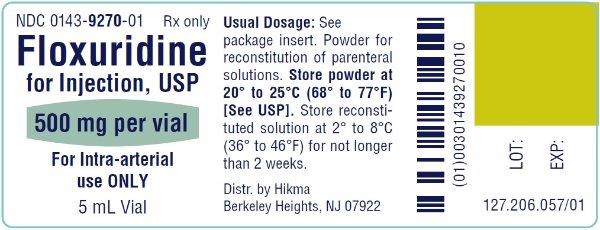
Floxuridine 100 mg/mL Injection, Powder, Lyophilized, For Solution — NDC 0143-9270-01 (Billing 00143-9270-01)
This is a package of Floxuridine 100 mg/mL Injection, Powder, Lyophilized, For Solution from Hikma Pharmaceuticals USA Inc., marketed since Feb 2018 and currently FDA-listed. It is this product's only package size.
NDC database record
One package, one record: these facts belong to NDC 0143-9270-01 alone.
- Record
- FDA NDC Directory package listing · Human prescription drug
- Code segments
- 0143 labeler · 9270 product · 01 package
- Package marketed since
- Feb 15, 2018
- Sample package
- No — commercial package
- Listing certified through
- Dec 31, 2026
- Barcode (UPC-A, from the NDC)
- 3 0143927001 0
- FDA record last changed
- Jul 24, 2026
Identity & classification
Regulatory identifiers FDA, NLM and CMS codes for this package
Drug-database identifiers Medi-Span GPI and First Databank GCN / HICL / AHFS classification
- GSN (GCN sequence number): 008803
- GCN: 38531
- GPI-14 (Medi-Span): 21300020002105
- HICL (First Databank): 003909
- AHFS class code: 10:00.00.00
- RxCUI (RxNorm): 310351
Where does this data come from?
- FDA openFDA NDC Directory · synced Oct 8, 2026
- FDA label on DailyMed · label index refreshed Oct 8, 2026
- RxNorm (NLM RxNav) · catalog refreshed Oct 1, 2026
- Medi-Span GPI (licensed)
- First Databank (licensed) · refreshed Oct 8, 2026
RxNorm drug class
This medicine belongs to the Antimetabolite class.
Where does this data come from?
- RxClass (NLM) · catalog refreshed Oct 1, 2026
Clinical
Floxuridine is used to treat cancer of gastrointestinal (GI) tract (cancer of the stomach or intestines) that has spread to the liver. Floxuridine is in a class of medications called antimetabolites. It works by slowing or stopping the growth of cancer cells in your body.
Read the full MedlinePlus article ↗- It is used to ease gastrointestinal cancer that has spread to the liver, when it is considered incurable by surgery or other means. It is given into an artery that feeds the liver....
- Floxuridine can cause severe toxic reactions. Your first course is given in the hospital so your team can watch you closely. That is a safety step.
- Why do I have to be in the hospital at first?
- It is given as a continuous infusion into an artery, usually with a pump that keeps the flow steady. Your doctor decides the schedule and how long you continue. Treatment may be pa...
Patient education
Supplement & herbal interactions
Where does this data come from?
- MedlinePlus (NLM) · refreshed Oct 8, 2026
- FDA label on DailyMed · label index refreshed Oct 8, 2026
Ask a licensed pharmacist directly — free, answered by our team.
Pricing
A drug doesn't have one price. Each row is a different public payment system, and none is what you'd pay at the counter — that depends on your insurance. The ⓘ on each row explains what it measures.
| Price system | Per mL | Per package |
|---|---|---|
| Retail pharmacies payNADAC · weekly | Not in the retail survey — common for institutional, discontinued, or low-volume packs. | |
| Medicaid paysCMS SDUD · 12 mo | No recent Medicaid claims on file for this NDC — rare and low-volume NDCs are suppressed in the public data. | |
| Medicare drug plans payPart D · quarterly | No Part D plan price is available for this NDC in our data. | |
| Medicare Part B allowsASP · J9200 | $4,396.492 / J9200 unit | — |
Where does this data come from?
- CMS NADAC weekly file
- CMS ASP pricing files · refreshed Sep 20, 2026
- CMS Medicaid State Drug Utilization Data · refreshed Oct 8, 2026
- CMS Part D plan pricing files · refreshed Sep 24, 2026
- VA National Acquisition Center price file
Billing & reimbursement
Where does this data come from?
- CMS ASP NDC-HCPCS crosswalk · refreshed Sep 22, 2026
- DMEPDAC NDC-HCPCS crosswalk
- openFDA NSDE billing units · refreshed Oct 7, 2026
Packaging — all sizes for this product
| Package NDC | Description | Marketing start | Marketing end | Status |
|---|---|---|---|---|
| 00143-9270-01 You're viewing this Main listing | 1 VIAL in 1 BOX, UNIT-DOSE / 5 mL in 1 VIAL | 2018-02-15 | — | Active |
Therapeutic equivalents
| Product | Labeler | Pack | NADAC/unit | TE | Status | Price vs. this |
|---|---|---|---|---|---|---|
| Floxuridine 100 mg/mLthis 00143-9270-01 | Hikma | 1 vial | — | AP | FDA listed | — |
| Floxuridine 500 mg/5mL 63323-0145-07 | Fresenius | 1 vial | — | AP | FDA listed | — |
| Floxuridine 500 mg 81643-9270-01 | JND | 1 vial | — | AP | FDA listed | — |
Where does this data come from?
- FDA openFDA NDC Directory · synced Oct 8, 2026
- FDA Orange Book · refreshed Oct 3, 2026
- CMS NADAC weekly file
Availability & generic status
This product is an FDA-approved generic. Other versions of the same drug are listed under Therapeutic equivalents, least expensive first.
Where does this data come from?
- FDA Orange Book · refreshed Oct 3, 2026
Inactive Ingredients / Excipients
Inactive ingredients, also called excipients, are components of the drug product other than the active ingredient. They may include fillers, dyes, coatings, preservatives, flavors, or other formulation ingredients.
🧪 Avoiding an ingredient? See Floxuridine inactive ingredients by manufacturer: every current product's list side by side, so you can ask your pharmacy for the version that does not list it.
💡 Tap an ingredient (hover on desktop) to see what it is and why it’s used.
-
UNII 059QF0KO0R
Water is a liquid solvent that dissolves and mixes ingredients together in liquid medicines, syrups, and injections. It helps distribute the active drug evenly throughout the product.
1 inactive ingredient listed in the exact product block matched to this NDC.
Where does this data come from?
ingredient classCode="IACT" elements from the exact product block matched by this NDC. Label-section narrative from DailyMed / the openFDA label index is shown separately when available.- FDA label on DailyMed · label index refreshed Oct 8, 2026
- FDA openFDA NDC Directory · synced Oct 8, 2026
Inactive ingredient FAQ
Are inactive ingredients the same for every manufacturer?
Why might an inactive ingredient be missing?
Can inactive ingredients matter?
Manufacturer & labeler
More NDCs from Hikma Pharmaceuticals USA Inc. labeler code 00143
- Ropivacaine Hydrochloride 5 mg/mL Injection NDC 0143-9264-10
- Ropivacaine Hydrochloride 7.5 mg/mL Injection NDC 0143-9265-10
- Ropivacaine Hydrochloride 10 mg/mL Injection NDC 0143-9266-10
- Clindamycin in 5 percent Dextrose 6 mg/mL Injection, Solution NDC 0143-9267-01
- Clindamycin in 5 percent Dextrose 12 mg/mL Injection, Solution NDC 0143-9268-01
- Clindamycin in 5 percent Dextrose 18 mg/mL Injection, Solution NDC 0143-9269-01
- Dihydroergotamine Mesylate 1 mg/mL Injection NDC 0143-9273-10
- Mitomycin 20 mg/40mL Injection, Powder, Lyophilized, For Solution NDC 0143-9279-01
- Mitomycin 40 mg/80mL Injection, Powder, Lyophilized, For Solution NDC 0143-9280-01
- Levetiracetam in Sodium Chloride 5 mg/mL Injection NDC 0143-9281-10
- Levetiracetam in Sodium Chloride 10 mg/mL Injection NDC 0143-9282-10
- Levetiracetam in Sodium Chloride 15 mg/mL Injection NDC 0143-9283-10
Where does this data come from?
- FDA openFDA NDC Directory · synced Oct 8, 2026
- Drugs@FDA
Full prescribing information FDA SPL
🚨 Boxed Warning ▾
WARNING It is recommended that floxuridine be given only by or under the supervision of a qualified physician who is experienced in cancer chemotherapy and intra-arterial drug therapy and is well versed in the use of potent antimetabolites. Because of the possibility of severe toxic reactions, all patients should be hospitalized for initiation of the first course of therapy.
🎯 Indications and Usage ▾
INDICATIONS AND USAGE Floxuridine for Injection, USP is effective in the palliative management of gastrointestinal adenocarcinoma metastatic to the liver, when given by continuous regional intra-arterial infusion in carefully selected patients who are considered incurable by surgery or other means. Patients with known disease extending beyond an area capable of infusion via a single artery should, except in unusual circumstances, be considered for systemic therapy with other chemotherapeutic agents.
⏱️ Dosage and Administration ▾
DOSAGE AND ADMINISTRATION Each vial must be reconstituted with 5 mL of sterile water for injection to yield a solution containing approximately 100 mg of floxuridine/mL. The calculated daily dose(s) of the drug is then diluted with 5% dextrose or 0.9% sodium chloride injection to a volume appropriate for the infusion apparatus to be used. The administration of floxuridine is best achieved with the use of an appropriate pump to overcome pressure in large arteries and to ensure a uniform rate of infusion.
Parenteral drug products should be inspected visually for particulate matter and discoloration prior to administration whenever solution and container permit. The recommended therapeutic dosage schedule of floxuridine by continuous arterial infusion is 0.1 to 0.6 mg/kg/day. The higher dosage ranges (0.4 to 0.6 mg) are usually employed for hepatic artery infusion because the liver metabolizes the drug, thus reducing the potential for systemic toxicity.
Therapy can be given until adverse reactions appear. (See PRECAUTIONS section.) When these side effects have subsided, therapy may be resumed. The patient should be maintained on therapy as long as response to floxuridine continues.
Procedures for proper handling and disposal of anticancer drugs should be considered. Several guidelines on this subject have been published. 1-7 There is no general agreement that all of the procedures recommended in the guidelines are necessary or appropriate.
⛔ Contraindications ▾
CONTRAINDICATIONS Floxuridine therapy is contraindicated for patients in a poor nutritional state, those with depressed bone marrow function or those with potentially serious infections.
⚠️ Warnings ▾
WARNINGS BECAUSE OF THE POSSIBILITY OF SEVERE TOXIC REACTIONS, ALL PATIENTS SHOULD BE HOSPITALIZED FOR THE FIRST COURSE OF THERAPY. Floxuridine should be used with extreme caution in poor risk patients with impaired hepatic or renal function or a history of high-dose pelvic irradiation or previous use of alkylating agents. The drug is not intended as an adjuvant to surgery.
Floxuridine may cause fetal harm when administered to a pregnant woman. It has been shown to be teratogenic in the chick embryo, mouse (at doses of 2.5 to 100 mg/kg) and rat (at doses of 75 to 150 mg/kg). Malformations included cleft palates; skeletal defects; and deformed appendages, paws and tails.
The dosages which were teratogenic in animals are 4.2 to 125 times the recommended human therapeutic dose. There are no adequate and well-controlled studies with floxuridine in pregnant women. If this drug is used during pregnancy or if the patient becomes pregnant while taking (receiving) this drug, the patient should be apprised of the potential hazard to the fetus.
Women of childbearing potential should be advised to avoid becoming pregnant. Combination Therapy Any form of therapy which adds to the stress of the patient, interferes with nutrition or depresses bone marrow function will increase the toxicity of floxuridine.
🤒 Adverse Reactions ▾
ADVERSE REACTIONS Adverse reactions to the arterial infusion of floxuridine are generally related to the procedural complications of regional arterial infusion. The more common adverse reactions to the drug are nausea, vomiting, diarrhea, enteritis, stomatitis and localized erythema. The more common laboratory abnormalities are anemia, leukopenia, thrombo-cytopenia and elevations of alkaline phosphatase, serum transaminase, serum bilirubin and lactic dehydrogenase.
Other adverse reactions are: Gastrointestinal: duodenal ulcer, duodenitis, gastritis, bleeding, gastroenteritis, glossitis, pharyngitis, anorexia, cramps, abdominal pain; possible intra- and extrahepatic biliary sclerosis, as well as acalculous cholecystitis. Dermatologic: alopecia, dermatitis, nonspecific skin toxicity, rash. Cardiovascular: myocardial ischemia.
Miscellaneous Clinical Reactions: fever, lethargy, malaise, weakness. Laboratory Abnormalities: BSP, prothrombin, total proteins, sedimentation rate and thrombopenia. Procedural Complications of Regional Arterial Infusion: arterial aneurysm; arterial ischemia; arterial thrombosis; embolism; fibromyositis; thrombophlebitis; hepatic necrosis; abscesses; infection at catheter site; bleeding at catheter site; catheter blocked, displaced or leaking.
The following adverse reactions have not been reported with floxuridine but have been noted following the administration of 5-fluorouracil. While the possibility of these occurring following floxuridine therapy is remote because of its regional administration, one should be alert for these reactions following the administration of floxuridine because of the pharmacological similarity of these two drugs: pancytopenia, agranulocytosis, myocardial ischemia, angina, anaphylaxis, generalized allergic reactions, acute cerebellar syndrome, nystagmus, headache, dry skin, fissuring, photosensitivity, pruritic maculopapular rash, increased pigmentation of the skin, vein pigmentation, lacrimal duct stenosis, visual changes, lacrimation, photophobia, disorientation, confusion, euphoria, epistaxis and nail changes, including loss of nails.
🔄 Drug Interactions ▾
Drug Interactions See WARNINGS section.
🤰 Pregnancy ▾
Pregnancy Teratogenic Effects: Pregnancy Category D See WARNINGS section. Floxuridine has been shown to be teratogenic in the chick embryo, mouse (at doses of 2.5 to 100 mg/kg) and rat (at doses of 75 to 150 mg/kg). Malformations included cleft palates, skeletal defects and deformed appendages, paws and tails.
The dosages which were teratogenic in animals were 4.2 to 125 times the recommended human therapeutic dose. There are no adequate and well-controlled studies with floxuridine in pregnant women. While there is no evidence of teratogenicity in humans due to floxuridine, it should be kept in mind that other drugs which inhibit DNA synthesis (e.g., methotrexate and aminopterin) have been reported to be teratogenic in humans.
Floxuridine should be used during pregnancy only if the potential benefit justifies the potential risk to the fetus. Nonteratogenic Effects Floxuridine has not been studied in animals for its effects on peri- and postnatal development. However, compounds which inhibit DNA, RNA and protein synthesis might be expected to have adverse effects on peri- and postnatal development.
🧒 Pediatric Use ▾
Pediatric Use Safety and effectiveness in pediatric patients have not been established.
🆘 Overdosage ▾
OVERDOSAGE The possibility of overdosage with floxuridine is unlikely in view of the mode of administration. Nevertheless, the anticipated manifestations would be nausea, vomiting, diarrhea, gastrointestinal ulceration and bleeding, bone marrow depression (including thrombocytopenia, leukopenia and agranulocytosis). No specific antidotal therapy exists.
Patients who have been exposed to an overdosage of floxuridine should be monitored hematologically for at least 4 weeks. Should abnormalities appear, appropriate therapy should be utilized. The acute intravenous toxicity of floxuridine is as follows: LD 50 Species (mg/kg ± S.E.) Mouse 880 ± 51 Rat 670 ± 73 Rabbit 94 ±
19.6 Dog 157 ± 46
🧬 Clinical Pharmacology ▾
CLINICAL PHARMACOLOGY When floxuridine is given by rapid intra-arterial injection it is apparently rapidly catabolized to 5-fluorouracil. Thus, rapid injection of floxuridine produces the same toxic and antimetabolic effects as does 5-fluorouracil. The primary effect is to interfere with the synthesis of deoxyribonucleic acid (DNA) and to a lesser extent inhibit the formation of ribonucleic acid (RNA).
However, when floxuridine is given by continuous intra-arterial infusion its direct anabolism to floxuridine-monophosphate is enhanced, thus increasing the inhibition of DNA. Floxuridine is metabolized in the liver. The drug is excreted intact and as urea, fluorouracil, a-fluoro-b-ureidopropionic acid, dihydrofluorouracil, a-fluoro-b-guanidopropionic acid and a-fluoro-b-alanine in the urine; it is also expired as respiratory carbon dioxide.
Pharmacokinetic data on intra-arterial infusion of floxuridine are not available.
📦 How Supplied / Storage and Handling ▾
HOW SUPPLIED Floxuridine for Injection, USP, 500 mg, lyophilized, in a 5 mL vial, is supplied in individual cartons. NDC 0143-9270-01. This is to be reconstituted with 5 mL sterile water for injection.
The sterile powder should be stored at 20° to 25°C (68° to 77°F) [See USP Controlled Room Temperature]. Reconstituted vials should be stored under refrigeration 2° to 8°C (36° to 46°F) for not more than 2 weeks. To report SUSPECTED ADVERSE REACTIONS, contact Hikma Pharmaceuticals USA Inc. at 1-877-845-0689, or the FDA at 1-800-FDA-1088 or www.fda.gov/medwatch .
For Product Inquiry call 1-877-845-0689.
📋 Description ▾
DESCRIPTION Floxuridine for Injection, USP, an antineoplastic antimetabolite, is available as a sterile, nonpyrogenic, lyophilized powder for reconstitution. Each vial contains 500 mg of floxuridine which is to be reconstituted with 5 mL of sterile water for injection. An appropriate amount of reconstituted solution is then diluted with a parenteral solution for intra-arterial infusion (see DOSAGE AND ADMINISTRATION section).
Floxuridine is a fluorinated pyrimidine. Chemically, floxuridine is 2'-Deoxy-5-fluorouridine, with a molecular formula of C 9 H 11 FN 2 O 5 . It is a white to off-white odorless solid which is freely soluble in water.
The 2% aqueous solution has a pH of between 4.0 and 5.5. The molecular weight of floxuridine is 246.20 and the structural formula is: structural formula
💬 Information for Patients ▾
Information for Patients Patients should be informed of expected toxic effects, particularly oral manifestations. Patients should be alerted to the possibility of alopecia as a result of therapy and should be informed that it is usually a transient effect.
⚠️ Precautions ▾
PRECAUTIONS General Floxuridine is a highly toxic drug with a narrow margin of safety. Therefore, patients should be carefully supervised since therapeutic response is unlikely to occur without some evidence of toxicity. Severe hematological toxicity, gastrointestinal hemorrhage and even death may result from the use of floxuridine despite meticulous selection of patients and careful adjustment of dosage.
Although severe toxicity is more likely in poor risk patients, fatalities may be encountered occasionally even in patients in relatively good condition. Therapy is to be discontinued promptly whenever one of the following signs of toxicity appears: Myocardial ischemia Stomatitis or esophagopharyngitis, at the first visible sign Leukopenia (WBC under 3500) or a rapidly falling white blood count Vomiting, intractable Diarrhea, frequent bowel movements or watery stools Gastrointestinal ulceration and bleeding Thrombocytopenia (platelets under 100,000) Hemorrhage from any site Information for Patients Patients should be informed of expected toxic effects, particularly oral manifestations.
Patients should be alerted to the possibility of alopecia as a result of therapy and should be informed that it is usually a transient effect. Laboratory Tests Careful monitoring of the white blood count and platelet count is recommended. Drug Interactions See WARNINGS section.
Carcinogenesis, Mutagenesis, Impairment of Fertility Carcinogenesis Long-term studies in animals to evaluate the carcinogenic potential of floxuridine have not been conducted. On the basis of the available data, no evaluation can be made of the carcinogenic risk of floxuridine to humans. Mutagenesis Oncogenic transformation of fibroblasts from mouse embryo has been induced in vitro by floxuridine, but the relationship between oncogenicity and mutagenicity is not clear.
Floxuridine has also been shown to be mutagenic in human leukocytes in vitro and in the Drosophila test system. In addition, 5-fluorouracil, to which floxuridine is catabolized when given by intra-arterial injection, has been shown to be mutagenic in in vitro tests. Impairment of Fertility The effects of floxuridine on fertility and general reproductive performance have not been studied in animals.
However, because floxuridine is catabolized to 5-fluorouracil, it should be noted the 5-fluorouracil has been shown to induce chromosomal aberrations and changes in chromosome organization of spermatogonia in rats at doses of 125 or 250 mg/kg, administered intraperitoneally. Spermatogonial differentiation was also inhibited by fluorouracil, resulting in transient infertility. In female rats, fluorouracil, administered intraperitoneally at doses of 25 or 50 mg/kg during the preovulatory phase of oogenesis, significantly reduced the incidence of fertile matings, delayed the development of pre- and post-implantation embryos, increased the incidence of preimplantation lethality and induced chromosomal anomalies in these embryos.
Compounds such as floxuridine, which interfere with DNA, RNA and protein synthesis, might be expected to have adverse effects on gametogenesis. Pregnancy Teratogenic Effects: Pregnancy Category D See WARNINGS section. Floxuridine has been shown to be teratogenic in the chick embryo, mouse (at doses of 2.5 to 100 mg/kg) and rat (at doses of 75 to 150 mg/kg).
Malformations included cleft palates, skeletal defects and deformed appendages, paws and tails. The dosages which were teratogenic in animals were 4.2 to 125 times the recommended human therapeutic dose. There are no adequate and well-controlled studies with floxuridine in pregnant women.
While there is no evidence of teratogenicity in humans due to floxuridine, it should be kept in mind that other drugs which inhibit DNA synthesis (e.g., methotrexate and aminopterin) have been reported to be teratogenic in humans. Floxuridine should be used during pregnancy only if the potential benefit justifies the potential risk to the fetus. Nonterato… [Excerpted — this section continues on DailyMed.]
🍼 Nursing Mothers ▾
Nursing Mothers It is not known whether floxuridine is excreted in human milk. Because floxuridine inhibits DNA and RNA synthesis, mothers should not nurse while receiving this drug.
📄 Carcinogenesis, Mutagenesis, Impairment of Fertility ▾
Carcinogenesis, Mutagenesis, Impairment of Fertility Carcinogenesis Long-term studies in animals to evaluate the carcinogenic potential of floxuridine have not been conducted. On the basis of the available data, no evaluation can be made of the carcinogenic risk of floxuridine to humans. Mutagenesis Oncogenic transformation of fibroblasts from mouse embryo has been induced in vitro by floxuridine, but the relationship between oncogenicity and mutagenicity is not clear.
Floxuridine has also been shown to be mutagenic in human leukocytes in vitro and in the Drosophila test system. In addition, 5-fluorouracil, to which floxuridine is catabolized when given by intra-arterial injection, has been shown to be mutagenic in in vitro tests. Impairment of Fertility The effects of floxuridine on fertility and general reproductive performance have not been studied in animals.
However, because floxuridine is catabolized to 5-fluorouracil, it should be noted the 5-fluorouracil has been shown to induce chromosomal aberrations and changes in chromosome organization of spermatogonia in rats at doses of 125 or 250 mg/kg, administered intraperitoneally. Spermatogonial differentiation was also inhibited by fluorouracil, resulting in transient infertility. In female rats, fluorouracil, administered intraperitoneally at doses of 25 or 50 mg/kg during the preovulatory phase of oogenesis, significantly reduced the incidence of fertile matings, delayed the development of pre- and post-implantation embryos, increased the incidence of preimplantation lethality and induced chromosomal anomalies in these embryos.
Compounds such as floxuridine, which interfere with DNA, RNA and protein synthesis, might be expected to have adverse effects on gametogenesis.
📚 References ▾
REFERENCES 1.Recommendations for the safe handling of parenteral antineoplastic drugs. Washington, DC, US Government Printing Office, NIH publication 83-2621. 2.AMA Council Report.
Guidelines for handling parenteral antineoplastics. JAMA . Mar 15, 1985, 253:1590-1592.
3.National Study Commission on Cytotoxic Exposure: Recommendation for handling cytotoxic agents. Available from Louis P. Jeffrey, ScD, Director of Pharmacy Services, Rhode Island Hospital, 593 Eddy Street, Providence, Rhode Island 02902.
4.Clinical Oncological Society of Australia: Guidelines and recommendations for safe handling of antineoplastic agents. Med J Aust . Apr 30, 1983, 1:426-428.
5.Jones, RB, Frank R, Mass T: Safe handling of chemotherapeutic agents: a report from the Mount Sinai Medical Center. CA. Sept - Oct, 1983, 33:258-263.
6.American Society of Hospital Pharmacists Technical Assistance Bulletin on Handling Cytotoxic and Hazardous Drugs. AM J Hosp Pharm 1990:47:1033-1049. 7.Controlling Occupational Exposure to Hazardous Drugs.
(OSHA WORK-PRACTICE GUIDELINES). AM J Health-Syst Pharm . 1996:523:1669-1685
📄 Package Label / Principal Display Panel ▾
VIAL LABEL NDC 0143- 9270 -01 Rx only Floxuridine for Injection, USP 500 mg per vial For Intra-arterial use ONLY 5 mL Vial vial
SERIALIZATION IMAGE Representative Carton Serialization Image Representative Carton Serialization Image
About this NDC listing & data coverage
What data is (and isn’t) available for this NDC — tap to expand
| NDC identity (package / product / labeler codes) | ✓ Available |
| Labeler | ✓ Available |
| Product & package description | ✓ Available |
| Marketing category & status | ✓ Available |
| Active ingredient / dosage form / route | ✓ Available |
| FDA label (SPL via DailyMed) | ✓ Available |
| Package photos | ✓ Available |
| Inactive ingredients (structured) | ✓ Available |
| NADAC pharmacy acquisition price (CMS) | — Not published for this NDC CMS publishes NADAC only for NDCs reported in its retail-pharmacy survey. |
| Orange Book / therapeutic-equivalence data | ✓ Available |
| HCPCS J-code billing crosswalk | ✓ Available |
| Medicaid utilization (CMS SDUD) | — Not published for this NDC CMS reports utilization only for NDCs with Medicaid claims above its privacy threshold. |