
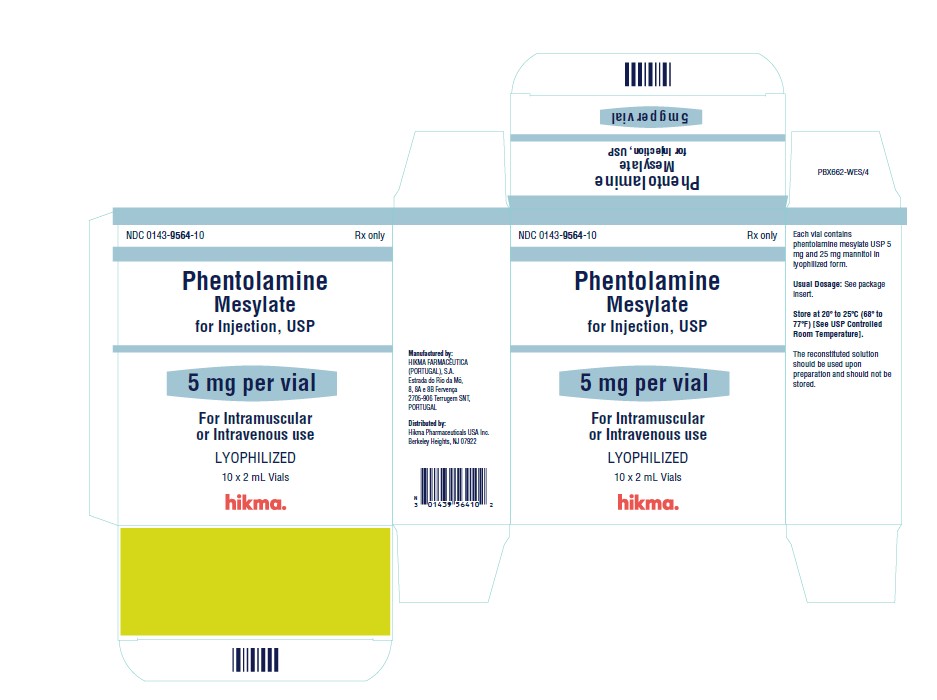
Phentolamine Mesylate 5 mg/mL Injection, Powder, For Solution, 10 vials — NDC 0143-9564-10 (Billing 00143-9564-10)
This is a package of 10 vials of Phentolamine Mesylate 5 mg/mL Injection, Powder, For Solution from Hikma Pharmaceuticals USA Inc., marketed since May 1998 and currently FDA-listed.
NDC database record
One package, one record: these facts belong to NDC 0143-9564-10 alone.
- Record
- FDA NDC Directory package listing · Human prescription drug
- Code segments
- 0143 labeler · 9564 product · 10 package
- Package marketed since
- Nov 4, 2015
- Sample package
- No — commercial package
- Listing certified through
- Dec 31, 2026
- Billing quantity
- 10 EA per package
- Barcode (UPC-A, from the NDC)
- 3 0143956410 2
- FDA record last changed
- Jul 24, 2026
Other active recalls for Phentolamine Mesylate (different manufacturers) — 1 · tap to view
Identity & classification
Regulatory identifiers FDA, NLM and CMS codes for this package
Drug-database identifiers Medi-Span GPI and First Databank GCN / HICL / AHFS classification
- GSN (GCN sequence number): 005112
- GCN: 20610
- GPI-14 (Medi-Span): 36300020102105
- HICL (First Databank): 002100
- AHFS class code: 12:16.04.04
- RxCUI (RxNorm): 1361023
Where does this data come from?
- FDA openFDA NDC Directory · synced Oct 8, 2026
- FDA label on DailyMed · label index refreshed Oct 6, 2026
- RxNorm (NLM RxNav) · catalog refreshed Oct 1, 2026
- Medi-Span GPI (licensed)
- First Databank (licensed) · refreshed Oct 8, 2026
RxNorm drug class
This medicine belongs to the alpha-Adrenergic Blocker class.
Where does this data come from?
- RxClass (NLM) · catalog refreshed Oct 1, 2026
Clinical
Patient education
Supplement & herbal interactions
Where does this data come from?
- MedlinePlus (NLM) · refreshed Oct 1, 2026
- FDA label on DailyMed · label index refreshed Oct 6, 2026
Ask a licensed pharmacist directly — free, answered by our team.
Pricing
A drug doesn't have one price. Each row is a different public payment system, and none is what you'd pay at the counter — that depends on your insurance. The ⓘ on each row explains what it measures.
| Price system | Per mL | Per package |
|---|---|---|
| Retail pharmacies payNADAC · weekly | Not in the retail survey — common for institutional, discontinued, or low-volume packs. | |
| Medicaid paysCMS SDUD · 12 mo | No recent Medicaid claims on file for this NDC — rare and low-volume NDCs are suppressed in the public data. | |
| Medicare drug plans payPart D · quarterly | No Part D plan price is available for this NDC in our data. | |
| Medicare Part B allowsASP · J2760 | $288.625 / J2760 unit | — |
Where does this data come from?
- CMS NADAC weekly file
- CMS ASP pricing files · refreshed Sep 20, 2026
- CMS Medicaid State Drug Utilization Data · refreshed Oct 8, 2026
- CMS Part D plan pricing files · refreshed Sep 24, 2026
- VA National Acquisition Center price file
Billing & reimbursement
Where does this data come from?
- CMS ASP NDC-HCPCS crosswalk · refreshed Sep 22, 2026
- DMEPDAC NDC-HCPCS crosswalk
- openFDA NSDE billing units · refreshed Oct 7, 2026
Packaging — all sizes for this product
| Package NDC | Description | Marketing start | Marketing end | Status |
|---|---|---|---|---|
| 00143-9564-01 0143-9564-01 Main listing | 1 VIAL in 1 BOX / 1 mL in 1 VIAL | 2015-11-04 | — | Active |
| 00143-9564-10 You're viewing this | 10 VIAL in 1 BOX / 1 mL in 1 VIAL | 2015-11-04 | — | Active |
Pack size FAQ
What quantity is in this package?
How does this package differ from NDC 00143-9564-01?
What NDC number is used to bill for this package of Phentolamine Mesylate 5 mg/mL Injection, Powder, For Solution?
Therapeutic equivalents
| Product | Labeler | Pack | NADAC/unit | TE | Status | Price vs. this |
|---|---|---|---|---|---|---|
| Phentolamine Mesylate 5 mg/mLthis 00143-9564-10 | Hikma | 10 vials | — | AP | FDA listed | — |
| Phentolamine Mesylate 5 mg 68094-0101-10 | Precision | 1 vial | — | AP | Discontinued | — |
Where does this data come from?
- FDA openFDA NDC Directory · synced Oct 8, 2026
- FDA Orange Book · refreshed Oct 3, 2026
- CMS NADAC weekly file
Availability & generic status
This product is an FDA-approved generic. Other versions of the same drug are listed under Therapeutic equivalents, least expensive first.
Where does this data come from?
- FDA Orange Book · refreshed Oct 3, 2026
Inactive Ingredients / Excipients
Inactive ingredients, also called excipients, are components of the drug product other than the active ingredient. They may include fillers, dyes, coatings, preservatives, flavors, or other formulation ingredients.
💡 Tap an ingredient (hover on desktop) to see what it is and why it’s used.
-
25 mg / 1 mL
UNII 3OWL53L36A
A natural sugar alcohol derived from seaweed or synthesized in the lab. It's used as a filler to add bulk, a sweetener in sugar-free formulas, and a disintegrant to help tablets break apart in the stomach.
1 inactive ingredient listed in the exact product block matched to this NDC.
Where does this data come from?
ingredient classCode="IACT" elements from the exact product block matched by this NDC. Label-section narrative from DailyMed / the openFDA label index is shown separately when available.- FDA label on DailyMed · label index refreshed Oct 6, 2026
- FDA openFDA NDC Directory · synced Oct 8, 2026
Inactive ingredient FAQ
Are inactive ingredients the same for every manufacturer?
Why might an inactive ingredient be missing?
Can inactive ingredients matter?
Manufacturer & labeler
More NDCs from Hikma Pharmaceuticals USA Inc. labeler code 00143
- Leucovorin Calcium 350 mg/17.5mL Injection, Powder, Lyophilized, For Solution NDC 0143-9552-01
- Leucovorin Calcium 200 mg/20mL Injection, Powder, Lyophilized, For Solution NDC 0143-9553-01
- Leucovorin Calcium 100 mg/10mL Injection, Powder, Lyophilized, For Solution NDC 0143-9554-01
- Leucovorin Calcium 50 mg/5mL Injection, Powder, Lyophilized, For Solution NDC 0143-9555-01
- Levoleucovorin 50 mg/5mL Injection, Powder, Lyophilized, For Solution NDC 0143-9558-01
- Argatroban 50 mg/50mL Injection NDC 0143-9559-01
- Thiotepa 15 mg/1.5mL Injection, Powder, Lyophilized, For Solution NDC 0143-9565-01
- Azathioprine Sodium 100 mg/10mL Injection, Powder, Lyophilized, For Solution NDC 0143-9566-01
- Cefuroxime 1.5 g Injection, Powder, For Solution NDC 0143-9567-25
- Cefuroxime 750 mg Injection, Powder, For Solution NDC 0143-9568-25
- Cefuroxime 7.5 g Injection, Powder, For Solution NDC 0143-9569-10
- Sodium Ferric Gluconate Complex in Sucrose 12.5 mg/mL Injection NDC 0143-9570-10
Where does this data come from?
- FDA openFDA NDC Directory · synced Oct 8, 2026
- Drugs@FDA
Full prescribing information FDA SPL
🎯 Indications and Usage ▾
INDICATIONS AND USAGE Phentolamine Mesylate for Injection is indicated for the prevention or control of hypertensive episodes that may occur in a patient with pheochromocytoma as a result of stress or manipulation during preoperative preparation and surgical excision. Phentolamine Mesylate for Injection is indicated for the prevention or treatment of dermal necrosis and sloughing following intravenous administration or extravasation of norepinephrine. Phentolamine Mesylate for Injection is also indicated for the diagnosis of pheochromocytoma by the phentolamine blocking test.
⏱️ Dosage and Administration ▾
DOSAGE AND ADMINISTRATION The reconstituted solution should be used upon preparation and should not be stored. 1. Prevention or control of hypertensive episodes in the patient with pheochromo-cytoma.
For preoperative reduction of elevated blood pressure, 5 mg of phentolamine mesylate (1 mg for children) is injected intravenously or intramuscularly 1 or 2 hours before surgery, and repeated if necessary. During surgery, phentolamine mesylate (5 mg for adults, 1 mg for children) is administered intravenously as indicated, to help prevent or control paroxysms of hypertension, tachycardia, respiratory depression, convulsions, or other effects of epinephrine intoxication. (Postoperatively, norepinephrine may be given to control the hypotension that commonly follows complete removal of a pheochromocytoma.) 2.
Prevention or treatment of dermal necrosis and sloughing following intravenous administration or extravasation of norepinephrine. For Prevention: 10 mg of phentolamine mesylate is added to each liter of solution containing norepinephrine. The pressor effect of norepinephrine is not affected.
For Treatment: 5 to 10 mg of phentolamine mesylate in 10 mL of saline is injected into the area of extravasation within 12 hours. 3. Diagnosis of pheochromocytoma - phentolamine blocking test .
The test is most reliable in detecting pheochromocytoma in patients with sustained hypertension and least reliable in those with paroxysmal hypertension. False-positive tests may occur in patients with hypertension without pheochromocytoma. a. Intravenous Preparation The CONTRAINDICATIONS , WARNINGS , and PRECAUTIONS sections should be reviewed.
Sedatives, analgesics, and all other medications except those that might be deemed essential (such as digitalis and insulin) are withheld for at least 24 hours, and preferably 48 to 72 hours, prior to the test. Antihypertensive drugs are withheld until blood pressure returns to the untreated, hypertensive level. This test is not preformed on a patient who is normotensive.
Procedure The patient is kept at rest in a supine position throughout the test, preferably in a quiet, darkened room. Injection of phentolamine is delayed until blood pressure is stabilized, as evidenced by blood pressure readings taken every 10 minutes for at least 30 minutes. Five milligrams of phentolamine mesylate is dissolved in 1 mL of Sterile Water for Injection.
The dose for adults is 5 mg; for children, 1 mg. The syringe needle is inserted into the vein, and injection is delayed until pressor response to venipuncture has subsided. Phentolamine is injected rapidly.
Blood pressure is recorded immediately after injection, at 30-second intervals for the first 3 minutes, and at 60-second intervals for the next 7 minutes. Interpretation A positive response, suggestive of pheochromocytoma, is indicated when the blood pressure is reduced more than 35 mm Hg systolic and 25 mm Hg diastolic. A typical positive response is a reduction in pressure of 60 mm Hg systolic and 25 mm Hg diastolic.
Usually, maximal effect is evident within 2 minutes after injection. A return to preinjection pressure commonly occurs within 15 to 30 minutes but may occur more rapidly. If blood pressure decreases to a dangerous level, the patient should be treated as outlined under OVERDOSAGE .
A positive response should always be confirmed by other diagnostic procedures, preferably by measurement of urinary catecholamines or their metabolites. A negative response is indicated when the blood pressure is elevated, unchanged, or reduced less than 35 mm Hg systolic and 25 mm Hg diastolic after injection of phentolamine. A negative response to this test does not exclude the diagnosis of pheo-chromocytoma, especially in patients with paroxysmal hypertension in whom the incidence of false-negative responses is high. b.
Intramuscular If the intramuscular test for pheochromocytoma is preferred, preparation is the same as for the intravenous test. Five milligrams of phentolamine me… [Excerpted — this section continues on DailyMed.]
⛔ Contraindications ▾
CONTRAINDICATIONS Myocardial infarction, history of myocardial infarction, coronary insufficiency, angina, or other evidence suggestive of coronary artery disease; hypersensitivity to phentolamine or related compounds.
⚠️ Warnings ▾
WARNINGS Myocardial infarction, cerebrovascular spasm, and cerebrovascular occlusion have been reported to occur following the administration of phentolamine, usually in association with marked hypotensive episodes. For screening tests in patients with hypertension, the generally available urinary assay of catecholamines or other biochemical assays have largely replaced the phentolamine and other pharmacological tests for reasons of accuracy and safety. None of the chemical or pharmacological tests is infallible in the diagnosis of pheochromocytoma.
The phentolamine blocking test is not the procedure of choice and should be reserved for cases in which additional confirmatory evidence is necessary and the relative risks involved in conducting the test have been considered.
🤒 Adverse Reactions ▾
ADVERSE REACTIONS Acute and prolonged hypotensive episodes, tachycardia, and cardiac arrhythmias have been reported. In addition, weakness, dizziness, flushing, orthostatic hypotension, nasal stuffiness, nausea, vomiting, and diarrhea may occur.
🔄 Drug Interactions ▾
Drug Interactions See DOSAGE AND ADMINISTRATION . Diagnosis of pheochromocytoma , Preparation .
🤰 Pregnancy ▾
Pregnancy Teratogenic Effects-Pregnancy Category C Administration of phentolamine to pregnant rats and mice at oral doses 24 to 30 times the usual daily human dose (based on a 60 kg human) resulted in slightly decreased growth and slight skeletal immaturity of the fetuses. Immaturity was manifested by increased incidence of incomplete or unossified calcanei and phalangeal nuclei of the hind limb and of incompletely ossified sternebrae. At oral doses 60 times the usual daily human dose (based on a 60 kg human), a slightly lower rate of implantation was found in the rat.
Phentolamine did not affect embryonic or fetal development in the rabbit at oral doses 20 times the usual daily human dose (based on a 60 kg human). No teratogenic or embryotoxic effects were observed in the rat, mouse, or rabbit studies. There are no adequate and well-controlled studies in pregnant women.
Phentolamine should be used during pregnancy only if the potential benefit justifies the potential risk to the fetus.
🧒 Pediatric Use ▾
Pediatric Use See DOSAGE AND ADMINISTRATION .
🆘 Overdosage ▾
OVERDOSAGE Acute Toxicity No deaths due to acute poisoning with phentolamine have been reported. Oral LD 50 ’s (mg/kg): mice, 1000; rats, 1250. Signs and Symptoms Overdosage with phentolamine is characterized chiefly by cardiovascular disturbances, such as arrhythmias, tachycardia, hypotension, and possibly shock.
In addition, the following might occur: excitation, headache, sweating, pupillary contraction, visual disturbances; nausea, vomiting, diarrhea; hypoglycemia. Treatment There is no specific antidote. A decrease in blood pressure to dangerous levels or other evidence of shocklike conditions should be treated vigorously and promptly.
The patient’s legs should be kept raised and a plasma expander should be administered. If necessary, intravenous infusion or norepi-nephrine, titrated to maintain blood pressure at the normotensive level, and all available supportive measures should be included. Epinephrine should not be used, since it may cause a paradoxical reduction in blood pressure.
🧬 Clinical Pharmacology ▾
CLINICAL PHARMACOLOGY Phentolamine mesylate produces an alpha-adrenergic block of relatively short duration. It also has direct, but less marked, positive inotropic and chronotropic effects on cardiac muscle and vasodilator effects on vascular smooth muscle. Phentolamine has a half-life in the blood of 19 minutes following intravenous administration. Approximately 13% of a single intravenous dose appears in the urine as unchanged drug.
📦 How Supplied / Storage and Handling ▾
HOW SUPPLIED Phentolamine Mesylate for Injection, USP, 5 mg, for intramuscular or intravenous use, is supplied as follows: NDC 0143-9564-01 - 2 mL vials packaged individually. NDC 0143-9564-10 - 2 mL vials packaged in cartons of 10 vials. The reconstituted solution should be used upon preparation and should not be stored.
Store at 20° to 25° C (68° to 77° F) [See USP Controlled Room Temperature]. To report SUSPECTED ADVERSE REACTIONS, contact Hikma Pharmaceuticals USA Inc. at 1-877-845-0689, or the FDA at 1-800-FDA-1088 or www.fda.gov/medwatch . For Product Inquiry call 1-877-845-0689.
Manufactured by: HIKMA FARMACÊUTICA (PORTUGAL), S.A. Estrada do Rio da Mó, 8, 8A e 8B – Fervença – 2705-906 Terrugem SNT, PORTUGAL Distributed by: Hikma Pharmaceuticals USA Inc. Berkeley Heights, NJ 07922 Revised May 2022 PIN385-WES/5
📋 Description ▾
DESCRIPTION Phentolamine Mesylate for Injection, USP, is an antihypertensive, available in vials for intravenous and intramuscular administration. Each vial contains phentolamine mesylate USP, 5 mg and mannitol USP, 25 mg in sterile, lyophilized form. Phentolamine mesylate is m -[ N -(2-Imidazolin-2-ylmethyl)- p -toluidino]phenol monomethanesulfonate (salt), and its structural formula is: Molecular Formula C 17 H 19 N 3 O•CH 4 O 3 S M.W.
377.47 Phentolamine mesylate, USP is a white or off-white, odorless crystalline powder. Its solutions are acid to litmus. It is freely soluble in water and in alcohol, and slightly soluble in chloroform.
It melts at about 178°C. structural formula
⚠️ Precautions ▾
PRECAUTIONS General Tachycardia and cardiac arrhythmias may occur with the use of phentolamine or other alpha-adrenergic blocking agents. When possible, administration of cardiac glycosides should be deferred until cardiac rhythm returns to normal. Drug Interactions See DOSAGE AND ADMINISTRATION .
Diagnosis of pheochromocytoma , Preparation . Carcinogenesis, Mutagenesis, Impairment of Fertility Long-term carcinogenicity studies, mutagenicity studies, and fertility studies have not been conducted with phentolamine. Pregnancy Teratogenic Effects-Pregnancy Category C Administration of phentolamine to pregnant rats and mice at oral doses 24 to 30 times the usual daily human dose (based on a 60 kg human) resulted in slightly decreased growth and slight skeletal immaturity of the fetuses.
Immaturity was manifested by increased incidence of incomplete or unossified calcanei and phalangeal nuclei of the hind limb and of incompletely ossified sternebrae. At oral doses 60 times the usual daily human dose (based on a 60 kg human), a slightly lower rate of implantation was found in the rat. Phentolamine did not affect embryonic or fetal development in the rabbit at oral doses 20 times the usual daily human dose (based on a 60 kg human).
No teratogenic or embryotoxic effects were observed in the rat, mouse, or rabbit studies. There are no adequate and well-controlled studies in pregnant women. Phentolamine should be used during pregnancy only if the potential benefit justifies the potential risk to the fetus.
Nursing Mothers It is not known whether this drug is excreted in human milk. Because many drugs are excreted in human milk and because of the potential for serious adverse reactions in nursing infants from phentolamine, a decision should be made whether to discontinue nursing or to discontinue the drug, taking into account the importance of the drug to the mother. Pediatric Use See DOSAGE AND ADMINISTRATION .
🍼 Nursing Mothers ▾
Nursing Mothers It is not known whether this drug is excreted in human milk. Because many drugs are excreted in human milk and because of the potential for serious adverse reactions in nursing infants from phentolamine, a decision should be made whether to discontinue nursing or to discontinue the drug, taking into account the importance of the drug to the mother.
📄 Carcinogenesis, Mutagenesis, Impairment of Fertility ▾
Carcinogenesis, Mutagenesis, Impairment of Fertility Long-term carcinogenicity studies, mutagenicity studies, and fertility studies have not been conducted with phentolamine.
📄 Package Label / Principal Display Panel ▾
PACKAGE LABEL PRINCIPAL DISPLAY PANEL NDC 0143- 9564 -01 Rx only Phentolamine Mesylate for Injection, USP 5 mg per vial For IM or IV Use LYOPHILIZED 5 mg vial
PACKAGE LABEL PRINCIPAL DISPLAY PANEL NDC 0143- 9564 -01 Rx only Phentolamine Mesylate for Injection, USP 5 mg per vial For IM or IV Use LYOPHILIZED 1 x 2 mL Vial 5 mg carton
PACKAGE LABEL PRINCIPAL DISPLAY PANEL NDC 0143- 9564 -10 Rx only Phentolamine Mesylate for Injection, USP 5 mg/vial For IM or IV Use LYOPHILIZED 10 x 2 mL Vials 10 x 2mL 5mg carton
SERIALIZATION IMAGE Representative Carton Serialization Image Representative Carton Serialization Image
Reported adverse events (FAERS)
Top reported reactions
Age at onset
Reporter sex
Serious outcomes
Where does this data come from?
About this NDC listing & data coverage
What data is (and isn’t) available for this NDC — tap to expand
| NDC identity (package / product / labeler codes) | ✓ Available |
| Labeler | ✓ Available |
| Product & package description | ✓ Available |
| Marketing category & status | ✓ Available |
| Active ingredient / dosage form / route | ✓ Available |
| FDA label (SPL via DailyMed) | ✓ Available |
| Package photos | ✓ Available |
| Inactive ingredients (structured) | ✓ Available |
| NADAC pharmacy acquisition price (CMS) | — Not published for this NDC CMS publishes NADAC only for NDCs reported in its retail-pharmacy survey. |
| Orange Book / therapeutic-equivalence data | ✓ Available |
| HCPCS J-code billing crosswalk | ✓ Available |
| Medicaid utilization (CMS SDUD) | — Not published for this NDC CMS reports utilization only for NDCs with Medicaid claims above its privacy threshold. |