
Acyclovir 1 g Injection, Powder, Lyophilized, For Solution, 10 vials — NDC 0143-9658-10 (Billing 00143-9658-10)
This is a package of 10 vials of Acyclovir 1 g Injection, Powder, Lyophilized, For Solution from Hikma Pharmaceuticals USA Inc., marketed since Feb 2016 and currently FDA-listed. It is this product's only package size.
NDC database record
One package, one record: these facts belong to NDC 0143-9658-10 alone.
- Record
- FDA NDC Directory package listing · Human prescription drug
- Code segments
- 0143 labeler · 9658 product · 10 package
- Package marketed since
- Feb 29, 2016
- Sample package
- No — commercial package
- Listing certified through
- Dec 31, 2026
- Barcode (UPC-A, from the NDC)
- 3 0143965810 8
- FDA record last changed
- Oct 8, 2026
Identity & classification
Regulatory identifiers FDA, NLM and CMS codes for this package
- RxCUI (RxNorm): 2263503
Where does this data come from?
- FDA openFDA NDC Directory · synced Oct 8, 2026
- FDA label on DailyMed · label index refreshed Oct 6, 2026
- RxNorm (NLM RxNav) · catalog refreshed Oct 1, 2026
- Medi-Span GPI (licensed)
- First Databank (licensed) · refreshed Oct 8, 2026
RxNorm drug class
This medicine belongs to the Herpesvirus Nucleoside Analog DNA Polymerase Inhibitor class.
Where does this data come from?
- RxClass (NLM) · catalog refreshed Oct 1, 2026
Clinical
- Acyclovir treats infections caused by herpes-family viruses. Oral forms treat shingles, genital herpes and chickenpox. Creams, ointments, the eye ointment, the buccal tablet and th...
- As early as possible. For cold sores, that means at the first tingling, itching or burning. For genital herpes recurrences, start at the first sign of an outbreak. Early treatment...
- The most common ones are headache, nausea and belly pain. Some people also get vomiting, dizziness or fatigue. These are usually manageable, but tell me if they bother you.
- Call right away for confusion, hallucinations, seizures or unusual drowsiness. Also call if you urinate much less than usual, which can signal kidney trouble. Any allergic reaction...
Patient education
Supplement & herbal interactions
Some supplements/herbs that may interact with Acyclovir — tap one for details:
Where does this data come from?
- MedlinePlus (NLM) · refreshed Oct 1, 2026
- FDA label on DailyMed · label index refreshed Oct 6, 2026
Ask a licensed pharmacist directly — free, answered by our team.
Pricing
A drug doesn't have one price. Each row is a different public payment system, and none is what you'd pay at the counter — that depends on your insurance. The ⓘ on each row explains what it measures.
| Price system | Per mL | Per package |
|---|---|---|
| Retail pharmacies payNADAC · weekly | Not in the retail survey — common for institutional, discontinued, or low-volume packs. | |
| Medicaid paysCMS SDUD · 12 mo | No recent Medicaid claims on file for this NDC — rare and low-volume NDCs are suppressed in the public data. | |
| Medicare drug plans payPart D · quarterly | No Part D plan price is available for this NDC in our data. | |
Where does this data come from?
- CMS NADAC weekly file
- CMS ASP pricing files · refreshed Sep 20, 2026
- CMS Medicaid State Drug Utilization Data · refreshed Oct 8, 2026
- CMS Part D plan pricing files · refreshed Sep 24, 2026
- VA National Acquisition Center price file
Packaging — all sizes for this product
| Package NDC | Description | Marketing start | Marketing end | Status |
|---|---|---|---|---|
| 00143-9658-10 You're viewing this Main listing | 10 VIAL, SINGLE-DOSE in 1 BOX / 1 INJECTION, POWDER, LYOPHILIZED, FOR SOLUTION in 1 VIAL, SINGLE-DOSE | 2016-02-29 | — | Active |
Therapeutic equivalents
| Product | Labeler | Pack | NADAC/unit | TE | Status | Price vs. this |
|---|---|---|---|---|---|---|
| Acyclovir 1 gthis 00143-9658-10 | Hikma | 10 vials | — | — | FDA listed | — |
Where does this data come from?
- FDA openFDA NDC Directory · synced Oct 8, 2026
- FDA Orange Book · refreshed Oct 3, 2026
- CMS NADAC weekly file
Availability & generic status
This product is an FDA-approved generic. Other versions of the same drug are listed under Therapeutic equivalents, least expensive first.
Where does this data come from?
- FDA Orange Book · refreshed Oct 3, 2026
Inactive Ingredients / Excipients
Inactive ingredients, also called excipients, are components of the drug product other than the active ingredient. They may include fillers, dyes, coatings, preservatives, flavors, or other formulation ingredients.
🧪 Avoiding an ingredient? See Acyclovir inactive ingredients by manufacturer: every current product's list side by side, so you can ask your pharmacy for the version that does not list it.
Where does this data come from?
IACT rows and label-wide narrative are kept separate; availability and product-level specificity depend on the submitted label.- FDA label on DailyMed · label index refreshed Oct 6, 2026
- FDA openFDA NDC Directory · synced Oct 8, 2026
Inactive ingredient FAQ
Are inactive ingredients the same for every manufacturer?
Why might an inactive ingredient be missing?
Can inactive ingredients matter?
Manufacturer & labeler
More NDCs from Hikma Pharmaceuticals USA Inc. labeler code 00143
- Nicardipine Hydrochloride .2 mg/mL Injection NDC 0143-9633-10
- Nicardipine Hydrochloride .1 mg/mL Injection NDC 0143-9634-10
- Valproate Sodium 100 mg/mL Injection NDC 0143-9637-10
- SUMATRIPTAN 6 mg/.5mL Injection NDC 0143-9638-05
- Zoledronic Acid 4 mg/5mL Injection, Solution, Concentrate NDC 0143-9642-01
- Acyclovir 500 mg Injection, Powder, Lyophilized, For Solution NDC 0143-9657-10
- Testosterone Cypionate 200 mg/mL Injection NDC 0143-9659-01
- Metoprolol Tartrate Metoroprolol 5 mg/5mL Injection, Solution NDC 0143-9660-10
- Cefazolin 20 g Injection, Powder, For Solution NDC 0143-9665-10
- Fluconazole 2 mg/mL Injection NDC 0143-9666-06
- Fluconazole 2 mg/mL Injection NDC 0143-9667-06
- Fluconazole 2 mg/mL Injection NDC 0143-9668-06
Where does this data come from?
- FDA openFDA NDC Directory · synced Oct 8, 2026
- Drugs@FDA
Full prescribing information FDA SPL
🎯 Indications and Usage ▾
INDICATIONS AND USAGE Herpes Simplex Infections in Immunocompromised Patients Acyclovir for Injection is indicated for the treatment of initial and recurrent mucosal and cutaneous herpes simplex (HSV-1 and HSV-2) in immunocompromised patients. Initial Episodes of Herpes Genitalis Acyclovir for Injection is indicated for the treatment of severe initial clinical episodes of herpes genitalis in immunocompetent patients. Herpes Simplex Encephalitis Acyclovir for Injection is indicated for the treatment of herpes simplex encephalitis.
Neonatal Herpes Simplex Virus Infection Acyclovir for Injection is indicated for the treatment of neonatal herpes infections. Varicella-Zoster Infections in Immunocompromised Patients Acyclovir for Injection is indicated for the treatment of varicella-zoster (shingles) infections in immunocompromised patients.
⏱️ Dosage and Administration ▾
DOSAGE AND ADMINISTRATION CAUTION—RAPID OR BOLUS INTRAVENOUS INJECTION MUST BE AVOIDED (see WARNINGS and PRECAUTIONS ). INTRAMUSCULAR OR SUBCUTANEOUS INJECTION MUST BE AVOIDED (see WARNINGS ). Therapy should be initiated as early as possible following onset of signs and symptoms of herpes infections.
A maximum dose equivalent to 20 mg/kg every 8 hours should not be exceeded for any patient. Dosage Herpes Simplex Infections Mucosal and Cutaneous Herpes Simplex (HSV-1 and HSV-2) Infections in Immunocompromised Patients Adults and Adolescents (12 years of age and older): 5 mg/kg infused at a constant rate over 1 hour, every 8 hours for 7 days. Pediatrics (Under 12 years of age): 10 mg/kg infused at a constant rate over 1 hour, every 8 hours for 7 days.
Severe Initial Clinical Episodes of Herpes Genitalis Adults and Adolescents (12 years of age and older): 5 mg/kg infused at a constant rate over 1 hour, every 8 hours for 5 days. Herpes Simplex Encephalitis Adults and Adolescents (12 years of age and older) : 10 mg/kg infused at a constant rate over 1 hour, every 8 hours for 10 days. Pediatrics (3 months to 12 years of age): 20 mg/kg infused at a constant rate over 1 hour, every 8 hours for 10 days .
Neonatal Herpes Simplex Virus Infections (Birth to 3 months) 10 mg/kg infused at a constant rate over 1 hour, every 8 hours for 10 days. In neonatal herpes simplex infections, doses of 15 mg/kg or 20 mg/kg (infused at a constant rate over 1 hour every 8 hours) have been used; the safety and efficacy of these doses are not known. Varicella Zoster Infections Zoster in Immunocompromised Patients Adults and Adolescents (12 years of age and older): 10 mg/kg infused at a constant rate over 1 hour, every 8 hours for 7 days.
Pediatrics (Under 12 years of age): 20 mg/kg infused at a constant rate over 1 hour, every 8 hours for 7 days. Obese Patients: Obese patients should be dosed at the recommended adult dose using Ideal Body Weight. Patients with Acute or Chronic Renal Impairment Refer to DOSAGE AND ADMINISTRATION for recommended doses, and adjust the dosing interval as indicated in Table 5.
Table 5. Dosage Adjustments for Patients with Renal Impairment Creatinine Clearance (mL/min/1.73 m 2 ) Percent of Recommended Dose Dosing Interval (hours) >50 100% 8 25 - 50 100% 12 10 - 25 100% 24 0 - 10 50% 24 Hemodialysis For patients who require dialysis, the mean plasma half-life of acyclovir during hemodialysis is approximately 5 hours. This results in a 60% decrease in plasma concentrations following a 6-hour dialysis period.
Therefore, the patient’s dosing schedule should be adjusted so that an additional dose is administered after each dialysis. Peritoneal Dialysis No supplemental dose appears to be necessary after adjustment of the dosing interval. Method of Preparation Each 10 mL vial contains acyclovir sodium equivalent to 500 mg of acyclovir.
Each 20 mL vial contains acyclovir sodium equivalent to 1,000 mg of acyclovir. The contents of the vial should be dissolved in Sterile Water for Injection as follows: Contents of Vial Amount of Diluent 500 mg 10 mL 1,000 mg 20 mL The resulting solution in each case contains 50 mg acyclovir per mL (pH approximately 11). Shake the vial well to assure complete dissolution before measuring and transferring each individual dose.
The reconstituted solution should be used within 12 hours. Refrigeration of reconstituted solution may result in the formation of a precipitate which will redissolve at room temperature. DO NOT USE BACTERIOSTATIC WATER FOR INJECTION CONTAINING BENZYL ALCOHOL OR PARABENS.
Administration The calculated dose should then be removed and added to any appropriate intravenous solution at a volume selected for administration during each 1 hour infusion. Infusion concentrations of approximately 7 mg/mL or lower are recommended. In clinical studies, the average 70 kg adult received between 60 and 150 mL of fluid per dose.
Higher concentrations (e.g., 10 mg/mL) may produce phlebitis or inflammati… [Excerpted — this section continues on DailyMed.]
⛔ Contraindications ▾
CONTRAINDICATIONS Acyclovir for Injection is contraindicated for patients who develop hypersensitivity to acyclovir or valacyclovir.
⚠️ Warnings ▾
WARNINGS Acyclovir for Injection is intended for intravenous infusion only, and should not be administered topically, intramuscularly, orally, subcutaneously, or in the eye. Intravenous infusions must be given over a period of at least 1 hour to reduce the risk of renal tubular damage (see PRECAUTIONS and DOSAGE AND ADMINISTRATION ). Renal failure, in some cases resulting in death, has been observed with acyclovir therapy (see ADVERSE REACTIONS: Observed During Clinical Practice and OVERDOSAGE ).
Thrombotic thrombocytopenic purpura/hemolytic uremic syndrome (TTP/HUS), which has resulted in death, has occurred in immunocompromised patients receiving acyclovir therapy.
🤒 Adverse Reactions ▾
ADVERSE REACTIONS The adverse reactions listed below have been observed in controlled and uncontrolled clinical trials in approximately 700 patients who received acyclovir at approximately 5 mg/kg (250 mg/m 2 ) three times daily, and approximately 300 patients who received approximately 10 mg/kg (500 mg/m 2 ) three times daily. The most frequent adverse reactions reported during administration of acyclovir were inflammation or phlebitis at the injection site in approximately 9% of the patients, and transient elevations of serum creatinine or BUN in 5% to 10% (the higher incidence occurred usually following rapid [less than 10 minutes] intravenous infusion).
Nausea and/or vomiting occurred in approximately 7% of the patients (the majority occurring in nonhospitalized patients who received 10 mg/kg). Itching, rash, or hives occurred in approximately 2% of patients. Elevation of transaminases occurred in 1% to 2% of patients.
The following hematologic abnormalities occurred at a frequency of less than 1%: anemia, neutropenia, thrombocytopenia, thrombocytosis, leukocytosis, and neutrophilia. In addition, anorexia and hematuria were observed. Observed During Clinical Practice In addition to adverse events reported from clinical trials, the following events have been identified during post-approval use of Acyclovir for Injection in clinical practice.
Because they are reported voluntarily from a population of unknown size, estimates of frequency cannot be made. These events have been chosen for inclusion due to either their seriousness, frequency of reporting, potential causal connection to acyclovir, or a combination of these factors. General: Anaphylaxis, angioedema, fatigue, fever, headache, pain, peripheral edema.
Digestive: Abdominal pain, diarrhea, gastrointestinal distress, nausea. Cardiovascular: Hypotension. Hematologic and Lymphatic: Disseminated intravascular coagulation, hemolysis, leukocytoclastic vasculitis, leukopenia, lymphadenopathy.
Hepatobiliary Tract and Pancreas : Elevated liver function tests, hepatitis, hyperbilirubinemia, jaundice. Musculoskeletal: Myalgia. Nervous: Aggressive behavior, agitation, ataxia, coma, confusion, delirium, dizziness, dysarthria, encephalopathy, hallucinations, obtundation, paresthesia, psychosis, seizure, somnolence, tremor.
These symptoms may be marked, particularly in older adults (see PRECAUTIONS ). Skin: Alopecia, erythema multiforme, photosensitive rash, pruritus, rash, Stevens-Johnson syndrome, toxic epidermal necrolysis, urticaria. Severe local inflammatory reactions, including tissue necrosis, have occurred following infusion of acyclovir into extravascular tissues.
Special Senses: Visual abnormalities. Urogenital: Renal failure, elevated blood urea nitrogen, elevated creatinine (see WARNINGS ). To report SUSPECTED ADVERSE REACTIONS, contact Hikma Pharmaceuticals USA Inc. at 1-877-845-0689 or the FDA at 1-800-FDA-1088 or www.fda.gov/medwatch.
🔄 Drug Interactions ▾
Drug Interactions Coadministration of probenecid with acyclovir has been shown to increase the mean acyclovir half-life and the area under the concentration-time curve. Urinary excretion and renal clearance were correspondingly reduced.
Drug Interactions See CLINICAL PHARMACOLOGY: Pharmacokinetics .
🤰 Pregnancy ▾
Pregnancy: Teratogenic Effects Acyclovir administered during organogenesis was not teratogenic in the mouse (450 mg/kg/day, PO), rabbit (50 mg/kg/day, SC and IV), or rat (50 mg/kg/day, SC). These exposures resulted in plasma levels the same as, 4 and 9, and 1and 2 times, respectively, human levels. There are no adequate and well-controlled studies in pregnant women.
A prospective epidemiologic registry of acyclovir use during pregnancy was established in 1984 and completed in April 1999. There were 749 pregnancies followed in women exposed to systemic acyclovir during the first trimester of pregnancy resulting in 756 outcomes. The occurrence rate of birth defects approximates that found in the general population.
However, the small size of the registry is insufficient to evaluate the risk for less common defects or to permit reliable or definitive conclusions regarding the safety of acyclovir in pregnant women and their developing fetuses. Acyclovir should be used during pregnancy only if the potential benefit justifies the potential risk to the fetus.
🧒 Pediatric Use ▾
Pediatric Use See DOSAGE AND ADMINISTRATION .
🧓 Geriatric Use ▾
Geriatric Use Clinical studies of Acyclovir for Injection did not include sufficient numbers of patients aged 65 and over to determine whether they respond differently from younger patients. Other reported clinical experience has identified differences in the severity of CNS adverse events between elderly and younger patients (see ADVERSE REACTIONS: Observed During Clinical Practice ). In general, dose selection for an elderly patient should be cautious, reflecting the greater frequency of decreased renal function, and of concomitant disease or other drug therapy.
This drug is known to be substantially excreted by the kidney, and the risk of toxic reactions to this drug may be greater in patients with impaired renal function. Because elderly patients are more likely to have decreased renal function, care should be taken in dose selection, and it may be useful to monitor renal function.
🆘 Overdosage ▾
OVERDOSAGE Overdoses involving ingestions of up to 20 g have been reported. Adverse events that have been reported in association with overdosage include agitation, coma, seizures, and lethargy. Precipitation of acyclovir in renal tubules may occur when the solubility (2.5 mg/mL) is exceeded in the intratubular fluid.
Overdosage has been reported following bolus injections or inappropriately high doses, and in patients whose fluid and electrolyte balance were not properly monitored. This has resulted in elevated BUN and serum creatinine, and subsequent renal failure. In the event of acute renal failure and anuria, the patient may benefit from hemodialysis until renal function is restored (see DOSAGE AND ADMINISTRATION ).
🧬 Clinical Pharmacology ▾
CLINICAL PHARMACOLOGY Pharmacokinetics The pharmacokinetics of acyclovir after intravenous administration have been evaluated in adult patients with normal renal function during Phase 1/2 studies after single doses ranging from 0.5 to 15 mg/kg and after multiple doses ranging from 2.5 to 15 mg/kg every 8 hours. Proportionality between dose and plasma levels is seen after single doses or at steady-state after multiple dosing. Average steady-state peak and trough concentrations from 1-hour infusions administered every 8 hours are given in Table 1.
Table 1. Acyclovir Peak and Trough Concentrations at Steady State Dosage Regimen C SS max C SS trough 5 mg/kg q 8 hr (n = 8) 9.8 mcg/mL range: 5.5 to 13.8 0.7 mcg/mL range: 0.2 to 1 10 mg/kg q 8 hr (n = 7) 22.9 mcg/mL range: 14.1 to 44.1 1.9 mcg/mL range: 0.5 to
2.9Concentrations achieved in the cerebrospinal fluid are approximately 50% of plasma values. Plasma protein binding is relatively low (9% to 33%) and drug interactions involving binding site displacement are not anticipated. Renal excretion of unchanged drug is the major route of acyclovir elimination accounting for 62% to 91% of the dose.
The only major urinary metabolite detected is 9-carboxymethoxymethylguanine accounting for up to 14.1% of the dose in patients with normal renal function. The half-life and total body clearance of acyclovir are dependent on renal function as shown in Table 2. Table 2.
Acyclovir Half-life and Total Body Clearance Creatinine Clearance (mL/min/1.73 m 2 ) Half-life (hr) Total Body Clearance (mL/min/1.73 m 2 ) (mL/min/kg) >80 2.5 327 5.1 50 - 80 3 248 3.9 15 - 50 3.5 190 3.4 0 (Anuric) 19.5 29
0.5Special Populations Adults with Impaired Renal Function Acyclovir was administered at a dose of 2.5 mg/kg to 6 adult patients with severe renal failure. The peak and trough plasma levels during the 47 hours preceding hemodialysis were 8.5 mcg/mL and 0.7 mcg/mL, respectively. Consult DOSAGE AND ADMINISTRATION for recommended adjustments in dosing based upon creatinine clearance.
Pediatrics Acyclovir pharmacokinetics were determined in 16 pediatric patients with normal renal function ranging in age from 3 months to 16 years at doses of approximately 10 mg/kg and 20 mg/kg every 8 hours (Table 3). Concentrations achieved at these regimens are similar to those in adults receiving 5 mg/kg and 10 mg/kg every 8 hours, respectively (Table 1). Acyclovir pharmacokinetics were determined in 12 patients ranging in age from birth to 3 months at doses of 5 mg/kg, 10 mg/kg, and 15 mg/kg every 8 hours (Table 3).
Table 3. Acyclovir Pharmacokinetics in Pediatric Patients (Mean ± SD) Parameter Birth to 3 Months of Age (n = 12) 3 Months to 12 Years of Age (n = 16) CL (mL/min/kg) 4.46 ± 1.61 8.44 ±
2.92VDSS (L/kg) 1.08 ± 0.35 1.01 ±
0.28Elimination half-life (hr) 3.80 ± 1.19 2.36 ±
0.97Geriatrics Acyclovir plasma concentrations are higher in geriatric patients compared to younger adults, in part due to age-related changes in renal function. Dosage reduction may be required in geriatric patients with underlying renal impairment (see PRECAUTIONS: Geriatric Use ). Drug Interactions Coadministration of probenecid with acyclovir has been shown to increase the mean acyclovir half-life and the area under the concentration-time curve.
Urinary excretion and renal clearance were correspondingly reduced. Clinical Trials Herpes Simplex Infections in Immunocompromised Patients A multicenter trial of acyclovir at a dose of 250 mg/m 2 every 8 hours (750 mg/m 2 /day) for 7 days was conducted in 98 immunocompromised patients (73 adults and 25 children) with orofacial, esophageal, genital, and other localized infections (52 treated with acyclovir and 46 with placebo). Acyclovir decreased virus excretion, reduced pain, and promoted healing of lesions.
Initial Episodes of Herpes Genitalis In placebo-controlled trials, 58 patients with initial genital herpes were treated with intravenous acyclovir 5 mg/kg or placebo (27 patients treated with… [Excerpted — this section continues on DailyMed.]
📦 How Supplied / Storage and Handling ▾
HOW SUPPLIED Acyclovir for Injection, USP is available as sterile vials, each containing: NDC Packaged Acyclovir Sodium equivalent to 500 mg of Acyclovir 0143-9657-10 Box of 10 vials Acyclovir Sodium equivalent to 1 g of Acyclovir 0143-9658-10 Box of 10 vials Storage Store at 15° to 25°C (59° to 77°F). Manufactured by : HIKMA FARMACÊUTICA (PORTUGAL), S.A. Estrada do Rio da Mó, nº 8, 8A e 8B - Fervença, 2705 – 906 Terrugem SNT PORTUGAL Distributed by: Hikma Pharmaceuticals USA Inc.
Berkeley Heights, NJ 07922 Revised:February 2021 PIN428-WES/2
📦 Storage and Handling ▾
Storage Store at 15° to 25°C (59° to 77°F). Manufactured by : HIKMA FARMACÊUTICA (PORTUGAL), S.A. Estrada do Rio da Mó, nº 8, 8A e 8B - Fervença, 2705 – 906 Terrugem SNT PORTUGAL Distributed by: Hikma Pharmaceuticals USA Inc. Berkeley Heights, NJ 07922 Revised:February 2021 PIN428-WES/2
📋 Description ▾
DESCRIPTION Acyclovir is a synthetic nucleoside analog active against herpes viruses. Acyclovir for Injection, USP is a sterile lyophilized powder for intravenous administration only. Each 500 mg vial contains 500 mg of acyclovir and 49 mg of sodium, and each 1,000 mg vial contains 1,000 mg acyclovir and 98 mg of sodium.
Reconstitution of the 500 mg or 1,000 mg vials with 10 mL or 20 mL, respectively, of Sterile Water for Injection, USP results in a solution containing 50 mg/mL of acyclovir. The pH of the reconstituted solution is approximately 11. Further dilution in any appropriate intravenous solution must be performed before infusion (see DOSAGE AND ADMINISTRATION: Method of Preparation and Administration ).
Acyclovir sodium is a white, crystalline powder with the molecular formula C 8 H 10 N 5 NaO 3 and a molecular weight of 247.19. The maximum solubility in water at 25°C exceeds 100 mg/mL. At physiologic pH, acyclovir sodium exists as the un-ionized form with a molecular weight of 225 and a maximum solubility in water at 37°C of 2.5 mg/mL.
The pkas of acyclovir are 2.27 and 9.25. The chemical name of acyclovir sodium is 2-amino-1,9-dihydro-9-[(2-hydroxyethoxy)methyl]-6 H -purin-6-one monosodium salt; it has the following structural formula: chemical structure
💬 Patient Medication Information ▾
PRINCIPAL DISPLAY PANEL NDC 0143- 9658 -01 Rx only Acyclovir for Injection, USP 1 g per vial For Intravenous Infusion ONLY Single Dose Vial NDC 0143- 9658 -10 Rx only Acyclovir for Injection, USP 1 g per vial For Intravenous Infusion ONLY 10 x 1 g Single Dose Vials 1 g vial 1 g shelfpack
⚠️ Precautions ▾
PRECAUTIONS General Precipitation of acyclovir crystals in renal tubules can occur if the maximum solubility of free acyclovir (2.5 mg/mL at 37°C in water) is exceeded or if the drug is administered by bolus injection. Ensuing renal tubular damage can produce acute renal failure. Abnormal renal function (decreased creatinine clearance) can occur as a result of acyclovir administration and depends on the state of the patient’s hydration, other treatments, and the rate of drug administration.
Concomitant use of other nephrotoxic drugs, pre-existing renal disease, and dehydration make further renal impairment with acyclovir more likely. Administration of acyclovir by intravenous infusion must be accompanied by adequate hydration. When dosage adjustments are required, they should be based on estimated creatinine clearance (see DOSAGE AND ADMINISTRATION ).
Approximately 1% of patients receiving intravenous acyclovir have manifested encephalopathic changes characterized by either lethargy, obtundation, tremors, confusion, hallucinations, agitation, seizures, or coma. Acyclovir should be used with caution in those patients who have underlying neurologic abnormalities and those with serious renal, hepatic, or electrolyte abnormalities, or significant hypoxia. Drug Interactions See CLINICAL PHARMACOLOGY: Pharmacokinetics .
Carcinogenesis, Mutagenesis, Impairment of Fertility The data presented below include references to peak steady-state plasma acyclovir concentrations observed in humans treated with 30 mg/kg/day (10 mg/kg every 8 hours, dosing appropriate for treatment of herpes zoster or herpes encephalitis), or 15 mg/kg/day (5 mg/kg every 8 hours, dosing appropriate for treatment of primary genital herpes or herpes simplex infections in immunocompromised patients). Plasma drug concentrations in animal studies are expressed as multiples of human exposure to acyclovir at the higher and lower dosing schedules (see CLINICAL PHARMACOLOGY: Pharmacokinetics ).
Acyclovir was tested in lifetime bioassays in rats and mice at single daily doses of up to 450 mg/kg administered by gavage. There was no statistically significant difference in the incidence of tumors between treated and control animals, nor did acyclovir shorten the latency of tumors. At 450 mg/kg/day, plasma concentrations in both the mouse and rat bioassay were lower than concentrations in humans.
Acyclovir was tested in 16 in vitro and in vivo genetic toxicity assays. Acyclovir was positive in 5 of the assays. Acyclovir did not impair fertility or reproduction in mice (450 mg/kg/day, PO) or in rats (25 mg/kg/day, SC).
In the mouse study, plasma levels were the same as human levels, while in the rat study, they were 1 to 2 times human levels. At higher doses (50 mg/kg/day, SC) in rats and rabbits (1 to 2 and 1 to 3 times human levels, respectively) implantation efficacy, but not litter size, was decreased. In a rat peri- and post-natal study at 50 mg/kg/day, SC., there was a statistically significant decrease in group mean numbers of corpora lutea, total implantation sites, and live fetuses.
No testicular abnormalities were seen in dogs given 50 mg/kg/day, IV for 1 month (1 to 3 times human levels) or in dogs given 60 mg/kg/day orally for 1 year (the same as human levels). Testicular atrophy and aspermatogenesis were observed in rats and dogs at higher dose levels. Pregnancy: Teratogenic Effects Acyclovir administered during organogenesis was not teratogenic in the mouse (450 mg/kg/day, PO), rabbit (50 mg/kg/day, SC and IV), or rat (50 mg/kg/day, SC).
These exposures resulted in plasma levels the same as, 4 and 9, and 1and 2 times, respectively, human levels. There are no adequate and well-controlled studies in pregnant women. A prospective epidemiologic registry of acyclovir use during pregnancy was established in 1984 and completed in April 1999.
There were 749 pregnancies followed in women exposed to systemic acyclovir during the first trimester of pregnancy resulting in 756… [Excerpted — this section continues on DailyMed.]
🍼 Nursing Mothers ▾
Nursing Mothers Acyclovir concentrations have been documented in breast milk in 2 women following oral administration of acyclovir and ranged from 0.6 to 4.1 times corresponding plasma levels. These concentrations would potentially expose the nursing infant to a dose of acyclovir up to 0.3 mg/kg/day. Acyclovir should be administered to a nursing mother with caution and only when indicated.
🧬 Pharmacokinetics ▾
Pharmacokinetics The pharmacokinetics of acyclovir after intravenous administration have been evaluated in adult patients with normal renal function during Phase 1/2 studies after single doses ranging from 0.5 to 15 mg/kg and after multiple doses ranging from 2.5 to 15 mg/kg every 8 hours. Proportionality between dose and plasma levels is seen after single doses or at steady-state after multiple dosing. Average steady-state peak and trough concentrations from 1-hour infusions administered every 8 hours are given in Table 1.
Table 1. Acyclovir Peak and Trough Concentrations at Steady State Dosage Regimen C SS max C SS trough 5 mg/kg q 8 hr (n = 8) 9.8 mcg/mL range: 5.5 to 13.8 0.7 mcg/mL range: 0.2 to 1 10 mg/kg q 8 hr (n = 7) 22.9 mcg/mL range: 14.1 to 44.1 1.9 mcg/mL range: 0.5 to
2.9Concentrations achieved in the cerebrospinal fluid are approximately 50% of plasma values. Plasma protein binding is relatively low (9% to 33%) and drug interactions involving binding site displacement are not anticipated. Renal excretion of unchanged drug is the major route of acyclovir elimination accounting for 62% to 91% of the dose.
The only major urinary metabolite detected is 9-carboxymethoxymethylguanine accounting for up to 14.1% of the dose in patients with normal renal function. The half-life and total body clearance of acyclovir are dependent on renal function as shown in Table 2. Table 2.
Acyclovir Half-life and Total Body Clearance Creatinine Clearance (mL/min/1.73 m 2 ) Half-life (hr) Total Body Clearance (mL/min/1.73 m 2 ) (mL/min/kg) >80 2.5 327 5.1 50 - 80 3 248 3.9 15 - 50 3.5 190 3.4 0 (Anuric) 19.5 29 0.5
🔬 Clinical Studies ▾
Clinical Trials Herpes Simplex Infections in Immunocompromised Patients A multicenter trial of acyclovir at a dose of 250 mg/m 2 every 8 hours (750 mg/m 2 /day) for 7 days was conducted in 98 immunocompromised patients (73 adults and 25 children) with orofacial, esophageal, genital, and other localized infections (52 treated with acyclovir and 46 with placebo). Acyclovir decreased virus excretion, reduced pain, and promoted healing of lesions. Initial Episodes of Herpes Genitalis In placebo-controlled trials, 58 patients with initial genital herpes were treated with intravenous acyclovir 5 mg/kg or placebo (27 patients treated with acyclovir and 31 treated with placebo) every 8 hours for 5 days.
Acyclovir decreased the duration of viral excretion, new lesion formation, duration of vesicles, and promoted healing of lesions. Herpes Simplex Encephalitis Sixty-two patients ages 6 months to 79 years with brain biopsy-proven herpes simplex encephalitis were randomized to receive either acyclovir (10 mg/kg every 8 hours) or vidarabine (15 mg/kg/day) for 10 days (28 were treated with acyclovir and 34 with vidarabine). Overall mortality at 12 months for patients treated with acyclovir was 25% compared to 59% for patients treated with vidarabine.
The proportion of patients treated with acyclovir functioning normally or with only mild sequelae (e.g., decreased attention span) was 32% compared to 12% of patients treated with vidarabine. Patients less than 30 years of age and those who had the least severe neurologic involvement at time of entry into study had the best outcome with treatment with acyclovir. An additional controlled study performed in Europe demonstrated similar findings.
Neonatal Herpes Simplex Virus Infection Two hundred and two infants with neonatal herpes simplex infections were randomized to receive either acyclovir 10 mg/kg every 8 hours (n = 107) or vidarabine 30 mg/kg/day (n = 95) for 10 days. Outcomes are presented in Table 4. Table 4.
Mortality at 1 Year HSV Disease Classification Treatment Group Acyclovir (n=107) Vidarabine (n=95) SEM SEM refers to localized infection with disease limited to skin, eye, and/or mouth. (n = 85) 0/54 0/31 CNS CNS refers to infection of the central nervous system with compatible neurologic and CSF findings. (n = 71) 5/35 5/36 DISS DISS refers to visceral organ involvement such as hepatitis or pneumonitis with or without CNS involvement.
(n = 46) 11/18 14/28 Rates of neurologic sequelae at 1 year were comparable between the treatment groups. Varicella-Zoster Infections in Immunocompromised Patients A multicenter trial of Acyclovir for Injection at a dose of 500 mg/m 2 every 8 hours for 7 days was conducted in immunocompromised patients with zoster infections (shingles). Ninety-four (94) patients were evaluated (52 patients were treated with acyclovir and 42 with placebo).
Acyclovir was superior to placebo as measured by reductions in cutaneous dissemination and visceral dissemination.
📄 Carcinogenesis, Mutagenesis, Impairment of Fertility ▾
Carcinogenesis, Mutagenesis, Impairment of Fertility The data presented below include references to peak steady-state plasma acyclovir concentrations observed in humans treated with 30 mg/kg/day (10 mg/kg every 8 hours, dosing appropriate for treatment of herpes zoster or herpes encephalitis), or 15 mg/kg/day (5 mg/kg every 8 hours, dosing appropriate for treatment of primary genital herpes or herpes simplex infections in immunocompromised patients). Plasma drug concentrations in animal studies are expressed as multiples of human exposure to acyclovir at the higher and lower dosing schedules (see CLINICAL PHARMACOLOGY: Pharmacokinetics ).
Acyclovir was tested in lifetime bioassays in rats and mice at single daily doses of up to 450 mg/kg administered by gavage. There was no statistically significant difference in the incidence of tumors between treated and control animals, nor did acyclovir shorten the latency of tumors. At 450 mg/kg/day, plasma concentrations in both the mouse and rat bioassay were lower than concentrations in humans.
Acyclovir was tested in 16 in vitro and in vivo genetic toxicity assays. Acyclovir was positive in 5 of the assays. Acyclovir did not impair fertility or reproduction in mice (450 mg/kg/day, PO) or in rats (25 mg/kg/day, SC).
In the mouse study, plasma levels were the same as human levels, while in the rat study, they were 1 to 2 times human levels. At higher doses (50 mg/kg/day, SC) in rats and rabbits (1 to 2 and 1 to 3 times human levels, respectively) implantation efficacy, but not litter size, was decreased. In a rat peri- and post-natal study at 50 mg/kg/day, SC., there was a statistically significant decrease in group mean numbers of corpora lutea, total implantation sites, and live fetuses.
No testicular abnormalities were seen in dogs given 50 mg/kg/day, IV for 1 month (1 to 3 times human levels) or in dogs given 60 mg/kg/day orally for 1 year (the same as human levels). Testicular atrophy and aspermatogenesis were observed in rats and dogs at higher dose levels.
📄 Package Label / Principal Display Panel ▾
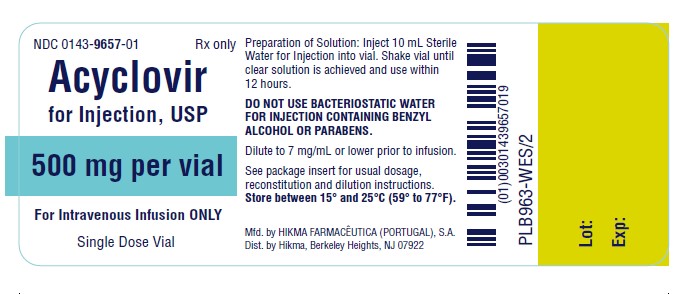
PRINCIPAL DISPLAY PANEL NDC 0143- 9657 -01 Rx only Acyclovir for Injection, USP 500 mg per vial For Intravenous Infusion ONLY Single Dose Vial NDC 0143- 9657 -10 Rx only Acyclovir for Injection, USP 500 mg per vial For Intravenous Infusion ONLY 10 x 500 mg Single Dose Vials 500 mg vial 500 mg shelfpack
Medicare Part D spend CMS · PART D · 2026 (Q1)
About this NDC listing & data coverage
What data is (and isn’t) available for this NDC — tap to expand
| NDC identity (package / product / labeler codes) | ✓ Available |
| Labeler | ✓ Available |
| Product & package description | ✓ Available |
| Marketing category & status | ✓ Available |
| Active ingredient / dosage form / route | ✓ Available |
| FDA label (SPL via DailyMed) | ✓ Available |
| Package photos | ✓ Available |
| Inactive ingredients (structured) | — Not published for this NDC The labeler did not submit a structured excipient list, or no SPL is available. |
| NADAC pharmacy acquisition price (CMS) | — Not published for this NDC CMS publishes NADAC only for NDCs reported in its retail-pharmacy survey. |
| Orange Book / therapeutic-equivalence data | — Not published for this NDC Applies only to products approved under an NDA/ANDA; many listings are out of scope. |
| HCPCS J-code billing crosswalk | — Not published for this NDC Most self-administered / retail products have no J-code — that is normal. |
| Medicaid utilization (CMS SDUD) | — Not published for this NDC CMS reports utilization only for NDCs with Medicaid claims above its privacy threshold. |