
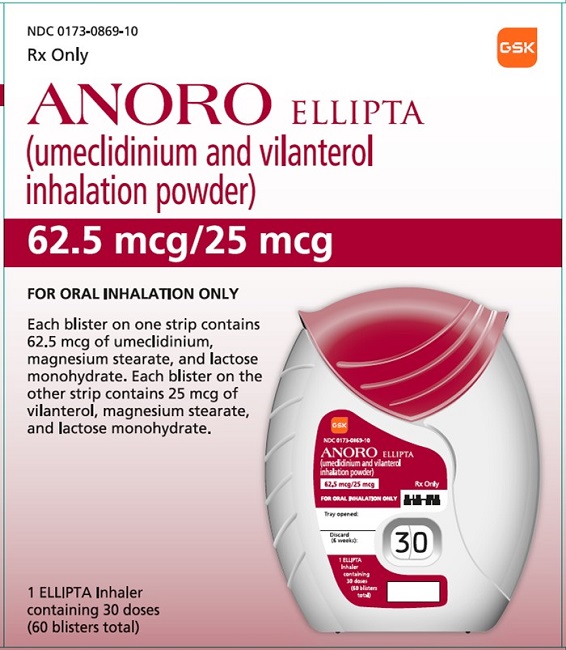
Anoro Ellipta umeclidinium bromide and vilanterol trifenatate 62.5 ug; 25 ug Powder
Past resolved recalls for this product (1)
🆔 Identity & classification
Where does this data come from?
🏷️ RxNorm drug class
This medicine belongs to the beta2-Adrenergic Agonist class.
Where does this data come from?
🏭 Manufacturer & labeler
Where does this data come from?
🩺 Clinical
The combination of umeclidinium and vilanterol is used to control wheezing, shortness of breath, coughing, and chest tightness caused by chronic obstructive pulmonary disease (COPD; a group of diseases that affect the lungs and airways, which includes chronic bronchitis and emphysema). Umeclidinium is in a class of medications called anticholinergics. Vilanterol is in a class of medications called long-acting beta-agonists (LABAs). These medications work by relaxing and opening air passages in the lungs, making it easier to breathe.
Read the full MedlinePlus article ↗- This inhaler is specifically approved for the long-term management of COPD — it helps keep your airways open day to day so breathing is easier. It is not approved for asthma, and u...
- What exactly is this inhaler for — and can I use it if I also have asthma?
- No — this is a maintenance inhaler, not a rescue inhaler. It works over time to keep your airways open, but it doesn't act fast enough to help during a sudden attack. You should al...
- Can I use this inhaler when I'm having a breathing attack?
Patient education
Supplement & herbal interactions
Where does this data come from?
Ask a licensed pharmacist directly — free, answered by our team.
🧪 Inactive Ingredients / Excipients
Inactive ingredients, also called excipients, are components of the drug product other than the active ingredient. They may include fillers, dyes, coatings, preservatives, flavors, or other formulation ingredients.
💡 Tap an ingredient (hover on desktop) to see what it is and why it’s used.
-
UNII EWQ57Q8I5X
Lactose monohydrate is a natural sugar derived from milk. It serves as a filler and binder in tablets and capsules, helping create the proper size, texture, and consistency of the medicine.
-
UNII 70097M6I30
Magnesium stearate is a salt made from magnesium and stearic acid, a fatty substance. It's used in tablets and capsules as a lubricant and glidant to help ingredients flow smoothly during manufacturing and prevent sticking.
2 inactive ingredients listed in the exact product block matched to this NDC.
Where does this data come from?
ingredient classCode="IACT" elements from the exact product block matched by this NDC. Label-section narrative from DailyMed / the openFDA label index is shown separately when available.Inactive ingredient FAQ
Are inactive ingredients the same for every manufacturer?
Why might an inactive ingredient be missing?
Can inactive ingredients matter?
💲 Pricing
A drug doesn't have one price. Each row is a different public payment system, and none is what you'd pay at the counter — that depends on your insurance. The ⓘ on each row explains what it measures.
| Price system | Per g | Per package |
|---|---|---|
| Retail pharmacies payNADAC · weekly | Not in the retail survey — common for institutional, discontinued, or low-volume packs. | |
| Medicaid paysCMS SDUD · 12 mo | No recent Medicaid claims on file for this NDC — rare and low-volume NDCs are suppressed in the public data. | |
| Medicare drug plans payPart D · quarterly | No Part D plan price is available for this NDC in our data. | |
Where does this data come from?
🔁 Therapeutic equivalents
| Product | Labeler | Pack | NADAC/unit | TE | Status | Price vs. this |
|---|---|---|---|---|---|---|
| Umeclidinium and Vilanterol Ellipta 62.5 ug/1; 25 ug 66993-0134-97 | Prasco | 1 inhaler | $4.951 | — | Availability likely | — |
| Anoro Ellipta 62.5 ug/1; 25 ugthis 00173-0869-61 | GlaxoSmithKline | 1 inhaler | — | — | Discontinued | — |
Where does this data come from?
⏳ Availability & generic status
We did not find an FDA-approved generic match for this exact strength, form and route. Patent/protection dates below may affect future generic timing.
Why the date isn’t exact: Generic timing can change because patents may be challenged, settled, licensed, added, removed, or worked around with a narrower label — and FDA approval does not always mean a pharmacy can get the generic today.
🛈 What do these terms mean?
- Patent
- Legal protection listed in the Orange Book that may delay generic approval or launch. Issued by the U.S. Patent & Trademark Office.
- Substance patent
- Covers the active drug molecule itself — the hardest to design around. A generic generally can’t launch until it expires.
- Formulation (product) patent
- Covers a specific formulation or dosage form. A generic can sometimes work around it with a different formulation.
- Method-of-use patent
- A patent covering one specific approved use of the drug — not necessarily the whole molecule. A generic can sometimes launch with a “skinny label” that carves out the protected use and keeps the others.
- Skinny label
- A generic label that omits a still-patented use when the FDA allows it — letting a generic reach the market for the unprotected uses.
- Exclusivity
- FDA-granted marketing protection, separate from patents — e.g. 5-yr new chemical entity, 7-yr orphan drug, or a +6-month pediatric extension.
- Paragraph IV
- A generic applicant’s formal challenge to a listed patent. It can potentially lead to earlier generic entry, but often involves litigation or a settlement.
- RLD / RS
- Reference Listed Drug — the brand product the FDA uses as the reference for generic applications. Reference Standard — the product the FDA expects generics to compare against in bioequivalence testing.
- TE / AB rating
- FDA therapeutic-equivalence rating. An AB rating generally means the FDA considers a generic therapeutically equivalent to — and substitutable for — the brand.
- LOE (loss of exclusivity)
- The latest patent or exclusivity currently listed — the loss-of-exclusivity / latest-listed-protection date shown on this page. Paragraph-IV challenges and settlements can move the real date earlier; FDA approval and a manufacturer’s decision to market can move it later.
Built from the FDA Orange Book. The bars above are scaled to each protection’s expiry; the red LOE marker is the last one to lapse.
| Patent | Type | Use code | Expires |
|---|---|---|---|
| US 11090294 ↗ | Method of use | U-3203 | Nov 29, 2030 |
| US 8511304 ↗ | Method of use | U-1476 | Jun 14, 2027 |
| US 9750726 ↗ | Drug product | — | Nov 29, 2030 |
| US 7488827 ↗ | Drug substance | — | Dec 18, 2027 |
| US 12396986 ↗ | Drug product | — | Nov 29, 2030 |
| US 8511304*PED ↗ | Drug product | — | Dec 14, 2027 |
Is there a generic version of ANORO ELLIPTA 62.5-25 MCG INH?
The FDA approved a generic — why can’t I get it at my pharmacy yet?
Why do different websites show different generic release dates?
What does “FDA listed” mean?
What does a patent or protection date mean here?
What does “current Orange Book estimate” mean?
Can a generic come out before the last patent expires?
Can a generic come out after the listed dates?
What is the difference between patents and exclusivity?
Why are there multiple patent dates?
Where does this data come from?
💊 Medicaid utilization by pack size
📊 Medicare Part D spend CMS · PART D · 2026 (Q1)
📦 Packaging — all sizes for this product
| Package NDC | Description | Per unit | Per pack | Marketing start | Status |
|---|---|---|---|---|---|
| 00173-0869-06 | 1 TRAY in 1 CARTON (0173-0869-06) / 1 INHALER in 1 TRAY / 7 POWDER in 1 INHALER | $8.03 / ea | $56.23 | 2014-01-31 | Active |
| 00173-0869-10 | 1 TRAY in 1 CARTON (0173-0869-10) / 1 INHALER in 1 TRAY / 30 POWDER in 1 INHALER | $7.80 / ea | $233.95 | 2014-01-31 | Active |
| 00173-0869-61 You're viewing this | 1 TRAY in 1 CARTON (0173-0869-61) / 1 INHALER in 1 TRAY / 7 POWDER in 1 INHALER | — | — | 2014-01-31 | Discontinued by firm |
This pack shows little to no recent Medicaid volume — a different pack size carries most fills. See all packs ↓
Pack size FAQ
What quantity is in NDC 00173-0869-61?
What NDC number is used to bill for this package of Anoro Ellipta umeclidinium bromide and vilanterol trifenatate 62.5 ug; 25 ug Powder?
Prices are the latest CMS NADAC pharmacy acquisition cost per NDC; per-pack figures are per-unit × pack quantity, shown only when the pack is denominated in the same measure NADAC prices.
🧭 About this NDC listing & data coverage
What data is (and isn’t) available for this NDC — tap to expand
| NDC identity (package / product / labeler codes) | ✓ Available |
| Labeler | ✓ Available |
| Product & package description | ✓ Available |
| Marketing category & status | ✓ Available |
| Active ingredient / dosage form / route | ✓ Available |
| FDA label (SPL via DailyMed) | ✓ Available |
| Package photos | ✓ Available |
| Inactive ingredients (structured) | ✓ Available |
| NADAC pharmacy acquisition price (CMS) | — Not published for this NDC CMS publishes NADAC only for NDCs reported in its retail-pharmacy survey. |
| Orange Book / therapeutic-equivalence data | ✓ Available |
| HCPCS J-code billing crosswalk | — Not published for this NDC Most self-administered / retail products have no J-code — that is normal. |
| Medicaid utilization (CMS SDUD) | — Not published for this NDC CMS reports utilization only for NDCs with Medicaid claims above its privacy threshold. |
Questions about this listing
Why is there no price listed?
What does the discontinued status mean for this NDC?
Is the NDC printed on the package the same as the 11-digit billing NDC?
What do the three segments of this NDC mean?
Does this product come in other package sizes?
Who lists this product with the FDA?
Do I need a prescription for this product?
Where does this data come from?
📄 Full prescribing information FDA SPL
🎯 Indications and Usage ▾
1 INDICATIONS AND USAGE ANORO ELLIPTA is indicated for the maintenance treatment of patients with chronic obstructive pulmonary disease (COPD). Limitations of Use ANORO ELLIPTA is NOT indicated for the relief of acute bronchospasm or for the treatment of asthma. The safety and effectiveness of ANORO ELLIPTA in asthma have not been established.
ANORO ELLIPTA is a combination of umeclidinium, an anticholinergic, and vilanterol, a long-acting beta 2 -adrenergic agonist (LABA), indicated for the maintenance treatment of patients with chronic obstructive pulmonary disease (COPD). ( 1 ) Limitations of Use: Not indicated for relief of acute bronchospasm or for the treatment of asthma. ( 1 , 5.2 )
⏱️ Dosage and Administration ▾
2 DOSAGE AND ADMINISTRATION The recommended dosage of ANORO ELLIPTA for maintenance treatment of COPD is 62.5 mcg umeclidinium and 25 mcg vilanterol (1 actuation of ANORO ELLIPTA 62.5/25 mcg) once daily by oral inhalation. • ANORO ELLIPTA should be used at the same time every day. Do not use ANORO ELLIPTA more than 1 time every 24 hours. • No dosage adjustment is required for geriatric patients, patients with renal impairment, or patients with moderate hepatic impairment [see Clinical Pharmacology ( 12.3 )] . • For oral inhalation only.
( 2 ) • Maintenance treatment of COPD: 1 actuation of ANORO ELLIPTA once daily administered by oral inhalation. ( 2 )
💊 Dosage Forms and Strengths ▾
3 DOSAGE FORMS AND STRENGTHS Inhalation powder: 62.5 mcg umeclidinium and 25 mcg vilanterol (62.5/25 mcg) per actuation. Inhalation powder: 62.5 mcg umeclidinium and 25 mcg vilanterol (62.5/25 mcg) per actuation. ( 3 )
⛔ Contraindications ▾
4 CONTRAINDICATIONS ANORO ELLIPTA is contraindicated in: • patients with severe hypersensitivity to milk proteins or who have demonstrated hypersensitivity to umeclidinium, vilanterol, or any of the excipients [see Warnings and Precautions (5.6), Description (11)] . • use of a long-acting beta 2 -adrenergic agonist (LABA), including vilanterol, one of the active ingredients in ANORO ELLIPTA, without an inhaled corticosteroid (ICS), in patients with asthma [see Warnings and Precautions (5.1)] . ANORO ELLIPTA is not indicated for the treatment of asthma. • Severe hypersensitivity to milk proteins or any ingredients.
( 4 ) • Use of a LABA, including ANORO ELLIPTA, without an inhaled corticosteroid is contraindicated in patients with asthma. ( 4 )
⚠️ Warnings and Cautions ▾
5 WARNINGS AND PRECAUTIONS • LABA monotherapy (without an inhaled corticosteroid) for asthma increases the risk of serious asthma-related events. ( 5.1 ) • Do not initiate in acutely deteriorating COPD. Do not use to treat acute symptoms.
( 5.2 ) • Do not use in combination with additional therapy containing a LABA because of risk of overdose. ( 5.3 ) • If paradoxical bronchospasm occurs, discontinue ANORO ELLIPTA and institute alternative therapy. ( 5.5 ) • Use with caution in patients with cardiovascular disorders because of beta-adrenergic stimulation.
( 5.7 ) • Use with caution in patients with convulsive disorders, thyrotoxicosis, diabetes mellitus, and ketoacidosis. ( 5.8 ) • Worsening of narrow-angle glaucoma may occur. Use with caution in patients with narrow-angle glaucoma and instruct patients to contact a healthcare provider immediately if symptoms occur.
( 5.9 ) • Worsening of urinary retention may occur. Use with caution in patients with prostatic hyperplasia or bladder-neck obstruction and instruct patients to contact a healthcare provider immediately if symptoms occur. ( 5.10 ) • Be alert to hypokalemia and hyperglycemia.
( 5.11 )
5.1Serious Asthma-Related Events – Hospitalizations, Intubations, Death The safety and effectiveness of ANORO ELLIPTA in patients with asthma have not been established. ANORO ELLIPTA is not indicated for the treatment of asthma [see Contraindications ( 4 )] . Use of LABA as monotherapy (without ICS) for asthma is associated with an increased risk of asthma-related death.
Available data from controlled clinical trials also suggest that use of LABA as monotherapy increases the risk of asthma-related hospitalization in pediatric and adolescent patients. These findings are considered a class effect of LABA monotherapy. When LABA are used in fixed-dose combination with ICS, data from large clinical trials do not show a significant increase in the risk of serious asthma-related events (hospitalizations, intubations, death) compared with ICS alone.
Salmeterol Multicenter Asthma Research Trial (SMART) A 28-week, placebo-controlled, US trial that compared the safety of another LABA (salmeterol) with placebo, each added to usual asthma therapy, showed an increase in asthma-related deaths in subjects receiving salmeterol (13/13,176 in subjects treated with salmeterol vs. 3/13,179 in subjects treated with placebo; relative risk: 4.37 [95% CI: 1.25, 15.34]). The increased risk of asthma-related death is considered a class effect of LABAs, including vilanterol, one of the active ingredients in ANORO ELLIPTA.
No trial adequate to determine whether the rate of asthma-related death is increased in subjects treated with ANORO ELLIPTA has been conducted. Available data do not suggest an increased risk of death with use of LABA in patients with COPD.
5.2Deterioration of Disease and Acute Episodes ANORO ELLIPTA should not be initiated in patients during rapidly deteriorating or potentially life-threatening episodes of COPD. ANORO ELLIPTA has not been studied in subjects with acutely deteriorating COPD. The initiation of ANORO ELLIPTA in this setting is not appropriate.
If ANORO ELLIPTA no longer controls symptoms of bronchoconstriction; the patient’s inhaled, short-acting beta 2 -agonist becomes less effective; or the patient needs more short-acting beta 2 -agonist than usual, these may be markers of deterioration of disease. In this setting, re-evaluate the patient and the COPD treatment regimen at once. The daily dose of ANORO ELLIPTA should not be increased.
Increasing use of inhaled, short-acting beta 2 -agonists is a signal of deteriorating disease. In this situation, the patient requires immediate re-evaluation with reassessment of the treatment regimen, giving special consideration to the need for additional therapeutic options. Patients should not use more than 1 inhalation of ANORO ELLIPTA once daily.
ANORO ELLIPTA should not be used for the relief of acute symptoms, i.e., as rescue therapy for…
🤒 Adverse Reactions ▾
6 ADVERSE REACTIONS The following clinically significant adverse reactions are described elsewhere in labeling: • Serious asthma-related events–hospitalizations, intubations, death [see Warnings and Precautions ( 5.1 )] • Paradoxical bronchospasm [see Warnings and Precautions ( 5.5 )] • Cardiovascular effects [see Warnings and Precautions ( 5.7 )] • Worsening of narrow-angle glaucoma [see Warnings and Precautions ( 5.9 )] • Worsening of urinary retention [see Warnings and Precautions ( 5.10 )] Most common adverse reactions (incidence ≥1% and more common than placebo) are pharyngitis, sinusitis, lower respiratory tract infection, constipation, diarrhea, pain in extremity, muscle spasms, neck pain, and chest pain.
( 6.1 ) To report SUSPECTED ADVERSE REACTIONS, contact GlaxoSmithKline at 1-888-825-5249 or FDA at 1-800-FDA-1088 or www.fda.gov/medwatch .
6.1Clinical Trials Experience Because clinical trials are conducted under widely varying conditions, adverse reaction rates observed in the clinical trials of a drug cannot be directly compared with rates in the clinical trials of another drug and may not reflect the rates observed in practice. The clinical program for ANORO ELLIPTA included 8,138 subjects with COPD in four 6‑month lung function trials, one 12-month long-term safety study, and 9 other trials of shorter duration. A total of 1,124 subjects have received at least 1 dose of ANORO ELLIPTA (umeclidinium/vilanterol 62.5/25 mcg), and 1,330 subjects have received a higher dose of umeclidinium/vilanterol (125/25 mcg).
The safety data described below are based on the four 6-month and one 12-month trials. Adverse reactions observed in the other trials were similar to those observed in the confirmatory trials. 6-Month Trials The incidence of adverse reactions associated with ANORO ELLIPTA in Table 1 is based on four 6-month trials: 2 placebo-controlled trials (Trial 1 and Trial 2); N = 1,532 and N = 1,489, respectively) and 2 active-controlled trials (Trial 3 and Trial 4); N = 843 and N = 869, respectively).
Of the 4,733 subjects, 68% were male and 84% were white. They had a mean age of 63 years and an average smoking history of 45 pack-years, with 50% identified as current smokers. At screening, the mean postbronchodilator percent predicted forced expiratory volume in 1 second (FEV 1 ) was 48% (range: 13% to 76%), the mean postbronchodilator FEV 1 /forced vital capacity (FVC) ratio was 0.47 (range: 0.13 to 0.78), and the mean percent reversibility was 14% (range: -45% to 109%).
Subjects received 1 dose once daily of the following: ANORO ELLIPTA, umeclidinium/vilanterol 125/25 mcg, umeclidinium 62.5 mcg, umeclidinium 125 mcg, vilanterol 25 mcg, active control, or placebo. Table 1. Adverse Reactions with ANORO ELLIPTA with ≥1% Incidence and More Common than Placebo in Subjects with Chronic Obstructive Pulmonary Disease Adverse Reaction ANORO ELLIPTA (n = 842) % Umeclidinium 62.5 mcg (n = 418) % Vilanterol 25 mcg (n = 1,034) % Placebo (n = 555) % Infections and infestations Pharyngitis 2 1 2 <1 Sinusitis 1 <1 1 <1 Lower respiratory tract infection 1 <1 <1 <1 Gastrointestinal disorders Constipation 1 <1 <1 <1 Diarrhea 2 <1 2 1 Musculoskeletal and connective tissue disorders Pain in extremity 2 <1 2 1 Muscle spasms 1 <1 <1 <1 Neck pain 1 <1 <1 <1 General disorders and administration site conditions Chest pain 1 <1 <1 <1 Other adverse reactions with ANORO ELLIPTA observed with an incidence <1% but more common than placebo included the following: productive cough, dry mouth, dyspepsia, abdominal pain, gastroesophageal reflux disease, vomiting, musculoskeletal chest pain, chest discomfort, asthenia, atrial fibrillation, ventricular extrasystoles, supraventricular extrasystoles, myocardial infarction, pruritus, rash, and conjunctivitis.
12-Month Trial In a long-term safety trial (Trial 5), 335 subjects were treated for up to 12 months with umeclidinium/vilanterol 125/25 mcg or placebo. The demographic and baseline characteristics of t…
🔄 Drug Interactions ▾
7 DRUG INTERACTIONS • Strong cytochrome P450 3A4 inhibitors (e.g., ketoconazole): Use with caution. May cause cardiovascular effects. ( 7.1 ) • Monoamine oxidase inhibitors and tricyclic antidepressants: Use with extreme caution.
May potentiate effect of vilanterol on cardiovascular system. ( 7.2 ) • Beta-blockers: Use with caution. May block bronchodilatory effects of beta-agonists and produce severe bronchospasm.
( 7.3 ) • Diuretics: Use with caution. Electrocardiographic changes and/or hypokalemia associated with non–potassium-sparing diuretics may worsen with concomitant beta-agonists. ( 7.4 ) • Anticholinergics: May interact additively with concomitantly used anticholinergic medications.
Avoid administration of ANORO ELLIPTA with other anticholinergic-containing drugs. ( 7.5 )
7.1Inhibitors of Cytochrome P450 3A4 Vilanterol is a substrate of CYP3A4. Concomitant administration of the strong CYP3A4 inhibitor ketoconazole increases the systemic exposure to vilanterol. Caution should be exercised when considering the coadministration of ANORO ELLIPTA with ketoconazole and other known strong CYP3A4 inhibitors [see Warnings and Precautions ( 5.4 ), Clinical Pharmacology ( 12.3 )] .
7.2Monoamine Oxidase Inhibitors, Tricyclic Antidepressants, and QTc Prolonging Drugs Vilanterol, like other beta 2 -agonists, should be administered with extreme caution to patients being treated with monoamine oxidase inhibitors, tricyclic antidepressants, or drugs known to prolong the QTc interval or within 2 weeks of discontinuation of such agents, because the effect of adrenergic agonists on the cardiovascular system may be potentiated by these agents. Drugs that are known to prolong the QTc interval have an increased risk of ventricular arrhythmias.
7.3Beta-adrenergic Receptor Blocking Agents Beta-blockers not only block the pulmonary effect of beta-agonists, such as vilanterol, but may also produce severe bronchospasm in patients with COPD. Therefore, patients with COPD should not normally be treated with beta-blockers. However, under certain circumstances, there may be no acceptable alternatives to the use of beta-adrenergic blocking agents for these patients; cardioselective beta-blockers could be considered, although they should be administered with caution.
7.4Non–Potassium-Sparing Diuretics The electrocardiographic changes and/or hypokalemia that may result from the administration of non–potassium-sparing diuretics (such as loop or thiazide diuretics) can be acutely worsened by beta-agonists, especially when the recommended dose of the beta-agonist is exceeded. Although the clinical significance of these effects is not known, caution is advised in the coadministration of beta-agonists with non–potassium-sparing diuretics.
7.5Anticholinergics There is potential for an additive interaction with concomitantly used anticholinergic medicines. Therefore, avoid coadministration of ANORO ELLIPTA with other anticholinergic-containing drugs as this may lead to an increase in anticholinergic adverse effects [see Warnings and Precautions ( 5.9 , 5.10 )] .
👥 Use in Specific Populations ▾
8 USE IN SPECIFIC POPULATIONS
8.1Pregnancy Risk Summary There are insufficient data on the use of ANORO ELLIPTA or its individual components, umeclidinium and vilanterol, in pregnant women to inform a drug-associated risk. (See Clinical Considerations.) In animal reproduction studies, umeclidinium administered via inhalation or subcutaneously to pregnant rats and rabbits was not associated with adverse effects on embryofetal development at exposures approximately 50 and 200 times, respectively, the human exposure at the maximum recommended human daily inhaled dose (MRHDID).
Vilanterol administered via inhalation to pregnant rats and rabbits produced no fetal structural abnormalities at exposures approximately 70 times the MRHDID. (See Data.) The estimated risk of major birth defects and miscarriage for the indicated populations is unknown. In the U.S. general population, the estimated risk of major birth defects and miscarriage in clinically recognized pregnancies is 2% to 4% and 15% to 20%, respectively.
Clinical Considerations Labor or Delivery: ANORO ELLIPTA should be used during late gestation and labor only if the potential benefit justifies the potential for risks related to beta-agonists interfering with uterine contractility. Data Animal Data: The combination of umeclidinium and vilanterol has not been studied in pregnant animals. Studies in pregnant animals have been conducted with umeclidinium and vilanterol individually.
Umeclidinium: In separate embryofetal developmental studies, pregnant rats and rabbits received umeclidinium during the period of organogenesis at doses up to approximately 50 and 200 times the MRHDID, respectively (on an AUC basis at maternal inhalation doses up to 278 mcg/kg/day in rats and at maternal subcutaneous doses up to 180 mcg/kg/day in rabbits). No evidence of teratogenic effects was observed in either species. In a perinatal and postnatal developmental study in rats, dams received umeclidinium during late gestation and lactation periods with no evidence of effects on offspring development at doses up to approximately 26 times the MRHDID (on an AUC basis at maternal subcutaneous doses up to 60 mcg/kg/day).
Vilanterol: In separate embryofetal developmental studies, pregnant rats and rabbits received vilanterol during the period of organogenesis at doses up to approximately 13,000 and 450 times, respectively, the MRHDID (on a mcg/m 2 basis at maternal inhalation doses up to 33,700 mcg/kg/day in rats and on an AUC basis at maternal inhaled doses up to 5,740 mcg/kg/day in rabbits). No evidence of structural abnormalities was observed at any dose in rats or in rabbits up to approximately 70 times the MRHDID (on an AUC basis at maternal doses up to 591 mcg/kg/day in rabbits).
However, fetal skeletal variations were observed in rabbits at approximately 450 times the MRHDID (on an AUC basis at maternal inhaled or subcutaneous doses of 5,740 or 300 mcg/kg/day, respectively). The skeletal variations included decreased or absent ossification in cervical vertebral centrum and metacarpals. In a perinatal and postnatal developmental study in rats, dams received vilanterol during late gestation and the lactation periods at doses up to approximately 3,900 times the MRHDID (on a mcg/m 2 basis at maternal oral doses up to 10,000 mcg/kg/day).
No evidence of effects in offspring development was observed.
8.2Lactation Risk Summary There is no information available on the presence of umeclidinium or vilanterol in human milk, the effects on the breastfed child, or the effects on milk production. Umeclidinium was detected in the plasma of offspring of lactating rats treated with umeclidinium suggesting its presence in maternal milk. (See Data.) The developmental and health benefits of breastfeeding should be considered along with the mother’s clinical need for ANORO ELLIPTA and any potential adverse effects on the breastfed child from umeclidinium or vilanterol or from the underlying maternal condition.
Data S…
🤰 Pregnancy ▾
8.1Pregnancy Risk Summary There are insufficient data on the use of ANORO ELLIPTA or its individual components, umeclidinium and vilanterol, in pregnant women to inform a drug-associated risk. (See Clinical Considerations.) In animal reproduction studies, umeclidinium administered via inhalation or subcutaneously to pregnant rats and rabbits was not associated with adverse effects on embryofetal development at exposures approximately 50 and 200 times, respectively, the human exposure at the maximum recommended human daily inhaled dose (MRHDID).
Vilanterol administered via inhalation to pregnant rats and rabbits produced no fetal structural abnormalities at exposures approximately 70 times the MRHDID. (See Data.) The estimated risk of major birth defects and miscarriage for the indicated populations is unknown. In the U.S. general population, the estimated risk of major birth defects and miscarriage in clinically recognized pregnancies is 2% to 4% and 15% to 20%, respectively.
Clinical Considerations Labor or Delivery: ANORO ELLIPTA should be used during late gestation and labor only if the potential benefit justifies the potential for risks related to beta-agonists interfering with uterine contractility. Data Animal Data: The combination of umeclidinium and vilanterol has not been studied in pregnant animals. Studies in pregnant animals have been conducted with umeclidinium and vilanterol individually.
Umeclidinium: In separate embryofetal developmental studies, pregnant rats and rabbits received umeclidinium during the period of organogenesis at doses up to approximately 50 and 200 times the MRHDID, respectively (on an AUC basis at maternal inhalation doses up to 278 mcg/kg/day in rats and at maternal subcutaneous doses up to 180 mcg/kg/day in rabbits). No evidence of teratogenic effects was observed in either species. In a perinatal and postnatal developmental study in rats, dams received umeclidinium during late gestation and lactation periods with no evidence of effects on offspring development at doses up to approximately 26 times the MRHDID (on an AUC basis at maternal subcutaneous doses up to 60 mcg/kg/day).
Vilanterol: In separate embryofetal developmental studies, pregnant rats and rabbits received vilanterol during the period of organogenesis at doses up to approximately 13,000 and 450 times, respectively, the MRHDID (on a mcg/m 2 basis at maternal inhalation doses up to 33,700 mcg/kg/day in rats and on an AUC basis at maternal inhaled doses up to 5,740 mcg/kg/day in rabbits). No evidence of structural abnormalities was observed at any dose in rats or in rabbits up to approximately 70 times the MRHDID (on an AUC basis at maternal doses up to 591 mcg/kg/day in rabbits).
However, fetal skeletal variations were observed in rabbits at approximately 450 times the MRHDID (on an AUC basis at maternal inhaled or subcutaneous doses of 5,740 or 300 mcg/kg/day, respectively). The skeletal variations included decreased or absent ossification in cervical vertebral centrum and metacarpals. In a perinatal and postnatal developmental study in rats, dams received vilanterol during late gestation and the lactation periods at doses up to approximately 3,900 times the MRHDID (on a mcg/m 2 basis at maternal oral doses up to 10,000 mcg/kg/day).
No evidence of effects in offspring development was observed.
🧒 Pediatric Use ▾
8.4Pediatric Use The safety and effectiveness of ANORO ELLIPTA have not been established in pediatric patients. ANORO ELLIPTA is not indicated for use in pediatric patients.
🧓 Geriatric Use ▾
8.5Geriatric Use Based on available data, no adjustment of the dosage of ANORO ELLIPTA in geriatric patients is necessary, but greater sensitivity in some older individuals cannot be ruled out. Clinical trials of ANORO ELLIPTA for COPD included 2,143 subjects aged 65 years and older and 478 subjects aged 75 years and older. No overall differences in safety or effectiveness were observed between these subjects and younger subjects, and other reported clinical experience has not identified differences in responses between the elderly and younger subjects.
🆘 Overdosage ▾
10 OVERDOSAGE ANORO ELLIPTA contains both umeclidinium and vilanterol; therefore, the risks associated with overdosage for the individual components described below apply to ANORO ELLIPTA. Treatment of overdosage consists of discontinuation of ANORO ELLIPTA together with institution of appropriate symptomatic and/or supportive therapy. The judicious use of a cardioselective beta-receptor blocker may be considered, bearing in mind that such medicine can produce bronchospasm.
Cardiac monitoring is recommended in cases of overdosage. Umeclidinium High doses of umeclidinium may lead to anticholinergic signs and symptoms. Vilanterol The expected signs and symptoms with overdosage of vilanterol are those of excessive beta-adrenergic stimulation and/or occurrence or exaggeration of any of the signs and symptoms of beta-adrenergic stimulation (e.g., seizures, angina, hypertension or hypotension, tachycardia with rates up to 200 beats/min, arrhythmias, nervousness, headache, tremor, muscle cramps, dry mouth, palpitation, nausea, dizziness, fatigue, malaise, insomnia, hyperglycemia, hypokalemia, metabolic acidosis).
As with all inhaled sympathomimetic medicines, cardiac arrest and even death may be associated with an overdose of vilanterol.
🧬 Clinical Pharmacology ▾
12 CLINICAL PHARMACOLOGY
12.1Mechanism of Action ANORO ELLIPTA ANORO ELLIPTA contains both umeclidinium and vilanterol. The mechanisms of action described below for the individual components apply to ANORO ELLIPTA. These drugs represent 2 different classes of medications (an anticholinergic and a LABA) each having different effects on clinical and physiological indices.
Umeclidinium Umeclidinium is a long-acting muscarinic antagonist, which is often referred to as an anticholinergic. It has similar affinity to the subtypes of muscarinic receptors M1 to M5. In the airways, it exhibits pharmacological effects through inhibition of M3 receptor at the smooth muscle leading to bronchodilation.
The competitive and reversible nature of antagonism was shown with human and animal origin receptors and isolated organ preparations. In preclinical in vitro as well as in vivo studies, prevention of methacholine- and acetylcholine-induced bronchoconstrictive effects was dose-dependent and lasted longer than 24 hours. The clinical relevance of these findings is unknown.
The bronchodilation following inhalation of umeclidinium is predominantly a site-specific effect. Vilanterol Vilanterol is a LABA. In vitro tests have shown the functional selectivity of vilanterol was similar to salmeterol.
The clinical relevance of this in vitro finding is unknown. Although beta 2 -receptors are the predominant adrenergic receptors in bronchial smooth muscle and beta 1 -receptors are the predominant receptors in the heart, there are also beta 2 -receptors in the human heart comprising 10% to 50% of the total beta-adrenergic receptors. The precise function of these receptors has not been established, but they raise the possibility that even highly selective beta 2 -agonists may have cardiac effects.
The pharmacologic effects of beta 2 -adrenergic agonist drugs, including vilanterol, are at least in part attributable to stimulation of intracellular adenyl cyclase, the enzyme that catalyzes the conversion of adenosine triphosphate (ATP) to cyclic-3′,5′-adenosine monophosphate (cyclic AMP). Increased cyclic AMP levels cause relaxation of bronchial smooth muscle and inhibition of release of mediators of immediate hypersensitivity from cells, especially from mast cells.
12.2Pharmacodynamics Cardiac Electrophysiology Healthy Subjects: QTc interval prolongation was studied in a double-blind, multiple-dose, placebo- and positive-controlled crossover study in 86 healthy subjects. The maximum mean (95% upper confidence bound) difference in QTcF from placebo after baseline correction was 4.6 (7.1) milliseconds and 8.2 (10.7) milliseconds for umeclidinium/vilanterol 125/25 mcg and umeclidinium/vilanterol 500/100 mcg (8/4 times the recommended dosage), respectively. A dose-dependent increase in heart rate was also observed.
The maximum mean (95% upper confidence bound) difference in heart rate from placebo after baseline correction was 8.8 (10.5) beats/min and 20.5 (22.3) beats/min seen 10 minutes after dosing for umeclidinium/vilanterol 125/25 mcg and umeclidinium/vilanterol 500/100 mcg, respectively. Subjects with Chronic Obstructive Pulmonary Disease: The effect of ANORO ELLIPTA on cardiac rhythm in subjects diagnosed with COPD was assessed using 24-hour Holter monitoring in 6- and 12-month trials: 53 subjects received ANORO ELLIPTA, 281 subjects received umeclidinium/vilanterol 125/25 mcg, and 182 subjects received placebo.
No clinically meaningful effects on cardiac rhythm were observed.
12.3Pharmacokinetics Linear pharmacokinetics was observed for umeclidinium (62.5 to 500 mcg) and vilanterol (25 to 100 mcg). Absorption Umeclidinium: Umeclidinium plasma levels may not predict therapeutic effect. Following inhaled administration of umeclidinium in healthy subjects, C max occurred at 5 to 15 minutes.
Umeclidinium is mostly absorbed from the lung after inhaled doses with minimum contribution from oral absorption. Following repeat dosing of inhaled ANORO ELLIPTA, ste…
🧬 Mechanism of Action ▾
12.1Mechanism of Action ANORO ELLIPTA ANORO ELLIPTA contains both umeclidinium and vilanterol. The mechanisms of action described below for the individual components apply to ANORO ELLIPTA. These drugs represent 2 different classes of medications (an anticholinergic and a LABA) each having different effects on clinical and physiological indices.
Umeclidinium Umeclidinium is a long-acting muscarinic antagonist, which is often referred to as an anticholinergic. It has similar affinity to the subtypes of muscarinic receptors M1 to M5. In the airways, it exhibits pharmacological effects through inhibition of M3 receptor at the smooth muscle leading to bronchodilation.
The competitive and reversible nature of antagonism was shown with human and animal origin receptors and isolated organ preparations. In preclinical in vitro as well as in vivo studies, prevention of methacholine- and acetylcholine-induced bronchoconstrictive effects was dose-dependent and lasted longer than 24 hours. The clinical relevance of these findings is unknown.
The bronchodilation following inhalation of umeclidinium is predominantly a site-specific effect. Vilanterol Vilanterol is a LABA. In vitro tests have shown the functional selectivity of vilanterol was similar to salmeterol.
The clinical relevance of this in vitro finding is unknown. Although beta 2 -receptors are the predominant adrenergic receptors in bronchial smooth muscle and beta 1 -receptors are the predominant receptors in the heart, there are also beta 2 -receptors in the human heart comprising 10% to 50% of the total beta-adrenergic receptors. The precise function of these receptors has not been established, but they raise the possibility that even highly selective beta 2 -agonists may have cardiac effects.
The pharmacologic effects of beta 2 -adrenergic agonist drugs, including vilanterol, are at least in part attributable to stimulation of intracellular adenyl cyclase, the enzyme that catalyzes the conversion of adenosine triphosphate (ATP) to cyclic-3′,5′-adenosine monophosphate (cyclic AMP). Increased cyclic AMP levels cause relaxation of bronchial smooth muscle and inhibition of release of mediators of immediate hypersensitivity from cells, especially from mast cells.
📦 How Supplied / Storage and Handling ▾
16 HOW SUPPLIED/STORAGE AND HANDLING ANORO ELLIPTA is supplied as a disposable light grey and red plastic inhaler containing 2 foil strips, each with 30 blisters (or 7 blisters for the institutional pack). One strip contains umeclidinium (62.5 mcg per blister), and the other strip contains vilanterol (25 mcg per blister). A blister from each strip is used to create 1 dose.
The inhaler is packaged in a moisture-protective foil tray with a desiccant and a peelable lid in the following packs: NDC 0173-0869-10 30 inhalations (60 blisters) NDC 0173-0869-06 7 inhalations (14 blisters), institutional pack Store at room temperature between 68°F and 77°F (20°C and 25°C); excursions permitted from 59°F to 86°F (15°C to 30°C) [See USP Controlled Room Temperature]. Store in a dry place away from direct heat or sunlight. Keep out of reach of children.
ANORO ELLIPTA should be stored inside the unopened moisture-protective foil tray and only removed from the tray immediately before initial use. Discard ANORO ELLIPTA 6 weeks after opening the foil tray or when the counter reads “0” (after all blisters have been used), whichever comes first. The inhaler is not reusable.
Do not attempt to take the inhaler apart.
📋 Description ▾
11 DESCRIPTION ANORO ELLIPTA is an inhalation powder drug product for delivery of a combination of umeclidinium (an anticholinergic) and vilanterol (a LABA) to patients by oral inhalation. Umeclidinium bromide has the chemical name 1-[2-(benzyloxy)ethyl]-4-(hydroxydiphenylmethyl)-1-azoniabicyclo[2.2.2]octane bromide and the following chemical structure: Umeclidinium bromide is a white powder with a molecular weight of 508.5, and the empirical formula is C 29 H 34 NO 2 •Br (as a quaternary ammonium bromide compound).
It is slightly soluble in water. Vilanterol trifenatate has the chemical name triphenylacetic acid-4-{(1 R )-2-[(6-{2-[(2,6-dicholorobenzyl)oxy]ethoxy}hexyl)amino]-1-hydroxyethyl}-2-(hydroxymethyl)phenol (1:1) and the following chemical structure: Vilanterol trifenatate is a white powder with a molecular weight of 774.8, and the empirical formula is C 24 H 33 Cl 2 NO 5 •C 20 H 16 O 2 . It is practically insoluble in water.
ANORO ELLIPTA is a light grey and red plastic inhaler containing 2 foil blister strips. Each blister on one strip contains a white powder blend of micronized umeclidinium bromide (74.2 mcg equivalent to 62.5 mcg of umeclidinium), magnesium stearate (75 mcg), and lactose monohydrate (to 12.5 mg), and each blister on the other strip contains a white powder blend of micronized vilanterol trifenatate (40 mcg equivalent to 25 mcg of vilanterol), magnesium stearate (125 mcg), and lactose monohydrate (to 12.5 mg). The lactose monohydrate contains milk proteins.
After the inhaler is activated, the powder within both blisters is exposed and ready for dispersion into the airstream created by the patient inhaling through the mouthpiece. Under standardized in vitro test conditions, ANORO ELLIPTA delivers 55 mcg of umeclidinium and 22 mcg of vilanterol per dose when tested at a flow rate of 60 L/min for 4 seconds. In adult subjects with obstructive lung disease and severely compromised lung function (COPD with FEV 1 /FVC <70% and FEV 1 <30% predicted or FEV 1 <50% predicted plus chronic respiratory failure), mean peak inspiratory flow through the ELLIPTA inhaler was
66.5L/min (range: 43.5 to
81.0L/min). The actual amount of drug delivered to the lung will depend on patient factors, such as inspiratory flow profile. Umeclidinium bromide chemical structure Vilanterol trifenatate chemical structure
💬 Information for Patients ▾
17 PATIENT COUNSELING INFORMATION Advise the patient to read the FDA-approved patient labeling (Patient Information and Instructions for Use). Serious Asthma-Related Events ANORO ELLIPTA is not indicated for the treatment of asthma. Inform patients that LABAs, such as vilanterol (one of the active ingredients in ANORO ELLIPTA), when used alone (without ICS) for asthma increase the risk of asthma-related hospitalization or asthma-related death. [See Warnings and Precautions (5.1).] Not for Acute Symptoms Inform patients that ANORO ELLIPTA is not meant to relieve acute symptoms of COPD and extra doses should not be used for that purpose.
Advise patients to treat acute symptoms with an inhaled, short-acting beta 2 -agonist such as albuterol. Provide patients with such medication and instruct them in how it should be used. Instruct patients to seek medical attention immediately if they experience any of the following: • Decreasing effectiveness of inhaled, short-acting beta 2 -agonists • Need for more inhalations than usual of inhaled, short-acting beta 2 -agonists • Significant decrease in lung function as outlined by the physician Tell patients they should not stop therapy with ANORO ELLIPTA without physician/provider guidance since symptoms may recur after discontinuation. [See Warnings and Precautions (5.2).] Do Not Use Additional Long-acting Beta 2 -agonists Instruct patients not to use other LABAs for COPD. [See Warnings and Precautions (5.3).] Paradoxical Bronchospasm As with other inhaled medicines, ANORO ELLIPTA can cause paradoxical bronchospasm.
If paradoxical bronchospasm occurs, instruct patients to discontinue ANORO ELLIPTA and contact their healthcare provider right away. [See Warnings and Precautions (5.5).] Risks Associated with Beta-agonist Therapy Inform patients of adverse effects associated with beta 2 -agonists, such as palpitations, chest pain, rapid heart rate, tremor, or nervousness. Instruct patients to consult a healthcare practitioner immediately should any of these signs and symptoms develop. [See Warnings and Precautions (5.7).] Worsening of Narrow-Angle Glaucoma Instruct patients to be alert for signs and symptoms of acute narrow-angle glaucoma (e.g., eye pain or discomfort, blurred vision, visual halos or colored images in association with red eyes from conjunctival congestion and corneal edema).
Instruct patients to consult a physician immediately if any of these signs or symptoms develop. [See Warnings and Precautions (5.9).] Worsening of Urinary Retention Instruct patients to be alert for signs and symptoms of urinary retention (e.g., difficulty passing urine, painful urination). Instruct patients to consult a physician immediately if any of these signs or symptoms develop. [See Warnings and Precautions (5.10).] Trademarks are owned by or licensed to the GSK group of companies. ANORO ELLIPTA was developed in collaboration with Innoviva.
GlaxoSmithKline Durham, NC 27701 ©2023 GSK group of companies or its licensor. ANR:12PI