
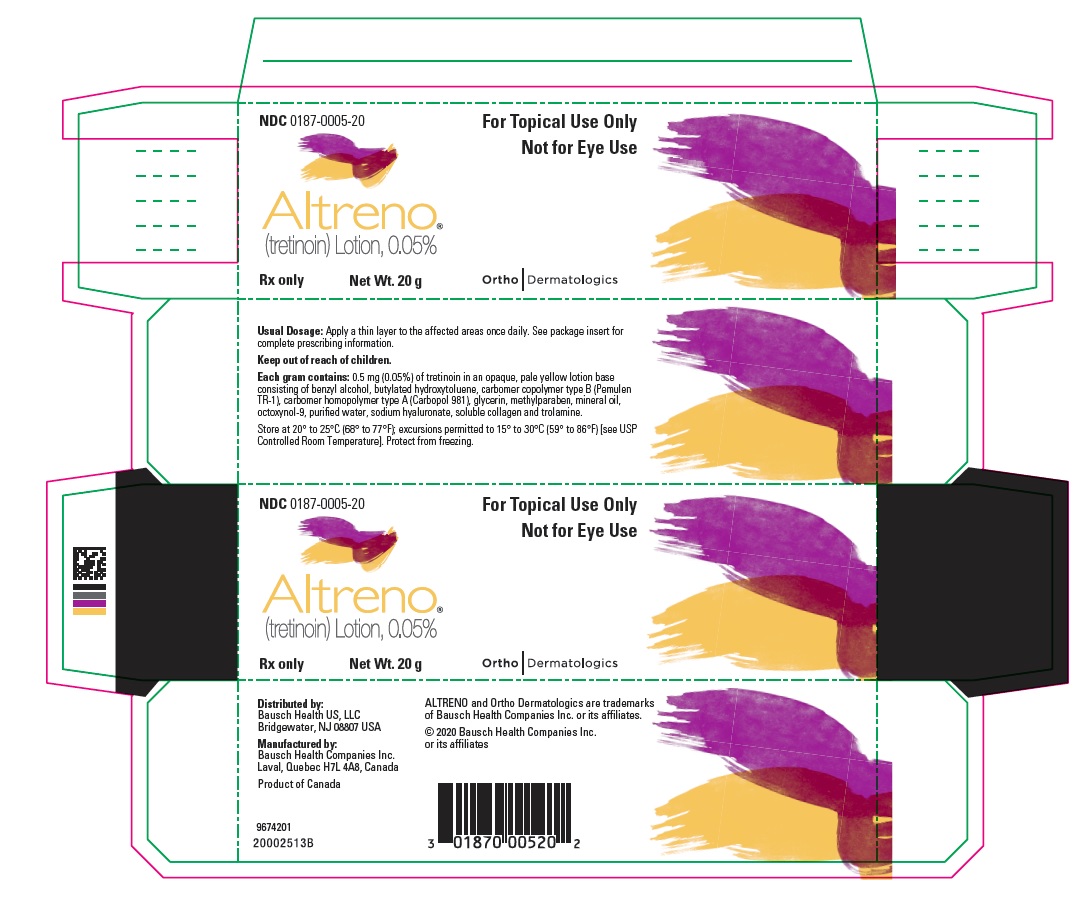
Altreno tretinoin .5 mg/g Lotion
🆔 Identity & classification
Where does this data come from?
🏷️ RxNorm drug class
This medicine belongs to the Retinoid class.
Where does this data come from?
🏭 Manufacturer & labeler
Where does this data come from?
🩺 Clinical
- Honestly, it won't erase wrinkles — and the label is pretty direct about that. What it's approved to do is help reduce the appearance of fine wrinkles as part of a full routine tha...
- Will tretinoin actually get rid of my wrinkles?
- Redness, peeling, and irritation in the first couple of weeks are very common and usually mean your skin is adjusting — not that something is wrong. If it's tolerable, try hanging...
- My skin is really red and peeling after the first week — should I stop?
Patient education
Supplement & herbal interactions
Some supplements/herbs that may interact with Tretinoin — tap one for details:
Tretinoin may be associated with lower levels of 1 nutrient — worth a chat with your pharmacist, not a cause for alarm.
Where does this data come from?
Ask a licensed pharmacist directly — free, answered by our team.
🧪 Inactive Ingredients / Excipients
Inactive ingredients, also called excipients, are components of the drug product other than the active ingredient. They may include fillers, dyes, coatings, preservatives, flavors, or other formulation ingredients.
💡 Tap an ingredient (hover on desktop) to see what it is and why it’s used.
-
UNII LKG8494WBH
Benzyl alcohol is a clear liquid used as a preservative and solvent in medicines. It helps prevent bacterial and fungal growth and dissolves other ingredients to create uniform liquid formulations.
-
UNII 1P9D0Z171K
BHT is a synthetic antioxidant that prevents fats and oils in medicines from breaking down and becoming rancid. It helps keep the product stable and effective during storage.
-
UNII 809Y72KV36
A synthetic polymer made from acrylic acid and crosslinked with allyl pentaerythritol. It's used as a thickening agent and gelling ingredient in creams, gels, and lotions to create the proper texture and help the medicine spread and stay on the skin.
-
UNII F68VH75CJC
A synthetic polymer made from acrylic acid that thickens and stabilizes liquid or gel formulations. It's used as a gelling agent and emulsifier to create the desired texture and consistency in topical medicines.
-
UNII PDC6A3C0OX
Glycerin is a clear, thick liquid derived from plant oils or fats. It acts as a humectant to retain moisture, a sweetener, and a solvent in medications.
-
UNII YSE9PPT4TH
Hyaluronate sodium is a natural carbohydrate that holds moisture. It's used in medicines as a lubricant, thickener, and moisture-retaining agent to improve texture and delivery of the active ingredient.
-
UNII 8JC99XGU4W
Soluble fish skin collagen is a protein derived from fish skin that acts as a binder and thickening agent in medicines. It helps hold ingredients together and gives the product the right texture or consistency.
-
UNII A2I8C7HI9T
Methylparaben is a preservative derived from benzoic acid that prevents growth of bacteria, fungi, and mold in medicines. It extends the product's shelf life and maintains safety during storage.
-
UNII T5L8T28FGP
Mineral oil is a clear, odorless liquid derived from crude oil. It acts as a lubricant and emollient in medications, helping pills slide smoothly during manufacturing and aiding moisture retention in topical products.
-
UNII 7JPC6Y25QS
A synthetic nonionic surfactant, a type of cleaning agent used in pharmaceutical formulations. It functions as an emulsifier and solubilizer, helping mix water and oil-based ingredients and improving how the medicine dissolves and spreads in the body.
-
UNII 9O3K93S3TK
Trolamine is an alkaline compound used as a pH buffer and emulsifier in medicines. It helps neutralize acids, stabilize formulations, and enable mixing of oil and water-based ingredients.
-
UNII 059QF0KO0R
Water is a liquid solvent that dissolves and mixes ingredients together in liquid medicines, syrups, and injections. It helps distribute the active drug evenly throughout the product.
12 inactive ingredients listed in the exact product block matched to this NDC.
Where does this data come from?
ingredient classCode="IACT" elements from the exact product block matched by this NDC. Label-section narrative from DailyMed / the openFDA label index is shown separately when available.Inactive ingredient FAQ
Are inactive ingredients the same for every manufacturer?
Why might an inactive ingredient be missing?
Can inactive ingredients matter?
💲 Pricing
A drug doesn't have one price. Each row is a different public payment system, and none is what you'd pay at the counter — that depends on your insurance. The ⓘ on each row explains what it measures.
| Price system | Per g | Per package |
|---|---|---|
| Retail pharmacies payNADAC · weekly | Not in the retail survey — common for institutional, discontinued, or low-volume packs. | |
| Medicaid paysCMS SDUD · 12 mo | No recent Medicaid claims on file for this NDC — rare and low-volume NDCs are suppressed in the public data. | |
| Medicare drug plans payPart D · Q2 2026 | $2.45 | $122.55 / 50 g |
Where does this data come from?
🔁 Therapeutic equivalents
| Product | Labeler | Pack | NADAC/unit | TE | Status | Price vs. this |
|---|---|---|---|---|---|---|
| Retin-A .5 mg/g 00187-5162-20 | Bausch | 1 tube | $0.721 | AB1 | FDA listed | — |
| Tretinoin .5 mg/g 16714-0249-01 | NORTHSTAR | 1 tube | $1.569 | AB1 | Availability likely | — |
| Tretinoin .5 mg/g 51672-1394-00 | Sun | 1 tube | $1.569 | AB1 | Availability likely | — |
| Tretinoin .5 mg/g 00378-8083-20 | Mylan | 1 tube | $1.569 | AB1 | Availability likely | — |
| Tretinoin .5 mg/g 00574-2205-20 | Padagis | 1 tube | $1.569 | AB1 | Availability likely | — |
| Tretinoin .5 mg/g 00378-8090-45 | Mylan | 1 tube | $4.000 | AB | Availability likely | — |
| Altreno .5 mg/gthis 00187-0005-50 | Bausch | 1 bottle | — | — | FDA listed | — |
| Tretinoin .5 mg/g 72162-2158-02 | Bryant | 1 tube | — | AB1 | FDA listed | — |
| Tretinoin Cream .5 mg/g 62032-0412-20 | Obagi | 1 tube | — | AB1 | FDA listed | — |
| Tretinoin .5 mg/g 21922-0078-06 | Encube | 1 tube | — | AB1 | FDA listed | — |
| Tretinoin .5 mg/g 50090-3058-00 | A-S | 1 tube | — | AB1 | FDA listed | — |
| Tretinoin .5 mg/g 68071-3865-02 | NuCare | 1 tube | — | AB1 | FDA listed | — |
| Tretinoin .5 mg/g 50090-6819-00 | A-S | 1 tube | — | AB1 | FDA listed | — |
| Tretinoin .5 mg/g 62332-0808-20 | Alembic | 1 tube | — | AB1 | FDA listed | — |
| Tretinoin .5 mg/g 46708-0808-00 | Alembic | 1 tube | — | AB1 | FDA listed | — |
Where does this data come from?
⏳ Availability & generic status
FDA-approved generic versions are listed, and recent pricing/market data suggests they may be available — see Therapeutic equivalents.
Why the date isn’t exact: Generic timing can change because patents may be challenged, settled, licensed, added, removed, or worked around with a narrower label — and FDA approval does not always mean a pharmacy can get the generic today.
🛈 What do these terms mean?
- Patent
- Legal protection listed in the Orange Book that may delay generic approval or launch. Issued by the U.S. Patent & Trademark Office.
- Substance patent
- Covers the active drug molecule itself — the hardest to design around. A generic generally can’t launch until it expires.
- Formulation (product) patent
- Covers a specific formulation or dosage form. A generic can sometimes work around it with a different formulation.
- Method-of-use patent
- A patent covering one specific approved use of the drug — not necessarily the whole molecule. A generic can sometimes launch with a “skinny label” that carves out the protected use and keeps the others.
- Skinny label
- A generic label that omits a still-patented use when the FDA allows it — letting a generic reach the market for the unprotected uses.
- Exclusivity
- FDA-granted marketing protection, separate from patents — e.g. 5-yr new chemical entity, 7-yr orphan drug, or a +6-month pediatric extension.
- Paragraph IV
- A generic applicant’s formal challenge to a listed patent. It can potentially lead to earlier generic entry, but often involves litigation or a settlement.
- RLD / RS
- Reference Listed Drug — the brand product the FDA uses as the reference for generic applications. Reference Standard — the product the FDA expects generics to compare against in bioequivalence testing.
- TE / AB rating
- FDA therapeutic-equivalence rating. An AB rating generally means the FDA considers a generic therapeutically equivalent to — and substitutable for — the brand.
- LOE (loss of exclusivity)
- The latest patent or exclusivity currently listed — the loss-of-exclusivity / latest-listed-protection date shown on this page. Paragraph-IV challenges and settlements can move the real date earlier; FDA approval and a manufacturer’s decision to market can move it later.
Built from the FDA Orange Book. The bars above are scaled to each protection’s expiry; the red LOE marker is the last one to lapse.
| Patent | Type | Use code | Expires |
|---|---|---|---|
| US 10653656 ↗ | Method of use | U-2368 | Aug 22, 2038 |
| US 11324710 ↗ | Method of use | U-2368 | Aug 22, 2038 |
Is there a generic version of ALTRENO 0.05% LOTION?
The FDA approved a generic — why can’t I get it at my pharmacy yet?
Why do different websites show different generic release dates?
What does “FDA listed” mean?
What does a patent or protection date mean here?
What does “current Orange Book estimate” mean?
Can a generic come out before the last patent expires?
Can a generic come out after the listed dates?
What is the difference between patents and exclusivity?
Why are there multiple patent dates?
Where does this data come from?
💊 Medicaid utilization by pack size
📊 Medicare Part D spend CMS · PART D · 2026 (Q1)
🔬 Reported adverse events (FAERS)
Top reported reactions
Reporter sex
Serious outcomes
Where does this data come from?
📦 Packaging — all sizes for this product
| Package NDC | Description | Per unit | Per pack | Marketing start | Status |
|---|---|---|---|---|---|
| 00187-0005-03 | 6 TUBE in 1 CARTON (0187-0005-03) / 3 g in 1 TUBE | — | — | 2018-08-24 | Active |
| 00187-0005-10 | 10 TUBE in 1 CARTON (0187-0005-10) / 3 g in 1 TUBE (0187-0005-04) | — | — | 2019-05-22 | Active |
| 00187-0005-20 | 1 TUBE in 1 CARTON (0187-0005-20) / 20 g in 1 TUBE | — | — | 2019-11-08 | Active |
| 00187-0005-45 | 1 TUBE in 1 CARTON (0187-0005-45) / 45 g in 1 TUBE | $2.44 / g | $109.83 | 2018-08-24 | Active |
| 00187-0005-50 You're viewing this | 1 BOTTLE, PUMP in 1 CARTON (0187-0005-50) / 50 g in 1 BOTTLE, PUMP | — | — | 2019-04-13 | Active |
This pack shows little to no recent Medicaid volume — a different pack size carries most fills. See all packs ↓
Pack size FAQ
What quantity is in NDC 00187-0005-50?
What NDC number is used to bill for this package of Altreno tretinoin .5 mg/g Lotion?
Prices are the latest CMS NADAC pharmacy acquisition cost per NDC; per-pack figures are per-unit × pack quantity, shown only when the pack is denominated in the same measure NADAC prices.
🧭 About this NDC listing & data coverage
What data is (and isn’t) available for this NDC — tap to expand
| NDC identity (package / product / labeler codes) | ✓ Available |
| Labeler | ✓ Available |
| Product & package description | ✓ Available |
| Marketing category & status | ✓ Available |
| Active ingredient / dosage form / route | ✓ Available |
| FDA label (SPL via DailyMed) | ✓ Available |
| Package photos | ✓ Available |
| Inactive ingredients (structured) | ✓ Available |
| NADAC pharmacy acquisition price (CMS) | — Not published for this NDC CMS publishes NADAC only for NDCs reported in its retail-pharmacy survey. |
| Orange Book / therapeutic-equivalence data | ✓ Available |
| HCPCS J-code billing crosswalk | — Not published for this NDC Most self-administered / retail products have no J-code — that is normal. |
| Medicaid utilization (CMS SDUD) | — Not published for this NDC CMS reports utilization only for NDCs with Medicaid claims above its privacy threshold. |
Questions about this listing
Why is there no price listed?
Is the NDC printed on the package the same as the 11-digit billing NDC?
What do the three segments of this NDC mean?
Is this package still being marketed?
Does this product come in other package sizes?
Who lists this product with the FDA?
Do I need a prescription for this product?
Where does this data come from?
📄 Full prescribing information FDA SPL
🎯 Indications and Usage ▾
1 INDICATIONS AND USAGE ALTRENO ® (tretinoin) lotion, 0.05% is indicated for the topical treatment of acne vulgaris in patients 9 years of age and older. ALTRENO is a retinoid indicated for the topical treatment of acne vulgaris in patients 9 years of age and older. (1)
⏱️ Dosage and Administration ▾
2 DOSAGE AND ADMINISTRATION Apply a thin layer of ALTRENO to the affected areas once daily. Avoid the eyes, mouth, paranasal creases, and mucous membranes. ALTRENO is for topical use only. Not for ophthalmic, oral, or intravaginal use. • Apply a thin layer of ALTRENO to affected areas once daily. Avoid eyes, mouth, paranasal creases, and mucous membranes. ( 2 ) • Not for ophthalmic, oral, or intravaginal use. ( 2 )
💊 Dosage Forms and Strengths ▾
3 DOSAGE FORMS AND STRENGTHS Lotion, 0.05% Each gram of ALTRENO contains 0.5 mg (0.05%) tretinoin in an opaque, pale yellow topical lotion. Lotion, 0.05% ( 3 ) Each gram of ALTRENO contains 0.5 mg (0.05%) tretinoin. ( 3 )
⛔ Contraindications ▾
4 CONTRAINDICATIONS None. None. ( 4 )
⚠️ Warnings and Cautions ▾
5 WARNINGS AND PRECAUTIONS • Skin Irritation: Dryness, pain, erythema, irritation and exfoliation may occur with use of ALTRENO. ( 5.1 ) • Ultraviolet Light and Environmental Exposure: Minimize exposure to sunlight and sunlamps. Use sunscreen and protective clothing when sun exposure cannot be avoided.
( 5.2 ) • Fish Allergies: Use ALTRENO with caution if allergic to fish due to potential for allergenicity to fish protein. Advise patients to contact their healthcare provider if they develop pruritus or urticaria. ( 5.3 )
5.1Skin Irritation Patients using ALTRENO may experience application site dryness, pain, erythema, irritation, and exfoliation. Depending upon the severity of these adverse reactions, instruct patients to use a moisturizer, reduce the frequency of the application of ALTRENO, or discontinue use. Avoid application of ALTRENO to eczematous or sunburned skin.
5.2Ultraviolet Light and Environmental Exposure Minimize unprotected exposure to ultraviolet light including sunlight and sunlamps during the use of ALTRENO. Warn patients who normally experience high levels of sun exposure and those with inherent sensitivity to sun to exercise caution. Use sunscreen products and protective clothing over treated areas when sun exposure cannot be avoided.
5.3Fish Allergies ALTRENO contains soluble fish proteins. Use with caution in patients with known sensitivity or allergy to fish. Advise patients to contact their healthcare provider if they develop pruritus or urticaria.
🤒 Adverse Reactions ▾
6 ADVERSE REACTIONS • The most common adverse reactions occurring in ≥1% of subjects and greater than vehicle were dryness, pain, erythema, irritation and exfoliation (all at the application site). ( 6.1 ) To report SUSPECTED ADVERSE REACTIONS, contact Bausch Health US, LLC at 1-800-321-4576 or FDA at 1-800-FDA-1088 or www.fda.gov/medwatch.
6.1Clinical Trials Experience Because clinical trials are conducted under widely varying conditions, adverse reaction rates observed in the clinical trials of a drug cannot be directly compared to rates in the clinical trials of another drug and may not reflect the rates observed in clinical practice. In 2 randomized, double-blind, vehicle-controlled trials, subjects age 9 years and older applied ALTRENO or vehicle once daily for 12 weeks. The majority of subjects were White (74%) and female (55%).
Approximately 47% were Hispanic/Latino and 45% were younger than 18 years of age. Adverse reactions reported by ≥1% of subjects treated with ALTRENO and more frequently than vehicle are summarized in Table 1. Table 1: Adverse Reactions Reported by ≥1% of Subjects Treated with ALTRENO and More Frequently than Vehicle Adverse Reactions n (%) ALTRENO N=767 Vehicle N=783 Application site dryness 29 (4) 1 (<1) Application site pain Application site pain defined as application site stinging, burning or pain.
25 (3) 3 (<1) Application site erythema 12 (2) 1 (<1) Application site irritation 7 (1) 1 (<1) Application site exfoliation 6 (1) 3 (<1) Skin irritation was evaluated by active assessment of erythema, scaling, hypopigmentation, hyperpigmentation, itching, burning and stinging. The percentage of subjects who were assessed to have these signs and symptoms at any post baseline visit are summarized in Table 2. Table 2: Application Site Tolerability Reactions at Any Post Baseline Visit ALTRENO N=760 Mild/Mod/Severe Vehicle N=782 Mild/Mod/Severe Erythema 51% 44% Scaling 49% 30% Hypopigmentation 12% 10% Hyperpigmentation 35% 35% Itching 35% 28% Burning 30% 14% Stinging 21% 8%
👥 Use in Specific Populations ▾
8 USE IN SPECIFIC POPULATIONS
8.1Pregnancy Risk Summary Available data from published observational studies of topical tretinoin in pregnant women have not established a drug-associated risk of major birth defects, miscarriage, or adverse maternal or fetal outcomes. There are no data on ALTRENO use in pregnant women. The systemic levels following topical administration are lower than with administration of oral tretinoin; however, absorption of this product may result in fetal exposure.
There are reports of major birth defects similar to those seen in infants exposed to oral retinoids, but these case reports do not establish a pattern or association with tretinoin-related embryopathy (see Data). Animal reproduction studies have not been conducted with ALTRENO. Topical administration of tretinoin in a different formulation to pregnant rats during organogenesis was associated with malformations (craniofacial abnormalities [hydrocephaly], asymmetrical thyroids, variations in ossification, and increased supernumerary ribs) at doses up to 0.5 mg tretinoin/kg/day, approximately 2 times the maximum recommended human dose (MRHD) based on body surface area (BSA) comparison and assuming 100% absorption.
Oral administration of tretinoin to pregnant cynomolgus monkeys during organogenesis was associated with malformations at 10 mg/kg/day (approximately 100 times the MRHD based on BSA comparison and assuming 100% absorption) (see Data) . The estimated background risk of major birth defects and miscarriage for the indicated population is unknown. All pregnancies have a background risk of major birth defects, loss, and other adverse outcomes.
The background risk in the U.S. general population of major birth defects is 2 to 4% and of miscarriage is 15 to 20% of clinically recognized pregnancies. Data Human Data While available studies cannot definitively establish the absence of risk, published data from multiple prospective controlled observational studies on the use of topical tretinoin products during pregnancy have not identified an association with topical tretinoin and major birth defects or miscarriage. The available studies have methodologic limitations, including small sample size and in some cases, lack of physical exam by an expert in birth defects.
There are published case reports of infants exposed to topical tretinoin during the first trimester that describe major birth defects similar to those seen in infants exposed to oral retinoids; however, no pattern of malformations has been identified and no causal association has been established in these cases. The significance of these spontaneous reports in terms of risk to the fetus is not known. Animal Data Tretinoin in a 0.05% gel formulation was topically administered to pregnant rats during organogenesis at doses of 0.1, 0.3 and 1 g/kg/day (0.05, 0.15, 0.5 mg tretinoin/kg/day).
Possible tretinoin malformations (craniofacial abnormalities [hydrocephaly], asymmetrical thyroids, variations in ossification, and increased supernumerary ribs) were observed at maternal doses of 0.5 mg tretinoin/kg/day (approximately 2 times the MRHD based on BSA comparison and assuming 100% absorption). These findings were not observed in control animals. Other maternal and reproductive parameters in tretinoin-treated animals were not different from control.
For purposes of comparison of the animal exposure to human exposure, the MRHD is defined as 4 g of ALTRENO applied daily to a 60 kg person. Other topical tretinoin embryofetal development studies have generated equivocal results. There is evidence for malformations (shortened or kinked tail) after topical administration of tretinoin to pregnant Wistar rats during organogenesis at doses greater than 1 mg/kg/day (approximately 5 times the MRHD based on BSA comparison and assuming 100% absorption).
Anomalies (humerus: short 13%, bent 6%, os parietal incompletely ossified 14%) have also been reported when 10 mg/kg/day (approximately 50 times the MRHD…
🤰 Pregnancy ▾
8.1Pregnancy Risk Summary Available data from published observational studies of topical tretinoin in pregnant women have not established a drug-associated risk of major birth defects, miscarriage, or adverse maternal or fetal outcomes. There are no data on ALTRENO use in pregnant women. The systemic levels following topical administration are lower than with administration of oral tretinoin; however, absorption of this product may result in fetal exposure.
There are reports of major birth defects similar to those seen in infants exposed to oral retinoids, but these case reports do not establish a pattern or association with tretinoin-related embryopathy (see Data). Animal reproduction studies have not been conducted with ALTRENO. Topical administration of tretinoin in a different formulation to pregnant rats during organogenesis was associated with malformations (craniofacial abnormalities [hydrocephaly], asymmetrical thyroids, variations in ossification, and increased supernumerary ribs) at doses up to 0.5 mg tretinoin/kg/day, approximately 2 times the maximum recommended human dose (MRHD) based on body surface area (BSA) comparison and assuming 100% absorption.
Oral administration of tretinoin to pregnant cynomolgus monkeys during organogenesis was associated with malformations at 10 mg/kg/day (approximately 100 times the MRHD based on BSA comparison and assuming 100% absorption) (see Data) . The estimated background risk of major birth defects and miscarriage for the indicated population is unknown. All pregnancies have a background risk of major birth defects, loss, and other adverse outcomes.
The background risk in the U.S. general population of major birth defects is 2 to 4% and of miscarriage is 15 to 20% of clinically recognized pregnancies. Data Human Data While available studies cannot definitively establish the absence of risk, published data from multiple prospective controlled observational studies on the use of topical tretinoin products during pregnancy have not identified an association with topical tretinoin and major birth defects or miscarriage. The available studies have methodologic limitations, including small sample size and in some cases, lack of physical exam by an expert in birth defects.
There are published case reports of infants exposed to topical tretinoin during the first trimester that describe major birth defects similar to those seen in infants exposed to oral retinoids; however, no pattern of malformations has been identified and no causal association has been established in these cases. The significance of these spontaneous reports in terms of risk to the fetus is not known. Animal Data Tretinoin in a 0.05% gel formulation was topically administered to pregnant rats during organogenesis at doses of 0.1, 0.3 and 1 g/kg/day (0.05, 0.15, 0.5 mg tretinoin/kg/day).
Possible tretinoin malformations (craniofacial abnormalities [hydrocephaly], asymmetrical thyroids, variations in ossification, and increased supernumerary ribs) were observed at maternal doses of 0.5 mg tretinoin/kg/day (approximately 2 times the MRHD based on BSA comparison and assuming 100% absorption). These findings were not observed in control animals. Other maternal and reproductive parameters in tretinoin-treated animals were not different from control.
For purposes of comparison of the animal exposure to human exposure, the MRHD is defined as 4 g of ALTRENO applied daily to a 60 kg person. Other topical tretinoin embryofetal development studies have generated equivocal results. There is evidence for malformations (shortened or kinked tail) after topical administration of tretinoin to pregnant Wistar rats during organogenesis at doses greater than 1 mg/kg/day (approximately 5 times the MRHD based on BSA comparison and assuming 100% absorption).
Anomalies (humerus: short 13%, bent 6%, os parietal incompletely ossified 14%) have also been reported when 10 mg/kg/day (approximately 50 times the MRHD based on BSA comparison and as…
🧒 Pediatric Use ▾
8.4Pediatric Use Safety and effectiveness of ALTRENO for the topical treatment of acne vulgaris have been established in pediatric patients age 9 years to less than 17 years based on evidence from two multicenter, randomized, double-blind, parallel-group, vehicle-controlled, 12-week trials and an open-label pharmacokinetic study. A total of 318 pediatric subjects aged 9 to less than 17 years received ALTRENO in the clinical studies [see Clinical Pharmacology (12.3) and Clinical Studies (14) ] . The safety and effectiveness of ALTRENO in pediatric patients below the age of 9 years have not been established.
🧓 Geriatric Use ▾
8.5Geriatric Use Clinical trials of ALTRENO did not include any subjects age 65 years and older to determine whether they respond differently from younger subjects.
🧬 Clinical Pharmacology ▾
12 CLINICAL PHARMACOLOGY
12.1Mechanism of Action Tretinoin is a metabolite of vitamin A that binds with high affinity to specific retinoic acid receptors located in both the cytosol and nucleus. Tretinoin activates three members of the retinoic acid (RAR) nuclear receptors (RARα, RARβ, and RARγ) which act to modify gene expression, subsequent protein synthesis, and epithelial cell growth and differentiation. It has not been established whether the clinical effects of tretinoin are mediated through activation of retinoic acid receptors, other mechanisms, or both.
Although the exact mode of action of tretinoin in acne treatment is unknown, current evidence suggests that topical tretinoin decreases cohesiveness of follicular epithelial cells with decreased microcomedo formation. Additionally, tretinoin stimulates mitotic activity and increased turnover of follicular epithelial cells causing extrusion of the comedones.
12.2Pharmacodynamics The pharmacodynamics of ALTRENO in the treatment of acne vulgaris are unknown.
12.3Pharmacokinetics Plasma concentrations of tretinoin and its major metabolites (isotretinoin and 4-oxo-isotretinoin) were evaluated in 20 subjects in an open-label, randomized, pharmacokinetic study. Subjects aged 10 years to less than 17 years old with acne vulgaris applied approximately 3.5 g of ALTRENO to the skin of the entire face (excluding eyes and lips), neck, upper chest, upper back and shoulders once daily for 14 days. Single-dose pharmacokinetic (PK) characteristics were determined from samples drawn on Days 1 and 2 of dosing and steady-state PK characteristics were determined from samples drawn on Days 14 and 15 under maximal use conditions.
The mean baseline corrected C max and AUC 0-t of tretinoin and its metabolites after once daily application of ALTRENO for 14 days are shown below: Compound Mean (±SD) C max (ng/mL) Mean (±SD) AUC 0-t (ng*h/mL) Tretinoin 0.33 (0.33) 6.46 (5.15) Isotretinoin 0.49 (0.66) 9.30 (9.95) 4-oxo-isotretinoin 0.57 (0.82) 14.51 (18.28) The mean concentrations of tretinoin and its metabolites (isotretinoin and 4‑oxo‑isotretinoin) remain relatively stable and unchanged over the 24‑hour period after both the Day 1 dose and the Day 14 dose.
Systemic concentrations of tretinoin appear to be at or near steady state by Day 14. Mean accumulation ratios of the baseline corrected AUC between Day 14 and Day 1 were 1.5, 4.5 and 7.3 for tretinoin, isotretinoin, and 4-oxo-isotretinoin, respectively.
🧬 Mechanism of Action ▾
12.1Mechanism of Action Tretinoin is a metabolite of vitamin A that binds with high affinity to specific retinoic acid receptors located in both the cytosol and nucleus. Tretinoin activates three members of the retinoic acid (RAR) nuclear receptors (RARα, RARβ, and RARγ) which act to modify gene expression, subsequent protein synthesis, and epithelial cell growth and differentiation. It has not been established whether the clinical effects of tretinoin are mediated through activation of retinoic acid receptors, other mechanisms, or both.
Although the exact mode of action of tretinoin in acne treatment is unknown, current evidence suggests that topical tretinoin decreases cohesiveness of follicular epithelial cells with decreased microcomedo formation. Additionally, tretinoin stimulates mitotic activity and increased turnover of follicular epithelial cells causing extrusion of the comedones.
📦 How Supplied / Storage and Handling ▾
16 HOW SUPPLIED/STORAGE AND HANDLING ALTRENO (tretinoin) lotion, 0.05% is an opaque, pale yellow topical lotion and available as: • 45 g tube (NDC 0187-0005-45) • 20 g tube (NDC 0187-0005-20) • 50 g pump (NDC 0187-0005-50) Storage and Handling Conditions Store at 20° to 25°C (68° to 77°F); excursions permitted to 15° to 30°C (59° to 86°F) [see USP Controlled Room Temperature]. Protect from freezing. Store pump upright.
📋 Description ▾
11 DESCRIPTION ALTRENO (tretinoin) lotion is an opaque, pale yellow lotion containing 0.05% tretinoin by weight for topical administration. Chemically, tretinoin is all-trans-retinoic acid, also known as (all-E)-3,7-dimethyl-9-(2,6,6-trimethyl-1-cyclohexen-1-yl)-2,4,6,8-nonatetraenoic acid. It is a member of the retinoid class of compounds and a metabolite of vitamin A.
Tretinoin has the following chemical structure: Molecular Formula: C 20 H 28 O 2 Molecular Weight: 300.44 Each gram of ALTRENO contains 0.5 mg (0.05%) of tretinoin in an opaque, pale yellow lotion base consisting of benzyl alcohol, butylated hydroxytoluene, carbomer copolymer type B (Pemulen TR-1), carbomer homopolymer type A (Carbopol 981), glycerin, methylparaben, mineral oil, octoxynol-9, purified water, sodium hyaluronate, soluble collagen and trolamine. chemstructure.jpg
💬 Information for Patients ▾
17 PATIENT COUNSELING INFORMATION Advise the patient to read the FDA-approved patient labeling (Patient Information). • Warn patients of the potential for skin irritation during treatment. • Advise patients to minimize exposure to sunlight and sunlamps; recommend the use of sunscreen products and protective apparel (e.g., hat) when sun exposure cannot be avoided. Distributed by: Bausch Health US, LLC Bridgewater, NJ 08807 USA Manufactured by: Bausch Health Companies Inc. Laval, Quebec H7L 4A8, Canada ALTRENO is a trademark of Bausch Health Companies Inc. or its affiliates. © 2020 Bausch Health Companies Inc. or its affiliates 9650303