
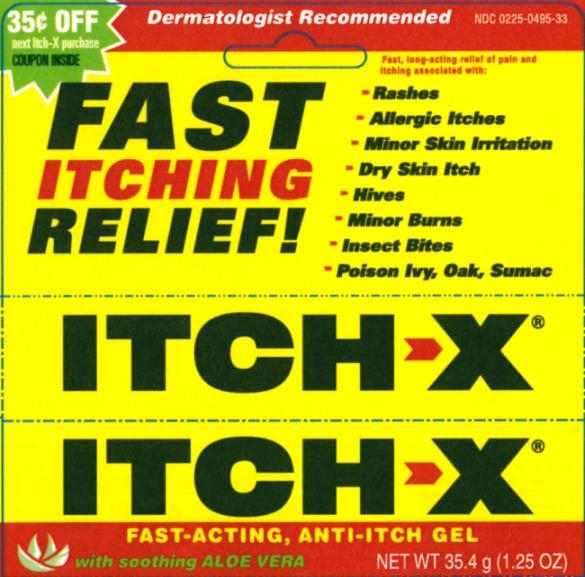
Itch X Benzyl ALCOHOL/PRAMOXINE Hydrochloride 10 g/100g; 1 g/100g Gel, 35.4 g — NDC 0225-0495-33 (Billing 00225-0495-33)
This is a package of 35.4 g of Itch X Benzyl ALCOHOL/PRAMOXINE Hydrochloride 10 g/100g; 1 g/100g Gel from BF ASCHER AND CO INC, marketed since Sep 2014 and currently FDA-listed; retail pharmacies pay about $0.0816 per g (NADAC). It is this product's only package size.
Identity & classification
Regulatory identifiers FDA, NLM and CMS codes for this package
Drug-database identifiers Medi-Span GPI and First Databank GCN / HICL / AHFS classification
- GSN (GCN sequence number): 014190
- GCN: 85140
- GPI-14 (Medi-Span): 90859902924020
- HICL (First Databank): 005169
- AHFS class code: 84:08.00.00
- RxCUI (RxNorm): 1293632
Where does this data come from?
- FDA openFDA NDC Directory · synced Oct 1, 2026
- FDA label on DailyMed · label index refreshed Oct 1, 2026
- RxNorm (NLM RxNav) · catalog refreshed Oct 1, 2026
- Medi-Span GPI (licensed)
- First Databank (licensed) · refreshed Oct 1, 2026
RxNorm drug class
This medicine belongs to the Pediculicide class.
Where does this data come from?
- RxClass (NLM) · catalog refreshed Oct 1, 2026
Clinical
Benzyl alcohol lotion is used to treat head lice (small insects that attach themselves to the skin) in adults and children 6 months of age and older. It should not be used in children less than 6 months of age. Benzyl alcohol is in a class of medications called pediculicides. It works by killing the lice. Benzyl alcohol lotion will not kill lice eggs, so the medication must be used a second time to kill the lice that may hatch from these eggs.
Read the full MedlinePlus article ↗Itch X is a topical gel containing benzyl alcohol and pramoxine hydrochloride, marketed as an over-the-counter monograph product. Benzyl alcohol is commonly used in products meant to treat head lice and similar parasitic infestations of the skin and scalp. Pramoxine hydrochloride is a local anesthetic typically used to reduce itching and discomfort associated with skin irritation. Together, these ingredients are formulated to address itching and related symptoms of lice infestation when applied directly to affected areas.
Patient education
Supplement & herbal interactions
Where does this data come from?
- MedlinePlus (NLM) · refreshed Oct 1, 2026
- FDA label on DailyMed · label index refreshed Oct 1, 2026
Ask a licensed pharmacist directly — free, answered by our team.
Pricing
A drug doesn't have one price. Each row is a different public payment system, and none is what you'd pay at the counter — that depends on your insurance. The ⓘ on each row explains what it measures.
| Price system | Per g | Per package |
|---|---|---|
| Retail pharmacies payNADAC · weekly | $0.082 | $2.89 / 35.4 g |
| Medicaid paysCMS SDUD · 12 mo | No recent Medicaid claims on file for this NDC — rare and low-volume NDCs are suppressed in the public data. | |
| Medicare drug plans payPart D · quarterly | No Part D plan price is available for this NDC in our data. | |
Where does this data come from?
- CMS NADAC weekly file · file of Nov 23, 2022
- CMS ASP pricing files · refreshed Sep 20, 2026
- CMS Medicaid State Drug Utilization Data · refreshed Oct 2, 2026
- CMS Part D plan pricing files · refreshed Sep 24, 2026
- VA National Acquisition Center price file
Packaging — all sizes for this product
| Package NDC | Description | Marketing start | Marketing end | Status |
|---|---|---|---|---|
| 00225-0495-33 You're viewing this Main listing | 35.4 g in 1 TUBE | 2014-09-19 | — | Active |
Therapeutic equivalents
| Product | Labeler | Pack | NADAC/unit | TE | Status | Price vs. this |
|---|---|---|---|---|---|---|
| Itch X 10 g/100g; 1 g/100gthis 00225-0495-33 | BF | 35.4 g | $0.082 | — | FDA listed | — |
Where does this data come from?
- FDA openFDA NDC Directory · synced Oct 1, 2026
- FDA Orange Book · refreshed Sep 3, 2026
- CMS NADAC weekly file · file of Nov 23, 2022
Availability & generic status
We did not find an FDA-approved generic match for this exact strength, form and route.
Where does this data come from?
- FDA Orange Book · refreshed Sep 3, 2026
Inactive Ingredients / Excipients
Inactive ingredients, also called excipients, are components of the drug product other than the active ingredient. They may include fillers, dyes, coatings, preservatives, flavors, or other formulation ingredients.
💡 Tap an ingredient (hover on desktop) to see what it is and why it’s used.
-
UNII 3K9958V90M
A liquid solvent derived from fermentation or chemical synthesis. In medicines, alcohol dissolves active ingredients, helps preserve the product, and improves how the body absorbs certain drugs.
-
UNII V5VD430YW9
A plant-derived substance from the aloe vera leaf. Used in medicines as a natural flavor, skin-soothing agent in topical products, and sometimes as a mild laxative ingredient in oral formulations.
-
UNII 3XUS85K0RA
Butylene glycol is a clear liquid derived from petroleum or plants that acts as a humectant, solvent, and preservative booster in medicines. It helps keep formulations stable, dissolve active ingredients, and maintain moisture in topical products.
-
UNII Z135WT9208
Carbomer is a synthetic polymer that forms a thick, gel-like consistency. It's used in medicines as a thickener and stabilizer to improve texture and keep ingredients evenly mixed throughout the product.
-
UNII 2968PHW8QP
A weak organic acid derived from citrus fruits or made through fermentation. It works as a buffer to control pH, a preservative to extend shelf life, and a flavoring agent in medications.
-
UNII H5RIZ3MPW4
A chemical preservative used to prevent bacterial and fungal growth in medicines. It helps extend shelf life and maintain product safety during storage and use.
-
UNII Q4R969U9FR
A chelating agent derived from ethylenediamine, used in formulations to bind metal ions and prevent oxidation, helping preserve the medicine's stability and potency over time.
-
UNII H3R47K3TBD
FD&C Blue No. 1 is a synthetic blue dye approved for use in foods and medicines. It serves as a colorant to give the medication its distinctive appearance and help with product identification.
-
UNII 603P14DHEB
A synthetic antimicrobial chemical used as a preservative in topical and cosmetic formulations. It prevents bacterial and fungal growth in products to maintain stability and safety during storage and use.
-
UNII 1VPU26JZZ4
Potassium sorbate is a salt derived from sorbic acid, a naturally occurring preservative. It prevents growth of mold, yeast, and some bacteria, extending the medicine's shelf life.
-
UNII OJ245FE5EU
Sodium benzoate is a salt derived from benzoic acid, a preservative. It's added to medicines to prevent growth of bacteria, fungi, and other microorganisms that could spoil the product.
-
UNII VTK01UQK3G
Sodium sulfite is a salt preservative derived from sulfur. It prevents discoloration and microbial growth in medicines, helping keep products stable during storage.
-
UNII PA4J9TF5U2
A synthetic polymer made from styrene and acrylic compounds. It acts as a film-former and binder in tablets and capsules, helping hold ingredients together and control how quickly the medicine releases into your body.
-
UNII 059QF0KO0R
Water is a liquid solvent that dissolves and mixes ingredients together in liquid medicines, syrups, and injections. It helps distribute the active drug evenly throughout the product.
14 inactive ingredients listed in the exact product block matched to this NDC.
Label-section wording can be broader than the structured product block and may mention additional formulation ingredients.
Where does this data come from?
ingredient classCode="IACT" elements from the exact product block matched by this NDC. Label-section narrative from DailyMed / the openFDA label index is shown separately when available.- FDA label on DailyMed · label index refreshed Oct 1, 2026
- FDA openFDA NDC Directory · synced Oct 1, 2026
Inactive ingredient FAQ
Are inactive ingredients the same for every manufacturer?
Why might an inactive ingredient be missing?
Can inactive ingredients matter?
Manufacturer & labeler
Where does this data come from?
- FDA openFDA NDC Directory · synced Oct 1, 2026
- Drugs@FDA
FDA label — Drug Facts FDA SPL
🎯 Indications and Usage ▾
Use Temporarily relieves pain and itching associated with insect bites, minor burns, sunburn, minor cuts, scrapes, minor skin irritations, hives and rashes due to poison ivy, poison oak, or poison sumac
⏱️ Dosage and Administration ▾
Directions adults and children 2 years and older - apply to affected area not more than 3 or 4 times daily children under 2 years - consult a physician
⚠️ Warnings ▾
Warnings For external use only. Avoid contact with eyes.
📦 Storage and Handling ▾
Other information store at 59°-86° F (15°-30° C) in a dry place mfd. in the USA for B.F. Ascher & Co., Inc.
🧪 Active Ingredient ▾
Active ingredients......................................Purpose Benzyl alcohol 10%......................................Topical analgesic Pramoxine hydrochloride 1%.......................Topical analgesic
🧪 Inactive Ingredients ▾
Inactive ingredients: aloe barbadensis leaf juice (aloe vera gel), blue 1, butylene glycol, carbomer, citric acid, diazolidinyl urea, iodopropynyl butylcarbamate, potassium sorbate, SD alcohol 40, sodium benzoate, sodium sulfite, styrene/acrylates copolymer, tetrahydroxypropyl ethylenediamine, and water
🎯 Purpose ▾
Use Temporarily relieves pain and itching associated with insect bites, minor burns, sunburn, minor cuts, scrapes, minor skin irritations, hives and rashes due to poison ivy, poison oak, or poison sumac