
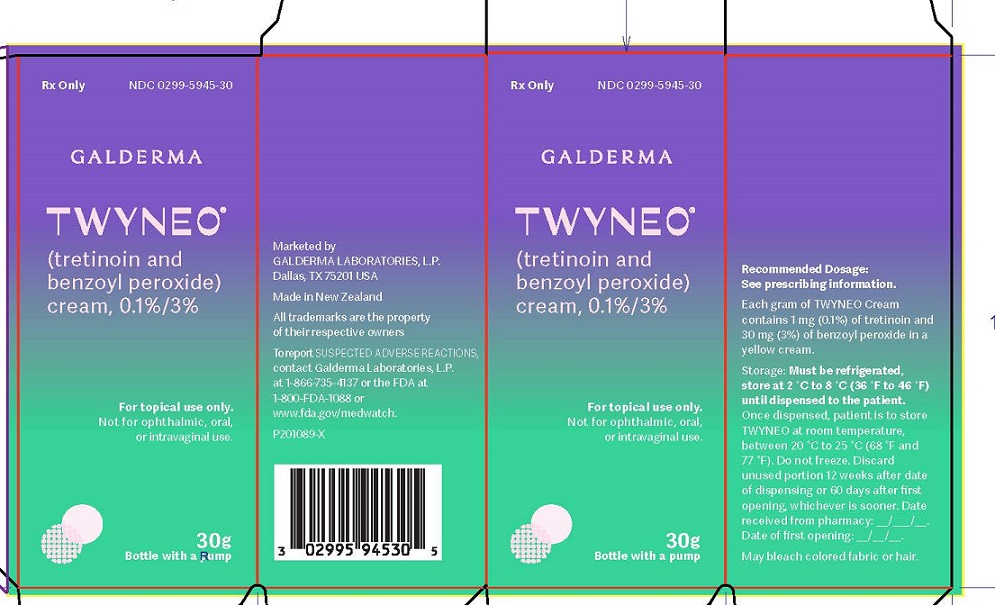
Twyneo tretinoin and benzoyl peroxide 1 mg/g; 30 mg/g Cream, 6 g — NDC 0299-5945-00 (Billing 00299-5945-00)
This is a package of 6 g of Twyneo tretinoin and benzoyl peroxide 1 mg/g; 30 mg/g Cream from Galderma Laboratories, L.P., marketed since Mar 2022 and currently FDA-listed.
Identity & classification
Regulatory identifiers FDA, NLM and CMS codes for this package
Drug-database identifiers Medi-Span GPI and First Databank GCN / HICL / AHFS classification
- GSN (GCN sequence number): 082535
- GCN: 49985
- GPI-14 (Medi-Span): 90059902853720
- HICL (First Databank): 047506
- AHFS class code: 84:04.04.00
- RxCUI (RxNorm): 2565807
Where does this data come from?
- FDA openFDA NDC Directory · synced Oct 1, 2026
- FDA label on DailyMed · label index refreshed Oct 1, 2026
- RxNorm (NLM RxNav) · catalog refreshed Oct 1, 2026
- Medi-Span GPI (licensed)
- First Databank (licensed) · refreshed Oct 1, 2026
RxNorm drug class
This medicine belongs to the Retinoid class.
Where does this data come from?
- RxClass (NLM) · catalog refreshed Oct 1, 2026
Clinical
Benzoyl peroxide is used to treat mild to moderate acne.
Read the full MedlinePlus article ↗- Twyneo is a cream for acne vulgaris, the common type of acne. It's approved for adults and children 9 and older. It combines tretinoin and benzoyl peroxide, which work in different...
- Apply a thin layer to the affected areas once a day on clean, dry skin. Keep it away from your eyes, lips, the creases beside your nose, and the inside of your mouth or nose. Wash...
- Stinging, burning, dryness, peeling, redness and itching where you apply it are the most common. These tend to peak in the first couple of weeks and then ease. If irritation is bot...
- Stop right away and get medical help if you notice swelling of your face, lips or throat, hives, or trouble breathing. These can be signs of a serious allergic reaction. Also stop...
Patient education
Supplement & herbal interactions
Where does this data come from?
- MedlinePlus (NLM) · refreshed Oct 1, 2026
- FDA label on DailyMed · label index refreshed Oct 1, 2026
Ask a licensed pharmacist directly — free, answered by our team.
Pricing
A drug doesn't have one price. Each row is a different public payment system, and none is what you'd pay at the counter — that depends on your insurance. The ⓘ on each row explains what it measures.
| Price system | Per g | Per package |
|---|---|---|
| Retail pharmacies payNADAC · weekly | Not in the retail survey — common for institutional, discontinued, or low-volume packs. | |
| Medicaid paysCMS SDUD · 12 mo | No recent Medicaid claims on file for this NDC — rare and low-volume NDCs are suppressed in the public data. | |
| Medicare drug plans payPart D · quarterly | No Part D plan price is available for this NDC in our data. | |
Where does this data come from?
- CMS NADAC weekly file
- CMS ASP pricing files · refreshed Sep 20, 2026
- CMS Medicaid State Drug Utilization Data · refreshed Oct 2, 2026
- CMS Part D plan pricing files · refreshed Sep 24, 2026
- VA National Acquisition Center price file
Packaging — all sizes for this product
| Package NDC | Description | Per unit | Per pack | Marketing start | Marketing end | Status |
|---|---|---|---|---|---|---|
| 00299-5945-00 You're viewing this | 6 g in 1 TUBE | — | — | 2022-03-15 | — | Active |
| 00299-5945-30 0299-5945-30 Main listing | 1 BOTTLE, PUMP in 1 BOX / 30 g in 1 BOTTLE, PUMP | $31.66 / g | $949.70 | 2022-03-15 | — | Active |
| 00299-5945-05 0299-5945-05 | 30 g in 1 BOTTLE, PUMP | — | — | 2023-07-11 | — | Active |
Pack size FAQ
What quantity is in this package?
How does this package differ from NDC 00299-5945-05?
What NDC number is used to bill for this package of Twyneo tretinoin and benzoyl peroxide 1 mg/g; 30 mg/g Cream?
Prices are the latest CMS NADAC pharmacy acquisition cost per NDC; per-pack figures are per-unit × pack quantity, shown only when the pack is denominated in the same measure NADAC prices.
Therapeutic equivalents
| Product | Labeler | Pack | NADAC/unit | TE | Status | Price vs. this |
|---|---|---|---|---|---|---|
| Twyneo 30 mg/g; 1 mg/g 51862-0771-30 | Mayne | 1 bottle | $31.657 | — | Availability likely | — |
| Twyneo 1 mg/g; 30 mg/gthis 00299-5945-00 | Galderma | 6 g | — | — | FDA listed | — |
Where does this data come from?
- FDA openFDA NDC Directory · synced Oct 1, 2026
- FDA Orange Book · refreshed Sep 3, 2026
- CMS NADAC weekly file
Availability & generic status
We did not find an FDA-approved generic match for this exact strength, form and route. Patent/protection dates below may affect future generic timing.
Why the date isn’t exact: Generic timing can change because patents may be challenged, settled, licensed, added, removed, or worked around with a narrower label — and FDA approval does not always mean a pharmacy can get the generic today.
🛈 What do these terms mean?
- Patent
- Legal protection listed in the Orange Book that may delay generic approval or launch. Issued by the U.S. Patent & Trademark Office.
- Substance patent
- Covers the active drug molecule itself — the hardest to design around. A generic generally can’t launch until it expires.
- Formulation (product) patent
- Covers a specific formulation or dosage form. A generic can sometimes work around it with a different formulation.
- Method-of-use patent
- A patent covering one specific approved use of the drug — not necessarily the whole molecule. A generic can sometimes launch with a “skinny label” that carves out the protected use and keeps the others.
- Skinny label
- A generic label that omits a still-patented use when the FDA allows it — letting a generic reach the market for the unprotected uses.
- Exclusivity
- FDA-granted marketing protection, separate from patents — e.g. 5-yr new chemical entity, 7-yr orphan drug, or a +6-month pediatric extension.
- Paragraph IV
- A generic applicant’s formal challenge to a listed patent. It can potentially lead to earlier generic entry, but often involves litigation or a settlement.
- RLD / RS
- Reference Listed Drug — the brand product the FDA uses as the reference for generic applications. Reference Standard — the product the FDA expects generics to compare against in bioequivalence testing.
- TE / AB rating
- FDA therapeutic-equivalence rating. An AB rating generally means the FDA considers a generic therapeutically equivalent to — and substitutable for — the brand.
- LOE (loss of exclusivity)
- The latest patent or exclusivity currently listed — the loss-of-exclusivity / latest-listed-protection date shown on this page. Paragraph-IV challenges and settlements can move the real date earlier; FDA approval and a manufacturer’s decision to market can move it later.
Built from the FDA Orange Book. The bars above are scaled to each protection’s expiry; the red LOE marker is the last one to lapse.
| Patent | Type | Use code | Expires |
|---|---|---|---|
| US 12295935 ↗ | Method of use | U-3987 | Dec 27, 2040 |
| US 12357602 ↗ | Method of use | U-3987 | Jul 12, 2038 |
| US 12257348 ↗ | Method of use | U-3987 | May 23, 2041 |
| US 12491163 ↗ | Method of use | U-3987 | May 23, 2041 |
| US 9868103 ↗ | Method of use | U-3194 | Aug 8, 2028 |
| US 10420743 ↗ | Method of use | U-3194 | Jul 12, 2038 |
| US 10653899 ↗ | Method of use | U-3194 | Dec 30, 2030 |
| US 12070629 ↗ | Method of use | U-3987 | Dec 30, 2030 |
| US 12133919 ↗ | Method of use | U-3987 | May 23, 2041 |
| US 12053546 ↗ | Drug product | — | Jun 29, 2032 |
| US 8617580 ↗ | Drug product | — | Feb 3, 2028 |
| US 11071878 ↗ | Drug product | — | Dec 30, 2030 |
| US 12156946 ↗ | Drug product | — | Feb 3, 2028 |
Is there a generic version of TWYNEO 0.1%-3% CREAM PUMP?
The FDA approved a generic — why can’t I get it at my pharmacy yet?
Why do different websites show different generic release dates?
What does “FDA listed” mean?
What does a patent or protection date mean here?
What does “current Orange Book estimate” mean?
Can a generic come out before the last patent expires?
Can a generic come out after the listed dates?
What is the difference between patents and exclusivity?
Why are there multiple patent dates?
Where does this data come from?
- FDA Orange Book · refreshed Sep 3, 2026
Inactive Ingredients / Excipients
Inactive ingredients, also called excipients, are components of the drug product other than the active ingredient. They may include fillers, dyes, coatings, preservatives, flavors, or other formulation ingredients.
Where does this data come from?
IACT rows and label-wide narrative are kept separate; availability and product-level specificity depend on the submitted label.- FDA label on DailyMed · label index refreshed Oct 1, 2026
- FDA openFDA NDC Directory · synced Oct 1, 2026
Inactive ingredient FAQ
Are inactive ingredients the same for every manufacturer?
Why might an inactive ingredient be missing?
Can inactive ingredients matter?
Manufacturer & labeler
Where does this data come from?
- FDA openFDA NDC Directory · synced Oct 1, 2026
- Drugs@FDA
Full prescribing information FDA SPL
🎯 Indications and Usage ▾
1 INDICATIONS AND USAGE TWYNEO is indicated for the topical treatment of acne vulgaris in adults and pediatric patients 9 years of age and older. TWYNEO is a combination tretinoin, a retinoid, and benzoyl peroxide indicated for the topical treatment of acne vulgaris in adults and pediatric patients 9 years of age and older. ( 1 )
⏱️ Dosage and Administration ▾
2 DOSAGE AND ADMINISTRATION Apply a thin layer of TWYNEO to the affected areas once daily on clean and dry skin. Avoid contact with the eyes, lips, paranasal creases, and mucous membranes. Wash hands after application.
TWYNEO is for topical use only. TWYNEO is not for oral, ophthalmic, or intravaginal use. Apply a thin layer of TWYNEO to the affected areas once daily.
( 2 ) Avoid contact with eyes, lips, paranasal creases, and mucous membranes. ( 2 ) Wash hand after application. ( 2 ) Not for oral, ophthalmic, or intravaginal use.
( 2 )
💊 Dosage Forms and Strengths ▾
3 DOSAGE FORMS AND STRENGTHS Cream, 0.1%/3%: Each gram of TWYNEO contains 1mg (0.1%) of tretinoin and 30 mg (3%) of benzoyl peroxide in a yellow cream in a 30-gram bottle with a pump. Cream , 0.1% tretinoin/3% benzoyl peroxide ( 3 )
⛔ Contraindications ▾
4 CONTRAINDICATIONS TWYNEO is contraindicated in patients with a history of hypersensitivity reaction to benzoyl peroxide or any components of TWYNEO [see Warnings and Precautions (5.1) ] . History of serious hypersensitivity reaction to benzoyl peroxide or any component of TWYNEO. ( 4 )
⚠️ Warnings and Cautions ▾
5 WARNINGS AND PRECAUTIONS Hypersensitivity: Severe hypersensitivity reactions, including anaphylaxis and angioedema, have been reported with use of benzoyl peroxide products. ( 4 , 5.1 ) Skin Irritation: Pain, dryness, exfoliation, erythema, and irritation may occur with use of TWYNEO. Avoid application of TWYNEO to cuts abrasions, eczematous or sunburned skin.
( 5.2 ) Photosensitivity : Minimize unprotected exposure to sunlight and sunlamps. Use sunscreen and protective clothing when sun exposure cannot be avoided. ( 5.3 )
5.1Hypersensitivity Hypersensitivity reactions, including anaphylaxis, angioedema, and urticaria, have been reported with the use of benzoyl peroxide products. If a serious hypersensitivity reaction occurs, discontinue TWYNEO immediately and initiate appropriate therapy.
5.2Skin Irritation Patients using TWYNEO may experience application site dryness, pain, exfoliation, erythema, dermatitis, pruritis, and irritation [ see Adverse Reactions (6.1) ]. Depending upon the severity of these adverse reactions, instruct patients to use a moisturizer, reduce the frequency of the application of TWYNEO, or discontinue use. Avoid application of TWYNEO to cuts, abrasions, eczematous, or sunburned skin.
5.3Photosensitivity TWYNEO may increase sensitivity to ultraviolet light. Minimize or avoid exposure to natural or artificial sunlight (tanning beds or UVA/B treatment) while using TWYNEO. Instruct patients to implement sun protection measures (e.g., sunscreen and loose-fitting clothes) when sun exposure cannot be avoided. Discontinue TWYNEO at the first evidence of sunburn.
🤒 Adverse Reactions ▾
6 ADVERSE REACTIONS The most common adverse reactions (incidence ≥ 1%) are pain, dryness, exfoliation erythema, dermatitis, pruritus and irritation (all at the application site). ( 6.1 ) To report SUSPECTED ADVERSE REACTIONS, contact Galderma Laboratories, L.P. at 1-866-735-4137 or FDA at 1-800-FDA-1088 or www.fda.gov/medwatch.
6.1Clinical trials experience The following adverse reactions are discussed in greater detail elsewhere in the labeling: Hypersensitivity [see Warnings and Precautions (5.1 )] Skin Irritation [see Warnings and Precautions (5.2) ] Because clinical trials are conducted under widely varying conditions, adverse reaction rates are observed in the clinical trials of a drug cannot be directly compared to rates in the clinical trials of another drug and may not reflect the rates observed in practice. In two multicenter, randomized, double-blind, vehicle-controlled trials (Trial 1 and 2), 832 subjects 9 years of age and older with facial acne vulgaris applied TWYNEO (N=555) or vehicle (N=277) daily for 12 weeks.
The majority of subjects were White (73%) and female (59%). Approximately 33% were Hispanic/Latino, and 46% were younger than 18 years of age. Adverse reactions reported in ≥ 1.0% of subjects treated with TWYNEO (and for which the rate exceeded the rate for vehicle), as well as the corresponding rates reported in subjects treated with vehicle are presented in Table 1 .
Table 1: Adverse Reactions Reported by ≥ 1% of Subjects with Facial Acne Vulgaris Treated with TWYNEO and More Frequently than Vehicle in Trials 1 and 2 TWYNEO Cream (N = 555) n (%) Vehicle Cream (N = 277) n (%) Application Site Pain* 59 (10.6) 1 (0.4) Application Site Dryness 27 (4.9) 1 (0.4) Application Site Exfoliation 23 (4.1) 0 Application Site Erythema 22 (4.0) 0 Application Site Dermatitis 7 (1.3) 1 (0.4) Application Site Pruritus 7 (1.3) 0 Application Site Irritation 6 (1.1) 1 (0.4) * Application site pain defined as application site stinging, burning or pain.
Local tolerability evaluations were conducted at each study visit in the clinical trial by assessment of erythema, scaling, pigmentation, dryness, itching, burning and stinging. Table 2 presents the active assessment of the signs and symptoms of local facial tolerability at Week 12 in subjects treated with TWYNEO. Table 2.
Facial Cutaneous Tolerability Assessment at Week 12 in Subjects with Acne Vulgaris Treated with TWYNEO TWYNEO (N=494*) (%) Vehicle (N = 264*) (%) Mild Moderate Severe Mild Moderate Severe Erythema 33.0 6.9 0.2 26.9 8.0 0 Pigmentation 27.3 6.3 0.4 26.5 4.5 0 Dryness 22.3 5.3 0.4 16.7 2.3 0 Scaling 16.4 2.6 0 12.9 0.8 0 Burning 5.9 2.2 0 3.4 0.8 0 Itching 11.1 1.8 0 8.7 2.7 0 Stinging 5.3 0.2 0 1.9 1.1 0 * The denominators for calculating the percentages were 494 of 555 subjects treated with TWYNEO and 264 of 277 subjects treated with vehicle in these trials who had cutaneous signs and local tolerability results reported at Week 12.
Local tolerability scores for erythema, scaling, dryness, itching, burning and stinging rose during the first two weeks of treatment and decreased thereafter.
6.2Postmarketing Experience The following adverse reactions have been identified during use of benzoyl peroxide. Because these reactions are reported voluntarily from a population of uncertain size, it is not always possible to reliably estimate their frequency or establish a causal relationship to drug exposure. Immune System Disorders: Anaphylaxis, angioedema and urticaria
👥 Use in Specific Populations ▾
8 USE IN SPECIFIC POPULATIONS
8.1Pregnancy Risk Summary Available data from published observational studies of topical tretinoin in pregnant women have not established a drug-associated risk of major birth defects, miscarriage, or adverse maternal or fetal outcomes. Studies conducted with topical benzoyl peroxide have not demonstrated systemic absorption and maternal use is not expected to result in fetal exposure to benzoyl peroxide. There are no data on TWYNEO use in pregnant women.
There are reports of major birth defects reported with maternal use of topical tretinoin similar to those seen in infants exposed to oral retinoids, but these case reports do not establish a pattern or association with tretinoin-related embryopathy ( see Data ). Animal reproductive studies have not been conducted with TWYNEO or benzoyl peroxide. Topical administration of tretinoin to pregnant rats during organogenesis was associated with malformations (craniofacial abnormalities [hydrocephaly], asymmetrical thyroids, variations in ossification, and increased supernumerary ribs) at doses greater than 1 mg tretinoin/kg/day, approximately 5 times the maximum recommended human dose (MRHD) based on body surface area (BSA) comparison and assuming 100% absorption.
Oral administration of tretinoin to pregnant cynomolgus monkeys during organogenesis was associated with malformations at 10 mg/kg/day (approximately 100 times the MRHD based on BSA comparison and assuming 100% absorption) ( see Data ). The background risk of major birth defects and miscarriage for the indicated population is unknown. All pregnancies have a background risk of major birth defects, loss and other adverse outcomes.
The background risk in the U.S. general population of major birth defects is 2 to 4% of miscarriage is 15 to 20% of clinically recognized pregnancies. Data Human Data While available studies cannot definitively establish the absence of risk, published data from multiple prospective controlled observational studies on the use of topical tretinoin products during pregnancy have not identified an association with topical tretinoin and major birth defects or miscarriage. The available studies have methodologic limitations, including small sample size and in some cases, lack of physical exam by an expert in birth defects.
There are published case reports of infants exposed to topical tretinoin during the first trimester that describe major birth defects similar to those seen in infants exposed to oral retinoids; however, no pattern of malformations has been identified and no causal association has been established in these cases. The significance of these spontaneous reports in terms of risk to the fetus is not known. Animal Data For purposes of comparison of the animal exposure to human exposure, the MRHD is defined as 1.5 g of TWYNEO (containing 0.1% tretinoin) applied daily to a 60-kg person (0.03 mg tretinoin/kg body weight).
Topical tretinoin embryofetal development studies have generated equivocal results. There is evidence for malformations (shortened or kinked tail) after topical tretinoin administration in Wistar rats at doses greater than 1 mg/kg/day (approximately 5 times the MHRD based on BSA comparison and assuming 100% absorption). Anomalies (humerus: short 13%, bent 6%, or parietal incompletely ossified 14%) have also been reported when 10 mg/kg/day (approximately 50 times the MRHD based on BSA comparison and assuming 100% absorption) was topically applied to pregnant rats during organogenesis.
Increased incidence of domed head and hydrocephaly, typical of retinoid-induced fetal malformations were noted in New Zealand White rabbits administered topical doses greater than 0.2 mg/kg/day (2.2 times the MRHD based on BSA comparison and assuming 100% absorption). Oral tretinoin induced malformations in rats, mice, hamsters, and nonhuman primates when administered during the period of organogenesis. Fetal malformations were observed when tretinoin was orally admin…
🤰 Pregnancy ▾
8.1Pregnancy Risk Summary Available data from published observational studies of topical tretinoin in pregnant women have not established a drug-associated risk of major birth defects, miscarriage, or adverse maternal or fetal outcomes. Studies conducted with topical benzoyl peroxide have not demonstrated systemic absorption and maternal use is not expected to result in fetal exposure to benzoyl peroxide. There are no data on TWYNEO use in pregnant women.
There are reports of major birth defects reported with maternal use of topical tretinoin similar to those seen in infants exposed to oral retinoids, but these case reports do not establish a pattern or association with tretinoin-related embryopathy ( see Data ). Animal reproductive studies have not been conducted with TWYNEO or benzoyl peroxide. Topical administration of tretinoin to pregnant rats during organogenesis was associated with malformations (craniofacial abnormalities [hydrocephaly], asymmetrical thyroids, variations in ossification, and increased supernumerary ribs) at doses greater than 1 mg tretinoin/kg/day, approximately 5 times the maximum recommended human dose (MRHD) based on body surface area (BSA) comparison and assuming 100% absorption.
Oral administration of tretinoin to pregnant cynomolgus monkeys during organogenesis was associated with malformations at 10 mg/kg/day (approximately 100 times the MRHD based on BSA comparison and assuming 100% absorption) ( see Data ). The background risk of major birth defects and miscarriage for the indicated population is unknown. All pregnancies have a background risk of major birth defects, loss and other adverse outcomes.
The background risk in the U.S. general population of major birth defects is 2 to 4% of miscarriage is 15 to 20% of clinically recognized pregnancies. Data Human Data While available studies cannot definitively establish the absence of risk, published data from multiple prospective controlled observational studies on the use of topical tretinoin products during pregnancy have not identified an association with topical tretinoin and major birth defects or miscarriage. The available studies have methodologic limitations, including small sample size and in some cases, lack of physical exam by an expert in birth defects.
There are published case reports of infants exposed to topical tretinoin during the first trimester that describe major birth defects similar to those seen in infants exposed to oral retinoids; however, no pattern of malformations has been identified and no causal association has been established in these cases. The significance of these spontaneous reports in terms of risk to the fetus is not known. Animal Data For purposes of comparison of the animal exposure to human exposure, the MRHD is defined as 1.5 g of TWYNEO (containing 0.1% tretinoin) applied daily to a 60-kg person (0.03 mg tretinoin/kg body weight).
Topical tretinoin embryofetal development studies have generated equivocal results. There is evidence for malformations (shortened or kinked tail) after topical tretinoin administration in Wistar rats at doses greater than 1 mg/kg/day (approximately 5 times the MHRD based on BSA comparison and assuming 100% absorption). Anomalies (humerus: short 13%, bent 6%, or parietal incompletely ossified 14%) have also been reported when 10 mg/kg/day (approximately 50 times the MRHD based on BSA comparison and assuming 100% absorption) was topically applied to pregnant rats during organogenesis.
Increased incidence of domed head and hydrocephaly, typical of retinoid-induced fetal malformations were noted in New Zealand White rabbits administered topical doses greater than 0.2 mg/kg/day (2.2 times the MRHD based on BSA comparison and assuming 100% absorption). Oral tretinoin induced malformations in rats, mice, hamsters, and nonhuman primates when administered during the period of organogenesis. Fetal malformations were observed when tretinoin was orally administered to pregnant Wistar rat…
🧒 Pediatric Use ▾
8.4Pediatric Use The safety and effectiveness of TWYNEO for the topical treatment of acne vulgaris have been established in pediatric patients 9 years of age and older based on evidence from two multicenter, randomized, double-blind, parallel-group, vehicle-controlled, 12-week clinical trials and an open-label pharmacokinetic study. A total of 283 pediatric subjects 9 years of age and older received TWYNEO in the clinical studies [ see Clinical Pharmacology (12.3) and Clinical Studies (14) ]. The safety and effectiveness of TWYNEO in pediatric patients below 9 years of age have not been established.
🧓 Geriatric Use ▾
8.5Geriatric Use Clinical trials of TWYNEO did not include sufficient numbers of subjects 65 years of age and older to determine whether they respond differently than younger subjects.
🧬 Clinical Pharmacology ▾
12 CLINICAL PHARMACOLOGY
12.1Mechanism of Action Benzoyl peroxide is an oxidizing agent with bactericidal and keratolytic effects, but the precise mechanism of action is unknown. Tretinoin is a metabolite of vitamin A that binds with high affinity to specific retinoic acid receptors located in both the cytosol and nucleus. Tretinoin activates three members of the retinoic acid (RAR) nuclear receptors (RARα , RARß, RARγ) which act to modify gene expression, subsequent protein synthesis, and epithelial cell growth and differentiation.
It has not been established whether the clinical effects of tretinoin are mediated through activation of retinoic acid receptors, and/or other mechanisms. Although the exact mode of action of tretinoin in acne treatment is unknown, current evidence suggests that topical tretinoin decreases cohesiveness of follicular epithelial cells with decreased microcomedo formation. Additionally, tretinoin stimulates mitotic activity and increased turnover of follicular epithelial cells causing extrusion of the comedones.
12.2Pharmacodynamics Pharmacodynamics of TWYNEO in the treatment of acne vulgaris are unknown.
12.3Pharmacokinetics The systemic exposure of benzoyl peroxide was not assessed. Benzoyl peroxide is absorbed by skin where it is converted to benzoic acid and eliminated in the urine. Plasma concentrations of tretinoin and its major metabolites were evaluated in 35 subjects in an open-label, randomized, pharmacokinetic (PK) study.
Subjects 9 years of age and older with acne vulgaris applied a mean dose of 1.9 g TWYNEO to the skin of the face, shoulders, upper back and upper chest once daily for 14 days. Steady-state PK characteristics were determined from samples drawn on Day 14. The mean baseline corrected C max and AUC 0-24 of tretinoin and its metabolites after once daily application of TWYNEO for 14 days are provided in Table 3 .
No detectable levels of the metabolites all-trans 4-keto retinoic acid and 9-cis retinoid acid were found in subjects treated with TWYNEO. Table 3: Pharmacokinetics of Tretinoin and its Major Metabolites When Treated with TWYNEO in Subjects 9 Years of Age and Older With Acne Vulgaris for 14 Days Age Group (years) n Compound Mean(± SD) C max (ng/mL) Mean(± SD) AUC 0-24 (ng-h/mL) ≥ 18 years of age 12 tretinoin 0.15 ± 0.17 0.63 ± 0.95 4-keto 13-cis RA 0.27 ± 0.29 2.88 ± 3.61 13-cis RA 0.21 ± 0.19 1.99 ± 2.90 12 to 17 15 tretinoin 0.19 ± 0.18 1.56 ± 1.97 4-keto 13-cis RA 0.32 ± 0.28 2.39 ± 3.05 13-cis RA 0.28 ± 0.35 1.79 ± 2.79 9 to 11 8 tretinoin 0.18 ± 0.22 2.06 ± 3.96 4-keto 13-cis RA 0.34 ± 0.36 2.89 ± 3.17 13-cis RA 0.13 ± 0.09 0.96 ± 1.36
🧬 Mechanism of Action ▾
12.1Mechanism of Action Benzoyl peroxide is an oxidizing agent with bactericidal and keratolytic effects, but the precise mechanism of action is unknown. Tretinoin is a metabolite of vitamin A that binds with high affinity to specific retinoic acid receptors located in both the cytosol and nucleus. Tretinoin activates three members of the retinoic acid (RAR) nuclear receptors (RARα , RARß, RARγ) which act to modify gene expression, subsequent protein synthesis, and epithelial cell growth and differentiation.
It has not been established whether the clinical effects of tretinoin are mediated through activation of retinoic acid receptors, and/or other mechanisms. Although the exact mode of action of tretinoin in acne treatment is unknown, current evidence suggests that topical tretinoin decreases cohesiveness of follicular epithelial cells with decreased microcomedo formation. Additionally, tretinoin stimulates mitotic activity and increased turnover of follicular epithelial cells causing extrusion of the comedones.
📦 How Supplied / Storage and Handling ▾
16 HOW SUPPLIED/STORAGE AND HANDLING How Supplied TWYNEO (tretinoin and benzoyl peroxide) cream, 0.1%/3% is a yellow cream and is supplied as: 30-gram bottle with a pump, NDC 0299-5945-30 Storage and Handling Prior to Dispensing: Store TWYNEO between 2ºC to 8ºC (36ºF to 46ºF) until dispensed to the patient. After Dispensing: Store TWYNEO at room temperature between 20ºC to 25ºC (68ºF to 77ºF). Discard 12 weeks after date of dispensing or 60 days after first opening, whichever is sooner.
Do not freeze.
📦 Storage and Handling ▾
30-gram bottle with a pump, NDC 0299-5945-30 Storage and Handling Prior to Dispensing: Store TWYNEO between 2ºC to 8ºC (36ºF to 46ºF) until dispensed to the patient. After Dispensing: Store TWYNEO at room temperature between 20ºC to 25ºC (68ºF to 77ºF). Discard 12 weeks after date of dispensing or 60 days after first opening, whichever is sooner. Do not freeze.
📋 Description ▾
11 DESCRIPTION TWYNEO (tretinoin and benzoyl peroxide) cream is a yellow cream for topical use. Each gram of TWYNEO contains 1 mg (0.1%) of tretinoin and 30 mg (3%) of benzoyl peroxide. Tretinoin is a retinoid and benzoyl peroxide is an oxidizing agent.
The chemical name for tretinoin is all-trans-retinoic acid, also known as (all-E)-3,7-dimethyl-9-(2,6,6-trimethyl-1-cyclohexen-1-yl)-2,4,6,8-nonatetraenoic acid. Tretinoin has the following structural formula: Molecular Formula: C 20 H 28 O 2 Molecular Weight: 300.44 The chemical name for benzoyl peroxide is benzoyl benzenecarboperoxoate. Benzoyl peroxide has the following structural formula: Molecular Formula: C 14 H 10 O 4 Molecular Weight: 242.23 The formulation of TWYNEO uses silica (silicon dioxide) core shell structures to separately micro-encapsulate tretinoin crystals and benzoyl peroxide crystals enabling inclusion of the two active ingredients in the.
TWYNEO contains the following inactive ingredients: anhydrous citric acid, butylated hydroxytoluene, carbomer homopolymer type C, cetrimonium chloride, cetyl alcohol, cyclomethicone, edetate disodium, glycerin, hydrochloric acid, imidurea, (S)lactic acid, macrogol stearate, mono and di-glycerides, polyquaternium-7, purified water, silicon dioxide, sodium hydroxide, squalane, tetraethyl ortho silicate and white wax.
💬 Information for Patients ▾
17 PATIENT COUNSELING INFORMATION Advise the patient to read the FDA-approved patient labeling ( Patient Information ). Hypersensitivity Inform patients that serious hypersensitivity reactions have occurred with the use of benzoyl peroxide products. If a patient experiences a serious hypersensitivity reaction, instruct patient to discontinue TWYNEO immediately and seek medical help [ see Warnings and Precautions ( 5.1 ) ].
Skin Irritation Inform patients that TWYNEO may cause irritation such as erythema, dryness, stinging or burning. Advise the patient to use a moisturizer for irritation. [ see Warnings and Precautions ( 5.2 ) ]. Photosensitivity Advise patients to minimize unprotected exposure to sunlight and sunlamps; recommend the use of sunscreen products and protective apparel (e.g., hat) over treated areas when sun exposure cannot be avoided. [ see Warnings and Precautions ( 5.3 ) ].
Administration Instructions Advise patients to apply TWYNEO exactly as directed in a thin layer, avoiding the eyes, lips, paranasal creases and mucous membranes and to wash hands immediately after application. Inform patients that TWYNEO may bleach hair or colored fabric [ see Dosage and Administration ( 2 ) ]. Discard Instructions Instruct patients to store TWYNEO at room temperature and to discard 12 weeks after date of dispensing or 60 days after first opening, whichever is sooner. [ see How Supplied/Storage and Handling ( 16 ) ].
Medicaid utilization by pack size
Medicare Part D spend CMS · PART D · 2026 (Q1)
Reported adverse events (FAERS)
Top reported reactions
Age at onset
Reporter sex
Where does this data come from?
About this NDC listing & data coverage
What data is (and isn’t) available for this NDC — tap to expand
| NDC identity (package / product / labeler codes) | ✓ Available |
| Labeler | ✓ Available |
| Product & package description | ✓ Available |
| Marketing category & status | ✓ Available |
| Active ingredient / dosage form / route | ✓ Available |
| FDA label (SPL via DailyMed) | ✓ Available |
| Package photos | ✓ Available |
| Inactive ingredients (structured) | — Not published for this NDC The labeler did not submit a structured excipient list, or no SPL is available. |
| NADAC pharmacy acquisition price (CMS) | — Not published for this NDC CMS publishes NADAC only for NDCs reported in its retail-pharmacy survey. |
| Orange Book / therapeutic-equivalence data | ✓ Available |
| HCPCS J-code billing crosswalk | — Not published for this NDC Most self-administered / retail products have no J-code — that is normal. |
| Medicaid utilization (CMS SDUD) | — Not published for this NDC CMS reports utilization only for NDCs with Medicaid claims above its privacy threshold. |