
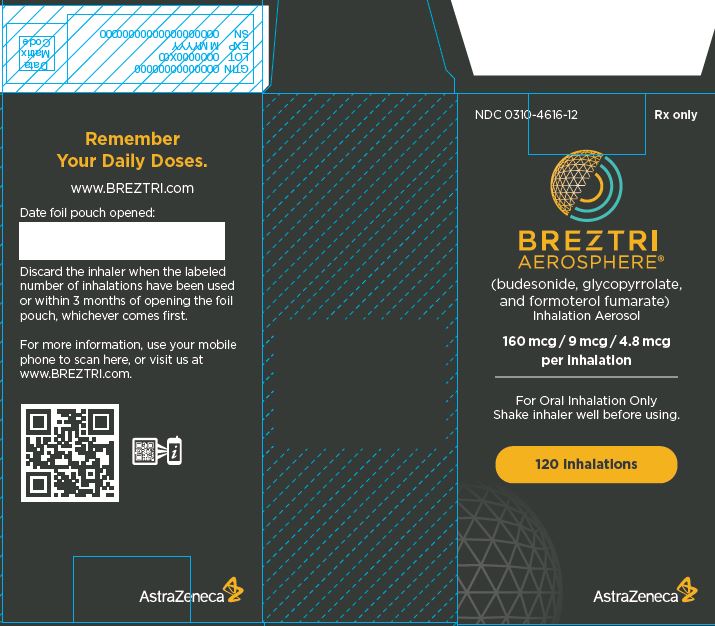
Breztri budesonide, glycopyrrolate, and formoterol fumarate 160 ug; 9 ug; 4.8 ug Aerosol, Metered, 120-count — NDC 0310-4616-12 (Billing 00310-4616-12)
This is a package of 120 aerosols of Breztri budesonide, glycopyrrolate, and formoterol fumarate 160 ug; 9 ug; 4.8 ug Aerosol, Metered from AstraZeneca Pharmaceuticals LP, marketed since Jul 2020 and currently FDA-listed; retail pharmacies pay about $61.30 per g (NADAC). It is the main listing for this product, which comes in 3 package sizes.
NDC database record
One package, one record: these facts belong to NDC 0310-4616-12 alone.
- Record
- FDA NDC Directory package listing · Human prescription drug
- Code segments
- 0310 labeler · 4616 product · 12 package
- Package marketed since
- Jul 23, 2020
- Sample package
- No — commercial package
- Listing certified through
- Dec 31, 2027
- Barcode (UPC-A, from the NDC)
- 3 0310461612 3
- Medicaid fills, this package
- 161,172 prescriptions in the last four reported quarters
- FDA record last changed
- Oct 8, 2026
Identity & classification
Regulatory identifiers FDA, NLM and CMS codes for this package
Drug-database identifiers Medi-Span GPI and First Databank GCN / HICL / AHFS classification
- GSN (GCN sequence number): 081351
- GCN: 48435
- GPI-14 (Medi-Span): 44209903303220
- HICL (First Databank): 046753
- AHFS class code: 48:12.04.12
- RxCUI (RxNorm): 2387326
Where does this data come from?
- FDA openFDA NDC Directory · synced Oct 8, 2026
- FDA label on DailyMed · label index refreshed Oct 8, 2026
- RxNorm (NLM RxNav) · catalog refreshed Oct 1, 2026
- Medi-Span GPI (licensed)
- First Databank (licensed) · refreshed Oct 8, 2026
RxNorm drug class
This medicine belongs to the Anticholinergic class.
Where does this data come from?
- RxClass (NLM) · catalog refreshed Oct 1, 2026
Clinical
Budesonide is used to prevent difficulty breathing, chest tightness, wheezing, and coughing caused by asthma. Budesonide powder for oral inhalation (Pulmicort Flexhaler) is used in adults and children 6 years of age and older. Budesonide suspension (liquid) for oral inhalation (Pulmicort Respules) is used in children 12 months to 8 years of age. Budesonide belongs to a class of medications called corticosteroids. It works by decreasing swelling and irritation in the airways to allow for easier breathing.
Read the full MedlinePlus article ↗Patient education
Supplement & herbal interactions
Where does this data come from?
- MedlinePlus (NLM) · refreshed Oct 8, 2026
- FDA label on DailyMed · label index refreshed Oct 8, 2026
Ask a licensed pharmacist directly — free, answered by our team.
Pricing
A drug doesn't have one price. Each row is a different public payment system, and none is what you'd pay at the counter — that depends on your insurance. The ⓘ on each row explains what it measures.
| Price system | Per g | Per package |
|---|---|---|
| Retail pharmacies payNADAC · weekly | $61.304 | — |
| Medicaid paysCMS SDUD · 12 mo | $60.18 | — |
| Medicare drug plans payPart D · Q2 2026 | $61.59 | — |
Where does this data come from?
- CMS NADAC weekly file · file of Oct 7, 2026
- CMS ASP pricing files · refreshed Sep 20, 2026
- CMS Medicaid State Drug Utilization Data · through Q1 2026
- CMS Part D plan pricing files · refreshed Sep 24, 2026
- VA National Acquisition Center price file
Packaging — all sizes for this product
| Package NDC | Description | Per unit | Per pack | Marketing start | Marketing end | Status |
|---|---|---|---|---|---|---|
| 00310-4616-12 You're viewing this Main listing | 120 AEROSOL, METERED in 1 INHALER | $61.30 / g | — | 2020-07-23 | — | Active |
| 00310-4616-28 0310-4616-28 | 28 AEROSOL, METERED in 1 INHALER Sample | — | — | 2020-07-23 | — | Active |
| 00310-4616-39 0310-4616-39 | 28 AEROSOL, METERED in 1 INHALER | $61.52 / g | — | 2020-07-23 | — | Active |
This pack has the lowest per-g cost of the 2 priced pack sizes ($61.30 NADAC).
In Medicaid, this is the most-dispensed pack of this product — about 100% of fills over the last four reported quarters. See all packs ↓
Pack size FAQ
What quantity is in this package?
How does this package differ from NDC 00310-4616-28?
What NDC number is used to bill for this package of Breztri budesonide, glycopyrrolate, and formoterol fumarate 160 ug; 9 ug; 4.8 ug Aerosol, Metered?
Prices are the latest CMS NADAC pharmacy acquisition cost per NDC; per-pack figures are per-unit × pack quantity, shown only when the pack is denominated in the same measure NADAC prices.
Therapeutic equivalents
| Product | Labeler | Pack | NADAC/unit | TE | Status | Price vs. this |
|---|---|---|---|---|---|---|
| Breztri 160 ug/1; 9 ug/1; 4.8 ugthis 00310-4616-12 | AstraZeneca | 120 aerosols | $61.304 | — | Availability likely | — |
Where does this data come from?
- FDA openFDA NDC Directory · synced Oct 8, 2026
- FDA Orange Book · refreshed Oct 3, 2026
- CMS NADAC weekly file · file of Oct 7, 2026
Availability & generic status
We did not find an FDA-approved generic match for this exact strength, form and route. Patent/protection dates below may affect future generic timing.
Why the date isn’t exact: Generic timing can change because patents may be challenged, settled, licensed, added, removed, or worked around with a narrower label — and FDA approval does not always mean a pharmacy can get the generic today.
🛈 What do these terms mean?
- Patent
- Legal protection listed in the Orange Book that may delay generic approval or launch. Issued by the U.S. Patent & Trademark Office.
- Substance patent
- Covers the active drug molecule itself — the hardest to design around. A generic generally can’t launch until it expires.
- Formulation (product) patent
- Covers a specific formulation or dosage form. A generic can sometimes work around it with a different formulation.
- Method-of-use patent
- A patent covering one specific approved use of the drug — not necessarily the whole molecule. A generic can sometimes launch with a “skinny label” that carves out the protected use and keeps the others.
- Skinny label
- A generic label that omits a still-patented use when the FDA allows it — letting a generic reach the market for the unprotected uses.
- Exclusivity
- FDA-granted marketing protection, separate from patents — e.g. 5-yr new chemical entity, 7-yr orphan drug, or a +6-month pediatric extension.
- Paragraph IV
- A generic applicant’s formal challenge to a listed patent. It can potentially lead to earlier generic entry, but often involves litigation or a settlement.
- RLD / RS
- Reference Listed Drug — the brand product the FDA uses as the reference for generic applications. Reference Standard — the product the FDA expects generics to compare against in bioequivalence testing.
- TE / AB rating
- FDA therapeutic-equivalence rating. An AB rating generally means the FDA considers a generic therapeutically equivalent to — and substitutable for — the brand.
- LOE (loss of exclusivity)
- The latest patent or exclusivity currently listed — the loss-of-exclusivity / latest-listed-protection date shown on this page. Paragraph-IV challenges and settlements can move the real date earlier; FDA approval and a manufacturer’s decision to market can move it later.
Built from the FDA Orange Book. The bars above are scaled to each protection’s expiry; the red LOE marker is the last one to lapse.
| Patent | Type | Use code | Expires |
|---|---|---|---|
| US 8815258 ↗ | Method of use | U-2889 | Mar 17, 2031 |
| US 8703806 ↗ | Method of use | U-2889 | May 28, 2030 |
| US 8808713 ↗ | Method of use | U-2889 | May 28, 2030 |
| US 8324266 ↗ | Method of use | U-2889 | May 28, 2030 |
| US 9415009 ↗ | Method of use | U-2889 | May 28, 2030 |
| US 10716753 ↗ | Method of use | U-2889 | May 28, 2030 |
| US 9463161 ↗ | Method of use | U-2889 | May 28, 2030 |
| US 8324266 ↗ | Method of use | U-4503 | May 28, 2030 |
| US 8703806 ↗ | Method of use | U-4503 | May 28, 2030 |
| US 8808713 ↗ | Method of use | U-4503 | May 28, 2030 |
| US 8815258 ↗ | Method of use | U-4503 | Mar 17, 2031 |
| US 9415009 ↗ | Method of use | U-4503 | May 28, 2030 |
| US 9463161 ↗ | Method of use | U-4503 | May 28, 2030 |
| US 10716753 ↗ | Method of use | U-4503 | May 28, 2030 |
| US 11331442 ↗ | Drug product | — | Oct 5, 2038 |
| US 11833292 ↗ | Drug product | — | Oct 5, 2038 |
| US 11833292 ↗ | Drug product | — | Oct 5, 2038 |
| US 11331442 ↗ | Drug product | — | Oct 5, 2038 |
| Code | What it grants | Expires |
|---|---|---|
| NS | New Strength | Apr 27, 2029 |
Is there a generic version of BREZTRI AEROSPHR 160-9-4.8 MCG?
The FDA approved a generic — why can’t I get it at my pharmacy yet?
Why do different websites show different generic release dates?
What does “FDA listed” mean?
What does a patent or protection date mean here?
What does “current Orange Book estimate” mean?
Can a generic come out before the last patent expires?
Can a generic come out after the listed dates?
What is the difference between patents and exclusivity?
Why are there multiple patent dates?
Where does this data come from?
- FDA Orange Book · refreshed Oct 3, 2026
Inactive Ingredients / Excipients
Inactive ingredients, also called excipients, are components of the drug product other than the active ingredient. They may include fillers, dyes, coatings, preservatives, flavors, or other formulation ingredients.
💡 Tap an ingredient (hover on desktop) to see what it is and why it’s used.
-
UNII 043IPI2M0K
A phospholipid derived from natural sources, commonly used as an emulsifier and surfactant in medicines. It helps mix oil and water-based ingredients together and is often used in injectable formulations and lipid-based drug delivery systems.
-
UNII M4I0D6VV5M
Calcium chloride is a salt compound that acts as a firming agent and source of calcium ions in medications. It's used in formulations to help maintain tablet structure, improve texture, or serve as a buffering agent.
-
UNII DH9E53K1Y8
A synthetic fluorinated hydrocarbon used primarily as a propellant or aerosol dispersant in pressurized inhaler formulations to help deliver medication to the lungs.
3 inactive ingredients listed in the exact product block matched to this NDC.
Where does this data come from?
ingredient classCode="IACT" elements from the exact product block matched by this NDC. Label-section narrative from DailyMed / the openFDA label index is shown separately when available.- FDA label on DailyMed · label index refreshed Oct 8, 2026
- FDA openFDA NDC Directory · synced Oct 8, 2026
Inactive ingredient FAQ
Are inactive ingredients the same for every manufacturer?
Why might an inactive ingredient be missing?
Can inactive ingredients matter?
Manufacturer & labeler
More NDCs from AstraZeneca Pharmaceuticals LP labeler code 00310
- IMFINZI Durvalumab 120 mg/2.4mL Injection, Solution NDC 0310-4500-12
- IMJUDO tremelimumab 25 mg/1.25mL Injection, Solution NDC 0310-4505-25
- Calquence acalabrutinib 100 mg Tablet, Film Coated NDC 0310-4513-60
- IMJUDO tremelimumab 300 mg/15mL Injection, Solution NDC 0310-4535-30
- BEVESPI AEROSPHERE Glycopyrrolate and formoterol fumarate 9 ug; 4.8 ug Aerosol, Metered NDC 0310-4600-12
- IMFINZI Durvalumab 500 mg/10mL Injection, Solution NDC 0310-4611-50
- durvalumab 194.2 kg/194.2kg Liquid NDC 0310-5500-00
- acalabrutinib 100 mg Tablet, Film Coated NDC 0310-5512-00
- Micronized Glycopyrronium Bromide 68 g/68g Powder NDC 0310-5600-00
- Baxfendy baxdrostat 1 mg Tablet, Film Coated NDC 0310-6001-30
- Baxfendy baxdrostat 2 mg Tablet, Film Coated NDC 0310-6002-30
- Farxiga Dapagliflozin 5 mg Tablet, Film Coated NDC 0310-6205-30
Where does this data come from?
- FDA openFDA NDC Directory · synced Oct 8, 2026
- Drugs@FDA
Full prescribing information FDA SPL
🎯 Indications and Usage ▾
1 INDICATIONS AND USAGE BREZTRI AEROSPHERE is a combination of budesonide, an inhaled corticosteroid (ICS); glycopyrrolate, an anticholinergic; and formoterol fumarate, a long-acting beta 2 -adrenergic agonist (LABA), indicated for: • the maintenance treatment of chronic obstructive pulmonary disease (COPD) in adult patients. ( 1.1 ) • the maintenance treatment of asthma in adult and pediatric patients 12 years of age and older. ( 1.2 ) Limitations of Use: Not indicated for the relief of acute bronchospasm.
( 1.3 , 5.1 , 5.2 )
1.1Maintenance Treatment of Chronic Obstructive Pulmonary Disease BREZTRI AEROSPHERE is indicated for the maintenance treatment of chronic obstructive pulmonary disease (COPD) in adult patients.
1.2Maintenance Treatment of Asthma BREZTRI AEROSPHERE is indicated for the maintenance treatment of asthma in adult and pediatric patients 12 years of age and older.
1.3Limitations of Use BREZTRI AEROSPHERE is not indicated for the relief of acute bronchospasm [see Warnings and Precautions (5.1 , 5.2) ] .
⏱️ Dosage and Administration ▾
2 DOSAGE AND ADMINISTRATION • For oral inhalation only. ( 2 ) • Prime BREZTRI AEROSPHERE before first time use and re-prime if not used for more than 7 days. ( 2.1 ) • Maintenance treatment of COPD: 2 inhalations of BREZTRI AEROSPHERE 160 mcg/9 mcg/4.8 mcg twice daily administered by oral inhalation. ( 2.2 ) • Maintenance treatment of asthma: 2 inhalations of BREZTRI AEROSPHERE 160 mcg/18 mcg/4.8 mcg twice daily administered by oral inhalation. ( 2.3 )
2.1Preparation and Administration Information BREZTRI AEROSPHERE should be administered as 2 inhalations twice daily, in the morning and in the evening, by oral inhalation. Do not take more than two inhalations twice daily. After inhalation, rinse mouth with water without swallowing [see Warnings and Precautions (5.4) ] .
Priming Before Use Priming BREZTRI AEROSPHERE is essential to ensure appropriate drug content in each actuation. Prime BREZTRI AEROSPHERE before using for the first time. Prime BREZTRI AEROSPHERE by releasing 4 sprays into the air away from the face, shaking well before each spray.
Re-prime BREZTRI AEROSPHERE if the inhaler has not been used for more than 7 days, is dropped, or after weekly rinsing. Prime BREZTRI AEROSPHERE by releasing 2 sprays into the air away from the face, shaking well before each spray. Dose counter BREZTRI AEROSPHERE canister has an attached dose indicator (also known as puff indicator), which indicates how many inhalations (puffs) remain.
The dose indicator display has a pointer which will move after every actuation. When nearing the end of the usable inhalations, the pointer is in the yellow zone. BREZTRI AEROSPHERE should be discarded when the pointer is at zero in the red zone of the dose indicator.
2.2Recommended Dosage for Maintenance Treatment of Chronic Obstructive Pulmonary Disease The recommended dosage of BREZTRI AEROSPHERE for treatment of COPD is budesonide 320 mcg, glycopyrrolate 18 mcg, and formoterol fumarate 9.6 mcg (administered as 2 inhalations of BREZTRI AEROSPHERE 160 mcg/9 mcg/4.8 mcg [budesonide 160 mcg, glycopyrrolate 9 mcg, and formoterol fumarate 4.8 mcg]) twice daily, in the morning and in the evening, by oral inhalation.
2.3Recommended Dosage for Maintenance Treatment of Asthma The recommended dosage of BREZTRI AEROSPHERE for maintenance treatment of asthma is budesonide 320 mcg, glycopyrrolate 36 mcg, and formoterol fumarate 9.6 mcg (administered as 2 inhalations of BREZTRI AEROSPHERE 160 mcg/18 mcg/4.8 mcg [budesonide 160 mcg, glycopyrrolate 18 mcg, and formoterol fumarate 4.8 mcg]) twice daily, in the morning and in the evening, by oral inhalation.
2.1Preparation and Administration Information BREZTRI AEROSPHERE should be administered as 2 inhalations twice daily, in the morning and in the evening, by oral inhalation. Do not take more than two inhalations twice daily. After inhalation, rinse mouth with water without swallowing [see Warnings and Precautions (5.4) ] .
Priming Before Use Priming BREZTRI AEROSPHERE is essential to ensure appropriate drug content in each actuation. Prime BREZTRI AEROSPHERE before using for the first time. Prime BREZTRI AEROSPHERE by releasing 4 sprays into the air away from the face, shaking well before each spray.
Re-prime BREZTRI AEROSPHERE if the inhaler has not been used for more than 7 days, is dropped, or after weekly rinsing. Prime BREZTRI AEROSPHERE by releasing 2 sprays into the air away from the face, shaking well before each spray. Dose counter BREZTRI AEROSPHERE canister has an attached dose indicator (also known as puff indicator), which indicates how many inhalations (puffs) remain.
The dose indicator display has a pointer which will move after every actuation. When nearing the end of the usable inhalations, the pointer is in the yellow zone. BREZTRI AEROSPHERE should be discarded when the pointer is at zero in the red zone of the dose indicator.
2.2Recommended Dosage for Maintenance Treatment of Chronic Obstructive Pulmonary Disease The recommended dosage o… [Excerpted — this section continues on DailyMed.]
💊 Dosage Forms and Strengths ▾
3 DOSAGE FORMS AND STRENGTHS Inhalation aerosol: a pressurized metered dose inhaler with an attached dose indicator, a yellow plastic actuator, a white mouthpiece, and a grey plastic dust cap that delivers a combination of: • 160 mcg/9 mcg/4.8 mcg (budesonide 160 mcg, glycopyrrolate 9 mcg, and formoterol fumarate 4.8 mcg) per inhalation. • 160 mcg/18 mcg/4.8 mcg (budesonide 160 mcg, glycopyrrolate 18 mcg, and formoterol fumarate 4.8 mcg) per inhalation. Inhalation aerosol: Pressurized metered dose inhaler with a combination of: • 160 mcg/9 mcg/4.8 mcg (budesonide 160 mcg, glycopyrrolate 9 mcg, and formoterol fumarate 4.8 mcg) per inhalation.
( 3 ) • 160 mcg/18 mcg/4.8 mcg (budesonide 160 mcg, glycopyrrolate 18 mcg, and formoterol fumarate 4.8 mcg) per inhalation. ( 3 )
⛔ Contraindications ▾
4 CONTRAINDICATIONS BREZTRI AEROSPHERE is contraindicated in the following conditions: • Primary treatment of status asthmaticus or other acute episodes of COPD or asthma where intensive measures are required [see Warnings and Precautions (5.2) ] . • Hypersensitivity to budesonide, glycopyrrolate, formoterol, or any of the excipients [see Warnings and Precautions (5.11) and Description (11) ] . • Primary treatment of status asthmaticus or other acute episodes of asthma or COPD requiring intensive measures. ( 4 ) • Hypersensitivity to budesonide, glycopyrrolate, formoterol fumarate, or to any of the excipients.
( 4 )
⚠️ Warnings and Cautions ▾
5 WARNINGS AND PRECAUTIONS • LABA as monotherapy (without an inhaled-corticosteroid) is associated with an increased risk of serious asthma-related events. ( 5.1 ) • Do not initiate in acutely deteriorating COPD or asthma. Do not use to relieve acute symptoms.
( 5.2 ) • Do not use in combination with an additional therapy containing a LABA because of the risk of overdose. ( 5.3 ) • Candida albicans infection of the mouth and pharynx may occur. Monitor patients periodically.
Advise the patient to rinse his/her mouth with water without swallowing after inhalation to help reduce the risk. ( 5.4 ) • Increased risk of pneumonia in patients with COPD. Monitor patients for signs and symptoms of pneumonia.
( 5.5 ) • Potential worsening of infections (e.g., existing tuberculosis; fungal, bacterial, viral, or parasitic infections; ocular herpes simplex). Use with caution in patients with these infections. More serious or even fatal course of chickenpox or measles can occur in susceptible patients.
( 5.6 ) • Risk of impaired adrenal function when transferring from systemic corticosteroids. Taper patients slowly from systemic corticosteroids if transferring to BREZTRI AEROSPHERE. ( 5.7 ) • Hypercorticism and adrenal suppression may occur with very high dosages or at the regular dosage in susceptible individuals.
If such changes occur, consider appropriate therapy. ( 5.8 ) • If paradoxical bronchospasm occurs, discontinue BREZTRI AEROSPHERE and institute alternative therapy. ( 5.10 ) • Use with caution in patients with cardiovascular disorders because of beta-adrenergic stimulation.
( 5.12 ) • Assess for decrease in bone mineral density initially and periodically thereafter. ( 5.13 ) • Monitor growth in pediatric patients. ( 5.14 ) • Glaucoma and cataracts may occur with long-term use of ICS.
Worsening of narrow-angle glaucoma may occur. Use with caution in patients with narrow-angle glaucoma and instruct patients to contact a healthcare provider immediately if symptoms occur. Consider referral to an ophthalmologist in patients who develop ocular symptoms or use BREZTRI AEROSPHERE long term.
( 5.15 ) • Worsening of urinary retention may occur. Use with caution in patients with prostatic hyperplasia or bladder-neck obstruction and instruct patients to contact a healthcare provider immediately if symptoms occur. ( 5.16 ) • Use with caution in patients with convulsive disorders, thyrotoxicosis, diabetes mellitus, and ketoacidosis.
( 5.17 ) • Be alert to hypokalemia and hyperglycemia. ( 5.18 )
5.1Serious Asthma-Related Events – Hospitalizations, Intubations, Death Use of long-acting beta 2 -adrenergic agonists (LABA) as monotherapy [without inhaled corticosteroid (ICS)] for asthma is associated with an increased risk of asthma-related death. Available data from controlled clinical trials also suggest that use of LABA as monotherapy increases the risk of asthma-related hospitalization in pediatric and adolescent patients. These findings are considered a class effect of LABA monotherapy.
When a LABA is used in fixed‑dose combination with ICS, data from large clinical trials do not show a significant increase in the risk of serious asthma-related events (hospitalizations, intubations, death) compared with ICS alone (see Serious Asthma-Related Events with ICS/LABA) . Available data do not suggest an increased risk of death with use of LABA in patients with COPD. Serious Asthma-Related Events with ICS/LABA Four large, 26-week, randomized, blinded, active-controlled clinical safety trials were conducted to evaluate the risk of serious asthma-related events when LABA were used in fixed-dose combination with ICS compared to ICS alone in patients with asthma.
Three trials included adult and adolescent patients aged ≥12 years: one trial compared budesonide/formoterol to budesonide; one trial compared fluticasone propionate/salmeterol inhalation powder to fluticasone propionate inhalation powder; and one trial compared mometasone furoate/formoterol to m… [Excerpted — this section continues on DailyMed.]
🤒 Adverse Reactions ▾
6 ADVERSE REACTIONS The following adverse reactions are discussed in greater detail in other sections of the labeling. • Serious asthma-related events – hospitalizations, intubations, death [see Warnings and Precautions (5.1) ] • Oropharyngeal candidiasis infection [see Warnings and Precautions (5.4) ] • Increased risk of pneumonia in COPD [see Warnings and Precautions (5.5) ] • Immunosuppression and risk of infections [see Warnings and Precautions (5.6) ] • Hypercorticism and adrenal suppression [see Warnings and Precautions (5.8) ] • Paradoxical bronchospasm [see Warnings and Precautions (5.10) ] • Hypersensitivity reactions including anaphylaxis [see Contraindications (4) and Warnings and Precautions (5.11) ] • Cardiovascular effects [see Warnings and Precautions (5.12) ] • Reduction in bone mineral density [see Warnings and Precautions (5.13) ] • Growth effects in pediatric patients [see Warnings and Precautions (5.14) ] • Worsening of narrow-angle glaucoma and cataracts [see Warnings and Precautions (5.15) ] • Worsening of urinary retention [see Warnings and Precautions (5.16) ] Because clinical trials are conducted under widely varying conditions, adverse reaction rates observed in the clinical trials of a drug cannot be directly compared with rates in the clinical trials of another drug and may not reflect the rates observed in practice. • COPD: Most common adverse reactions (incidence ≥ 2%) are upper respiratory tract infection, pneumonia, back pain, oral candidiasis, influenza, muscle spasm, urinary tract infection, cough, sinusitis and diarrhea.
( 6.1 ) • Asthma: Most common adverse reactions (incidence ≥ 2%) are nasopharyngitis, pneumonia, and headache. ( 6.1 ) To report SUSPECTED ADVERSE REACTIONS, contact AstraZeneca at 1-800-236-9933 or FDA at 1-800-FDA-1088 or www.fda.gov/medwatch.
6.1Clinical Trials Experience Chronic Obstructive Pulmonary Disease The safety of BREZTRI AEROSPHERE in COPD is based on the safety data from one 52-week exacerbation trial (ETHOS) and one 24-week lung function trial with a 28-week safety extension study, resulting in up to 52 weeks of treatment (KRONOS). In ETHOS and KRONOS, a total of 2783 subjects have received at least 1 dose of BREZTRI AEROSPHERE 320 mcg/18 mcg/9.6 mcg [see Clinical Studies (14.1) ]. In ETHOS and KRONOS, subjects received one of the following treatments: BREZTRI AEROSPHERE 320 mcg/18 mcg/9.6 mcg, glycopyrrolate and formoterol fumarate (GFF MDI 18 mcg/9.6 mcg), or budesonide and formoterol fumarate (BFF MDI 320 mcg/9.6 mcg).
Each treatment was administered twice daily. In ETHOS, a 52-week, randomized, double-blind clinical trial, a total of 2144 subjects with COPD received at least 1 dose of BREZTRI AEROSPHERE 320 mcg/18 mcg/9.6 mcg (mean age: 64.7 years, 84.9% Caucasian, 59.7% male across all treatments) [see Clinical Studies (14.1) ] . In KRONOS, a 24-week, randomized, double-blind clinical trial, with a 28-week long-term safety extension resulting in up to 52 weeks of treatment, a total of 639 subjects received at least 1 dose of BREZTRI AEROSPHERE 320 mcg/18 mcg/9.6 mcg (mean age: 65.2 years, 50.1% Caucasian, 71.2% male across all treatments) [see Clinical Studies (14.1) ] .
The incidence of adverse reactions from the 52-week trial (ETHOS) is presented in Table 2 for subjects treated with BREZTRI AEROSPHERE 320 mcg/18 mcg/9.6 mcg, GFF MDI 18 mcg/9.6 mcg, or BFF MDI 320 mcg/9.6 mcg. Table 2: Adverse Reactions Occurring at an Incidence of ≥ 2% of Subjects with COPD and More Common in BREZTRI AEROSPHERE Compared to GFF MDI and/or BFF MDI (ETHOS) Adverse Reaction BREZTRI AEROSPHERE BREZTRI AEROSPHERE = budesonide/glycopyrrolate/formoterol fumarate 320 mcg/18 mcg/9.6 mcg; GFF MDI = glycopyrrolate/formoterol fumarate 18 mcg/9.6 mcg; BFF MDI = budesonide/formoterol fumarate 320 mcg/9.6 mcg; all treatments were administered twice daily.
320 mcg/18 mcg/9.6 mcg N=2144 (%) GFF MDI 18 mcg/9.6 mcg N=2125 (%) BFF MDI 320 mcg/9.6 mcg N=2136 (%) Upper Respiratory Tract Infec… [Excerpted — this section continues on DailyMed.]
🔄 Drug Interactions ▾
7 DRUG INTERACTIONS No formal drug interaction studies have been performed with BREZTRI AEROSPHERE. • Strong cytochrome P450 3A4 inhibitors (e.g. ritonavir): Use with caution. May cause systemic corticosteroid effects. ( 7.1 ) • Other adrenergic drugs may potentiate effect: Use with caution.
( 7.2 ) • Diuretics, xanthine derivatives or steroids may potentiate hypokalemia or ECG changes. Use with caution. ( 7.3 , 7.4 ) • Monoamine oxidase inhibitors and tricyclic antidepressants: Use with extreme caution.
May potentiate effect of formoterol fumarate on cardiovascular system. ( 7.5 ) • Beta-blockers: Use with caution. May block bronchodilatory effects of beta-agonists and produce severe bronchospasm.
( 7.6 ) • Anticholinergics: May interact additively with concomitantly used anticholinergic medications. Avoid administration of BREZTRI AEROSPHERE with other anticholinergic-containing drugs. ( 7.7 )
7.1Inhibitors of Cytochrome P450 3A4 The main route of metabolism of corticosteroids, including budesonide, a component of BREZTRI AEROSPHERE, is via cytochrome P450 isoenzyme 3A4 (CYP3A4). After oral administration of ketoconazole, a strong inhibitor of CYP3A4, the mean plasma concentration of orally administered budesonide increased. Concomitant administration of a CYP3A4 inhibitor may inhibit the metabolism of, and increase the systemic exposure to, budesonide.
Caution should be exercised when considering the coadministration of BREZTRI AEROSPHERE with long-term ketoconazole and other known strong CYP3A4 inhibitors (e.g., ritonavir, atazanavir, clarithromycin, indinavir, itraconazole, nefazodone, nelfinavir, saquinavir, telithromycin) [see Warnings and Precautions (5.9) ] .
7.2Adrenergic Drugs If additional adrenergic drugs are to be administered by any route, they should be used with caution because the sympathetic effects of formoterol, a component of BREZTRI AEROSPHERE, may be potentiated [see Warnings and Precautions (5.3) ] .
7.3Xanthine Derivatives, Steroids, or Diuretics Concomitant treatment with xanthine derivatives, steroids, or diuretics may potentiate the hypokalemic effect of beta 2 -adrenergic agonists such as formoterol, a component of BREZTRI AEROSPHERE.
7.4Non-Potassium Sparing Diuretics The hypokalemia and/or ECG changes that may result from the administration of non-potassium sparing diuretics (such as loop or thiazide diuretics) can be acutely worsened by beta 2 -agonists, especially when the recommended dose of the beta 2 -agonist is exceeded.
7.5Monoamine Oxidase Inhibitors, Tricyclic Antidepressants, QTc Prolonging Drugs BREZTRI AEROSPHERE, as with other beta 2 -agonists, should be administered with extreme caution to patients being treated with monoamine oxidase inhibitors or tricyclic antidepressants or other drugs known to prolong the QTc interval because the action of adrenergic agonists on the cardiovascular system may be potentiated by these agents. Drugs that are known to prolong the QTc interval may be associated with an increased risk of ventricular arrhythmias.
7.6Beta-adrenergic Receptor Blocking Agents Beta-adrenergic receptor antagonists (beta-blockers) and BREZTRI AEROSPHERE may interfere with the effect of each other when administered concurrently. Beta-blockers not only block the therapeutic effects of beta 2 -agonists, but may produce severe bronchospasm in COPD and asthma patients. Therefore, patients with COPD or asthma should not normally be treated with beta-blockers.
However, under certain circumstances, e.g., as prophylaxis after myocardial infarction, there may be no acceptable alternatives to the use of beta-blockers in patients with COPD or asthma. In this setting, cardioselective beta-blockers could be considered, although they should be administered with caution.
7.7Anticholinergics There is a potential for an additive interaction with concomitantly used anticholinergic medications. Therefore, avoid coadministration of BREZTRI AEROSPHERE with other anticholinergic-containing… [Excerpted — this section continues on DailyMed.]
👥 Use in Specific Populations ▾
8 USE IN SPECIFIC POPULATIONS Hepatic impairment: Budesonide and formoterol fumarate systemic exposure may increase in patients with severe hepatic impairment. Monitor patients for signs of increased drug exposure. ( 8.6 , 12.3 ) Renal impairment: In patients with severe renal impairment, use should be considered only if the potential benefit of the treatment outweighs the risk ( 8.7 ).
8.1Pregnancy Risk Summary There are no adequate and well-controlled studies with BREZTRI AEROSPHERE or with two of its individual components, glycopyrrolate or formoterol fumarate, in pregnant women to inform a drug-associated risk; however, studies are available for the other component, budesonide. In animal reproduction studies, budesonide alone, administered by the subcutaneous route, caused structural abnormalities, was embryocidal, and reduced fetal weights in rats and rabbits at 0.3 and 0.75 times maximum recommended human daily inhaled dose (MRHDID), respectively, but these effects were not seen in rats that received inhaled doses up to 4 times the MRHDID.
Studies of pregnant women who received inhaled budesonide alone during pregnancy have not shown increased risk of abnormalities. Experience with oral corticosteroids suggests that rodents are more prone to teratogenic effects from corticosteroid exposure than humans. Formoterol fumarate alone, administered by the oral route in rats and rabbits, caused structural abnormalities at 1500 and 61,000 times the MRHDID, respectively.
Formoterol fumarate was also embryocidal, increased pup loss at birth and during lactation, and decreased pup weight in rats at 110 times the MRHDID. These adverse effects generally occurred at large multiples of the MRHDID when formoterol fumarate was administered by the oral route to achieve high systemic exposures. No structural abnormalities, embryocidal, or developmental effects were seen in rats that received inhalation doses up to 350 times the MRHDID.
Glycopyrrolate alone, administered by the subcutaneous route in rats and rabbits, did not cause structural abnormalities or affect fetal survival at exposures approximately 1350 and 2700 times from MRHDID, respectively. Glycopyrrolate had no effects on the physical, functional, and behavioral development of rat pups with exposures up to 1350 times the MRHDID. The estimated background risk of major birth defects and miscarriage for the indicated population is unknown.
In the U.S. general population, the estimated background risk of major birth defects and miscarriage in clinically recognized pregnancies is 2-4% and 15-20%, respectively. Clinical Considerations Disease-Associated Maternal and/or Embryo/Fetal risk: In women with poorly or moderately controlled asthma, there is an increased risk of several perinatal adverse outcomes such as preeclampsia in the mother and prematurity, low birth weight, and small for gestational age in the neonate. Pregnant women with asthma should be closely monitored and medication adjusted as necessary to maintain optimal asthma control.
Labor or Delivery: There are no well-controlled human trials that have investigated the effects of BREZTRI AEROSPHERE on preterm labor or labor at term. Because of the potential for beta-agonist interference with uterine contractility, use of BREZTRI AEROSPHERE during labor should be restricted to those patients in whom the benefits clearly outweigh the risks. Data Human Data Studies of pregnant women have not shown that inhaled budesonide increases the risk of abnormalities when administered during pregnancy.
The results from a large population-based prospective cohort epidemiological study reviewing data from three Swedish registries covering approximately 99% of the pregnancies from 1995-1997 (i.e., Swedish Medical Birth Registry; Registry of Congenital Malformations; Child Cardiology Registry) indicate no increased risk for congenital malformations from the use of inhaled budesonide during early pregnancy. Congenital malformations were stud… [Excerpted — this section continues on DailyMed.]
🤰 Pregnancy ▾
8.1Pregnancy Risk Summary There are no adequate and well-controlled studies with BREZTRI AEROSPHERE or with two of its individual components, glycopyrrolate or formoterol fumarate, in pregnant women to inform a drug-associated risk; however, studies are available for the other component, budesonide. In animal reproduction studies, budesonide alone, administered by the subcutaneous route, caused structural abnormalities, was embryocidal, and reduced fetal weights in rats and rabbits at 0.3 and 0.75 times maximum recommended human daily inhaled dose (MRHDID), respectively, but these effects were not seen in rats that received inhaled doses up to 4 times the MRHDID.
Studies of pregnant women who received inhaled budesonide alone during pregnancy have not shown increased risk of abnormalities. Experience with oral corticosteroids suggests that rodents are more prone to teratogenic effects from corticosteroid exposure than humans. Formoterol fumarate alone, administered by the oral route in rats and rabbits, caused structural abnormalities at 1500 and 61,000 times the MRHDID, respectively.
Formoterol fumarate was also embryocidal, increased pup loss at birth and during lactation, and decreased pup weight in rats at 110 times the MRHDID. These adverse effects generally occurred at large multiples of the MRHDID when formoterol fumarate was administered by the oral route to achieve high systemic exposures. No structural abnormalities, embryocidal, or developmental effects were seen in rats that received inhalation doses up to 350 times the MRHDID.
Glycopyrrolate alone, administered by the subcutaneous route in rats and rabbits, did not cause structural abnormalities or affect fetal survival at exposures approximately 1350 and 2700 times from MRHDID, respectively. Glycopyrrolate had no effects on the physical, functional, and behavioral development of rat pups with exposures up to 1350 times the MRHDID. The estimated background risk of major birth defects and miscarriage for the indicated population is unknown.
In the U.S. general population, the estimated background risk of major birth defects and miscarriage in clinically recognized pregnancies is 2-4% and 15-20%, respectively. Clinical Considerations Disease-Associated Maternal and/or Embryo/Fetal risk: In women with poorly or moderately controlled asthma, there is an increased risk of several perinatal adverse outcomes such as preeclampsia in the mother and prematurity, low birth weight, and small for gestational age in the neonate. Pregnant women with asthma should be closely monitored and medication adjusted as necessary to maintain optimal asthma control.
Labor or Delivery: There are no well-controlled human trials that have investigated the effects of BREZTRI AEROSPHERE on preterm labor or labor at term. Because of the potential for beta-agonist interference with uterine contractility, use of BREZTRI AEROSPHERE during labor should be restricted to those patients in whom the benefits clearly outweigh the risks. Data Human Data Studies of pregnant women have not shown that inhaled budesonide increases the risk of abnormalities when administered during pregnancy.
The results from a large population-based prospective cohort epidemiological study reviewing data from three Swedish registries covering approximately 99% of the pregnancies from 1995-1997 (i.e., Swedish Medical Birth Registry; Registry of Congenital Malformations; Child Cardiology Registry) indicate no increased risk for congenital malformations from the use of inhaled budesonide during early pregnancy. Congenital malformations were studied in 2014 infants born to mothers reporting the use of inhaled budesonide for asthma in early pregnancy (usually 10-12 weeks after the last menstrual period), the period when most major organ malformations occur.
The rate of recorded congenital malformations was similar compared to the general population rate (3.8% vs. 3.5%, respectively). In addition, after exposure to inhaled budeson… [Excerpted — this section continues on DailyMed.]
🧒 Pediatric Use ▾
8.4Pediatric Use The safety and effectiveness of BREZTRI AEROSPHERE have been established for the maintenance treatment of asthma in pediatric patients 12 years of age and older. Use of BREZTRI AEROSPHERE for this indication is supported by evidence from two adequate and well-controlled studies (KALOS and LOGOS) in adults and pediatric patients 12 years of age and older, in which 30 pediatric patients 12 years to less than 18 years of age were treated with BREZTRI AEROSPHERE 320 mcg/36 mcg/9.6 mcg twice daily by oral inhalation [see Adverse Reactions (6.1) and Clinical Studies (14.2) ] .
The safety and effectiveness of BREZTRI AEROSPHERE in pediatric patients less than 12 years of age have not been established. Controlled clinical studies have shown that ICS agents, including budesonide, one of the components of BREZTRI AEROSPHERE, may cause a reduction in growth velocity in pediatric patients. The effects of long-term treatment of pediatric patients with ICS on final adult height are not known.
The potential growth effects of prolonged treatment should be weighed against the clinical benefits obtained [see Warnings and Precautions (5.14) ] .
🧓 Geriatric Use ▾
8.5Geriatric Use Based on available data, no adjustment of the dosage of BREZTRI AEROSPHERE in geriatric patients is necessary, but greater sensitivity in some older individuals cannot be ruled out. In the COPD trials, ETHOS and KRONOS, 1100 subjects and 343 subjects, respectively, aged 65 years and older were administered BREZTRI AEROSPHERE 320 mcg/18 mcg/9.6 mcg twice daily [see Clinical Studies (14.1) ] . In both trials, no overall differences in safety or effectiveness were observed between these subjects and younger subjects.
In the asthma trials, KALOS and LOGOS, 141 subjects and 124 subjects, respectively, aged 65 years and older were administered BREZTRI AEROSPHERE 320 mcg/36 mcg/9.6 mcg twice daily [see Clinical Studies (14.2) ] . In both trials, no overall differences in safety or effectiveness were observed between these subjects and younger subjects.
🆘 Overdosage ▾
10 OVERDOSAGE BREZTRI AEROSPHERE contains budesonide, glycopyrrolate, and formoterol fumarate; therefore, the risks associated with overdosage for the individual components described below apply to BREZTRI AEROSPHERE. Treatment of overdosage consists of discontinuation of BREZTRI AEROSPHERE together with institution of appropriate symptomatic and/or supportive therapy. The judicious use of a cardioselective beta-receptor blocker may be considered, bearing in mind that such medication can produce bronchospasm.
Cardiac monitoring is recommended in case of overdosage. Budesonide If used at excessive doses for prolonged periods, systemic corticosteroid effects, such as hypercorticism may occur [see Warnings and Precautions (5.8) ] . Glycopyrrolate High doses of glycopyrrolate, a component of BREZTRI AEROSPHERE, may lead to anticholinergic signs and symptoms such as nausea, vomiting, dizziness, lightheadedness, blurred vision, increased intraocular pressure (causing pain, vision disturbances or reddening of the eye), obstipation, or difficulties in voiding.
Formoterol Fumarate An overdose of formoterol fumarate would likely lead to an exaggeration of effects that are typical for beta 2 -agonists: seizures, angina, hypertension, hypotension, tachycardia, atrial and ventricular tachyarrhythmias, nervousness, headache, tremor, palpitations, muscle cramps, nausea, dizziness, sleep disturbances, metabolic acidosis, hyperglycemia, hypokalemia. As with all sympathomimetic medications, cardiac arrest, and even death may be associated with overdosage of formoterol fumarate.
🧬 Clinical Pharmacology ▾
12 CLINICAL PHARMACOLOGY
12.1Mechanism of Action BREZTRI AEROSPHERE BREZTRI AEROSPHERE contains budesonide, glycopyrrolate, and formoterol fumarate. The mechanism of action described below for the individual components applies to BREZTRI AEROSPHERE. These drugs represent three different classes of medications (a synthetic corticosteroid, an anticholinergic, and a long-acting selective beta 2 -adrenoceptor agonist) that have different effects on clinical physiology and inflammatory indices of COPD and asthma.
Budesonide Budesonide is an anti-inflammatory corticosteroid that exhibits potent glucocorticoid activity and weak mineralocorticoid activity. In standard in vitro and animal models, budesonide has approximately a 200-fold higher affinity for the glucocorticoid receptor and a 1000-fold higher topical anti-inflammatory potency than cortisol (rat croton oil ear edema assay). As a measure of systemic activity, budesonide is 40 times more potent than cortisol when administered subcutaneously and 25 times more potent when administered orally in the rat thymus involution assay.
In glucocorticoid receptor affinity studies, the 22R epimer of budesonide was two times as active as the 22S epimer. In vitro studies indicated that the two forms of budesonide do not interconvert. Inflammation is an important component in the pathogenesis of COPD and asthma.
Corticosteroids have a wide range of inhibitory activities against multiple cell types (e.g., mast cells, eosinophils, neutrophils, macrophages, and lymphocytes) and mediators (e.g., histamine, eicosanoids, leukotrienes, and cytokines) involved in allergic and non-allergic-mediated inflammation. These anti-inflammatory actions of corticosteroids may contribute to their efficacy. Glycopyrrolate Glycopyrrolate is a long-acting antimuscarinic agent which is often referred to as an anticholinergic.
It has similar affinity to the subtypes of muscarinic receptors M1 to M5. In the airways, it exhibits pharmacological effects through inhibition of the M3 receptor at the smooth muscle leading to bronchodilation. The competitive and reversible nature of antagonism was shown with human and animal origin receptors and isolated organ preparations.
In preclinical in vitro as well as in vivo studies, prevention of methylcholine and acetylcholine-induced bronchoconstrictive effects was dose-dependent and lasted more than 12 hours. The clinical relevance of these findings is unknown. The bronchodilation following inhalation of glycopyrrolate is predominantly a site-specific effect.
Formoterol Fumarate Formoterol fumarate is a long-acting selective beta 2 -adrenergic agonist (beta 2 -agonist) with a rapid onset of action. Inhaled formoterol fumarate acts locally in the lung as a bronchodilator. In vitro studies have shown that formoterol has more than 200-fold greater agonist activity at beta 2 -receptors than at beta 1 -receptors.
The in vitro binding selectivity to beta 2 - over beta 1 -adrenoceptors is higher for formoterol than for albuterol (5 times), whereas salmeterol has a higher (3 times) beta 2 -selectivity ratio than formoterol. Although beta 2 -receptors are the predominant adrenergic receptors in bronchial smooth muscle and beta 1 -receptors are the predominant receptors in the heart, there are also beta 2 -receptors in the human heart comprising 10% to 50% of the total beta-adrenergic receptors. The precise function of these receptors has not been established, but they raise the possibility that even highly selective beta 2 -agonists may have cardiac effects.
The pharmacologic effects of beta 2 -adrenoceptor agonist drugs, including formoterol fumarate, are at least in part attributable to stimulation of intracellular adenyl cyclase, the enzyme that catalyzes the conversion of adenosine triphosphate (ATP) to cyclic-3',5'-adenosine monophosphate (cyclic AMP). Increased cyclic AMP levels cause relaxation of bronchial smooth muscle and inhibition of release of mediators of immediate hypers… [Excerpted — this section continues on DailyMed.]
🧬 Mechanism of Action ▾
12.1Mechanism of Action BREZTRI AEROSPHERE BREZTRI AEROSPHERE contains budesonide, glycopyrrolate, and formoterol fumarate. The mechanism of action described below for the individual components applies to BREZTRI AEROSPHERE. These drugs represent three different classes of medications (a synthetic corticosteroid, an anticholinergic, and a long-acting selective beta 2 -adrenoceptor agonist) that have different effects on clinical physiology and inflammatory indices of COPD and asthma.
Budesonide Budesonide is an anti-inflammatory corticosteroid that exhibits potent glucocorticoid activity and weak mineralocorticoid activity. In standard in vitro and animal models, budesonide has approximately a 200-fold higher affinity for the glucocorticoid receptor and a 1000-fold higher topical anti-inflammatory potency than cortisol (rat croton oil ear edema assay). As a measure of systemic activity, budesonide is 40 times more potent than cortisol when administered subcutaneously and 25 times more potent when administered orally in the rat thymus involution assay.
In glucocorticoid receptor affinity studies, the 22R epimer of budesonide was two times as active as the 22S epimer. In vitro studies indicated that the two forms of budesonide do not interconvert. Inflammation is an important component in the pathogenesis of COPD and asthma.
Corticosteroids have a wide range of inhibitory activities against multiple cell types (e.g., mast cells, eosinophils, neutrophils, macrophages, and lymphocytes) and mediators (e.g., histamine, eicosanoids, leukotrienes, and cytokines) involved in allergic and non-allergic-mediated inflammation. These anti-inflammatory actions of corticosteroids may contribute to their efficacy. Glycopyrrolate Glycopyrrolate is a long-acting antimuscarinic agent which is often referred to as an anticholinergic.
It has similar affinity to the subtypes of muscarinic receptors M1 to M5. In the airways, it exhibits pharmacological effects through inhibition of the M3 receptor at the smooth muscle leading to bronchodilation. The competitive and reversible nature of antagonism was shown with human and animal origin receptors and isolated organ preparations.
In preclinical in vitro as well as in vivo studies, prevention of methylcholine and acetylcholine-induced bronchoconstrictive effects was dose-dependent and lasted more than 12 hours. The clinical relevance of these findings is unknown. The bronchodilation following inhalation of glycopyrrolate is predominantly a site-specific effect.
Formoterol Fumarate Formoterol fumarate is a long-acting selective beta 2 -adrenergic agonist (beta 2 -agonist) with a rapid onset of action. Inhaled formoterol fumarate acts locally in the lung as a bronchodilator. In vitro studies have shown that formoterol has more than 200-fold greater agonist activity at beta 2 -receptors than at beta 1 -receptors.
The in vitro binding selectivity to beta 2 - over beta 1 -adrenoceptors is higher for formoterol than for albuterol (5 times), whereas salmeterol has a higher (3 times) beta 2 -selectivity ratio than formoterol. Although beta 2 -receptors are the predominant adrenergic receptors in bronchial smooth muscle and beta 1 -receptors are the predominant receptors in the heart, there are also beta 2 -receptors in the human heart comprising 10% to 50% of the total beta-adrenergic receptors. The precise function of these receptors has not been established, but they raise the possibility that even highly selective beta 2 -agonists may have cardiac effects.
The pharmacologic effects of beta 2 -adrenoceptor agonist drugs, including formoterol fumarate, are at least in part attributable to stimulation of intracellular adenyl cyclase, the enzyme that catalyzes the conversion of adenosine triphosphate (ATP) to cyclic-3',5'-adenosine monophosphate (cyclic AMP). Increased cyclic AMP levels cause relaxation of bronchial smooth muscle and inhibition of release of mediators of immediate hypersensitivity from cells, es… [Excerpted — this section continues on DailyMed.]
📦 How Supplied / Storage and Handling ▾
16 HOW SUPPLIED/STORAGE AND HANDLING BREZTRI AEROSPHERE Inhalation Aerosol: • is supplied as a pressurized aluminum canister with an attached dose indicator, a yellow plastic actuator, a white mouthpiece, and a grey plastic dust cap. • each canister of BREZTRI AEROSPHERE is packaged in a foil laminate pouch with a desiccant sachet and is placed into a carton. • each carton contains one canister and Patient Information. BREZTRI AEROSPHERE is available as presented in Table 7. Table 7: Package Information for BREZTRI AEROSPHERE Strength (budesonide/glycopyrrolate/formoterol fumarate) Number of Inhalations per Canister Net Fill Weight (g) NDC 160 mcg/9 mcg/4.8 mcg 120 10.7 0310-4616-12 160 mcg/9 mcg/4.8 mcg (institutional pack) 28 5.9 0310-4616-39 160 mcg/18 mcg/4.8 mcg 120 10.7 0310-6616-01 160 mcg/18 mcg/4.8 mcg (institutional pack) 28 5.9 0310-6616-39 The BREZTRI AEROSPHERE canister should only be used with the BREZTRI AEROSPHERE actuator, and the BREZTRI AEROSPHERE actuator should not be used with any other inhalation drug product.
Dose Counter The correct amount of medication in each inhalation cannot be assured after the label number of inhalations from the canister have been used, when the dose indicator pointer is at zero in the red zone, even though the canister may not feel completely empty. BREZTRI AEROSPHERE should be discarded when the dose indicator pointer is at zero in the red zone or 3 months (for the 120-inhalation canister) or 3 weeks (for the 28-inhalation canister) after removal from the foil pouch, whichever comes first. Never immerse the canister into water to determine the amount remaining in the canister (“float test”).
Storage Store at controlled room temperature 20°C to 25°C (68°F to 77°F); excursions permitted to 15°C to 30°C (59°F to 86°F) [see USP]. Keep in a dry place away from heat and sunlight. For best results, the canister should be at room temperature before use.
Shake well before using. Keep out of reach of children. Contents under pressure.
Do not puncture. Do not use or store near heat or open flames. Exposure to temperatures above 120°F (49°C) may cause bursting.
Never throw canister into fire or incinerator. Avoid spraying in eyes.
📋 Description ▾
11 DESCRIPTION BREZTRI AEROSPHERE (budesonide, glycopyrrolate and formoterol fumarate) Inhalation Aerosol is a pressurized metered-dose inhaler that delivers a combination of micronized budesonide [an inhaled corticosteroid (ICS)], micronized glycopyrrolate (an anticholinergic), and micronized formoterol fumarate [an inhaled long-acting beta 2 -adrenergic agonist (a LABA)] for oral inhalation. Budesonide is a corticosteroid with the following chemical name: (RS)-11β, 16α, 17,21-Tetrahydroxypregna-1,4-diene-3,20-dione cyclic 16,17-acetal with butyraldehyde.
Budesonide is a white to off-white, powder which is practically insoluble in water. The molecular formula is C 25 H 34 O 6 and the molecular weight is 430.54. The structural formula is as follows: Budesonide contains nine chiral centers and is a mixture of the two epimers (22R and 22S).
Glycopyrrolate is a quaternary ammonium salt with the following chemical name: (RS)-[3-(SR)-Hydroxy-1,1-dimethylpyrrolidinium bromide] α-cyclopentylmandelate. Glycopyrrolate is a powder that is freely soluble in water. The molecular formula is C 19 H 28 BrNO 3 , and the molecular weight is 398.33 g/mol.
The structural formula is as follows: Glycopyrrolate contains two chiral centers and is a racemate of a 1:1 mixture of the R,S and S,R diastereomers. The active moiety, glycopyrronium, is the positively charged ion of glycopyrrolate. Formoterol fumarate has the chemical name N-[2-Hydroxy-5-[(1RS)-1-hydroxy-2-[[(1RS)-2-(4-methoxyphenyl)-1-methylethyl]-amino] ethyl]phenyl] formamide, (E)-2-butenedioate dihydrate.
Formoterol fumarate is a powder that is slightly soluble in water. The molecular formula is (C 19 H 24 N 2 O 4 ) 2 ·C 4 H 4 O 4 ·2H 2 O and the molecular weight is 840.91 g/mol. The structural formula is as follows: Formoterol fumarate contains two chiral centers and consists of a single enantiomeric pair (a racemate of R,R and S,S).
BREZTRI AEROSPHERE is formulated as a hydrofluoroalkane (HFA 134a) propelled pressurized metered dose inhaler containing 28 or 120 inhalations. The canister has an attached dose indicator and is supplied with a yellow plastic actuator and white mouthpiece with a grey dust cap. After priming, each actuation of the inhaler meters 170 mcg of budesonide, 9.6 or 19.1 mcg of glycopyrrolate (equivalent to 7.7 or 15.3 mcg of glycopyrronium), and 5.1 mcg of formoterol fumarate (equivalent to 4.4 mcg of formoterol) from the valve which delivers 160 mcg of budesonide, 9.0 or 18 mcg of glycopyrrolate (equivalent to 7.2 or 14.4 mcg of glycopyrronium), and 4.8 mcg of formoterol fumarate (equivalent to 4.1 mcg of formoterol) from the actuator.
The actual amount of drug delivered to the lung may depend on patient factors, such as the coordination between actuation of the device and inspiration through the delivery system. BREZTRI AEROSPHERE also contains porous particles that form a co-suspension with the drug crystals. The porous particles are comprised of the phospholipid, 1,2-distearoyl- sn -glycero-3-phosphocholine (DSPC), and calcium chloride.
Porous particles and HFA 134a are excipients in the formulation. Budesonide Chemical Structure Glycopyrrolate Chemical Structure Formoterol Fumarate Chemical Structure
💬 Information for Patients ▾
17 PATIENT COUNSELING INFORMATION Advise the patient to read the FDA-approved patient labeling (Patient Information and Instructions for Use). Serious Asthma-Related Events Inform patients with asthma that LABA when used alone increases the risk of asthma-related hospitalization or asthma‑related death. Available data show that when ICS and LABA are used together, such as with BREZTRI AEROSPHERE, there is not a significant increase in the risk of these events [see Warnings and Precautions (5.1) ] .
Not for Treatment of Acute Symptoms Inform patients that BREZTRI AEROSPHERE is not meant to relieve acute symptoms of COPD or asthma and extra doses should not be used for that purpose. Advise patients to treat acute symptoms with an inhaled, short-acting beta 2 -agonist/corticosteroid for asthma or, an inhaled, short-acting beta 2 -agonist for asthma or COPD [see Warnings and Precautions (5.2) ] . Provide patients with such medication and instruct them on how it should be used.
Instruct patients to seek medical attention immediately if they experience any of the following: • Decreasing effectiveness of inhaled, short-acting beta 2 -agonist/corticosteroid combination, or inhaled, short-acting beta 2 -agonists. • Need for more inhalations than usual of inhaled, short-acting beta 2 -agonist/corticosteroid combination, or inhaled, short-acting beta 2 -agonists. • Significant decrease in lung function as outlined by the health care practitioner. Tell patients they should not stop therapy with BREZTRI AEROSPHERE without physician guidance since symptoms may recur after discontinuation [see Warnings and Precautions (5.2) ].
Do Not Use Additional Long-acting Beta 2 -agonists or Anticholinergics Instruct patients not to use other LABA or anticholinergic medicines [see Warnings and Precautions (5.3) ]. Oropharyngeal Candidiasis Inform patients that localized infections with Candida albicans occurred in the mouth and pharynx in some patients. If oropharyngeal candidiasis develops, it should be treated with appropriate local or systemic (i.e., oral) antifungal therapy while still continuing therapy with BREZTRI AEROSPHERE, but at times therapy with BREZTRI AEROSPHERE may need to be temporarily interrupted under close medical supervision.
Advise patients to rinse the mouth with water without swallowing after inhalation to help reduce the risk of thrush [see Warnings and Precautions (5.4) ]. Pneumonia Patients with COPD have a higher risk of pneumonia; instruct them to contact their healthcare providers if they develop symptoms of pneumonia [see Warnings and Precautions (5.5) ]. Immunosuppression and Risk of Infections Warn patients who are on immunosuppressant doses of corticosteroids to avoid exposure to chickenpox or measles and, if exposed, to consult their physicians without delay.
Inform patients of potential worsening of existing tuberculosis, fungal, bacterial, viral, or parasitic infections, or ocular herpes simplex [see Warnings and Precautions (5.6) ] . Hypercorticism and Adrenal Suppression Advise patients that BREZTRI AEROSPHERE may cause systemic corticosteroid effects of hypercorticism and adrenal suppression. Additionally, inform patients that deaths due to adrenal insufficiency have occurred during and after transfer from systemic corticosteroids.
Patients should taper slowly from systemic corticosteroids if transferring to BREZTRI AEROSPHERE [see Warnings and Precautions (5.8) ]. Paradoxical Bronchospasm As with other inhaled medicines, BREZTRI AEROSPHERE can cause paradoxical bronchospasm. If paradoxical bronchospasm occurs, instruct patients to discontinue BREZTRI AEROSPHERE and contact their healthcare provider right away [see Warnings and Precautions (5.10) ].
Hypersensitivity Reactions, including Anaphylaxis Advise patients that hypersensitivity reactions (e.g., anaphylaxis, angioedema, rash, urticaria) may occur after administration of BREZTRI AEROSPHERE. Instruct patients to discontinue BREZTRI AEROSPHERE if such reactio… [Excerpted — this section continues on DailyMed.]
🧬 Pharmacokinetics ▾
12.3Pharmacokinetics Linear pharmacokinetics were demonstrated for budesonide (80 to 320 mcg), glycopyrrolate (18 to 144 mcg), and formoterol fumarate (2.4 to 38.4 mcg). Pharmacokinetic information for glycopyrrolate and formoterol fumarate is for the active moieties, glycopyrronium and formoterol, respectively. The pharmacokinetics of budesonide, glycopyrronium, and formoterol from BREZTRI AEROSPHERE are comparable to the pharmacokinetics of budesonide, glycopyrronium, and formoterol when administered as budesonide/formoterol or glycopyrrolate/formoterol in studies of healthy subjects (single dose) and subjects with COPD (repeated dose).
The pharmacokinetics of the individual components of BREZTRI AEROSPHERE are presented below. Absorption Budesonide: Following inhaled administration of BREZTRI AEROSPHERE in subjects with COPD or asthma, C max occurred within 20 to 40 minutes. Steady state is estimated to be achieved after approximately 1 day of repeated dosing of BREZTRI AEROSPHERE via population pharmacokinetic analysis in subjects with COPD and the AUC 0-12 is approximately 1.3 times higher than after the first dose.
Glycopyrrolate : Following inhaled administration of BREZTRI AEROSPHERE in subjects with COPD or asthma, C max occurred within 2 to 6 minutes. Steady state is estimated to be achieved after approximately 3 days of repeated dosing of BREZTRI AEROSPHERE via population pharmacokinetic analysis in subjects with COPD and the AUC 0-12 is approximately 1.8 times higher than after the first dose. Formoterol Fumarate: Following inhaled administration of BREZTRI AEROSPHERE in subjects with COPD or asthma, C max occurred within 20 to 90 minutes.
Steady state is estimated to be achieved after approximately 2 days of repeated dosing with BREZTRI AEROSPHERE via population pharmacokinetic analysis in subjects with COPD and the AUC 0-12 is approximately 1.4 times higher than after the first dose. Distribution Budesonide : The estimated budesonide apparent volume of distribution at steady-state in subjects with COPD is approximately 1200 L, via population pharmacokinetic analysis. Over the concentration range of 1-100 nmol/L, mean plasma protein binding of budesonide ranged from 86% to 87%.
Glycopyrrolate: The estimated glycopyrronium apparent volume of distribution at steady-state in subjects with COPD is approximately 5500 L, via population pharmacokinetic analysis. Over the concentration range of 2-500 nmol/L, plasma protein binding of glycopyrronium ranged from 43% to 54%. Formoterol Fumarate: The estimated formoterol apparent volume of distribution at steady-state in subjects with COPD is approximately 2400 L, via population pharmacokinetic analysis.
Over the concentration range of 10-500 nmol/L, plasma protein binding of formoterol ranged from 46% to 58%. Elimination Budesonide: Budesonide was excreted in urine and feces in the form of metabolites. Only negligible amounts of unchanged budesonide have been detected in the urine.
The effective half-life of budesonide in subjects with COPD derived via population pharmacokinetic analysis was approximately 5 hours. Glycopyrrolate: After IV administration of a 0.2 mg radiolabeled glycopyrronium, 85% of dose recovered was recovered in urine 48 hours post-dose and some of radioactivity was also recovered in bile. The effective half-life of glycopyrronium in subjects with COPD derived via population pharmacokinetics analysis was approximately 15 hours.
Formoterol Fumarate: The excretion of formoterol was studied in six healthy subjects following simultaneous administration of radiolabeled formoterol via the oral and IV routes. In that study, 62% of the drug related radioactivity of formoterol was excreted in the urine while 24% was eliminated in the feces. The effective half-life of formoterol in subjects with COPD derived via population pharmacokinetics analysis was approximately 10 hours.
Metabolism Budesonide : In vitro studies with human liver homogenates have shown that bud… [Excerpted — this section continues on DailyMed.]
🧬 Pharmacodynamics ▾
12.2Pharmacodynamics Cardiac Electrophysiology A TQT study was not performed with BREZTRI AEROSPHERE as budesonide is not known to affect the QT interval. However, the potential for QTc interval prolongation with glycopyrrolate/formoterol fumarate was assessed in a double-blind, single-dose, placebo- and positive-controlled crossover trial in 69 healthy subjects. The largest mean (90% upper confidence bound) differences from placebo in baseline-corrected QTcI for 2 inhalations of glycopyrrolate/formoterol fumarate 9/4.8 mcg and glycopyrrolate/formoterol fumarate 72/19.2 mcg, were 3.1 (4.7) ms and 7.6 (9.2) ms, respectively, and excluded the clinically relevant threshold of 10 ms.
A dose-dependent increase in heart rate was also observed. The largest mean (90% upper confidence bound) differences from placebo in baseline-corrected heart rate were 3.3 (4.9) beats/min and 7.6 (9.5) beats/min seen within 10 minutes of dosing with 2 inhalations of glycopyrrolate/formoterol fumarate 9/4.8 mcg and glycopyrrolate/formoterol fumarate 72/19.2 mcg, respectively. Chronic Obstructive Pulmonary Disease The effects of BREZTRI AEROSPHERE on cardiac rhythm in subjects with COPD was assessed using 24-hour Holter monitoring at Week 16 in ETHOS.
The Holter monitoring population in ETHOS included 180 subjects on BREZTRI AEROSPHERE 320 mcg/18 mcg/9.6 mcg, 160 subjects on glycopyrrolate and formoterol fumarate (GFF MDI 18 mcg/9.6 mcg), and 183 subjects on budesonide/formoterol fumarate (BFF MDI 320 mcg/9.6 mcg). No clinically meaningful effects on cardiac rhythm were observed. Asthma The effects of BREZTRI AEROSPHERE on cardiac rhythm in subjects with asthma was assessed using 24-hour Holter monitoring at Week 4 or Week 24 in KALOS.
The Holter monitoring population in KALOS included 44 subjects on BREZTRI AEROSPHERE 320 mcg/36 mcg/9.6 mcg, 56 subjects on budesonide and formoterol fumarate (BFF MDI) 320 mcg/9.6 mcg, and 36 subjects on budesonide/formoterol fumarate (BUD/FORM MDI) 320 mcg/9 mcg. No clinically meaningful effects on cardiac rhythm were observed. HPA Axis Effects Effects of BREZTRI AEROSPHERE on the HPA axis were assessed by measurement of 24-hour serum cortisol at Baseline and Week 24 in subjects with COPD.
The geometric mean ratio (Week 24/Baseline) was 0.86 (Co-efficient of variation (CV) =39%) and 0.94 (CV=36.6%) for BREZTRI AEROSPHERE 320 mcg/18mcg/9.6mcg and GFF MDI 18 mcg/9.6 mcg, respectively.
🔬 Clinical Studies ▾
14 CLINICAL STUDIES
14.1Chronic Obstructive Pulmonary Disease The clinical efficacy of BREZTRI AEROSPHERE has been evaluated in two (ETHOS and KRONOS) randomized, double-blind, multicenter, parallel-group trials in subjects with moderate to very severe COPD who remained symptomatic while receiving 2 or more inhaled maintenance treatments for COPD for at least 6 weeks prior to screening. ETHOS (NCT02465567) was conducted over 52 weeks in a total of 8,588 subjects randomized (1:1:1:1) to receive BREZTRI AEROSPHERE (budesonide/glycopyrrolate/formoterol fumarate 320 mcg/18 mcg/9.6 mcg), budesonide, glycopyrrolate and formoterol fumarate (BGF MDI 160 mcg/18 mcg/9.6 mcg) (the BGF MDI 160 mcg/18 mcg/9.6 mcg dosing regimen is not approved), glycopyrrolate and formoterol fumarate (GFF MDI 18 mcg/9.6 mcg), or budesonide and formoterol fumarate (BFF MDI 320 mcg/9.6 mcg), all administered twice daily.
GFF MDI and BFF MDI used the same inhaler and excipients as BREZTRI AEROSPHERE. ETHOS was conducted in subjects with a history of 1 or more moderate or severe exacerbations in the year prior to screening, post-bronchodilator FEV 1 /FVC ratio less than 0.7 and the post-bronchodilator FEV 1 less than 65% predicted normal value. The population demographics across all treatments in ETHOS were: mean age of 65 years, 60% male, 85% Caucasian, and an average smoking history of 48 pack-years, with 41% identified as current smokers.
The mean post-bronchodilator percent predicted FEV 1 was 43% (range 16% to 73%). At study entry, the most common COPD medications were ICS + long-acting muscarinic antagonist (LAMA) + LABA (39%), ICS + LABA (31%), and LAMA + LABA (14%). In ETHOS, the primary endpoint was the rate of moderate or severe COPD exacerbations for BREZTRI AEROSPHERE compared with GFF MDI and BFF MDI.
KRONOS (NCT02497001) was conducted over 24 weeks, in a total of 1,896 subjects randomized (2:2:1:1) to receive BREZTRI AEROSPHERE (budesonide/glycopyrrolate/formoterol fumarate 320 mcg/18 mcg/9.6 mcg), glycopyrrolate and formoterol fumarate (GFF MDI 18 mcg/9.6 mcg), budesonide and formoterol fumarate (BFF MDI 320 mcg/9.6 mcg), or open-label active comparator, all administered twice daily. GFF MDI and BFF MDI used the same inhaler and excipients as BREZTRI AEROSPHERE. KRONOS was conducted in subjects with a screening post-bronchodilator FEV 1 /FVC ratio less than 0.7 and post-bronchodilator FEV 1 less than 80% predicted normal value.
Subjects in KRONOS were not required to have a history of moderate or severe exacerbations in the year prior to screening. The population demographics across all treatments in KRONOS were: mean age of 65 years, 71% male, 50% Caucasian, 45% Asian, and an average smoking history of 52 pack-years, with 40% identified as current smokers. The mean post-bronchodilator percent predicted FEV 1 was 50% (range 22% to 84%).
At study entry, the most common COPD medications were ICS + LAMA + LABA (27%), ICS + LABA (38%), and LAMA + LABA (20%). In KRONOS, the primary endpoints were FEV 1 area under the curve from 0-4 hours (FEV 1 AUC 0-4 ) at Week 24 for BREZTRI AEROSPHERE compared to BFF MDI and change from baseline in morning pre-dose trough FEV 1 at Week 24 for BREZTRI AEROSPHERE compared to GFF MDI. Lung Function In ETHOS, a subset of subjects were included in a spirometric sub-study with primary endpoints of FEV 1 AUC 0-4 at Week 24 (mL) and change from baseline in morning pre-dose trough FEV 1 at Week 24 (mL).
BREZTRI AEROSPHERE demonstrated an increase in on-treatment FEV 1 AUC 0-4 and trough FEV 1 at Week 24 relative to BFF MDI and GFF MDI (Table 2). The effects on lung function (mean change from baseline in on-treatment morning pre-dose trough FEV 1 ) of BREZTRI AEROSPHERE compared with GFF MDI and BFF MDI were observed at all timepoints over the course of the study (Figure 1). In KRONOS, BREZTRI AEROSPHERE demonstrated an increase in on-treatment FEV 1 AUC 0-4 at Week 24 relative to BFF MDI and an increase in mean change fro… [Excerpted — this section continues on DailyMed.]
🧪 Nonclinical Toxicology ▾
13 NONCLINICAL TOXICOLOGY
13.1Carcinogenesis, Mutagenesis, Impairment of Fertility No studies of carcinogenicity, mutagenicity, or impairment of fertility were conducted with BREZTRI AEROSPHERE; however, separate studies of budesonide, glycopyrrolate, and formoterol fumarate are described below. Budesonide Long-term studies were conducted in rats and mice using oral administration to evaluate the carcinogenic potential of budesonide. In a 2-year study in Sprague-Dawley rats, budesonide caused a statistically significant increase in the incidence of gliomas in male rats at an oral dose of 50 mcg/kg (approximately equivalent to the MRHDID on a mcg/m 2 basis).
No tumorigenicity was seen in male and female rats at respective oral doses up to 25 and 50 mcg/kg (approximately equivalent to the MRHDID on a mcg/m 2 basis). In two additional 2-year studies in male Fischer and Sprague-Dawley rats, budesonide caused no gliomas at an oral dose of 50 mcg/kg (approximately equivalent to the MRHDID on a mcg/m 2 basis). However, in the male Sprague- Dawley rats, budesonide caused a statistically significant increase in the incidence of hepatocellular tumors at an oral dose of 50 mcg/kg (approximately equivalent to the MRHDID on a mcg/m 2 basis).
The concurrent reference corticosteroids (prednisolone and triamcinolone acetonide) in these two studies showed similar findings. In a 91-week carcinogenicity study in mice, budesonide produced no treatment-related increases in the incidence of tumors at oral doses up to 200 mcg/kg (approximately 2 times the MRHDID on a mcg/m 2 basis). Budesonide was not mutagenic or clastogenic in the Ames Salmonella /microsome plate test, mouse micronucleus test, mouse lymphoma test, chromosome aberration test in human lymphocytes, sex-linked recessive lethal test in Drosophila melanogaster , and DNA repair analysis in rat hepatocyte culture.
Fertility and reproductive performance were unaffected in rats at subcutaneous doses up to 80 mcg/kg (approximately equal to the MRHDID on a mcg/m 2 basis). However, it caused a decrease in prenatal viability and viability in the pups at birth and during lactation, along with a decrease in maternal body-weight gain, at subcutaneous doses of 20 mcg/kg and above (0.3 times the MRHDID on a mcg/m 2 basis). No such effects were noted at 5 mcg/kg (0.08 times the MRHDID on a mcg/m 2 basis).
Glycopyrrolate Long-term studies were conducted in mice using inhalation administration and rats using oral administration to evaluate the carcinogenic potential of glycopyrrolate. In a 24-month inhalation carcinogenicity study in B6C3F1 mice, glycopyrrolate produced no evidence of tumorigenicity when administered to males or females at doses up to 705 and 335 mcg/kg/day, respectively (approximately 48 and 23 times the MRHDID of glycopyrrolate on a mcg/m 2 basis, respectively). In a 24-month carcinogenicity study in rats, glycopyrrolate produced no evidence of tumorigenicity when administered to males or females by oral gavage at dosages up to 40,000 mcg/kg/day (approximately 5400 times the MRHDID of glycopyrrolate on a mcg/m 2 basis).
Glycopyrrolate was not mutagenic or clastogenic in the Ames Salmonella /microsome plate test, in vitro mammalian cell micronucleus assay in TK6 cells, or in vivo micronucleus assay in rats. Fertility and reproductive performance indices were unaffected in male and female rats that received glycopyrrolate by the subcutaneous route at doses up to 10,000 μg/kg/day (approximately 1350 times the MRHDID on a mcg/m 2 basis). Formoterol Fumarate Long-term studies were conducted in mice using oral administration and rats using inhalation administration to evaluate the carcinogenic potential of formoterol fumarate.
In a 24-month carcinogenicity study in CD-1 mice, formoterol fumarate at oral doses of 100 mcg/kg and above (approximately 25 times MRHDID on a mcg/m 2 basis) caused a dose-related increase in the incidence of uterine leiomyomas. In a 24-month carcinogenicity study… [Excerpted — this section continues on DailyMed.]
📄 Carcinogenesis, Mutagenesis, Impairment of Fertility ▾
13.1Carcinogenesis, Mutagenesis, Impairment of Fertility No studies of carcinogenicity, mutagenicity, or impairment of fertility were conducted with BREZTRI AEROSPHERE; however, separate studies of budesonide, glycopyrrolate, and formoterol fumarate are described below. Budesonide Long-term studies were conducted in rats and mice using oral administration to evaluate the carcinogenic potential of budesonide. In a 2-year study in Sprague-Dawley rats, budesonide caused a statistically significant increase in the incidence of gliomas in male rats at an oral dose of 50 mcg/kg (approximately equivalent to the MRHDID on a mcg/m 2 basis).
No tumorigenicity was seen in male and female rats at respective oral doses up to 25 and 50 mcg/kg (approximately equivalent to the MRHDID on a mcg/m 2 basis). In two additional 2-year studies in male Fischer and Sprague-Dawley rats, budesonide caused no gliomas at an oral dose of 50 mcg/kg (approximately equivalent to the MRHDID on a mcg/m 2 basis). However, in the male Sprague- Dawley rats, budesonide caused a statistically significant increase in the incidence of hepatocellular tumors at an oral dose of 50 mcg/kg (approximately equivalent to the MRHDID on a mcg/m 2 basis).
The concurrent reference corticosteroids (prednisolone and triamcinolone acetonide) in these two studies showed similar findings. In a 91-week carcinogenicity study in mice, budesonide produced no treatment-related increases in the incidence of tumors at oral doses up to 200 mcg/kg (approximately 2 times the MRHDID on a mcg/m 2 basis). Budesonide was not mutagenic or clastogenic in the Ames Salmonella /microsome plate test, mouse micronucleus test, mouse lymphoma test, chromosome aberration test in human lymphocytes, sex-linked recessive lethal test in Drosophila melanogaster , and DNA repair analysis in rat hepatocyte culture.
Fertility and reproductive performance were unaffected in rats at subcutaneous doses up to 80 mcg/kg (approximately equal to the MRHDID on a mcg/m 2 basis). However, it caused a decrease in prenatal viability and viability in the pups at birth and during lactation, along with a decrease in maternal body-weight gain, at subcutaneous doses of 20 mcg/kg and above (0.3 times the MRHDID on a mcg/m 2 basis). No such effects were noted at 5 mcg/kg (0.08 times the MRHDID on a mcg/m 2 basis).
Glycopyrrolate Long-term studies were conducted in mice using inhalation administration and rats using oral administration to evaluate the carcinogenic potential of glycopyrrolate. In a 24-month inhalation carcinogenicity study in B6C3F1 mice, glycopyrrolate produced no evidence of tumorigenicity when administered to males or females at doses up to 705 and 335 mcg/kg/day, respectively (approximately 48 and 23 times the MRHDID of glycopyrrolate on a mcg/m 2 basis, respectively). In a 24-month carcinogenicity study in rats, glycopyrrolate produced no evidence of tumorigenicity when administered to males or females by oral gavage at dosages up to 40,000 mcg/kg/day (approximately 5400 times the MRHDID of glycopyrrolate on a mcg/m 2 basis).
Glycopyrrolate was not mutagenic or clastogenic in the Ames Salmonella /microsome plate test, in vitro mammalian cell micronucleus assay in TK6 cells, or in vivo micronucleus assay in rats. Fertility and reproductive performance indices were unaffected in male and female rats that received glycopyrrolate by the subcutaneous route at doses up to 10,000 μg/kg/day (approximately 1350 times the MRHDID on a mcg/m 2 basis). Formoterol Fumarate Long-term studies were conducted in mice using oral administration and rats using inhalation administration to evaluate the carcinogenic potential of formoterol fumarate.
In a 24-month carcinogenicity study in CD-1 mice, formoterol fumarate at oral doses of 100 mcg/kg and above (approximately 25 times MRHDID on a mcg/m 2 basis) caused a dose-related increase in the incidence of uterine leiomyomas. In a 24-month carcinogenicity study in Sprague-Dawley rats, an… [Excerpted — this section continues on DailyMed.]
📄 Patient Package Insert ▾
PATIENT INFORMATION BREZTRI AEROSPHERE ® (brez-TREE) (budesonide, glycopyrrolate, and formoterol fumarate) inhalation aerosol, for oral inhalation use What is BREZTRI AEROSPHERE? BREZTRI AEROSPHERE combines 3 medicines, an inhaled corticosteroid (ICS) medicine (budesonide), an anticholinergic medicine (glycopyrrolate), and a long-acting beta 2 -adrenergic agonist (LABA) medicine (formoterol fumarate) in 1 inhaler, delivered as a propelled spray. • ICS medicines such as budesonide help to decrease inflammation in the lungs.
Inflammation in the lungs can lead to breathing problems. • Anticholinergic medicines, such as glycopyrrolate and LABA medicines, such as formoterol fumarate help the muscles around the airways in your lungs stay relaxed to prevent symptoms, such as wheezing, cough, chest tightness, and shortness of breath. These symptoms can happen when the muscles around the airways tighten. This makes it hard to breathe. • BREZTRI AEROSPHERE is a prescription medicine used long term to treat people with: Chronic obstructive pulmonary disease (COPD): ∘ BREZTRI AEROSPHERE is used to treat COPD in adults.
COPD is a chronic lung disease that includes chronic bronchitis, emphysema, or both. ∘ BREZTRI AEROSPHERE is used to improve symptoms of COPD for better breathing and to reduce the number of flare-ups (the worsening of your COPD symptoms for several days). Asthma: ∘ BREZTRI AEROSPHERE is used to prevent and control symptoms of asthma for better breathing and to prevent symptoms such as wheezing in adults and children 12 years of age and older. ∘ BREZTRI AEROSPHERE contains formoterol fumarate. LABA medicines such as formoterol fumarate when used alone increase the risk of hospitalizations and death from asthma problems.
BREZTRI AEROSPHERE contains an ICS, an anticholinergic, and a LABA. When an ICS and LABA are used together, there is not a significant risk in hospitalizations and deaths from asthma problems. • BREZTRI AEROSPHERE is not to be used to relieve sudden breathing problems and will not replace a rescue inhaler . Always have a rescue inhaler with you to treat sudden breathing problems.
If you do not have a rescue inhaler, contact your healthcare provider to have one prescribed for you. • BREZTRI AEROSPHERE should not be used in children less than 12 years of age. It is not known if BREZTRI AEROSPHERE is safe and effective in children less than 12 years of age. Do not use BREZTRI AEROSPHERE: • to treat sudden severe symptoms of COPD or asthma. • if you are allergic to budesonide, glycopyrrolate, formoterol, or any of the ingredients in BREZTRI AEROSPHERE.
See “What are the ingredients in BREZTRI AEROSPHERE?” at the end of this Patient Information leaflet below for a complete list of ingredients in BREZTRI AEROSPHERE. Before using BREZTRI AEROSPHERE, tell your healthcare provider about all of your medical conditions, including if you: • have heart problems. • have high blood pressure. • have seizures. • have thyroid problems. • have diabetes. • have liver problems. • have kidney problems. • have weak bones (osteoporosis). • have an immune system problem. • have eye problems such as glaucoma or cataracts.
BREZTRI AEROSPHERE may make your glaucoma worse. • have prostate or bladder problems, or problems passing urine. BREZTRI AEROSPHERE may make these problems worse. • have any type of viral, bacterial, parasitic, or fungal infection. • are exposed to chickenpox or measles. • are pregnant or plan to become pregnant. It is not known if BREZTRI AEROSPHERE may harm your unborn baby. • are breastfeeding.
It is not known if the medicines in BREZTRI AEROSPHERE pass into your breast milk and if they can harm your baby. You and your healthcare provider should decide if you will take BREZTRI AEROSPHERE while breastfeeding. Tell your healthcare provider about all the medicines you take , including prescription and over-the-counter medicines, vitamins, and herbal supplements.
BREZTRI AEROSPHERE and certain other medicines may aff… [Excerpted — this section continues on DailyMed.]
📖 Instructions for Use ▾
INSTRUCTIONS FOR USE BREZTRI AEROSPHERE ® (brez-TREE) (budesonide, glycopyrrolate, and formoterol fumarate) inhalation aerosol, for oral inhalation use 120‑inhalation canister Read this Instructions for Use before you start using BREZTRI AEROSPHERE and each time you get a new refill. There may be new information. This information does not take the place of talking to your doctor about your medical condition or treatment.
Your BREZTRI AEROSPHERE inhaler may be different from inhalers you have used before. Important information • For oral inhalation use only. • Prime your BREZTRI AEROSPHERE inhaler before using it for the first time. • Rinse the yellow actuator 1-time each week. • Take 2 puffs of medicine in the morning and 2 puffs of medicine in the evening. • Rinse mouth with water after the 2 puffs to reduce your chance of getting a fungal infection. Storing your inhaler • Store your inhaler at room temperature between 68°F to 77°F (20°C to 25°C). • Do not store in a humid environment, such as a bathroom. • Keep your inhaler and all medicines out of the reach of children.
Parts of your BREZTRI AEROSPHERE inhaler BEFORE FIRST USE – Prime your inhaler 4 times before first use • Before you use your BREZTRI AEROSPHERE inhaler for the first time, prime it so that you will get the right amount of medicine when you use it. DAILY USE - Using your BREZTRI AEROSPHERE inhaler • Dose: 2 puffs in the morning and 2 puffs in the evening. • Rinse mouth with water after the 2 puffs to reduce your chance of getting a fungal infection. WEEKLY RINSE – Rinse your actuator 1-time each week • Rinse the yellow actuator 1-time each week so that the medicine does not build up and block the spray through the mouthpiece. • Keep canister dry. • Re-prime after rinsing.
Throwing away your BREZTRI AEROSPHERE inhaler Throw away your inhaler in household trash when: • puff indicator shows 0 or • 3 months after your inhaler has been removed from the foil pouch. Do not reuse or use the actuator with medicine canisters from other inhalers. Do not puncture or throw the canister into a fire or incinerator.
Ordering a new BREZTRI AEROSPHERE inhaler • Order a new BREZTRI AEROSPHERE inhaler when the pointer on the puff indicator is in the yellow zone. BREZTRI AEROSPHERE is a registered trademark of the AstraZeneca group of companies. © AstraZeneca 2026 Distributed by: AstraZeneca Pharmaceuticals LP, Wilmington, DE 19850 Revised: April 2026 This Instructions for Use has been approved by the U.S. Food and Drug Administration.
2_IFU_parts_of_your_inhaler Reading_the_puff_indicator Prime_1 prime_2 re_prime step_1 step_2 step_3_4_5 rinse_1_rinse_2 rinse_3_and_4 rinse_3_rinse_5 rinse_7_rinse_8
INSTRUCTIONS FOR USE BREZTRI AEROSPHERE ® (brez-TREE) (budesonide, glycopyrrolate, and formoterol fumarate) inhalation aerosol, for oral inhalation use 28-inhalation canister Read this Instructions for Use before you start using BREZTRI AEROSPHERE and each time you get a new refill. There may be new information. This information does not take the place of talking to your doctor about your medical condition or treatment.
Your BREZTRI AEROSPHERE inhaler may be different from inhalers you have used before. Important information • For oral inhalation use only. • Prime your BREZTRI AEROSPHERE inhaler before using it for the first time. • Take 2 puffs of medicine in the morning and 2 puffs of medicine in the evening. • Rinse mouth with water after the 2 puffs to reduce your chance of getting a fungal infection. Storing your inhaler • Store your inhaler at room temperature between 68°F to 77°F (20°C to 25°C). • Do not store in a humid environment, such as a bathroom. • Keep your inhaler and all medicines out of the reach of children.
Parts of your BREZTRI AEROSPHERE inhaler Reading the puff indicator The puff indicator will count down by 1 each time you spray a puff of medicine. Do not try to take a puff of medicine when the pointer is at 0 because you will not receive a full dose. BEFORE… [Excerpted — this section continues on DailyMed.]
📄 Recent Major Changes ▾
Indications and Usage ( 1.2 ) 04/2026 Dosage and Administration ( 2.3 ) 04/2026 Contraindications ( 4 ) 04/2026 Warnings and Precautions ( 5.1 ), ( 5.2 ), ( 5.14 ) 04/2026
📄 Package Label / Principal Display Panel ▾
PACKAGE/LABEL PRINCIPAL DISPLAY PANEL NDC 0310-4616-12 Rx only BREZTRI AEROSPHERE ® (budesonide, glycopyrrolate, and formoterol fumarate) Inhalation Aerosol 160 mcg / 9 mcg / 4.8 mcg per inhalation For Oral Inhalation Only Shake inhaler well before using. 120 Inhalations AstraZeneca carton_120
PACKAGE/LABEL PRINCIPAL DISPLAY PANEL NDC 0310-4616-39 Rx only BREZTRI AEROSPHERE ® (budesonide, glycopyrrolate, and formoterol fumarate) Inhalation Aerosol 160 mcg / 9 mcg / 4.8 mcg per inhalation For Oral Inhalation Only Shake inhaler well before using. 28 Inhalations AstraZeneca Carton_28
PACKAGE/LABEL PRINCIPAL DISPLAY PANEL NDC 0310-6616-01 Rx only BREZTRI AEROSPHERE ® (budesonide, glycopyrrolate, and formoterol fumarate) Inhalation Aerosol 160 mcg / 18 mcg / 4.8 mcg per inhalation For Oral Inhalation Only Shake inhaler well before using. 120 Inhalations AstraZeneca breztri_asthma_160mcg
PACKAGE/LABEL PRINCIPAL DISPLAY PANEL NDC 0310-6616-39 Rx only BREZTRI AEROSPHERE ® (budesonide, glycopyrrolate, and formoterol fumarate) Inhalation Aerosol 160 mcg / 18 mcg / 4.8 mcg per inhalation For Oral Inhalation Only Shake inhaler well before using. 28 Inhalations AstraZeneca breztri_asthma_160mcg_28