
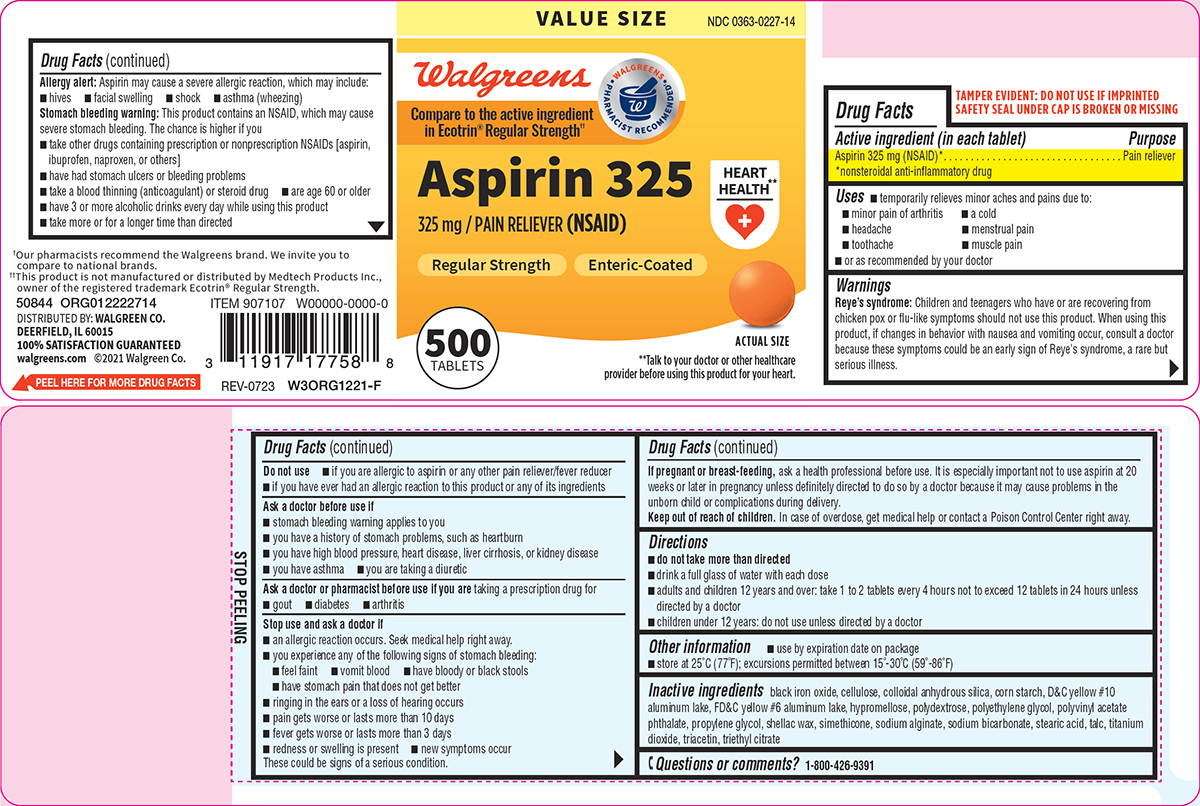
Aspirin Enteric Coated, Regular Strength 325 mg Tablet, Delayed Release, 500-count — NDC 0363-0227-14 (Billing 00363-0227-14)
This is a package of 500 tablets of Aspirin Enteric Coated, Regular Strength 325 mg Tablet, Delayed Release from Walgreen Company, marketed since Dec 1992 and currently FDA-listed. It is this product's only package size.
NDC database record
One package, one record: these facts belong to NDC 0363-0227-14 alone.
- Record
- FDA NDC Directory package listing · Human OTC drug
- Code segments
- 0363 labeler · 0227 product · 14 package
- Package marketed since
- Dec 14, 1992
- Sample package
- No — commercial package
- Listing certified through
- Dec 31, 2026
- Billing quantity
- 500 EA per package
- Barcode (UPC)
- 0311917177588
- FDA record last changed
- Jul 24, 2026
Identity & classification
Regulatory identifiers FDA, NLM and CMS codes for this package
Drug-database identifiers Medi-Span GPI and First Databank GCN / HICL / AHFS classification
- GSN (GCN sequence number): 004381
- GCN: 16720
- GPI-14 (Medi-Span): 64100010000605
- HICL (First Databank): 001820
- AHFS class code: 20:12.18.00
- RxCUI (RxNorm): 198467
Where does this data come from?
- FDA openFDA NDC Directory · synced Oct 8, 2026
- FDA label on DailyMed · label index refreshed Oct 6, 2026
- RxNorm (NLM RxNav) · catalog refreshed Oct 1, 2026
- Medi-Span GPI (licensed)
- First Databank (licensed) · refreshed Oct 8, 2026
RxNorm drug class
This medicine belongs to the Platelet Aggregation Inhibitor class.
Where does this data come from?
- RxClass (NLM) · catalog refreshed Oct 1, 2026
Clinical
Aspirin is used to: reduce fever relieve mild to moderate pain and inflammation prevent heart attacks, strokes or mini-strokes reduce the risk of death in people who are experiencing or who have had a heart attack Aspirin is in a group of medications called salicylates. It works by blocking natural substances that cause fever, pain, swelling, and blood clots. Aspirin is also available in combination with other medications such as pain relievers and cough and cold medications. This monograph only includes information about the use of aspirin alone. If you are taking a combination product,...
Read the full MedlinePlus article ↗- Aspirin is used to temporarily relieve common minor pains — things like headaches, backaches, muscle aches, toothaches, menstrual cramps, and discomfort from a cold — and to reduce...
- Generally, no — aspirin should not be given to children under 12. More importantly, children and teenagers who have or are recovering from chickenpox or a flu-like illness should n...
- Yes, stomach upset, heartburn, and nausea are real possibilities with aspirin. Taking it with a full glass of water helps. Some people tolerate enteric-coated or delayed-release fo...
- Does aspirin upset your stomach? What can I do about it?
Patient education
Supplement & herbal interactions
Some supplements/herbs that may interact with Aspirin — tap one for details:
Aspirin may be associated with lower levels of 3 nutrients — worth a chat with your pharmacist, not a cause for alarm.
Where does this data come from?
- MedlinePlus (NLM) · refreshed Oct 1, 2026
- FDA label on DailyMed · label index refreshed Oct 6, 2026
Ask a licensed pharmacist directly — free, answered by our team.
Pricing
A drug doesn't have one price. Each row is a different public payment system, and none is what you'd pay at the counter — that depends on your insurance. The ⓘ on each row explains what it measures.
| Price system | Per each | Per package |
|---|---|---|
| Retail pharmacies payNADAC · weekly | Not in the retail survey — common for institutional, discontinued, or low-volume packs. | |
| Medicaid paysCMS SDUD · 12 mo | No recent Medicaid claims on file for this NDC — rare and low-volume NDCs are suppressed in the public data. | |
| Medicare drug plans payPart D · quarterly | No Part D plan price is available for this NDC in our data. | |
Where does this data come from?
- CMS NADAC weekly file
- CMS ASP pricing files · refreshed Sep 20, 2026
- CMS Medicaid State Drug Utilization Data · refreshed Oct 8, 2026
- CMS Part D plan pricing files · refreshed Sep 24, 2026
- VA National Acquisition Center price file
Packaging — all sizes for this product
| Package NDC | Description | Marketing start | Marketing end | Status |
|---|---|---|---|---|
| 00363-0227-14 You're viewing this Main listing | 500 TABLET, DELAYED RELEASE in 1 BOTTLE, PLASTIC | 1992-12-14 | — | Active |
Therapeutic equivalents
| Product | Labeler | Pack | NADAC/unit | TE | Status | Price vs. this |
|---|---|---|---|---|---|---|
| Enteric Aspirin 325 mg 63868-0898-10 | CHAIN | 100 tablets | $0.019 | — | Discontinued | — |
| Aspirin Regular Strength 325 mg 00536-1232-01 | Rugby | 100 tablets | $0.022 | — | Availability likely | — |
| Aspirin 325 mg 46122-0596-02 | Amerisource | 125 tablets | $0.022 | — | Availability likely | — |
| Regular Strength Aspirin 325 mg 70000-0014-01 | CARDINAL | 300 tablets | $0.022 | — | Availability likely | — |
| Aspirin Regular Strength 325 mg 70000-0035-01 | Cardinal | 125 tablets | $0.022 | — | Availability likely | — |
| Enteric Coated Aspirin 325 mg 70677-1122-01 | STRATEGIC | 125 tablets | $0.022 | — | Availability likely | — |
| Enteric Aspirin 325 mg 83324-0058-01 | Chain | 100 tablets | $0.022 | — | Availability likely | — |
| Bayer Aspirin Regimen enteric coated 325 mg 00280-2110-10 | Bayer | 100 tablets | — | — | FDA listed | — |
| Aspirin Enteric Coated, Regular Strength 325 mgthis 00363-0227-14 | Walgreen | 500 tablets | — | — | FDA listed | — |
| Aspirin 325 325 mg 00363-0691-12 | Walgreen | 100 tablets | — | — | FDA listed | — |
| Aspirin 325 mg 00363-6453-53 | WALGREENS | 500 tablets | — | — | FDA listed | — |
| aspirin pain relief 325 mg 11822-2270-04 | Rite | 500 tablets | — | — | FDA listed | — |
| Aspirin Regular Strength 325 mg 11822-6910-01 | Rite | 100 tablets | — | — | FDA listed | — |
| Aspirin 325 mg 17714-0011-01 | Advance | 100 tablets | — | — | FDA listed | — |
| Regular Strength Enteric coated aspirin 325 mg 17856-0922-01 | ATLANTIC | 1 tablet | — | — | FDA listed | — |
| Enteric Coated Aspirin Regular Strength 325 mg 21130-0081-05 | Safeway | 500 tablets | — | — | FDA listed | — |
| Aspirin 325 mg 37808-0174-32 | H-E-B | 300 tablets | — | — | FDA listed | — |
| Aspirin Regular Strength 325 mg 41163-0522-02 | United | 125 tablets | — | — | FDA listed | — |
| Enteric Coated Aspirin Regular Strength 325 mg/3251 49483-0331-00 | Time-Cap | 100000 tablets | — | — | FDA listed | — |
| Aspirin 325 mg 51662-1494-01 | HF | 100 tablets | — | — | FDA listed | — |
| Enteric Coated Aspirin 325 mg 53943-0081-02 | DISCOUNT | 125 tablets | — | — | FDA listed | — |
| Aspirin 325 mg 54738-0111-01 | Richmond | 100 tablets | — | — | FDA listed | — |
| Regular Strength Enteric coated aspirin 325 mg 57896-0921-01 | Geri-Care | 100 tablets | — | — | FDA listed | — |
| Aspirin 325 mg 59779-0157-14 | CVS | 500 tablets | — | — | FDA listed | — |
| Regular Strength Enteric coated aspirin 325 mg 60760-0799-24 | St. | 24 tablets | — | — | Discontinued | — |
| Ecotrin Regular Strength 325 mg 63029-0302-01 | Medtech | 300 tablets | — | — | FDA listed | — |
| Enteric Coated Aspirin 325 mg 63941-0181-02 | VALU | 125 tablets | — | — | FDA listed | — |
| Aspirin 325 mg 67091-0110-10 | WinCo | 100 tablets | — | — | Discontinued | — |
| Aspirin 325 mg 68071-5192-01 | NuCare | 100 tablets | — | — | FDA listed | — |
| Aspirin 325 Mg Ec 69618-0015-01 | Reliable | 100 tablets | — | — | FDA listed | — |
| Aspirin 325 mg 69842-0927-14 | CVS | 500 tablets | — | — | FDA listed | — |
| Aspirin 325 Mg Ec 71205-0318-20 | Proficient | 20 tablets | — | — | FDA listed | — |
| Enteric Coated Aspirin Regular Strength 325 mg 71335-0157-01 | Bryant | 30 tablets | — | — | FDA listed | — |
| Regular Strength Enteric coated aspirin 325 mg 71335-0513-01 | Bryant | 30 tablets | — | — | FDA listed | — |
| Aspirin 325 Mg Ec 71335-1800-01 | Bryant | 30 tablets | — | — | FDA listed | — |
| Aspirin 325 mg 71610-0034-65 | Aphena | 100 tablets | — | — | FDA listed | — |
| Aspirin 325 mg 72036-0181-02 | HARRIS | 125 tablets | — | — | FDA listed | — |
| Aspirin 325 mg 72789-0556-07 | PD-Rx | 7 tablets | — | — | FDA listed | — |
| Aspirin Enteric Coated, Regular Strength 325 mg 77333-0035-20 | Gendose | 1 tablet | — | — | FDA listed | — |
| Aspirin 325 mg 79481-2270-05 | Meijer | 125 tablets | — | — | FDA listed | — |
| Aspirin 325 mg 80425-0293-01 | Advanced | 30 tablets | — | — | FDA listed | — |
| Aspirin 325 mg 81522-0018-11 | FSA | 100 tablets | — | — | FDA listed | — |
| Aspirin 325 mg 84269-2501-01 | Wildman | 2 tablets | — | — | FDA listed | — |
| Aspirin 325 mg 85111-0921-10 | RMT | 1000 tablets | — | — | FDA listed | — |
Where does this data come from?
- FDA openFDA NDC Directory · synced Oct 8, 2026
- FDA Orange Book · refreshed Oct 3, 2026
- CMS NADAC weekly file
Availability & generic status
We did not find an FDA-approved generic match for this exact strength, form and route.
Where does this data come from?
- FDA Orange Book · refreshed Oct 3, 2026
What it looks like
Where does this data come from?
- FDA label on DailyMed · label index refreshed Oct 6, 2026
Inactive Ingredients / Excipients
Inactive ingredients, also called excipients, are components of the drug product other than the active ingredient. They may include fillers, dyes, coatings, preservatives, flavors, or other formulation ingredients.
🧪 Avoiding an ingredient? See Aspirin inactive ingredients by manufacturer: every current product's list side by side, so you can ask your pharmacy for the version that does not list it.
💡 Tap an ingredient (hover on desktop) to see what it is and why it’s used.
-
UNII CQ3XH3DET6
D&C Yellow No. 10 Aluminum Lake is a yellow colorant made by combining a dye with aluminum salts. It's used in medicines to add color for product identification and visual appeal.
-
UNII 92RU3N3Y1O
Dimethicone is a silicone-based oil that acts as an anti-foaming agent and lubricant in medicines. It reduces gas bubbles in liquid formulations and helps coat and protect the stomach lining when ingested.
-
UNII GYP6Z2JR6Q
FD&C Yellow No. 6 Aluminum Lake is a yellow colorant made by combining FD&C Yellow No. 6 dye with aluminum salts. It's used to color tablets, capsules, and other medicines so they're easier to identify.
-
UNII XM0M87F357
A dark iron oxide compound that gives medicines their black or dark color. It's used as a colorant in tablets and capsules to help identify the product and make it visually distinctive.
-
UNII 3NXW29V3WO
Hypromellose is a plant-based thickener made from cellulose. It's used in medicines as a binder to hold ingredients together, a coating for tablets, and a thickener for liquids.
-
UNII VH2XOU12IE
Polydextrose is a synthetic polymer made from dextrose (sugar) that acts as a bulking agent and filler in medicines. It helps give tablets and capsules proper volume and texture while often adding slight sweetness.
-
UNII 3WJQ0SDW1A
Polyethylene glycol is a synthetic liquid or solid polymer used in medicines as a solvent, lubricant, and humectant. It helps dissolve active ingredients, reduces friction during manufacturing, and retains moisture in the final product.
-
UNII 58QVG85GW3
A synthetic polymer made from vinyl acetate and phthalic acid. It coats tablets and capsules to control when and where the medicine dissolves in the digestive system, protecting the contents from stomach acid.
-
UNII SMD1X3XO9M
Powdered cellulose is a fine, plant-based powder made from purified wood fibers. In medicines, it acts as a filler to add bulk and volume, and helps tablets or capsules hold together during manufacturing and storage.
-
UNII 6DC9Q167V3
Propylene glycol is a clear liquid derived from petroleum or vegetable sources. It acts as a solvent, humectant, and preservative in medicines, helping dissolve active ingredients and maintain product stability.
-
UNII 46N107B71O
Shellac is a natural resin secreted by the lac beetle. It's used as a coating on tablets and capsules to control how quickly the medicine dissolves and to improve appearance and stability.
-
UNII ETJ7Z6XBU4
Silicon dioxide is a naturally occurring mineral used as a glidant and anti-caking agent. It helps powder ingredients flow smoothly and prevents clumping during manufacturing and storage.
-
UNII C269C4G2ZQ
Sodium alginate is a natural thickener and gelling agent derived from seaweed. In medicines, it acts as a binder to hold ingredients together, a thickener to adjust texture, and a disintegrant to help the tablet or capsule break apart for absorption.
-
UNII 8MDF5V39QO
A white powder form of baking soda that acts as a buffer and pH regulator in medicines. It helps maintain the right acid-base balance and may aid tablet disintegration.
-
UNII O8232NY3SJ
A plant-based carbohydrate derived from corn kernels. It acts as a filler to add bulk, a binder to hold ingredients together, and a disintegrant to help the tablet break apart in your stomach for absorption.
-
UNII 4ELV7Z65AP
Stearic acid is a fatty acid derived from plant or animal sources. It acts as a binder and lubricant in tablets and capsules, helping them hold together and flow smoothly during manufacturing.
-
UNII 7SEV7J4R1U
A powder made from a naturally occurring mineral. In medicines, talc works as a glidant and anti-caking agent, helping tablets and capsules flow smoothly during manufacturing and preventing clumping.
-
UNII 15FIX9V2JP
Titanium dioxide is a bright white mineral powder commonly used as a colorant and opacifying agent. It makes pills and tablets white or lighter in color and helps make coatings non-transparent.
-
UNII XHX3C3X673
Triacetin is a clear, oily liquid made from glycerin and acetic acid. It works as a plasticizer and solvent in medicines, helping soften coatings and improve how liquids mix together in formulations.
-
UNII 8Z96QXD6UM
Triethyl citrate is a clear liquid derived from citric acid. It acts as a plasticizer and solvent in tablet coatings and film formulations, helping the coating remain flexible and adhere properly to the medicine.
-
UNII 059QF0KO0R
Water is a liquid solvent that dissolves and mixes ingredients together in liquid medicines, syrups, and injections. It helps distribute the active drug evenly throughout the product.
21 inactive ingredients listed in the exact product block matched to this NDC.
Label-section wording can be broader than the structured product block and may mention additional formulation ingredients.
Where does this data come from?
ingredient classCode="IACT" elements from the exact product block matched by this NDC. Label-section narrative from DailyMed / the openFDA label index is shown separately when available.- FDA label on DailyMed · label index refreshed Oct 6, 2026
- FDA openFDA NDC Directory · synced Oct 8, 2026
Inactive ingredient FAQ
Are inactive ingredients the same for every manufacturer?
Why might an inactive ingredient be missing?
Can inactive ingredients matter?
Manufacturer & labeler
More NDCs from Walgreen Company labeler code 00363
- Aspirin Low Dose 81 mg Tablet, Chewable NDC 0363-0218-79
- Salicylic Acid Wart Remover Gel .17 g/7g Gel NDC 0363-0219-25
- Clotrimazole 10 mg/g Cream NDC 0363-0220-63
- Ibuprofen 200 mg Capsule, Liquid Filled NDC 0363-0221-11
- Ibuprofen 200 200 mg Capsule, Liquid Filled NDC 0363-0222-22
- Dye-Free Ibuprofen 200 200 mg/1201 Capsule, Liquid Filled NDC 0363-0225-22
- WALGREENS 100 SHEER BROAD SPECTRUM SPF 100 AVOBENZONE, HOMOSALATE, OCTISALATE, OCTOCRYLENE 30 mg/mL; 150 mg/mL; 100 mg/mL; 50 mg/mL Lotion NDC 0363-0228-66
- Acne Treatment Benzoyl peroxide 1 mg/g Gel NDC 0363-0229-10
- Maximum Strength Hydrocortisone Hydrocortisone Ointment 1 g/100g Ointment NDC 0363-0230-03
- Hydrocortisone Cream Intensive Healing 1 g/100g Cream NDC 0363-0237-03
- Migraine Relief Ibuprofen 200 mg Capsule, Liquid Filled NDC 0363-0240-78
- Walgreen BENZALKONIUM CHLORIDE 130 mg/100mL Soap NDC 0363-0242-04
Where does this data come from?
- FDA openFDA NDC Directory · synced Oct 8, 2026
- Drugs@FDA
FDA label — Drug Facts FDA SPL
🎯 Indications and Usage ▾
Uses temporarily relieves minor aches and pains due to: minor pain of arthritis a cold headache menstrual pain toothache muscle pain or as recommended by your doctor
⏱️ Dosage and Administration ▾
Directions do not take more than directed drink a full glass of water with each dose adults and children 12 years and over: take 1 to 2 tablets every 4 hours not to exceed 12 tablets in 24 hours unless directed by a doctor children under 12 years: do not use unless directed by a doctor
⚠️ Warnings ▾
Warnings Reye’s syndrome: Children and teenagers who have or are recovering from chicken pox or flu-like symptoms should not use this product. When using this product, if changes in behavior with nausea and vomiting occur, consult a doctor because these symptoms could be an early sign of Reye's syndrome, a rare but serious illness. Allergy alert: Aspirin may cause a severe allergic reaction, which may include: hives facial swelling shock asthma (wheezing) Stomach bleeding warning: This product contains an NSAID, which may cause severe stomach bleeding.
The chance is higher if you take other drugs containing prescription or nonprescription NSAIDs [aspirin, ibuprofen, naproxen, or others] have had stomach ulcers or bleeding problems take a blood thinning (anticoagulant) or steroid drug are age 60 or older have 3 or more alcoholic drinks every day while using this product take more or for a longer time than directed Do not use if you are allergic to aspirin or any other pain reliever/fever reducer if you have ever had an allergic reaction to this product or any of its ingredients Ask a doctor before use if stomach bleeding warning applies to you you have a history of stomach problems, such as heartburn you have high blood pressure, heart disease, liver cirrhosis, or kidney disease you have asthma you are taking a diuretic Ask a doctor or pharmacist before use if you are taking a prescription drug for gout diabetes arthritis Stop use and ask a doctor if an allergic reaction occurs.
Seek medical help right away. you experience any of the following signs of stomach bleeding: feel faint vomit blood have bloody or black stools have stomach pain that does not get better ringing in the ears or a loss of hearing occurs pain gets worse or lasts more than 10 days fever gets worse or lasts more than 3 days redness or swelling is present new symptoms occur These could be signs of a serious condition. If pregnant or breast-feeding, ask a health professional before use. It is especially important not to use aspirin at 20 weeks or later in pregnancy unless definitely directed to do so by a doctor because it may cause problems in the unborn child or complications during delivery.
Keep out of reach of children. In case of overdose, get medical help or contact a Poison Control Center right away.
📦 Storage and Handling ▾
Other information use by expiration date on package store at 25°C (77°F); excursions permitted between 15°-30°C (59°-86°F)
🧪 Active Ingredient ▾
Active ingredient (in each tablet) Aspirin 325 mg (NSAID)* *nonsteroidal anti-inflammatory drug
🧪 Inactive Ingredients ▾
Inactive ingredients black iron oxide, cellulose, colloidal anhydrous silica, corn starch, D&C yellow #10 aluminum lake, FD&C yellow #6 aluminum lake, hypromellose, polydextrose, polyethylene glycol, polyvinyl acetate phthalate, propylene glycol, shellac wax, simethicone, sodium alginate, sodium bicarbonate, stearic acid, talc, titanium dioxide, triacetin, triethyl citrate
🎯 Purpose ▾
Purpose Pain reliever
📄 Do Not Use ▾
Do not use if you are allergic to aspirin or any other pain reliever/fever reducer if you have ever had an allergic reaction to this product or any of its ingredients
📄 Ask a Doctor Before Use If ▾
Ask a doctor before use if stomach bleeding warning applies to you you have a history of stomach problems, such as heartburn you have high blood pressure, heart disease, liver cirrhosis, or kidney disease you have asthma you are taking a diuretic
📄 Ask a Doctor or Pharmacist Before Use If ▾
Ask a doctor or pharmacist before use if you are taking a prescription drug for gout diabetes arthritis
📄 Stop Use and Ask a Doctor If ▾
Stop use and ask a doctor if an allergic reaction occurs. Seek medical help right away. you experience any of the following signs of stomach bleeding: feel faint vomit blood have bloody or black stools have stomach pain that does not get better ringing in the ears or a loss of hearing occurs pain gets worse or lasts more than 10 days fever gets worse or lasts more than 3 days redness or swelling is present new symptoms occur These could be signs of a serious condition.
🤰 If Pregnant or Breast-Feeding ▾
If pregnant or breast-feeding, ask a health professional before use. It is especially important not to use aspirin at 20 weeks or later in pregnancy unless definitely directed to do so by a doctor because it may cause problems in the unborn child or complications during delivery.
📄 Keep Out of Reach of Children ▾
Keep out of reach of children. In case of overdose, get medical help or contact a Poison Control Center right away.
📄 Questions or Comments ▾
Questions or comments? 1-800-426-9391
📄 Package Label / Principal Display Panel ▾
Principal Display Panel VALUE SIZE NDC 0363-0227-14 Walgreens Compare to the active ingredient in Ecotrin® Regular Strength †† WALGREENS PHARMACIST RECOMMENDED † Aspirin 325 325 mg / PAIN RELIEVER (NSAID) Regular Strength Enteric-Coated 500 TABLETS ACTUAL SIZE HEART HEALTH** **Talk to your doctor or other healthcare provider before using this product for your heart. TAMPER EVIDENT: DO NOT USE IF IMPRINTED SAFETY SEAL UNDER CAP IS BROKEN OR MISSING † Our pharmacists recommend the Walgreens brand. We invite you to compare to national brands. †† This product is not manufactured or distributed by Medtech Products Inc., owner of the registered trademark Ecotrin® Regular Strength.
50844 ORG012222714 DISTRIBUTED BY: WALGREEN CO. DEERFIELD, IL 60015 100% SATISFACTION GUARANTEED walgreens.com ©2021 Walgreen Co. Walgreens 44-227 Walgreens 44-227
About this NDC listing & data coverage
What data is (and isn’t) available for this NDC — tap to expand
| NDC identity (package / product / labeler codes) | ✓ Available |
| Labeler | ✓ Available |
| Product & package description | ✓ Available |
| Marketing category & status | ✓ Available |
| Active ingredient / dosage form / route | ✓ Available |
| FDA label (SPL via DailyMed) | ✓ Available |
| Package photos | ✓ Available |
| Inactive ingredients (structured) | ✓ Available |
| NADAC pharmacy acquisition price (CMS) | — Not published for this NDC CMS publishes NADAC only for NDCs reported in its retail-pharmacy survey. |
| Orange Book / therapeutic-equivalence data | — Not published for this NDC Applies only to products approved under an NDA/ANDA; many listings are out of scope. |
| HCPCS J-code billing crosswalk | — Not published for this NDC Most self-administered / retail products have no J-code — that is normal. |
| Medicaid utilization (CMS SDUD) | — Not published for this NDC CMS reports utilization only for NDCs with Medicaid claims above its privacy threshold. |