
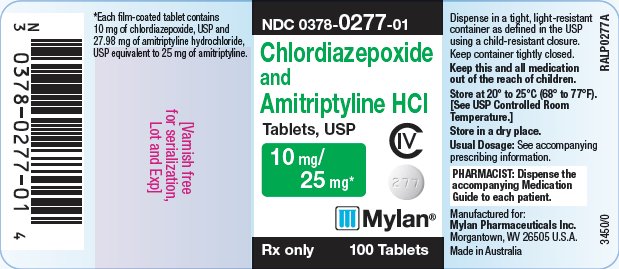
Chlordiazepoxide and Amitriptyline Hydrochloride 10 mg; 27.98 mg Tablet, Film Coated, 100-count — NDC 0378-0277-01 (Billing 00378-0277-01)
This is a package of 100 tablets of Chlordiazepoxide and Amitriptyline Hydrochloride 10 mg; 27.98 mg Tablet, Film Coated from Mylan Pharmaceuticals Inc., marketed since Dec 1986 and currently FDA-listed; retail pharmacies pay about $1.58 per tablet (NADAC). It is the main listing for this product, which comes in 2 package sizes.
NDC database record
One package, one record: these facts belong to NDC 0378-0277-01 alone.
- Record
- FDA NDC Directory package listing · Human prescription drug
- Code segments
- 0378 labeler · 0277 product · 01 package
- Package marketed since
- Dec 10, 1986
- Sample package
- No — commercial package
- Listing certified through
- Dec 31, 2027
- Billing quantity
- 100 EA per package
- Barcode (UPC)
- 0303780277014, 0303780211018
- FDA record last changed
- Sep 17, 2026
Identity & classification
Regulatory identifiers FDA, NLM and CMS codes for this package
Drug-database identifiers Medi-Span GPI and First Databank GCN / HICL / AHFS classification
- GSN (GCN sequence number): 046192
- GCN: 16684
- GPI-14 (Medi-Span): 62992002200320
- HICL (First Databank): 001656
- AHFS class code: 28:16.04.28
- RxCUI (RxNorm): 856769
Where does this data come from?
- FDA openFDA NDC Directory · synced Oct 8, 2026
- FDA label on DailyMed · label index refreshed Oct 8, 2026
- RxNorm (NLM RxNav) · catalog refreshed Oct 1, 2026
- Medi-Span GPI (licensed)
- First Databank (licensed) · refreshed Oct 8, 2026
RxNorm drug class
This medicine belongs to the Benzodiazepine class.
Where does this data come from?
- RxClass (NLM) · catalog refreshed Oct 1, 2026
Clinical
Amitriptyline is used to treat symptoms of depression. Amitriptyline is in a class of medications called tricyclic antidepressants. It works by increasing the amounts of certain natural substances in the brain that are needed to maintain mental balance.
Read the full MedlinePlus article ↗Patient education
Supplement & herbal interactions
Where does this data come from?
- MedlinePlus (NLM) · refreshed Oct 8, 2026
- FDA label on DailyMed · label index refreshed Oct 8, 2026
Ask a licensed pharmacist directly — free, answered by our team.
Pricing
A drug doesn't have one price. Each row is a different public payment system, and none is what you'd pay at the counter — that depends on your insurance. The ⓘ on each row explains what it measures.
| Price system | Per ea | Per package |
|---|---|---|
| Retail pharmacies payNADAC · weekly | $1.577 | $157.74 / 100 tablets |
| Medicaid paysCMS SDUD · 12 mo | No recent Medicaid claims on file for this NDC — rare and low-volume NDCs are suppressed in the public data. | |
| Medicare drug plans payPart D · Q2 2026 | $1.51 | $151.39 / 100 tablets |
Where does this data come from?
- CMS NADAC weekly file · file of Jun 10, 2026
- CMS ASP pricing files · refreshed Sep 20, 2026
- CMS Medicaid State Drug Utilization Data · refreshed Oct 8, 2026
- CMS Part D plan pricing files · refreshed Sep 24, 2026
- VA National Acquisition Center price file
Packaging — all sizes for this product
| Package NDC | Description | Per unit | Per pack | Marketing start | Marketing end | Status |
|---|---|---|---|---|---|---|
| 00378-0277-01 You're viewing this Main listing | 100 TABLET, FILM COATED in 1 BOTTLE, PLASTIC | $1.58 / ea | $157.74 | 1986-12-10 | — | Active |
| 00378-0277-05 0378-0277-05 | 500 TABLET, FILM COATED in 1 BOTTLE, PLASTIC | $1.58 / ea | $788.69 | 1986-12-10 | — | Active |
You're viewing the smallest of 2 pack sizes for this product.
This pack has the lowest per-ea cost of the 2 priced pack sizes ($1.58 NADAC).
Pack size FAQ
What quantity is in this package?
How does this package differ from NDC 00378-0277-05?
What NDC number is used to bill for this package of Chlordiazepoxide and Amitriptyline Hydrochloride 10 mg; 27.98 mg Tablet, Film Coated?
Prices are the latest CMS NADAC pharmacy acquisition cost per NDC; per-pack figures are per-unit × pack quantity, shown only when the pack is denominated in the same measure NADAC prices.
Therapeutic equivalents
| Product | Labeler | Pack | NADAC/unit | TE | Status | Price vs. this |
|---|---|---|---|---|---|---|
| Chlordiazepoxide and Amitriptyline Hydrochloride 10 mg/1; 27.98 mgthis 00378-0277-01 | Mylan | 100 tablets | $1.577 | — | Availability likely | — |
Where does this data come from?
- FDA openFDA NDC Directory · synced Oct 8, 2026
- FDA Orange Book · refreshed Oct 3, 2026
- CMS NADAC weekly file · file of Jun 10, 2026
Availability & generic status
This product is an FDA-approved generic. Other versions of the same drug are listed under Therapeutic equivalents, least expensive first.
Where does this data come from?
- FDA Orange Book · refreshed Oct 3, 2026
What it looks like
Where does this data come from?
- FDA label on DailyMed · label index refreshed Oct 8, 2026
Inactive Ingredients / Excipients
Inactive ingredients, also called excipients, are components of the drug product other than the active ingredient. They may include fillers, dyes, coatings, preservatives, flavors, or other formulation ingredients.
💡 Tap an ingredient (hover on desktop) to see what it is and why it’s used.
-
UNII M28OL1HH48
Croscarmellose sodium is a plant-based substance derived from cellulose. It acts as a disintegrant, helping tablets and capsules break down quickly in the digestive system so the medicine can be absorbed.
-
UNII 9XZ8H6N6OH
A plant-based cellulose derivative used as a binder to hold tablet ingredients together, a thickener in liquids, and a coating agent to control how fast the medicine dissolves.
-
UNII 3NXW29V3WO
Hypromellose is a plant-based thickener made from cellulose. It's used in medicines as a binder to hold ingredients together, a coating for tablets, and a thickener for liquids.
-
UNII 70097M6I30
Magnesium stearate is a salt made from magnesium and stearic acid, a fatty substance. It's used in tablets and capsules as a lubricant and glidant to help ingredients flow smoothly during manufacturing and prevent sticking.
-
UNII OP1R32D61U
Microcrystalline cellulose is a purified form of cellulose, a natural fiber from plant sources. It acts as a binder and filler in tablets and capsules, helping hold ingredients together and give the medicine its shape and size.
-
UNII VH2XOU12IE
Polydextrose is a synthetic polymer made from dextrose (sugar) that acts as a bulking agent and filler in medicines. It helps give tablets and capsules proper volume and texture while often adding slight sweetness.
-
UNII 3WJQ0SDW1A
Polyethylene glycol is a synthetic liquid or solid polymer used in medicines as a solvent, lubricant, and humectant. It helps dissolve active ingredients, reduces friction during manufacturing, and retains moisture in the final product.
-
UNII ETJ7Z6XBU4
Silicon dioxide is a naturally occurring mineral used as a glidant and anti-caking agent. It helps powder ingredients flow smoothly and prevents clumping during manufacturing and storage.
-
UNII 368GB5141J
A detergent and foaming agent derived from coconut or palm oil. In medications, it helps break down and mix oil and water-based ingredients, aids in tablet disintegration, and improves how the drug dissolves and spreads in the mouth or digestive system.
-
UNII O8232NY3SJ
A plant-based carbohydrate derived from corn kernels. It acts as a filler to add bulk, a binder to hold ingredients together, and a disintegrant to help the tablet break apart in your stomach for absorption.
-
UNII 15FIX9V2JP
Titanium dioxide is a bright white mineral powder commonly used as a colorant and opacifying agent. It makes pills and tablets white or lighter in color and helps make coatings non-transparent.
-
UNII XHX3C3X673
Triacetin is a clear, oily liquid made from glycerin and acetic acid. It works as a plasticizer and solvent in medicines, helping soften coatings and improve how liquids mix together in formulations.
12 inactive ingredients listed in the exact product block matched to this NDC.
Where does this data come from?
ingredient classCode="IACT" elements from the exact product block matched by this NDC. Label-section narrative from DailyMed / the openFDA label index is shown separately when available.- FDA label on DailyMed · label index refreshed Oct 8, 2026
- FDA openFDA NDC Directory · synced Oct 8, 2026
Inactive ingredient FAQ
Are inactive ingredients the same for every manufacturer?
Why might an inactive ingredient be missing?
Can inactive ingredients matter?
Manufacturer & labeler
More NDCs from Mylan Pharmaceuticals Inc. labeler code 00378
- Spironolactone 50 mg Tablet, Film Coated NDC 0378-0243-01
- Haloperidol 1 mg Tablet NDC 0378-0257-01
- Dabigatran Etexilate 75 mg Capsule NDC 0378-0265-91
- Dabigatran Etexilate 150 mg Capsule NDC 0378-0266-91
- Diazepam 2 mg Tablet NDC 0378-0271-01
- Tamoxifen Citrate 20 mg Tablet NDC 0378-0274-93
- Cimetidine 300 mg Tablet, Film Coated NDC 0378-0317-01
- Haloperidol 5 mg Tablet NDC 0378-0327-01
- Perphenazine and Amitriptyline Hydrochloride 2 mg; 10 mg Tablet, Film Coated NDC 0378-0330-01
- Haloperidol 10 mg Tablet NDC 0378-0334-01
- Diazepam 5 mg Tablet NDC 0378-0345-01
- Haloperidol .5 mg Tablet NDC 0378-0351-01
Where does this data come from?
- FDA openFDA NDC Directory · synced Oct 8, 2026
- Drugs@FDA
Full prescribing information FDA SPL
🚨 Boxed Warning ▾
WARNING: RISKS FROM CONCOMITANT USE WITH OPIOIDS; ABUSE, MISUSE, AND ADDICTION; DEPENDENCE AND WITHDRAWAL REACTIONS; and SUICIDAL THOUGHTS AND BEHAVIORS • Concomitant use of benzodiazepines and opioids may result in profound sedation, respiratory depression, coma, and death. Reserve concomitant prescribing of these drugs for patients for whom alternative treatment options are inadequate. Limit dosages and durations to the minimum required.
Follow patients for signs and symptoms of respiratory depression and sedation (see WARNINGS and PRECAUTIONS ). • The use of benzodiazepines, including chlordiazepoxide and amitriptyline hydrochloride tablets, exposes users to risks of abuse, misuse, and addiction, which can lead to overdose or death. Abuse and misuse of benzodiazepines commonly involve concomitant use of other medications, alcohol, and/or illicit substances, which is associated with an increased frequency of serious adverse outcomes. Before prescribing chlordiazepoxide and amitriptyline hydrochloride tablets and throughout treatment, assess each patient’s risk for abuse, misuse, and addiction (see WARNINGS ). • The continued use of benzodiazepines, including chlordiazepoxide and amitriptyline hydrochloride tablets, may lead to clinically significant physical dependence.
The risks of dependence and withdrawal increase with longer treatment duration and higher daily dose. Abrupt discontinuation or rapid dosage reduction of chlordiazepoxide and amitriptyline hydrochloride tablets after continued use may precipitate acute withdrawal reactions, which can be life-threatening. To reduce the risk of withdrawal reactions, use a gradual taper to discontinue chlordiazepoxide and amitriptyline hydrochloride tablets or reduce the dosage (see DOSAGE AND ADMINISTRATION and WARNINGS ). • Antidepressants increased the risk of suicidal thoughts and behaviors in pediatric and young adult patients in short-term studies.
Closely monitor all antidepressant-treated patients for clinical worsening, and for emergence of suicidal thoughts and behaviors (see WARNINGS ). Chlordiazepoxide and amitriptyline hydrochloride tablets are not approved for use in pediatric patients (see PRECAUTIONS ).
🎯 Indications and Usage ▾
INDICATIONS AND USAGE Chlordiazepoxide and amitriptyline hydrochloride tablets are indicated for the treatment of patients with moderate to severe depression associated with moderate to severe anxiety. The therapeutic response to chlordiazepoxide and amitriptyline hydrochloride tablets occurs earlier and with fewer treatment failures than when either amitriptyline or chlordiazepoxide is used alone. Symptoms likely to respond in the first week of treatment include: insomnia, feelings of guilt or worthlessness, agitation, psychic and somatic anxiety, suicidal ideation and anorexia.
⏱️ Dosage and Administration ▾
DOSAGE AND ADMINISTRATION Optimum dosage varies with the severity of the symptoms and the response of the individual patient. When a satisfactory response is obtained, dosage should be reduced to the smallest amount needed to maintain the remission. The larger portion of the total daily dose may be taken at bedtime.
In some patients, a single dose at bedtime may be sufficient. In general, lower dosages are recommended for elderly patients. Chlordiazepoxide and amitriptyline hydrochloride tablets 10 mg/25 mg are recommended in an initial dosage of 3 or 4 tablets daily in divided doses; this may be increased to 6 tablets daily as required.
Some patients respond to smaller doses and can be maintained on 2 tablets daily. Chlordiazepoxide and amitriptyline hydrochloride tablets 5 mg/12.5 mg in an initial dosage of 3 or 4 tablets daily in divided doses may be satisfactory in patients who do not tolerate higher doses. Screen for Bipolar Disorder Prior to Starting Chlordiazepoxide and Amitriptyline Hydrochloride Tablets Prior to initiating treatment with chlordiazepoxide and amitriptyline hydrochloride tablets or another antidepressant, screen patients for a personal or family history of bipolar disorder, mania, or hypomania (see WARNINGS: Activation of Mania or Hypomania ).
Discontinuation or Dosage Reduction of Chlordiazepoxide and Amitriptyline Hydrochloride Tablets To reduce the risk of withdrawal reactions, use a gradual taper to discontinue chlordiazepoxide and amitriptyline hydrochloride tablets or reduce the dosage. If a patient develops withdrawal reactions, consider pausing the taper or increasing the dosage to the previous tapered dosage level. Subsequently decrease the dosage more slowly (see WARNINGS: Dependence and Withdrawal Reactions and DRUG ABUSE AND DEPENDENCE: Dependence ).
⛔ Contraindications ▾
CONTRAINDICATIONS Chlordiazepoxide and amitriptyline hydrochloride tablets are contraindicated in patients with hypersensitivity to either benzodiazepines or tricyclic antidepressants. It should not be given concomitantly with a monoamine oxidase inhibitor. Hyperpyretic crises, severe convulsions and deaths have occurred in patients receiving a tricyclic antidepressant and a monoamine oxidase inhibitor simultaneously.
When it is desired to replace a monoamine oxidase inhibitor with chlordiazepoxide and amitriptyline hydrochloride tablets, a minimum of 14 days should be allowed to elapse after the former is discontinued. Chlordiazepoxide and amitriptyline hydrochloride tablets should then be initiated cautiously with gradual increase in dosage until optimum response is achieved. This drug is contraindicated during the acute recovery phase following myocardial infarction.
⚠️ Warnings ▾
WARNINGS Risks from Concomitant Use with Opioids Concomitant use of benzodiazepines, including chlordiazepoxide and amitriptyline hydrochloride tablets, and opioids may result in profound sedation, respiratory depression, coma, and death. Because of these risks, reserve concomitant prescribing of these drugs in patients for whom alternative treatment options are inadequate. Observational studies have demonstrated that concomitant use of opioid analgesics and benzodiazepines increases the risk of drug-related mortality compared to use of opioids alone.
If a decision is made to prescribe chlordiazepoxide and amitriptyline hydrochloride tablets concomitantly with opioids, prescribe the lowest effective dosages and minimum durations of concomitant use, and follow patients closely for signs and symptoms of respiratory depression and sedation. In patients already receiving an opioid analgesic, prescribe a lower initial dose of chlordiazepoxide and amitriptyline hydrochloride tablets than indicated in the absence of an opioid and titrate based on clinical response. If an opioid is initiated in a patient already taking chlordiazepoxide and amitriptyline hydrochloride tablets, prescribe a lower initial dose of the opioid and titrate based upon clinical response.
Advise both patients and caregivers about the risks of respiratory depression and sedation when chlordiazepoxide and amitriptyline hydrochloride tablets are used with opioids. Advise patients not to drive or operate heavy machinery until the effects of concomitant use with the opioid have been determined (see PRECAUTIONS: Drug-Drug Interactions ). Abuse, Misuse, and Addiction The use of benzodiazepines, including chlordiazepoxide and amitriptyline hydrochloride tablets, exposes users to the risks of abuse, misuse, and addiction, which can lead to overdose or death.
Abuse and misuse of benzodiazepines often (but not always) involve the use of doses greater than the maximum recommended dosage and commonly involve concomitant use of other medications, alcohol, and/or illicit substances, which is associated with an increased frequency of serious adverse outcomes, including respiratory depression, overdose, or death (see DRUG ABUSE AND DEPENDENCE: Abuse ). Before prescribing chlordiazepoxide and amitriptyline hydrochloride tablets and throughout treatment, assess each patient’s risk for abuse, misuse, and addiction (e.g., using a standardized screening tool).
Use of chlordiazepoxide and amitriptyline hydrochloride tablets, particularly in patients at elevated risk, necessitates counseling about the risks and proper use of chlordiazepoxide and amitriptyline hydrochloride tablets along with monitoring for signs and symptoms of abuse, misuse, and addiction. Prescribe the lowest effective dosage; avoid or minimize concomitant use of CNS depressants and other substances associated with abuse, misuse, and addiction (e.g., opioid analgesics, stimulants); and advise patients on the proper disposal of unused drug.
If a substance use disorder is suspected, evaluate the patient and institute (or refer them for) early treatment, as appropriate. Dependence and Withdrawal Reactions To reduce the risk of withdrawal reactions, use a gradual taper to discontinue chlordiazepoxide and amitriptyline hydrochloride tablets or reduce the dosage (a patient-specific plan should be used to taper the dose) (see DOSAGE AND ADMINISTRATION: Discontinuation or Dosage Reduction of Chlordiazepoxide and Amitriptyline Hydrochloride Tablets ). Patients at an increased risk of withdrawal adverse reactions after benzodiazepine discontinuation or rapid dosage reduction include those who take higher dosages, and those who have had longer durations of use.
Acute Withdrawal Reactions The continued use of benzodiazepines, including chlordiazepoxide and amitriptyline hydrochloride tablets, may lead to clinically significant physical dependence. Abrupt discontinuation or rapid dosage reduction of chlordiazepoxide and amitripty… [Excerpted — this section continues on DailyMed.]
🤒 Adverse Reactions ▾
ADVERSE REACTIONS Adverse reactions to chlordiazepoxide and amitriptyline hydrochloride are those associated with the use of either component alone. Most frequently reported were drowsiness, dry mouth, constipation, blurred vision, dizziness and bloating. Other side effects occurring less commonly included vivid dreams, impotence, tremor, confusion and nasal congestion.
Many symptoms common to the depressive state, such as anorexia, fatigue, weakness, restlessness and lethargy, have been reported as side effects of treatment with both chlordiazepoxide and amitriptyline hydrochloride tablets and amitriptyline. Granulocytopenia, jaundice and hepatic dysfunction of uncertain etiology have also been observed rarely with chlordiazepoxide and amitriptyline hydrochloride tablets. When treatment with chlordiazepoxide and amitriptyline hydrochloride tablets is prolonged, periodic blood counts and liver function tests are advisable.
Note Included in the listing which follows are adverse reactions which have not been reported with chlordiazepoxide and amitriptyline hydrochloride. However, they are included because they have been reported during therapy with one or both of the components or closely related drugs. Cardiovascular: Hypotension, hypertension, tachycardia, palpitations, myocardial infarction, arrhythmias, heart block, stroke.
Psychiatric: Euphoria, apprehension, poor concentration, delusions, hallucinations, hypomania and increased or decreased libido. Neurologic: Incoordination, ataxia, numbness, tingling and paresthesias of the extremities, extrapyramidal symptoms, syncope, changes in EEG patterns. Anticholinergic: Disturbance of accommodation, paralytic ileus, urinary retention, dilatation of urinary tract.
Allergic: Skin rash, urticaria, photosensitization, edema of face and tongue, pruritus, drug reaction with eosinophilia and systemic symptoms (DRESS). Hematologic: Bone marrow depression including agranulocytosis, eosinophilia, purpura, thrombocytopenia. Gastrointestinal: Nausea, epigastric distress, vomiting, anorexia, stomatitis, peculiar taste, diarrhea, black tongue.
Endocrine: Testicular swelling and gynecomastia in the male, breast enlargement, galactorrhea and minor menstrual irregularities in the female, elevation and lowering of blood sugar levels, and syndrome of inappropriate ADH (antidiuretic hormone) secretion. Other: Headache, weight gain or loss, increased perspiration, urinary frequency, mydriasis, jaundice, alopecia, parotid swelling, hyponatremia.
🤰 Pregnancy ▾
Pregnancy Advise pregnant females that use of chlordiazepoxide and amitriptyline hydrochloride tablets late in pregnancy can result in sedation (respiratory depression, lethargy, hypotonia) and/or withdrawal symptoms (hyperreflexia, irritability, restlessness, tremors, inconsolable crying, and feeding difficulties) in newborns (see WARNINGS: Neonatal Sedation and Withdrawal Syndrome and Precautions, Pregnancy ). Instruct patients to inform their healthcare provider if they are pregnant. Advise patients that there is a pregnancy exposure registry that monitors pregnancy outcomes in women exposed to chlordiazepoxide and amitriptyline hydrochloride tablets during pregnancy (see PRECAUTIONS: Pregnancy ).
Pregnancy Pregnancy Exposure Registry There is a pregnancy registry that monitors pregnancy outcomes in women exposed to psychiatric medications, including chlordiazepoxide and amitriptyline hydrochloride tablets, during pregnancy. Healthcare providers are encouraged to register patients by calling the National Pregnancy Registry for Psychiatric Medications at 1-866-961-2388 or visiting online at https://womensmentalhealth.org/pregnancyregistry/. Risk Summary Neonates born to mothers using benzodiazepines late in pregnancy have been reported to experience symptoms of sedation and/or neonatal withdrawal (see WARNINGS: Neonatal Sedation and Withdrawal Syndrome , and Clinical Considerations ) .
Available data from published observational studies of pregnant women exposed to benzodiazepines do not report a clear association with benzodiazepines and major birth defects (see Data ) . The background risk of major birth defects and miscarriage for the indicated population is unknown. All pregnancies have a background risk of birth defect, loss, or other adverse outcomes.
In the U.S. general population, the estimated risk of major birth defects and of miscarriage in clinically recognized pregnancies is 2% to 4% and 15% to 20%, respectively. Clinical Considerations Fetal/Neonatal Adverse Reactions Benzodiazepines cross the placenta and may produce respiratory depression, hypotonia and sedation in neonates. Monitor neonates exposed to chlordiazepoxide and amitriptyline hydrochloride tablets during pregnancy or labor for signs of sedation, respiratory depression, hypotonia, and feeding problems.
Monitor neonates exposed to chlordiazepoxide and amitriptyline hydrochloride tablets during pregnancy for signs of withdrawal. Manage these neonates accordingly (see WARNINGS: Neonatal Sedation and Withdrawal Syndrome ) . Data Human Data Published data from observational studies on the use of benzodiazepines during pregnancy do not report a clear association with benzodiazepines and major birth defects.
Although early studies reported an increased risk of congenital malformations with diazepam and chlordiazepoxide, there was no consistent pattern noted. In addition, the majority of more recent case-control and cohort studies of benzodiazepine use during pregnancy, which were adjusted for confounding exposures to alcohol, tobacco and other medications, have not confirmed these findings.
🧒 Pediatric Use ▾
Pediatric Use Safety and effectiveness in the pediatric population have not been established (see BOX WARNING and WARNINGS: Suicidal Thoughts and Behaviors in Adolescents and Young Adults ). Anyone considering the use of chlordiazepoxide and amitriptyline hydrochloride tablets in a child or adolescent must balance the potential risks with the clinical need.
🧓 Geriatric Use ▾
Geriatric Use In elderly and debilitated patients it is recommended that dosage be limited to the smallest effective amount to preclude the development of ataxia, oversedation, confusion or anticholinergic effects. Of the total number of subjects in clinical studies of chlordiazepoxide and amitriptyline hydrochloride tablets, 74 individuals were 65 years and older. An additional 34 subjects were between 60 and 69 years of age.
No overall differences in safety and effectiveness were observed between these subjects and younger subjects, and other reported clinical experience has not identified differences in responses between the elderly and younger patients, but greater sensitivity of some older individuals cannot be ruled out. The active ingredients in chlordiazepoxide and amitriptyline hydrochloride tablets are known to be substantially excreted by the kidney and the risk of toxic reactions to this drug may be greater in patients with impaired renal function.
Because elderly patients are more likely to have decreased renal function, care should be taken in dose selection and it may be useful to monitor renal function. Sedating drugs may cause confusion and over-sedation in the elderly; elderly patients generally should be started on low doses of chlordiazepoxide and amitriptyline hydrochloride tablets and observed closely. Clinical studies of chlordiazepoxide and amitriptyline hydrochloride tablets did not include sufficient numbers of subjects aged 65 years and older to determine whether they respond differently than younger subjects.
Other reported clinical experience has not identified differences in responses between the elderly and younger patients. In general, dose selection for an elderly patient should be cautious, usually starting at the low end of the dosing range, reflecting the greater frequency of decreased hepatic, renal or cardiac function and of concomitant disease or other drug therapy.
🆘 Overdosage ▾
OVERDOSAGE Overdosage of chlordiazepoxide and amitriptyline hydrochloride tablets, which contain a benzodiazepine (chlordiazepoxide) and a tricyclic antidepressant (amitriptyline hydrochloride), may manifest signs and symptoms related to either of its components. Deaths may occur from overdosage with this class of drugs. Multiple drug ingestion (including alcohol) is common in deliberate tricyclic antidepressant overdose.
Signs and symptoms of toxicity develop rapidly after tricyclic antidepressant overdose. Critical manifestations of tricyclic antidepressant overdosage include cardiac dysrhythmias, severe hypotension, convulsions and CNS depression, including coma. Changes in the electrocardiogram, particularly in QRS axis or width, are clinically significant indicators of tricyclic antidepressant toxicity.
Obtain an ECG and immediately initiate cardiac monitoring; hospital monitoring is required as soon as possible. Other signs of overdosage may include confusion, disturbed concentration, transient visual hallucinations, dilated pupils, agitation, hyperactive reflexes, stupor, drowsiness, muscle rigidity, vomiting, hypothermia, hyperpyrexia or any of the symptoms listed under ADVERSE REACTIONS. Overdosage of benzodiazepines is characterized by central nervous system depression ranging from drowsiness to coma.
In mild to moderate cases, symptoms can include drowsiness, confusion, dysarthria, lethargy, hypnotic state, diminished reflexes, ataxia, and hypotonia. Rarely, paradoxical or disinhibitory reactions (including agitation, irritability, impulsivity, violent behavior, confusion, restlessness, excitement, and talkativeness) may occur. In severe overdosage cases, patients may develop respiratory depression and coma.
Overdosage of benzodiazepines in combination with other CNS depressants (including alcohol and opioids) may be fatal (see WARNINGS: Abuse, Misuse, and Addiction ). Markedly abnormal (lowered or elevated) blood pressure, heart rate, or respiratory rate raise the concern that additional drugs and/or alcohol are involved in the overdosage. In managing benzodiazepine overdosage, employ general supportive measures, including intravenous fluids and airway management.
Flumazenil, a specific benzodiazepine receptor antagonist indicated for the complete or partial reversal of the sedative effects of benzodiazepines in the management of benzodiazepine overdosage, can lead to withdrawal and adverse reactions, including seizures with chlordiazepoxide and amitriptyline hydrochloride tablets because overdosage with amitriptyline and other tricyclic and tetracyclic antidepressants increases the risk of seizures. Seizure risk is also increased in patients with long-term benzodiazepine use and physical dependency.
The risk of withdrawal seizures with flumazenil use also may be increased in patients with epilepsy. Flumazenil is contraindicated in patients who have received a benzodiazepine for control of a potentially life-threatening condition (e.g., status epilepticus). Contact the Poison Help line (1-800-222-1222) or medical toxicologist for additional overdosage management recommendations.
🧬 Clinical Pharmacology ▾
CLINICAL PHARMACOLOGY Both components of chlordiazepoxide and amitriptyline hydrochloride tablets exert their action in the central nervous system. Extensive studies with chlordiazepoxide in many animal species suggest action in the limbic system. Recent evidence indicates that the limbic system is involved in emotional response.
Taming action was observed in some species. The mechanism of action of amitriptyline in man is not known, but the drug appears to interfere with the reuptake of norepinephrine into adrenergic nerve endings. This action may prolong the sympathetic activity of biogenic amines.
📦 How Supplied / Storage and Handling ▾
HOW SUPPLIED Chlordiazepoxide and Amitriptyline Hydrochloride Tablets, USP are available containing 5 mg of chlordiazepoxide, USP and 14 mg of amitriptyline hydrochloride, USP equivalent to 12.5 mg of amitriptyline or 10 mg of chlordiazepoxide, USP and 27.98 mg of amitriptyline hydrochloride, USP equivalent to 25 mg of amitriptyline. The 5 mg/12.5 mg tablets are green, film-coated, round, unscored tablets debossed with MYLAN on one side of the tablet and 211 on the other side. They are available as follows: NDC 0378-0211-01 bottles of 100 tablets NDC 0378-0211-05 bottles of 500 tablets The 10 mg/25 mg tablets are white, film-coated, round, unscored tablets debossed with MYLAN on one side of the tablet and 277 on the other side.
They are available as follows: NDC 0378-0277-01 bottles of 100 tablets NDC 0378-0277-05 bottles of 500 tablets Store at 20° to 25°C (68° to 77°F). [See USP Controlled Room Temperature.] Store in a dry place. Dispense in a tight, light-resistant container as defined in the USP using a child-resistant closure. PHARMACIST: Dispense a Medication Guide with each prescription.
📋 Description ▾
DESCRIPTION Chlordiazepoxide and amitriptyline hydrochloride tablets, USP combine for oral administration, chlordiazepoxide, an agent for the relief of anxiety and tension, and amitriptyline, an antidepressant. Chlordiazepoxide, USP is a benzodiazepine with the formula 7-chloro-2-(methylamino)-5-phenyl-3 H -1,4-benzodiazepine-4-oxide. It is a yellow crystalline powder and is insoluble in water.
The chemical structure is: Amitriptyline hydrochloride, USP is a dibenzocycloheptadiene derivative. The formula is 10,11-dihydro- N,N -dimethyl-5 H -dibenzo[a,d]cycloheptene-Δ 5 ,γ-propylamine hydrochloride. It is a white or practically white crystalline powder that is freely soluble in water.
The chemical structure is: Each film-coated tablet for oral administration contains 5 mg of chlordiazepoxide and 14 mg of amitriptyline hydrochloride equivalent to 12.5 mg of amitriptyline or 10 mg of chlordiazepoxide and 27.98 mg of amitriptyline hydrochloride equivalent to 25 mg of amitriptyline. Each tablet contains the following inactive ingredients: colloidal silicon dioxide, croscarmellose sodium, hydroxypropyl cellulose, hypromellose, magnesium stearate, microcrystalline cellulose, polyethylene glycol, pregelatinized starch (corn), sodium lauryl sulfate and titanium dioxide.
In addition, the 5 mg/12.5 mg tablets also contain D&C Yellow No. 10 Aluminum Lake, FD&C Blue No. 1 Aluminum Lake and FD&C Yellow No.
6 Aluminum Lake and the 10 mg/25 mg tablets also contain polydextrose and triacetin. Chlordiazepoxide Structural Formula Amitriptyline Hydrochloride Structural Formula
💬 Information for Patients ▾
Information for Patients Advise the patient to read the FDA-approved patient labeling ( Medication Guide ).
💬 Medication Guide ▾
Medication Guide Chlordiazepoxide and Amitriptyline Hydrochloride Tablets, USP CIV (klorʺ dye azʺ e poxʹ ide amʺ i tripʹ ti leen hyeʺ droe klorʹ ide) What is the most important information I should know about chlordiazepoxide and amitriptyline hydrochloride tablets? • Chlordiazepoxide is a benzodiazepine medicine. Taking benzodiazepines with opioid medicines, alcohol, or other central nervous system (CNS) depressants (including street drugs) can cause severe drowsiness, breathing problems (respiratory depression), coma and death.
Get emergency help right away if any of the following happens: o shallow or slowed breathing o breathing stops (which may lead to the heart stopping) o excessive sleepiness (sedation) Do not drive or operate heavy machinery until you know how taking chlordiazepoxide and amitriptyline hydrochloride tablets with opioids affect you. • Risk of abuse, misuse, and addiction. There is a risk of abuse, misuse, and addiction with benzodiazepines, including chlordiazepoxide and amitriptyline hydrochloride tablets, which can lead to overdose and serious side effects including coma and death. o Serious side effects including coma and death have happened in people who have abused or misused benzodiazepines, including chlordiazepoxide and amitriptyline hydrochloride tablets.
These serious side effects may also include delirium, paranoia, suicidal thoughts or actions, seizures, and difficulty breathing. Call your healthcare provider or go to the nearest hospital emergency room right away if you get any of these serious side effects. o You can develop an addiction even if you take chlordiazepoxide and amitriptyline hydrochloride tablets exactly as prescribed by your healthcare provider. o Take chlordiazepoxide and amitriptyline hydrochloride tablets exactly as your healthcare provider prescribed. o Do not share your chlordiazepoxide and amitriptyline hydrochloride tablets with other people. o Keep chlordiazepoxide and amitriptyline hydrochloride tablets in a safe place and away from children. • Physical dependence and withdrawal reactions.
Chlordiazepoxide and amitriptyline hydrochloride tablets can cause physical dependence and withdrawal reactions. o Do not suddenly stop taking chlordiazepoxide and amitriptyline hydrochloride tablets. Stopping chlordiazepoxide and amitriptyline hydrochloride tablets suddenly can cause serious and life-threatening side effects, including, unusual movements, responses, or expressions, seizures, sudden and severe mental or nervous system changes, depression, seeing or hearing things that others do not see or hear, an extreme increase in activity or talking, losing touch with reality, and suicidal thoughts or actions.
Call your healthcare provider or go to the nearest hospital emergency room right away if you get any of these symptoms. o Some people who suddenly stop benzodiazepines have symptoms that can last for several weeks to more than 12 months , including, anxiety, trouble remembering, learning, or concentrating, depression, problems sleeping, feeling like insects are crawling under your skin, weakness, shaking, muscle twitching, burning or prickling feeling in your hands, arms, legs or feet, and ringing in your ears. o Physical dependence is not the same as drug addiction.
Your healthcare provider can tell you more about the differences between physical dependence and drug addiction. o Do not take more chlordiazepoxide and amitriptyline hydrochloride tablets than prescribed or take chlordiazepoxide and amitriptyline hydrochloride tablets for longer than prescribed. • Increased risk of suicidal thoughts or actions in children, adolescents and young adults. Chlordiazepoxide and amitriptyline hydrochloride tablets and other antidepressant medicines may increase suicidal thoughts or actions in some people 24 years of age and younger, especially within the first few months of treatment or when the dose is changed. o Depression or other serious mental illnesses are the most important… [Excerpted — this section continues on DailyMed.]
⚠️ Precautions ▾
PRECAUTIONS General Use with caution in patients with a history of seizures. Close supervision is required when chlordiazepoxide and amitriptyline hydrochloride tablets are given to hyperthyroid patients or those on thyroid medication. The usual precautions should be observed when treating patients with impaired renal or hepatic function.
Patients with suicidal ideation should not have easy access to large quantities of the drug. The possibility of suicide in depressed patients remains until significant remission occurs. Information for Patients Advise the patient to read the FDA-approved patient labeling ( Medication Guide ).
Risks from Concomitant Use with Opioids Advise both patients and caregivers about the risks of potentially fatal respiratory depression and sedation when chlordiazepoxide and amitriptyline hydrochloride tablets are used with opioids and not to use such drugs concomitantly unless supervised by a health care provider. Advise patients not to drive or operate heavy machinery until the effects of concomitant use with the opioid have been determined (see WARNINGS: Risks from Concomitant Use with Opioids and PRECAUTIONS: Drug Interactions ).
Abuse, Misuse, and Addiction Inform patients that the use of chlordiazepoxide and amitriptyline hydrochloride tablets, even at recommended dosages, exposes users to risks of abuse, misuse, and addiction, which can lead to overdose and death, especially when used in combination with other medications (e.g., opioid analgesics), alcohol, and/or illicit substances. Inform patients about the signs and symptoms of benzodiazepine abuse, misuse, and addiction; to seek medical help if they develop these signs and/or symptoms; and on the proper disposal of unused drug (see WARNINGS: Abuse, Misuse, and Addiction and DRUG ABUSE AND DEPENDENCE ).
Withdrawal Reactions Inform patients that the continued use of chlordiazepoxide and amitriptyline hydrochloride tablets may lead to clinically significant physical dependence and that abrupt discontinuation or rapid dosage reduction of chlordiazepoxide and amitriptyline hydrochloride tablets may precipitate acute withdrawal reactions, which can be life-threatening. Inform patients that in some cases, patients taking benzodiazepines have developed a protracted withdrawal syndrome with withdrawal symptoms lasting weeks to more than 12 months.
Instruct patients that discontinuation or dosage reduction of chlordiazepoxide and amitriptyline hydrochloride tablets may require a slow taper (see WARNINGS: Dependence and Withdrawal Reactions and DRUG ABUSE AND DEPENDENCE ). Suicidal Thoughts and Behaviors Advise patients and caregivers to look for the emergence of suicidal thoughts and behaviors, especially early during treatment and when the dosage is adjusted up or down (see WARNINGS: Suicidal Thoughts and Behaviors in Adolescents and Young Adults ). Pregnancy Advise pregnant females that use of chlordiazepoxide and amitriptyline hydrochloride tablets late in pregnancy can result in sedation (respiratory depression, lethargy, hypotonia) and/or withdrawal symptoms (hyperreflexia, irritability, restlessness, tremors, inconsolable crying, and feeding difficulties) in newborns (see WARNINGS: Neonatal Sedation and Withdrawal Syndrome and Precautions, Pregnancy ).
Instruct patients to inform their healthcare provider if they are pregnant. Advise patients that there is a pregnancy exposure registry that monitors pregnancy outcomes in women exposed to chlordiazepoxide and amitriptyline hydrochloride tablets during pregnancy (see PRECAUTIONS: Pregnancy ). Nursing Advise patients that breastfeeding is not recommended during treatment with chlordiazepoxide and amitriptyline hydrochloride tablets (see PRECAUTIONS: Nursing Mothers ).
Essential Laboratory Tests Patients on prolonged treatment should have periodic liver function tests and blood counts. Drug-Drug Interactions The concomitant use of benzodiazepines and opioids increases the risk of respiratory depressi… [Excerpted — this section continues on DailyMed.]
🔒 Drug Abuse and Dependence ▾
DRUG ABUSE AND DEPENDENCE Controlled Substance Chlordiazepoxide and amitriptyline hydrochloride tablets contain chlordiazepoxide, a Schedule IV controlled substance. Abuse Chlordiazepoxide and amitriptyline hydrochloride tablets are a benzodiazepine and a CNS depressant with a potential for abuse and addiction. Abuse is the intentional, non-therapeutic use of a drug, even once, for its desirable psychological or physiological effects.
Misuse is the intentional use, for therapeutic purposes, of a drug by an individual in a way other than prescribed by a health care provider or for whom it was not prescribed. Drug addiction is a cluster of behavioral, cognitive, and physiological phenomena that may include a strong desire to take the drug, difficulties in controlling drug use (e.g., continuing drug use despite harmful consequences, giving a higher priority to drug use than other activities and obligations), and possible tolerance or physical dependence.
Even taking benzodiazepines as prescribed may put patients at risk for abuse and misuse of their medication. Abuse and misuse of benzodiazepines may lead to addiction. Abuse and misuse of benzodiazepines often (but not always) involve the use of doses greater than the maximum recommended dosage and commonly involve concomitant use of other medications, alcohol, and/or illicit substances, which is associated with an increased frequency of serious adverse outcomes, including respiratory depression, overdose, or death.
Benzodiazepines are often sought by individuals who abuse drugs and other substances, and by individuals with addictive disorders (see WARNINGS: Abuse, Misuse, and Addiction ). The following adverse reactions have occurred with benzodiazepine abuse and/or misuse: abdominal pain, amnesia, anorexia, anxiety, aggression, ataxia, blurred vision, confusion, depression, disinhibition, disorientation, dizziness, euphoria, impaired concentration and memory, indigestion, irritability, muscle pain, slurred speech, tremors, and vertigo.
The following severe adverse reactions have occurred with benzodiazepine abuse and/or misuse: delirium, paranoia, suicidal ideation and behavior, seizures, coma, breathing difficulty, and death. Death is more often associated with polysubstance use (especially benzodiazepines with other CNS depressants such as opioids and alcohol). Dependence Physical Dependence Chlordiazepoxide and amitriptyline hydrochloride tablets may produce physical dependence from continued therapy.
Physical dependence is a state that develops as a result of physiological adaptation in response to repeated drug use, manifested by withdrawal signs and symptoms after abrupt discontinuation or a significant dose reduction of a drug. Abrupt discontinuation or rapid dosage reduction of benzodiazepines or administration of flumazenil, a benzodiazepine antagonist, may precipitate acute withdrawal reactions, including seizures, which can be life-threatening. Patients at an increased risk of withdrawal adverse reactions after benzodiazepine discontinuation or rapid dosage reduction include those who take higher dosages (i.e., higher and/or more frequent doses) and those who have had longer durations of use (see WARNINGS: Dependence and Withdrawal Reactions ).
To reduce the risk of withdrawal reactions, use a gradual taper to discontinue chlordiazepoxide and amitriptyline hydrochloride tablets or reduce the dosage (see DOSAGE AND ADMINISTRATION: Discontinuation or Dosage Reduction of Chlordiazepoxide and Amitriptyline Hydrochloride Tablets and WARNINGS: Dependence and Withdrawal Reactions ). Acute Withdrawal Signs and Symptoms Acute withdrawal signs and symptoms associated with benzodiazepines have included abnormal involuntary movements, anxiety, blurred vision, depersonalization, depression, derealization, dizziness, fatigue, gastrointestinal adverse reactions (e.g., nausea, vomiting, diarrhea, weight loss, decreased appetite), headache, hyperacusis, hypertension, irritability, in… [Excerpted — this section continues on DailyMed.]
🔒 Controlled Substance ▾
Controlled Substance Chlordiazepoxide and amitriptyline hydrochloride tablets contain chlordiazepoxide, a Schedule IV controlled substance.
📄 Package Label / Principal Display Panel ▾
PRINCIPAL DISPLAY PANEL – 5 mg/12.5 mg NDC 0378-0211-01 Chlordiazepoxide and Amitriptyline HCl Tablets, USP CIV 5 mg/ 12.5 mg* Rx only 100 Tablets *Each film-coated tablet contains 5 mg of chlordiazepoxide, USP and 14 mg of amitriptyline hydrochloride, USP equivalent to 12.5 mg of amitriptyline. Dispense in a tight, light-resistant container as defined in the USP using a child-resistant closure. Keep container tightly closed.
Keep this and all medication out of the reach of children. Store at 20° to 25°C (68° to 77°F). [See USP Controlled Room Temperature.] Store in a dry place. Usual Dosage: See accompanying prescribing information.
PHARMACIST: Dispense the accompanying Medication Guide to each patient. Distributed by: Mylan Pharmaceuticals Inc., a Viatris Company Morgantown, WV 26505 U.S.A. Made in Australia 3448/1 RALP0211A1 Chlordiazepoxide and Amitriptyline Hydrochloride Tablets, USP 5 mg/12.5 mg Bottle Label
PRINCIPAL DISPLAY PANEL – 10 mg/25 mg NDC 0378-0277-01 Chlordiazepoxide and Amitriptyline HCl Tablets, USP CIV 10 mg/ 25 mg* Rx only 100 Tablets *Each film-coated tablet contains 10 mg of chlordiazepoxide, USP and 27.98 mg of amitriptyline hydrochloride, USP equivalent to 25 mg of amitriptyline. Dispense in a tight, light-resistant container as defined in the USP using a child-resistant closure. Keep container tightly closed.
Keep this and all medication out of the reach of children. Store at 20° to 25°C (68° to 77°F). [See USP Controlled Room Temperature.] Store in a dry place. Usual Dosage: See accompanying prescribing information.
PHARMACIST: Dispense the accompanying Medication Guide to each patient. Distributed by: Mylan Pharmaceuticals Inc., a Viatris Company Morgantown, WV 26505 U.S.A. Made in Australia 3450/1 RALP0277A1 Chlordiazepoxide and Amitriptyline Hydrochloride Tablets, USP 10 mg/25 mg Bottle Label