
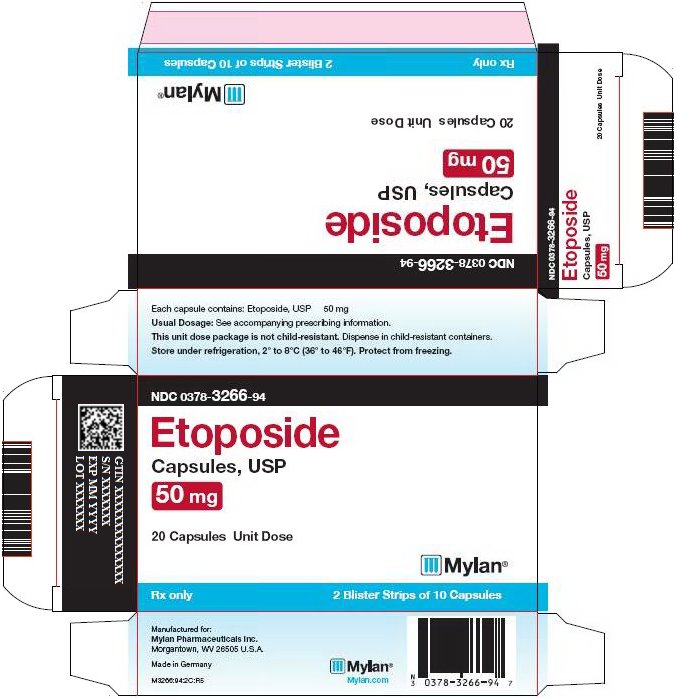
Etoposide 50 mg Capsule, 20-count — NDC 0378-3266-94 (Billing 00378-3266-94)
This is a package of 20 capsules of Etoposide 50 mg Capsule from Mylan Pharmaceuticals Inc., marketed since Oct 2001 and currently FDA-listed. It is this product's only package size.
NDC database record
One package, one record: these facts belong to NDC 0378-3266-94 alone.
- Record
- FDA NDC Directory package listing · Human prescription drug
- Code segments
- 0378 labeler · 3266 product · 94 package
- Package marketed since
- Oct 22, 2001
- Sample package
- No — commercial package
- Listing certified through
- Dec 31, 2026
- Billing quantity
- 20 EA per package
- Barcode (UPC-A, from the NDC)
- 3 0378326694 7
- Medicaid fills, this package
- 168 prescriptions in the last four reported quarters
- FDA record last changed
- Jul 24, 2026
Identity & classification
Regulatory identifiers FDA, NLM and CMS codes for this package
Drug-database identifiers Medi-Span GPI and First Databank GCN / HICL / AHFS classification
- GSN (GCN sequence number): 008838
- GCN: 07560
- GPI-14 (Medi-Span): 21500010000120
- HICL (First Databank): 003930
- AHFS class code: 10:00.00.00
- RxCUI (RxNorm): 197687
Where does this data come from?
- FDA openFDA NDC Directory · synced Oct 1, 2026
- FDA label on DailyMed · label index refreshed Oct 5, 2026
- RxNorm (NLM RxNav) · catalog refreshed Oct 1, 2026
- Medi-Span GPI (licensed)
- First Databank (licensed) · refreshed Oct 1, 2026
RxNorm drug class
This medicine belongs to the Topoisomerase Inhibitor class.
Where does this data come from?
- RxClass (NLM) · catalog refreshed Oct 1, 2026
Clinical
- It's a chemotherapy medicine used with other cancer drugs. It is used for small cell lung cancer, and the injection forms are also used for refractory testicular cancer, meaning ca...
- It comes as an IV injection given by your healthcare team, slowly over time, or as capsules you take by mouth. It's given in repeated courses, usually every 3 to 4 weeks. Capsules...
- Common ones are low blood counts, nausea and vomiting, poor appetite, diarrhea, mouth sores, and hair loss. Hair loss is usually reversible, and nausea can often be controlled with...
- Call right away for fever, chills, or signs of infection, unusual bleeding or bruising, or trouble breathing. Also report swelling of the face or tongue, a severe rash, or pain and...
Patient education
Supplement & herbal interactions
Some supplements/herbs that may interact with Etoposide — tap one for details:
Where does this data come from?
- MedlinePlus (NLM) · refreshed Oct 1, 2026
- FDA label on DailyMed · label index refreshed Oct 5, 2026
Ask a licensed pharmacist directly — free, answered by our team.
Pricing
A drug doesn't have one price. Each row is a different public payment system, and none is what you'd pay at the counter — that depends on your insurance. The ⓘ on each row explains what it measures.
| Price system | Per each | Per package |
|---|---|---|
| Retail pharmacies payNADAC · weekly | Not in the retail survey — common for institutional, discontinued, or low-volume packs. | |
| Medicaid paysCMS SDUD · 12 mo | $69.75 | $1,394.90 / 20 capsules |
| Medicare drug plans payPart D · quarterly | No Part D plan price is available for this NDC in our data. | |
| Medicare Part B allowsASP · NONE | No ASP payment limit on file for NONE this quarter. | |
Where does this data come from?
- CMS NADAC weekly file
- CMS ASP pricing files · refreshed Sep 20, 2026
- CMS Medicaid State Drug Utilization Data · through Q4 2025
- CMS Part D plan pricing files · refreshed Sep 24, 2026
- VA National Acquisition Center price file
Billing & reimbursement
Where does this data come from?
- CMS ASP NDC-HCPCS crosswalk · refreshed Sep 22, 2026
- DMEPDAC NDC-HCPCS crosswalk
- openFDA NSDE billing units · refreshed Sep 7, 2026
Packaging — all sizes for this product
| Package NDC | Description | Marketing start | Marketing end | Status |
|---|---|---|---|---|
| 00378-3266-94 You're viewing this Main listing | 20 CAPSULE in 1 CARTON | 2001-10-22 | — | Active |
Therapeutic equivalents
| Product | Labeler | Pack | NADAC/unit | TE | Status | Price vs. this |
|---|---|---|---|---|---|---|
| Etoposide 50 mgthis 00378-3266-94 | Mylan | 20 capsules | — | AB | FDA listed | — |
| VePesid 50 mg 69238-2811-02 | Amneal | 20 capsules | — | AB | FDA listed | — |
| Etoposide 50 mg 83270-0451-05 | Onesource | 20 capsules | — | AB | FDA listed | — |
Where does this data come from?
- FDA openFDA NDC Directory · synced Oct 1, 2026
- FDA Orange Book · refreshed Oct 3, 2026
- CMS NADAC weekly file
Availability & generic status
This product is an FDA-approved generic. Other versions of the same drug are listed under Therapeutic equivalents, least expensive first.
Where does this data come from?
- FDA Orange Book · refreshed Oct 3, 2026
Inactive Ingredients / Excipients
Inactive ingredients, also called excipients, are components of the drug product other than the active ingredient. They may include fillers, dyes, coatings, preservatives, flavors, or other formulation ingredients.
💡 Tap an ingredient (hover on desktop) to see what it is and why it’s used.
-
UNII XF417D3PSL
Anhydrous citric acid is a sour, crystalline powder derived from citric acid with water removed. In medicines, it acts as a buffer to control pH, adds tartness to improve taste, and helps tablets disintegrate.
-
UNII H3R47K3TBD
FD&C Blue No. 1 is a synthetic blue dye approved for use in foods and medicines. It serves as a colorant to give the medication its distinctive appearance and help with product identification.
-
UNII WZB9127XOA
A synthetic red dye used to color medications and make them easier to identify. It serves as a colorant in tablets, capsules, and liquid formulations.
-
UNII 1K09F3G675
Ferric oxide red is an inorganic iron compound used as a colorant in medicines. It gives tablets, capsules, or other dosage forms a red or reddish tint for identification and appearance.
-
UNII 2G86QN327L
Gelatin is a protein derived from animal collagen, commonly used in medicines as a gelling agent and capsule material. It helps create soft or hard capsule shells that hold and release medication, and can also thicken liquid formulations.
-
UNII PDC6A3C0OX
Glycerin is a clear, thick liquid derived from plant oils or fats. It acts as a humectant to retain moisture, a sweetener, and a solvent in medications.
-
UNII 3NXW29V3WO
Hypromellose is a plant-based thickener made from cellulose. It's used in medicines as a binder to hold ingredients together, a coating for tablets, and a thickener for liquids.
-
UNII 3WJQ0SDW1A
Polyethylene glycol is a synthetic liquid or solid polymer used in medicines as a solvent, lubricant, and humectant. It helps dissolve active ingredients, reduces friction during manufacturing, and retains moisture in the final product.
-
UNII 6DC9Q167V3
Propylene glycol is a clear liquid derived from petroleum or vegetable sources. It acts as a solvent, humectant, and preservative in medicines, helping dissolve active ingredients and maintain product stability.
-
UNII 15FIX9V2JP
Titanium dioxide is a bright white mineral powder commonly used as a colorant and opacifying agent. It makes pills and tablets white or lighter in color and helps make coatings non-transparent.
10 inactive ingredients listed in the exact product block matched to this NDC.
Where does this data come from?
ingredient classCode="IACT" elements from the exact product block matched by this NDC. Label-section narrative from DailyMed / the openFDA label index is shown separately when available.- FDA label on DailyMed · label index refreshed Oct 5, 2026
- FDA openFDA NDC Directory · synced Oct 1, 2026
Inactive ingredient FAQ
Are inactive ingredients the same for every manufacturer?
Why might an inactive ingredient be missing?
Can inactive ingredients matter?
Manufacturer & labeler
More NDCs from Mylan Pharmaceuticals Inc. labeler code 00378
- Doxepin Hydrochloride 25 mg Capsule NDC 0378-3125-01
- Prazosin Hydrochloride 5 mg Capsule NDC 0378-3205-01
- candesartan cilexetil 4 mg Tablet NDC 0378-3224-77
- candesartan cilexetil 8 mg Tablet NDC 0378-3225-77
- candesartan cilexetil 16 mg Tablet NDC 0378-3231-77
- candesartan cilexetil 32 mg Tablet NDC 0378-3232-77
- Xulane norelgestromin and ethinyl estradiol 150 ug/d; 35 ug/d Patch NDC 0378-3340-32
- Estradiol .025 mg/d Patch NDC 0378-3349-99
- Estradiol .05 mg/d Patch NDC 0378-3350-99
- Estradiol .075 mg/d Patch NDC 0378-3351-99
- Estradiol .1 mg/d Patch NDC 0378-3352-99
- Estradiol .0375 mg/d Patch NDC 0378-3360-99
Where does this data come from?
- FDA openFDA NDC Directory · synced Oct 1, 2026
- Drugs@FDA
Full prescribing information FDA SPL
🚨 Boxed Warning ▾
WARNINGS Etoposide should be administered under the supervision of a qualified physician experienced in the use of cancer chemotherapeutic agents. Severe myelosuppression with resulting infection or bleeding may occur.
🎯 Indications and Usage ▾
INDICATIONS AND USAGE Etoposide capsules are indicated in the management of the following neoplasms: Small Cell Lung Cancer Etoposide capsules in combination with other approved chemotherapeutic agents as first line treatment in patients with small cell lung cancer.
⏱️ Dosage and Administration ▾
DOSAGE AND ADMINISTRATION Etoposide Capsules In small cell lung cancer, the recommended dose of etoposide capsules is two times the IV dose rounded to the nearest 50 mg (i.e., Two times 35 mg/m 2 /day for 4 days to 50 mg/m 2 /day for 5 days). The dosage should be modified to take into account the myelosuppressive effects of other drugs in the combination or the effects of prior x-ray therapy or chemotherapy which may have compromised bone marrow reserve. Stability Etoposide capsules must be stored under refrigeration 2° to 8°C (36° to 46°F).
The capsules are stable for 36 months under such refrigeration conditions. Procedures for proper handling and disposal of anticancer drugs should be considered. Several guidelines on this subject have been published 1-8 .
There is no general agreement that all of the procedures recommended in the guidelines are necessary or appropriate.
⛔ Contraindications ▾
CONTRAINDICATIONS Etoposide capsules are contraindicated in patients who have demonstrated a previous hypersensitivity to etoposide or any component of the formulation.
⚠️ Warnings ▾
WARNINGS Patients being treated with etoposide must be frequently observed for myelosuppression both during and after therapy. Myelosuppression resulting in death has been reported. Dose-limiting bone marrow suppression is the most significant toxicity associated with etoposide therapy.
Therefore, the following studies should be obtained at the start of therapy and prior to each subsequent cycle of etoposide: platelet count, hemoglobin, white blood cell count and differential. The occurrence of a platelet count below 50,000/mm 3 or an absolute neutrophil count below 500/mm 3 is an indication to withhold further therapy until the blood counts have sufficiently recovered. Pregnancy Etoposide can cause fetal harm when administered to a pregnant woman.
Etoposide has been shown to be teratogenic in mice and rats. In rats, an intravenous etoposide dose of 0.4 mg/kg/day (about 1/20 th of the human dose on a mg/m2 basis) during organogenesis caused maternal toxicity, embryotoxicity, and teratogenicity (skeletal abnormalities, exencephaly, encephalocele and anophthalmia); higher doses of 1.2 mg/kg/day and 3.6 mg/kg/day (about 1/7 th and 1/2 of human dose on a mg/m 2 basis) resulted in 90% and 100% embryonic resorptions. In mice, a single 1.0 mg/kg (1/16 th of human dose on a mg/m 2 basis) dose of etoposide administered intraperitoneally on days 6, 7 or 8 of gestation caused embryotoxicity, cranial abnormalities, and major skeletal malformations.
An I.P. dose of 1.5 mg/kg (about 1/10 th of human dose on a mg/m 2 basis) on day 7 of gestation caused an increase in the incidence of intrauterine death and fetal malformations and a significant decrease in the average fetal body weight. Women of childbearing potential should be advised to avoid becoming pregnant. If this drug is used during pregnancy, or if the patient becomes pregnant while receiving this drug, the patient should be warned of the potential hazard to the fetus.
Etoposide should be considered a potential carcinogen in humans. The occurrence of acute leukemia with or without a preleukemic phase has been reported in rare instances in patients treated with etoposide alone or in association with other neoplastic agents. The risk of development of a preleukemic or leukemic syndrome is unclear.
Carcinogenicity tests with etoposide have not been conducted in laboratory animals.
🤒 Adverse Reactions ▾
ADVERSE REACTIONS The following data on adverse reactions are based on both oral and intravenous administration of etoposide as a single agent, using several different dose schedules for treatment of a wide variety of malignancies. Hematologic Toxicity Myelosuppression is dose related and dose limiting, with granulocyte nadirs occurring 7 to 14 days after drug administration and platelet nadirs occurring 9 to 16 days after drug administration. Bone marrow recovery is usually complete by day 20, and no cumulative toxicity has been reported.
Fever and infection have also been reported in patients with neutropenia. Death associated with myelosuppression has been reported. The occurrence of acute leukemia with or without a preleukemic phase has been reported rarely in patients treated with etoposide in association with other antineoplastic agents (see WARNINGS ).
Gastrointestinal Toxicity Nausea and vomiting are the major gastrointestinal toxicities. The severity of such nausea and vomiting is generally mild to moderate with treatment discontinuation required in 1% of patients. Nausea and vomiting can usually be controlled with standard antiemetic therapy.
Mild to severe mucositis/esophagitis may occur. Gastrointestinal toxicities are slightly more frequent after oral administration than after intravenous infusion. Hypotension Transient hypotension following rapid intravenous administration has been reported in 1% to 2% of patients.
It has not been associated with cardiac toxicity or electrocardiographic changes. No delayed hypotension has been noted. To prevent this rare occurrence, it is recommended that etoposide be administered by slow intravenous infusion over a 30- to 60-minute period.
If hypotension occurs, it usually responds to cessation of the infusion and administration of fluids or other supportive therapy as appropriate. When restarting the infusion, a slower administration rate should be used. Allergic Reactions Anaphylactic-like reactions characterized by chills, fever, tachycardia, bronchospasm, dyspnea and/or hypotension have been reported to occur in 0.7% to 2% of patients receiving intravenous etoposide and in less than 1% of the patients treated with the oral capsules.
These reactions have usually responded promptly to the cessation of the infusion and administration of pressor agents, corticosteroids, antihistamines or volume expanders as appropriate; however, the reactions can be fatal. Hypertension and/or flushing have also been reported. Blood pressure usually normalizes within a few hours after cessation of the infusion.
Anaphylactic-like reactions have occurred during the initial infusion of etoposide. Facial/tongue swelling, coughing, diaphoresis, cyanosis, tightness in throat, laryngospasm, back pain and/or loss of consciousness have sometimes occurred in association with the above reactions. In addition, an apparent hypersensitivity-associated apnea has been reported rarely.
Rash, urticaria, and/or pruritus have infrequently been reported at recommended doses. At investigational doses, a generalized pruritic erythematous maculopapular rash, consistent with perivasculitis, has been reported. Alopecia Reversible alopecia, sometimes progressing to total baldness, was observed in up to 66% of patients.
Other Toxicities The following adverse reactions have been infrequently reported: abdominal pain, aftertaste, constipation, dysphagia, asthenia, fatigue, malaise, somnolence, transient cortical blindness, optic neuritis, interstitial pneumonitis/pulmonary fibrosis, fever, seizure (occasionally associated with allergic reactions), Stevens-Johnson Syndrome, and toxic epidermal necrolysis, pigmentation, and a single report of radiation recall dermatitis. Hepatic toxicity, generally in patients receiving higher doses of the drug than those recommended, has been reported with etoposide.
Metabolic acidosis has also been reported in patients receiving higher doses. The incidences of adverse reactions in the table t… [Excerpted — this section continues on DailyMed.]
🔄 Drug Interactions ▾
Drug Interactions High-dose cyclosporin A resulting in concentrations above 2000 ng/mL administered with oral etoposide has led to an 80% increase in etoposide exposure with a 38% decrease in total body clearance of etoposide compared to etoposide alone.
🤰 Pregnancy ▾
Pregnancy Teratogenic Effects Pregnancy Category D (see WARNINGS ).
🧒 Pediatric Use ▾
Pediatric Use Safety and effectiveness in pediatric patients have not been established.
🧓 Geriatric Use ▾
Geriatric Use Of more than 600 patients in four clinical studies in the NDA databases who received etoposide or etoposide phosphate in combination with other chemotherapeutic agents for the treatment of small cell lung cancer (SCLC), about one-third were older than 65 years. When advanced age was determined to be a prognostic factor for response or survival in these studies, comparisons between treatment groups were performed for the elderly subset. In the one study (etoposide in combination with cyclophosphamide and vincristine compared with cyclophosphamide and vincristine or cyclophosphamide, vincristine and doxorubicin) where age was a significant prognostic factor for survival, a survival benefit for elderly patients was observed for the etoposide regimen compared with the control regimens.
No differences in myelosuppression were seen between elderly and younger patients in these studies except for an increased frequency of WHO Grade III or IV leukopenia among elderly patients in a study of etoposide phosphate or etoposide in combination with cisplatin. Elderly patients in this study also had more anorexia, mucositis, dehydration, somnolence and elevated BUN levels than younger patients. In five single-agent studies of etoposide phosphate in patients with a variety of tumor types, 34% of patients were age 65 years or more.
WHO Grade III or IV leukopenia, granulocytopenia and asthenia were more frequent among elderly patients. Post-marketing experience also suggests that elderly patients may be more sensitive to some of the known adverse effects of etoposide, including myelosuppression, gastrointestinal effects, infectious complications and alopecia. Although some minor differences in pharmacokinetic parameters between elderly and nonelderly patients have been observed, these differences were not considered clinically significant.
Etoposide and its metabolites are known to be substantially excreted by the kidney, and the risk of adverse reactions to this drug may be greater in patients with impaired renal function. Because elderly patients are more likely to have decreased renal function, care should be taken in dose selection, and it may be useful to monitor renal function (see PRECAUTIONS: Renal Impairment for recommended dosing adjustments in patients with renal impairment).
🆘 Overdosage ▾
OVERDOSAGE No proven antidotes have been established for etoposide overdosage.
🧬 Clinical Pharmacology ▾
CLINICAL PHARMACOLOGY Etoposide has been shown to cause metaphase arrest in chick fibroblasts. Its main effect, however, appears to be at the G 2 portion of the cell cycle in mammalian cells. Two different dose dependent responses are seen.
At high concentrations (10 mcg/mL or more), lysis of cells entering mitosis is observed. At low concentrations (0.3 mcg/mL to 10 mcg/mL), cells are inhibited from entering prophase. It does not interfere with microtubular assembly.
The predominant macromolecular effect of etoposide appears to be the induction of DNA strand breaks by an interaction with DNA topoisomerase II or the formation of free radicals. Pharmacokinetics On intravenous administration, the disposition of etoposide is best described as a biphasic process with a distribution half-life of about 1.5 hours and terminal elimination half-life ranging from 4 to 11 hours. Total body clearance values range from 33 mL/min to 48 mL/min or 16 mL/min/m 2 to 36 mL/min/m 2 and, like the terminal elimination half-life, are independent of dose over a range 100 mg/m 2 to 600 mg/m 2 .
Over the same dose range, the areas under the plasma concentration vs. time curves (AUC) and the maximum plasma concentration (C max ) values increase linearly with dose. Etoposide does not accumulate in the plasma following daily administration of 100 mg/m 2 for 4 to 5 days. The mean volumes of distribution at steady-state fall in the range of 18 to 29 liters or 7 L/m 2 to 17 L/m 2 .
Etoposide enters the CSF poorly. Although it is detectable in CSF and intracerebral tumors, the concentrations are lower than in extracerebral tumors and in plasma. Etoposide concentrations are higher in normal lung than in lung metastases and are similar in primary tumors and normal tissues of the myometrium.
In vitro , etoposide is highly protein bound (97%) to human plasma proteins. An inverse relationship between plasma albumin levels and etoposide renal clearance is found in children. In a study determining the effect of other therapeutic agents on the in vitro binding of 14 C-etoposide to human serum proteins, only phenylbutazone, sodium salicylate and aspirin displaced protein bound etoposide at concentrations achieved in vivo .
Etoposide binding ratio correlates directly with serum albumin in patients with cancer and in normal volunteers. The unbound fraction of etoposide significantly correlated with bilirubin in a population of cancer patients. Data have suggested a significant inverse correlation between serum albumin concentration and free fraction of etoposide (see PRECAUTIONS ).
After intravenous administration of 14 C-etoposide (100 mg/m 2 to 124 mg/m 2 ), mean recovery of radioactivity in the urine was 56% of the dose at 120 hours, 45% of which was excreted as etoposide; fecal recovery of radioactivity was 44% of the dose at 120 hours. In children, approximately 55% of the dose is excreted in the urine as etoposide in 24 hours. The mean renal clearance of etoposide is 7 mL/min/m 2 to 10 mL/min/m 2 or about 35% of the total body clearance over a dose range of 80 mg/m 2 to 600 mg/m 2 .
Etoposide, therefore, is cleared by both renal and nonrenal processes, i.e., metabolism and biliary excretion. The effect of renal disease on plasma etoposide clearance is not known. Biliary excretion of unchanged drug and/or metabolites is an important route of etoposide elimination as fecal recovery of radioactivity is 44% of the intravenous dose.
The hydroxy acid metabolite [4’-demethylepipodophyllic acid-9-(4,6-0-( R )-ethylidene-ß-D-glucopyranoside)], formed by opening of the lactone ring, is found in the urine of adults and children. It is also present in human plasma, presumably as the trans isomer. Glucoronide and/or sulfate conjugates of etoposide are also excreted in human urine.
Only 8% or less of an intravenous dose is excreted in the urine as radiolabeled metabolites of 14 C-etoposide. In addition, 0-demethylation of the dimethoxyphenol ring occurs through the CYP450 3A4 i… [Excerpted — this section continues on DailyMed.]
📦 How Supplied / Storage and Handling ▾
HOW SUPPLIED Etoposide Capsules, USP are available containing 50 mg of etoposide, USP. The 50 mg capsule is an opaque dark pink, soft gelatin capsule printed with E50 in black ink. They are available as follows: NDC 0378-3266-94 20 Capsules - Unit Dose Capsules are to be stored under refrigeration, between 2° to 8°C (36° to 46°F). Protect from freezing. Dispense in a tight, light-resistant container as defined in the USP using a child-resistant closure.
📋 Description ▾
DESCRIPTION Etoposide (also commonly known as VP-16) is a semisynthetic derivative of podophyllotoxin used in the treatment of certain neoplastic diseases. It is 4’-Demethylepipodophyllotoxin 9-[4,6-O-( R )-ethylidene-β-D-glucopyranoside]. It is very soluble in methanol and chloroform, slightly soluble in ethanol, and sparingly soluble in water and ether.
It is made more miscible with water by means of organic solvents. It has a molecular weight of 588.56 and a molecular formula of C 29 H 32 O 13 . Etoposide may be administered either intravenously or orally.
Etoposide capsules, USP are available as 50 mg opaque dark pink, oblong capsules. Each liquid filled, soft gelatin capsule contains 50 mg of etoposide, USP in a vehicle consisting of citric acid anhydrous, glycerol and polyethylene glycol. The soft gelatin capsules contain anidrisorb, gelatin and glycerol with the following dye system: red iron oxide and titanium dioxide; the capsules are printed with edible black ink containing FD&C Blue No.
1 Aluminum Lake, FD&C Red No. 40 Aluminum Lake, hypromellose and propylene glycol. The structural formula is: Etoposide Structural Formula
⚠️ Precautions ▾
PRECAUTIONS General In all instances where the use of etoposide is considered for chemotherapy, the physician must evaluate the need and usefulness of the drug against the risk of adverse reactions. Most such adverse reactions are reversible if detected early. If severe reactions occur, the drug should be reduced in dosage or discontinued and appropriate corrective measures should be taken according to the clinical judgment of the physician.
Reinstitution of etoposide therapy should be carried out with caution, and with adequate consideration of the further need for the drug and alertness as to possible recurrence of toxicity. Patients with low serum albumin may be at an increased risk for etoposide associated toxicities. Drug Interactions High-dose cyclosporin A resulting in concentrations above 2000 ng/mL administered with oral etoposide has led to an 80% increase in etoposide exposure with a 38% decrease in total body clearance of etoposide compared to etoposide alone.
Laboratory Tests Periodic complete blood counts should be done during the course of etoposide treatment. They should be performed prior to each cycle of therapy and at appropriate intervals during and after therapy. At least one determination should be done prior to each dose of etoposide.
Renal Impairment In patients with impaired renal function, the following initial dose modification should be considered based on measured creatinine clearance: Measured Creatinine Clearance > 50 mL/min 15 to 50 mL/min etoposide 100% of dose 75% of dose Subsequent etoposide dosing should be based on patient tolerance and clinical effect. Data are not available in patients with creatinine clearances < 15 mL/min and further dose reduction should be considered in these patients. Carcinogenesis (see WARNINGS), Mutagenesis, Impairment of Fertility Etoposide has been shown to be mutagenic in Ames assay.
Treatment of Swiss-Albino mice with 1.5 mg/kg I.P. of etoposide on day 7 of gestation increased the incidence of intrauterine death and fetal malformations as well as significantly decreased the average fetal body weight. Maternal weight gain was not affected. Irreversible testicular atrophy was present in rats treated with etoposide intravenously for 30 days at 0.5 mg/kg/day (about 1/16 th of the human dose on a mg/m 2 basis).
Pregnancy Teratogenic Effects Pregnancy Category D (see WARNINGS ). Nursing Mothers It is not known whether this drug is excreted in human milk. Because many drugs are excreted in human milk and because of the potential for serious adverse reactions in nursing infants from etoposide, a decision should be made whether to discontinue nursing or to discontinue the drug, taking into account the importance of the drug to the mother.
Pediatric Use Safety and effectiveness in pediatric patients have not been established. Geriatric Use Of more than 600 patients in four clinical studies in the NDA databases who received etoposide or etoposide phosphate in combination with other chemotherapeutic agents for the treatment of small cell lung cancer (SCLC), about one-third were older than 65 years. When advanced age was determined to be a prognostic factor for response or survival in these studies, comparisons between treatment groups were performed for the elderly subset.
In the one study (etoposide in combination with cyclophosphamide and vincristine compared with cyclophosphamide and vincristine or cyclophosphamide, vincristine and doxorubicin) where age was a significant prognostic factor for survival, a survival benefit for elderly patients was observed for the etoposide regimen compared with the control regimens. No differences in myelosuppression were seen between elderly and younger patients in these studies except for an increased frequency of WHO Grade III or IV leukopenia among elderly patients in a study of etoposide phosphate or etoposide in combination with cisplatin.
Elderly patients in this study also had more anorexia, mucositis, dehydration, somnolence a… [Excerpted — this section continues on DailyMed.]
🍼 Nursing Mothers ▾
Nursing Mothers It is not known whether this drug is excreted in human milk. Because many drugs are excreted in human milk and because of the potential for serious adverse reactions in nursing infants from etoposide, a decision should be made whether to discontinue nursing or to discontinue the drug, taking into account the importance of the drug to the mother.
🧬 Pharmacokinetics ▾
Pharmacokinetics On intravenous administration, the disposition of etoposide is best described as a biphasic process with a distribution half-life of about 1.5 hours and terminal elimination half-life ranging from 4 to 11 hours. Total body clearance values range from 33 mL/min to 48 mL/min or 16 mL/min/m 2 to 36 mL/min/m 2 and, like the terminal elimination half-life, are independent of dose over a range 100 mg/m 2 to 600 mg/m 2 . Over the same dose range, the areas under the plasma concentration vs. time curves (AUC) and the maximum plasma concentration (C max ) values increase linearly with dose.
Etoposide does not accumulate in the plasma following daily administration of 100 mg/m 2 for 4 to 5 days. The mean volumes of distribution at steady-state fall in the range of 18 to 29 liters or 7 L/m 2 to 17 L/m 2 . Etoposide enters the CSF poorly.
Although it is detectable in CSF and intracerebral tumors, the concentrations are lower than in extracerebral tumors and in plasma. Etoposide concentrations are higher in normal lung than in lung metastases and are similar in primary tumors and normal tissues of the myometrium. In vitro , etoposide is highly protein bound (97%) to human plasma proteins.
An inverse relationship between plasma albumin levels and etoposide renal clearance is found in children. In a study determining the effect of other therapeutic agents on the in vitro binding of 14 C-etoposide to human serum proteins, only phenylbutazone, sodium salicylate and aspirin displaced protein bound etoposide at concentrations achieved in vivo . Etoposide binding ratio correlates directly with serum albumin in patients with cancer and in normal volunteers.
The unbound fraction of etoposide significantly correlated with bilirubin in a population of cancer patients. Data have suggested a significant inverse correlation between serum albumin concentration and free fraction of etoposide (see PRECAUTIONS ). After intravenous administration of 14 C-etoposide (100 mg/m 2 to 124 mg/m 2 ), mean recovery of radioactivity in the urine was 56% of the dose at 120 hours, 45% of which was excreted as etoposide; fecal recovery of radioactivity was 44% of the dose at 120 hours.
In children, approximately 55% of the dose is excreted in the urine as etoposide in 24 hours. The mean renal clearance of etoposide is 7 mL/min/m 2 to 10 mL/min/m 2 or about 35% of the total body clearance over a dose range of 80 mg/m 2 to 600 mg/m 2 . Etoposide, therefore, is cleared by both renal and nonrenal processes, i.e., metabolism and biliary excretion.
The effect of renal disease on plasma etoposide clearance is not known. Biliary excretion of unchanged drug and/or metabolites is an important route of etoposide elimination as fecal recovery of radioactivity is 44% of the intravenous dose. The hydroxy acid metabolite [4’-demethylepipodophyllic acid-9-(4,6-0-( R )-ethylidene-ß-D-glucopyranoside)], formed by opening of the lactone ring, is found in the urine of adults and children.
It is also present in human plasma, presumably as the trans isomer. Glucoronide and/or sulfate conjugates of etoposide are also excreted in human urine. Only 8% or less of an intravenous dose is excreted in the urine as radiolabeled metabolites of 14 C-etoposide.
In addition, 0-demethylation of the dimethoxyphenol ring occurs through the CYP450 3A4 isoenzyme pathway to produce the corresponding catechol. After either intravenous infusion or oral capsule administration, the C max and AUC values exhibit marked intra- and inter-subject variability. This results in variability in the estimates of the absolute oral bioavailability of etoposide oral capsules.
C max and AUC values for orally administered etoposide capsules consistently fall in the same range as the C max and AUC values for an intravenous dose of one-half the size of the oral dose. The overall mean value of oral capsule bioavailability is approximately 50% (range 25% to 75%). The bioavailability of etoposide capsules appears to be… [Excerpted — this section continues on DailyMed.]
📄 Carcinogenesis, Mutagenesis, Impairment of Fertility ▾
Carcinogenesis (see WARNINGS), Mutagenesis, Impairment of Fertility Etoposide has been shown to be mutagenic in Ames assay. Treatment of Swiss-Albino mice with 1.5 mg/kg I.P. of etoposide on day 7 of gestation increased the incidence of intrauterine death and fetal malformations as well as significantly decreased the average fetal body weight. Maternal weight gain was not affected.
Irreversible testicular atrophy was present in rats treated with etoposide intravenously for 30 days at 0.5 mg/kg/day (about 1/16 th of the human dose on a mg/m 2 basis).
📚 References ▾
REFERENCES 1. ONS Clinical Practice Committee. Cancer Chemotherapy Guidelines and Recommendations for Practice.
Pittsburgh, PA: Oncology Nursing Society; 1999:32-41. 2. Recommendations for the safe handling of parenteral antineoplastic drugs.
Washington, DC: Division of Safety, National Institutes of Health; 1983. US Dept of Health and Human Services, Public Health Service publication NIH 83-2621. 3.
AMA Council on Scientific Affairs. Guidelines for handling parenteral antineoplastics. JAMA.1985; 253: 1590-1591.
4. National Study Commission on Cytotoxic Exposure. Recommendations for handling cytotoxic agents.
1987. Available from Louis P. Jeffrey, Chairman, National Study Commission on Cytotoxic Exposure.
Massachusetts College of Pharmacy and Allied Health Sciences, 179 Longwood Avenue, Boston, MA 02115. 5. Clinical Oncological Society of Australia.
Guidelines and recommendations for safe handling of antineoplastic agents. Med J Australia.1983; 1:426–428. 6.
Jones RB, Frank R, Mass T. Safe handling of chemotherapeutic agents: a report from the Mount Sinai Medical Center. CA–A Cancer J for Clin.1983; 33:258–263.
7. American Society of Hospital Pharmacists, ASHP technical assistance bulletin on handling cytotoxic and hazardous drugs. Am J Hosp Pharm.1990; 47:1033–1049.
8. Controlling Occupational Exposure to Hazardous Drugs. (OSHA Work-Practice Guidelines.).
Am J Health-SystPharm.1996; 53:1669-1685. Manufactured for: Mylan Pharmaceuticals Inc. Morgantown, WV 26505 U.S.A.
Manufactured by: Catalent Germany Eberbach GmbH D-69412 Eberbach/Baden Germany REVISED: 4/2016 ETOP:R3
📄 Package Label / Principal Display Panel ▾
PRINCIPAL DISPLAY PANEL - 50 mg NDC 0378-3266-94 Etoposide Capsules, USP 50 mg 20 Capsules Unit Dose Rx only 2 Blister Strips of 10 Capsules Each capsule contains: Etoposide, USP 50 mg Usual Dosage: See accompanying prescribing information. This unit dose package is not child-resistant. Dispense in child-resistant containers.
Store under refrigeration, 2° to 8°C (36° to 46°F). Protect from freezing. Manufactured for: Mylan Pharmaceuticals Inc.
Morgantown, WV 26505 Made in Germany M3266:94:2C:R5 Mylan.com Etoposide Capsules 50 mg Carton Label
Medicaid utilization & spend
Medicare Part D spend CMS · PART D · 2026 (Q1)
About this NDC listing & data coverage
What data is (and isn’t) available for this NDC — tap to expand
| NDC identity (package / product / labeler codes) | ✓ Available |
| Labeler | ✓ Available |
| Product & package description | ✓ Available |
| Marketing category & status | ✓ Available |
| Active ingredient / dosage form / route | ✓ Available |
| FDA label (SPL via DailyMed) | ✓ Available |
| Package photos | ✓ Available |
| Inactive ingredients (structured) | ✓ Available |
| NADAC pharmacy acquisition price (CMS) | — Not published for this NDC CMS publishes NADAC only for NDCs reported in its retail-pharmacy survey. |
| Orange Book / therapeutic-equivalence data | ✓ Available |
| HCPCS J-code billing crosswalk | ✓ Available |
| Medicaid utilization (CMS SDUD) | ✓ Available |