
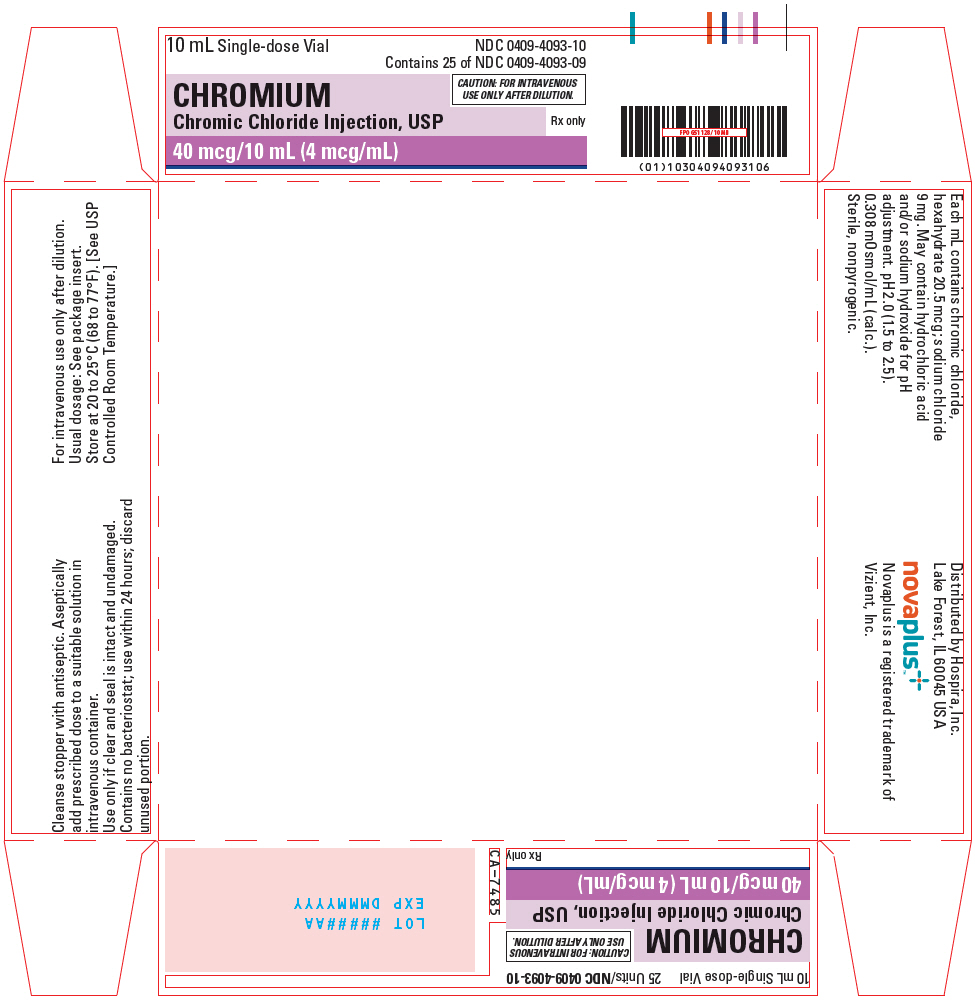
Chromium Chromic Chloride 4 ug/mL Injection, Solution — NDC 0409-4093-01 (Billing 00409-4093-01)
This is a package of Chromium Chromic Chloride 4 ug/mL Injection, Solution from Hospira, Inc., marketed since Apr 2016 and currently FDA-listed. It is the main listing for this product, which comes in 2 package sizes.
NDC database record
One package, one record: these facts belong to NDC 0409-4093-01 alone.
- Record
- FDA NDC Directory package listing · Human prescription drug
- Code segments
- 0409 labeler · 4093 product · 01 package
- Package marketed since
- Jun 30, 2005
- Sample package
- No — commercial package
- Listing certified through
- Dec 31, 2027
- Barcode (UPC-A, from the NDC)
- 3 0409409301 7
- Medicaid fills, this package
- 1,553 prescriptions in the last four reported quarters
- FDA record last changed
- Jul 24, 2026
Identity & classification
Regulatory identifiers FDA, NLM and CMS codes for this package
Drug-database identifiers Medi-Span GPI and First Databank GCN / HICL / AHFS classification
- GSN (GCN sequence number): 001707
- GCN: 05312
- GPI-14 (Medi-Span): 79900030122020
- HICL (First Databank): 000760
- AHFS class code: 40:12.00.00
- RxCUI (RxNorm): 204401
Where does this data come from?
- FDA openFDA NDC Directory · synced Oct 8, 2026
- FDA label on DailyMed · label index refreshed Oct 8, 2026
- RxNorm (NLM RxNav) · catalog refreshed Oct 1, 2026
- Medi-Span GPI (licensed)
- First Databank (licensed) · refreshed Oct 8, 2026
Clinical
Patient education
Supplement & herbal interactions
Where does this data come from?
- MedlinePlus (NLM) · refreshed Oct 8, 2026
- FDA label on DailyMed · label index refreshed Oct 8, 2026
Ask a licensed pharmacist directly — free, answered by our team.
Pricing
A drug doesn't have one price. Each row is a different public payment system, and none is what you'd pay at the counter — that depends on your insurance. The ⓘ on each row explains what it measures.
| Price system | Per mL | Per package |
|---|---|---|
| Retail pharmacies payNADAC · weekly | Not in the retail survey — common for institutional, discontinued, or low-volume packs. | |
| Medicaid paysCMS SDUD · 12 mo | $93.94 | $23,485.98 / 250 ml |
| Medicare drug plans payPart D · quarterly | No Part D plan price is available for this NDC in our data. | |
Where does this data come from?
- CMS NADAC weekly file
- CMS ASP pricing files · refreshed Sep 20, 2026
- CMS Medicaid State Drug Utilization Data · through Q1 2026
- CMS Part D plan pricing files · refreshed Sep 24, 2026
- VA National Acquisition Center price file
Packaging — all sizes for this product
| Package NDC | Description | Marketing start | Marketing end | Status |
|---|---|---|---|---|
| 00409-4093-10 0409-4093-10 | 25 VIAL, SINGLE-DOSE in 1 TRAY / 10 mL in 1 VIAL, SINGLE-DOSE | 2016-04-27 | — | Active |
| 00409-4093-01 You're viewing this Main listing | 25 VIAL, SINGLE-DOSE in 1 TRAY / 10 mL in 1 VIAL, SINGLE-DOSE | 2005-06-30 | — | Active |
In Medicaid, this is the most-dispensed pack of this product — about 100% of fills over the last four reported quarters. See all packs ↓
Pack size FAQ
What quantity is in this package?
What NDC number is used to bill for this package of Chromium Chromic Chloride 4 ug/mL Injection, Solution?
Therapeutic equivalents
| Product | Labeler | Pack | NADAC/unit | TE | Status | Price vs. this |
|---|---|---|---|---|---|---|
| Chromium 4 ug/mLthis 00409-4093-01 | Hospira, | 25 vials | — | AP | FDA listed | — |
| Chromic Chloride 4 ug/mL 72819-0235-16 | Archis | 25 vials | — | AP | FDA listed | — |
Where does this data come from?
- FDA openFDA NDC Directory · synced Oct 8, 2026
- FDA Orange Book · refreshed Oct 3, 2026
- CMS NADAC weekly file
Availability & generic status
The FDA lists approved generic versions of this medicine, but that does not always mean a pharmacy can get one today. Patent rules, launch agreements, supply and pricing can affect when generics actually arrive.
Where does this data come from?
- FDA Orange Book · refreshed Oct 3, 2026
Inactive Ingredients / Excipients
Inactive ingredients, also called excipients, are components of the drug product other than the active ingredient. They may include fillers, dyes, coatings, preservatives, flavors, or other formulation ingredients.
💡 Tap an ingredient (hover on desktop) to see what it is and why it’s used.
-
UNII QTT17582CB
A strong acid used to adjust and maintain the proper pH level in liquid medicines, ensuring stability and preventing breakdown of active ingredients.
-
9 mg / 1 mL
UNII 451W47IQ8X
Sodium chloride is common table salt. It's used in medicines as a buffer to maintain proper pH, as a filler to add bulk, or to adjust the osmotic balance in liquid formulations.
-
UNII 55X04QC32I
A strong alkaline chemical used to adjust and maintain the pH balance of liquid medicines. It helps keep the medicine stable and ensures it stays effective during storage.
3 inactive ingredients listed in the exact product block matched to this NDC.
Where does this data come from?
ingredient classCode="IACT" elements from the exact product block matched by this NDC. Label-section narrative from DailyMed / the openFDA label index is shown separately when available.- FDA label on DailyMed · label index refreshed Oct 8, 2026
- FDA openFDA NDC Directory · synced Oct 8, 2026
Inactive ingredient FAQ
Are inactive ingredients the same for every manufacturer?
Why might an inactive ingredient be missing?
Can inactive ingredients matter?
Manufacturer & labeler
More NDCs from Hospira, Inc. labeler code 00409
- Bacteriostatic Water 1 mL/mL Injection, Solution NDC 0409-3977-03
- Verapamil Hydrochloride 2.5 mg/mL Injection, Solution NDC 0409-4011-01
- Mannitol 12.5 g/50mL Injection, Solution NDC 0409-4031-01
- ZINC 1 mg/mL Injection, Solution NDC 0409-4090-01
- MANGANESE .1 mg/mL Injection, Solution NDC 0409-4091-01
- COPPER CUPRIC CHLORIDE .4 mg/mL Injection, Solution NDC 0409-4092-01
- Magnesium Sulfate in Water 4 g/100mL Injection, Solution NDC 0409-4121-24
- Marcaine with Epinephrine BUPIVACAINE HYDROCHLORIDE AND 5 mg/mL; .0091 mg/mL Injection, Solution NDC 0409-4208-10
- Docetaxel 20 mg/mL Injection, Solution NDC 0409-4235-01
- Hydromorphone Hydrochloride .5 mg/.5mL Injection, Solution NDC 0409-4264-01
- Lidocaine Hydrochloride 5 mg/mL Injection, Solution NDC 0409-4275-01
- Lidocaine Hydrochloride 10 mg/mL Injection, Solution NDC 0409-4276-01
Where does this data come from?
- FDA openFDA NDC Directory · synced Oct 8, 2026
- Drugs@FDA
Full prescribing information FDA SPL
🎯 Indications and Usage ▾
INDICATIONS AND USAGE Chromium 4 mcg/mL (Chromic Chloride Injection, USP) is indicated for use as a supplement to intravenous solutions given for TPN. Administration helps to maintain chromium serum levels and to prevent depletion of endogenous stores and subsequent deficiency symptoms.
⏱️ Dosage and Administration ▾
DOSAGE AND ADMINISTRATION Chromium 4 mcg/mL (Chromic Chloride Injection, USP) contains 4 mcg chromium/mL and is administered intravenously only after dilution. The additive should be administered in a volume of fluid not less than 100 mL. For the adult receiving TPN, the suggested additive dosage is 10 to 15 mcg chromium/day (2.5 to 3.75 mL/day).
The metabolically stable adult with intestinal fluid loss may require 20 mcg chromium/day (5 mL/day), with frequent monitoring of blood levels as a guideline for subsequent administration. For pediatric patients, the suggested additive dosage is 0.14 to 0.20 mcg/kg/day (0.035 to 0.05 mL/kg/day). Parenteral drug products should be inspected visually for particulate matter and discoloration prior to administration, whenever solution and container permit.
See PRECAUTIONS .
⛔ Contraindications ▾
CONTRAINDICATIONS None known.
⚠️ Warnings ▾
WARNINGS Direct intramuscular or intravenous injection of Chromium 4 mcg/mL (Chromic Chloride Injection, USP) is contraindicated, as the acidic pH of the solution may cause considerable tissue irritation. Severe kidney disease may make it necessary to reduce or omit chromium and zinc doses because these elements are primarily eliminated in the urine. WARNING: This product contains aluminum that may be toxic.
Aluminum may reach toxic levels with prolonged parenteral administration if kidney function is impaired. Premature neonates are particularly at risk because their kidneys are immature, and they require large amounts of calcium and phosphate solutions, which contain aluminum. Research indicates that patients with impaired kidney function, including premature neonates, who receive parenteral levels of aluminum at greater than 4 to 5 mcg/kg/day accumulate aluminum at levels associated with central nervous system and bone toxicity.
Tissue loading may occur at even lower rates of administration.
🤒 Adverse Reactions ▾
ADVERSE REACTIONS None known.
🤰 Pregnancy ▾
Pregnancy Animal reproduction studies have not been conducted with chromic chloride. It is also not known whether chromic chloride can cause fetal harm when administered to a pregnant woman or can affect reproductive capacity. Chromic chloride should be given to a pregnant woman only if clearly indicated.
🧒 Pediatric Use ▾
Pediatric Use See DOSAGE and ADMINISTRATION section. Safety and effectiveness in children have not been established.
🧓 Geriatric Use ▾
Geriatric Use An evaluation of current literature revealed no clinical experience identifying differences in response between elderly and younger patients. In general, dose selection for an elderly patient should be cautious, usually starting at the low end of the dosing range, reflecting the greater frequency of decreased hepatic, renal, or cardiac function, and of concomitant disease or other drug therapy. This drug is known to be substantially excreted by the kidney, and the risk of toxic reactions to this drug may be greater in patients with impaired renal function.
Because elderly patients are more likely to have decreased renal function, care should be taken in dose selection, and it may be useful to monitor renal function.
🆘 Overdosage ▾
OVERDOSAGE Trivalent chromium administered intravenously to TPN patients has been shown to be nontoxic when given at dosage levels of up to 250 mcg/day for two consecutive weeks. Reported toxic reactions to chromium include nausea, vomiting, ulcers of the gastrointestinal tract, renal and hepatic damage, convulsions and coma. The acute LD 50 for intravenous trivalent chromium in rats was reported as 10 to 18 mg/kg.
🧬 Clinical Pharmacology ▾
CLINICAL PHARMACOLOGY Trivalent chromium is part of glucose tolerance factor, an essential activator of insulin-mediated reactions. Chromium helps to maintain normal glucose metabolism and peripheral nerve function. Providing chromium during TPN helps prevent deficiency symptoms including impaired glucose tolerance, ataxia, peripheral neuropathy and a confusional state similar to mild/moderate hepatic encephalopathy.
Serum chromium is bound to transferrin (siderophilin) in the beta globulin fraction. Typical blood levels for chromium range from 1 to 5 mcg/liter, but blood levels are not considered a meaningful index of tissue stores. Administration of chromium supplements to chromium-deficient patients can result in normalization of the glucose tolerance curve from the diabetic-like curve typical of chromium deficiency.
This response is viewed as a more meaningful indicator of chromium nutriture than serum chromium levels. Excretion of chromium is via the kidneys, ranging from 3 to 50 mcg/day. Biliary excretion via the small intestine may be an ancillary route, but only small amounts of chromium are believed to be excreted in this manner.
📦 How Supplied / Storage and Handling ▾
HOW SUPPLIED Chromium (Chromic Chloride Injection, USP) is supplied as follows: Unit of Sale Concentration NDC 0409-4093-10 40 mcg/10 mL Tray of 25 Single-dose plastic vials (4 mcg/mL) Store at 20 to 25ºC (68 to 77ºF). [See USP Controlled Room Temperature.] Distributed by Hospira, Inc., Lake Forest, IL 60045 USA Novaplus is a registered trademark of Vizient, Inc. LAB-1066-3.0 Revised: 4/2021 Novaplus Logo
📋 Description ▾
DESCRIPTION Chromium 4 mcg/mL (Chromic Chloride Injection, USP) is a sterile, nonpyrogenic solution intended for use as an additive to intravenous solutions for total parenteral nutrition (TPN). Each mL of solution contains 20.5 mcg chromic chloride, hexahydrate and 9 mg sodium chloride. The solution contains no bacteriostat, antimicrobial agent, or added buffer.
The pH is 2.0 (1.5 to 2.5); product may contain hydrochloric acid and/or sodium hydroxide for pH adjustment. The osmolarity is 0.308 mOsm/mL (calc.). Chromic Chloride, USP is chemically designated chromic chloride, hexahydrate CrCl 3 • 6H 2 O, a crystalline compound soluble in water.
Sodium Chloride, USP is chemically designated NaCl, a white, crystalline compound freely soluble in water. The semi-rigid vial is fabricated from a specially formulated polyolefin. It is a copolymer of ethylene and propylene.
The safety of the plastic has been confirmed by tests in animals according to USP biological standards for plastic containers. The small amount of water vapor that can pass through the plastic container wall will not significantly alter the drug concentration.
⚠️ Precautions ▾
PRECAUTIONS General Do not use unless solution is clear and seal is intact. Chromium 4 mcg/mL (Chromic Chloride Injection, USP) should only be used in conjunction with a pharmacy directed admixture program using aseptic technique in a laminar flow environment; it should be used promptly and in a single operation without any repeated penetrations. Solution contains no preservatives; discard unused portion immediately after admixture procedure is completed.
In assessing the contribution of chromium supplements to maintenance of glucose homeostasis, consideration should be given to the possibility that the patient may be diabetic. Geriatric Use An evaluation of current literature revealed no clinical experience identifying differences in response between elderly and younger patients. In general, dose selection for an elderly patient should be cautious, usually starting at the low end of the dosing range, reflecting the greater frequency of decreased hepatic, renal, or cardiac function, and of concomitant disease or other drug therapy.
This drug is known to be substantially excreted by the kidney, and the risk of toxic reactions to this drug may be greater in patients with impaired renal function. Because elderly patients are more likely to have decreased renal function, care should be taken in dose selection, and it may be useful to monitor renal function. Laboratory Tests Because chromium is present in the bloodstream in microgram quantities, routine measurement is impractical.
If necessary, samples can be sent to a reference laboratory for assay. Carcinogenesis, Mutagenesis, and Impairment of Fertility Long-term animal studies to evaluate the carcinogenic potential of Chromium 4 mcg/mL (Chromic Chloride Injection, USP) have not been performed, nor have studies been done to assess mutagenesis or impairment of fertility. Nursing Mothers It is not known whether this drug is excreted in human milk.
Because many drugs are excreted in human milk, caution should be exercised when Chromium 4 mcg/mL (Chromic Chloride Injection, USP) is administered to a nursing woman. Pediatric Use See DOSAGE and ADMINISTRATION section. Safety and effectiveness in children have not been established.
Pregnancy Animal reproduction studies have not been conducted with chromic chloride. It is also not known whether chromic chloride can cause fetal harm when administered to a pregnant woman or can affect reproductive capacity. Chromic chloride should be given to a pregnant woman only if clearly indicated.
🍼 Nursing Mothers ▾
Nursing Mothers It is not known whether this drug is excreted in human milk. Because many drugs are excreted in human milk, caution should be exercised when Chromium 4 mcg/mL (Chromic Chloride Injection, USP) is administered to a nursing woman.
🔒 Drug Abuse and Dependence ▾
DRUG ABUSE AND DEPENDENCE None known.
📄 Package Label / Principal Display Panel ▾
PRINCIPAL DISPLAY PANEL - 10 mL Vial Label 10 mL Single-dose Vial CHROMIUM Chromic Chloride Inj., USP 40 mcg/10 mL (4 mcg/mL) novaplus ™ Distributed by Hospira, Inc., Lake Forest, IL 60045 USA PRINCIPAL DISPLAY PANEL - 10 mL Vial Label
PRINCIPAL DISPLAY PANEL - 10 mL Vial Tray 10 mL Single-dose Vial NDC 0409-4093-10 Contains 25 of NDC 0409-4093-09 CHROMIUM Chromic Chloride Injection, USP 40 mcg/10 mL (4 mcg/mL) CAUTION: FOR INTRAVENOUS USE ONLY AFTER DILUTION. Rx only PRINCIPAL DISPLAY PANEL - 10 mL Vial Tray
Medicaid utilization & spend
Medicaid utilization by pack size
Reported adverse events (FAERS)
Top reported reactions
Age at onset
Reporter sex
Serious outcomes
Where does this data come from?
About this NDC listing & data coverage
What data is (and isn’t) available for this NDC — tap to expand
| NDC identity (package / product / labeler codes) | ✓ Available |
| Labeler | ✓ Available |
| Product & package description | ✓ Available |
| Marketing category & status | ✓ Available |
| Active ingredient / dosage form / route | ✓ Available |
| FDA label (SPL via DailyMed) | ✓ Available |
| Package photos | ✓ Available |
| Inactive ingredients (structured) | ✓ Available |
| NADAC pharmacy acquisition price (CMS) | — Not published for this NDC CMS publishes NADAC only for NDCs reported in its retail-pharmacy survey. |
| Orange Book / therapeutic-equivalence data | ✓ Available |
| HCPCS J-code billing crosswalk | — Not published for this NDC Most self-administered / retail products have no J-code — that is normal. |
| Medicaid utilization (CMS SDUD) | ✓ Available |