
TPN Electrolytes SODIUM CHLORIDE, CALCIUM CHLORIDE, POTASSIUM CHLORIDE, MAGNESIUM CHLORIDE, and SODIUM ACETATE ANHYDROUS 321 mg/20mL; 331 mg/20mL; 1491 mg/20mL; 508 mg/20mL; 2420 mg/20mL Injection, Solution, Concentrate — NDC 0409-5779-01 (Billing 00409-5779-01)
This is a package of TPN Electrolytes SODIUM CHLORIDE, CALCIUM CHLORIDE, POTASSIUM CHLORIDE, MAGNESIUM CHLORIDE, and SODIUM ACETATE ANHYDROUS 321 mg/20mL; 331 mg/20mL; 1491 mg/20mL; 508 mg/20mL; 2420 mg/20mL Injection, Solution, Concentrate from Hospira, Inc., marketed since Feb 2005 and currently FDA-listed. It is this product's only package size.
NDC database record
One package, one record: these facts belong to NDC 0409-5779-01 alone.
- Record
- FDA NDC Directory package listing · Human prescription drug
- Code segments
- 0409 labeler · 5779 product · 01 package
- Package marketed since
- Feb 28, 2005
- Sample package
- No — commercial package
- Listing certified through
- Dec 31, 2027
- Barcode (UPC-A, from the NDC)
- 3 0409577901 9
- FDA record last changed
- Oct 8, 2026
Identity & classification
Regulatory identifiers FDA, NLM and CMS codes for this package
Drug-database identifiers Medi-Span GPI and First Databank GCN / HICL / AHFS classification
- GSN (GCN sequence number): 062660
- GCN: 98434
- GPI-14 (Medi-Span): 79992000001300
- HICL (First Databank): 034760
- AHFS class code: 40:12.00.00
- RxCUI (RxNorm): 801451
Where does this data come from?
- FDA openFDA NDC Directory · synced Oct 8, 2026
- FDA label on DailyMed · label index refreshed Oct 8, 2026
- RxNorm (NLM RxNav) · catalog refreshed Oct 1, 2026
- Medi-Span GPI (licensed)
- First Databank (licensed) · refreshed Oct 8, 2026
RxNorm drug class
This medicine belongs to the Calcium class.
Where does this data come from?
- RxClass (NLM) · catalog refreshed Oct 1, 2026
Clinical
Patient education
Supplement & herbal interactions
Where does this data come from?
- MedlinePlus (NLM) · refreshed Oct 8, 2026
- FDA label on DailyMed · label index refreshed Oct 8, 2026
Ask a licensed pharmacist directly — free, answered by our team.
Pricing
A drug doesn't have one price. Each row is a different public payment system, and none is what you'd pay at the counter — that depends on your insurance. The ⓘ on each row explains what it measures.
| Price system | Per mL | Per package |
|---|---|---|
| Retail pharmacies payNADAC · weekly | Not in the retail survey — common for institutional, discontinued, or low-volume packs. | |
| Medicaid paysCMS SDUD · 12 mo | No recent Medicaid claims on file for this NDC — rare and low-volume NDCs are suppressed in the public data. | |
| Medicare drug plans payPart D · Q2 2026 | $0.5418 | $270.90 / 500 ml |
Where does this data come from?
- CMS NADAC weekly file
- CMS ASP pricing files · refreshed Sep 20, 2026
- CMS Medicaid State Drug Utilization Data · refreshed Oct 8, 2026
- CMS Part D plan pricing files · refreshed Sep 24, 2026
- VA National Acquisition Center price file
Packaging — all sizes for this product
| Package NDC | Description | Marketing start | Marketing end | Status |
|---|---|---|---|---|
| 00409-5779-01 You're viewing this Main listing | 25 VIAL, SINGLE-DOSE in 1 CARTON / 20 mL in 1 VIAL, SINGLE-DOSE | 2005-02-28 | — | Active |
Therapeutic equivalents
| Product | Labeler | Pack | NADAC/unit | TE | Status | Price vs. this |
|---|---|---|---|---|---|---|
| TPN Electrolytes 321 mg/20mL; 331 mg/20mL; 1491 mg/20mL; 508 mg/20mL; 2420 mg/20mLthis 00409-5779-01 | Hospira, | 25 vials | — | — | FDA listed | — |
Where does this data come from?
- FDA openFDA NDC Directory · synced Oct 8, 2026
- FDA Orange Book · refreshed Oct 3, 2026
- CMS NADAC weekly file
Availability & generic status
We did not find an FDA-approved generic match for this exact strength, form and route.
Where does this data come from?
- FDA Orange Book · refreshed Oct 3, 2026
Inactive Ingredients / Excipients
Inactive ingredients, also called excipients, are components of the drug product other than the active ingredient. They may include fillers, dyes, coatings, preservatives, flavors, or other formulation ingredients.
Where does this data come from?
IACT rows and label-wide narrative are kept separate; availability and product-level specificity depend on the submitted label.- FDA label on DailyMed · label index refreshed Oct 8, 2026
- FDA openFDA NDC Directory · synced Oct 8, 2026
Inactive ingredient FAQ
Are inactive ingredients the same for every manufacturer?
Why might an inactive ingredient be missing?
Can inactive ingredients matter?
Manufacturer & labeler
More NDCs from Hospira, Inc. labeler code 00409
- Tazicef Ceftazidime 2 g Injection, Powder, For Solution NDC 0409-5093-11
- rocuronium bromide 10 mg/mL Injection, Solution NDC 0409-5160-10
- Magnesium Sulfate in Water 2 g/50mL Injection, Solution NDC 0409-5239-24
- Metoclopramide 5 mg/mL Injection, Solution NDC 0409-5255-15
- Sodium Bicarbonate 42 mg/mL Injection, Solution NDC 0409-5555-01
- Marcaine with Epinephrine BUPIVACAINE HYDROCHLORIDE AND 2.5 mg/mL; .0091 mg/mL Injection, Solution NDC 0409-5738-10
- DOPamine Hydrochloride 40 mg/mL Injection, Solution, Concentrate NDC 0409-5820-01
- Aminophylline 25 mg/mL Injection, Solution NDC 0409-5921-01
- Aminophylline 25 mg/mL Injection, Solution NDC 0409-5922-01
- PROPOFOL 10 mg/mL Injection, Emulsion NDC 0409-6010-25
- FUROSEMIDE 10 mg/mL Injection, Solution NDC 0409-6102-02
- Erythrocin Lactobionate ERYTHROMYCIN 500 mg/10mL Injection, Powder, Lyophilized, For Solution NDC 0409-6482-01
Where does this data come from?
- FDA openFDA NDC Directory · synced Oct 8, 2026
- Drugs@FDA
Full prescribing information FDA SPL
🎯 Indications and Usage ▾
INDICATIONS AND USAGE TPN Electrolytes (multiple electrolyte additive) is indicated for use as a supplement to nutritional solutions containing concentrated dextrose and amino acids delivered by central venous infusion, to help maintain electrolyte homeostasis in adult patients.
⏱️ Dosage and Administration ▾
DOSAGE AND ADMINISTRATION One 20 mL volume of TPN Electrolytes (multiple electrolyte additive) is added to each liter of amino acid/dextrose solution. Alternatively, the TPN Electrolytes can be added to the bottle of amino acids or concentrated dextrose, to permit addition of the necessary phosphate additive to the remaining bottle. This latter technique helps avoid physical incompatibilities between calcium and phosphorus.
A potassium phosphate additive is recommended for addition to nutritional solutions containing TPN Electrolytes. Between 10 and 30 mEq of potassium (as phosphate) should be added per liter of TPN solution, to augment the 20 mEq of potassium provided by TPN Electrolytes. Between two and three liters of TPN solution with added TPN Electrolytes are usually administered daily to adults.
Solutions are given continuously over the entire 24-hour period at a constant rate, ranging from 83 to 125 mL/hour. TPN solutions containing TPN Electrolytes and concentrated dextrose are administered intravenously, through a central venous catheter. Parenteral drug products should be inspected visually for particulate matter and discoloration prior to administration, whenever solution and container permit.
See PRECAUTIONS.
⛔ Contraindications ▾
CONTRAINDICATIONS TPN Electrolytes (multiple electrolyte additive) is contraindicated in pathological conditions where additives of potassium, sodium, calcium, magnesium or chloride could be clinically deleterious, e.g., anuria, hyperkalemia, heart block or myocardial damage and severe edema due to cardiovascular, renal or hepatic failure.
⚠️ Warnings ▾
WARNINGS CONCENTRATED, HYPERTONIC, ADDITIVE SOLUTION. Must be diluted in TPN solution prior to administration. CONTAINS NO PHOSPHATE.
Patients receiving TPN solutions containing concentrated dextrose require additive phosphate, in addition to TPN Electrolytes. Between 10 and 15 mM (310 to 465 mg) phosphorus are physically compatible with as much as 10 to 12 mEq calcium in the same admixture. The phosphate supplement should first be added to the amino acid or dextrose bottle and diluted well to avoid precipitation with calcium.
CONTAINS 20 mEq of POTASSIUM. The potassium content of other additives, such as potassium phosphate or potassium-containing antibiotics, must be considered in the context of total potassium delivered. TPN patients usually require 30 to 50 mEq of potassium per liter of TPN solution containing concentrated (20—25%) dextrose.
NOT INTENDED FOR PEDIATRIC USE. Solutions containing sodium ions should be used with great care, if at all, in patients with congestive heart failure, severe renal insufficiency and in clinical states in which there exists edema with sodium retention. Solutions which contain potassium ions should be used with great care, if at all, in patients with hyperkalemia, severe renal failure and in conditions in which potassium retention is present.
In patients with diminished renal function, administration of solutions containing sodium or potassium ions may result in sodium or potassium retention. Solutions containing acetate ions should be used with great care in patients with metabolic or respiratory alkalosis. Acetate should be administered with great care in those conditions in which there is an increased level or an impaired utilization of this ion, such as severe hepatic insufficiency.
Warning: This product contains aluminum that may be toxic. Aluminum may reach toxic levels with prolonged parenteral administration if kidney function is impaired. Premature neonates are particularly at risk because their kidneys are immature, and they require large amounts of calcium and phosphate solutions, which contain aluminum.
Research indicates that patients with impaired kidney function, including premature neonates, who receive parenteral levels of aluminum at greater than 4 to 5 mcg/kg/day accumulate aluminum levels associated with central nervous system and bone toxicity. Tissue loading may occur at even lower rates of administration.
🤒 Adverse Reactions ▾
ADVERSE REACTIONS Symptoms may result from an excess or deficit of one or more of the ions present in TPN Electrolytes. Therefore, frequent monitoring of electrolyte blood levels is recommended. Sodium excess can cause edema and exacerbation of congestive heart failure.
Excess potassium can cause deviations from the normal ECG (electrocardiogram). Potassium deficits can impair neuromuscular function, causing muscle weakness or frank paralysis, intestinal dilatation and ileus. Calcium deficits can produce neuromuscular hyperexcitability, ranging from paresthesias, cramps and laryngospasm to tetany and grand mal seizures.
Depressed calcium levels can accompany administration of parenteral phosphorous or large amounts of albumin. Magnesium deficiency can precipitate neuromuscular dysfunction, hyperirritability, psychotic behavior, tachycardia and hypertension. Magnesium excess can cause muscle weakness, ECG changes, sedation and mental confusion.
🤰 Pregnancy ▾
Pregnancy Animal reproduction studies have not been conducted with TPN Electrolytes. It is also not known whether TPN Electrolytes can cause fetal harm when administered to a pregnant woman or can affect reproduction capacity. TPN Electrolytes should be given to a pregnant woman only if clearly needed.
🧓 Geriatric Use ▾
GERIATRIC USE An evaluation of current literature revealed no clinical experience identifying differences in response between elderly and younger patients. In general, dose selection for an elderly patient should be cautious, usually starting at the low end of the dosing range, reflecting the greater frequency of decreased hepatic, renal, or cardiac function, and of concomitant disease or other drug therapy. Sodium ions and phosphorus are known to be substantially secreted by the kidney, and the risk of toxic reactions may be greater in patients with impaired renal function.
Because elderly patients are more likely to have decreased renal function, care should be taken in dose selection, and it may be useful to monitor renal function.
🆘 Overdosage ▾
OVERDOSAGE In the event of overhydration or solute overload, re-evaluate the patient and institute appropriate corrective measures. See WARNINGS and PRECAUTIONS .
🧬 Clinical Pharmacology ▾
CLINICAL PHARMACOLOGY TPN Electrolytes (multiple electrolyte additive) helps to maintain normal cellular metabolism during TPN (total parenteral nutrition). Providing electrolytes in appropriate amounts prevents deficiency symptoms which otherwise would occur in their absence. Cations: Sodium is the principal extracellular cation; it helps maintain motor nerve depolarization, proper fluid balance and normal renal metabolism.
Potassium is the principal intracellular cation; it helps transport dextrose across the cell membrane and contributes to normal renal function. Magnesium is an important cofactor for enzymatic reactions and helps to maintain normal CNS (central nervous system) activity and amino acid utilization. Calcium participates in muscle contraction, blood coagulation and helps maintain normal neuromuscular function.
Anions: Chloride is the principal extracellular anion which, along with bicarbonate, is involved in maintaining proper anion balance. Acetate is an important metabolic intermediate in the tricarboxylic acid cycle and is a bicarbonate alternate. The distribution and excretion of sodium (Na + ) and chloride (Cl − ) are largely under the control of the kidney which maintains a balance between intake and output.
Approximately 80% of body calcium (Ca ++ ) is excreted in the feces as insoluble salts; urinary excretion accounts for the remaining 20%. Potassium (K + ) is found in low concentration in the plasma and extracellular fluids (3.5 to 5.0 mEq/liter in a healthy adult). Normally about 80% to 90% of the potassium intake is excreted in the urine, the remainder in the stools and to a small extent, in the perspiration.
The kidney does not conserve potassium well so that during fasting or in patients on a potassium-free diet, potassium loss from the body continues resulting in potassium depletion. Magnesium (Mg ++ ) is the second most plentiful intracellular cation. Normal plasma concentration ranges from 1.5 to 2.5 or 3.0 mEq per liter.
Magnesium is excreted solely by the kidney at a rate proportional to the plasma concentration and glomerular filtration. Acetate (CH 3 COO − ) provides bicarbonate (HCO 3 − ) by metabolic conversion in the liver. This has been shown to proceed readily even in the presence of severe liver disease.
📦 How Supplied / Storage and Handling ▾
HOW SUPPLIED TPN Electrolytes (multiple electrolyte additive) is supplied in the following single-dose delivery system: Unit of Sale Concentration Each NDC 0409-5779-01 25 in a carton 20 mL NDC 0409-5779-11 20 mL Vial Exposure of pharmaceutical products to heat should be minimized. Avoid excessive heat. Protect from freezing.
Store at 20 to 25°C (68 to 77°F). [See USP Controlled Room Temperature.] Distributed by Hospira, Inc., Lake Forest, IL 60045 USA LAB-1091-1.0 Revised: 9/2017 Logo
📋 Description ▾
DESCRIPTION TPN Electrolytes (multiple electrolyte additive) is a sterile, nonpyrogenic, concentrated solution of intra- and extracellular ions for intravenous infusion after dilution as a maintenance electrolyte replenisher only. It contains no phosphate and no bacteriostat, antimicrobial agent or added buffer. The pH is 6.6 (6.0 to 7.5).
May contain hydrochloric acid for pH adjustment. The osmolar concentration is 6.2 mOsmol/mL (calc.). __________________________ *Total Parenteral Nutrition Ingredients and ion constituents of the solution are as follows: Ingredient or Ion mg/20 mL mEq/20 mL Sodium Chloride 321 Calcium Chloride (dihydrate) 331 Potassium Chloride 1491 Magnesium Chloride (hexahydrate) 508 Sodium Acetate (anhydrous) 2420 Sodium (Na + ) 35 Potassium (K + ) 20 Calcium (Ca ++ )
4.5 Magnesium (Mg ++ ) 5 Chloride (Cl − ) 35 Acetate (CH 3 COO − )
29.5Sodium Chloride, USP is chemically designated NaCl, a white crystalline compound freely soluble in water. Calcium Chloride, USP dihydrate is chemically designated CaCl 2 • 2H 2 O, white, odorless fragments or granules, freely soluble in water. Potassium Chloride, USP is chemically designated KCl, a white granular powder freely soluble in water.
Magnesium Chloride, USP hexahydrate is chemically designated MgCl 2 • 6H 2 O, deliquescent crystals very soluble in water. Sodium Acetate, USP anhydrous is chemically designated C 2 H 3 NaO 2 , a hygroscopic powder very soluble in water. Water for Injection, USP is chemically designated H 2 O.
The semi-rigid container is fabricated from a specially formulated polyolefin. It is a copolymer of ethylene and propylene. The safety of the plastic has been confirmed by tests in animals according to USP biological standards for plastic containers.
The container requires no vapor barrier to maintain the proper drug concentration.
⚠️ Precautions ▾
PRECAUTIONS Do not administer unless solution is clear and seal is intact. Discard unused portion. Blood levels of sodium, potassium, calcium, magnesium, phosphorus and chloride should be monitored frequently during TPN (total parenteral nutrition).
Significant deviations from normal may justify further supplementation or substitution of individual electrolyte additives (in place of TPN Electrolytes) to tailor the electrolyte supplement to meet individual patient requirements. In patients with renal dysfunction or cardiovascular insufficiency, especially in elderly or postsurgical patients, consider the potential effects of sodium (35 mEq) and potassium (20 mEq) present in TPN Electrolytes. Extraordinary electrolyte losses are not necessarily corrected by TPN Electrolytes.
In protracted vomiting or diarrhea or in patients with fistula drainage or nasogastric suction, separate replacement therapy may be necessary, based upon analysis of losses sustained. Caution must be exercised in the administration of parenteral fluids, especially those containing sodium ions, to patients receiving corticosteroids or corticotropin. Solutions containing acetate ions should be used with caution as excess administration may result in metabolic alkalosis.
Pregnancy Animal reproduction studies have not been conducted with TPN Electrolytes. It is also not known whether TPN Electrolytes can cause fetal harm when administered to a pregnant woman or can affect reproduction capacity. TPN Electrolytes should be given to a pregnant woman only if clearly needed.
GERIATRIC USE An evaluation of current literature revealed no clinical experience identifying differences in response between elderly and younger patients. In general, dose selection for an elderly patient should be cautious, usually starting at the low end of the dosing range, reflecting the greater frequency of decreased hepatic, renal, or cardiac function, and of concomitant disease or other drug therapy. Sodium ions and phosphorus are known to be substantially secreted by the kidney, and the risk of toxic reactions may be greater in patients with impaired renal function.
Because elderly patients are more likely to have decreased renal function, care should be taken in dose selection, and it may be useful to monitor renal function.
🔒 Drug Abuse and Dependence ▾
DRUG ABUSE AND DEPENDENCE None known.
📄 Package Label / Principal Display Panel ▾
PRINCIPAL DISPLAY PANEL - 20 mL Vial Label 20 mL Single-dose TPN* ELECTROLYTES MULTIPLE ELECTROLYTE ADDITIVE Rx only *Total Parenteral Nutrition CAUTION: MUST BE DILUTED. FOR INTRAVENOUS USE. Distributed by Hospira, Inc., Lake Forest, IL 60045 USA PRINCIPAL DISPLAY PANEL - 20 mL Vial Label
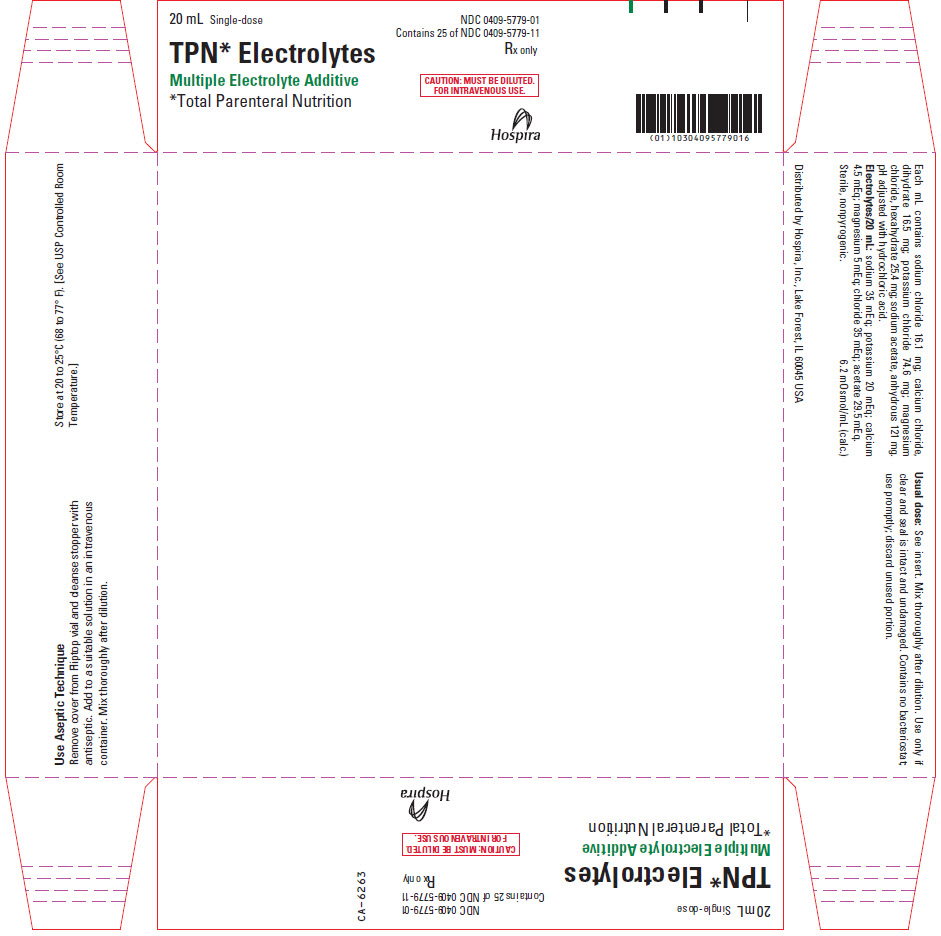
PRINCIPAL DISPLAY PANEL - 20 mL Vial Carton 20 mL Single-dose NDC 0409-5779-01 Contains 25 of NDC 0409-5779-11 TPN* Electrolytes Multiple Electrolyte Additive *Total Parenteral Nutrition Rx only CAUTION: MUST BE DILUTED. FOR INTRAVENOUS USE. Hospira PRINCIPAL DISPLAY PANEL - 20 mL Vial Carton
Reported adverse events (FAERS)
Top reported reactions
Reporter sex
Serious outcomes
Where does this data come from?
About this NDC listing & data coverage
What data is (and isn’t) available for this NDC — tap to expand
| NDC identity (package / product / labeler codes) | ✓ Available |
| Labeler | ✓ Available |
| Product & package description | ✓ Available |
| Marketing category & status | ✓ Available |
| Active ingredient / dosage form / route | ✓ Available |
| FDA label (SPL via DailyMed) | ✓ Available |
| Package photos | ✓ Available |
| Inactive ingredients (structured) | — Not published for this NDC The labeler did not submit a structured excipient list, or no SPL is available. |
| NADAC pharmacy acquisition price (CMS) | — Not published for this NDC CMS publishes NADAC only for NDCs reported in its retail-pharmacy survey. |
| Orange Book / therapeutic-equivalence data | — Not published for this NDC Applies only to products approved under an NDA/ANDA; many listings are out of scope. |
| HCPCS J-code billing crosswalk | — Not published for this NDC Most self-administered / retail products have no J-code — that is normal. |
| Medicaid utilization (CMS SDUD) | — Not published for this NDC CMS reports utilization only for NDCs with Medicaid claims above its privacy threshold. |