
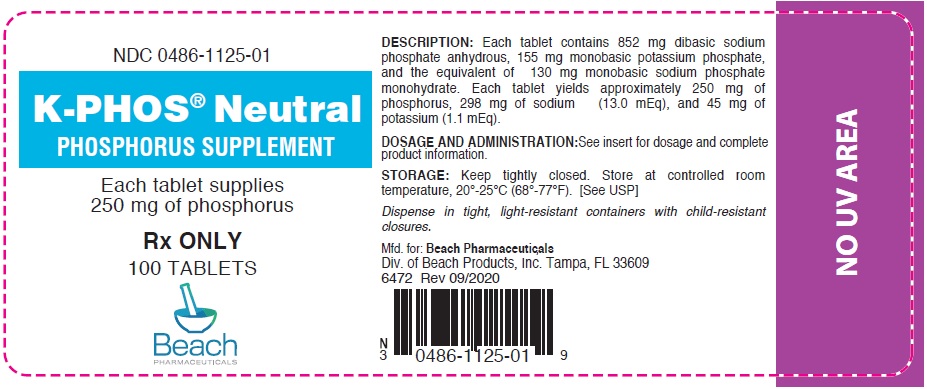
K Phos Neutral Sodium Phosphate, Dibasic, Anhydrous, Potassium Phosphate, Monobasic, and Sodium Phosphate, Monobasic, Monohydrate 852 mg; 155 mg; 130 mg Tablet, Coated, 100-count — NDC 0486-1125-01 (Billing 00486-1125-01)
This is a package of 100 tablets of K Phos Neutral Sodium Phosphate, Dibasic, Anhydrous, Potassium Phosphate, Monobasic, and Sodium Phosphate, Monobasic, Monohydrate 852 mg; 155 mg; 130 mg Tablet, Coated from Beach Products, Inc., marketed since Apr 1977 and currently FDA-listed; retail pharmacies pay about $0.3976 per tablet (NADAC). It is the main listing for this product, which comes in 2 package sizes.
NDC database record
One package, one record: these facts belong to NDC 0486-1125-01 alone.
- Record
- FDA NDC Directory package listing · Human prescription drug
- Code segments
- 0486 labeler · 1125 product · 01 package
- Package marketed since
- Apr 11, 1977
- Sample package
- No — commercial package
- Listing certified through
- Dec 31, 2026
- Billing quantity
- 100 EA per package
- Barcode (UPC-A, from the NDC)
- 3 0486112501 9
- Medicaid fills, this package
- 1,985 prescriptions in the last four reported quarters
- FDA record last changed
- Aug 27, 2026
Identity & classification
Regulatory identifiers FDA, NLM and CMS codes for this package
Drug-database identifiers Medi-Span GPI and First Databank GCN / HICL / AHFS classification
- GSN (GCN sequence number): 001711
- GCN: 12000
- GPI-14 (Medi-Span): 79600030100320
- HICL (First Databank): 034106
- AHFS class code: 40:04.00.00
- RxCUI (RxNorm): 200251
Where does this data come from?
- FDA openFDA NDC Directory · synced Oct 1, 2026
- FDA label on DailyMed · label index refreshed Oct 5, 2026
- RxNorm (NLM RxNav) · catalog refreshed Oct 1, 2026
- Medi-Span GPI (licensed)
- First Databank (licensed) · refreshed Oct 1, 2026
Clinical
K Phos Neutral is an oral coated tablet containing a blend of phosphate salts (sodium phosphate dibasic, potassium phosphate monobasic, and sodium phosphate monobasic). These phosphate compounds are typically used to help maintain phosphate and electrolyte balance in the body. This product is marketed without an approved FDA application.
Patient education
Supplement & herbal interactions
Where does this data come from?
- MedlinePlus (NLM) · refreshed Oct 1, 2026
- FDA label on DailyMed · label index refreshed Oct 5, 2026
Ask a licensed pharmacist directly — free, answered by our team.
Pricing
A drug doesn't have one price. Each row is a different public payment system, and none is what you'd pay at the counter — that depends on your insurance. The ⓘ on each row explains what it measures.
| Price system | Per ea | Per package |
|---|---|---|
| Retail pharmacies payNADAC · weekly | $0.398 | $39.76 / 100 tablets |
| Medicaid paysCMS SDUD · 12 mo | $0.3746 | $37.46 / 100 tablets |
| Medicare drug plans payPart D · quarterly | No Part D plan price is available for this NDC in our data. | |
Where does this data come from?
- CMS NADAC weekly file · file of Sep 30, 2026
- CMS ASP pricing files · refreshed Sep 20, 2026
- CMS Medicaid State Drug Utilization Data · through Q1 2026
- CMS Part D plan pricing files · refreshed Sep 24, 2026
- VA National Acquisition Center price file
Packaging — all sizes for this product
| Package NDC | Description | Per unit | Per pack | Marketing start | Marketing end | Status |
|---|---|---|---|---|---|---|
| 00486-1125-01 You're viewing this Main listing | 100 TABLET, COATED in 1 BOTTLE | $0.3976 / ea | $39.76 | 1977-04-11 | — | Active |
| 00486-1125-05 0486-1125-05 | 500 TABLET, COATED in 1 BOTTLE | $0.3976 / ea | $198.78 | 1977-04-11 | — | Active |
You're viewing the smallest of 2 pack sizes for this product.
This pack has the lowest per-ea cost of the 2 priced pack sizes ($0.3976 NADAC).
In Medicaid, this is the most-dispensed pack of this product — about 98% of fills over the last four reported quarters. See all packs ↓
Pack size FAQ
What quantity is in this package?
How does this package differ from NDC 00486-1125-05?
What NDC number is used to bill for this package of K Phos Neutral Sodium Phosphate, Dibasic, Anhydrous, Potassium Phosphate, Monobasic, and Sodium Phosphate, Monobasic, Monohydrate 852 mg; 155 mg; 130 mg Tablet, Coated?
Prices are the latest CMS NADAC pharmacy acquisition cost per NDC; per-pack figures are per-unit × pack quantity, shown only when the pack is denominated in the same measure NADAC prices.
Therapeutic equivalents
| Product | Labeler | Pack | NADAC/unit | TE | Status | Price vs. this |
|---|---|---|---|---|---|---|
| K Phos Neutral 852 mg/1; 155 mg/1; 130 mgthis 00486-1125-01 | Beach | 100 tablets | $0.398 | — | Availability likely | — |
| Dibasic Sodium Phosphate, Monobasic Potassium Phosphate and Monobasic Sodium Phosphate 852 mg/1; 155 mg/1; 130 mg 64980-0104-01 | Rising | 100 tablets | $0.398 | — | Availability likely | — |
| Phospha 250 Neutral 852 mg/1; 155 mg/1; 130 mg 64980-0729-01 | Rising | 100 tablets | $0.398 | — | Availability likely | — |
Where does this data come from?
- FDA openFDA NDC Directory · synced Oct 1, 2026
- FDA Orange Book · refreshed Oct 3, 2026
- CMS NADAC weekly file · file of Sep 30, 2026
Availability & generic status
We did not find an FDA-approved generic match for this exact strength, form and route.
Where does this data come from?
- FDA Orange Book · refreshed Oct 3, 2026
What it looks like
Where does this data come from?
- FDA label on DailyMed · label index refreshed Oct 5, 2026
Inactive Ingredients / Excipients
Inactive ingredients, also called excipients, are components of the drug product other than the active ingredient. They may include fillers, dyes, coatings, preservatives, flavors, or other formulation ingredients.
💡 Tap an ingredient (hover on desktop) to see what it is and why it’s used.
-
UNII 3NXW29V3WO
Hypromellose is a plant-based thickener made from cellulose. It's used in medicines as a binder to hold ingredients together, a coating for tablets, and a thickener for liquids.
-
UNII EWQ57Q8I5X
Lactose monohydrate is a natural sugar derived from milk. It serves as a filler and binder in tablets and capsules, helping create the proper size, texture, and consistency of the medicine.
-
UNII 70097M6I30
Magnesium stearate is a salt made from magnesium and stearic acid, a fatty substance. It's used in tablets and capsules as a lubricant and glidant to help ingredients flow smoothly during manufacturing and prevent sticking.
-
UNII 7CVR7L4A2D
A starch-derived carbohydrate produced by breaking down corn, potato, or tapioca starch. It functions as a filler and binder to give the medicine bulk and texture, and sometimes as a mild sweetener or texture enhancer in powders and tablets.
-
UNII 3WJQ0SDW1A
Polyethylene glycol is a synthetic liquid or solid polymer used in medicines as a solvent, lubricant, and humectant. It helps dissolve active ingredients, reduces friction during manufacturing, and retains moisture in the final product.
-
UNII 390RMW2PEQ
Povidone K29/32 is a synthetic polymer made from vinyl pyrrolidone. It acts as a binder to hold tablet ingredients together and as a disintegrant to help the tablet break down in the stomach for drug release.
-
UNII 1Q73Q2JULR
Sodium citrate is a salt derived from citric acid. It works as a buffer to maintain the medicine's pH level and may also help improve taste or act as a preservative in the formulation.
-
UNII 5856J3G2A2
A starch-based powder made from potatoes and processed with sodium. It acts as a disintegrant, helping the tablet or capsule break apart quickly in the stomach so the medicine can be absorbed.
-
UNII 4ELV7Z65AP
Stearic acid is a fatty acid derived from plant or animal sources. It acts as a binder and lubricant in tablets and capsules, helping them hold together and flow smoothly during manufacturing.
-
UNII 15FIX9V2JP
Titanium dioxide is a bright white mineral powder commonly used as a colorant and opacifying agent. It makes pills and tablets white or lighter in color and helps make coatings non-transparent.
-
UNII XHX3C3X673
Triacetin is a clear, oily liquid made from glycerin and acetic acid. It works as a plasticizer and solvent in medicines, helping soften coatings and improve how liquids mix together in formulations.
11 inactive ingredients listed in the exact product block matched to this NDC.
Where does this data come from?
ingredient classCode="IACT" elements from the exact product block matched by this NDC. Label-section narrative from DailyMed / the openFDA label index is shown separately when available.- FDA label on DailyMed · label index refreshed Oct 5, 2026
- FDA openFDA NDC Directory · synced Oct 1, 2026
Inactive ingredient FAQ
Are inactive ingredients the same for every manufacturer?
Why might an inactive ingredient be missing?
Can inactive ingredients matter?
Manufacturer & labeler
More NDCs from Beach Products, Inc. labeler code 00486
Where does this data come from?
- FDA openFDA NDC Directory · synced Oct 1, 2026
- Drugs@FDA
Full prescribing information FDA SPL
🎯 Indications and Usage ▾
INDICATIONS AND USAGE K-PHOS® NEUTRAL increases urinary phosphate and pyrophosphate. As a phosphorus supplement, each tablet supplies 25% of the U.S. Recommended Daily Allowance (U.S.RDA) of phosphorus for adul t s and children over 4 years of age.
⏱️ Dosage and Administration ▾
DOSAGE AND ADMINISTRATION K-PHOS® NEUTRAL tablets should be taken with a full glass of water, with meals and at bedtime. Adults: One or two tablets four times daily; Pediatric Patients over 4 years of age: One tablet four times daily. For Pediatric Patients under 4 years of age, use only as directed by a physician.
⛔ Contraindications ▾
CONTRAINDICATIONS This product is contraindicated in patients with infected phosphate stones, in patients with severely impaired renal function (less than 30% of normal) and in the presence of hyperphosphatemia.
🤒 Adverse Reactions ▾
ADVERSE REACTIONS Gastrointestinal upset (diarrhea, nausea, stomach pain and vomiting) may occur with phosphate therapy. Also, bone and joint pain (possible phosphate-induced osteomalacia) could occur. The following adverse effects may be observed (primarily from sodium or potassium): headaches; dizziness; mental confusion; seizures; weakness or heaviness of legs; unusual tiredness or weakness; muscle cramps; numbness, tingling, pain, or weakness of hands or feet; numbness or tingling around lips; fast or irregular heartbeat; shortness of breath or troubled breathing; swelling of feet or lower legs; unusual weight gain; low urine output; unusual thirst.
🔄 Drug Interactions ▾
Drug Interactions The use of antacids containing magnesium, aluminum, or calcium in conjunction with phosphate preparations may bind the phosphate and prevent its absorption. Concurrent use of antihypertensives, especially diazoxide, guanethidine, hydralazine, methyldopa, or rauwolfia alkaloid; or corticosteroids, especially mineralocorticoids or corticotropin, with sodium phosphate may result in hypernatremia. Calciumcontaining preparations and/or Vitamin D may antagonize the effects of phosphates in the treatment of hypercalcemia.
Potassium-containing medications or potassium-sparingdiuretics may cause hyperkalemia. Patients should have serum potassium level determinations at periodic intervals.
🤰 Pregnancy ▾
Pregnancy Teratogenic Effects Pregnancy Category C Animal reproduction studies have not been conducted with K-PHOS® NEUTRAL. It is also not known whether this product can cause fetal harm when administered to a pregnant woman or can affect reproductive capacity. This product should be given to a pregnant woman only if clearly needed.
🧒 Pediatric Use ▾
Pediatric Use See DOSAGE AND ADMINISTRATION
🧬 Clinical Pharmacology ▾
CLINICAL PHARMACOLOGY Phosphorus has a number of important functions in the biochemistry of the body. The bulk of the body's phosphorus is located in the bones, where it plays a key role in osteoblastic and osteoclastic activities. Enzymatically catalyzed phosphate-transfer reactions are numerous and vital in the metabolism of carbohydrate, lipid and protein, and a proper concentration of the anion is of primary importance in assuring an orderly biochemical sequence.
In addition, phosphorus plays an important role in modifying steady-state tissue concentrations of calcium. Phosphate ions are important buffers of the intracellular fluid, and also play a primary role in the renal excretion of hydrogen ion. Oral administration of inorganic phosphates increases serum phosphate levels.
Phosphates lower urinary calcium levels in idiopathic hypercalciuria. In general, in adults, about two thirds of the ingested phosphate is absorbed from the bowel, most of which is rapidly excreted into the urine.
📦 How Supplied / Storage and Handling ▾
HOW SUPPLIED White, film coated, scored capsule-shaped tablet with the name BEACH and the number 1125 imprinted on each tablet. Bottles of 100 (NDC 0486-1125-01) and bottles of 500 (NDC 0486-1125-05) tablets. STORAGE Keep tightly closed. Store at controlled room temperature, 20°-25°C (68°-77°F). [See USP] Dispense in tight, light-resistant containers with child-resistant closures.
📦 Storage and Handling ▾
STORAGE Keep tightly closed. Store at controlled room temperature, 20°-25°C (68°-77°F). [See USP] Dispense in tight, light-resistant containers with child-resistant closures.
📋 Description ▾
DESCRIPTION Each tablet contains 852 mg dibasic sodium phosphate anhydrous, 155 mg monobasic potassium phosphate, and the equivalent of 130 mg monobasic sodium phosphate monohydrate. Each tablet yields approximately 250 mg of phosphorus, 298 mg of sodium (13.0 mEq) and 45 mg of potassium (1.1 mEq). The components of K-PHOS® NEUTRAL have the following chemical names and molecular formulae: Dibasic Sodium Phosphate, Anhydrous Molecular Formula: Na2HPO4, Molecular Weight: 141.96.
Monobasic Potassium Phosphate Molecular Formula: KH2PO4, Molecular Weight: 136.09. Monobasic Sodium Phosphate, Monohydrate Molecular Formula:NaH2PO4.H2O, Molecular Weight: 137.98. Inactive Ingredients: Lactose monohydrate, povidone, white coating (hydroxypropyl methylcellulose, titanium dioxide, maltodextrin, triacetin, glycerol triacetate, polyethylene glycol, sodium citrate, and stearic acid), sodium starch glycolate, and magnesium stearate.
💬 Information for Patients ▾
Information for Patients Patients with kidney stones may pass old stones when phosphate therapy is started and should be warned of this possibility. Patients should be advised to avoid the use of antacids containing aluminum, magnesium, or calcium which may prevent the absorption of phosphate.
⚠️ Precautions ▾
PRECAUTIONS General This product contains potassium and sodium and should be used with caution if regulation of these elements is desired. Occasionally, some individuals may experience a mild laxative effect during the first few days of phosphate therapy. If laxation persists to an unpleasant degree, reduce the daily dosage until this effect subsides or, if necessary, discontinue the use of this product.
Caution should be exercised when prescribing this product in the following conditions: Cardiac disease (particularly in digitalized patients); severe adrenal insufficiency (Addison's disease); acute dehydration; severe renal insufficiency; renal function impairment or chronic renal disease; extensive tissue breakdown (such as severe burns); myotonia congenita; cardiac failure; cirrhosis of the liver or severe hepatic disease; peripheral or pulmonary edema; hypernatremia; hypertension; toxemia of pregnancy; hypoparathyroidism; and acute pancreatitis.
Rickets may benefit from phosphate therapy, but caution should be exercised. High serum phosphate levels may increase the incidence of extra-skeletal calcification. Information for Patients Patients with kidney stones may pass old stones when phosphate therapy is started and should be warned of this possibility.
Patients should be advised to avoid the use of antacids containing aluminum, magnesium, or calcium which may prevent the absorption of phosphate. Laboratory Tests Careful monitoring of renal function and serum calcium, phosphorus, potassium and sodium may be required at periodic intervals during phosphate therapy. Other tests may be warranted in some patients, depending on conditions.
Drug Interactions The use of antacids containing magnesium, aluminum, or calcium in conjunction with phosphate preparations may bind the phosphate and prevent its absorption. Concurrent use of antihypertensives, especially diazoxide, guanethidine, hydralazine, methyldopa, or rauwolfia alkaloid; or corticosteroids, especially mineralocorticoids or corticotropin, with sodium phosphate may result in hypernatremia. Calciumcontaining preparations and/or Vitamin D may antagonize the effects of phosphates in the treatment of hypercalcemia.
Potassium-containing medications or potassium-sparingdiuretics may cause hyperkalemia. Patients should have serum potassium level determinations at periodic intervals. Carcinogenesis, Mutagenesis, Impairment of Fertility No long-term or reproduction studies in animals or humans have been performed with K-PHOS ® NEUTRAL to evaluate its carcinogenic, mutagenic, or impairment of fertility potential.
Pregnancy Teratogenic Effects Pregnancy Category C Animal reproduction studies have not been conducted with K-PHOS® NEUTRAL. It is also not known whether this product can cause fetal harm when administered to a pregnant woman or can affect reproductive capacity. This product should be given to a pregnant woman only if clearly needed.
Nursing Mothers It is not known whether this drug is excreted in human milk. Because many drugs are excreted in human milk, caution should be exercised when this product is administered to a nursing woman. Pediatric Use See DOSAGE AND ADMINISTRATION
🍼 Nursing Mothers ▾
Nursing Mothers It is not known whether this drug is excreted in human milk. Because many drugs are excreted in human milk, caution should be exercised when this product is administered to a nursing woman.
📄 Carcinogenesis, Mutagenesis, Impairment of Fertility ▾
Carcinogenesis, Mutagenesis, Impairment of Fertility No long-term or reproduction studies in animals or humans have been performed with K-PHOS ® NEUTRAL to evaluate its carcinogenic, mutagenic, or impairment of fertility potential.
📄 Package Label / Principal Display Panel ▾
PRINCIPAL DISPLAY PANEL - 250 mg Tablet Bottle Label NDC 0486-1125-01 K-PHOS ® Neutral PHOSPHORUS SUPPLEMENT Each tablet supplies 250 mg of phosphorus Rx ONLY 100 TABLETS Beach PHARMACEUTICALS PRINCIPAL DISPLAY PANEL - 250 mg Tablet Bottle Label NDC 0486-1125-05 K-PHOS ® Neutral PHOSPHORUS SUPPLEMENT Each tablet supplies 250 mg of phosphorus Rx ONLY 500 TABLETS Beach PHARMACEUTICALS PRINCIPAL DISPLAY PANEL - 250 mg Tablet Bottle Label PRINCIPAL DISPLAY PANEL - 250 mg Tablet Bottle Label
Medicaid utilization & spend
Medicaid utilization by pack size
Reported adverse events (FAERS)
Top reported reactions
Age at onset
Reporter sex
Serious outcomes
Where does this data come from?
About this NDC listing & data coverage
Listed without an FDA application
This product's marketing category indicates it is marketed without an approved FDA application (no NDA, ANDA, or BLA on file). Having an NDC does not by itself establish FDA approval — the NDC Directory is a listing system, not an approval decision. Approval-linked data such as Orange Book therapeutic-equivalence ratings therefore does not apply.
What data is (and isn’t) available for this NDC — tap to expand
| NDC identity (package / product / labeler codes) | ✓ Available |
| Labeler | ✓ Available |
| Product & package description | ✓ Available |
| Marketing category & status | ✓ Available |
| Active ingredient / dosage form / route | ✓ Available |
| FDA label (SPL via DailyMed) | ✓ Available |
| Package photos | ✓ Available |
| Inactive ingredients (structured) | ✓ Available |
| NADAC pharmacy acquisition price (CMS) | ✓ Available |
| Orange Book / therapeutic-equivalence data | — Not published for this NDC Applies only to products approved under an NDA/ANDA; many listings are out of scope. |
| HCPCS J-code billing crosswalk | — Not published for this NDC Most self-administered / retail products have no J-code — that is normal. |
| Medicaid utilization (CMS SDUD) | ✓ Available |