
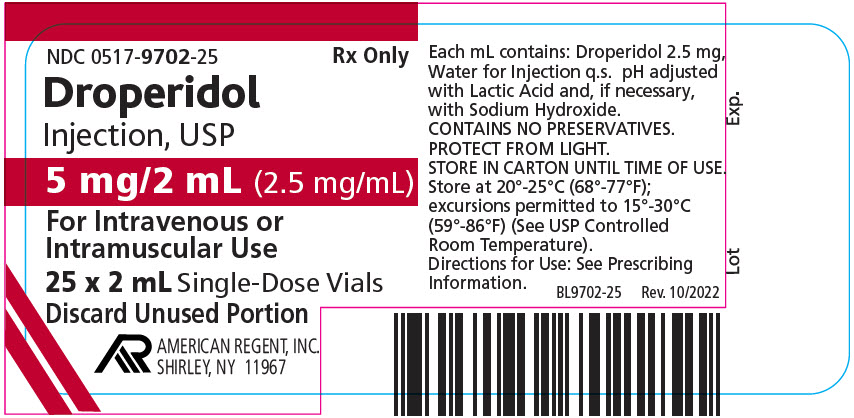
Droperidol 2.5 mg/mL Injection, Solution — NDC 0517-9702-25 (Billing 00517-9702-25)
This is a package of Droperidol 2.5 mg/mL Injection, Solution from American Regent, Inc., marketed since Sep 1990 and currently FDA-listed. It is this product's only package size.
NDC database record
One package, one record: these facts belong to NDC 0517-9702-25 alone.
- Record
- FDA NDC Directory package listing · Human prescription drug
- Code segments
- 0517 labeler · 9702 product · 25 package
- Package marketed since
- Sep 30, 1990
- Sample package
- No — commercial package
- Listing certified through
- Dec 31, 2026
- Barcode (UPC)
- 0305179702251
- Medicaid fills, this package
- 27,744 prescriptions in the last four reported quarters
- FDA record last changed
- Jul 24, 2026
Identity & classification
Regulatory identifiers FDA, NLM and CMS codes for this package
Drug-database identifiers Medi-Span GPI and First Databank GCN / HICL / AHFS classification
- GSN (GCN sequence number): 003965
- GCN: 15489
- GPI-14 (Medi-Span): 57200030002005
- HICL (First Databank): 001659
- AHFS class code: 28:24.92.00
- RxCUI (RxNorm): 282485
Where does this data come from?
- FDA openFDA NDC Directory · synced Oct 8, 2026
- FDA label on DailyMed · label index refreshed Oct 6, 2026
- RxNorm (NLM RxNav) · catalog refreshed Oct 1, 2026
- Medi-Span GPI (licensed)
- First Databank (licensed) · refreshed Oct 8, 2026
RxNorm drug class
This medicine belongs to the Dopamine-2 Receptor Antagonist class.
Where does this data come from?
- RxClass (NLM) · catalog refreshed Oct 1, 2026
Clinical
Patient education
Supplement & herbal interactions
Some supplements/herbs that may interact with droperidol — tap one for details:
Where does this data come from?
- MedlinePlus (NLM) · refreshed Oct 1, 2026
- FDA label on DailyMed · label index refreshed Oct 6, 2026
Ask a licensed pharmacist directly — free, answered by our team.
Pricing
A drug doesn't have one price. Each row is a different public payment system, and none is what you'd pay at the counter — that depends on your insurance. The ⓘ on each row explains what it measures.
| Price system | Per mL | Per package |
|---|---|---|
| Retail pharmacies payNADAC · weekly | Not in the retail survey — common for institutional, discontinued, or low-volume packs. | |
| Medicaid paysCMS SDUD · 12 mo | $16.58 | $828.75 / 50 ml |
| Medicare drug plans payPart D · quarterly | No Part D plan price is available for this NDC in our data. | |
| Medicare Part B allowsASP · J1790 | $8.124 / J1790 unit | — |
Where does this data come from?
- CMS NADAC weekly file
- CMS ASP pricing files · refreshed Sep 20, 2026
- CMS Medicaid State Drug Utilization Data · through Q1 2026
- CMS Part D plan pricing files · refreshed Sep 24, 2026
- VA National Acquisition Center price file
Billing & reimbursement
Where does this data come from?
- CMS ASP NDC-HCPCS crosswalk · refreshed Sep 22, 2026
- DMEPDAC NDC-HCPCS crosswalk
- openFDA NSDE billing units · refreshed Oct 7, 2026
Packaging — all sizes for this product
| Package NDC | Description | Marketing start | Marketing end | Status |
|---|---|---|---|---|
| 00517-9702-25 You're viewing this Main listing | 25 VIAL, SINGLE-DOSE in 1 TRAY / 2 mL in 1 VIAL, SINGLE-DOSE | 1990-09-30 | — | Active |
Therapeutic equivalents
| Product | Labeler | Pack | NADAC/unit | TE | Status | Price vs. this |
|---|---|---|---|---|---|---|
| Droperidol 2.5 mg/mL 00143-9514-25 | Hikma | 25 vials | — | AP | FDA listed | — |
| Droperidol 2.5 mg/mLthis 00517-9702-25 | American | 25 vials | — | AP | FDA listed | — |
| Droperidol 2.5 mg/mL 00143-9515-25 | Hikma | 25 vials | — | AP | FDA listed | — |
Where does this data come from?
- FDA openFDA NDC Directory · synced Oct 8, 2026
- FDA Orange Book · refreshed Oct 3, 2026
- CMS NADAC weekly file
Availability & generic status
This product is an FDA-approved generic. Other versions of the same drug are listed under Therapeutic equivalents, least expensive first.
Where does this data come from?
- FDA Orange Book · refreshed Oct 3, 2026
Inactive Ingredients / Excipients
Inactive ingredients, also called excipients, are components of the drug product other than the active ingredient. They may include fillers, dyes, coatings, preservatives, flavors, or other formulation ingredients.
💡 Tap an ingredient (hover on desktop) to see what it is and why it’s used.
-
UNII 33X04XA5AT
Lactic acid is a naturally occurring organic acid derived from milk or plant sources. It lowers and maintains pH in formulations, helps preserve the product, and can enhance ingredient stability and absorption.
-
UNII 55X04QC32I
A strong alkaline chemical used to adjust and maintain the pH balance of liquid medicines. It helps keep the medicine stable and ensures it stays effective during storage.
-
UNII 059QF0KO0R
Water is a liquid solvent that dissolves and mixes ingredients together in liquid medicines, syrups, and injections. It helps distribute the active drug evenly throughout the product.
3 inactive ingredients listed in the exact product block matched to this NDC.
Where does this data come from?
ingredient classCode="IACT" elements from the exact product block matched by this NDC. Label-section narrative from DailyMed / the openFDA label index is shown separately when available.- FDA label on DailyMed · label index refreshed Oct 6, 2026
- FDA openFDA NDC Directory · synced Oct 8, 2026
Inactive ingredient FAQ
Are inactive ingredients the same for every manufacturer?
Why might an inactive ingredient be missing?
Can inactive ingredients matter?
Manufacturer & labeler
More NDCs from American Regent, Inc. labeler code 00517
- Multitrace-5 Trace Elements 5 4.39 mg/mL; 1.57 mg/mL; .308 mg/mL; 20.5 ug/mL; 32.7 ug/mL Injection, Solution NDC 0517-8510-25
- Aminocaproic Acid 250 mg/mL Injection, Solution NDC 0517-9120-25
- Aminocaproic Acid 250 mg/mL Injection, Solution NDC 0517-9191-25
- Multitrace -4 Pediatric Trace Elements 4 4.39 mg/mL; .4 mg/mL; 77 ug/mL; 5.12 ug/mL Injection, Solution, Concentrate NDC 0517-9203-25
- Multrys Trace Elements Injection 4 2470 ug/mL; 150 ug/mL; 8.22 ug/mL; 9.8 ug/mL Injection, Solution NDC 0517-9302-25
- Tralement Trace Elements Injection 4 3 mg/mL; .3 mg/mL; 55 ug/mL; 60 ug/mL Injection, Solution NDC 0517-9305-25
Where does this data come from?
- FDA openFDA NDC Directory · synced Oct 8, 2026
- Drugs@FDA
Full prescribing information FDA SPL
🚨 Boxed Warning ▾
WARNING Cases of QT prolongation and/or torsade de pointes have been reported in patients receiving droperidol at doses at or below recommended doses. Some cases have occurred in patients with no known risk factors for QT prolongation and some cases have been fatal. Due to its potential for serious proarrhythmic effects and death, droperidol should be reserved for use in the treatment of patients who fail to show an acceptable response to other adequate treatments, either because of insufficient effectiveness or the inability to achieve an effective dose due to intolerable adverse effects from those drugs (see CONTRAINDICATIONS , WARNINGS , PRECAUTIONS , and ADVERSE REACTIONS ).
Cases of QT prolongation and serious arrhythmias (e.g., torsade de pointes) have been reported in patients treated with droperidol. Based on these reports, all patients should undergo a 12-lead ECG prior to administration of droperidol to determine if a prolonged QT interval (i.e., QTc greater than 440 msec for males or 450 msec for females) is present. If there is a prolonged QT interval, droperidol should NOT be administered.
For patients in whom the potential benefit of droperidol treatment is felt to outweigh the risks of potentially serious arrhythmias, ECG monitoring should be performed prior to treatment and continued for 2-3 hours after completing treatment to monitor for arrhythmias. Droperidol is contraindicated in patients with known or suspected QT prolongation, including patients with congenital long QT syndrome. Droperidol should be administered with extreme caution to patients who may be at risk for development of prolonged QT syndrome (e.g., congestive heart failure, bradycardia, use of a diuretic, cardiac hypertrophy, hypokalemia, hypomagnesemia, or administration of other drugs known to increase the QT interval).
Other risk factors may include age over 65 years, alcohol abuse, and use of agents such as benzodiazepines, volatile anesthetics, and IV opiates. Droperidol should be initiated at a low dose and adjusted upward, with caution, as needed to achieve the desired effect.
🎯 Indications and Usage ▾
INDICATIONS AND USAGE Droperidol Injection is indicated to reduce the incidence of nausea and vomiting associated with surgical and diagnostic procedures.
⏱️ Dosage and Administration ▾
DOSAGE AND ADMINISTRATION Dosage should be individualized . Some of the factors to be considered in determining the dose are age, body weight, physical status, underlying pathological condition, use of other drugs, type of anesthesia to be used, and the surgical procedure involved. Vital signs and ECG should be monitored routinely.
Adult Dosage: The maximum recommended initial dose of droperidol is 2.5 mg IM or slow IV. Additional 1.25 mg doses of droperidol may be administered to achieve the desired effect. However, additional doses should be administered with caution, and only if the potential benefit outweighs the potential risk.
Children’s Dosage: For children two to 12 years of age, the maximum recommended initial dose is 0.1 mg/kg, taking into account the patient's age and other clinical factors. However, additional doses should be administered with caution, and only if the potential benefit outweighs the potential risk. See WARNINGS and PRECAUTIONS for use of droperidol with other CNS depressants, and in patients with altered response.
Parenteral drug products should be inspected visually for particulate matter and discoloration prior to administration, whenever solution and container permit. If such abnormalities are observed, the drug should not be administered.
⛔ Contraindications ▾
CONTRAINDICATIONS Droperidol is contraindicated in patients with known or suspected QT prolongation (i.e., QTc interval greater than 440 msec for males or 450 msec for females). This would include patients with congenital long QT syndrome. Droperidol is contraindicated in patients with known hypersensitivity to the drug.
Droperidol is not recommended for any use other than for the treatment of perioperative nausea and vomiting in patients for whom other treatments are ineffective or inappropriate (see WARNINGS ).
⚠️ Warnings ▾
WARNINGS Droperidol should be administered with extreme caution in the presence of risk factors for development of prolonged QT syndrome, such as: 1) clinically significant bradycardia (less than 50 bpm), 2) any clinically significant cardiac disease, 3) treatment with Class I and Class III antiarrhythmics, 4) treatment with monoamine oxidase inhibitors (MAOI's), 5) concomitant treatment with other drug products known to prolong the QT interval (see PRECAUTIONS, Drug Interactions ), and 6) electrolyte imbalance, in particular hypokalemia and hypomagnesemia, or concomitant treatment with drugs (e.g., diuretics) that may cause electrolyte imbalance.
Effects on Cardiac Conduction: A dose-dependent prolongation of the QT interval was observed within 10 minutes of droperidol administration in a study of 40 patients without known cardiac disease who underwent extracranial head and neck surgery. Significant QT prolongation was observed at all three dose levels evaluated, with 0.1, 0.175, and 0.25 mg/kg associated with prolongation of median QTc by 37,44, and 59 msec, respectively. Cases of QT prolongation and serious arrhythmias (e.g., torsade de pointes, ventricular arrhythmias, cardiac arrest, and death) have been observed during post-marketing treatment with droperidol.
Some cases have occurred in patients with no known risk factors and at doses at or below recommended doses. There has been at least one case of nonfatal torsade de pointes confirmed by rechallenge. Based on these reports, all patients should undergo a 12-lead ECG prior to administration of droperidol to determine if a prolonged QT interval (i.e., QTc greater than 440 msec for males or 450 msec for females) is present.
If there is a prolonged QT interval, droperidol should NOT be administered. For patients in whom the potential benefit of droperidol treatment is felt to outweigh the risks of potentially serious arrhythmias, ECG monitoring should be performed prior to treatment and continued for 2-3 hours after completing treatment to monitor for arrhythmias. FLUIDS AND OTHER COUNTERMEASURES TO MANAGE HYPOTENSION SHOULD BE READILY AVAILABLE.
As with other CNS depressant drugs, patients who have received droperidol should have appropriate surveillance. It is recommended that opioids, when required, initially be used in reduced doses. As with other neuroleptic agents, very rare reports of neuroleptic malignant syndrome (altered consciousness, muscle rigidity and autonomic instability) have occurred in patients who have received droperidol.
Since it may be difficult to distinguish neuroleptic malignant syndrome from malignant hyperpyrexia in the perioperative period, prompt treatment with dantrolene should be considered if increases in temperature, heart rate or carbon dioxide production occur.
🤒 Adverse Reactions ▾
ADVERSE REACTIONS QT interval prolongation, torsade de pointes, cardiac arrest, and ventricular tachycardia have been reported in patients treated with droperidol. Some of these cases were associated with death. Some cases occurred in patients with no known risk factors, and some were associated with droperidol doses at or below recommended doses.
Physicians should be alert to palpitations, syncope, or other symptoms suggestive of episodes of irregular cardiac rhythm in patients taking droperidol and promptly evaluate such cases (see WARNINGS, Effects on Cardiac Conduction ). The most common somatic adverse reactions reported to occur with droperidol are mild to moderate hypotension and tachycardia, but these effects usually subside without treatment. If hypotension occurs and is severe or persists, the possibility of hypovolemia should be considered and managed with appropriate parenteral fluid therapy.
The most common behavioral adverse effects of droperidol include dysphoria, postoperative drowsiness, restlessness, hyperactivity and anxiety, which can either be the result of an inadequate dosage (lack of adequate treatment effect) or of an adverse drug reaction (part of the symptom complex of akathisia). Care should be taken to search for extrapyramidal signs and symptoms (dystonia, akathisia, oculogyric crisis) to differentiate these different clinical conditions. When extrapyramidal symptoms are the cause, they can usually be controlled with anticholinergic agents.
Postoperative hallucinatory episodes (sometimes associated with transient periods of mental depression) have also been reported. Other less common reported adverse reactions include anaphylaxis, dizziness, chills and/or shivering, laryngospasm and bronchospasm. Elevated blood pressure, with or without pre-existing hypertension, has been reported following administration of droperidol combined with fentanyl citrate or other parenteral analgesics.
This might be due to unexplained alterations in sympathetic activity following large doses; however, it is also frequently attributed to anesthetic or surgical stimulation during light anesthesia.
🔄 Drug Interactions ▾
Drug Interactions Potentially Arrhythmogenic Agents: Any drug known to have the potential to prolong the QT interval should not be used together with droperidol. Possible pharmacodynamic interactions can occur between droperidol and potentially arrhythmogenic agents such as class I or III antiarrhythmics, antihistamines that prolong the QT interval, antimalarials, calcium channel blockers, neuroleptics that prolong the QT interval, and antidepressants. Caution should be used when patients are taking concomitant drugs known to induce hypokalemia or hypomagnesemia as they may precipitate QT prolongation and interact with droperidol.
These would include diuretics, laxatives and supraphysiological use of steroid hormones with mineralocorticoid potential. CNS Depressant Drugs: Other CNS depressant drugs (e.g. barbiturates, tranquilizers, opioids and general anesthetics) have additive or potentiating effects with droperidol. When patients have received such drugs, the dose of droperidol required will be less than usual.
Following the administration of droperidol, the dose of other CNS depressant drugs should be reduced.
🤰 Pregnancy ▾
Pregnancy Category C. Droperidol administered intravenously has been shown to cause a slight increase in mortality of the newborn rat at 4.4 times the upper human dose. At 44 times the upper human dose, mortality rate was comparable to that for control animals.
Following intramuscular administration, increased mortality of the offspring at 1.8 times the upper human dose is attributed to CNS depression in the dams who neglected to remove placentae from their offspring. Droperidol has not been shown to be teratogenic in animals. There are no adequate and well-controlled studies in pregnant women.
Droperidol should be used during pregnancy only if the potential benefit justifies the potential risk to the fetus.
🧒 Pediatric Use ▾
Pediatric Use The safety of droperidol in children younger than two years of age has not been established.
🆘 Overdosage ▾
OVERDOSAGE Manifestations: The manifestations of droperidol overdosage are an extension of its pharmacologic actions and may include QT prolongation and serious arrhythmias (e.g., torsade de pointes) (see BOXED WARNING , WARNINGS , and PRECAUTIONS ). Treatment: In the presence of hypoventilation or apnea, oxygen should be administered and respiration should be assisted or controlled as indicated. A patent airway must be maintained; an oropharyngeal airway or endotracheal tube might be indicated.
The patient should be carefully observed for 24 hours; body warmth and adequate fluid intake should be maintained. If hypotension occurs and is severe or persists, the possibility of hypovolemia should be considered and managed with appropriate parenteral fluid therapy. (see PRECAUTIONS ).
If significant extrapyramidal reactions occur in the context of an overdose, an anticholinergic should be administered. The intravenous Median Lethal Dose of droperidol is 20-43 mg/kg in mice; 30 mg/kg in rats; 25 mg/kg in dogs and 11-13 mg/kg in rabbits. The intramuscular Median Lethal Dose of droperidol is 195 mg/kg in mice; 104-110 mg/kg in rats; 97 mg/kg in rabbits and 200 mg/kg in guinea pigs.
🧬 Clinical Pharmacology ▾
CLINICAL PHARMACOLOGY Droperidol produces marked tranquilization and sedation. It allays apprehension and provides a state of mental detachment and indifference while maintaining a state of reflex alertness. Droperidol produces an antiemetic effect as evidenced by the antagonism of apomorphine in dogs.
It lowers the incidence of nausea and vomiting during surgical procedures and provides antiemetic protection in the postoperative period. Droperidol potentiates other CNS depressants. It produces mild alpha-adrenergic blockade, peripheral vascular dilatation and reduction of the pressor effect of epinephrine.
It can produce hypotension and decreased peripheral vascular resistance and may decrease pulmonary arterial pressure (particularly if it is abnormally high). It may reduce the incidence of epinephrine-induced arrhythmias but it does not prevent other cardiac arrhythmias. The onset of action of single intramuscular and intravenous doses is from three to ten minutes following administration, although the peak effect may not be apparent for up to thirty minutes.
The duration of the tranquilizing and sedative effects generally is two to four hours, although alteration of alertness may persist for as long as twelve hours.
📦 How Supplied / Storage and Handling ▾
HOW SUPPLIED Droperidol Injection USP, (2.5 mg/mL) is available as: Product No. Strength Size How Packaged NDC 0517-9702-25 5 mg/2 mL 2 mL Single Dose Vial Boxes of 25 Store at 20° to 25°C (68° to 77°F); excursions permitted to 15° to 30°C (59° to 86°F) (See USP Controlled Room Temperature). PROTECT FROM LIGHT. RETAIN IN CARTON UNTIL TIME OF USE.
📋 Description ▾
DESCRIPTION Droperidol Injection, USP, is a sterile, non-pyrogenic, aqueous solution for intravenous or intramuscular use only. Each mL contains: Droperidol…………………………………….2.5 mg Water for Injection………………………........q.s. pH adjusted between 3.0 and 3.8 with lactic acid and, if necessary, with sodium hydroxide. Droperidol is a neuroleptic (tranquilizer) agent.
Chemically it is 1-(1-[3-(p-fluorobenzoyl)propyl]-1,2,3,6-tetrahydro-4-pyridyl)-2-benzimidazolinone and the structural formula is: ad2af77a-figure-01
⚠️ Precautions ▾
PRECAUTIONS General The initial dose of droperidol should be appropriately reduced in elderly, debilitated and other poor-risk patients. The effect of the initial dose should be considered in determining incremental doses. Certain forms of conduction anesthesia, such as spinal anesthesia and some peridural anesthetics, can alter respiration by blocking intercostal nerves and can cause peripheral vasodilation and hypotension because of sympathetic blockade.
Through other mechanisms (see CLINICAL PHARMACOLOGY ), droperidol can also alter circulation. Therefore, when droperidol is used to supplement these forms of anesthesia, the anesthetist should be familiar with the physiological alterations involved, and be prepared to manage them in the patients elected for these forms of anesthesia. If hypotension occurs, the possibility of hypovolemia should be considered and managed with appropriate parenteral fluid therapy.
Repositioning the patient to improve venous return to the heart should be considered when operative conditions permit. It should be noted that in spinal and peridural anesthesia, tilting the patient into a head-down position may result in a higher level of anesthesia than is desirable, as well as impair venous return to the heart. Care should be exercised in moving and positioning of patients because of a possibility of orthostatic hypotension.
If volume expansion with fluids plus these other countermeasures do not correct the hypotension, then the administration of pressor agents other than epinephrine should be considered. Epinephrine may paradoxically decrease the blood pressure in patients treated with droperidol due to the alpha-adrenergic blocking action of droperidol. Since droperidol may decrease pulmonary arterial pressure, this fact should be considered by those who conduct diagnostic or surgical procedures where interpretation of pulmonary arterial pressure measurements might determine final management of the patient.
Vital signs and ECG should be monitored routinely. When the EEG is used for postoperative monitoring, it may be found that the EEG pattern returns to normal slowly. Impaired Hepatic or Renal Function: Droperidol should be administered with caution to patients with liver and kidney dysfunction because of the importance of these organs in the metabolism and excretion of drugs.
Pheochromocytoma: In patients with diagnosed/suspected pheochromocytoma, severe hypertension and tachycardia have been observed after the administration of droperidol. Drug Interactions Potentially Arrhythmogenic Agents: Any drug known to have the potential to prolong the QT interval should not be used together with droperidol. Possible pharmacodynamic interactions can occur between droperidol and potentially arrhythmogenic agents such as class I or III antiarrhythmics, antihistamines that prolong the QT interval, antimalarials, calcium channel blockers, neuroleptics that prolong the QT interval, and antidepressants.
Caution should be used when patients are taking concomitant drugs known to induce hypokalemia or hypomagnesemia as they may precipitate QT prolongation and interact with droperidol. These would include diuretics, laxatives and supraphysiological use of steroid hormones with mineralocorticoid potential. CNS Depressant Drugs: Other CNS depressant drugs (e.g. barbiturates, tranquilizers, opioids and general anesthetics) have additive or potentiating effects with droperidol.
When patients have received such drugs, the dose of droperidol required will be less than usual. Following the administration of droperidol, the dose of other CNS depressant drugs should be reduced. Carcinogenesis, Mutagenesis, Impairment of Fertility No carcinogenicity studies have been carried out with droperidol.
The micronucleus test in female rats revealed no mutagenic effects in single oral doses as high as 160 mg/kg. An oral study in rats (Segment 1) revealed no impairment of fertility in either males or females at 0.63, 2.5 and 10 mg/k… [Excerpted — this section continues on DailyMed.]
🍼 Nursing Mothers ▾
Nursing Mothers It is not known whether droperidol is excreted in human milk. Because many drugs are excreted in human milk, caution should be exercised when droperidol is administered to a nursing mother.
📄 Carcinogenesis, Mutagenesis, Impairment of Fertility ▾
Carcinogenesis, Mutagenesis, Impairment of Fertility No carcinogenicity studies have been carried out with droperidol. The micronucleus test in female rats revealed no mutagenic effects in single oral doses as high as 160 mg/kg. An oral study in rats (Segment 1) revealed no impairment of fertility in either males or females at 0.63, 2.5 and 10 mg/kg doses (approximately 2, 9 and 36 times maximum recommended human iv/im dosage).
📚 References ▾
REFERENCES Saarnivaara L, Klemola UM, Lindgren L, et al. QT interval of the ECG, heart rate and arterial pressure using propofol, methohexital or midazolam for induction of anaesthesia. Acta Anaesthesiol Scand 1990: 34: 276-81.
Schmeling WT, Warltier DC, McDonald DJ, et al. Prolongation of the QT interval by enflurane, isoflurane and halothane in humans. Anesth Analg 1991:72:137-44.
Spath G. Torsade des pointe oder die andere Ursache des plotz-lichen Herztodes. Wien: Ueberreuter.
1998. Riley DC, Schmeling WT, al-Wathiqui MH, et al. Prolongation of the QT interval by volatile anesthetics in chronically instrumented dogs.
Anesth Analg 1988: 67:741-9. McConachie I, Keaveny JP, Healy TE, et al. Effects of anaesthesia on the QT interval.
Br J Anaesth 1989:63:558-60. Lawrence KR, Nasraway SA. Conduction disturbances associated with administration of butyrophenone antipsychotics in the critically ill: a review of the literature.
Pharmacother 1997: 17(3):531-7. Lischke V, Behne M, Doelken P, et al. Droperidol causes a dose-dependent prolongation of the QT interval.
Anesth Analg 1994:79:983-6. AMERICAN REGENT, INC. SHIRLEY, NY 11967 IN9702 Rev.
1/09
📄 Package Label / Principal Display Panel ▾
PACKAGE LABEL.PRINICIPAL DISPLAY PANEL - Container NDC 0517- 9702 -01 Rx Only Droperidol Injection, USP 5 mg/2 mL (2.5 mg/mL) For Intravenous or Intramuscular Use 2 mL Single-Dose Vial Discard Unused Portion Droperidol Vial Label
PACKAGE LABEL.PRINCIPAL DISPLAY PANEL - Carton NDC 0517- 9702 -25 DROPERIDOL INJECTION, USP 5 mg/2 mL (2.5 mg/mL) For Intravenous or Intramuscular Use 25 X 2 mL Single-Dose Vials Discard Unused Portion AMERICAN REGENT, INC. SHIRLEY, NY 11967 Droperidol Box Label
Serialization Label Serialization Label
Medicaid utilization & spend
Medicare Part D spend CMS · PART D · 2025 (Q1-Q4)
Reported adverse events (FAERS)
Top reported reactions
Age at onset
Reporter sex
Serious outcomes
Where does this data come from?
About this NDC listing & data coverage
What data is (and isn’t) available for this NDC — tap to expand
| NDC identity (package / product / labeler codes) | ✓ Available |
| Labeler | ✓ Available |
| Product & package description | ✓ Available |
| Marketing category & status | ✓ Available |
| Active ingredient / dosage form / route | ✓ Available |
| FDA label (SPL via DailyMed) | ✓ Available |
| Package photos | ✓ Available |
| Inactive ingredients (structured) | ✓ Available |
| NADAC pharmacy acquisition price (CMS) | — Not published for this NDC CMS publishes NADAC only for NDCs reported in its retail-pharmacy survey. |
| Orange Book / therapeutic-equivalence data | ✓ Available |
| HCPCS J-code billing crosswalk | ✓ Available |
| Medicaid utilization (CMS SDUD) | ✓ Available |