
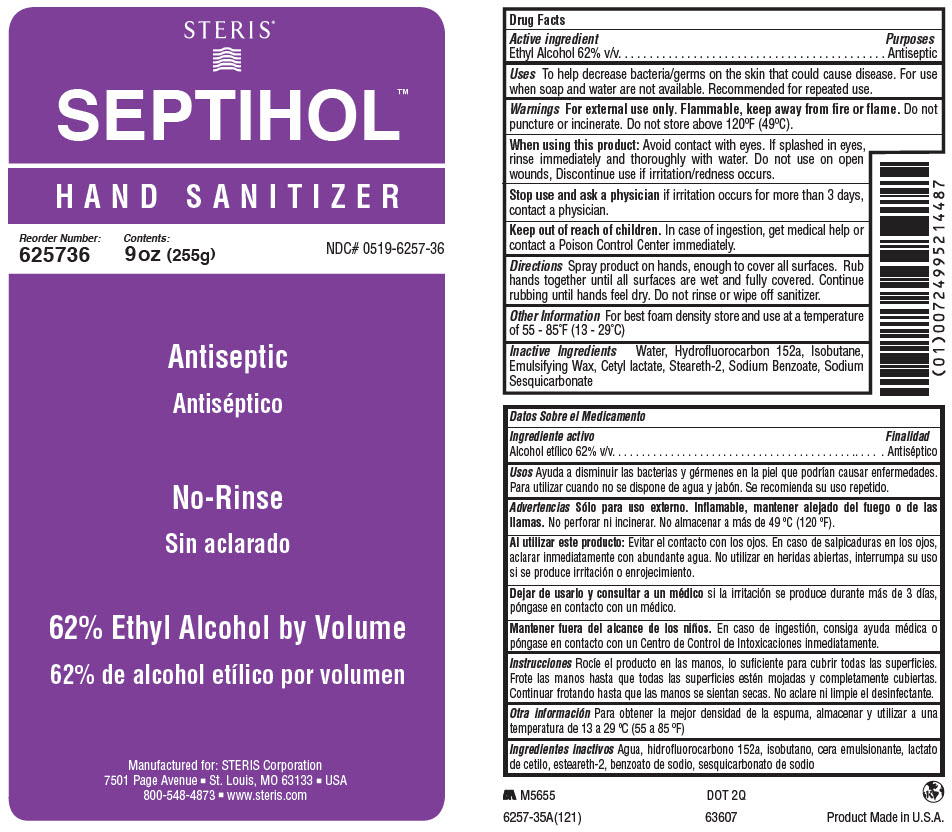
Septihol Hand Sanitizer Alcohol 62 mL/100mL Aerosol, Foam — NDC 0519-6257-35 (Billing 00519-6257-35)
This is a package of Septihol Hand Sanitizer Alcohol 62 mL/100mL Aerosol, Foam from STERIS Corporation, marketed since May 2021 and currently FDA-listed. It is this product's only package size.
NDC database record
One package, one record: these facts belong to NDC 0519-6257-35 alone.
- Record
- FDA NDC Directory package listing · Human OTC drug
- Code segments
- 0519 labeler · 6257 product · 35 package
- Package marketed since
- May 1, 2021
- Sample package
- No — commercial package
- Listing certified through
- Dec 31, 2026
- Barcode (UPC-A, from the NDC)
- 3 0519625735 2
- FDA record last changed
- Jul 24, 2026
Identity & classification
Regulatory identifiers FDA, NLM and CMS codes for this package
- RxCUI (RxNorm): 1020364
Where does this data come from?
- FDA openFDA NDC Directory · synced Oct 8, 2026
- FDA label on DailyMed · label index refreshed Oct 6, 2026
- RxNorm (NLM RxNav) · catalog refreshed Oct 1, 2026
- Medi-Span GPI (licensed)
- First Databank (licensed) · refreshed Oct 8, 2026
RxNorm drug class
This medicine belongs to the Other antiseptics and disinfectants class.
Where does this data come from?
- RxClass (NLM) · catalog refreshed Oct 1, 2026
Clinical
- It depends on the product. Hand sanitizers and wipes help reduce bacteria on your skin, and alcohol pads prepare skin before an injection. A separate injected form is used by heart...
- Most directions say to cover all surfaces of your hands and rub until dry. Sprays and wipes follow similar steps. Check your product's label, since directions differ a bit between...
- Children under 6 should use hand sanitizer only with adult supervision to avoid swallowing. Keep all products out of reach of children. If someone swallows it, get medical help or...
- Stop using it and ask a doctor if you get irritation and redness, or if your condition lasts more than 72 hours. Avoid broken skin and keep it out of your eyes. If it gets in your...
Patient education
Supplement & herbal interactions
Where does this data come from?
- MedlinePlus (NLM) · refreshed Oct 1, 2026
- FDA label on DailyMed · label index refreshed Oct 6, 2026
Ask a licensed pharmacist directly — free, answered by our team.
Pricing
A drug doesn't have one price. Each row is a different public payment system, and none is what you'd pay at the counter — that depends on your insurance. The ⓘ on each row explains what it measures.
| Price system | Per g | Per package |
|---|---|---|
| Retail pharmacies payNADAC · weekly | Not in the retail survey — common for institutional, discontinued, or low-volume packs. | |
| Medicaid paysCMS SDUD · 12 mo | No recent Medicaid claims on file for this NDC — rare and low-volume NDCs are suppressed in the public data. | |
| Medicare drug plans payPart D · quarterly | No Part D plan price is available for this NDC in our data. | |
Where does this data come from?
- CMS NADAC weekly file
- CMS ASP pricing files · refreshed Sep 20, 2026
- CMS Medicaid State Drug Utilization Data · refreshed Oct 8, 2026
- CMS Part D plan pricing files · refreshed Sep 24, 2026
- VA National Acquisition Center price file
Packaging — all sizes for this product
| Package NDC | Description | Marketing start | Marketing end | Status |
|---|---|---|---|---|
| 00519-6257-35 You're viewing this Main listing | 24 BOTTLE in 1 CASE / 255 mL in 1 BOTTLE | 2021-05-01 | — | Active |
Therapeutic equivalents
Where does this data come from?
- FDA openFDA NDC Directory · synced Oct 8, 2026
- FDA Orange Book · refreshed Oct 3, 2026
- CMS NADAC weekly file
Availability & generic status
We did not find an FDA-approved generic match for this exact strength, form and route.
Where does this data come from?
- FDA Orange Book · refreshed Oct 3, 2026
Inactive Ingredients / Excipients
Inactive ingredients, also called excipients, are components of the drug product other than the active ingredient. They may include fillers, dyes, coatings, preservatives, flavors, or other formulation ingredients.
🧪 Avoiding an ingredient? See Alcohol inactive ingredients by manufacturer: every current product's list side by side, so you can ask your pharmacy for the version that does not list it.
💡 Tap an ingredient (hover on desktop) to see what it is and why it’s used.
-
UNII 0B1U8K2ME0
A synthetic gas used as a propellant in pressurized aerosol inhalers. It helps deliver the active medication as a fine mist or spray into the lungs or airways.
-
UNII A7EVH2RK4O
Cetyl lactate is a waxy compound made from lactic acid and cetyl alcohol. It works as an emulsifier and thickener to help mix oil and water ingredients and give the medicine the right texture.
-
UNII BXR49TP611
Isobutane is a liquefied gas used as a propellant in aerosol inhalers and sprays. It helps push the medicine out of the container so you can breathe or spray it as directed.
-
UNII OJ245FE5EU
Sodium benzoate is a salt derived from benzoic acid, a preservative. It's added to medicines to prevent growth of bacteria, fungi, and other microorganisms that could spoil the product.
-
UNII Y1X815621J
Sodium sesquicarbonate is a white crystalline salt made from sodium carbonate and sodium bicarbonate. In medicines, it acts as a buffer to help maintain pH balance and may serve as a disintegrant to help tablets break apart in the stomach.
-
UNII V56DFE46J5
Steareth-2 is a synthetic emulsifier made from stearic acid and ethylene oxide. It helps mix oil and water-based ingredients together in the formulation and may improve how the medicine spreads or dissolves.
-
UNII 059QF0KO0R
Water is a liquid solvent that dissolves and mixes ingredients together in liquid medicines, syrups, and injections. It helps distribute the active drug evenly throughout the product.
7 inactive ingredients listed in the exact product block matched to this NDC.
Label-section wording can be broader than the structured product block and may mention additional formulation ingredients.
Where does this data come from?
ingredient classCode="IACT" elements from the exact product block matched by this NDC. Label-section narrative from DailyMed / the openFDA label index is shown separately when available.- FDA label on DailyMed · label index refreshed Oct 6, 2026
- FDA openFDA NDC Directory · synced Oct 8, 2026
Inactive ingredient FAQ
Are inactive ingredients the same for every manufacturer?
Why might an inactive ingredient be missing?
Can inactive ingredients matter?
Manufacturer & labeler
Where does this data come from?
- FDA openFDA NDC Directory · synced Oct 8, 2026
- Drugs@FDA
FDA label — Drug Facts FDA SPL
🎯 Indications and Usage ▾
Uses To help decrease bacteria/germs on the skin that could cause disease. For use when soap and water are not available. Recommended for repeated use.
⏱️ Dosage and Administration ▾
Directions Spray product on hands, enough to cover all surfaces. Rub hands together until all surfaces are wet and fully covered. Continue rubbing until hands feel dry. Do not rinse or wipe off sanitizer.
⚠️ Warnings ▾
Warnings For external use only . Flammable, keep away from fire or flame. Do not puncture or incinerate.
Do not store above 120ºF (49ºC). When using this product Avoid contact with eyes. If splashed in eyes, rinse immediately and thoroughly with water.
Do not use on open wounds, Discontinue use if irritation/redness occurs. Stop use and ask a physician if irritation occurs for more than 3 days, contact a physician. Keep out of reach of children.
In case of ingestion, get medical help or contact a Poison Control Center immediately.
📦 Storage and Handling ▾
Other Information For best foam density store and use at a temperature of 55 - 85˚F (13 - 29˚C)
🧪 Active Ingredient ▾
Active ingredient Ethyl Alcohol 62% v/v
🧪 Inactive Ingredients ▾
Inactive Ingredients Water, Hydrofluorocarbon 152a, Isobutane, Emulsifying Wax, Cetyl lactate, Steareth-2, Sodium Benzoate, Sodium Sesquicarbonate
🎯 Purpose ▾
Purposes Antiseptic
📄 When Using This Product ▾
When using this product Avoid contact with eyes. If splashed in eyes, rinse immediately and thoroughly with water. Do not use on open wounds, Discontinue use if irritation/redness occurs.
📄 Stop Use and Ask a Doctor If ▾
Stop use and ask a physician if irritation occurs for more than 3 days, contact a physician.
📄 Keep Out of Reach of Children ▾
Keep out of reach of children. In case of ingestion, get medical help or contact a Poison Control Center immediately.
📄 Package Label / Principal Display Panel ▾
PRINCIPAL DISPLAY PANEL - 255 g Bottle Label STERIS ® SEPTIHOL™ HAND SANITIZER Reorder Number: 625736 Contents: 9 oz (255g) NDC# 0519-6257-36 Antiseptic No-Rinse 62% Ethyl Alcohol by Volume Manufactured for: STERIS Corporation 7501 Page Avenue ■ St. Louis, MO 63133 ■ USA 800-548-4873 ■ www.steris.com PRINCIPAL DISPLAY PANEL - 255 g Bottle Label
Reported adverse events (FAERS)
Top reported reactions
Age at onset
Reporter sex
Serious outcomes
Where does this data come from?
About this NDC listing & data coverage
What data is (and isn’t) available for this NDC — tap to expand
| NDC identity (package / product / labeler codes) | ✓ Available |
| Labeler | ✓ Available |
| Product & package description | ✓ Available |
| Marketing category & status | ✓ Available |
| Active ingredient / dosage form / route | ✓ Available |
| FDA label (SPL via DailyMed) | ✓ Available |
| Package photos | ✓ Available |
| Inactive ingredients (structured) | ✓ Available |
| NADAC pharmacy acquisition price (CMS) | — Not published for this NDC CMS publishes NADAC only for NDCs reported in its retail-pharmacy survey. |
| Orange Book / therapeutic-equivalence data | — Not published for this NDC Applies only to products approved under an NDA/ANDA; many listings are out of scope. |
| HCPCS J-code billing crosswalk | — Not published for this NDC Most self-administered / retail products have no J-code — that is normal. |
| Medicaid utilization (CMS SDUD) | — Not published for this NDC CMS reports utilization only for NDCs with Medicaid claims above its privacy threshold. |