
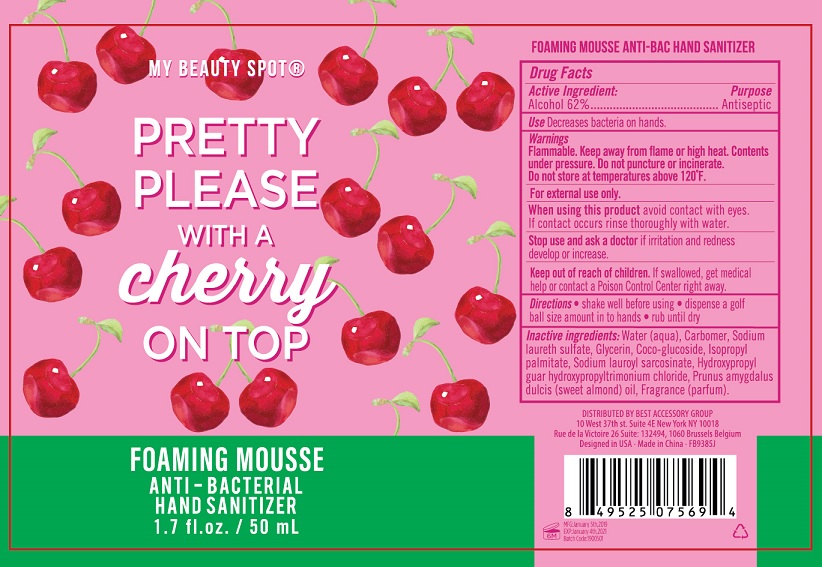
Foaming Mousse Anti-Bacterial Hand Sanitizer Cherry Scented ALCOHOL 62 mL/100mL Aerosol, Foam, 50 mL — NDC 56136-021-01 (Billing 56136-0021-01)
This is a package of 50 mL of Foaming Mousse Anti-Bacterial Hand Sanitizer Cherry Scented ALCOHOL 62 mL/100mL Aerosol, Foam from Ganzhou Olivee Cosmetic Co., Ltd., marketed since Nov 2018 and currently FDA-listed. It is this product's only package size.
NDC database record
One package, one record: these facts belong to NDC 56136-021-01 alone.
- Record
- FDA NDC Directory package listing · Human OTC drug
- Code segments
- 56136 labeler · 021 product · 01 package
- Package marketed since
- Nov 28, 2018
- Sample package
- No — commercial package
- Listing certified through
- Dec 31, 2027
- Barcode (UPC)
- 0849525075694
- FDA record last changed
- Oct 8, 2026
Identity & classification
Regulatory identifiers FDA, NLM and CMS codes for this package
- RxCUI (RxNorm): 616763
Where does this data come from?
- FDA openFDA NDC Directory · synced Oct 8, 2026
- FDA label on DailyMed · label index refreshed Oct 8, 2026
- RxNorm (NLM RxNav) · catalog refreshed Oct 1, 2026
- Medi-Span GPI (licensed)
- First Databank (licensed) · refreshed Oct 8, 2026
RxNorm drug class
This medicine belongs to the Other antiseptics and disinfectants class.
Where does this data come from?
- RxClass (NLM) · catalog refreshed Oct 1, 2026
Clinical
- It depends on the product. Hand sanitizers and wipes help reduce bacteria on your skin, and alcohol pads prepare skin before an injection. A separate injected form is used by heart...
- Most directions say to cover all surfaces of your hands and rub until dry. Sprays and wipes follow similar steps. Check your product's label, since directions differ a bit between...
- Children under 6 should use hand sanitizer only with adult supervision to avoid swallowing. Keep all products out of reach of children. If someone swallows it, get medical help or...
- Stop using it and ask a doctor if you get irritation and redness, or if your condition lasts more than 72 hours. Avoid broken skin and keep it out of your eyes. If it gets in your...
Patient education
Supplement & herbal interactions
Where does this data come from?
- MedlinePlus (NLM) · refreshed Oct 8, 2026
- FDA label on DailyMed · label index refreshed Oct 8, 2026
Ask a licensed pharmacist directly — free, answered by our team.
Pricing
A drug doesn't have one price. Each row is a different public payment system, and none is what you'd pay at the counter — that depends on your insurance. The ⓘ on each row explains what it measures.
| Price system | Per g | Per package |
|---|---|---|
| Retail pharmacies payNADAC · weekly | Not in the retail survey — common for institutional, discontinued, or low-volume packs. | |
| Medicaid paysCMS SDUD · 12 mo | No recent Medicaid claims on file for this NDC — rare and low-volume NDCs are suppressed in the public data. | |
| Medicare drug plans payPart D · quarterly | No Part D plan price is available for this NDC in our data. | |
Where does this data come from?
- CMS NADAC weekly file
- CMS ASP pricing files · refreshed Sep 20, 2026
- CMS Medicaid State Drug Utilization Data · refreshed Oct 8, 2026
- CMS Part D plan pricing files · refreshed Sep 24, 2026
- VA National Acquisition Center price file
Packaging — all sizes for this product
| Package NDC | Description | Marketing start | Marketing end | Status |
|---|---|---|---|---|
| 56136-0021-01 You're viewing this Main listing | 50 mL in 1 BOTTLE | 2018-11-28 | — | Active |
Therapeutic equivalents
Where does this data come from?
- FDA openFDA NDC Directory · synced Oct 8, 2026
- FDA Orange Book · refreshed Oct 3, 2026
- CMS NADAC weekly file
Availability & generic status
We did not find an FDA-approved generic match for this exact strength, form and route.
Where does this data come from?
- FDA Orange Book · refreshed Oct 3, 2026
Inactive Ingredients / Excipients
Inactive ingredients, also called excipients, are components of the drug product other than the active ingredient. They may include fillers, dyes, coatings, preservatives, flavors, or other formulation ingredients.
🧪 Avoiding an ingredient? See Alcohol inactive ingredients by manufacturer: every current product's list side by side, so you can ask your pharmacy for the version that does not list it.
💡 Tap an ingredient (hover on desktop) to see what it is and why it’s used.
-
UNII Z135WT9208
Carbomer is a synthetic polymer that forms a thick, gel-like consistency. It's used in medicines as a thickener and stabilizer to improve texture and keep ingredients evenly mixed throughout the product.
-
UNII ICS790225B
A plant-derived cleaning agent made from coconut oil and glucose. It works as a surfactant and emulsifier to help mix oil and water-based ingredients together in the formulation.
-
UNII PDC6A3C0OX
Glycerin is a clear, thick liquid derived from plant oils or fats. It acts as a humectant to retain moisture, a sweetener, and a solvent in medications.
-
UNII 3A1I7376TC
A natural gum derived from guar seeds, used as a thickener and binder in medicines. It increases viscosity to improve texture and help hold ingredients together in liquid or semi-solid formulations.
-
UNII 8XE51CV5DE
A synthetic polymer derived from cellulose that acts as a film-former and thickening agent. It's used in topical formulations to create a protective coating on skin or mucous membranes and improve product texture and spreadability.
-
UNII 8CRQ2TH63M
Isopropyl palmitate is an oily liquid derived from palm oil. It acts as an emollient and lubricant in medicines, helping soften the skin or improve how the product spreads and flows.
-
UNII 6DC9Q167V3
Propylene glycol is a clear liquid derived from petroleum or vegetable sources. It acts as a solvent, humectant, and preservative in medicines, helping dissolve active ingredients and maintain product stability.
-
UNII BPV390UAP0
Sodium laureth sulfate is a mild detergent and surfactant derived from coconut oil or petroleum. It helps mix oil and water in formulations and is often used as a cleaning or foaming agent in topical products like shampoos and cleansers.
-
UNII 632GS99618
Sodium lauroyl sarcosinate is a mild, plant-derived cleaning agent used in medicines as a surfactant and emulsifier. It helps mix oil and water-based ingredients and may aid tablet disintegration.
-
UNII 059QF0KO0R
Water is a liquid solvent that dissolves and mixes ingredients together in liquid medicines, syrups, and injections. It helps distribute the active drug evenly throughout the product.
10 inactive ingredients listed in the exact product block matched to this NDC.
Label-section wording can be broader than the structured product block and may mention additional formulation ingredients.
Where does this data come from?
ingredient classCode="IACT" elements from the exact product block matched by this NDC. Label-section narrative from DailyMed / the openFDA label index is shown separately when available.- FDA label on DailyMed · label index refreshed Oct 8, 2026
- FDA openFDA NDC Directory · synced Oct 8, 2026
Inactive ingredient FAQ
Are inactive ingredients the same for every manufacturer?
Why might an inactive ingredient be missing?
Can inactive ingredients matter?
Manufacturer & labeler
More NDCs from Ganzhou Olivee Cosmetic Co., Ltd. labeler code 56136
- Foaming Mousse Anti-Bacterial Hand Sanitizer Pineapple Scented ALCOHOL 62 mL/100mL Aerosol, Foam NDC 56136-022-01
- Foaming Mousse Anti-Bacterial Hand Sanitizer Pink Grapefruit Scented ALCOHOL 62 mL/100mL Aerosol, Foam NDC 56136-023-01
- hydrating mist hand sanitizer with silicone keychain holder - beaver nuggets Alcohol 70 mL/100mL Gel NDC 56136-150-01
- hydrating mist hand sanitizer with silicone keychain holder - signature scent Alcohol 70 mL/100mL Gel NDC 56136-151-01
- hand sanitizer - cherry sundae Alcohol 70 mL/100mL Gel NDC 56136-152-01
- hand sanitizer - vanilla frosting Alcohol 70 mL/100mL Gel NDC 56136-153-01
Where does this data come from?
- FDA openFDA NDC Directory · synced Oct 8, 2026
- Drugs@FDA
FDA label — Drug Facts FDA SPL
🎯 Indications and Usage ▾
Avoid contact with eyes, if contact occurs rinse thoroughly with water.
⏱️ Dosage and Administration ▾
shake well before using; dispense a golf bass size amount in to hands; rub until dry.
⚠️ Warnings ▾
For external use only. Flammable. Keep product away from flame or high heat. contents under pressure. Do not puncture or in cinerate. Stop using and ask a doctor, if irritation and redness develop or increase.
🧪 Active Ingredient ▾
Active ingredient Purpose Alcohol 62% ... Antiseptic
🧪 Inactive Ingredients ▾
Water (aqua), Carbomer, Sodium laureth sulfate, Glycerin, Coco-glucoside, Isopropyl palmitate, Sodium laureyl sarcosinate, Hydroxypropyl guar, Hydroxypropyl trimonium chloride, Prunus amygdalus dulcis (sweet almond) oil, Fragrance (parfum).
🎯 Purpose ▾
Decrease bacteria on hands.
📄 Keep Out of Reach of Children ▾
If swallowed, get medical help or contact local poison control center right away.
📄 Package Label / Principal Display Panel ▾
image of label
Reported adverse events (FAERS)
Top reported reactions
Age at onset
Reporter sex
Serious outcomes
Where does this data come from?
About this NDC listing & data coverage
What data is (and isn’t) available for this NDC — tap to expand
| NDC identity (package / product / labeler codes) | ✓ Available |
| Labeler | ✓ Available |
| Product & package description | ✓ Available |
| Marketing category & status | ✓ Available |
| Active ingredient / dosage form / route | ✓ Available |
| FDA label (SPL via DailyMed) | ✓ Available |
| Package photos | ✓ Available |
| Inactive ingredients (structured) | ✓ Available |
| NADAC pharmacy acquisition price (CMS) | — Not published for this NDC CMS publishes NADAC only for NDCs reported in its retail-pharmacy survey. |
| Orange Book / therapeutic-equivalence data | — Not published for this NDC Applies only to products approved under an NDA/ANDA; many listings are out of scope. |
| HCPCS J-code billing crosswalk | — Not published for this NDC Most self-administered / retail products have no J-code — that is normal. |
| Medicaid utilization (CMS SDUD) | — Not published for this NDC CMS reports utilization only for NDCs with Medicaid claims above its privacy threshold. |