
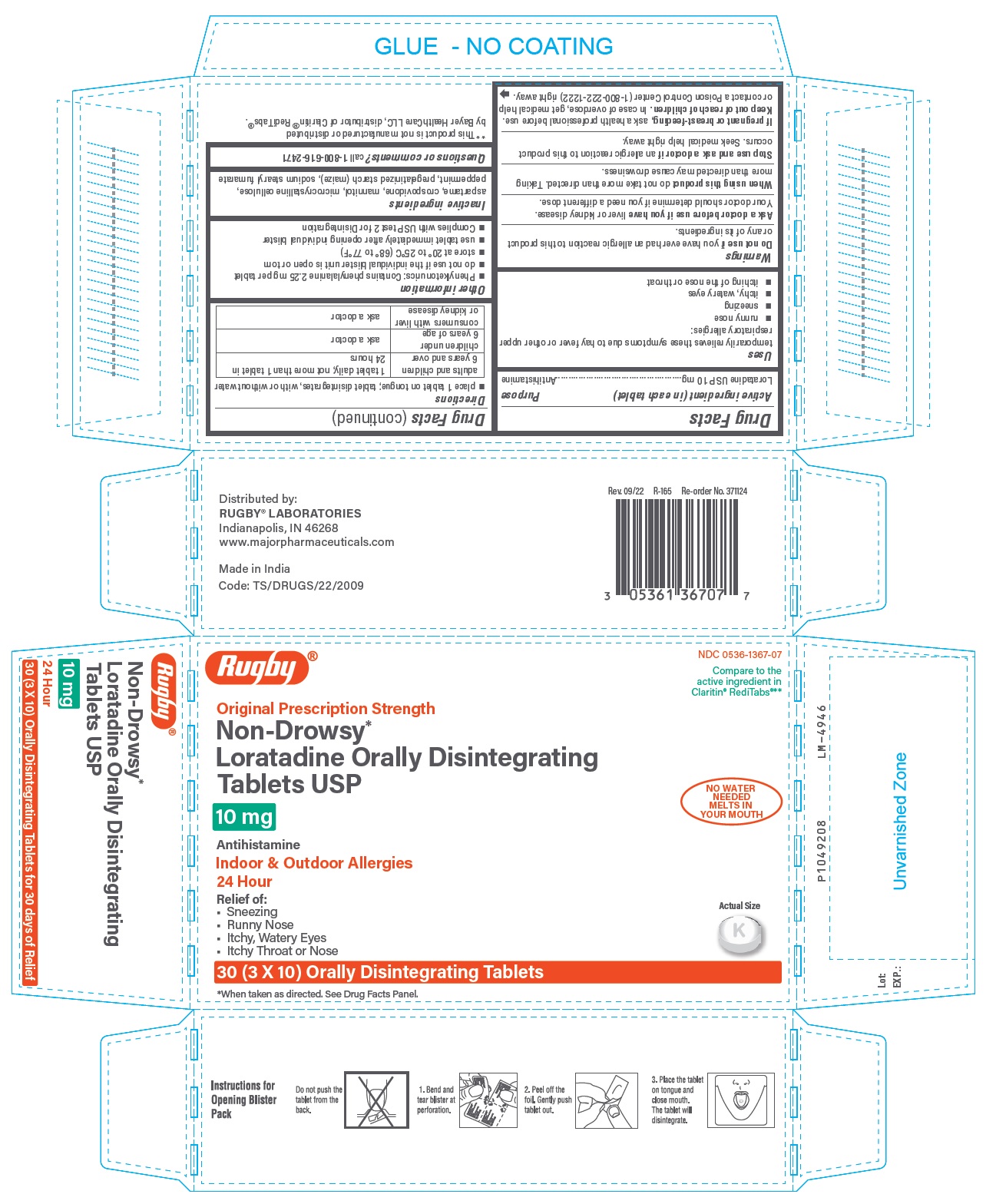
Loratadine ODT 10 mg Tablet, Orally Disintegrating — NDC 0536-1367-07 (Billing 00536-1367-07)
This is a package of Loratadine ODT 10 mg Tablet, Orally Disintegrating from Rugby Laboratories, marketed since Oct 2022 and currently FDA-listed; retail pharmacies pay about $0.5274 per unit (NADAC). It is this product's only package size.
NDC database record
One package, one record: these facts belong to NDC 0536-1367-07 alone.
- Record
- FDA NDC Directory package listing · Human OTC drug
- Code segments
- 0536 labeler · 1367 product · 07 package
- Package marketed since
- Oct 6, 2022
- Sample package
- No — commercial package
- Listing certified through
- Dec 31, 2027
- Barcode (UPC-A, from the NDC)
- 3 0536136707 7
- Medicaid fills, this package
- 2,909 prescriptions in the last four reported quarters
- FDA record last changed
- Aug 27, 2026
Identity & classification
Regulatory identifiers FDA, NLM and CMS codes for this package
Drug-database identifiers Medi-Span GPI and First Databank GCN / HICL / AHFS classification
- GSN (GCN sequence number): 030476
- GCN: 60521
- HICL (First Databank): 007605
- AHFS class code: 04:08.00.00
- RxCUI (RxNorm): 311373
Where does this data come from?
- FDA openFDA NDC Directory · synced Oct 8, 2026
- FDA label on DailyMed · label index refreshed Oct 6, 2026
- RxNorm (NLM RxNav) · catalog refreshed Oct 1, 2026
- Medi-Span GPI (licensed)
- First Databank (licensed) · refreshed Oct 8, 2026
RxNorm drug class
This medicine belongs to the Other antihistamines for systemic use class.
Where does this data come from?
- RxClass (NLM) · catalog refreshed Oct 1, 2026
Clinical
Loratadine is used to treat allergy symptoms: sneezing runny nose itching of the nose or throat red, itchy, or watery eyes Loratadine is in a class of medications called antihistamines. It works by blocking the action of histamine, a substance in the body that causes allergic symptoms.
Read the full MedlinePlus article ↗- It temporarily relieves symptoms of hay fever and other upper respiratory allergies. That means runny nose, sneezing, itchy, watery eyes, and an itchy nose or throat.
- It is taken by mouth, generally once a day. Follow the directions on your specific product. Chewable tablets should be chewed or crushed completely, and liquids should be measured...
- No. Do not take more than directed. Taking more than directed may cause drowsiness. If you think you took too much, get medical help or call Poison Control right away.
- Can I take extra if my allergies are bad?
Patient education
Supplement & herbal interactions
Some supplements/herbs that may interact with Loratadine — tap one for details:
Where does this data come from?
- MedlinePlus (NLM) · refreshed Oct 1, 2026
- FDA label on DailyMed · label index refreshed Oct 6, 2026
Ask a licensed pharmacist directly — free, answered by our team.
Pricing
A drug doesn't have one price. Each row is a different public payment system, and none is what you'd pay at the counter — that depends on your insurance. The ⓘ on each row explains what it measures.
| Price system | Per ea | Per package |
|---|---|---|
| Retail pharmacies payNADAC · weekly | $0.527 | $15.82 / 30 tablets |
| Medicaid paysCMS SDUD · 12 mo | $0.7668 | $23.00 / 30 tablets |
| Medicare drug plans payPart D · quarterly | No Part D plan price is available for this NDC in our data. | |
Where does this data come from?
- CMS NADAC weekly file · file of Oct 7, 2026
- CMS ASP pricing files · refreshed Sep 20, 2026
- CMS Medicaid State Drug Utilization Data · through Q1 2026
- CMS Part D plan pricing files · refreshed Sep 24, 2026
- VA National Acquisition Center price file
Packaging — all sizes for this product
| Package NDC | Description | Marketing start | Marketing end | Status |
|---|---|---|---|---|
| 00536-1367-07 You're viewing this Main listing | 3 BLISTER PACK in 1 CARTON / 10 TABLET, ORALLY DISINTEGRATING in 1 BLISTER PACK | 2022-10-06 | — | Active |
Therapeutic equivalents
| Product | Labeler | Pack | NADAC/unit | TE | Status | Price vs. this |
|---|---|---|---|---|---|---|
| Loratadine ODT 10 mgthis 00536-1367-07 | Rugby | 10 tablets | $0.527 | — | Availability likely | — |
| Loratadine ODT 10 mg 46122-0539-52 | Amerisource | 10 tablets | $0.527 | — | Availability likely | — |
| Loratadine 10 mg 72888-0029-09 | Advagen | 10 tablets | $0.527 | — | Availability likely | — |
| good sense allergy relief 10 mg 00113-1191-65 | L. | 1 tablet | — | — | FDA listed | — |
| good sense allergy relief 10 mg 00113-9755-65 | L. | 1 tablet | — | — | FDA listed | — |
| Childrens Loratadine Odt 10 mg 00363-4020-84 | WALGREEN | 10 tablets | — | — | FDA listed | — |
| Loratadine ODT 10 mg 00363-9937-84 | WALGREEN | 10 tablets | — | — | FDA listed | — |
| Claritin Reditabs 10 mg 11523-4329-01 | Bayer | 10 tablets | — | — | FDA listed | — |
| Claritin Reditabs 10 mg 11523-7157-02 | Bayer | 10 tablets | — | — | FDA listed | — |
| loratadine 10 mg 11822-0558-00 | Rite | 1 tablet | — | — | FDA listed | — |
| loratadine 10 mg 11822-0919-00 | Rite | 1 tablet | — | — | Discontinued | — |
| Loratadine ODT 10 mg 21130-0221-84 | Better | 10 tablets | — | — | FDA listed | — |
| signature care allergy relief 10 mg 21130-0301-65 | Safeway | 1 tablet | — | — | Discontinued | — |
| signature care allergy relief 10 mg 21130-0452-65 | Safeway | 1 tablet | — | — | FDA listed | — |
| allergy relief 10 mg 30142-0446-65 | Kroger | 1 tablet | — | — | FDA listed | — |
| Topcare Allergy Relief 10 mg 36800-0853-65 | Topco | 1 tablet | — | — | FDA listed | — |
| non drowsy allergy relief 10 mg 41250-0890-65 | Meijer | 1 tablet | — | — | FDA listed | — |
| careone allergy relief 10 mg 41520-0510-65 | American | 1 tablet | — | — | FDA listed | — |
| Loratadine 10 mg 43598-0707-30 | Dr. | 10 tablets | — | — | FDA listed | — |
| Loratadine 10 mg 43598-0758-10 | Dr. | 10 tablets | — | — | FDA listed | — |
| Loratadine ODT 10 mg 49035-0806-03 | Wal-Mart | 10 tablets | — | — | FDA listed | — |
| Loratadine 10 mg 51316-0503-01 | CVS | 10 tablets | — | — | FDA listed | — |
| Allergy Relief 10 mg 51316-0931-46 | CVS | 1 tablet | — | — | FDA listed | — |
| Allergy Relief 10 mg 51660-0527-31 | Ohm | 1 tablet | — | — | FDA listed | — |
| Loratadine ODT 10 mg 53943-0035-03 | DISCOUNT | 10 tablets | — | — | FDA listed | — |
| dg health allergy relief 10 mg 55910-0594-46 | Dolgencorp, | 1 tablet | — | — | FDA listed | — |
| dg health allergy relief 10 mg 55910-0970-46 | Dolgencorp, | 1 tablet | — | — | FDA listed | — |
| Allervarx 10 mg 57483-0950-10 | Innovus | 10 tablets | — | — | FDA listed | — |
| Loratadine ODT 10 mg 58602-0744-83 | Aurohealth | 10 tablets | — | — | FDA listed | — |
| Loratadine ODT 10 mg 58602-0821-83 | Aurohealth | 10 tablets | — | — | FDA listed | — |
| Loratadine ODT 10 mg 58602-0830-83 | Aurohealth | 10 tablets | — | — | FDA listed | — |
| Loratadine ODT 10 mg 58602-0881-15 | Aurohealth | 10 tablets | — | — | FDA listed | — |
| Loratadine 10 mg 59556-0917-01 | Strides | 10 tablets | — | — | FDA listed | — |
| Loratadine ODT 10 mg 60000-0950-83 | Ahold | 10 tablets | — | — | FDA listed | — |
| Loratadine ODT 10 mg 68016-0088-10 | Chain | 10 tablets | — | — | FDA listed | — |
| Alavert Allergy 10 mg 69536-0190-60 | Foundation | 1 tablet | — | — | FDA listed | — |
| Alavert Allergy 10 mg 69536-0195-20 | Foundation | 1 tablet | — | — | FDA listed | — |
| Loratadine ODT 10 mg 69842-0085-03 | CVS | 10 tablets | — | — | FDA listed | — |
| Basic Care Allergy Relief 10 mg 72288-0200-65 | Amazon.com | 1 tablet | — | — | FDA listed | — |
| Basic Care Allergy Relief 10 mg 72288-0451-65 | Amazon.com | 1 tablet | — | — | FDA listed | — |
| Loratadine 10 mg 72983-0501-01 | Tenshi | 10 tablets | — | — | FDA listed | — |
| Loratadine 10 mg 72983-0503-06 | Tenshi | 1 tablet | — | — | FDA listed | — |
| equate loratadine 10 mg 79903-0381-10 | WALMART | 1 tablet | — | — | FDA listed | — |
| Alavert Allergy 10 mg 80070-0110-18 | Foundation | 1 tablet | — | — | FDA listed | — |
| Alavert Allergy 10 mg 80070-0120-60 | Foundation | 1 tablet | — | — | Discontinued | — |
| Allergy Relief 10 mg 79481-9723-01 | Meijer, | 1 tablet | — | — | FDA listed | — |
Where does this data come from?
- FDA openFDA NDC Directory · synced Oct 8, 2026
- FDA Orange Book · refreshed Oct 3, 2026
- CMS NADAC weekly file · file of Oct 7, 2026
Availability & generic status
This product is an FDA-approved generic. Other versions of the same drug are listed under Therapeutic equivalents, least expensive first.
Where does this data come from?
- FDA Orange Book · refreshed Oct 3, 2026
What it looks like
Where does this data come from?
- FDA label on DailyMed · label index refreshed Oct 6, 2026
Inactive Ingredients / Excipients
Inactive ingredients, also called excipients, are components of the drug product other than the active ingredient. They may include fillers, dyes, coatings, preservatives, flavors, or other formulation ingredients.
🧪 Avoiding an ingredient? See Loratadine inactive ingredients by manufacturer: every current product's list side by side, so you can ask your pharmacy for the version that does not list it.
💡 Tap an ingredient (hover on desktop) to see what it is and why it’s used.
-
UNII Z0H242BBR1
Aspartame is an artificial sweetener made from amino acids. It's added to medicines to improve taste, making bitter or unpleasant-tasting drugs easier to take.
-
UNII 68401960MK
Crospovidone is a synthetic polymer made from polyvinylpyrrolidone. It acts as a disintegrant, helping tablets break apart quickly in the stomach so the medicine dissolves and absorbs into the body.
-
UNII 3OWL53L36A
A natural sugar alcohol derived from seaweed or synthesized in the lab. It's used as a filler to add bulk, a sweetener in sugar-free formulas, and a disintegrant to help tablets break apart in the stomach.
-
UNII OP1R32D61U
Microcrystalline cellulose is a purified form of cellulose, a natural fiber from plant sources. It acts as a binder and filler in tablets and capsules, helping hold ingredients together and give the medicine its shape and size.
-
UNII V95R5KMY2B
Peppermint is a flavoring agent derived from the peppermint plant. It's added to medicines to improve taste and mask bitter or unpleasant flavors, making them easier to take.
-
UNII 7CV7WJK4UI
Sodium stearyl fumarate is a synthetic compound made from stearyl alcohol and fumaric acid. It acts as a lubricant and glidant in tablets and capsules, helping ingredients flow smoothly during manufacturing and preventing sticking.
-
UNII O8232NY3SJ
A plant-based carbohydrate derived from corn kernels. It acts as a filler to add bulk, a binder to hold ingredients together, and a disintegrant to help the tablet break apart in your stomach for absorption.
7 inactive ingredients listed in the exact product block matched to this NDC.
Label-section wording can be broader than the structured product block and may mention additional formulation ingredients.
Where does this data come from?
ingredient classCode="IACT" elements from the exact product block matched by this NDC. Label-section narrative from DailyMed / the openFDA label index is shown separately when available.- FDA label on DailyMed · label index refreshed Oct 6, 2026
- FDA openFDA NDC Directory · synced Oct 8, 2026
Inactive ingredient FAQ
Are inactive ingredients the same for every manufacturer?
Why might an inactive ingredient be missing?
Can inactive ingredients matter?
Manufacturer & labeler
More NDCs from Rugby Laboratories labeler code 00536
- Maxi Nicotine nicotine polacrilex 4 mg Lozenge NDC 0536-1338-09
- rugby cough syrup dextromethorphan hydrobromide, guaifenesin 20 mg/20mL; 200 mg/20mL Solution NDC 0536-1348-97
- Muscle Rub menthol and methyl salicylate 100 mg/g; 150 mg/g Cream NDC 0536-1349-57
- Rugby Benzoyl Peroxide Wash Acne Medication 100 mg/g Lotion NDC 0536-1351-42
- Rugby Lidocaine Lidocaine 4% 4 g/100g Cream NDC 0536-1357-95
- Nicotine 2 mg Gum, Chewing NDC 0536-1362-06
- Lansoprazole 15 mg Capsule, Delayed Release NDC 0536-1368-13
- Rugby Nicotine Polacrilex Gum, Mint Flavor 4 mg Gum, Chewing NDC 0536-1372-06
- MICONAZOLE Nitrate 2% Cream ANTIFUNGAL 2 g/100g Cream NDC 0536-1375-75
- Acetaminophen and Ibuprofen 250 mg; 125 mg Tablet NDC 0536-1376-36
- Rugby mometasone furoate nasal 50 ug Spray, Metered NDC 0536-1381-30
- Rugby Carboxymethylcellulose Sodium 0.5% Eye Drops .5 g/100mL Solution/ Drops NDC 0536-1386-35
Where does this data come from?
- FDA openFDA NDC Directory · synced Oct 8, 2026
- Drugs@FDA
FDA label — Drug Facts FDA SPL
🎯 Indications and Usage ▾
Uses temporarily relieves these symptoms due to hay fever or other upper respiratory allergies: runny nose sneezing itchy, watery eyes itching of the nose or throat
⏱️ Dosage and Administration ▾
Directions place 1 tablet on tongue; tablet disintegrates, with or without water adults and children 6 years and over 1 tablet daily; not more than 1 tablet in 24 hours children under 6 years of age ask a doctor consumers with liver or kidney disease ask a doctor
⚠️ Warnings ▾
Warnings
📦 Storage and Handling ▾
Other information Phenylketonurics: Contains phenylalanine 2.25 mg per tablet do not use if the individual blister unit is open or torn store at 20° to 25°C (68° to 77°F) use tablet immediately after opening individual blister Complies with USP test 2 for Disintegration
🧪 Active Ingredient ▾
Active ingredient (in each tablet) Loratadine USP 10 mg
🧪 Inactive Ingredients ▾
Inactive ingredients aspartame, crospovidone, mannitol, microcrystalline cellulose, peppermint, pregelatinized starch (maize), sodium stearyl fumarate
🎯 Purpose ▾
Purpose Antihistamine
📄 Do Not Use ▾
Do not use if you have ever had an allergic reaction to this product or any of its ingredients.
📄 Ask a Doctor Before Use If ▾
Ask a doctor before use if you have liver or kidney disease. Your doctor should determine if you need a different dose.
📄 When Using This Product ▾
When using this product do not take more than directed. Taking more than directed may cause drowsiness.
📄 Stop Use and Ask a Doctor If ▾
Stop use and ask a doctor if an allergic reaction to this product occurs. Seek medical help right away.
🤰 If Pregnant or Breast-Feeding ▾
If pregnant or breast-feeding, ask a health professional before use.
📄 Keep Out of Reach of Children ▾
Keep out of reach of children. In case of overdose, get medical help or contact a Poison Control Center (1-800-222-1222) right away.
📄 Questions or Comments ▾
Questions or comments? call 1-855-274-4122 Distributed by: RUGBY ® LABORATORIES Indianapolis, IN 46268 www.major-rugby.com Made in India
📄 Package Label / Principal Display Panel ▾
PACKAGE LABEL-PRINCIPAL DISPLAY PANEL - 10 mg, Blister Carton 30 (3 X 10) Orally Disintegrating Tablets Rugby ® NDC 0536-1367-07 compare to the active ingredient in Claritin ® RediTabs ®** original prescription strength non-drowsy* loratadine orally disintegrating tablets USP loratadine 10 mg orally disintegrating tablets antihistamine indoor & outdoor allergies 24 hour relief of: • sneezing • runny nose • itchy, watery eyes • itchy throat or nose 30 (3 X 10) orally disintegrating tablets *when taken as directed. see Drug Facts panel.
NO WATER NEEDED MELTS IN YOUR MOUTH actual size PACKAGE LABEL-PRINCIPAL DISPLAY PANEL - 10 mg, Blister Carton 30 (3 X 10) Orally Disintegrating Tablets