
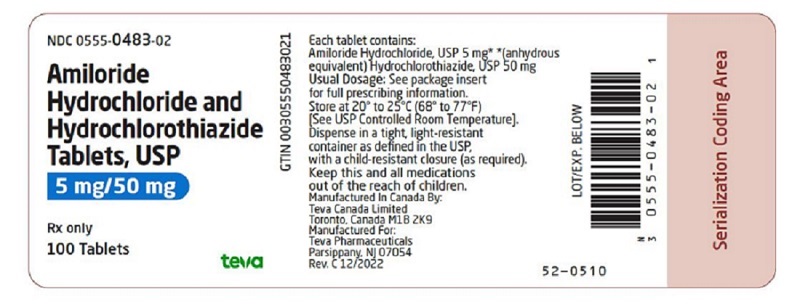
NDC 00555-0483-02: Amiloride Hydrochloride and Hydrochlorothiazide 5 mg; 50 mg Tablet, Bottle of 100
This is a package of 100 tablets of Amiloride Hydrochloride and Hydrochlorothiazide 5 mg; 50 mg Tablet from Teva Pharmaceuticals USA, Inc., first listed with the FDA Dec 1989 and currently FDA-listed; retail pharmacies pay about $0.4357 per tablet (NADAC). It is the main listing for this product, which comes in 3 package sizes.
NDC Database Record
One package, one record: these facts belong to NDC 0555-0483-02 alone.
- Record
- FDA NDC Directory package listing · Human prescription drug
- Code segments
- 0555 labeler · 0483 product · 02 package
- Listing certified through
- Dec 31, 2026
- Billing quantity
- 100 EA per package
- Barcode (UPC-A, from the NDC)
- 3 0555048302 1
- Medicaid fills, this package
- 1,203 prescriptions in the last four reported quarters
- FDA record last changed
- Jul 24, 2026
Identity & Classification
Regulatory identifiers FDA, NLM and CMS codes for this package
Drug-database identifiers Medi-Span GPI and First Databank GCN / HICL / AHFS classification
- GSN (GCN sequence number): 008178
- GCN: 82341
- GPI-14 (Medi-Span): 37990002100310
- HICL (First Databank): 003648
- AHFS class code: 24:36.20.00
- RxCUI (RxNorm): 977883
Where does this data come from?
- FDA openFDA NDC Directory · synced Nov 26, 2026
- FDA label on DailyMed · label index refreshed Nov 26, 2026
- RxNorm (NLM RxNav) · catalog refreshed Nov 26, 2026
- Medi-Span GPI (licensed)
- First Databank (licensed) · refreshed Nov 26, 2026
RxNorm Drug Class
This medicine belongs to the Thiazide Diuretic class.
Where does this data come from?
- RxClass (NLM) · catalog refreshed Nov 26, 2026
Clinical
The combination of amiloride and hydrochlorothiazide is used alone or in combination with other medications to treat high blood pressure and heart failure in patients who have low amounts of potassium in their bodies or for whom low potassium levels in the body could be dangerous. Amiloride and hydrochlorothiazide are in a class of medications called diuretics ('water pills'). They work by causing the kidneys to get rid of unneeded water and salt from the body into the urine. High blood pressure is a common condition and when not treated, can cause damage to the brain, heart, blood vessels, ki...
Read the full MedlinePlus article ↗- It treats high blood pressure or heart failure in people who lose too much potassium on other water pills, or who need to keep potassium normal. It can be used alone or with other...
- Take it by mouth with food, usually once a day. Your prescriber may adjust the amount, so follow their directions and the label.
- This medicine can raise potassium too high, which can be dangerous. We check your levels when you start, when the dose changes, and when you're ill.
- No, not unless your doctor specifically tells you to. Potassium pills, potassium salt substitutes, and a potassium-rich diet can push your level up quickly.
Patient education
Drug interactions
Supplement & herbal interactions
Where does this data come from?
- MedlinePlus (NLM) · refreshed Nov 26, 2026
- FDA label on DailyMed · label index refreshed Nov 26, 2026
Ask a licensed pharmacist directly — free, answered by our team.
Pricing
A drug doesn't have one price. Each row is a different public payment system, and none is what you'd pay at the counter — that depends on your insurance. The ⓘ on each row explains what it measures.
| Price system | Per ea | Per package |
|---|---|---|
| Retail pharmacies pay NADAC · weekly | $0.436 | $43.57 / 100 tablets |
| Medicaid paysCMS SDUD · 12 mo | $0.5398 | $53.98 / 100 tablets |
| Medicare drug plans payPart D · Q2 2026 | $0.6037 | $60.37 / 100 tablets |
See this NDC in the NADAC Price Lookup: every NDC at its price and what a fill costs the pharmacy →
Where does this data come from?
- CMS NADAC weekly file · file of Nov 25, 2026
- CMS ASP pricing files · refreshed Nov 20, 2026
- CMS Medicaid State Drug Utilization Data · through Q1 2026
- CMS Part D plan pricing files · refreshed Nov 24, 2026
- VA National Acquisition Center price file
Packaging — All Sizes for This Product
| Package NDC | Description | Per unit | Per pack | Marketing start | Marketing end | Status |
|---|---|---|---|---|---|---|
| 00555-0483-02 You're viewing this Main listing | 100 TABLET in 1 BOTTLE | $0.4357 / ea | $43.57 | 1989-12-01 | — | Active |
| 00555-0483-05 0555-0483-05 | 1000 TABLET in 1 BOTTLE | $0.4357 / ea | $435.72 | 1989-12-01 | — | Active |
| 00555-0483-99 0555-0483-99 | 60000 TABLET in 1 PAIL | — | — | — | — | Active |
You're viewing the smallest of 3 pack sizes for this product.
This pack has the lowest per-ea cost of the 2 priced pack sizes ($0.4357 NADAC).
In Medicaid, this is the most-dispensed pack of this product — about 100% of fills over the last four reported quarters. See all packs ↓
Pack size FAQ
What quantity is in this package?
How does this package differ from NDC 00555-0483-05?
What NDC number is used to bill for this package of Amiloride Hydrochloride and Hydrochlorothiazide 5 mg; 50 mg Tablet?
Prices are the latest CMS NADAC pharmacy acquisition cost per NDC; per-pack figures are per-unit × pack quantity, shown only when the pack is denominated in the same measure NADAC prices.
Therapeutic Equivalents
| Product | Labeler | Pack | NADAC/unit | TE | Status | Price vs. this |
|---|---|---|---|---|---|---|
| Amiloride Hydrochloride and Hydrochlorothiazide 5 mg/1; 50 mgthis 00555-0483-02 | Teva | 100 tablets | $0.436 | — | Availability likely | — |
Where does this data come from?
- FDA openFDA NDC Directory · synced Nov 26, 2026
- FDA Orange Book · refreshed Nov 6, 2026
- CMS NADAC weekly file · file of Nov 25, 2026
Availability & Generic Status
This product is an FDA-approved generic. Other versions of the same drug are listed under Therapeutic equivalents, least expensive first.
Where does this data come from?
- FDA Orange Book · refreshed Nov 6, 2026
What It Looks Like
Where does this data come from?
- FDA label on DailyMed · label index refreshed Nov 26, 2026
Inactive Ingredients / Excipients
Inactive ingredients, also called excipients, are components of the drug product other than the active ingredient. They may include fillers, dyes, coatings, preservatives, flavors, or other formulation ingredients.
Avoiding an ingredient? See Amiloride and Hydrochlorothiazide inactive ingredients by manufacturer: every current product's list side by side, so you can ask your pharmacy for the version that does not list it.
Tap an ingredient (hover on desktop) to see what it is and why it’s used.
-
UNII LMI26O6933
Alumina is a white powder form of aluminum oxide. It's used as a filler to add bulk to tablets and capsules, and sometimes as a thickening or anti-caking agent in powdered formulations.
-
UNII OP1R32D61U
Microcrystalline cellulose is a purified form of cellulose, a natural fiber from plant sources. It acts as a binder and filler in tablets and capsules, helping hold ingredients together and give the medicine its shape and size.
-
UNII M28OL1HH48
Croscarmellose sodium is a plant-based substance derived from cellulose. It acts as a disintegrant, helping tablets and capsules break down quickly in the digestive system so the medicine can be absorbed.
-
UNII CQ3XH3DET6
D&C Yellow No. 10 Aluminum Lake is a yellow colorant made by combining a dye with aluminum salts. It's used in medicines to add color for product identification and visual appeal.
-
UNII EWQ57Q8I5X
Lactose monohydrate is a natural sugar derived from milk. It serves as a filler and binder in tablets and capsules, helping create the proper size, texture, and consistency of the medicine.
-
UNII 3A3U0GI71G
Magnesium oxide is a mineral compound that acts as a buffer and filler in medications. It helps neutralize stomach acid and adds bulk to the tablet or capsule formulation.
-
UNII 70097M6I30
Magnesium stearate is a salt made from magnesium and stearic acid, a fatty substance. It's used in tablets and capsules as a lubricant and glidant to help ingredients flow smoothly during manufacturing and prevent sticking.
7 inactive ingredients listed in the exact product block matched to this NDC.
Where does this data come from?
ingredient classCode="IACT" elements from the exact product block matched by this NDC. Label-section narrative from DailyMed / the openFDA label index is shown separately when available.- FDA label on DailyMed · label index refreshed Nov 26, 2026
- FDA openFDA NDC Directory · synced Nov 26, 2026
Inactive ingredient FAQ
Are inactive ingredients the same for every manufacturer?
Why might an inactive ingredient be missing?
Can inactive ingredients matter?
Manufacturer & Labeler
More NDCs from Teva Pharmaceuticals USA, Inc. labeler code 00555
- Chlordiazepoxide Hydrochloride 25 mg Capsule NDC 0555-0159-02
- Mefloquine Hydrochloride 250 mg Tablet NDC 0555-0171-78
- Norethindrone Acetate 5 mg Tablet NDC 0555-0211-10
- Hydroxyzine Pamoate 50 mg Capsule NDC 0555-0302-02
- Hydroxyzine Pamoate 25 mg Capsule NDC 0555-0323-02
- Hydroxyzine Pamoate 100 mg Capsule NDC 0555-0324-02
- Leucovorin Calcium 5 mg Tablet NDC 0555-0484-01
- Leucovorin Calcium 25 mg Tablet NDC 0555-0485-04
- Methotrexate 2.5 mg Tablet NDC 0555-0572-02
- Megestrol Acetate 20 mg Tablet NDC 0555-0606-02
- Megestrol Acetate 40 mg Tablet NDC 0555-0607-02
- Danazol 50 mg Capsule NDC 0555-0633-02
Where does this data come from?
- FDA openFDA NDC Directory · synced Nov 26, 2026
- Drugs@FDA
Full Prescribing Information FDA SPL
Boxed Warning
Like other potassium-conserving diuretic combinations, amiloride and hydrochlorothiazide may cause hyperkalemia (serum potassium levels greater than 5.5 mEq per liter). In patients without renal impairment or diabetes mellitus, the risk of hyperkalemia with this combination product is about 1 to 2 percent. This risk is higher in patients with renal impairment or diabetes mellitus (even without recognized diabetic nephropathy).
Since hyperkalemia, if uncorrected, is potentially fatal, it is essential to monitor serum potassium levels carefully in any patient receiving amiloride hydrochloride and hydrochlorothiazide, particularly when it is first introduced, at the time of dosage adjustments, and during any illness that could affect renal function.
Indications and Usage
INDICATIONS AND USAGE Amiloride hydrochloride and hydrochlorothiazide tablets are indicated in those patients with hypertension or with congestive heart failure who develop hypokalemia when thiazides or other kaliuretic diuretics are used alone, or in whom maintenance of normal serum potassium levels is considered to be clinically important, e.g., digitalized patients, or patients with significant cardiac arrhythmias. The use of potassium-conserving agents is often unnecessary in patients receiving diuretics for uncomplicated essential hypertension when such patients have a normal diet.
Amiloride hydrochloride and hydrochlorothiazide tablets may be used alone or as an adjunct to other antihypertensive drugs, such as methyldopa or beta blockers. Since amiloride hydrochloride and hydrochlorothiazide enhances the action of these agents, dosage adjustments may be necessary to avoid an excessive fall in blood pressure and other unwanted side effects. The fixed combination drug is not indicated for the initial therapy of edema or hypertension except in individuals in whom the development of hypokalemia cannot be risked.
Dosage and Administration
DOSAGE AND ADMINISTRATION Amiloride hydrochloride and hydrochlorothiazide tablets should be administered with food. The usual starting dosage is 1 tablet a day. The dosage may be increased to 2 tablets a day, if necessary.
More than 2 tablets of amiloride hydrochloride and hydrochlorothiazide daily usually are not needed and there is no controlled experience with such doses. Hydrochlorothiazide can be given at doses of 12.5 to 50 mg per day when used alone. Patients usually do not require doses of hydrochlorothiazide in excess of 50 mg daily when combined with other antihypertensive agents.
The daily dose is usually given as a single dose but may be given in divided doses. Once an initial diuresis has been achieved, dosage adjustment may be necessary. Maintenance therapy may be on an intermittent basis.
Contraindications
CONTRAINDICATIONS Hyperkalemia Amiloride hydrochloride and hydrochlorothiazide tablets should not be used in the presence of elevated serum potassium levels (greater than 5.5 mEq per liter). Antikaliuretic Therapy or Potassium Supplementation Amiloride hydrochloride and hydrochlorothiazide should not be given to patients receiving other potassium-conserving agents, such as spironolactone or triamterene. Potassium supplementation in the form of medication, potassium-containing salt substitutes or a potassium-rich diet should not be used with this product except in severe and/or refractory cases of hypokalemia.
Such concomitant therapy can be associated with rapid increases in serum potassium levels. If potassium supplementation is used, careful monitoring of the serum potassium level is necessary. Impaired Renal Function Anuria, acute or chronic renal insufficiency, and evidence of diabetic nephropathy are contraindications to the use of amiloride hydrochloride and hydrochlorothiazide.
Patients with evidence of renal function impairment (blood urea nitrogen [BUN] levels over 30 mg per 100 mL or serum creatinine levels over 1.5 mg per 100 mL) or diabetes mellitus should not receive the drug without careful, frequent and continuing monitoring of serum electrolytes, creatinine, and BUN levels. Potassium retention associated with the use of an antikaliuretic agent is accentuated in the presence of renal impairment and may result in the rapid development of hyperkalemia. Hypersensitivity Amiloride hydrochloride and hydrochlorothiazide tablets is contraindicated in patients who are hypersensitive to this product, or to other sulfonamide-derived drugs.
Warnings
WARNINGS Hyperkalemia Like other potassium-conserving diuretic combinations, amiloride and hydrochlorothiazide may cause hyperkalemia (serum potassium levels greater than 5.5 mEq per liter). In patients without renal impairment or diabetes mellitus, the risk of hyperkalemia with this combination product is about 1 to 2 percent. This risk is higher in patients with renal impairment or diabetes mellitus (even without recognized diabetic nephropathy).
Since hyperkalemia, if uncorrected, is potentially fatal, it is essential to monitor serum potassium levels carefully in any patient receiving amiloride hydrochloride and hydrochlorothiazide, particularly when it is first introduced, at the time of dosage adjustments, and during any illness that could affect renal function. The risk of hyperkalemia may be increased when potassium-conserving agents, including amiloride hydrochloride and hydrochlorothiazide, are administered concomitantly with an angiotensin-converting enzyme inhibitor, cylosporine or tacrolimus (see PRECAUTIONS , Drug Interactions ).
Warning signs or symptoms of hyperkalemia include paresthesias, muscular weakness, fatigue, flaccid paralysis of the extremities, bradycardia, shock, and ECG abnormalities. Monitoring of the serum potassium level is essential because mild hyperkalemia is not usually associated with an abnormal ECG. When abnormal, the ECG in hyperkalemia is characterized primarily by tall, peaked T waves or elevations from previous tracings.
There may also be lowering of the R wave and increased depth of the S wave, widening and even disappearance of the P wave, progressive widening of the QRS complex, prolongation of the PR interval, and ST depression. Treatment of Hyperkalemia If hyperkalemia occurs in patients taking amiloride and hydrochlorothiazide, the drug should be discontinued immediately. If the serum potassium level exceeds 6.5 mEq per liter, active measures should be taken to reduce it.
Such measures include the intravenous administration of sodium bicarbonate solution or oral or parenteral glucose with a rapid-acting insulin preparation. If needed, a cation exchange resin such as sodium polystyrene sulfonate may be given orally or by enema. Patients with persistent hyperkalemia may require dialysis.
Diabetes Mellitus In diabetic patients, hyperkalemia has been reported with the use of all potassium-conserving diuretics, including amiloride HCl, even in patients without evidence of diabetic nephropathy. Therefore, amiloride and hydrochlorothiazide should be avoided, if possible, in diabetic patients and, if it is used, serum electrolytes and renal function must be monitored frequently. Amiloride and hydrochlorothiazide should be discontinued at least three days before glucose tolerance testing.
Metabolic or Respiratory Acidosis Antikaliuretic therapy should be instituted only with caution in severely ill patients in whom respiratory or metabolic acidosis may occur, such as patients with cardiopulmonary disease or poorly controlled diabetes. If amiloride and hydrochlorothiazide is given to these patients, frequent monitoring of acid-base balance is necessary. Shifts in acid-base balance alter the ratio of extracellular/intracellular potassium, and the development of acidosis may be associated with rapid increases in serum potassium levels.
Adverse Reactions
ADVERSE REACTIONS Amiloride hydrochloride and hydrochlorothiazide is usually well tolerated and significant clinical adverse effects have been reported infrequently. The risk of hyperkalemia (serum potassium levels greater than 5.5 mEq per liter) with amiloride hydrochloride and hydrochlorothiazide is about 1 to 2 percent in patients without renal impairment or diabetes mellitus (see WARNINGS ). Minor adverse reactions to amiloride hydrochloride have been reported relatively frequently (about 20%) but the relationship of many of the reports to amiloride HCl is uncertain and the overall frequency was similar to hydrochlorothiazide treated groups.
Nausea/anorexia, abdominal pain, flatulence, and mild skin rash have been reported and probably are related to amiloride. Other adverse experiences that have been reported with amiloride and hydrochlorothiazide are generally those known to be associated with diuresis, thiazide therapy, or with the underlying disease being treated. Clinical trials have not demonstrated that combining amiloride and hydrochlorothiazide increases the risk of adverse reactions over those seen with the individual components.
The adverse reactions for amiloride and hydrochlorothiazide listed in the following table have been arranged into two groups: (1) incidence greater than one percent; and (2) incidence one percent or less. The incidence for group (1) was determined from clinical studies conducted in the United States (607 patients treated with amiloride and hydrochlorothiazide). The adverse effects listed in group (2) include reports from the same clinical studies and voluntary reports since marketing.
The probability of a causal relationship exists between amiloride and hydrochlorothiazide and these adverse reactions, some of which have been reported only rarely. Incidence > 1% Incidence ≤ 1% Body as a Whole Headache 1 Weakness 1 Fatigue/tiredness Malaise Chest pain Back pain Syncope Cardiovascular Arrhythmia Tachycardia Digitalis toxicity Orthostatic hypotension Angina pectoris Digestive Nausea/anorexia 1 Diarrhea Gastrointestinal pain Abdominal pain Constipation GI bleeding GI disturbance Appetite changes Abdominal fullness Hiccups Thirst Vomiting Anorexia Flatulence Metabolic Elevated serum potassium levels (> 5.5 mEq per liter) 2 Gout Dehydration Symptomatic hyponatremia 3 Musculoskeletal Leg ache Muscle cramps/spasm Joint pain Nervous Dizziness 1 Paresthesia/numbness Stupor Vertigo Psychiatric None Insomnia Nervousness Depression Sleepiness Mental confusion Respiratory Dyspnea None Skin Rash 1 Pruritus Flushing Diaphoresis Erythema multiforme including Stevens- Johnson syndrome Exfoliative dermatitis including toxic epidermal necrolysis Alopecia Special Senses None Bad taste Visual disturbance Nasal congestion Urogenital None Impotence Nocturia Dysuria Incontinence Renal dysfunction including renal failure Gynecomastia 1.
Reactions occurring in 3% to 8% of patients treated with amiloride hydrochloride and hydrochlorothiazide. (Those reactions occurring in less than 3% of the patients are unmarked.) 2. See WARNINGS 3.
See PRECAUTIONS Other adverse reactions that have been reported with the individual components and within each category are listed in order of decreasing severity: Amiloride Body as a Whole: Painful extremities, neck/shoulder ache, fatigability. Cardiovascular: Palpitation. Digestive: Activation of probable pre-existing peptic ulcer, abnormal liver function, jaundice, dyspepsia, heartburn.
Hematologic: Aplastic anemia, neutropenia. Integumentary: Alopecia, itching, dry mouth. Nervous System/Psychiatric: Encephalopathy, tremors, decreased libido.
Respiratory: Shortness of breath, cough. Special Senses: Increased intraocular pressure, tinnitus. Urogenital: Bladder spasms, polyuria, urinary frequency.
Hydrochlorothiazide Digestive: Pancreatitis, jaundice (intrahepatic cholestatic jaundice), sialadenitis, cramping, gastric irritation. Hematologic: Aplastic anemia, agranulocytosis, leukopeni… [Excerpted — this section continues on DailyMed.]
Drug Interactions
Drug Interactions In some patients, the administration of a non-steroidal anti-inflammatory agent can reduce the diuretic, natriuretic, and antihypertensive effects of loop, potassium-sparing and thiazide diuretics. Therefore, when amiloride and hydrochlorothiazide plus non-steroidal anti-inflammatory agents are used concomitantly, the patient should be observed closely to determine if the desired effect of the diuretic is obtained. Since indomethacin and potassium-sparing diuretics, including this product, may each be associated with increased serum potassium levels, the potential effects on potassium kinetics and renal function should be considered when these agents are administered concurrently.
Amiloride HCl When amiloride HCl is administered concomitantly with an angiotensin-converting enzyme inhibitor, cyclosporine or tacrolimus, the risk of hyperkalemia may be increased. Therefore, if concomitant use of these agents is indicated because of demonstrated hypokalemia, they should be used with caution and with frequent monitoring of serum potassium (see WARNINGS ). Hydrochlorothiazide When given concurrently the following drugs may interact with thiazide diuretics.
Alcohol, Barbiturates, or Narcotics Potentiation of orthostatic hypotension may occur. Antidiabetic Drugs (Oral Agents and Insulin) Dosage adjustment of the antidiabetic drug may be required. Other Antihypertensive Drugs Additive effect or potentiation.
Cholestyramine and Colestipol Resins Absorption of hydrochlorothiazide is impaired in the presence of anionic exchange resins. Single doses of cholestyramine and colestipol resins bind the hydrochlorothiazide and reduce its absorption from the gastrointestinal tract by up to 85 and 43 percent, respectively. Corticosteroids, ACTH Intensified electrolyte depletion, particularly hypokalemia.
Pressor Amines (e.g., norepinephrine) Possible decreased response to pressor amines but not sufficient to preclude their use. Skeletal Muscle Relaxants, Nondepolarizing (e.g., tubocurarine) Possible increased responsiveness to the muscle relaxant. Lithium Generally should not be given with diuretics.
Diuretic agents reduce the renal clearance of lithium and add a high risk of lithium toxicity. Refer to the package insert for lithium preparations before use of such preparations with this combination product.
Pregnancy
Pregnancy
Overdosage
OVERDOSAGE No data are available in regard to overdosage in humans. The oral LD 50 of the combination drug is 189 and 422 mg/kg for female mice and female rats, respectively. It is not known whether the drug is dialyzable.
No specific information is available on the treatment of overdosage with amiloride and hydrochlorothiazide and no specific antidote is available. Treatment is symptomatic and supportive. Therapy with amiloride and hydrochlorothiazide should be discontinued and the patient observed closely.
Suggested measures include the induction of emesis and/or gastric lavage. Amiloride Hydrochloride No data are available in regard to overdosage in humans. The oral LD 50 of amiloride hydrochloride (calculated as the base) is 56 mg/kg in mice and 36 to 85 mg/kg in rats, depending on the strain.
The most common signs and symptoms to be expected with overdosage are dehydration and electrolyte imbalance. If hyperkalemia occurs, active measures should be taken to reduce the serum potassium levels. Hydrochlorothiazide The oral LD 50 of hydrochlorothiazide is greater than 10 g/kg in both mice and rats.
The most common signs and symptoms observed are those caused by electrolyte depletion (hypokalemia, hypochloremia, hyponatremia) and dehydration resulting from excessive diuresis. If digitalis has also been administered, hypokalemia may accentuate cardiac arrhythmias.
How Supplied / Storage and Handling
HOW SUPPLIED Amiloride hydrochloride and hydrochlorothiazide tablets, USP are available as: 5 mg/50 mg: Light yellow, round, scored, biconvex tablet. Debossed with 555 over 483 on the scored side and stylized barr on the other side. Each tablet contains 5 mg of anhydrous amiloride HCl, USP and 50 mg of hydrochlorothiazide, USP.
100 Tablets NDC 0555-0483-02 1000 Tablets NDC 0555-0483-05 Dispense in a tight, light-resistant container as defined in the USP, with a child-resistant closure (as required). Store at 20º to 25ºC (68º to 77ºF) [See USP Controlled Room Temperature]. Keep this and all medications out of the reach of children.
Manufactured In Canada By: Teva Canada Limited Toronto, Canada M1B 2K9 Manufactured For: Teva Pharmaceuticals Parsippany, NJ 07054 Rev. D 12/2022
Description
DESCRIPTION Amiloride hydrochloride and hydrochlorothiazide tablets, USP combine the potassium-conserving action of amiloride hydrochloride with the natriuretic action of hydrochlorothiazide. Amiloride HCl, USP is designated chemically as N -amidino-3,5,-diamino-6-chloropyrazine-carboxamide monohydrochloride dihydrate and its structural formula is: C 6 H 8 CIN 7 O•HCl•2H 2 O M.W. 302.12 Hydrochlorothiazide, USP is designated chemically as 6-chloro-3,4-dihydro-2 H -1, 2, 4-benzo-thiadiazine-7-sulfonamide 1, 1-dioxide.
Its structural formula is: C 7 H 8 CIN 3 O 4 S 2 M.W. 297.74 It is a white, or practically white, crystalline powder which is slightly soluble in water, but freely soluble in sodium hydroxide solution. Each tablet, for oral administration, contains 5 mg of amiloride hydrochloride, USP (calculated on the anhydrous basis) and 50 mg of hydrochlorothiazide, USP.
Inactive Ingredients: Croscarmellose sodium, D&C yellow no. 10 (aluminum lake), lactose monohydrate, magnesium oxide, magnesium stearate, microcrystalline cellulose. Chemical structure 1 Chemical structure 2
Precautions
PRECAUTIONS General Electrolyte Imbalance and BUN Increases Determination of serum electrolytes to detect possible electrolyte imbalance should be performed at appropriate intervals. Patients should be observed for clinical signs of fluid or electrolytes imbalance: i.e., hyponatremia, hypochloremic alkalosis, and hypokalemia. Serum and urine electrolyte determinations are particularly important when the patient is vomiting excessively or receiving parenteral fluids.
Warning signs or symptoms of fluid and electrolyte imbalance, irrespective of cause, include dryness of mouth, thirst, weakness, lethargy, drowsiness, restlessness, confusion, seizures, muscle pains or cramps, muscular fatigue, hypotension, oliguria, tachycardia, and gastrointestinal disturbances such as nausea and vomiting. Hyponatremia and hypochloremia may occur during the use of thiazides and other diuretics. Any chloride deficit during thiazide therapy is generally mild and may be lessened by the amiloride HCl component of this product.
Hypochloremia usually does not require specific treatment except under extraordinary circumstances (as in liver disease or renal disease). Dilutional hyponatremia may occur in edematous patients in hot weather; appropriate therapy is water restriction, rather than administration of salt, except in rare instances when the hyponatremia is life threatening. In actual salt depletion, appropriate replacement is the therapy of choice.
Hypokalemia may develop during thiazide therapy, especially with brisk diuresis, when severe cirrhosis is present, during concomitant use of corticosteroids or ACTH, or after prolonged therapy. However, this usually is prevented by the amiloride hydrochloride component of this combination drug product. Interference with adequate oral electrolyte intake will also contribute to hypokalemia.
Hypokalemia may cause cardiac arrhythmia and may also sensitize or exaggerate the response of the heart to the toxic effects of digitalis (e.g., increased ventricular irritability). Thiazides have been shown to increase the urinary excretion of magnesium; this may result in hypomagnesemia. Amiloride hydrochloride, a component of this combination product, has been shown to decrease the enhanced urinary excretion of magnesium which occurs when a thiazide or loop diuretic is used alone.
Increases in BUN levels have been reported with amiloride hydrochloride and with hydrochlorothiazide. These increases usually have accompanied vigorous fluid elimination, especially when diuretic therapy was used in seriously ill patients, such as those who had hepatic cirrhosis with ascites and metabolic alkalosis, or those with resistant edema. Therefore, when amiloride and hydrochlorothiazide is given to such patients, careful monitoring of serum electrolyte and BUN levels is important.
In patients with pre-existing severe liver disease, hepatic encephalopathy, manifested by tremors, confusion, and coma, and increased jaundice, have been reported in association with diuretic therapy including amiloride HCl and hydrochlorothiazide. In patients with renal disease, diuretics may precipitate azotemia. Cumulative effects of the components of amiloride hydrochloride and hydrochlorothiazide may develop in patients with impaired renal function.
If renal impairment becomes evident, amiloride and hydrochlorothiazide should be discontinued (see CONTRAINDICATIONS and WARNINGS ). Information for Patients Non-melanoma Skin Cancer: Instruct patients taking hydrochlorothiazide to protect skin from the sun and undergo regular skin cancer screening. Drug Interactions In some patients, the administration of a non-steroidal anti-inflammatory agent can reduce the diuretic, natriuretic, and antihypertensive effects of loop, potassium-sparing and thiazide diuretics.
Therefore, when amiloride and hydrochlorothiazide plus non-steroidal anti-inflammatory agents are used concomitantly, the patient should be observed closely to determine if the desired effect of t… [Excerpted — this section continues on DailyMed.]
Nursing Mothers
Nursing Mothers Studies in rats have shown that amiloride is excreted in milk in concentrations higher than those found in blood, but it is not known whether amiloride HCl is excreted in human milk. However, thiazides appear in breast milk. Because of the potential for serious adverse reactions in nursing infants, a decision should be made whether to discontinue nursing or to discontinue the drug, taking into account the importance of the drug to the mother.
Carcinogenesis, Mutagenesis, Impairment of Fertility
Carcinogenesis, Mutagenicity, Impairment of Fertility Long-term studies in animals have not been performed to evaluate the effects upon fertility, mutagenicity or carcinogenic potential of amiloride hydrochloride and hydrochlorothiazide. Amiloride HCl There was no evidence of a tumorigenic effect when amiloride hydrochloride was administered for 92 weeks to mice at doses up to 10 mg/kg/day (25 times the maximum daily human dose). Amiloride hydrochloride has also been administered for 104 weeks to male and female rats at doses up to 6 and 8 mg/kg/day (15 and 20 times the maximum daily dose for humans, respectively) and showed no evidence of carcinogenicity.
Amiloride hydrochloride was devoid of mutagenic activity in various strains of Salmonella typhimurium with or without a mammalian liver microsomal activation system (Ames test). Hydrochlorothiazide Two-year feeding studies in mice and rats conducted under the auspices of the National Toxicology Program (NTP) uncovered no evidence of a carcinogenic potential of hydrochlorothiazide in female mice (at doses of up to approximately 600 mg/kg/day) or in male and female rats (at doses up to approximately 100 mg/kg/day). The NTP, however, found equivocal evidence for hepatocarcinogenicity in male mice.
Hydrochlorothiazide was not genotoxic in vitro in the Ames mutagenicity assay of Salmonella typhimurium strains TA 98, TA 100, TA 1535, TA 1537, and TA 1538 and in the Chinese Hamster Ovary (CHO) test for chromosomal aberrations, or in vivo in assays using mouse germinal cell chromosomes, Chinese Hamster bone marrow chromosomes, and the Drosophila sex-linked recessive lethal trait gene. Positive test results were obtained only in the in vitro CHO Sister Chromatid Exchange (clastogenicity) and in the Mouse Lymphoma Cell (mutagenicity) assays, using concentrations of hydrochlorothiazide from 43 to 1300 mcg/mL, and in the Aspergillus nidulans non-disjunction assay at an unspecified concentration.
Hydrochlorothiazide had no adverse effects on the fertility of mice and rats of either sex in studies wherein these species were exposed, via their diet, to doses of up to 100 and 4 mg/kg, respectively, prior to conception and throughout gestation.
Package Label / Principal Display Panel
Package/Label Display Panel NDC 0555-0483-02 Amiloride Hydrochloride and Hydrochlorothiazide Tablets, USP 5 mg/50 mg Rx only 100 Tablets 1