
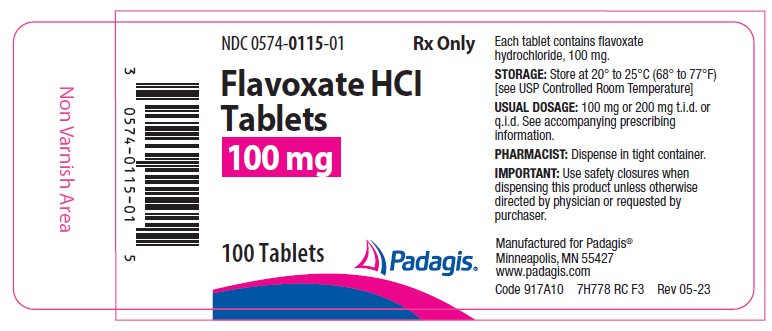
Flavoxate Hydrochloride 100 mg Tablet, Film Coated, 100-count — NDC 0574-0115-01 (Billing 00574-0115-01)
This is a package of 100 tablets of Flavoxate Hydrochloride 100 mg Tablet, Film Coated from Padagis US LLC, marketed since Dec 2004 and currently FDA-listed, this package's marketing is listed to end Dec 2026; retail pharmacies pay about $0.3894 per tablet (NADAC). It is this product's only package size.
NDC database record
One package, one record: these facts belong to NDC 0574-0115-01 alone.
- Record
- FDA NDC Directory package listing · Human prescription drug
- Code segments
- 0574 labeler · 0115 product · 01 package
- Package marketed since
- Dec 22, 2004
- Package marketing ended
- Dec 31, 2026
- Sample package
- No — commercial package
- Billing quantity
- 100 EA per package
- Barcode (UPC)
- 0305740115015
- Medicaid fills, this package
- 43 prescriptions in the last four reported quarters
- FDA record last changed
- Jul 24, 2026
Identity & classification
Regulatory identifiers FDA, NLM and CMS codes for this package
Drug-database identifiers Medi-Span GPI and First Databank GCN / HICL / AHFS classification
- GSN (GCN sequence number): 004927
- GCN: 19360
- GPI-14 (Medi-Span): 54400025100310
- HICL (First Databank): 002047
- AHFS class code: 86:12.04.00
- RxCUI (RxNorm): 1095229
Where does this data come from?
- FDA openFDA NDC Directory · synced Oct 8, 2026
- FDA label on DailyMed · label index refreshed Oct 8, 2026
- RxNorm (NLM RxNav) · catalog refreshed Oct 8, 2026
- Medi-Span GPI (licensed)
- First Databank (licensed) · refreshed Oct 8, 2026
RxNorm drug class
This medicine belongs to the Cholinergic Muscarinic Antagonist class.
Where does this data come from?
- RxClass (NLM) · catalog refreshed Oct 8, 2026
Clinical
Flavoxate is used to treat overactive bladder (a condition in which the bladder muscles contract uncontrollably and cause frequent urination, urgent need to urinate, and inability to control urination) relieve painful, frequent, or nighttime urination and urgency that may occur with infections of the prostate, bladder, or kidneys. Flavoxate is in a class of medications called antimuscarinics. It works by relaxing the bladder muscles. However, flavoxate is not an antibiotic; it does not cure infections.
Read the full MedlinePlus article ↗- No — and that's an important distinction. Flavoxate is a symptom reliever, not an antibiotic. It helps calm the spasms in your urinary tract that cause the burning, urgency, and fr...
- Will flavoxate actually cure my bladder infection?
- In a clinical study, flavoxate started working in about 55 minutes, with the strongest effect hitting around the 112-minute mark — so roughly two hours after your dose. You likely...
- How long does it take for flavoxate to start working?
Patient education
Supplement & herbal interactions
Where does this data come from?
- MedlinePlus (NLM) · refreshed Oct 8, 2026
- FDA label on DailyMed · label index refreshed Oct 8, 2026
Ask a licensed pharmacist directly — free, answered by our team.
Pricing
A drug doesn't have one price. Each row is a different public payment system, and none is what you'd pay at the counter — that depends on your insurance. The ⓘ on each row explains what it measures.
| Price system | Per ea | Per package |
|---|---|---|
| Retail pharmacies payNADAC · weekly | $0.389 | $38.94 / 100 tablets |
| Medicaid paysCMS SDUD · 12 mo | $0.8240 | $82.40 / 100 tablets |
| Medicare drug plans payPart D · Q2 2026 | $0.9602 | $96.02 / 100 tablets |
Where does this data come from?
- CMS NADAC weekly file · file of Oct 7, 2026
- CMS ASP pricing files · refreshed Sep 20, 2026
- CMS Medicaid State Drug Utilization Data · through Q1 2026
- CMS Part D plan pricing files · refreshed Sep 24, 2026
- VA National Acquisition Center price file
Packaging — all sizes for this product
| Package NDC | Description | Marketing start | Marketing end | Status |
|---|---|---|---|---|
| 00574-0115-01 You're viewing this Main listing | 100 TABLET, FILM COATED in 1 BOTTLE, PLASTIC | 2004-12-22 | Dec 31, 2026 | Active |
Therapeutic equivalents
| Product | Labeler | Pack | NADAC/unit | TE | Status | Price vs. this |
|---|---|---|---|---|---|---|
| Flavoxate Hydrochloride 100 mgthis 00574-0115-01 | Padagis | 100 tablets | $0.389 | AB | Availability likely | — |
| Flavoxate Hydrochloride 100 mg 42806-0058-01 | Epic | 100 tablets | $0.389 | AB | Availability likely | — |
| Flavoxate Hydrochloride 100 mg 24658-0720-01 | PuraCap | 100 tablets | $0.547 | AB | FDA listed | +40% |
Where does this data come from?
- FDA openFDA NDC Directory · synced Oct 8, 2026
- FDA Orange Book · refreshed Oct 3, 2026
- CMS NADAC weekly file · file of Oct 7, 2026
Availability & generic status
This product is an FDA-approved generic. Other versions of the same drug are listed under Therapeutic equivalents, least expensive first.
Where does this data come from?
- FDA Orange Book · refreshed Oct 3, 2026
What it looks like
Where does this data come from?
- FDA label on DailyMed · label index refreshed Oct 8, 2026
Inactive Ingredients / Excipients
Inactive ingredients, also called excipients, are components of the drug product other than the active ingredient. They may include fillers, dyes, coatings, preservatives, flavors, or other formulation ingredients.
🧪 Avoiding an ingredient? See Flavoxate inactive ingredients by manufacturer: every current product's list side by side, so you can ask your pharmacy for the version that does not list it.
💡 Tap an ingredient (hover on desktop) to see what it is and why it’s used.
-
UNII 71E6178C9T
A synthetic polymer that forms flexible coatings on tablets and capsules. It helps control how quickly the medicine dissolves and protects the contents from moisture and air.
-
UNII 0WZ8WG20P6
Hypromellose 2910 is a plant-based cellulose derivative that acts as a thickener, binder, and film-coating agent. It helps control how quickly the medicine dissolves and protects the tablet or capsule from moisture and light.
-
UNII 3NXW29V3WO
Hypromellose is a plant-based thickener made from cellulose. It's used in medicines as a binder to hold ingredients together, a coating for tablets, and a thickener for liquids.
-
UNII EWQ57Q8I5X
Lactose monohydrate is a natural sugar derived from milk. It serves as a filler and binder in tablets and capsules, helping create the proper size, texture, and consistency of the medicine.
-
UNII 70097M6I30
Magnesium stearate is a salt made from magnesium and stearic acid, a fatty substance. It's used in tablets and capsules as a lubricant and glidant to help ingredients flow smoothly during manufacturing and prevent sticking.
-
UNII 196OC77688
A synthetic plastic polymer used as a film-coating material on tablets and capsules. It helps protect the medication, control how fast it dissolves, and improve appearance.
-
UNII OP1R32D61U
Microcrystalline cellulose is a purified form of cellulose, a natural fiber from plant sources. It acts as a binder and filler in tablets and capsules, helping hold ingredients together and give the medicine its shape and size.
-
UNII A906T4D368
A synthetic compound derived from nonylphenol polyethylene glycol. In medications, it acts as a surfactant and emulsifier to help mix oil and water-based ingredients and improve product stability and consistency.
-
UNII 3WJQ0SDW1A
Polyethylene glycol is a synthetic liquid or solid polymer used in medicines as a solvent, lubricant, and humectant. It helps dissolve active ingredients, reduces friction during manufacturing, and retains moisture in the final product.
-
UNII ETJ7Z6XBU4
Silicon dioxide is a naturally occurring mineral used as a glidant and anti-caking agent. It helps powder ingredients flow smoothly and prevents clumping during manufacturing and storage.
-
UNII 5856J3G2A2
A starch-based powder made from potatoes and processed with sodium. It acts as a disintegrant, helping the tablet or capsule break apart quickly in the stomach so the medicine can be absorbed.
11 inactive ingredients listed in the exact product block matched to this NDC.
Where does this data come from?
ingredient classCode="IACT" elements from the exact product block matched by this NDC. Label-section narrative from DailyMed / the openFDA label index is shown separately when available.- FDA label on DailyMed · label index refreshed Oct 8, 2026
- FDA openFDA NDC Directory · synced Oct 8, 2026
Inactive ingredient FAQ
Are inactive ingredients the same for every manufacturer?
Why might an inactive ingredient be missing?
Can inactive ingredients matter?
Manufacturer & labeler
More NDCs from Padagis US LLC labeler code 00574
- Bromocriptine mesylate 2.5 mg Tablet NDC 0574-0106-01
- Clotrimazole 10 mg Lozenge NDC 0574-0107-14
- Trospium Chloride ER 60 mg Capsule, Extended Release NDC 0574-0118-30
- Trospium Chloride 20 mg Tablet, Film Coated NDC 0574-0145-60
- Midazolam Hydrochloride 2 mg/mL Syrup NDC 0574-0150-04
- benazepril hydrochloride and hydrochlorothiazide 20 mg; 25 mg Tablet NDC 0574-0228-01
- benazepril hydrochloride and hydrochlorothiazide 20 mg; 12.5 mg Tablet NDC 0574-0229-01
- Paroxetine 7.5 mg Capsule NDC 0574-0279-30
Where does this data come from?
- FDA openFDA NDC Directory · synced Oct 8, 2026
- Drugs@FDA
Full prescribing information FDA SPL
🎯 Indications and Usage ▾
INDICATIONS AND USAGE Flavoxate HCl tablets are indicated for symptomatic relief of dysuria, urgency, nocturia, suprapubic pain, frequency and incontinence as may occur in cystitis, prostatitis, urethritis, urethrocystitis/urethrotrigonitis. Flavoxate HCl tablets are not indicated for definitive treatment, but are compatible with drugs used for the treatment of urinary tract infections.
⏱️ Dosage and Administration ▾
DOSAGE AND ADMINISTRATION Adults and children over 12 years of age: One or two 100 mg tablets 3 or 4 times a day. With improvement of symptoms, the dose may be reduced. This drug cannot be recommended for infants and children under 12 years of age because safety and efficacy have not been demonstrated in this age group.
⛔ Contraindications ▾
CONTRAINDICATIONS Flavoxate HCl tablets are contraindicated in patients who have any of the following obstructive conditions: pyloric or duodenal obstruction, obstructive intestinal lesions or ileus, achalasia, gastrointestinal hemorrhage and obstructive uropathies of the lower urinary tract.
⚠️ Warnings ▾
WARNINGS Flavoxate HCl should be given cautiously in patients with suspected glaucoma.
🤒 Adverse Reactions ▾
ADVERSE REACTIONS The following adverse reactions have been observed, but there are not enough data to support an estimate of their frequency. Gastrointestinal: Nausea, vomiting, dry mouth. CNS: Vertigo, headache, mental confusion, especially in the elderly, drowsiness, nervousness.
Hematologic: Leukopenia (one case which was reversible upon discontinuation of the drug). Cardiovascular: Tachycardia and palpitation. Allergic: Urticaria and other dermatoses, eosinophilia and hyperpyrexia.
Ophthalmic: Increased ocular tension, blurred vision, disturbance in eye accommodation. Renal: Dysuria.
🤰 Pregnancy ▾
Pregnancy: Teratogenic Effects-Pregnancy Category B. Reproduction studies have been performed in rats and rabbits at doses up to 34 times the human dose and revealed no evidence of impaired fertility or harm to the fetus due to flavoxate HCl. There are, however, no well-controlled studies in pregnant women. Because animal reproduction studies are not always predictive of human response, this drug should be used during pregnancy only if clearly needed.
🧒 Pediatric Use ▾
Pediatric Use: Safety and effectiveness in children below the age of 12 years have not been established.
🆘 Overdosage ▾
OVERDOSAGE The oral LD 50 for flavoxate HCl in rats is 4273 mg/kg. The oral LD 50 for flavoxate HCl in mice is 1837 mg/kg. It is not known whether flavoxate HCl is dialyzable.
🧬 Clinical Pharmacology ▾
CLINICAL PHARMACOLOGY Flavoxate hydrochloride counteracts smooth muscle spasm of the urinary tract and exerts its effect directly on the muscle. In a single study of 11 normal male subjects, the time to onset of action was 55 minutes. The peak effect was observed at 112 minutes. 57% of the flavoxate HCl was excreted in the urine within 24 hours.
📦 How Supplied / Storage and Handling ▾
HOW SUPPLIED Flavoxate HCl Tablets, 100 mg, are supplied as round, white, film-coated tablets debossed "PAD" and "0115" on one side and plain on the other side, in bottles of 100. 100 mg 100's: NDC 0574- 0115 -01 Store at 20° to 25°C (68° to 77°F) [see USP Controlled Room Temperature] Manufactured For Padagis ® Minneapolis, MN 55427 www.padagis.com Rev 05-23 7H700 RC PH3 Code 917A00
📋 Description ▾
DESCRIPTION Flavoxate HCl tablets contain flavoxate hydrochloride, a synthetic urinary tract spasmolytic. Chemically, flavoxate hydrochloride is 2-piperidinoethyl 3-methyl-4-oxo-2-phenyl-4 H -1-benzopyran-8-carboxylate hydrochloride. The empirical formula of flavoxate hydrochloride is C 24 H 25 NO 4 •HCl.
The molecular weight is 427.94. The structural formula appears below: Flavoxate HCl is supplied in tablets for oral administration. Each round, white, film-coated Flavoxate HCl tablet is debossed "PAD" and "0115" on one side and plain on the other side and contains flavoxate hydrochloride, 100 mg.
Inactive ingredients consist of colloidal silicon dioxide, ethyl acrylate, hypromellose, lactose monohydrate, magnesium stearate, methyl methacrylate, microcrystalline cellulose, nonoxynol 100 and sodium starch glycolate. Film coating is composed of hypromellose 2910 6cP and polyethylene glycol. Chemical Structure
💬 Information for Patients ▾
Information for Patients: Patients should be informed that if drowsiness and blurred vision occur, they should not operate a motor vehicle or machinery or participate in activities where alertness is required.
⚠️ Precautions ▾
PRECAUTIONS Information for Patients: Patients should be informed that if drowsiness and blurred vision occur, they should not operate a motor vehicle or machinery or participate in activities where alertness is required. Carcinogenesis, Mutagenesis, Impairment of Fertility: Mutagenicity studies and long-term studies in animals to determine the carcinogenic potential of flavoxate HCl have not been performed. Pregnancy: Teratogenic Effects-Pregnancy Category B.
Reproduction studies have been performed in rats and rabbits at doses up to 34 times the human dose and revealed no evidence of impaired fertility or harm to the fetus due to flavoxate HCl. There are, however, no well-controlled studies in pregnant women. Because animal reproduction studies are not always predictive of human response, this drug should be used during pregnancy only if clearly needed.
Nursing Mothers: It is not known whether this drug is excreted in human milk. Because many drugs are excreted in human milk, caution should be exercised when flavoxate HCl is administered to a nursing woman. Pediatric Use: Safety and effectiveness in children below the age of 12 years have not been established.
🍼 Nursing Mothers ▾
Nursing Mothers: It is not known whether this drug is excreted in human milk. Because many drugs are excreted in human milk, caution should be exercised when flavoxate HCl is administered to a nursing woman.
📄 Carcinogenesis, Mutagenesis, Impairment of Fertility ▾
Carcinogenesis, Mutagenesis, Impairment of Fertility: Mutagenicity studies and long-term studies in animals to determine the carcinogenic potential of flavoxate HCl have not been performed.
📄 Package Label / Principal Display Panel ▾
PRINCIPAL DISPLAY PANEL - 100 mg Tablet Bottle NDC 0574- 0115 -01 Rx Only Flavoxate HCl Tablets 100 mg 100 Tablets label