
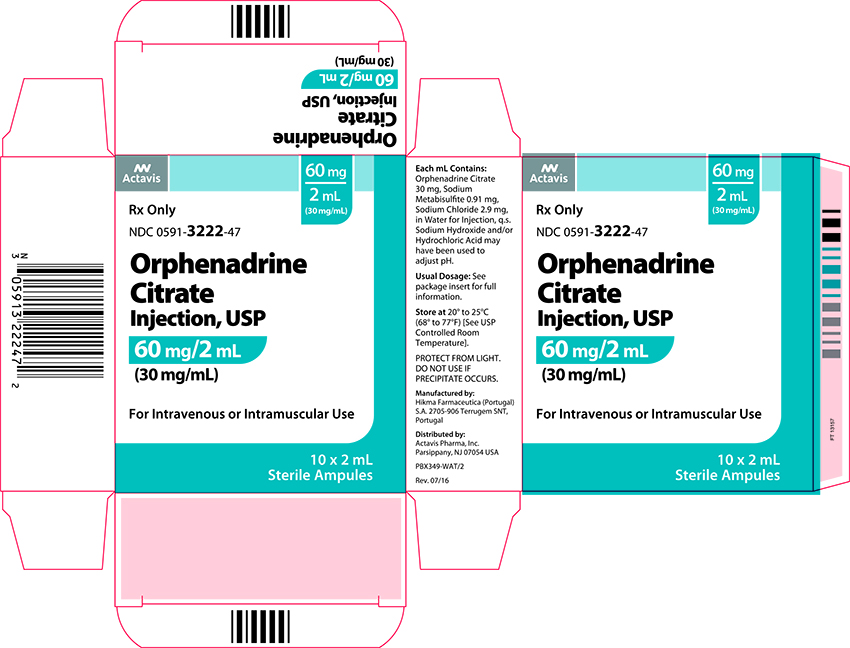
Orphenadrine Citrate 30 mg/mL Injection — NDC 0591-3222-47 (Billing 00591-3222-47)
This is a package of Orphenadrine Citrate 30 mg/mL Injection from Actavis Pharma, Inc., marketed since Jul 2010 and currently FDA-listed. It is this product's only package size.
NDC database record
One package, one record: these facts belong to NDC 0591-3222-47 alone.
- Record
- FDA NDC Directory package listing · Human prescription drug
- Code segments
- 0591 labeler · 3222 product · 47 package
- Package marketed since
- Jul 8, 2010
- Sample package
- No — commercial package
- Listing certified through
- Dec 31, 2026
- Barcode (UPC-A, from the NDC)
- 3 0591322247 2
- Medicaid fills, this package
- 36 prescriptions in the last four reported quarters
- FDA record last changed
- Jul 24, 2026
Identity & classification
Regulatory identifiers FDA, NLM and CMS codes for this package
Drug-database identifiers Medi-Span GPI and First Databank GCN / HICL / AHFS classification
- GSN (GCN sequence number): 004592
- GCN: 17640
- GPI-14 (Medi-Span): 75100080102005
- HICL (First Databank): 001906
- AHFS class code: 12:20.10.00
- RxCUI (RxNorm): 994541
Where does this data come from?
- FDA openFDA NDC Directory · synced Oct 8, 2026
- FDA label on DailyMed · label index refreshed Oct 6, 2026
- RxNorm (NLM RxNav) · catalog refreshed Oct 1, 2026
- Medi-Span GPI (licensed)
- First Databank (licensed) · refreshed Oct 8, 2026
RxNorm drug class
This medicine belongs to the Muscle Relaxant class.
Where does this data come from?
- RxClass (NLM) · catalog refreshed Oct 1, 2026
Clinical
- It's a common assumption, but orphenadrine actually doesn't directly relax tense muscles. Researchers believe its benefit comes from pain-relieving properties — so it helps you fee...
- What exactly does orphenadrine do — does it just relax my muscles?
- Take one extended-release tablet in the morning and one in the evening — that's twice a day. Try to stick to the same times each day. If you're unsure whether to take it with food...
- How should I take the extended-release tablet?
Patient education
Supplement & herbal interactions
Where does this data come from?
- MedlinePlus (NLM) · refreshed Oct 1, 2026
- FDA label on DailyMed · label index refreshed Oct 6, 2026
Ask a licensed pharmacist directly — free, answered by our team.
Pricing
A drug doesn't have one price. Each row is a different public payment system, and none is what you'd pay at the counter — that depends on your insurance. The ⓘ on each row explains what it measures.
| Price system | Per each | Per package |
|---|---|---|
| Retail pharmacies payNADAC · weekly | Not in the retail survey — common for institutional, discontinued, or low-volume packs. | |
| Medicaid paysCMS SDUD · 12 mo | $132.21 | $1,322.12 / 10 ampules |
| Medicare drug plans payPart D · quarterly | No Part D plan price is available for this NDC in our data. | |
Where does this data come from?
- CMS NADAC weekly file
- CMS ASP pricing files · refreshed Sep 20, 2026
- CMS Medicaid State Drug Utilization Data · through Q4 2025
- CMS Part D plan pricing files · refreshed Sep 24, 2026
- VA National Acquisition Center price file
Packaging — all sizes for this product
| Package NDC | Description | Marketing start | Marketing end | Status |
|---|---|---|---|---|
| 00591-3222-47 You're viewing this Main listing | 10 AMPULE in 1 CARTON / 2 mL in 1 AMPULE | 2010-07-08 | — | Active |
Therapeutic equivalents
| Product | Labeler | Pack | NADAC/unit | TE | Status | Price vs. this |
|---|---|---|---|---|---|---|
| Orphenadrine citrate 60 mg/2mL 00641-6182-10 | Hikma | 10 vials | $5.730 | AP | Availability likely | — |
| Orphenadrine Citrate 30 mg/mL 25021-0651-02 | Sagent | 10 vials | $5.730 | AP | Availability likely | — |
| Orphenadrine Citrate 30 mg/mLthis 00591-3222-47 | Actavis | 10 ampules | — | AP | FDA listed | — |
Where does this data come from?
- FDA openFDA NDC Directory · synced Oct 8, 2026
- FDA Orange Book · refreshed Oct 3, 2026
- CMS NADAC weekly file
Availability & generic status
This product is an FDA-approved generic. Other versions of the same drug are listed under Therapeutic equivalents, least expensive first.
Where does this data come from?
- FDA Orange Book · refreshed Oct 3, 2026
Inactive Ingredients / Excipients
Inactive ingredients, also called excipients, are components of the drug product other than the active ingredient. They may include fillers, dyes, coatings, preservatives, flavors, or other formulation ingredients.
🧪 Avoiding an ingredient? See Orphenadrine inactive ingredients by manufacturer: every current product's list side by side, so you can ask your pharmacy for the version that does not list it.
💡 Tap an ingredient (hover on desktop) to see what it is and why it’s used.
-
UNII QTT17582CB
A strong acid used to adjust and maintain the proper pH level in liquid medicines, ensuring stability and preventing breakdown of active ingredients.
-
2.9 mg / 1 mL
UNII 451W47IQ8X
Sodium chloride is common table salt. It's used in medicines as a buffer to maintain proper pH, as a filler to add bulk, or to adjust the osmotic balance in liquid formulations.
-
UNII 55X04QC32I
A strong alkaline chemical used to adjust and maintain the pH balance of liquid medicines. It helps keep the medicine stable and ensures it stays effective during storage.
-
0.91 mg / 1 mL
UNII 4VON5FNS3C
Sodium metabisulfite is a preservative derived from sulfur compounds. It prevents microbial growth and oxidation in medicines, helping extend shelf life and maintain product stability.
-
UNII 059QF0KO0R
Water is a liquid solvent that dissolves and mixes ingredients together in liquid medicines, syrups, and injections. It helps distribute the active drug evenly throughout the product.
5 inactive ingredients listed in the exact product block matched to this NDC.
Where does this data come from?
ingredient classCode="IACT" elements from the exact product block matched by this NDC. Label-section narrative from DailyMed / the openFDA label index is shown separately when available.- FDA label on DailyMed · label index refreshed Oct 6, 2026
- FDA openFDA NDC Directory · synced Oct 8, 2026
Inactive ingredient FAQ
Are inactive ingredients the same for every manufacturer?
Why might an inactive ingredient be missing?
Can inactive ingredients matter?
Manufacturer & labeler
More NDCs from Actavis Pharma, Inc. labeler code 00591
- Nizatidine 300 mg Capsule NDC 0591-3138-00
- Minocycline Hydrochloride 75 mg Capsule NDC 0591-3153-00
- Ursodiol 300 mg Capsule NDC 0591-3159-00
- Testosterone 10 mg/g Gel NDC 0591-3216-30
- Testosterone 10 mg/g Gel NDC 0591-3217-30
- Butalbital, Acetaminophen, Caffeine, and Codeine Phosphate 30 mg; 50 mg; 40 mg; 325 mg Capsule NDC 0591-3220-01
- Bupropion Hydrochloride XL 150 mg Tablet, Film Coated, Extended Release NDC 0591-3331-05
- Butalbital, Acetaminophen, and Caffeine 50 mg; 325 mg; 40 mg Tablet NDC 0591-3369-01
- Clonidine transdermal system .1 mg/d Patch NDC 0591-3508-04
- Clonidine transdermal system .2 mg/d Patch NDC 0591-3509-04
- Clonidine transdermal system .3 mg/d Patch NDC 0591-3510-04
- Testosterone 50 mg/5g Gel NDC 0591-3524-30
Where does this data come from?
- FDA openFDA NDC Directory · synced Oct 8, 2026
- Drugs@FDA
Full prescribing information FDA SPL
🎯 Indications and Usage ▾
INDICATIONS AND USAGE Orphenadrine citrate is indicated as an adjunct to rest, physical therapy, and other measures for the relief of discomfort associated with acute, painful musculo-skeletal conditions. The mode of action of this drug has not been clearly identified, but may be related to its analgesic properties. Orphenadrine citrate does not directly relax tense skeletal muscles in man.
⏱️ Dosage and Administration ▾
DOSAGE AND ADMINISTRATION Adults: 2 mL (60 mg) intravenously or intramuscularly - May be repeated every 12 hours. Relief may be maintained by one (100 mg) orphenadrine citrate tablet twice daily. Parenteral drug products should be inspected visually for particulate matter and discoloration prior to administration, whenever the solution and container permit.
⛔ Contraindications ▾
CONTRAINDICATIONS Orphenadrine citrate is contraindicated in patients with glaucoma, pyloric or duodenal obstruction, stenosing peptic ulcers, prostatic hypertrophy or obstruction at the bladder neck, cardiospasm (megaesophagus) and myasthenia gravis. Orphenadrine citrate is contraindicated in patients who have demonstrated a previous hypersensitivity to the drug.
⚠️ Warnings ▾
WARNINGS Contains Sodium Metabisulfite, a sulfite that may cause allergic-type reactions including anaphylactic symptoms and life-threatening or less severe asthmatic episodes in certain susceptible people. The overall prevalence of sulfite sensitivity in the general population is unknown and probably low. Sulfite sensitivity is seen more frequently in asthmatic than in nonasthmatic people.
Some patients may experience transient episodes of lightheadedness, dizziness or syncope. Orphenadrine citrate may impair the ability of the patient to engage in potentially hazardous activities such as operating machinery or driving a motor vehicle; ambulatory patients should therefore be cautioned accordingly. Usage in Pregnancy: Safe use of orphenadrine citrate has not been established with respect to adverse effects upon fetal development.
Therefore, orphenadrine citrate should be used in women of childbearing potential and particularly during early pregnancy only when in the judgment of the physician the potential benefits outweigh the possible hazards. Usage in Children: Safety and effectiveness in children have not been established; therefore, this drug is not recommended for use in the pediatric age group.
🤒 Adverse Reactions ▾
ADVERSE REACTIONS Adverse effects of orphenadrine citrate are mainly due to the mild anticholinergic action, and are usually associated with higher dosage. Dryness of the mouth is usually the first adverse effect to appear. When the daily dose is increased, possible adverse effects include: tachycardia, palpitation, urinary hesitancy or retention, blurred vision, dilatation of pupils, increased ocular tension, weakness, nausea, vomiting, headache, dizziness, constipation, drowsiness, hypersensitivity reactions, pruritus, hallucinations, agitation, tremor, gastric irritation, and rarely urticaria and other dermatoses.
Infrequently, an elderly patient may experience some degree of mental confusion. These adverse reactions can usually be eliminated by reduction in dosage. Very rare cases of aplastic anemia associated with the use of orphenadrine tablets have been reported.
No causal relationship has been established. Rare instances of anaphylactic reaction have been reported associated with the intramuscular injection of orphenadrine citrate.
🧬 Clinical Pharmacology ▾
CLINICAL PHARMACOLOGY The mode of action has not been clearly identified but may be related to analgesic properties. Orphenadrine citrate possesses anticholinergic actions.
📦 How Supplied / Storage and Handling ▾
HOW SUPPLIED Orphenadrine Citrate Injection USP, 30 mg/mL is available in 2 mL ampules in cartons of 10. Store at 20º to 25ºC (68º to 77ºF) [See USP Controlled Room Temperature.] PROTECT FROM LIGHT. DO NOT USE IF PRECIPITATE OCCURS. Literature revised: July 2016 Product No.: 1108-82 Mfd. by: Hikma Farmaceutica (Portugal) S.A. 2705-906 Terrugem SNT, Portugal Dist. by: Actavis Pharma, Inc. Parsippany, NJ 07054 USA
📋 Description ▾
DESCRIPTION Orphenadrine Citrate Injection is a sterile aqueous solution of orphenadrine citrate. It is intended for intravenous or intramuscular administration. Orphenadrine citrate is the citrate salt of orphenadrine and occurs as a white, crystalline powder having a bitter taste.
It is practically odorless, sparingly soluble in water and slightly soluble in alcohol. It has the following structural formula: N,N-Dimethyl-2-[( o -methyl-α-phenylbenzyl)oxy]ethylamine Citrate (1:1). Each mL contains: Orphenadrine Citrate 30 mg, Sodium Metabisulfite 0.91 mg, Sodium Chloride 2.9 mg, in Water for Injection q.s.
Sodium Hydroxide and/or Hydrochloric Acid may have been used to adjust pH. structural formula for orphenadrine citrate
⚠️ Precautions ▾
PRECAUTIONS Confusion, anxiety and tremors have been reported in few patients receiving propoxyphene and orphenadrine concomitantly. As these symptoms may be simply due to an additive effect, reduction of dosage and/or discontinuation of one or both agents is recommended in such cases. Orphenadrine citrate should be used with caution in patients with cardiac decompensation, coronary insufficiency, cardiac arrhythmias, and tachycardia.
Safety of continuous long term therapy with orphenadrine citrate has not been established. Therefore if orphenadrine citrate is prescribed for prolonged use, periodic monitoring of blood, urine, and liver function values is recommended.
📄 Package Label / Principal Display Panel ▾
PRINCIPAL DISPLAY PANEL Actavis 60 mg 2 mL (30 mg/mL) Rx Only NDC 0591-3222-47 Orphenadrine Citrate Injection, USP 60 mg/2 mL (30 mg/mL) For Intravenous or Intramuscular Use 10 x 2 mL Sterile Ampules 0591-3222-47
Medicaid utilization & spend
Medicare Part D spend CMS · PART D · 2026 (Q1)
About this NDC listing & data coverage
What data is (and isn’t) available for this NDC — tap to expand
| NDC identity (package / product / labeler codes) | ✓ Available |
| Labeler | ✓ Available |
| Product & package description | ✓ Available |
| Marketing category & status | ✓ Available |
| Active ingredient / dosage form / route | ✓ Available |
| FDA label (SPL via DailyMed) | ✓ Available |
| Package photos | ✓ Available |
| Inactive ingredients (structured) | ✓ Available |
| NADAC pharmacy acquisition price (CMS) | — Not published for this NDC CMS publishes NADAC only for NDCs reported in its retail-pharmacy survey. |
| Orange Book / therapeutic-equivalence data | ✓ Available |
| HCPCS J-code billing crosswalk | — Not published for this NDC Most self-administered / retail products have no J-code — that is normal. |
| Medicaid utilization (CMS SDUD) | ✓ Available |