
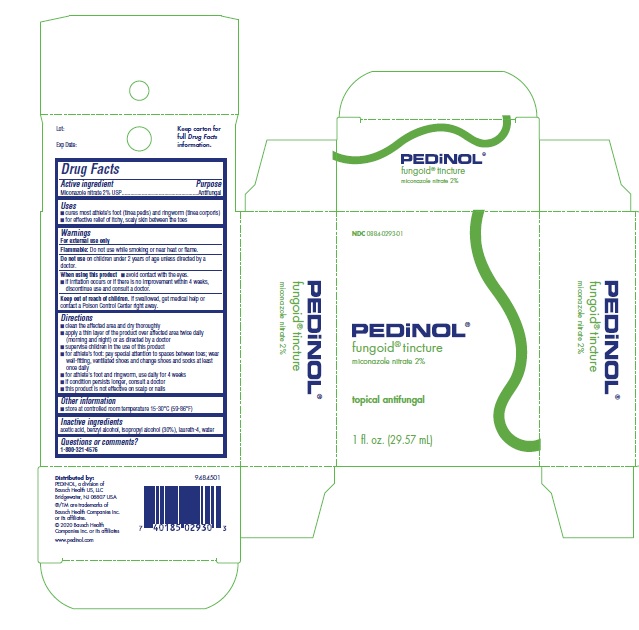
fungoid tincture miconazole nitrate 20 mg/mL Tincture, 1 bottle — NDC 0884-0293-01 (Billing 00884-0293-01)
This is a package of 1 bottle of fungoid tincture miconazole nitrate 20 mg/mL Tincture from Pedinol Pharmacal, Inc., marketed since Apr 2012 and currently FDA-listed. It is this product's only package size.
NDC database record
One package, one record: these facts belong to NDC 0884-0293-01 alone.
- Record
- FDA NDC Directory package listing · Human OTC drug
- Code segments
- 0884 labeler · 0293 product · 01 package
- Package marketed since
- Apr 11, 2012
- Sample package
- No — commercial package
- Listing certified through
- Dec 31, 2026
- Barcode (UPC-A, from the NDC)
- 3 0884029301 0
- Medicaid fills, this package
- 51 prescriptions in the last four reported quarters
- FDA record last changed
- Jul 24, 2026
Other active recalls for Miconazole Nitrate (different manufacturers) — 1 · tap to view
Identity & classification
Regulatory identifiers FDA, NLM and CMS codes for this package
Drug-database identifiers Medi-Span GPI and First Databank GCN / HICL / AHFS classification
- GSN (GCN sequence number): 021002
- GCN: 30421
- GPI-14 (Medi-Span): 90154050102020
- HICL (First Databank): 003031
- AHFS class code: 84:04.08.08
- RxCUI (RxNorm): 998525
Where does this data come from?
- FDA openFDA NDC Directory · synced Oct 8, 2026
- FDA label on DailyMed · label index refreshed Oct 8, 2026
- RxNorm (NLM RxNav) · catalog refreshed Oct 1, 2026
- Medi-Span GPI (licensed)
- First Databank (licensed) · refreshed Oct 8, 2026
RxNorm drug class
This medicine belongs to the Azole Antifungal class.
Where does this data come from?
- RxClass (NLM) · catalog refreshed Oct 1, 2026
Clinical
Topical miconazole is used to treat tinea corporis(ringworm; fungal skin infection that causes a red scaly rash on different parts of the body), tinea cruris (jock itch; fungal infection of the skin in the groin or buttocks), and tinea pedis (athlete's foot; fungal infection of the skin on the feet and between the toes). Miconazole is in a class of antifungal medications called imidazoles. It works by stopping the growth of fungi that cause infection. Not all products should be used to treat all of these conditions. Please read the label for each product to select the one to treat your conditi...
Read the full MedlinePlus article ↗- It treats fungal and yeast infections. Depending on the product, that means vaginal yeast infections, athlete's foot, jock itch, ringworm, or thrush in the mouth and throat (Oravig...
- Apply it to your upper gum in the morning after brushing, with dry hands. Hold it in place for 30 seconds. Don't crush, chew or swallow it. Use it once a day for 14 days.
- Most are mild, like diarrhea, nausea, headache, upper belly pain or a change in taste. Vaginal products may cause mild burning or itching at first. Stop and get help for hives, tro...
- Tell me if you take warfarin. Miconazole can boost its blood-thinning effect, so watch for bleeding or bruising. With Oravig, oral diabetes medicines, phenytoin and ergot alkaloids...
Patient education
Supplement & herbal interactions
Where does this data come from?
- MedlinePlus (NLM) · refreshed Oct 8, 2026
- FDA label on DailyMed · label index refreshed Oct 8, 2026
Ask a licensed pharmacist directly — free, answered by our team.
Pricing
A drug doesn't have one price. Each row is a different public payment system, and none is what you'd pay at the counter — that depends on your insurance. The ⓘ on each row explains what it measures.
| Price system | Per mL | Per package |
|---|---|---|
| Retail pharmacies payNADAC · weekly | Not in the retail survey — common for institutional, discontinued, or low-volume packs. | |
| Medicaid paysCMS SDUD · 12 mo | $0.9130 | $27.00 / 29.57 ml |
| Medicare drug plans payPart D · quarterly | No Part D plan price is available for this NDC in our data. | |
Where does this data come from?
- CMS NADAC weekly file
- CMS ASP pricing files · refreshed Sep 20, 2026
- CMS Medicaid State Drug Utilization Data · through Q3 2025
- CMS Part D plan pricing files · refreshed Sep 24, 2026
- VA National Acquisition Center price file
Packaging — all sizes for this product
| Package NDC | Description | Marketing start | Marketing end | Status |
|---|---|---|---|---|
| 00884-0293-01 You're viewing this Main listing | 1 BOTTLE, WITH APPLICATOR in 1 CARTON / 29.57 mL in 1 BOTTLE, WITH APPLICATOR | 2012-04-11 | — | Active |
Therapeutic equivalents
| Product | Labeler | Pack | NADAC/unit | TE | Status | Price vs. this |
|---|---|---|---|---|---|---|
| fungoid tincture 20 mg/mLthis 00884-0293-01 | Pedinol | 1 bottle | — | — | FDA listed | — |
| miconazole nitrate 20 mg/mL 50268-0503-29 | AvPAK | 29.57 ml | — | — | FDA listed | — |
| Azolen 20 mg/mL 58980-0818-10 | Stratus | 1 bottle | — | — | FDA listed | — |
| Azolen 2 mg/g 58980-0819-60 | STRATUS | 1 bottle | — | — | FDA listed | — |
| Vite20 .3 mg/15mL 63347-0810-01 | Blaine | 1 bottle | — | — | FDA listed | — |
Where does this data come from?
- FDA openFDA NDC Directory · synced Oct 8, 2026
- FDA Orange Book · refreshed Oct 3, 2026
- CMS NADAC weekly file
Availability & generic status
We did not find an FDA-approved generic match for this exact strength, form and route.
Where does this data come from?
- FDA Orange Book · refreshed Oct 3, 2026
Inactive Ingredients / Excipients
Inactive ingredients, also called excipients, are components of the drug product other than the active ingredient. They may include fillers, dyes, coatings, preservatives, flavors, or other formulation ingredients.
🧪 Avoiding an ingredient? See Miconazole inactive ingredients by manufacturer: every current product's list side by side, so you can ask your pharmacy for the version that does not list it.
💡 Tap an ingredient (hover on desktop) to see what it is and why it’s used.
-
UNII Q40Q9N063P
Acetic acid is a weak organic acid commonly used in medicines as a buffer and pH adjuster. It helps maintain the proper acidity level to ensure the drug remains stable and effective in its formulation.
-
UNII LKG8494WBH
Benzyl alcohol is a clear liquid used as a preservative and solvent in medicines. It helps prevent bacterial and fungal growth and dissolves other ingredients to create uniform liquid formulations.
-
UNII ND2M416302
Isopropyl alcohol is a clear liquid solvent derived from petroleum. In medicines, it dissolves active ingredients and other components, helps the product flow smoothly, and aids in sterilization during manufacturing.
-
UNII 6HQ855798J
Laureth-4 is a synthetic detergent made from lauryl alcohol and ethylene oxide. It acts as an emulsifier and solubilizer, helping blend oil and water-based ingredients and improve how the body absorbs the active drug.
-
UNII 059QF0KO0R
Water is a liquid solvent that dissolves and mixes ingredients together in liquid medicines, syrups, and injections. It helps distribute the active drug evenly throughout the product.
5 inactive ingredients listed in the exact product block matched to this NDC.
Label-section wording can be broader than the structured product block and may mention additional formulation ingredients.
Where does this data come from?
ingredient classCode="IACT" elements from the exact product block matched by this NDC. Label-section narrative from DailyMed / the openFDA label index is shown separately when available.- FDA label on DailyMed · label index refreshed Oct 8, 2026
- FDA openFDA NDC Directory · synced Oct 8, 2026
Inactive ingredient FAQ
Are inactive ingredients the same for every manufacturer?
Why might an inactive ingredient be missing?
Can inactive ingredients matter?
Manufacturer & labeler
Where does this data come from?
- FDA openFDA NDC Directory · synced Oct 8, 2026
- Drugs@FDA
FDA label — Drug Facts FDA SPL
🎯 Indications and Usage ▾
Uses cures most athlete's foot (tinea pedis) and ringworm (tinea corporis) for effective relief of itchy, scaly skin between the toes
⏱️ Dosage and Administration ▾
Directions clean the affected area and dry thoroughly apply a thin layer of the product over affected area twice daily (morning and night) or as directed by a doctor supervise children in the use of this product for athlete’s foot: pay special attention to spaces between toes; wear well-fitting, ventilated shoes and change shoes and socks at least once daily for athlete’s foot and ringworm, use daily for 4 weeks if condition persists longer, consult a doctor this product is not effective on scalp or nails.
⚠️ Warnings ▾
Warnings For external use only Flammable: Do not use while smoking or near heat or flame. Do not use on children under 2 years of age unless directed by a doctor. When using this product avoid contact with the eyes. if irritation occurs or if there is no improvement within 4 weeks, discontinue use and consult a doctor. Keep out of reach of children. If swallowed, get medical help or contact a Poison Control Center right away.
🧪 Active Ingredient ▾
Active ingredient Miconazole nitrate 2% USP
🧪 Inactive Ingredients ▾
Inactive ingredients acetic acid, benzyl alcohol, isopropyl alcohol (30%), laureth-4, water
🎯 Purpose ▾
Purpose Antifungal
📄 Do Not Use ▾
Do not use on children under 2 years of age unless directed by a doctor.
📄 When Using This Product ▾
When using this product avoid contact with the eyes. if irritation occurs or if there is no improvement within 4 weeks, discontinue use and consult a doctor.
📄 Keep Out of Reach of Children ▾
Keep out of reach of children. If swallowed, get medical help or contact a Poison Control Center right away.
📄 Questions or Comments ▾
Questions or comments? 1-800-321-4576
📄 Package Label / Principal Display Panel ▾
Fungoid Tincture – 1 fl. oz. (29.57 mL) Carton NDC 0884-0293-01 PEDiNOL® fungoid ® tincture miconazole nitrate 2% topical antifungal 1 fl. oz. (29.57 mL) Pedinol carton
Medicaid utilization & spend
Medicare Part D spend CMS · PART D · 2026 (Q1)
Reported adverse events (FAERS)
Top reported reactions
Reporter sex
Serious outcomes
Where does this data come from?
About this NDC listing & data coverage
What data is (and isn’t) available for this NDC — tap to expand
| NDC identity (package / product / labeler codes) | ✓ Available |
| Labeler | ✓ Available |
| Product & package description | ✓ Available |
| Marketing category & status | ✓ Available |
| Active ingredient / dosage form / route | ✓ Available |
| FDA label (SPL via DailyMed) | ✓ Available |
| Package photos | ✓ Available |
| Inactive ingredients (structured) | ✓ Available |
| NADAC pharmacy acquisition price (CMS) | — Not published for this NDC CMS publishes NADAC only for NDCs reported in its retail-pharmacy survey. |
| Orange Book / therapeutic-equivalence data | — Not published for this NDC Applies only to products approved under an NDA/ANDA; many listings are out of scope. |
| HCPCS J-code billing crosswalk | — Not published for this NDC Most self-administered / retail products have no J-code — that is normal. |
| Medicaid utilization (CMS SDUD) | ✓ Available |