
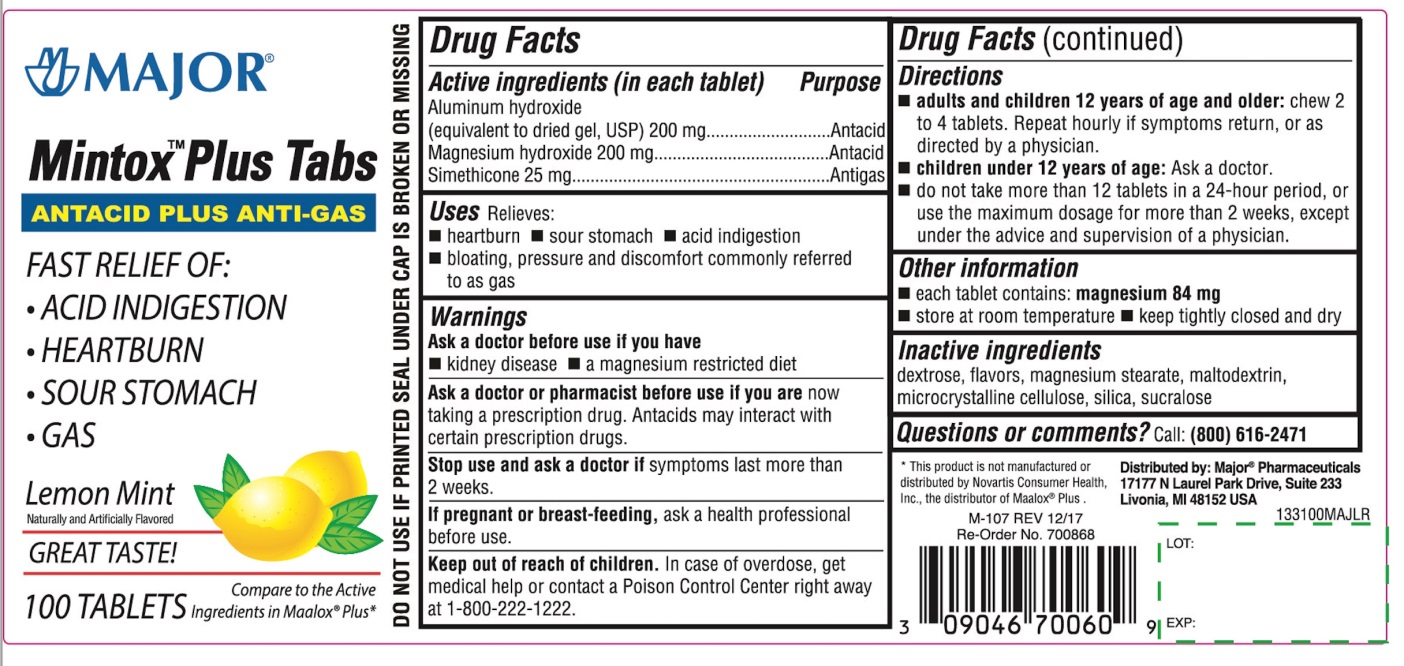
Mintox Plus Tabs Aluminum hydroxide, Magnesium hydroxide, Simethicone 200 mg; 200 mg; 25 mg Tablet, Chewable, 100-count — NDC 0904-6700-60 (Billing 00904-6700-60)
This is a package of 100 tablets of Mintox Plus Tabs Aluminum hydroxide, Magnesium hydroxide, Simethicone 200 mg; 200 mg; 25 mg Tablet, Chewable from Major Pharmaceuticals, marketed since Aug 2018 and currently FDA-listed; retail pharmacies pay about $0.0394 per tablet (NADAC). It is this product's only package size.
NDC database record
One package, one record: these facts belong to NDC 0904-6700-60 alone.
- Record
- FDA NDC Directory package listing · Human OTC drug
- Code segments
- 0904 labeler · 6700 product · 60 package
- Package marketed since
- Aug 2, 2018
- Sample package
- No — commercial package
- Listing certified through
- Dec 31, 2027
- Billing quantity
- 100 EA per package
- Barcode (UPC-A, from the NDC)
- 3 0904670060 9
- Medicaid fills, this package
- 22,346 prescriptions in the last four reported quarters
- FDA record last changed
- Oct 8, 2026
Identity & classification
Regulatory identifiers FDA, NLM and CMS codes for this package
Drug-database identifiers Medi-Span GPI and First Databank GCN / HICL / AHFS classification
- GSN (GCN sequence number): 002708
- GCN: 63951
- HICL (First Databank): 001168
- AHFS class code: 56:04.00.00
Where does this data come from?
- FDA openFDA NDC Directory · synced Oct 8, 2026
- FDA label on DailyMed · label index refreshed Oct 8, 2026
- RxNorm (NLM RxNav) · catalog refreshed Oct 8, 2026
- Medi-Span GPI (licensed)
- First Databank (licensed) · refreshed Oct 8, 2026
Clinical
Aluminum hydroxide is used for the relief of heartburn, sour stomach, and peptic ulcer pain and to promote the healing of peptic ulcers.
Read the full MedlinePlus article ↗Mintox Plus Tabs is a chewable tablet taken by mouth that contains three active ingredients commonly used for heartburn and indigestion relief. Aluminum hydroxide and magnesium hydroxide are antacids that work to neutralize stomach acid. Simethicone (also called dimethicone) is an anti-gas agent typically included to help reduce bloating and gas discomfort. This product is marketed as an over-the-counter monograph drug, meaning it follows established FDA guidelines for this category of antacid products.
Patient education
Supplement & herbal interactions
Some supplements/herbs that may interact with Aluminum Hydroxide, Magnesium Hydroxide, Simethicone (OTC drug) — tap one for details:
Aluminum Hydroxide, Magnesium Hydroxide, Simethicone (OTC drug) may be associated with lower levels of 5 nutrients — worth a chat with your pharmacist, not a cause for alarm.
Where does this data come from?
- MedlinePlus (NLM) · refreshed Oct 8, 2026
- FDA label on DailyMed · label index refreshed Oct 8, 2026
Ask a licensed pharmacist directly — free, answered by our team.
Pricing
A drug doesn't have one price. Each row is a different public payment system, and none is what you'd pay at the counter — that depends on your insurance. The ⓘ on each row explains what it measures.
| Price system | Per ea | Per package |
|---|---|---|
| Retail pharmacies payNADAC · weekly | $0.039 | $3.94 / 100 tablets |
| Medicaid paysCMS SDUD · 12 mo | $0.1482 | $14.82 / 100 tablets |
| Medicare drug plans payPart D · quarterly | No Part D plan price is available for this NDC in our data. | |
Where does this data come from?
- CMS NADAC weekly file · file of Oct 7, 2026
- CMS ASP pricing files · refreshed Sep 20, 2026
- CMS Medicaid State Drug Utilization Data · through Q1 2026
- CMS Part D plan pricing files · refreshed Sep 24, 2026
- VA National Acquisition Center price file
Packaging — all sizes for this product
| Package NDC | Description | Marketing start | Marketing end | Status |
|---|---|---|---|---|
| 00904-6700-60 You're viewing this Main listing | 100 TABLET, CHEWABLE in 1 BOTTLE | 2018-08-02 | — | Active |
Therapeutic equivalents
| Product | Labeler | Pack | NADAC/unit | TE | Status | Price vs. this |
|---|---|---|---|---|---|---|
| Mintox Plus Tabs 200 mg/1; 200 mg/1; 25 mgthis 00904-6700-60 | Major | 100 tablets | $0.039 | — | Availability likely | — |
| Gelusil 200 mg/1; 200 mg/1; 24 mg/1; 1 mg 65197-0300-10 | WellSpring | 10 tablets | — | — | FDA listed | — |
Where does this data come from?
- FDA openFDA NDC Directory · synced Oct 8, 2026
- FDA Orange Book · refreshed Oct 9, 2026
- CMS NADAC weekly file · file of Oct 7, 2026
Availability & generic status
We did not find an FDA-approved generic match for this exact strength, form and route.
Where does this data come from?
- FDA Orange Book · refreshed Oct 9, 2026
What it looks like
Where does this data come from?
- FDA label on DailyMed · label index refreshed Oct 8, 2026
Inactive Ingredients / Excipients
Inactive ingredients, also called excipients, are components of the drug product other than the active ingredient. They may include fillers, dyes, coatings, preservatives, flavors, or other formulation ingredients.
💡 Tap an ingredient (hover on desktop) to see what it is and why it’s used.
-
UNII IY9XDZ35W2
Dextrose is a simple sugar derived from corn or other sources. It serves as a filler and sweetener in medicines to add bulk, improve taste, and help stabilize the medication's form.
-
UNII 70097M6I30
Magnesium stearate is a salt made from magnesium and stearic acid, a fatty substance. It's used in tablets and capsules as a lubricant and glidant to help ingredients flow smoothly during manufacturing and prevent sticking.
-
UNII 7CVR7L4A2D
A starch-derived carbohydrate produced by breaking down corn, potato, or tapioca starch. It functions as a filler and binder to give the medicine bulk and texture, and sometimes as a mild sweetener or texture enhancer in powders and tablets.
-
UNII OP1R32D61U
Microcrystalline cellulose is a purified form of cellulose, a natural fiber from plant sources. It acts as a binder and filler in tablets and capsules, helping hold ingredients together and give the medicine its shape and size.
-
UNII ETJ7Z6XBU4
Silicon dioxide is a naturally occurring mineral used as a glidant and anti-caking agent. It helps powder ingredients flow smoothly and prevents clumping during manufacturing and storage.
-
UNII 96K6UQ3ZD4
Sucralose is a synthetic sweetener made from sugar. It's added to medicines to improve taste without adding calories, helping make bitter or unpleasant-tasting drugs easier to take.
6 inactive ingredients listed in the exact product block matched to this NDC.
Label-section wording can be broader than the structured product block and may mention additional formulation ingredients.
Where does this data come from?
ingredient classCode="IACT" elements from the exact product block matched by this NDC. Label-section narrative from DailyMed / the openFDA label index is shown separately when available.- FDA label on DailyMed · label index refreshed Oct 8, 2026
- FDA openFDA NDC Directory · synced Oct 8, 2026
Inactive ingredient FAQ
Are inactive ingredients the same for every manufacturer?
Why might an inactive ingredient be missing?
Can inactive ingredients matter?
Manufacturer & labeler
More NDCs from Major Pharmaceuticals labeler code 00904
- acetazolamide 250 mg Tablet NDC 0904-6663-61
- Gabapentin 100 mg Capsule NDC 0904-6665-61
- Gabapentin 300 mg Capsule NDC 0904-6666-61
- Gabapentin 400 mg Capsule NDC 0904-6667-61
- Sildenafil 20 mg Tablet, Film Coated NDC 0904-6671-04
- Oxycodone Hydrochloride 5 mg/5mL Solution NDC 0904-6678-40
- Pramipexole Dihydrochloride .25 mg Tablet NDC 0904-6704-61
- Sevelamer Carbonate 800 mg Tablet, Film Coated NDC 0904-6707-06
- Glycopyrrolate 1 mg Tablet NDC 0904-6709-61
- Fexofenadine hydrochloride 180 mg Tablet NDC 0904-6711-10
- Cetirizine 10 mg Tablet, Film Coated NDC 0904-6717-40
- Mucus Relief ER Guaifenesin 600 mg Tablet, Extended Release NDC 0904-6718-39
Where does this data come from?
- FDA openFDA NDC Directory · synced Oct 8, 2026
- Drugs@FDA
FDA label — Drug Facts FDA SPL
🎯 Indications and Usage ▾
Uses Relieves: heartburn sour stomach acid indigestion bloating, pressure and discomfort commonly referred to as gas
⏱️ Dosage and Administration ▾
Directions adults and children 12 years of age and older: chew 2 to 4 tablets. Repeat hourly if symptoms return, or as directed by a physician . children under 12 years of age : Ask a doctor. do not take more than 12 tablets in a 24- hour period, or use the maximum dosage for more than 2 weeks ,except under the advice and supervision of a physician.
⚠️ Warnings ▾
Warnings Ask a doctor before use if you have kidney disease a magnesium-restricted diet Ask a doctor or pharmacist before use if you are now taking a prescription drug. Antacids may interact with certain prescription drugs. Stop use and ask a doctor if symptoms last more than 2 weeks.
If Pregnant or breast -feeding ask a health professional before use. Keep out of reach of children. In case of overdose, get medical help or contact a Poison Control Center right away at 1-800-222-1222.
📦 Storage and Handling ▾
Other information each tablet contains: magnesium 84 mg store at room temperature keep tightly closed and dry
🧪 Active Ingredient ▾
Active ingredients (in each tablet) Aluminum hydroxide (equivalent to dried gel, USP) 200 mg Magnesium hydroxide 200 mg Simethicone 25mg
🧪 Inactive Ingredients ▾
Inactive ingredients dextrose, flavors, magnesium stearate, maltodextrin, microcrystalline cellulose, silica, sucralose
🎯 Purpose ▾
Purpose Antacid Antacid Antigas
📄 Ask a Doctor Before Use If ▾
Ask a doctor before use if you have kidney disease a magnesium-restricted diet
📄 Ask a Doctor or Pharmacist Before Use If ▾
Ask a doctor or pharmacist before use if you are now taking a prescription drug. Antacids may interact with certain prescription drugs.
📄 Stop Use and Ask a Doctor If ▾
Stop use and ask a doctor if symptoms last more than 2 weeks.
🤰 If Pregnant or Breast-Feeding ▾
If Pregnant or breast -feeding ask a health professional before use.
📄 Keep Out of Reach of Children ▾
Keep out of reach of children. In case of overdose, get medical help or contact a Poison Control Center right away at 1-800-222-1222.
📄 Questions or Comments ▾
Questions or comments? Call : (800)-616-2471
📄 Package Label / Principal Display Panel ▾
Principal Display Panel MAJOR ® Mintox™ Plus Tabs ANTACID PLUS ANTI-GAS FAST RELIEF OF: ACID INDIGESTION HEARTBURN SOUR STOMACH GAS Lemon Mint Naturally and Artificially Flavored GREAT TASTE! 100 TABLETS Compare to the Active Ingredients in Maalox ® Plus* Distributed by: Major ® Pharmaceuticals 17177N Laurel park drive, Suite 233 Livonia, MI 48152 USA *This product is not manufactured or distributed by Novartis Consumer Health Inc, the distributor of Maalox ® plus. Mintox Plus Tabs Antacid Plus Anti-Gas Lemon Mint 100 Tablets