
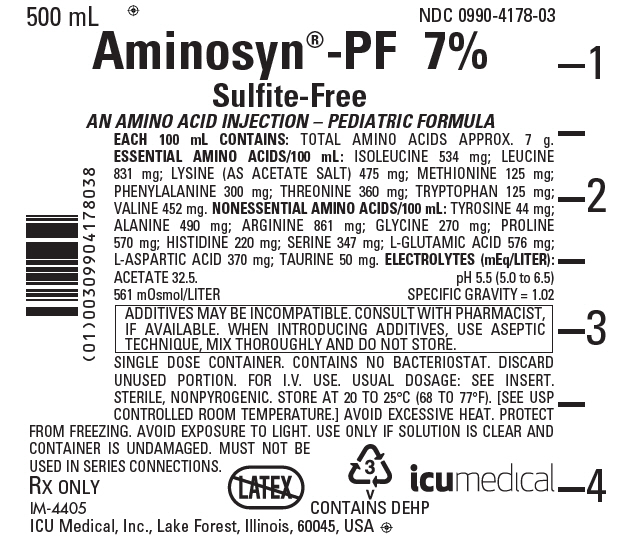
Aminosyn-PF ISOLEUCINE, LEUCINE, LYSINE ACETATE, METHIONINE, PHENYLALANINE, THREONINE, TRYPTOPHAN, VALINE, ALANINE, ARGININE, ASPARTIC ACID, GLUTAMIC ACID, GLYCINE, HISTIDINE, PROLINE, SERINE, TAURINE, and TYROSINE 534 mg/100mL; 831 mg/100mL; 475 mg/100mL; 125 mg/100mL; 300 mg/100mL; 360 mg/100mL; 125 mg/100mL; 452 mg/100mL; 490 mg/100mL; 861 mg/100mL Injection, Solution — NDC 0990-4178-03 (Billing 00990-4178-03)
This is a package of Aminosyn-PF ISOLEUCINE, LEUCINE, LYSINE ACETATE, METHIONINE, PHENYLALANINE, THREONINE, TRYPTOPHAN, VALINE, ALANINE, ARGININE, ASPARTIC ACID, GLUTAMIC ACID, GLYCINE, HISTIDINE, PROLINE, SERINE, TAURINE, and TYROSINE 534 mg/100mL; 831 mg/100mL; 475 mg/100mL; 125 mg/100mL; 300 mg/100mL; 360 mg/100mL; 125 mg/100mL; 452 mg/100mL; 490 mg/100mL; 861 mg/100mL Injection, Solution from ICU Medical Inc., marketed since Oct 2021 and currently FDA-listed. It is this product's only package size.
NDC database record
One package, one record: these facts belong to NDC 0990-4178-03 alone.
- Record
- FDA NDC Directory package listing · Human prescription drug
- Code segments
- 0990 labeler · 4178 product · 03 package
- Package marketed since
- Oct 1, 2021
- Sample package
- No — commercial package
- Listing certified through
- Dec 31, 2027
- Barcode (UPC-A, from the NDC)
- 3 0990417803 8
- FDA record last changed
- Oct 8, 2026
Identity & classification
Regulatory identifiers FDA, NLM and CMS codes for this package
Drug-database identifiers Medi-Span GPI and First Databank GCN / HICL / AHFS classification
- GSN (GCN sequence number): 063000
- GCN: 98760
- GPI-14 (Medi-Span): 80302010102024
- HICL (First Databank): 034943
- AHFS class code: 40:20.00.00
- RxCUI (RxNorm): 831426
Where does this data come from?
- FDA openFDA NDC Directory · synced Oct 8, 2026
- FDA label on DailyMed · label index refreshed Oct 6, 2026
- RxNorm (NLM RxNav) · catalog refreshed Oct 1, 2026
- Medi-Span GPI (licensed)
- First Databank (licensed) · refreshed Oct 8, 2026
Clinical
Patient education
Supplement & herbal interactions
Where does this data come from?
- MedlinePlus (NLM) · refreshed Oct 1, 2026
- FDA label on DailyMed · label index refreshed Oct 6, 2026
Ask a licensed pharmacist directly — free, answered by our team.
Pricing
A drug doesn't have one price. Each row is a different public payment system, and none is what you'd pay at the counter — that depends on your insurance. The ⓘ on each row explains what it measures.
| Price system | Per mL | Per package |
|---|---|---|
| Retail pharmacies payNADAC · weekly | Not in the retail survey — common for institutional, discontinued, or low-volume packs. | |
| Medicaid paysCMS SDUD · 12 mo | No recent Medicaid claims on file for this NDC — rare and low-volume NDCs are suppressed in the public data. | |
| Medicare drug plans payPart D · quarterly | No Part D plan price is available for this NDC in our data. | |
Where does this data come from?
- CMS NADAC weekly file
- CMS ASP pricing files · refreshed Sep 20, 2026
- CMS Medicaid State Drug Utilization Data · refreshed Oct 8, 2026
- CMS Part D plan pricing files · refreshed Sep 24, 2026
- VA National Acquisition Center price file
Packaging — all sizes for this product
| Package NDC | Description | Marketing start | Marketing end | Status |
|---|---|---|---|---|
| 00990-4178-03 You're viewing this Main listing | 12 BAG in 1 CASE / 500 mL in 1 BAG | 2021-10-01 | — | Active |
Therapeutic equivalents
| Product | Labeler | Pack | NADAC/unit | TE | Status | Price vs. this |
|---|---|---|---|---|---|---|
| Aminosyn-PF 534 mg/100mL; 831 mg/100mL; 475 mg/100mL; 125 mg/100mL; 300 mg/100mL; 360 mg/100mL; 125 mg/100mL; 452 mg/100mL; 490 mg/100mL; 861 mg/100mLthis 00990-4178-03 | ICU | 500 ml | — | — | FDA listed | — |
Where does this data come from?
- FDA openFDA NDC Directory · synced Oct 8, 2026
- FDA Orange Book · refreshed Oct 3, 2026
- CMS NADAC weekly file
Availability & generic status
We did not find an FDA-approved generic match for this exact strength, form and route.
Where does this data come from?
- FDA Orange Book · refreshed Oct 3, 2026
Inactive Ingredients / Excipients
Inactive ingredients, also called excipients, are components of the drug product other than the active ingredient. They may include fillers, dyes, coatings, preservatives, flavors, or other formulation ingredients.
💡 Tap an ingredient (hover on desktop) to see what it is and why it’s used.
-
UNII 059QF0KO0R
Water is a liquid solvent that dissolves and mixes ingredients together in liquid medicines, syrups, and injections. It helps distribute the active drug evenly throughout the product.
1 inactive ingredient listed in the exact product block matched to this NDC.
Where does this data come from?
ingredient classCode="IACT" elements from the exact product block matched by this NDC. Label-section narrative from DailyMed / the openFDA label index is shown separately when available.- FDA label on DailyMed · label index refreshed Oct 6, 2026
- FDA openFDA NDC Directory · synced Oct 8, 2026
Inactive ingredient FAQ
Are inactive ingredients the same for every manufacturer?
Why might an inactive ingredient be missing?
Can inactive ingredients matter?
Manufacturer & labeler
More NDCs from ICU Medical Inc. labeler code 00990
- Aminosyn-PF ISOLEUCINE, LEUCINE, LYSINE ACETATE, METHIONINE, PHENYLALANINE, THREONINE, TRYPTOPHAN, VALINE, ALANINE, ARGININE, ASPARTIC ACID, GLUTAMIC ACID, GLYCINE, HISTIDINE, PROLINE, SERINE, TAURINE, and TYROSINE 760 mg/100mL; 1200 mg/100mL; 677 mg/100mL; 180 mg/100mL; 427 mg/100mL; 512 mg/100mL; 180 mg/100mL; 673 mg/100mL; 698 mg/100mL; 1227 mg/100mL Injection, Solution NDC 0990-4179-05
- Potassium Chloride 10 meq/100mL Injection, Solution NDC 0990-7074-26
- Potassium Chloride 200 meq/1000mL Injection, Solution NDC 0990-7075-14
- Potassium Chloride 400 meq/1000mL Injection, Solution NDC 0990-7077-14
- Potassium Chloride in Dextrose and Sodium 50 g/1000mL; 9 g/1000mL; 1.49 g/1000mL Injection, Solution NDC 0990-7107-09
- Potassium Chloride in Dextrose and Sodium 50 g/1000mL; 9 g/1000mL; 2.98 g/1000mL Injection, Solution NDC 0990-7109-09
Where does this data come from?
- FDA openFDA NDC Directory · synced Oct 8, 2026
- Drugs@FDA
Full prescribing information FDA SPL
🎯 Indications and Usage ▾
INDICATIONS AND USAGE Aminosyn-PF 7%, Sulfite-Free, (an amino acid injection — pediatric formula) is indicated for the nutritional support of infants (including those of low birth weight) and young children requiring TPN via either central or peripheral infusion routes. Parenteral nutrition with Aminosyn-PF 7% is indicated to prevent nitrogen and weight loss or treat negative nitrogen balance in infants and young children where (1) the alimentary tract by the oral gastrostomy, or jejunostomy route, cannot or should not be used or adequate protein intake is not feasible by these routes, (2) gastrointestinal absorption of protein is impaired; or (3) protein requirements are substantially increased as with extensive burns.
Dosage, route of administration, and concomitant infusion of non-protein calories are dependent on various factors, such as nutritional and metabolic status of the patient, anticipated duration of parenteral nutrition support, and vein tolerance. See DOSAGE AND ADMINISTRATION for additional information. Central Venous Infusion Central venous infusion should be considered when amino acid solutions are to be admixed with hypertonic dextrose to promote protein synthesis in hypercatabolic or severely depleted infants or those requiring long-term parenteral nutrition.
Peripheral Parenteral Nutrition For moderately catabolic or depleted patients in whom the central venous route is not indicated, diluted amino acid solutions mixed with 5 to 10% dextrose solutions may be infused by peripheral vein, supplemented, if desired, with fat emulsion.
⏱️ Dosage and Administration ▾
DOSAGE AND ADMINISTRATION The total daily dose of the solution depends on the daily protein requirements and on the patient's metabolic and clinical response. Pediatric requirements for parenteral nutrition are constrained by the greater relative fluid requirements of the infant and greater caloric requirements per kilogram than in the adult. The recommended intravenous dose of Aminosyn-PF 7%, Sulfite-Free, (an amino acid injection — pediatric formula) is up to 2.5 g amino acid/kg/day for infants up to 10 kg.
For infants and children larger than 10 kg, the total daily dose of amino acids should be up to 25 g amino acids/day for the first 10 kg of body weight plus 1 to 1.25 g amino acid for each kg of body weight over 10 kg. Initial amino acid dosage levels of 1 g/kg/day may be increased gradually in increments of 0.5 g/kg/day to approximate desired intake levels. Aminosyn-PF 7% should be diluted with dextrose prior to use.
Nonprotein calories should constitute approximately 100 to 130 kcal/kg/day. Part of the nonprotein caloric requirement may be provided as lipid emulsion administered concurrently to provide up to 60% of daily calories at a dose not to exceed 4 g fat/kg/day. Fluid intake for the infant receiving central venous TPN should be approximately 125 mL/kg/day (range: 100 to 175 mL/kg/day), depending on the clinical condition of the patient.
Premature infants with respiratory distress syndrome suspected of having a patent ductus arteriosus should be given fluids more cautiously. Cysteine is considered to be an essential amino acid for infants, especially preterm infants with potentially immature enzyme pathways. Therefore, addition of a cysteine supplement to the TPN admixture is recommended.
The intake of cysteine by the preterm infant ingesting maternal milk is approximately 78 mg/kg/day. The suggested intravenous dosage level for Cysteine Hydrochloride Injection, USP is 500 mg (10 mL) for every 12.5 g (179 mL) of Aminosyn-PF 7% administered (see package insert for Cysteine Hydrochloride Injection, USP). In order to avoid potential insolubility of cysteine hydrochloride in admixtures, the foregoing concentration should not be exceeded.
In many patients, provision of adequate calories in the form of hypertonic dextrose may require the administration of exogenous insulin to prevent hyperglycemia and glycosuria. To prevent rebound hypoglycemia, a solution containing 5% dextrose should be administered when hypertonic dextrose solutions are abruptly discontinued. SERUM ELECTROLYTES SHOULD BE MONITORED FREQUENTLY.
Electrolytes may be added to the nutrient solution as indicated by the patient's clinical condition and laboratory determinations of plasma values. Major electrolytes are sodium, chloride, potassium, phosphate, magnesium and calcium. Daily administration of intravenous vitamin supplements including a complete complement of fat and water-soluble vitamins is required.
Trace metal additives including zinc, copper, manganese, and chromium should also be provided, especially when long-term parenteral therapy is anticipated. Calcium and phosphorus are added to the solution as indicated. Potentially incompatible ions such as calcium and phosphate may be added to alternate infusate bottles to avoid precipitation.
In patients with hyperchloremic or other metabolic acidosis, sodium and potassium may be added as the acetate or lactate salts to provide bicarbonate alternates. Bicarbonate should not be administered during infusion of the nutritional solution unless deemed absolutely necessary. Additives may be incompatible.
Consult with pharmacist, if available. When introducing additives, use aseptic technique, mix thoroughly and do not store. To ensure the precise delivery of the small volumes of fluid necessary for total parenteral nutrition in infants, accurately calibrated and reliable infusion systems should be used.
Central Venous Nutrition Hypertonic mixtures of amino acids and dextrose may be safely administered by… [Excerpted — this section continues on DailyMed.]
⛔ Contraindications ▾
CONTRAINDICATIONS Aminosyn-PF 7%, Sulfite-Free, (an amino acid injection — pediatric formula) is contraindicated in patients with untreated anuria, hepatic coma, inborn errors of amino acid metabolism (including those involving branched chain amino acid metabolism such as maple syrup urine disease and isovaleric acidemia), or hypersensitivity to one or more amino acids present in the solution.
⚠️ Warnings ▾
WARNINGS Safe, effective use of parenteral nutrition requires a knowledge of nutrition as well as clinical expertise in recognition and treatment of the complications which can occur. FREQUENT EVALUATION AND LABORATORY DETERMINATIONS ARE NECESSARY FOR PROPER MONITORING OF PARENTERAL NUTRITION. Studies should include blood sugar, serum proteins, kidney and liver function tests, electrolytes, hemogram, carbon dioxide content, serum osmolalities, blood cultures, and blood ammonia levels.
Administration of amino acids in the presence of impaired renal function or gastrointestinal bleeding may augment an already elevated blood urea nitrogen. Patients with azotemia from any cause should not be infused with amino acids without regard to total nitrogen intake. Administration of intravenous solutions can cause fluid and/or solute overload resulting in dilution of serum electrolyte concentrations, overhydration, congested states, or pulmonary edema.
The risk of dilutional states is inversely proportional to the electrolyte concentrations of the solutions. Administration of amino acid solutions to a patient with hepatic insufficiency may result in plasma amino acid imbalances, hyperammonemia, prerenal azotemia, stupor and coma. Hyperammonemia is of special significance in infants , as its occurrence in the syndrome caused by genetic metabolic defects is sometimes associated, although not necessarily in a causal relationship, with mental retardation.
This reaction appears to be dose-related and is more likely to develop during prolonged therapy. It is essential that blood ammonia be measured frequently in infants. Conservative doses of amino acids should be given, dictated by the nutritional status of the patient.
Should symptoms of hyperammonemia develop, amino acid dosage levels should be reduced and titrated against serum ammonia levels. WARNING: This product contains aluminum that may be toxic. Aluminum may reach toxic levels with prolonged parenteral administration if kidney function is impaired.
Premature neonates are particularly at risk because their kidneys are immature, and they require large amounts of calcium and phosphate solutions, which contain aluminum. Research indicates that patients with impaired kidney function, including premature neonates, who receive parenteral levels of aluminum at greater than 4 to 5 mcg/kg/day accumulate aluminum at levels associated with central nervous system and bone toxicity. Tissue loading may occur at even lower rates of administration.
🤒 Adverse Reactions ▾
ADVERSE REACTIONS Local reactions consisting of erythema, phlebitis and thrombosis at the infusion site have occurred with peripheral intravenous infusion of amino acids particularly if other substances, such as antibiotics, are also administered through the same site. In such cases the infusion site should be changed promptly to another vein. Use of large peripheral veins, inline filters, and slowing the rate of infusion may reduce the incidence of local venous irritation.
Electrolyte additives should be spread throughout the day. Irritating additive medications may need to be injected at another venous site. Generalized flushing, fever and nausea also have been reported during peripheral infusions of amino acid solutions.
If an adverse reaction does occur, discontinue the infusion, evaluate the patient, institute appropriate therapeutic countermeasures and save the remainder of the fluid for examination if deemed necessary.
🤰 Pregnancy ▾
Pregnancy Category C Animal reproduction studies have not been conducted with Aminosyn-PF 7%. It is also not known whether Aminosyn-PF 7% can cause fetal harm when administered to a pregnant woman or can affect reproduction capacity. Aminosyn-PF 7% should be given to a pregnant woman only if clearly needed.
🆘 Overdosage ▾
OVERDOSAGE In the event of overhydration or solute overload, re-evaluate the patient and institute appropriate corrective measures. See WARNINGS and PRECAUTIONS .
🧬 Clinical Pharmacology ▾
CLINICAL PHARMACOLOGY Aminosyn-PF 7% Sulfite-Free, (an amino acid injection — pediatric formula) contains a mixture of essential and nonessential amino acids as well as taurine. The amino acid composition has been specifically formulated to provide a well-tolerated nitrogen source for nutritional support and therapy for infants and young children. When administered in conjunction with a cysteine hydrochloride additive, Aminosyn-PF 7% results in plasma amino acid concentrations approximating a profile consistent with that of a breast-fed infant.
The rationale for Aminosyn-PF 7% is based on the observation of inadequate levels of essential amino acids in the plasma of infants receiving total parenteral nutrition (TPN) using conventional amino acid solutions. Clinical studies in infants who required TPN therapy showed that infusion of Aminosyn-PF 7% resulted in plasma amino acid concentrations approximating those of normal breast or formula fed infants. In addition, weight gains, nitrogen balance, and serum protein concentrations were consistent with an improving nutritional status.
When infused with hypertonic dextrose as a calorie source, supplemented with cysteine hydrochloride, electrolytes, vitamins, and minerals, Aminosyn-PF 7% provides TPN for infants and young children, with the exception of essential fatty acids. It is thought that the acetate from lysine acetate under the conditions of parenteral nutrition, does not impact net acid-base balance when renal and respiratory functions are normal. Clinical evidence seems to support this thinking; however, confirmatory experimental evidence is not available.
The amounts of sodium and acetate in Aminosyn-PF 7% are not of clinical significance. The addition of a cysteine hydrochloride additive will contribute to the chloride load. The electrolyte content of any additives that are introduced should be carefully considered and included in input computations.
The human newborn conjugates bile with taurine which becomes the primary method of biliary excretion. Taurine deficiency because of its effect on bile salt conjugation and, therefore, on bile salt flow may be of major importance in the genesis of cholestasis. Taurine has also been shown to play a role in central nervous system development.
📦 How Supplied / Storage and Handling ▾
HOW SUPPLIED NDC No. Concentration Container (mL) 0409-4178-03 Aminosyn-PF 7%, Sulfite-Free, (an amino acid injection - 500 0990-4178-03 pediatric formula) ICU Medical is transitioning NDC codes from the "0409" to a "0990" labeler code. Both NDC codes are expected to be in the market for a period of time.
Store at 20 to 25ºC (68 to 77ºF). [See USP Controlled Room Temperature.] Protect from freezing. Avoid exposure to light. Revised: August, 2018 EN-4682 ICU Medical, Inc., Lake Forest, Illinois, 60045 USA
📋 Description ▾
DESCRIPTION Aminosyn ® -PF 7%, Sulfite-Free, (an amino acid injection — pediatric formula) is a sterile, nonpyrogenic solution for intravenous infusion. Aminosyn ® -PF 7% is oxygen sensitive. The formulation is described below: Aminosyn-PF 7% An Amino Acid Injection — Pediatric Formula Essential Amino Acids (mg/100 mL) Isoleucine 534 Leucine 831 Lysine (acetate)* 475 Methionine 125 Phenylalanine 300 Threonine 360 Tryptophan 125 Valine 452 * Amount cited is for lysine alone and does not include the acetate salt.
Nonessential Amino Acids (mg/100 mL) Alanine 490 Arginine 861 L-Aspartic Acid 370 L-Glutamic Acid 576 Glycine 270 Histidine 220 Proline 570 Serine 347 Taurine 50 Tyrosine 44 Electrolytes (mEq/L) Sodium (Na + ) (mEq/L) None Potassium (K + ) (mEq/L) None Chloride (Clˉ) (mEq/L) None Acetate (C 2 H 3 O 2 ˉ) a (mEq/L) 32.5 a From lysine acetate. Product Characteristics Protein Equivalent (Approx. grams/L) 70 Total Nitrogen (grams/L)
10.69Osmolarity (mOsmol/L) 561 pH (range) 5.5 (5.0 to 6.5) The formulas for the individual amino acids present in Aminosyn-PF 7% are as follows: Essential Amino Acids Isoleucine, USP C 6 H 13 NO 2 Leucine, USP C 6 H 13 NO 2 Lysine Acetate, USP C 6 H 14 N 2 O 2 • CH 3 COOH Methionine, USP C 5 H 11 NO 2 S Phenylalanine, USP C 9 H 11 NO 2 Threonine, USP C 4 H 9 NO 3 Tryptophan, USP C 11 H 12 N 2 O 2 Valine, USP C 5 H 11 NO 2 Nonessential Amino Acids Alanine, USP C 3 H 7 NO 2 Glycine, USP C 2 H 5 NO 2 Arginine, USP C 6 H 14 N 4 O 2 L-Aspartic Acid C 4 H 7 NO 4 HO 2 CCH 2 CH(NH 2 )CO 2 H L-Glutamic Acid C 5 H 9 NO 4 HO 2 CCH 2 CHCH(NH 2 )CO 2 H Histidine, USP C 6 H 9 N 3 O 2 Proline, USP C 5 H 9 NO 2 Serine, USP C 3 H 7 NO 3 Taurine C 2 H 7 NO 3 S Tyrosine, USP C 9 H 11 NO 3 The flexible plastic container is fabricated from a specially formulated polyvinylchloride.
Water can permeate from inside the container into the overwrap but not in amounts sufficient to affect the solution significantly. Solutions in contact with the plastic container may leach out certain chemical components from the plastic in very small amounts; however, biological testing was supportive of the safety of the plastic container materials. Exposure to temperatures above 25°C/77°F during transport and storage will lead to minor losses in moisture content.
Higher temperatures lead to greater losses. It is unlikely that these minor losses will lead to clinically significant changes within the expiration period.
⚠️ Precautions ▾
PRECAUTIONS Clinical evaluation and periodic laboratory determinations are necessary to monitor changes in fluid balance, electrolyte concentrations, and acid-base balance during prolonged parenteral therapy or whenever the condition of the patient warrants such evaluation. Significant deviations from normal concentrations may require the use of additional electrolyte supplements. Strongly hypertonic nutrient solutions should be administered via an intravenous catheter placed in a central vein, preferably the superior vena cava.
Care should be taken to avoid circulatory overload, particularly in patients with cardiac insufficiency. Special care must be taken when giving hypertonic dextrose to a diabetic or pre-diabetic patient. To prevent severe hyperglycemia in such patients, insulin may be required.
Administration of glucose at a rate exceeding the patient's utilization rate may lead to hyperglycemia, coma, and death. The effect of infusion of amino acids, without dextrose, upon carbohydrate metabolism of children is not known at this time. It is essential to provide adequate exogenous dextrose calories concurrently with amino acids.
Administration of amino acids without carbohydrates may result in the accumulation of ketone bodies in the blood. Correction of this ketonemia may be achieved by the administration of carbohydrate. Essential fatty acid deficiency (EFAD) is becoming increasingly recognized in patients on long term TPN (more than 5 days).
The use of fat emulsion to provide 4 — 10% of total caloric intake as linoleic acid may prevent EFAD. Peripheral administration of Aminosyn-PF 7%, Sulfite-Free, (an amino acid injection — pediatric formula) requires appropriate dilution and provision of adequate calories. Care should be taken to assure proper placement of the needle within the lumen of the vein.
The venipuncture site should be inspected frequently for signs of infiltration. If venous thrombosis or phlebitis occurs, discontinue infusions or change infusion site and initiate appropriate treatment. Extraordinary electrolyte losses such as may occur during protracted nasogastric suction, vomiting, diarrhea, or gastrointestinal fistula drainage may necessitate additional electrolyte supplementation.
Metabolic acidosis can be prevented or readily controlled by adding a portion of the cations in the electrolyte mixture as acetate salts and in the case of hyperchloremic acidosis, by keeping the total chloride content of the infusate to a minimum. Aminosyn-PF 7% contains no chloride. Aminosyn-PF 7% contains no added phosphorus.
Patients, especially those with hypophosphatemia, may require the addition of phosphate. To prevent hypocalcemia, calcium supplementation should always accompany phosphate administration. To assure adequate intake, serum levels should be monitored frequently.
Aminosyn-PF 7% contains no more than 25 mcg/L of aluminum. To minimize the risk of possible incompatabilities arising from mixing this solution with other additives that may be prescribed, the final infusate should be inspected for cloudiness or precipitation immediately after mixing, prior to administration, and periodically during administration. SPECIAL PRECAUTIONS FOR CENTRAL INFUSIONS ADMINISTRATION BY CENTRAL VENOUS CATHETER SHOULD BE USED ONLY BY THOSE FAMILIAR WITH THIS TECHNIQUE AND ITS COMPLICATIONS.
Central vein infusion (with added concentrated carbohydrate solutions) of amino acid solutions requires a knowledge of nutrition as well as clinical expertise in recognition and treatment of complications. Attention must be given to solution preparation, administration and patient monitoring. IT IS ESSENTIAL THAT A CAREFULLY PREPARED PROTOCOL, BASED ON CURRENT MEDICAL PRACTICES, BE FOLLOWED, PREFERABLY BY AN EXPERIENCED TEAM.
SUMMARY HIGHLIGHTS OF COMPLICATIONS (See also Current Medical Literature). 1. Technical The placement of a central venous catheter should be regarded as a surgical procedure.
One should be fully acquainted with vari… [Excerpted — this section continues on DailyMed.]
📄 Package Label / Principal Display Panel ▾
PRINCIPAL DISPLAY PANEL - 500 mL Bag Label 500 mL NDC 0990-4178-03 Aminosyn ® -PF 7% Sulfite-Free AN AMINO ACID INJECTION – PEDIATRIC FORMULA EACH 100 mL CONTAINS: TOTAL AMINO ACIDS APPROX. 7 g. ESSENTIAL AMINO ACIDS/100 mL : ISOLEUCINE 534 mg; LEUCINE 831 mg; LYSINE (AS ACETATE SALT) 475 mg; METHIONINE 125 mg; PHENYLALANINE 300 mg; THREONINE 360 mg; TRYPTOPHAN 125 mg; VALINE 452 mg.
NONESSENTIAL AMINO ACIDS/100 mL: TYROSINE 44 mg; ALANINE 490 mg; ARGININE 861 mg; GLYCINE 270 mg; PROLINE 570 mg; HISTIDINE 220 mg; SERINE 347 mg; L-GLUTAMIC ACID 576 mg; L-ASPARTIC ACID 370 mg; TAURINE 50 mg. ELECTROLYTES (mEq/LITER): ACETATE 32.5. pH 5.5 (5.0 to 6.5) 561 mOsmol/LITER SPECIFIC GRAVITY =
1.02ADDITIVES MAY BE INCOMPATIBLE. CONSULT WITH PHARMACIST, IF AVAILABLE. WHEN INTRODUCING ADDITIVES, USE ASEPTIC TECHNIQUE, MIX THOROUGHLY AND DO NOT STORE.
SINGLE DOSE CONTAINER. CONTAINS NO BACTERIOSTAT. DISCARD UNUSED PORTION.
FOR I.V. USE. USUAL DOSAGE: SEE INSERT.
STERILE, NONPYROGENIC. STORE AT 20 TO 25°C (68 TO 77°F). [SEE USP CONTROLLED ROOM TEMPERATURE.] AVOID EXCESSIVE HEAT. PROTECT FROM FREEZING.
AVOID EXPOSURE TO LIGHT. USE ONLY IF SOLUTION IS CLEAR AND CONTAINER IS UNDAMAGED. MUST NOT BE USED IN SERIES CONNECTIONS.
RX ONLY IM-4405 3 v CONTAINS DEHP icumedical ICU Medical, Inc., Lake Forest, Illinois, 60045, USA PRINCIPAL DISPLAY PANEL - 500 mL Bag Label
PRINCIPAL DISPLAY PANEL - 500 mL Overwrap Label TO OPEN – TEAR AT NOTCH 500 mL NDC 0990-4178-03 Aminosyn ® -PF 7% Sulfite-Free AN AMINO ACID INJECTION — PEDIATRIC FORMULA Each 100 mL contains: Total amino acids approx. 7 g. Essential Amino Acids/100 mL: Isoleucine 534 mg; leucine 831 mg; lysine (as acetate salt) 475 mg; methionine 125 mg; phenylalanine 300 mg; threonine 360 mg; tryptophan 125 mg; valine 452 mg.
Nonessential Amino Acids/100 mL: Tyrosine 44 mg; alanine 490 mg; arginine 861 mg; glycine 270 mg; proline 570 mg; histidine 220 mg; serine 347 mg; L-glutamic acid 576 mg; L-aspartic acid 370 mg; taurine 50 mg. Electrolytes (mEq/Liter): Acetate 32.5. 561 mOsmol/Liter pH 5.5 (5.0 to 6.5) Specific Gravity =
1.02Single dose container. The overwrap is a moisture and oxygen barrier. Do not remove unit from overwrap until ready for use.
Visually inspect overwrap for tears or holes. Discard unit if overwrap is damaged. Use unit promptly when overwrap is opened.
Store at 20 to 25°C (68 to 77°F). [See USP Controlled Room Temperature.] Protect from freezing. After removing the overwrap, check for minute leaks by squeezing container firmly. If leaks are found, discard solution as sterility may be impaired.
COLOR VARIATION FROM PALE YELLOW TO YELLOW IS NORMAL AND DOES NOT ALTER EFFICACY. Rx only 7 OTHER icumedical F WR-0544 ICU Medical, Inc., Lake Forest, Illinois, 60045, USA PRINCIPAL DISPLAY PANEL - 500 mL Overwrap Label
About this NDC listing & data coverage
What data is (and isn’t) available for this NDC — tap to expand
| NDC identity (package / product / labeler codes) | ✓ Available |
| Labeler | ✓ Available |
| Product & package description | ✓ Available |
| Marketing category & status | ✓ Available |
| Active ingredient / dosage form / route | ✓ Available |
| FDA label (SPL via DailyMed) | ✓ Available |
| Package photos | ✓ Available |
| Inactive ingredients (structured) | ✓ Available |
| NADAC pharmacy acquisition price (CMS) | — Not published for this NDC CMS publishes NADAC only for NDCs reported in its retail-pharmacy survey. |
| Orange Book / therapeutic-equivalence data | — Not published for this NDC Applies only to products approved under an NDA/ANDA; many listings are out of scope. |
| HCPCS J-code billing crosswalk | — Not published for this NDC Most self-administered / retail products have no J-code — that is normal. |
| Medicaid utilization (CMS SDUD) | — Not published for this NDC CMS reports utilization only for NDCs with Medicaid claims above its privacy threshold. |