
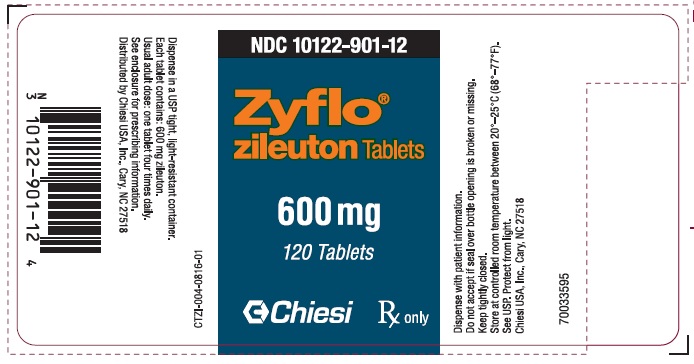
Zyflo zileuton 600 mg Tablet, 120-count — NDC 10122-901-12 (Billing 10122-0901-12)
This is a package of 120 tablets of Zyflo zileuton 600 mg Tablet from Chiesi USA, Inc., marketed since Dec 1996 and currently FDA-listed, this package's marketing is listed to end Nov 2027. It is this product's only package size.
NDC database record
One package, one record: these facts belong to NDC 10122-901-12 alone.
- Record
- FDA NDC Directory package listing · Human prescription drug
- Code segments
- 10122 labeler · 901 product · 12 package
- Package marketed since
- Dec 6, 1996
- Package marketing ended
- Nov 30, 2027
- Sample package
- No — commercial package
- Billing quantity
- 120 EA per package
- Barcode (UPC-A, from the NDC)
- 3 1012290112 4
- FDA record last changed
- Jul 24, 2026
Identity & classification
Regulatory identifiers FDA, NLM and CMS codes for this package
Drug-database identifiers Medi-Span GPI and First Databank GCN / HICL / AHFS classification
- GSN (GCN sequence number): 029803
- GCN: 40321
- GPI-14 (Medi-Span): 44504085000330
- HICL (First Databank): 012321
- AHFS class code: 48:10.24.00
- RxCUI (RxNorm): 199904
Where does this data come from?
- FDA openFDA NDC Directory · synced Oct 1, 2026
- FDA label on DailyMed · label index refreshed Oct 6, 2026
- RxNorm (NLM RxNav) · catalog refreshed Oct 1, 2026
- Medi-Span GPI (licensed)
- First Databank (licensed) · refreshed Oct 1, 2026
RxNorm drug class
This medicine belongs to the 5-Lipoxygenase Inhibitor class.
Where does this data come from?
- RxClass (NLM) · catalog refreshed Oct 1, 2026
Clinical
Zileuton is used to prevent wheezing, shortness of breath, coughing, and chest tightness due to asthma. Zileuton is not used to treat an asthma attack (sudden episode of shortness of breath, wheezing, and coughing) that has already started. Zileuton belongs to a class of medications called leukotriene synthesis inhibitors. It works by stopping the formation of certain natural substances that cause swelling, tightening, and mucus production in the airways.
Read the full MedlinePlus article ↗- No — zileuton is a controller medicine, not a rescue medicine. It works slowly over time to reduce airway inflammation and prevent attacks, but it won't open your airways quickly d...
- Can I use zileuton to stop an asthma attack that's already happening?
- Zileuton can raise liver enzyme levels, and in some people this can lead to real liver injury. Regular blood tests — especially a liver enzyme called ALT — let your doctor catch an...
- Why do I need blood tests while taking zileuton?
Patient education
Supplement & herbal interactions
Some supplements/herbs that may interact with Zileuton — tap one for details:
Where does this data come from?
- MedlinePlus (NLM) · refreshed Oct 1, 2026
- FDA label on DailyMed · label index refreshed Oct 6, 2026
Ask a licensed pharmacist directly — free, answered by our team.
Pricing
A drug doesn't have one price. Each row is a different public payment system, and none is what you'd pay at the counter — that depends on your insurance. The ⓘ on each row explains what it measures.
| Price system | Per each | Per package |
|---|---|---|
| Retail pharmacies payNADAC · weekly | Not in the retail survey — common for institutional, discontinued, or low-volume packs. | |
| Medicaid paysCMS SDUD · 12 mo | No recent Medicaid claims on file for this NDC — rare and low-volume NDCs are suppressed in the public data. | |
| Medicare drug plans payPart D · quarterly | No Part D plan price is available for this NDC in our data. | |
Where does this data come from?
- CMS NADAC weekly file
- CMS ASP pricing files · refreshed Sep 20, 2026
- CMS Medicaid State Drug Utilization Data · refreshed Oct 6, 2026
- CMS Part D plan pricing files · refreshed Sep 24, 2026
- VA National Acquisition Center price file
Packaging — all sizes for this product
| Package NDC | Description | Marketing start | Marketing end | Status |
|---|---|---|---|---|
| 10122-0901-12 You're viewing this Main listing | 120 TABLET in 1 BOTTLE | 1996-12-06 | Nov 30, 2027 | Active |
Therapeutic equivalents
| Product | Labeler | Pack | NADAC/unit | TE | Status | Price vs. this |
|---|---|---|---|---|---|---|
| Zyflo 600 mgthis 10122-0901-12 | Chiesi | 120 tablets | — | — | FDA listed | — |
Where does this data come from?
- FDA openFDA NDC Directory · synced Oct 1, 2026
- FDA Orange Book · refreshed Oct 3, 2026
- CMS NADAC weekly file
Availability & generic status
We did not find an FDA-approved generic match for this exact strength, form and route.
Where does this data come from?
- FDA Orange Book · refreshed Oct 3, 2026
What it looks like
Where does this data come from?
- FDA label on DailyMed · label index refreshed Oct 6, 2026
Inactive Ingredients / Excipients
Inactive ingredients, also called excipients, are components of the drug product other than the active ingredient. They may include fillers, dyes, coatings, preservatives, flavors, or other formulation ingredients.
🧪 Avoiding an ingredient? See Zileuton inactive ingredients by manufacturer: every current product's list side by side, so you can ask your pharmacy for the version that does not list it.
💡 Tap an ingredient (hover on desktop) to see what it is and why it’s used.
-
UNII OP1R32D61U
Microcrystalline cellulose is a purified form of cellulose, a natural fiber from plant sources. It acts as a binder and filler in tablets and capsules, helping hold ingredients together and give the medicine its shape and size.
-
UNII 2S7830E561
Crospovidone is a synthetic polymer derived from povidone. It acts as a disintegrant, helping the tablet or capsule break apart quickly in the stomach so the active ingredient can be absorbed.
-
UNII RFW2ET671P
Hydroxypropyl cellulose is a plant-derived thickening agent made from cellulose. It acts as a binder to hold tablet ingredients together and as a film-former to coat tablets or control how fast the medicine releases.
-
UNII 3NXW29V3WO
Hypromellose is a plant-based thickener made from cellulose. It's used in medicines as a binder to hold ingredients together, a coating for tablets, and a thickener for liquids.
-
UNII 70097M6I30
Magnesium stearate is a salt made from magnesium and stearic acid, a fatty substance. It's used in tablets and capsules as a lubricant and glidant to help ingredients flow smoothly during manufacturing and prevent sticking.
-
UNII 6DC9Q167V3
Propylene glycol is a clear liquid derived from petroleum or vegetable sources. It acts as a solvent, humectant, and preservative in medicines, helping dissolve active ingredients and maintain product stability.
-
UNII 5856J3G2A2
A starch-based powder made from potatoes and processed with sodium. It acts as a disintegrant, helping the tablet or capsule break apart quickly in the stomach so the medicine can be absorbed.
-
UNII O8232NY3SJ
A plant-based carbohydrate derived from corn kernels. It acts as a filler to add bulk, a binder to hold ingredients together, and a disintegrant to help the tablet break apart in your stomach for absorption.
-
UNII 7SEV7J4R1U
A powder made from a naturally occurring mineral. In medicines, talc works as a glidant and anti-caking agent, helping tablets and capsules flow smoothly during manufacturing and preventing clumping.
-
UNII 15FIX9V2JP
Titanium dioxide is a bright white mineral powder commonly used as a colorant and opacifying agent. It makes pills and tablets white or lighter in color and helps make coatings non-transparent.
10 inactive ingredients listed in the exact product block matched to this NDC.
Where does this data come from?
ingredient classCode="IACT" elements from the exact product block matched by this NDC. Label-section narrative from DailyMed / the openFDA label index is shown separately when available.- FDA label on DailyMed · label index refreshed Oct 6, 2026
- FDA openFDA NDC Directory · synced Oct 1, 2026
Inactive ingredient FAQ
Are inactive ingredients the same for every manufacturer?
Why might an inactive ingredient be missing?
Can inactive ingredients matter?
Manufacturer & labeler
More NDCs from Chiesi USA, Inc. labeler code 10122
- Mycapssa Octreotide 20 mg Capsule, Delayed Release NDC 10122-550-28
- Trimbow beclomethasone dipropionate/formoterol fumarate/glycopyrrolate 172 ug; 4.9 ug; 10.6 ug Aerosol, Metered NDC 10122-590-02
- Cleviprex clevipidine .5 mg/mL Emulsion NDC 10122-610-10
- Cleviprex clevipidine .5 mg/mL Emulsion NDC 10122-611-10
- Kengreal cangrelor 50 mg Injection, Powder, Lyophilized, For Solution NDC 10122-620-10
- BETHKIS tobramycin 300 mg/4mL Solution NDC 10122-820-04
Where does this data come from?
- FDA openFDA NDC Directory · synced Oct 1, 2026
- Drugs@FDA
Full prescribing information FDA SPL
🎯 Indications and Usage ▾
INDICATIONS AND USAGE ZYFLO is indicated for the prophylaxis and chronic treatment of asthma in adults and children 12 years of age and older.
⏱️ Dosage and Administration ▾
DOSAGE AND ADMINISTRATION The recommended dosage of ZYFLO for the symptomatic treatment of patients with asthma is one 600-mg tablet four times a day for a total daily dose of 2400 mg. For ease of administration, ZYFLO may be taken with meals and at bedtime. Hepatic transaminases should be evaluated prior to initiation of ZYFLO and periodically during treatment (see PRECAUTIONS, Hepatic ).
⛔ Contraindications ▾
CONTRAINDICATIONS ZYFLO tablets are contraindicated in patients with: Active liver disease or transaminase elevations greater than or equal to three times the upper limit of normal (≥3xULN) (see PRECAUTIONS, Hepatic ). Hypersensitivity to zileuton or any of its inactive ingredients.
⚠️ Warnings ▾
WARNINGS ZYFLO is not indicated for use in the reversal of bronchospasm in acute asthma attacks, including status asthmaticus. Therapy with ZYFLO can be continued during acute exacerbations of asthma. Co-administration of ZYFLO and theophylline results in, on average, an approximate doubling of serum theophylline concentrations.
Theophylline dosage in these patients should be reduced and serum theophylline concentrations monitored closely (see PRECAUTIONS, Drug Interactions ). Co-administration of ZYFLO and warfarin results in a clinically significant increase in prothrombin time (PT). Patients on oral warfarin therapy and ZYFLO should have their prothrombin times monitored closely and anticoagulant dose adjusted accordingly (see PRECAUTIONS, Drug Interactions ).
Co-administration of ZYFLO and propranolol results in doubling of propranolol AUC and consequent increased beta-blocker activity. Patients on ZYFLO and propranolol should be closely monitored and the dose of the propranolol reduced as necessary (see PRECAUTIONS, Drug Interactions ).
🤒 Adverse Reactions ▾
ADVERSE REACTIONS Clinical Studies : A total of 5542 patients have been exposed to zileuton in clinical trials, 2252 of them for greater than 6 months and 742 for greater than 1 year. Adverse events most frequently occurring (frequency ≥3%) in ZYFLO-treated patients and at a frequency greater than placebo-treated patients are summarized in Table 2. Proportion of Patients Experiencing Adverse Events in Placebo-Controlled Studies in Asthma Less common adverse events occurring at a frequency of greater than 1% and more commonly in ZYFLO-treated patients included: arthralgia, chest pain, conjunctivitis, constipation, dizziness, fever, flatulence, hypertonia, insomnia, lymphadenopathy, malaise, neck pain/rigidity, nervousness, pruritus, somnolence, urinary tract infection, vaginitis, and vomiting.
The frequency of discontinuation from the asthma clinical studies due to any adverse event was comparable between ZYFLO (9.7%) and placebo-treated (8.4%) groups. In placebo-controlled clinical trials, the frequency of ALT elevations ≥3xULN was 1.9% for ZYFLO-treated patients, compared with 0.2% for placebo-treated patients. In controlled and uncontrolled trials, one patient developed symptomatic hepatitis with jaundice, which resolved upon discontinuation of therapy.
An additional 3 patients with transaminase elevations developed mild hyperbilirubinemia that was less than three times the upper limit of normal. There was no evidence of hypersensitivity or other alternative etiologies for these findings. ZYFLO is contraindicated in patients with active liver disease or transaminase elevations greater than or equal to 3xULN (see CONTRAINDICATIONS ).
It is recommended that hepatic transaminases be evaluated at initiation of and during therapy with ZYFLO (see P RECAUTIONS , Hepatic ). Occurrences of low white blood cell count (≤2.8 x 10 9 /L) were observed in 1.0% of 1,678 patients taking ZYFLO and 0.6% of 1,056 patients taking placebo in placebo-controlled studies. These findings were transient and the majority of cases returned toward normal or baseline with continued ZYFLO dosing.
All remaining cases returned toward normal or baseline after discontinuation of ZYFLO. Similar findings were also noted in a long-term safety surveillance study of 2458 patients treated with ZYFLO plus usual asthma care versus 489 patients treated only with usual asthma care for up to one year. The clinical significance of these observations is not known.
In the long-term safety surveillance trial of ZYFLO plus usual asthma care versus usual asthma care alone, a similar adverse event profile was seen as in other clinical trials. Post-Marketing Experience : Cases of sleep disorders and behavior changes have been reported ( see PRECAUTIONS, Neuropsychiatric Events ). Rash and urticaria have been also reported with ZYFLO.
Proportion of Patients Experiencing Adverse Events in Placebo-Controlled Studies in Asthma
🆘 Overdosage ▾
OVERDOSAGE Human experience of acute overdose with zileuton is limited. A patient in a clinical trial took between 6.6 and 9.0 grams of zileuton in a single dose. Vomiting was induced and the patient recovered without sequelae.
Zileuton is not removed by dialysis. Should an overdose occur, the patient should be treated symptomatically and supportive measures instituted as required. If indicated, elimination of unabsorbed drug should be achieved by emesis or gastric lavage; usual precautions should be observed to maintain the airway.
A Certified Poison Control Center should be consulted for up-to-date information on management of overdose with ZYFLO. The oral minimum lethal doses in mice and rats were 500-4000 and 300-1000 mg/kg in various preparations, respectively (providing greater than 3 and 9 times the systemic exposure [AUC] achieved at the maximum recommended human daily oral dose, respectively). No deaths occurred, but nephritis was reported in dogs at an oral dose of 1000 mg/kg (providing in excess of 12 times the systemic exposure [AUC] achieved at the maximum recommended human daily oral dose).
🧬 Clinical Pharmacology ▾
CLINICAL PHARMACOLOGY Mechanism of Action : Zileuton is a specific inhibitor of 5-lipoxygenase and thus inhibits leukotriene (LTB 4 , LTC 4 , LTD 4 , and LTE 4 ) formation. Both the R(+) and S(-) enantiomers are pharmacologically active as 5-lipoxygenase inhibitors in in vitro systems. Leukotrienes are substances that induce numerous biological effects including augmentation of neutrophil and eosinophil migration, neutrophil and monocyte aggregation, leukocyte adhesion, increased capillary permeability, and smooth muscle contraction.
These effects contribute to inflammation, edema, mucus secretion, and bronchoconstriction in the airways of asthmatic patients. Sulfido-peptide leukotrienes (LTC 4 , LTD 4 , LTE 4 , also known as the slow-releasing substances of anaphylaxis) and LTB 4 , a chemoattractant for neutrophils and eosinophils, can be measured in a number of biological fluids including bronchoalveolar lavage fluid (BALF) from asthmatic patients. Zileuton is an orally active inhibitor of ex vivo LTB 4 formation in several species, including dogs, monkeys, rats, sheep, and rabbits.
Zileuton inhibits arachidonic acid-induced ear edema in mice, neutrophil migration in mice in response to polyacrylamide gel, and eosinophil migration into the lungs of antigen-challenged sheep. Zileuton inhibits leukotriene-dependent smooth muscle contractions in vitro in guinea pig and human airways. The compound inhibits leukotriene-dependent bronchospasm in antigen and arachidonic acid-challenged guinea pigs.
In antigen-challenged sheep, zileuton inhibits late-phase bronchoconstriction and airway hyperreactivity. In humans, pretreatment with zileuton attenuated bronchoconstriction caused by cold air challenge in patients with asthma.
📦 How Supplied / Storage and Handling ▾
HOW SUPPLIED ZYFLO Tablets are available as 1 dosage strength: 600-mg white to off white, ovaloid, film coated tablets debossed “CT 1” on one side and bisect on the other side. High-density polyethylene bottles of: 120 Tablets.....................................................................................NDC 10122-901-12 Recommended storage: Store tablets at controlled room temperature between 20˚-25˚C, (68˚-77˚F). See USP.
Protect from light. CTZI-003-0314-01-SPL-3 Manufactured for: Chiesi USA, Inc. Cary, NC 27518
📋 Description ▾
DESCRIPTION Zileuton is an orally active inhibitor of 5-lipoxygenase, the enzyme that catalyzes the formation of leukotrienes from arachidonic acid. Zileuton has the chemical name (±)-1-(1-Benzo[b]thien-2-ylethyl)-1-hydroxyurea and the following chemical structure: Zileuton Zileuton has the molecular formula C 11 H 12 N 2 O 2 S and a molecular weight of 236.29. It is a racemic mixture (50:50) of R(+) and S(-) enantiomers.
Zileuton is a practically odorless, white, crystalline powder that is soluble in methanol and ethanol, slightly soluble in acetonitrile, and practically insoluble in water and hexane. The melting point ranges from 144.2˚C to 145.2˚C. ZYFLO tablets for oral administration are supplied in one dosage strength containing 600 mg of zileuton.
Inactive Ingredients: crospovidone, hydroxypropyl cellulose, hypromellose, magnesium stearate, microcrystalline cellulose, pregelatinized starch, propylene glycol, sodium starch glycolate, talc, and titanium dioxide. Zileuton
💬 Information for Patients ▾
Patient Information Leaflet ZYFLO ® (zileuton tablets) Patient Information Leaflet ZYFLO ® Tablets Generic Name: zileuton Please read this leaflet carefully before you start taking ZYFLO ® tablets. Also, read it each time you get your ZYFLO prescription refilled. This leaflet provides important information about taking ZYFLO.
It is not meant to take the place of your doctor’s specific instructions. Talk to your doctor if you have any questions about ZYFLO. Your doctor or pharmacist can also provide you with additional information about ZYFLO.
What is the most important information I should know about ZYFLO? The most important things to remember are to take all your doses of ZYFLO every day and to make sure that you return to your doctor’s office for scheduled liver enzyme tests. You should also know that you should seek medical help immediately if you need more “puffs” of your bronchodilator inhaler than normal or if you use the maximum number of “puffs” prescribed for one 24-hour period.
These could be a sign of worsening asthma which means that your asthma therapy may need to be changed. What is ZYFLO? ZYFLO, which contains the active ingredient zileuton, blocks the formation of certain chemicals (leukotrienes) that may contribute to your asthma symptoms.
Who should not take ZYFLO? You should not take ZYFLO if you: have active liver disease or have liver enzymes that are elevated. have ever had an allergic reaction to this medicine. Your doctor will determine if it is safe for you to take ZYFLO.
What should I tell my doctor before I take the first dose of ZYFLO? You should tell your doctor if you: have ever had liver disease, hepatitis, jaundice (yellow eyes or skin), or dark urine. drink alcohol. are taking any prescription or nonprescription medicines. Your doctor may adjust the doses of some of your other medicines while you are taking ZYFLO. if you are taking theophylline for your asthma, the blood-thinning medication warfarin, or the blood-pressure medication propranolol, your doctor may need to change the doses of these drugs. are pregnant, planning to become pregnant, or are breast-feeding.
How should I take ZYFLO? ZYFLO is taken four times a day with or without food. It may be easier to remember to take ZYFLO if you make it part of your daily routine such as with meals and at bedtime.
For ZYFLO to help control your asthma symptoms, it must be taken everyday as prescribed by your doctor. ZYFLO WILL NOT relieve an asthma attack that has already started. While taking ZYFLO, it is important to keep taking your other asthma medicines as directed and to follow all of your doctor’s instructions.
Even if you have no asthma symptoms, do not decrease the dose of ZYFLO or stop taking the medicine without talking to your doctor first. Feeling good is a sign that the medicine is working. When you take your dose of ZYFLO, the tablets may be swallowed whole or split in half to make them easier to swallow.
What should I avoid while taking ZYFLO? Because ZYFLO may affect how other medications work, always talk to your doctor before you start or stop taking any medicines while taking ZYFLO. This includes all prescription and nonprescription medicines.
Never take a larger dose of ZYFLO or take it more often than your doctor has prescribed. It is also important for you to know that it may take several days or a few weeks to get the full benefit from ZYFLO and that you should not stop taking it if you do not feel better right away. What are the possible side effects of ZYFLO?
All medicines, including ZYFLO, cause side effects in some people. Some of the most common side effects are abdominal pain, upset stomach, and nausea. You should tell your doctor if you experience any new or unusual symptoms while taking ZYFLO.
One side effect that occurs in a small number of patients is an increased release of substances from the liver called “enzymes.” Liver enzymes can be measured by a simple blood test. It is important that your doctor makes sur… [Excerpted — this section continues on DailyMed.]
⚠️ Precautions ▾
PRECAUTIONS Hepatic : Elevations of one or more liver function tests may occur during ZYFLO therapy. These laboratory abnormalities may progress, remain unchanged, or resolve with continued therapy. In a few cases, initial transaminase elevations were first noted after discontinuing treatment, usually within 2 weeks.
The ALT (SGPT) test is considered the most sensitive indicator of liver injury. In placebo-controlled clinical trials, the frequency of ALT elevations greater than or equal to three times the upper limit of normal (3xULN) was 1.9% for ZYFLO-treated patients, compared with 0.2% for placebo-treated patients. In a long-term safety surveillance study, 2458 patients received ZYFLO in addition to their usual asthma care and 489 received their usual asthma care.
In patients treated for up to 12 months with ZYFLO in addition to their usual asthma care, 4.6% developed an ALT of at least 3xULN, compared with 1.1% of patients receiving only their usual asthma care. Sixty-one percent of these elevations occurred during the first two months of ZYFLO therapy. After two months of treatment, the rate of new ALT elevations ≥3xULN stabilized at a mean of 0.30% per month for patients receiving ZYFLO-plus-usual-asthma care compared with 0.11% per month for patients receiving usual asthma care alone.
Of the 61 ZYFLO plus-usual-asthma-care patients with ALT elevations between 3 to 5xULN, 32 patients (52%) had ALT values decrease to below 2xULN while continuing ZYFLO therapy. Twenty-one of the 61 patients (34%) had further increases in ALT levels to ≥5xULN and were withdrawn from the study in accordance with the study protocol. In patients who discontinued ZYFLO, elevated ALT levels returned to <2xULN in an average of 32 days (range 1-111 days).
In controlled and uncontrolled clinical trials involving more than 5000 patients treated with ZYFLO, the overall rate of ALT elevation ≥3xULN was 3.2%. In these trials, one patient developed symptomatic hepatitis with jaundice, which resolved upon discontinuation of therapy. An additional 3 patients with transaminase elevations developed mild hyperbilirubinemia that was less than three times the upper limit of normal.
There was no evidence of hypersensitivity or other alternative etiologies for these findings. In subset analyses, females over the age of 65 appeared to be at an increased risk for ALT elevations. Patients with pre-existing transaminase elevations may also be at an increased risk for ALT elevations (see CONTRAINDICATIONS ).
It is recommended that hepatic transaminases be evaluated at initiation of, and during therapy with, ZYFLO. Serum ALT should be monitored before treatment begins, once-a-month for the first 3 months, every two to three months for the remainder of the first year, and periodically thereafter for patients receiving long-term ZYFLO therapy. If clinical signs and/or symptoms of liver dysfunction (e.g., right upper quadrant pain, nausea, fatigue, lethargy, pruritus, jaundice, or “flu-like” symptoms) develop or transaminase elevations greater than 5 times the ULN occur, ZYFLO should be discontinued and transaminase levels followed until normal.
Since treatment with ZYFLO may result in increased hepatic transaminases, ZYFLO should be used with caution in patients who consume substantial quantities of alcohol and/or have a past history of liver disease. Neuropsychiatric Events : Neuropsychiatric events have been reported in adult and adolescent patients taking zileuton, the active ingredient in ZYFLO and zileuton extended-release tablets. Post-marketing reports with zileuton include sleep disorders and behavior changes.
The clinical details of some post-marketing reports involving ZYFLO appear consistent with a drug-induced effect. Patients and prescribers should be alert for neuropsychiatric events. Patients should be instructed to notify their prescriber if these changes occur.
Prescribers should carefully evaluate the risks and benefits of continuing treatment with ZY… [Excerpted — this section continues on DailyMed.]
🧬 Pharmacokinetics ▾
PHARMACOKINETICS Zileuton is rapidly absorbed upon oral administration with a mean time to peak plasma concentration (T max ) of 1.7 hours and a mean peak level (C max ) of 4.98 μg/mL. The absolute bioavailability of ZYFLO is unknown. Systemic exposure (mean AUC) following 600 mg ZYFLO administration is 19.2 μg.hr/mL.
Plasma concentrations of zileuton are proportional to dose, and steady-state levels are predictable from single-dose pharmacokinetic data. Administration of ZYFLO with food resulted in a small but statistically significant increase (27%) in zileuton C max without significant changes in the extent of absorption (AUC) or T max . Therefore, ZYFLO can be administered with or without food (see DOSAGE AND ADMINISTRATION ).
The apparent volume of distribution (V/F) of zileuton is approximately
1.2L/kg. Zileuton is 93% bound to plasma proteins, primarily to albumin, with minor binding to αl-acid glycoprotein. Elimination of zileuton is predominantly via metabolism with a mean terminal half-life of 2.5 hours.
Apparent oral clearance of zileuton is 7.0 mL/min/kg. ZYFLO activity is primarily due to the parent drug. Studies with radiolabeled drug demonstrated that orally administered zileuton is well absorbed into the systemic circulation with 94.5% and 2.2% of the radiolabeled dose recovered in urine and feces, respectively.
Several zileuton metabolites have been identified in human plasma and urine. These include two diastereomeric O-glucuronide conjugates (major metabolites) and an N-dehydroxylated metabolite of zileuton. The urinary excretion of the inactive N-dehydroxylated metabolite and unchanged zileuton each accounted for less than 0.5% of the dose.
In vitro studies utilizing human liver microsomes have shown that zileuton and its N-dehydroxylated metabolite can be oxidatively metabolized by the cytochrome P450 isoenzymes 1A2, 2C9 and 3A4 (CYP1A2, CYP2C9 and CYP3A4). Special populations : Effect of age : The pharmacokinetics of zileuton were investigated in healthy elderly volunteers (ages 65 to 81 years, 9 males, 9 females) and healthy young volunteers (ages 20 to 40 years, 5 males and 4 females) after single and multiple oral doses of 600 mg every 6 hours of zileuton.
Zileuton pharmacokinetics were similar in healthy elderly subjects (≥65 years) compared to healthy younger adults (18 to 40 years). Effect of gender : Across several studies, no significant gender effects were observed on the pharmacokinetics of zileuton. Renal insufficiency : The pharmacokinetics of zileuton were similar in healthy subjects and in subjects with mild, moderate, and severe renal insufficiency.
In subjects with renal failure requiring hemodialysis, zileuton pharmacokinetics were not altered by hemodialysis and a very small percentage of the administered zileuton dose (<0.5%) was removed by hemodialysis. Hence, dosing adjustment in patients with renal dysfunction or undergoing hemodialysis is not necessary. Hepatic insufficiency : ZYFLO is contraindicated in patients with active liver disease (see CONTRAINDICATIONS and PRECAUTIONS , Hepatic ).
🔬 Clinical Studies ▾
CLINICAL STUDIES Two double-blind, parallel, placebo-controlled, multi-center studies have established the efficacy of ZYFLO in the treatment of asthma. Three hundred seventy-three (373) patients were enrolled in the 6-month, double-blind phase of Study 1, and 401 patients were enrolled in the 3-month double-blind phase of Study 2. In these studies, the patients were mild-to-moderate asthmatics who had a mean baseline FEV 1 of approximately 2.3 liters and who used inhaled beta-agonists as needed, the mean being approximately 6 puffs of albuterol per day from a metered-dose inhaler.
In each study, patients were randomized to receive either ZYFLO 400 mg four times daily, ZYFLO 600 mg four times daily, or placebo. Only the ZYFLO 600 mg four times daily dosage regimen was shown to be efficacious by demonstrating statistically significant improvement across several parameters. Efficacy endpoints measured in Study 1 are shown in Table 1 below as mean change from baseline to the end of the study (six months).
Statistically significant differences from placebo at the p<0.05 level are indicated by an asterisk(*). Similar results were observed after three months in Study 2. Mean Change from Baseline to End of Study Figure 1 shows the mean effect of ZYFLO versus placebo for the primary efficacy variable, trough FEV 1 , over the course of Study 1.
Mean Change From Baseline to Trough FEV1 (L) Of all the patients in Study 1 and Study 2, 7.0% of those administered ZYFLO 600 mg four times daily required systemic corticosteroid therapy for exacerbation of asthma, whereas 18.7% of the placebo group required corticosteroid treatment. This difference was statistically significant. In these trials, there was a statistically significant improvement from baseline in FEV 1 , which occurred 2 hours after initial administration of ZYFLO.
This mean increase was approximately
0.10L greater than that in placebo-treated patients. These studies evaluated patients receiving as-needed inhaled beta-agonist as their only asthma therapy. In this patient population, post-hoc analyses suggested that individuals with lower FEV 1 values at baseline showed a greater improvement.
The role of ZYFLO in the management of patients with more severe asthma, patients receiving anti-asthma therapy other than as-needed, inhaled beta-agonists, or patients receiving it as an oral or inhaled corticosteroid-sparing agent remains to be fully characterized. Mean Change from Baseline to End of Study Mean Change From Baseline to Trough FEV1 (L)
📄 Package Label / Principal Display Panel ▾
Zyflo Bottle
Medicare Part D spend CMS · PART D · 2026 (Q1)
About this NDC listing & data coverage
What data is (and isn’t) available for this NDC — tap to expand
| NDC identity (package / product / labeler codes) | ✓ Available |
| Labeler | ✓ Available |
| Product & package description | ✓ Available |
| Marketing category & status | ✓ Available |
| Active ingredient / dosage form / route | ✓ Available |
| FDA label (SPL via DailyMed) | ✓ Available |
| Package photos | ✓ Available |
| Inactive ingredients (structured) | ✓ Available |
| NADAC pharmacy acquisition price (CMS) | — Not published for this NDC CMS publishes NADAC only for NDCs reported in its retail-pharmacy survey. |
| Orange Book / therapeutic-equivalence data | — Not published for this NDC Applies only to products approved under an NDA/ANDA; many listings are out of scope. |
| HCPCS J-code billing crosswalk | — Not published for this NDC Most self-administered / retail products have no J-code — that is normal. |
| Medicaid utilization (CMS SDUD) | — Not published for this NDC CMS reports utilization only for NDCs with Medicaid claims above its privacy threshold. |