Compiled from public FDA, CMS, DailyMed, NADAC, and related drug data sources. Editorial policy
⚠️
Other active recalls for Sodium Bicarbonate (different manufacturers) — 5 · tap to view
These affect other manufacturers’ products for the same ingredient — not necessarily the exact NDC on this page.
Class II · Aug 4, 2025 — Lack of Assurance of Sterility. (PFIZER INC)· FDA recall D-0591-2025
Class II · Jul 30, 2025 — Failed Impurities/Degradation Specifications: out of specification results for arsenic in the impurities tested. (Exela Pharma Sciences LLC)· FDA recall D-0620-2025
Class II · Mar 7, 2025 — Lack of Assurance of Sterility (Exela Pharma Sciences LLC)· FDA recall D-0303-2025
Class I · Dec 21, 2023 — Presence of Particulate Matter; identified as glass (Pfizer Inc.)· FDA recall D-0234-2024
Class I · Oct 18, 2023 — Presence of Particulate Matter: Silicone (Exela Pharma Sciences LLC)· FDA recall D-0116-2024
Each entry is an official FDA enforcement report — look up any recall number in the FDA recall database ↗
⚠️
Excluded from the active FDA NDC Directory.
FDA inactivated this product’s listing record, so it is excluded from the active NDC Directory. The listing was last certified through Dec 2023. A label may still appear on DailyMed, but the NDC is no longer in the current FDA NDC Directory.
Search the FDA NDC Directory ↗
🆔 Identity & classification
FDA NDC (as labeled)10135-684-10
Product NDC10135-684
11-digit billing NDC10135068410
NCPDP billing unitEA — each (per item)
Application #part334
SPL Set ID36c01ccb-1129-4e7f-9014-86f6ec1c14de
Established class (EPC)Increased Large Intestinal Motility [PE], Inhibition Large Intestine Fluid/Electrolyte Absorption [PE], Osmotic Activity [MoA], Osmotic Laxative
DEA scheduleNon-controlled
Marketing categoryOTC MONOGRAPH NOT FINAL
Marketing statusDiscontinued
FDA listing statusInactivated by FDA (certified through Dec 2023)
RouteORAL
Dosage formTABLET
SubstanceSODIUM BICARBONATE
GPI-1448200010000310
GCN Seq No002659
GCN07852
HICL code000523
Ingredient (HICL)Sodium Bicarbonate
HIC1 codeD
Therapeutic class — broad (HIC1)Biliary System/Gastro-Intestinal System
HIC2 codeD4
Therapeutic class — intermediate (HIC2)Drugs Acting Principally On The Alimentary Tract
HIC3 codeD4B
Therapeutic class — specific (HIC3)Antacids
AHFS code56:04.00.00
AHFS classAntacids And Adsorbents
FDB label nameSODIUM BICARB 325 MG TABLET
FDB brand nameSodium Bicarbonate
Legend statusO — Over-the-counter (OTC) drug or device
Why two NDCs?
The FDA registers this code as 10135-684-10 — a 5-3-2 layout, and that's what's printed on the package and shown on DailyMed. For insurance claims, every NDC is standardized to a uniform 11-digit 5-4-2 format by adding a zero to the product segment → 10135-0684-10. Same drug, same package — only the format differs.
Where does this data come from?
Identifiers from the FDA openFDA NDC Directory and Structured Product Labeling; RxCUI from RxNorm (NLM); GPI from Medi-Span; GCN / HIC / AHFS / legend from First Databank.
The labeler markets the product; the application holder owns the FDA approval. They’re often the same company but can differ (e.g. a repackager or an authorized generic). A mailing address / phone appears here when the manufacturer includes it in the product’s FDA label (not all do).
Where does this data come from?
Labeler, application holder and registered establishment from the FDA openFDA NDC Directory and Drugs@FDA; address/contact from the product’s FDA label.
🩺 Clinical
Label name SODIUM BICARB 325 MG TABLETIngredient Sodium Bicarbonate
📗 Our plain-language guide HelloPharmacist
Sodium bicarbonate antacids work fast for occasional heartburn, but they're not meant for daily long-term use on your own. Most labels say not to use the maximum dose for more than...
Can I use this for my heartburn every day?
The active ingredient is the same — sodium bicarbonate. Products like Arm and Hammer Baking Soda are actually FDA-labeled for both antacid use and skin soaks or compresses for irri...
Is baking soda from the kitchen the same as these antacid products?
An association is not a deficiency. Educational only — don't start or stop anything without professional guidance.
Where does this data come from?
Plain-language summary from MedlinePlus (U.S. National Library of Medicine); supplement & herbal interactions and nutrient depletion data from the Natural Medicines database; our full guide is HelloPharmacist editorial content.
💬 Questions about Sodium Bicarbonate?
Ask a licensed pharmacist directly — free, answered by our team.
One label can cover several strengths, so colors may be combined — always confirm a loose pill against the dispensed prescription label or a pharmacist.
Where does this data come from?
Physical description (imprint, shape, color, scoring, coating) from this product’s FDA Structured Product Labeling (SPL), mirrored from DailyMed / openFDA.
🧪 Inactive Ingredients / Excipients
Inactive ingredients, also called excipients, are components of the drug product
other than the active ingredient. They may include fillers, dyes, coatings, preservatives, flavors,
or other formulation ingredients.
Loading inactive ingredients from the official FDA label in the background. No external source is being called by this page request.
Where does this data come from?
Source: official FDA Structured Product Labeling (SPL) via DailyMed and the openFDA label index. Structured IACT rows and label-wide narrative are kept separate; availability and product-level specificity depend on the submitted label.
Inactive ingredient FAQ
Are inactive ingredients the same for every manufacturer?
No. Inactive ingredients can differ by manufacturer, dosage form, strength, and package / product version.
Why might an inactive ingredient be missing?
Some SPLs do not provide a complete structured inactive-ingredient list, and older or unusual labels may only include the information in narrative text.
Can inactive ingredients matter?
Yes. They can matter for allergies, intolerances, dyes, gluten / lactose concerns, preservatives, and formulation differences — but confirm with a pharmacist or the manufacturer when it’s clinically important.
💲 Pricing
A drug doesn't have one price. Each row is a different public payment system, and none is what you'd pay at the counter — that depends on your insurance. The ⓘ on each row explains what it measures.
Price system
Per each
Per package
Retail pharmacies payNADAC · weekly
Not in the retail survey — common for institutional, discontinued, or low-volume packs.
Medicaid paysCMS SDUD · 12 mo
No recent Medicaid claims on file for this NDC — rare and low-volume NDCs are suppressed in the public data.
Medicare drug plans payPart D · quarterly
No Part D plan price is available for this NDC in our data.
ℹ️
No price is published for this exact package yet. CMS surveys NADAC per package size, so a different pack of the same drug often has one.
Where does this data come from?
NADAC (National Average Drug Acquisition Cost) is the CMS weekly pharmacy-acquisition-cost survey — what pharmacies pay. ASP (Average Sales Price) is the CMS Medicare Part B drug-payment file, published quarterly. Medicaid pays is computed by us from CMS State Drug Utilization Data (total reimbursed ÷ units, trailing 12 months) — gross of rebates and inclusive of dispensing fees, so it reflects what Medicaid paid, not an acquisition cost. Medicare drug plans pay is the median negotiated point-of-sale unit cost across plans listing this NDC in the CMS quarterly Prescription Drug Plan pricing files, before rebates. The VA pays is the federal contract price (FSS, and the statutory Big 4 ceiling where listed) from the VA National Acquisition Center pharmaceutical price file. All are free public government data; each measures a different payer, so the figures are not directly comparable.
About this product: other versions of the same ingredient, strength and form are listed above, least expensive first, with FDA equivalence ratings where available.
Where does this data come from?
Equivalents are other NDCs of the same ingredient, form and route from the openFDA NDC Directory, ranked least-expensive-first by NADAC. Therapeutic-equivalence (AB) ratings come from the FDA Orange Book; biologics use the FDA Purple Book for biosimilar & interchangeable status.
⏳ Availability & generic status
📍
2026
Currently FDA-listed
listed with the FDA
🔒
·
No generic listed yet
brand only
ℹ️No FDA-approved generic found
We did not find an FDA-approved generic match for this exact strength, form and route.
Where does this data come from?
Patents and exclusivity from the FDA Orange Book (small-molecule drugs), refreshed from public FDA data. Generic launch timing is an estimate, not a guarantee.
📊 Medicare Part D spend CMS · PART D · 2026 (Q1)
Medicare Part D (outpatient prescription) spending for Sodium Bicarbonate — the program that covers self-administered drugs. 9 manufacturers.
⚠️ Drug-level data: CMS publishes Part D spending by drug, not by NDC — these figures combine every manufacturer, strength and package size sold under the name Sodium Bicarbonate. That’s a different level of aggregation than the Medicaid card above, which is specific to this exact 11-digit NDC (pack size included), so the two aren’t directly comparable.
Period
Total Part D spend
$136.8K
Claims incl. refills
2.2K
Beneficiaries
722
Spend / beneficiary
$189.50
Spend / claim
$61.05
Trend by period
💵 About the dollar figures: spending is what Part D plans paid before confidential manufacturer rebates, so the program’s real net cost is lower. A blank patient count means fewer than 11 people — CMS hides counts that small to protect privacy. Source: CMS Medicare Quarterly Part D Spending by Drug (data.cms.gov), updated quarterly.
🔬 Reported adverse events (FAERS)
Read carefully: FAERS reports are voluntary and unverified. Counts are not incidence, do not establish causation, are subject to reporting bias, and cannot be used to compare one drug to another. Shown for signal context only. Reports for Sodium Bicarbonate — the ingredient across all brands.
Top reported reactions
Acute Kidney Injury2,258
Renal Failure1,927
Chronic Kidney Disease1,858
Diarrhoea1,666
Nausea1,579
Vomiting1,291
Pain1,204
Age at onset
Neonate66
Infant41
Child132
Adolescent102
Adult2,519
Elderly2,003
Reporter sex
Male · 50%
Female · 50%
Unknown · 0%
Serious outcomes
Hospitalization13,189
Death4,590
Life-threatening2,443
Disabling841
Reports over time (by year) — tap or hover for the count & year
Most recent year is provisional (FAERS lags ~3 months).
Where does this data come from?
Adverse-event reports from the FDA Adverse Event Reporting System (FAERS) via openFDA. FAERS reports are voluntary and unverified — counts are not incidence and don’t establish causation.
📦 Packaging — all sizes for this product
Package NDC
Description
Marketing start
Status
10135-0684-10 You're viewing this
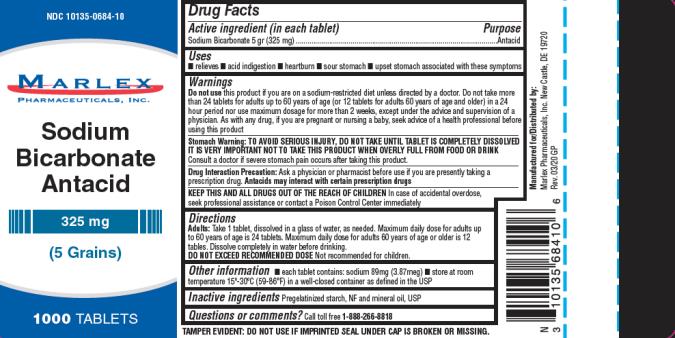
1000 TABLET in 1 BOTTLE (10135-684-10)
2020-03-01
Inactivated by FDA
🧭 About this NDC listing & data coverage
Over-the-counter (OTC) productNo longer marketed (per FDA listing data)
What data is (and isn’t) available for this NDC — tap to expand
NDC identity (package / product / labeler codes)
✓ Available
Labeler
✓ Available
Product & package description
✓ Available
Marketing category & status
✓ Available
Active ingredient / dosage form / route
✓ Available
FDA label (SPL via DailyMed)
✓ Available
Package photos
✓ Available
Inactive ingredients (structured)
— Not published for this NDCThe labeler did not submit a structured excipient list, or no SPL is available.
NADAC pharmacy acquisition price (CMS)
— Not published for this NDCCMS publishes NADAC only for NDCs reported in its retail-pharmacy survey.
Orange Book / therapeutic-equivalence data
— Not published for this NDCApplies only to products approved under an NDA/ANDA; many listings are out of scope.
HCPCS J-code billing crosswalk
— Not published for this NDCMost self-administered / retail products have no J-code — that is normal.
Medicaid utilization (CMS SDUD)
— Not published for this NDCCMS reports utilization only for NDCs with Medicaid claims above its privacy threshold.
“Not published” reflects what the public FDA / CMS / NLM sources provide for this exact package code — it is a property of the data feeds, not a judgment about the product.
Questions about this listing
Is this NDC FDA-approved?
An NDC listing does not by itself establish FDA approval — the NDC Directory records that a product is listed with FDA, not that it was reviewed and approved. This listing's marketing category is "Otc Monograph Not Final". Products approved under an application carry an NDA, ANDA, or BLA number.
Why is there no price listed?
The pricing shown on our NDC pages comes from CMS NADAC, a voluntary survey of retail community pharmacy invoices. CMS does not publish a NADAC for every NDC — packages outside the retail survey (institutional and hospital products, bulk packages, discontinued items, and many OTC items) may never receive one. A missing price reflects the survey's scope, not this product's actual cost, and does not mean the product is free or unavailable.
What does the discontinued status mean for this NDC?
The labeler reported a marketing end date (or the listing was delisted), so this specific package is no longer actively marketed. Remaining stock may still be dispensed for a time, and the NDC stays valid for historical records and claims — but data feeds (pricing, labeling) typically stop updating for it. Other package sizes or other manufacturers' versions of the same medication may still be marketed — see the equivalents section where available.
Is the NDC printed on the package the same as the 11-digit billing NDC?
Yes, they identify this exact package in different formats. The FDA registers it as 10135-684-10, which is what is printed on the packaging and shown on DailyMed. Insurance claims use a fixed 11-digit 5-4-2 format, so the short segment is padded with a leading zero: 10135-0684-10, written without dashes as 10135068410. The Identity section at the top of this page lists every form of this code.
What do the three segments of this NDC mean?
In 10135-0684-10, the first segment (10135) is the labeler code FDA assigned to Marlex Pharmaceuticals Inc; the middle segment (0684) identifies this specific product — its ingredient, strength, and dosage form; and the last segment (10) identifies this exact package size and type. Together they name one specific package of one specific product.
Who lists this product with the FDA?
Marlex Pharmaceuticals Inc is the labeler of record for this NDC — the company under whose FDA-assigned code the package is listed. The labeler may be the manufacturer itself or a distributor marketing the product under its own code.
Do I need a prescription for this product?
This NDC is listed with FDA as an over-the-counter product, so it does not require a prescription. Follow the package directions, and ask your pharmacist if you are unsure whether it is right for you.
This page identifies an FDA-listed package (the NDC) and reports public regulatory and pricing data about the listing. It is reference information, not a medical recommendation — talk to your pharmacist or prescriber about your own medication.
Where does this data come from?
Listing facts (marketing category, packager status, marketing dates) from the FDA openFDA NDC Directory; label availability from DailyMed; pricing coverage from CMS NADAC; equivalence scope from the FDA Orange Book.
📄 FDA label — Drug Facts FDA SPL
The complete FDA label for this product — the official Drug Facts labeling, verbatim, section by section. Jump with a chip, search within the label, or expand everything.
Uses Relieves acid indigestion heartburn sour stomach upset stomach associated with these symptoms
⏱️Dosage and Administration100 words▾
Directions do not use the maximum dosage for more than 2 weeks dissolve tablets completely in water prior to use 325mg, adults 60 years of age and over: 2-8 tablets every 4 hours, not more than 24 tablets in 24 hours adults under 60 years of age: 2-8 tablets every 4 hours, not more than 48 tablets in 24 hours 650mg, adults 60 years of age and over: 1-2 tablets every 4 hours, not more than 12 tablets in 24 hours adults under 60 years of age: 1-4 tablets every 4 hours, not more than 24 tablets in 24 hours
⚠️Warnings65 words▾
Warnings Ask a doctor before use if you have a sodium restricted diet Ask a doctor or p harmacist before use if you are taking a prescription drug. Antacids may interact with certain prescription drugs. Stop use and ask a doc tor if symptoms last more than 2 weeks If pregnant or breast-feeding, ask a health professional before use. Keep out of reach of children.
🧪Active Ingredient16 words▾
Active ingredient (in each tablet) Sodium bicarbonate 10 gr (650 mg) Sodium bicarbonate 5gr (325 mg)
🧪Inactive Ingredients9 words▾
Inactive ingredients Pregelatinized starch, NF and mineral oil, USP
🎯Purpose2 words▾
Purpose Antacid
No label section mentions that — try another word, or open the full label on DailyMed below.
Glossary — plain-language definitions of medical terms used in this label:
Active ingredient: The part of a medicine that produces its intended effect on the body.
Source: FDA Structured Product Labeling, mirrored from DailyMed / openFDA.
Prefer the government’s original formatting? View this label on DailyMed ↗
For educational and professional reference only — not medical advice. Pricing reflects published
NADAC and CMS ASP (free public data) and may differ from your acquisition cost; always verify before billing or dispensing.