
Acanya Clindamycin Phosphate and Benzoyl Peroxide 10 mg/g; 25 mg/g Gel — NDC 13548-132-50 (Billing 13548-0132-50)
This is a package of Acanya Clindamycin Phosphate and Benzoyl Peroxide 10 mg/g; 25 mg/g Gel from Bausch Health US, LLC, marketed since Jul 2010 and currently FDA-listed. It is this product's only package size.
NDC database record
One package, one record: these facts belong to NDC 13548-132-50 alone.
- Record
- FDA NDC Directory package listing · Human prescription drug
- Code segments
- 13548 labeler · 132 product · 50 package
- Package marketed since
- Jul 26, 2010
- Sample package
- No — commercial package
- Listing certified through
- Dec 31, 2026
- Barcode (UPC-A, from the NDC)
- 3 1354813250 9
- Medicaid fills, this package
- 22 prescriptions in the last four reported quarters
- FDA record last changed
- Aug 27, 2026
Identity & classification
Regulatory identifiers FDA, NLM and CMS codes for this package
Drug-database identifiers Medi-Span GPI and First Databank GCN / HICL / AHFS classification
- GSN (GCN sequence number): 066978
- GCN: 29418
- GPI-14 (Medi-Span): 90059902194030
- HICL (First Databank): 017263
- AHFS class code: 08:12.28.20
Where does this data come from?
- FDA openFDA NDC Directory · synced Oct 8, 2026
- FDA label on DailyMed · label index refreshed Oct 6, 2026
- RxNorm (NLM RxNav) · catalog refreshed Oct 1, 2026
- Medi-Span GPI (licensed)
- First Databank (licensed) · refreshed Oct 8, 2026
Clinical
Patient education
Supplement & herbal interactions
Where does this data come from?
- MedlinePlus (NLM) · refreshed Oct 1, 2026
- FDA label on DailyMed · label index refreshed Oct 6, 2026
Ask a licensed pharmacist directly — free, answered by our team.
Pricing
A drug doesn't have one price. Each row is a different public payment system, and none is what you'd pay at the counter — that depends on your insurance. The ⓘ on each row explains what it measures.
| Price system | Per g | Per package |
|---|---|---|
| Retail pharmacies payNADAC · weekly | Not in the retail survey — common for institutional, discontinued, or low-volume packs. | |
| Medicaid paysCMS SDUD · 12 mo | $9.23 | $461.36 / 50 g |
| Medicare drug plans payPart D · quarterly | No Part D plan price is available for this NDC in our data. | |
Where does this data come from?
- CMS NADAC weekly file
- CMS ASP pricing files · refreshed Sep 20, 2026
- CMS Medicaid State Drug Utilization Data · through Q1 2026
- CMS Part D plan pricing files · refreshed Sep 24, 2026
- VA National Acquisition Center price file
Packaging — all sizes for this product
| Package NDC | Description | Marketing start | Marketing end | Status |
|---|---|---|---|---|
| 13548-0132-50 You're viewing this Main listing | 1 BOTTLE, PUMP in 1 CARTON / 50 g in 1 BOTTLE, PUMP | 2010-07-26 | — | Active |
Therapeutic equivalents
| Product | Labeler | Pack | NADAC/unit | TE | Status | Price vs. this |
|---|---|---|---|---|---|---|
| Clindamycin Phosphate And Benzoyl Peroxide 10 mg/g; 25 mg/g 21922-0074-40 | Encube | 1 bottle | $0.819 | AB | Availability likely | — |
| Clindamycin Phosphate and Benzoyl Peroxide 10 mg/g; 25 mg/g 51672-1367-03 | Sun | 1 bottle | $0.819 | AB | Availability likely | — |
| Clindamycin Phosphate and Benzoyl Peroxide 10 mg/g; 25 mg/g 68682-0132-50 | Oceanside | 1 bottle | $1.330 | AB | FDA listed | — |
| Acanya 10 mg/g; 25 mg/gthis 13548-0132-50 | Bausch | 1 bottle | — | AB | FDA listed | — |
Where does this data come from?
- FDA openFDA NDC Directory · synced Oct 8, 2026
- FDA Orange Book · refreshed Oct 3, 2026
- CMS NADAC weekly file
Availability & generic status
FDA-approved generic versions are listed, and recent pricing/market data suggests they may be available — see Therapeutic equivalents.
Why the date isn’t exact: Generic timing can change because patents may be challenged, settled, licensed, added, removed, or worked around with a narrower label — and FDA approval does not always mean a pharmacy can get the generic today.
🛈 What do these terms mean?
- Patent
- Legal protection listed in the Orange Book that may delay generic approval or launch. Issued by the U.S. Patent & Trademark Office.
- Substance patent
- Covers the active drug molecule itself — the hardest to design around. A generic generally can’t launch until it expires.
- Formulation (product) patent
- Covers a specific formulation or dosage form. A generic can sometimes work around it with a different formulation.
- Method-of-use patent
- A patent covering one specific approved use of the drug — not necessarily the whole molecule. A generic can sometimes launch with a “skinny label” that carves out the protected use and keeps the others.
- Skinny label
- A generic label that omits a still-patented use when the FDA allows it — letting a generic reach the market for the unprotected uses.
- Exclusivity
- FDA-granted marketing protection, separate from patents — e.g. 5-yr new chemical entity, 7-yr orphan drug, or a +6-month pediatric extension.
- Paragraph IV
- A generic applicant’s formal challenge to a listed patent. It can potentially lead to earlier generic entry, but often involves litigation or a settlement.
- RLD / RS
- Reference Listed Drug — the brand product the FDA uses as the reference for generic applications. Reference Standard — the product the FDA expects generics to compare against in bioequivalence testing.
- TE / AB rating
- FDA therapeutic-equivalence rating. An AB rating generally means the FDA considers a generic therapeutically equivalent to — and substitutable for — the brand.
- LOE (loss of exclusivity)
- The latest patent or exclusivity currently listed — the loss-of-exclusivity / latest-listed-protection date shown on this page. Paragraph-IV challenges and settlements can move the real date earlier; FDA approval and a manufacturer’s decision to market can move it later.
Built from the FDA Orange Book. The bars above are scaled to each protection’s expiry; the red LOE marker is the last one to lapse.
| Patent | Type | Use code | Expires |
|---|---|---|---|
| US 8288434 ↗ | Method of use | U-818 | Aug 5, 2029 |
| US 8288434 ↗ | Method of use | U-124 | Aug 5, 2029 |
| US 8288434 ↗ | Method of use | U-134 | Aug 5, 2029 |
| US 9561208 ↗ | Method of use | U-916 | Jun 3, 2029 |
| US 10220049 ↗ | Method of use | U-916 | Jun 3, 2029 |
| US 9504704 ↗ | Method of use | U-134 | Jun 3, 2029 |
| US 9504704 ↗ | Method of use | U-818 | Jun 3, 2029 |
| US 9504704 ↗ | Method of use | U-916 | Jun 3, 2029 |
| US 8288434 ↗ | Method of use | U-124 | Aug 5, 2029 |
| US 8288434 ↗ | Method of use | U-1033 | Aug 5, 2029 |
| US 8288434 ↗ | Method of use | U-921 | Aug 5, 2029 |
| US 9504704 ↗ | Method of use | U-124 | Jun 3, 2029 |
| US 8288434 ↗ | Method of use | U-916 | Aug 5, 2029 |
| US 8895070 ↗ | Method of use | U-124 | Jun 3, 2029 |
| US 10137142 ↗ | Method of use | U-916 | Jun 3, 2029 |
| US 10220049 ↗ | Method of use | U-916 | Jun 3, 2029 |
| US 10624918 ↗ | Method of use | U-916 | Jun 3, 2029 |
| US 8663699 ↗ | Method of use | U-124 | Jun 3, 2029 |
| US 9078870 ↗ | Drug product | — | Jun 3, 2029 |
Is there a generic version of ACANYA GEL PUMP?
The FDA approved a generic — why can’t I get it at my pharmacy yet?
Why do different websites show different generic release dates?
What does “FDA listed” mean?
What does a patent or protection date mean here?
What does “current Orange Book estimate” mean?
Can a generic come out before the last patent expires?
Can a generic come out after the listed dates?
What is the difference between patents and exclusivity?
Why are there multiple patent dates?
Where does this data come from?
- FDA Orange Book · refreshed Oct 3, 2026
Inactive Ingredients / Excipients
Inactive ingredients, also called excipients, are components of the drug product other than the active ingredient. They may include fillers, dyes, coatings, preservatives, flavors, or other formulation ingredients.
💡 Tap an ingredient (hover on desktop) to see what it is and why it’s used.
-
UNII 4Q93RCW27E
A synthetic polymer made from acrylic acid that's crosslinked for stability. It acts as a thickener and gelling agent in creams and gels, helping the medicine spread evenly and maintain its texture.
-
UNII WZH3C48M4T
Potassium hydroxide is a strong alkaline chemical used in medicines to adjust and maintain the pH level of liquid formulations, helping keep the product stable and the active ingredients effective.
-
UNII 6DC9Q167V3
Propylene glycol is a clear liquid derived from petroleum or vegetable sources. It acts as a solvent, humectant, and preservative in medicines, helping dissolve active ingredients and maintain product stability.
-
UNII 059QF0KO0R
Water is a liquid solvent that dissolves and mixes ingredients together in liquid medicines, syrups, and injections. It helps distribute the active drug evenly throughout the product.
4 inactive ingredients listed in the exact product block matched to this NDC.
Where does this data come from?
ingredient classCode="IACT" elements from the exact product block matched by this NDC. Label-section narrative from DailyMed / the openFDA label index is shown separately when available.- FDA label on DailyMed · label index refreshed Oct 6, 2026
- FDA openFDA NDC Directory · synced Oct 8, 2026
Inactive ingredient FAQ
Are inactive ingredients the same for every manufacturer?
Why might an inactive ingredient be missing?
Can inactive ingredients matter?
Manufacturer & labeler
More NDCs from Bausch Health US, LLC labeler code 13548
Where does this data come from?
- FDA openFDA NDC Directory · synced Oct 8, 2026
- Drugs@FDA
Full prescribing information FDA SPL
🎯 Indications and Usage ▾
1 INDICATIONS AND USAGE ACANYA ® Gel is indicated for the topical treatment of acne vulgaris in patients 12 years or older. ACANYA Gel is a combination of clindamycin phosphate (a lincosamide antibacterial) and benzoyl peroxide indicated for the topical treatment of acne vulgaris in patients 12 years or older. ( 1 )
⏱️ Dosage and Administration ▾
2 DOSAGE AND ADMINISTRATION Before applying ACANYA Gel, wash your face gently with a mild soap, rinse with warm water, and pat your skin dry. Apply a pea-sized amount of ACANYA Gel to the face once daily. Avoid the eyes, mouth, mucous membranes, or areas of broken skin.
Use of ACANYA Gel beyond 12 weeks has not been evaluated. Concomitant topical acne therapy should be used with caution because a possible cumulative irritancy effect may occur, especially with the use of peeling, desquamating, or abrasive agents. ACANYA Gel is not for oral, ophthalmic, or intravaginal use. • Apply a pea-sized amount of ACANYA Gel to the face once daily.
( 2 ) • Not for oral, ophthalmic, or intravaginal use. ( 2 )
💊 Dosage Forms and Strengths ▾
3 DOSAGE FORMS AND STRENGTHS Gel, 1.2%/2.5% Each gram of ACANYA Gel contains 10 mg (1%) clindamycin as phosphate, and 25 mg (2.5%) benzoyl peroxide in a white to off-white, opaque, smooth gel. Gel, 1.2% clindamycin phosphate/2.5% benzoyl peroxide
⛔ Contraindications ▾
4 CONTRAINDICATIONS ACANYA Gel is contraindicated in: • Patients who have demonstrated hypersensitivity (e.g., anaphylaxis) to clindamycin, benzoyl peroxide, any components of the formulation, or lincomycin. ( 4.1 ) • Patients with a history of regional enteritis, ulcerative colitis, or antibiotic-associated colitis. ( 4.2 )
4.1Hypersensitivity ACANYA Gel is contraindicated in those individuals who have shown hypersensitivity to clindamycin, benzoyl peroxide, any components of the formulation, or lincomycin. Anaphylaxis, as well as allergic reactions leading to hospitalization, has been reported in postmarketing use with ACANYA Gel [see Postmarketing Experience (6.2) ] .
4.2Colitis/Enteritis ACANYA Gel is contraindicated in patients with a history of regional enteritis, ulcerative colitis, or antibiotic-associated colitis [see Warnings and Precautions (5.1) ] .
⚠️ Warnings and Cautions ▾
5 WARNINGS AND PRECAUTIONS • Colitis: Orally and parenterally administered clindamycin has been associated with severe colitis, which may result in death. Diarrhea, bloody diarrhea, and colitis (including pseudomembranous colitis) have been reported with the use of topical and systemic clindamycin. ACANYA Gel should be discontinued if significant diarrhea occurs.
( 5.1 ) • Ultraviolet Light and Environmental Exposure: Minimize sun exposure following drug application. ( 5.2 )
5.1Colitis Systemic absorption of clindamycin has been demonstrated following topical use of clindamycin. Diarrhea, bloody diarrhea, and colitis (including pseudomembranous colitis) have been reported with the use of topical and systemic clindamycin. When significant diarrhea occurs, ACANYA Gel should be discontinued.
Severe colitis has occurred following oral and parenteral administration of clindamycin with an onset of up to several weeks following cessation of therapy. Antiperistaltic agents such as opiates and diphenoxylate with atropine may prolong and/or worsen severe colitis. Severe colitis may result in death.
Studies indicate toxin(s) produced by Clostridia is one primary cause of antibiotic-associated colitis. The colitis is usually characterized by severe persistent diarrhea and severe abdominal cramps and may be associated with the passage of blood and mucus. Stool cultures for Clostridium difficile and stool assay for C. difficile toxin may be helpful diagnostically.
5.2Ultraviolet Light and Environmental Exposure Minimize sun exposure including use of tanning beds or sun lamps following drug application.
5.3Concomitant Topical Medications Concomitant topical acne therapy should be used with caution since a possible cumulative irritancy effect may occur, especially with the use of peeling, desquamating, or abrasive agents. If irritancy or dermatitis occurs, reduce frequency of application or temporarily interrupt treatment and resume once the irritation subsides. Treatment should be discontinued if the irritation persists.
🤒 Adverse Reactions ▾
6 ADVERSE REACTIONS The following selected adverse reactions occurred in less than 0.2% of patients: application site pain (0.1%); application site exfoliation (0.1%); and application site irritation (0.1%). ( 6.1 ) To report SUSPECTED ADVERSE REACTIONS, contact Bausch Health US, LLC at 1-800-321-4576 or FDA at 1-800-FDA-1088 or www.fda.gov/medwatch.
6.1Clinical Trials Experience Because clinical trials are conducted under widely varying conditions, adverse reactions observed in the clinical trials of a drug cannot always be directly compared to rates in the clinical trials of another drug and may not reflect the rates observed in practice. The following selected adverse reactions occurred in less than 0.2% of subjects treated with ACANYA Gel: application site pain (0.1%); application site exfoliation (0.1%); and application site irritation (0.1%). During clinical trials, subjects were assessed for local cutaneous signs and symptoms of erythema, scaling, itching, burning and stinging.
Most local skin reactions increased and peaked around Week 4 and continually decreased over time reaching near baseline levels by Week 12. The percentage of subjects that had symptoms present before treatment, the maximum value recorded during treatment, and the percent with symptoms present at Week 12 are shown in Table 1. Table 1: Percent of Subjects with Local Skin Reactions.
Combined Results from the Two Phase 3 Trials (N = 773) Before Treatment (Baseline) Maximum During Treatment End of Treatment (Week 12) Mild Mod.* Severe Mild Mod.* Severe Mild Mod.* Severe Erythema 22 4 0 25 5 < 1 15 2 0 Scaling 8 < 1 0 18 3 0 8 1 0 Itching 10 2 0 15 2 0 6 < 1 0 Burning 3 < 1 0 8 2 0 2 < 1 0 Stinging 2 < 1 0 6 1 0 1 < 1 0
6.2Postmarketing Experience Because these reactions are reported voluntarily from a population of uncertain size, it is not always possible to reliably estimate their frequency or establish a causal relationship to drug exposure. Anaphylaxis, as well as allergic reactions leading to hospitalizations, has been reported in postmarketing use of products containing clindamycin/benzoyl peroxide.
🔄 Drug Interactions ▾
7 DRUG INTERACTIONS • Avoid using ACANYA Gel in combination with topical or oral erythromycin-containing products because of its clindamycin component. ( 7.1 )
7.1Erythromycin ACANYA Gel should not be used in combination with topical or oral erythromycin-containing products due to its clindamycin component. In vitro studies have shown antagonism between erythromycin and clindamycin. The clinical significance of this in vitro antagonism is not known.
7.2Neuromuscular Blocking Agents Clindamycin has been shown to have neuromuscular blocking properties that may enhance the action of other neuromuscular blocking agents. Therefore, ACANYA Gel should be used with caution in patients receiving such agents.
👥 Use in Specific Populations ▾
8 USE IN SPECIFIC POPULATIONS
8.1Pregnancy Risk Summary There are no available data on ACANYA Gel use in pregnant women to evaluate a drug-associated risk of major birth defects, miscarriage, or adverse maternal or fetal outcomes. The limited published data on use of clindamycin in pregnant women with exposure during the first trimester are insufficient to inform a drug-associated risk of pregnancy-related adverse outcomes (see Data) .In limited published clinical trials with pregnant women, the systemic administration of clindamycin during the second and third trimesters has not been associated with an increased frequency of major birth defects.
In animal reproduction studies, clindamycin did not cause malformations or embryo-fetal development toxicity in pregnant rats and mice when administered during the period of organogenesis at systemic doses up to 240 times the maximum recommended human dose (MRHD) of 2.5 g ACANYA Gel, based on body surface area (BSA) comparisons (see Data) . The estimated background risk of major birth defects and miscarriage for the indicated population is unknown. All pregnancies have a background risk of major birth defects, loss, and other adverse outcomes.
In the U.S. general population, the estimated background risk of major birth defects and miscarriage in clinically recognized pregnancies is 2-4% and 15-20%, respectively. Data Human Data In limited published trials in pregnant women administered clindamycin during the first trimester of pregnancy, there was no difference in the rate of major birth defects reported among in utero exposed infants compared to unexposed infants. These data cannot definitely establish or exclude any clindamycin-associated risk during pregnancy.
Animal Data Animal reproductive/developmental toxicity studies have not been conducted with ACANYA Gel or benzoyl peroxide. Developmental toxicity studies of clindamycin performed in pregnant rats and mice administered during the period of organogenesis at oral doses of up to 600 mg/kg/day (240 and 120 times the MRHD for, respectively, based on BSA comparisons) or subcutaneous doses of up to 200 mg/kg/day (80 and 40 times the MRHD for clindamycin, respectively, based on BSA comparisons) revealed no malformations or embryo-fetal development toxicity.
8.2Lactation Risk Summary There are no data on the presence of clindamycin or benzoyl peroxide in human milk, the effects on the breastfed child, or the effects on milk production following topical administration. However, clindamycin has been reported to be present in breast milk in small amounts following oral and parenteral administration. The developmental and health benefits of breastfeeding should be considered along with the mother’s clinical need for ACANYA Gel and any potential adverse effects on the breastfed child from ACANYA Gel or from the underlying maternal condition.
Clinical Considerations If used during lactation and ACANYA Gel is applied to the chest, care should be taken to avoid accidental ingestion by the infant.
8.4Pediatric Use Safety and effectiveness of ACANYA Gel in pediatric patients under the age of 12 have not been evaluated.
8.5Geriatric Use Clinical trials of ACANYA Gel did not include sufficient numbers of subjects aged 65 and older to determine whether they respond differently from younger subjects.
🤰 Pregnancy ▾
8.1Pregnancy Risk Summary There are no available data on ACANYA Gel use in pregnant women to evaluate a drug-associated risk of major birth defects, miscarriage, or adverse maternal or fetal outcomes. The limited published data on use of clindamycin in pregnant women with exposure during the first trimester are insufficient to inform a drug-associated risk of pregnancy-related adverse outcomes (see Data) .In limited published clinical trials with pregnant women, the systemic administration of clindamycin during the second and third trimesters has not been associated with an increased frequency of major birth defects.
In animal reproduction studies, clindamycin did not cause malformations or embryo-fetal development toxicity in pregnant rats and mice when administered during the period of organogenesis at systemic doses up to 240 times the maximum recommended human dose (MRHD) of 2.5 g ACANYA Gel, based on body surface area (BSA) comparisons (see Data) . The estimated background risk of major birth defects and miscarriage for the indicated population is unknown. All pregnancies have a background risk of major birth defects, loss, and other adverse outcomes.
In the U.S. general population, the estimated background risk of major birth defects and miscarriage in clinically recognized pregnancies is 2-4% and 15-20%, respectively. Data Human Data In limited published trials in pregnant women administered clindamycin during the first trimester of pregnancy, there was no difference in the rate of major birth defects reported among in utero exposed infants compared to unexposed infants. These data cannot definitely establish or exclude any clindamycin-associated risk during pregnancy.
Animal Data Animal reproductive/developmental toxicity studies have not been conducted with ACANYA Gel or benzoyl peroxide. Developmental toxicity studies of clindamycin performed in pregnant rats and mice administered during the period of organogenesis at oral doses of up to 600 mg/kg/day (240 and 120 times the MRHD for, respectively, based on BSA comparisons) or subcutaneous doses of up to 200 mg/kg/day (80 and 40 times the MRHD for clindamycin, respectively, based on BSA comparisons) revealed no malformations or embryo-fetal development toxicity.
🧒 Pediatric Use ▾
8.4Pediatric Use Safety and effectiveness of ACANYA Gel in pediatric patients under the age of 12 have not been evaluated.
🧓 Geriatric Use ▾
8.5Geriatric Use Clinical trials of ACANYA Gel did not include sufficient numbers of subjects aged 65 and older to determine whether they respond differently from younger subjects.
🧬 Clinical Pharmacology ▾
12 CLINICAL PHARMACOLOGY
12.1Mechanisms of Action Clindamycin: Clindamycin is a lincosamide antibacterial [see Microbiology (12.4) ] . Benzoyl Peroxide: Benzoyl peroxide is an oxidizing agent with bactericidal and keratolytic effects but the precise mechanism of action is unknown.
12.3Pharmacokinetics The systemic absorption of clindamycin was investigated in an open-label, multiple-dose trial in 16 adult subjects with moderate to severe acne vulgaris treated with 1 gram of ACANYA Gel applied to the face once daily for 30 days. Twelve subjects (75%) had at least one quantifiable clindamycin plasma concentration above the lower limit of quantification (LOQ = 0.5 ng/mL) on Day 1 or Day 30. On Day 1, the mean (± standard deviation) peak plasma concentration (C max ) was 0.78 ± 0.22 ng/mL (n=9 with measurable concentrations), and the mean AUC 0-t was 5.29 ± 0.81 h.ng/mL (n=4).
On Day 30, the mean C max was 1.22 ± 0.88 ng/mL (n=10), and the mean AUC 0-t was 8.42 ± 6.01 h.ng/mL (n=6). Clindamycin plasma concentrations were below LOQ in all subjects at 24 hours post-dose on the three tested days (Day 1, 15, and 30). Benzoyl peroxide has been shown to be absorbed by the skin where it is converted to benzoic acid.
12.4Microbiology Clindamycin binds to the 50S ribosomal subunits of susceptible bacteria and prevents elongation of peptide chains by interfering with peptidyl transfer, thereby suppressing bacterial protein synthesis. Clindamycin and benzoyl peroxide individually have been shown to havein vitro activity against Propionibacterium acnes , an organism which has been associated with acne vulgaris; however, the clinical significance of this activity against P. acnes is not known. P. acnes resistance to clindamycin has been documented.
Resistance to clindamycin is often associated with resistance to erythromycin.
📦 How Supplied / Storage and Handling ▾
16 HOW SUPPLIED/STORAGE AND HANDLING
16.1How Supplied ACANYA Gel, 1.2%/2.5%, a white to off-white smooth gel is supplied as: NDC 13548-132-50 50 g pump
16.2Dispensing Instructions for the Pharmacist • Dispense ACANYA Gel with a 10-week expiration date. • Specify “Store at room temperature up to 25°C (77°F). Do not freeze.”
16.3Storage and Handling • PHARMACIST: Prior to Dispensing: Store in a refrigerator, 2° to 8°C (36° to 46°F). • PATIENT: Store at room temperature at or below 25°C (77°F). • Protect from freezing. • Store pump upright. • Keep out of the reach of children. • Keep container tightly closed.
📋 Description ▾
11 DESCRIPTION ACANYA (clindamycin phosphate and benzoyl peroxide) Gel, 1.2%/2.5% is a combination product with two active ingredients in a white to off-white, opaque, smooth, aqueous gel formulation intended for topical use. Clindamycin phosphate is a water-soluble ester of the semisynthetic antibiotic produced by a 7(S)-chloro-substitution of the 7(R)‑hydroxyl group of the parent antibiotic lincomycin. The chemical name for clindamycin phosphate is Methyl 7-chloro-6,7,8-trideoxy-6-(1-methyl-trans-4-propyl-L-2-pyrrolidinecarboxamido)-1-thio-L-threo-α-D-galacto-octopyranoside 2-(dihydrogen phosphate).
The structural formula for clindamycin phosphate is represented below: Clindamycin phosphate: Molecular Formula: C 18 H 34 ClN 2 O 8 PS Molecular Weight: 504.97 Benzoyl peroxide is an antibacterial and keratolytic agent. The structural formula for benzoyl peroxide is represented below: Benzoyl peroxide: Molecular Formula: C 14 H 10 O 4 Molecular Weight: 242.23 ACANYA Gel contains the following inactive ingredients: carbomer 980, potassium hydroxide, propylene glycol, and purified water. Each gram of ACANYA Gel contains 1.2% of clindamycin phosphate which is equivalent to 1% clindamycin. chem1 chem2
💬 Information for Patients ▾
17 PATIENT COUNSELING INFORMATION Advise the patient to read the FDA-approved patient labeling (Patient Information). • Patients who develop allergic reactions such as severe swelling or shortness of breath should discontinue use and contact their physician immediately. • ACANYA Gel may cause irritation such as erythema, scaling, itching, or burning, especially when used in combination with other topical acne therapies. • Excessive or prolonged exposure to sunlight should be limited. To minimize exposure to sunlight, a hat or other clothing should be worn.
Sunscreen may also be used. • ACANYA Gel may bleach hair or colored fabric. Distributed by: Bausch Health US, LLC Bridgewater, NJ 08807 USA Manufactured by: Bausch Health Companies Inc. Laval, Quebec H7L 4A8, Canada U.S.
Patent Numbers: 8,288,434; 8,663,699; 8,895,070; 9,078,870; 10,220,049 and 10,624,918 ACANYA is a trademark of Bausch Health Companies Inc. or its affiliates. © 2020 Bausch Health Companies Inc. or its affiliates 9387203
🧬 Pharmacokinetics ▾
12.3Pharmacokinetics The systemic absorption of clindamycin was investigated in an open-label, multiple-dose trial in 16 adult subjects with moderate to severe acne vulgaris treated with 1 gram of ACANYA Gel applied to the face once daily for 30 days. Twelve subjects (75%) had at least one quantifiable clindamycin plasma concentration above the lower limit of quantification (LOQ = 0.5 ng/mL) on Day 1 or Day 30. On Day 1, the mean (± standard deviation) peak plasma concentration (C max ) was 0.78 ± 0.22 ng/mL (n=9 with measurable concentrations), and the mean AUC 0-t was 5.29 ± 0.81 h.ng/mL (n=4).
On Day 30, the mean C max was 1.22 ± 0.88 ng/mL (n=10), and the mean AUC 0-t was 8.42 ± 6.01 h.ng/mL (n=6). Clindamycin plasma concentrations were below LOQ in all subjects at 24 hours post-dose on the three tested days (Day 1, 15, and 30). Benzoyl peroxide has been shown to be absorbed by the skin where it is converted to benzoic acid.
🔬 Clinical Studies ▾
14 CLINICAL STUDIES The safety and efficacy of once daily use of ACANYA Gel were assessed in two 12-week multi-center, randomized, blinded trials in subjects 12 years and older with moderate to severe acne vulgaris. The two trials were identical in design and compared ACANYA Gel to clindamycin in the vehicle gel, benzoyl peroxide in the vehicle gel, and the vehicle gel alone. The co-primary efficacy variables were: 1.
Mean absolute change from baseline at Week 12 in: 2. Inflammatory lesion counts 3. Non-inflammatory lesion counts 4.
Percent of subjects who had a 2-grade improvement from baseline on an Evaluator’s Global Severity (EGS) score. The EGS scoring scale used in all of the clinical trials for ACANYA Gel is as follows: Grade Description Clear Normal, clear skin with no evidence of acne vulgaris Almost Clear Rare non-inflammatory lesions present, with rare non-inflamed papules (papules must be resolving and may be hyperpigmented, though not pink-red) Mild Some non-inflammatory lesions are present, with few inflammatory lesions (papules/pustules only; no nodulocystic lesions) Moderate Non-inflammatory lesions predominate, with multiple inflammatory lesions evident: several to many comedones and papules/pustules, and there may or may not be one small nodulocystic lesion Severe Inflammatory lesions are more apparent, many comedones and papules/pustules, there may or may not be a few nodulocystic lesions Very Severe Highly inflammatory lesions predominate, variable number of comedones, many papules/pustules and many nodulocystic lesions The results of Trial 1 at Week 12 are presented in Table 2: Table 2: Trial 1 Results ACANYA Gel Clindamycin Gel Benzoyl Peroxide Gel Vehicle Gel Trial 1 N = 399 N = 408 N = 406 N = 201 EGSS Clear or Almost Clear 115 (29%) 84 (21%) 76 (19%) 29 (14%) 2-grade reduction from baseline 131 (33%) 100 (25%) 96 (24%) 38 (19%) Inflammatory Lesions: Mean absolute change 14.8 12.2 13.0
9.0Mean percent (%) reduction 55.0% 47.1% 49.3% 34.5% Non-Inflammatory Lesions: Mean absolute change 22.1 17.9 20.6
13.2Mean percent (%) reduction 45.3% 38.0% 40.2% 28.6% The results of Trial 2 at Week 12 are presented in Table 3: Table 3: Trial 2 Results ACANYA Gel Clindamycin Gel Benzoyl Peroxide Gel Vehicle Gel Trial 2 N = 398 N = 404 N = 403 N = 194 EGSS Clear or Almost Clear 113 (28%) 94 (23%) 94 (23%) 21 (11%) 2-grade reduction from baseline 147 (37%) 114 (28%) 114 (28%) 27 (14%) Inflammatory Lesions: Mean absolute change 13.7 11.3 11.2
5.7Mean percent (%) reduction 54.2% 45.3% 45.7% 23.3% Non-Inflammatory Lesions: Mean absolute change 19.0 14.9 15.2
8.3Mean percent (%) reduction 41.2% 34.3% 34.5% 19.2%
🧪 Nonclinical Toxicology ▾
13 NONCLINICAL TOXICOLOGY
13.1Carcinogenesis, Mutagenesis, Impairment of Fertility Carcinogenicity, mutagenicity, and impairment of fertility testing of ACANYA Gel have not been performed. Benzoyl peroxide has been shown to be a tumor promoter and progression agent in a number of animal studies. Benzoyl peroxide in acetone at doses of 5 and 10 mg administered topically twice per week for 20 weeks induced skin tumors in transgenic Tg.AC mice.
The clinical significance of this is unknown. Carcinogenicity studies have been conducted with a gel formulation containing 1% clindamycin and 5% benzoyl peroxide. In a 2-year dermal carcinogenicity study in mice, treatment with the gel formulation at doses of 900, 2700, and 15000 mg/kg/day (1.8, 5.4, and 30 times the MRHD for clindamycin and 3.6, 10.8, and 60 times the MRHD for benzoyl peroxide, respectively, based on BSA comparisons) did not cause any increase in tumors.
However, topical treatment with a different gel formulation containing 1% clindamycin and 5% benzoyl peroxide at doses of 100, 500, and 2000 mg/kg/day caused a dose-dependent increase in the incidence of keratoacanthoma at the treated skin site of male rats in a 2-year dermal carcinogenicity study in rats. In an oral (gavage) carcinogenicity study in rats, treatment with the gel formulation at doses of 300, 900, and 3000 mg/kg/day (1.2, 3.6, and 12 times the MRHD for clindamycin and 2.4, 7.2, and 24 times the MRHD for benzoyl peroxide, respectively, based on BSA comparisons) for up to 97 weeks did not cause any increase in tumors.
Clindamycin phosphate was not genotoxic in the human lymphocyte chromosome aberration assay. Benzoyl peroxide has been found to cause DNA strand breaks in a variety of mammalian cell types, to be mutagenic in S. typhimurium tests by some but not all investigators, and to cause sister chromatid exchanges in Chinese hamster ovary cells. Fertility studies have not been performed with ACANYA Gel or benzoyl peroxide, but fertility and mating ability have been studied with clindamycin.
Fertility studies in rats treated orally with up to 300 mg/kg/day of clindamycin (approximately 120 times the MRHD for clindamycin, based on BSA comparisons) revealed no effects on fertility or mating ability.
📄 Carcinogenesis, Mutagenesis, Impairment of Fertility ▾
13.1Carcinogenesis, Mutagenesis, Impairment of Fertility Carcinogenicity, mutagenicity, and impairment of fertility testing of ACANYA Gel have not been performed. Benzoyl peroxide has been shown to be a tumor promoter and progression agent in a number of animal studies. Benzoyl peroxide in acetone at doses of 5 and 10 mg administered topically twice per week for 20 weeks induced skin tumors in transgenic Tg.AC mice.
The clinical significance of this is unknown. Carcinogenicity studies have been conducted with a gel formulation containing 1% clindamycin and 5% benzoyl peroxide. In a 2-year dermal carcinogenicity study in mice, treatment with the gel formulation at doses of 900, 2700, and 15000 mg/kg/day (1.8, 5.4, and 30 times the MRHD for clindamycin and 3.6, 10.8, and 60 times the MRHD for benzoyl peroxide, respectively, based on BSA comparisons) did not cause any increase in tumors.
However, topical treatment with a different gel formulation containing 1% clindamycin and 5% benzoyl peroxide at doses of 100, 500, and 2000 mg/kg/day caused a dose-dependent increase in the incidence of keratoacanthoma at the treated skin site of male rats in a 2-year dermal carcinogenicity study in rats. In an oral (gavage) carcinogenicity study in rats, treatment with the gel formulation at doses of 300, 900, and 3000 mg/kg/day (1.2, 3.6, and 12 times the MRHD for clindamycin and 2.4, 7.2, and 24 times the MRHD for benzoyl peroxide, respectively, based on BSA comparisons) for up to 97 weeks did not cause any increase in tumors.
Clindamycin phosphate was not genotoxic in the human lymphocyte chromosome aberration assay. Benzoyl peroxide has been found to cause DNA strand breaks in a variety of mammalian cell types, to be mutagenic in S. typhimurium tests by some but not all investigators, and to cause sister chromatid exchanges in Chinese hamster ovary cells. Fertility studies have not been performed with ACANYA Gel or benzoyl peroxide, but fertility and mating ability have been studied with clindamycin.
Fertility studies in rats treated orally with up to 300 mg/kg/day of clindamycin (approximately 120 times the MRHD for clindamycin, based on BSA comparisons) revealed no effects on fertility or mating ability.
📄 Patient Package Insert ▾
Patient Package Insert PATIENT INFORMATION ACANYA ® (AH-CAN΄-YAH) (clindamycin phosphate and benzoyl peroxide) gel, 1.2%/2.5% Important information: ACANYA Gel is for use on skin only (topical use) . Do not use ACANYA Gel in your mouth, eyes, or vagina. What is ACANYA Gel?
ACANYA Gel is a prescription medicine used on the skin (topical) to treat acne vulgaris in people 12 years of age and older. It is not known if ACANYA Gel is safe and effective for use longer than 12 weeks. It is not known if ACANYA Gel is safe and effective in children under 12 years of age.
Do not use ACANYA Gel if you have: • had an allergic reaction to clindamycin, benzoyl peroxide, lincomycin or any of the ingredients in ACANYA Gel. See the end of this leaflet for a complete list of ingredients in ACANYA Gel. • Crohn’s disease or ulcerative colitis. • had inflammation of the colon (colitis), or severe diarrhea with past antibiotic use. Talk with your doctor if you are not sure if you have any of the conditions listed above.
Before using ACANYA Gel, tell your doctor about all of your medical conditions, including if you: • plan to have surgery. ACANYA Gel may affect how certain medicines work that may be given during surgery. • are pregnant or plan to become pregnant. It is not known if ACANYA Gel will harm your unborn baby. • are breastfeeding or plan to breastfeed.
It is not known if ACANYA Gel passes into your breast milk. Clindamycin when taken by mouth or by injection has been reported to appear in breast milk. Talk to your doctor about the best way to feed your baby during treatment with ACANYA Gel.
Tell your doctor about all the medicines you take, including prescription and over-the-counter medicines, vitamins and herbal supplements. ACANYA Gel may affect the way other medicines work and other medicines may affect how ACANYA Gel works. • Especially tell your doctor if you take medicine by mouth that contains erythromycin or use products on your skin that contain erythromycin. ACANYA Gel should not be used with products that contain erythromycin. • Tell your doctor about any skin products you use.
Other skin and topical acne products may increase the irritation of your skin when used with ACANYA Gel. Know the medicines you take. Keep a list of them and show it to your doctor and pharmacist when you get a new medicine.
How should I use ACANYA Gel? • Use ACANYA Gel exactly as your doctor tells you to use it. See the detailed “Instructions for Use” for directions about how to apply ACANYA Gel. • Your doctor will tell you how long to use ACANYA Gel. • Apply ACANYA Gel to your face 1 time each day. What should I avoid while using ACANYA Gel? • Limit your time in sunlight.
You should avoid using tanning beds or sunlamps during treatment with ACANYA Gel. If you have to be in sunlight, wear a wide-brimmed hat or other protective clothing, and use sunscreen to cover the treated areas. • Avoid getting ACANYA Gel in your hair or on colored fabric. ACANYA Gel may bleach hair or colored fabric.
What are possible side effects of ACANYA Gel? ACANYA Gel can cause serious side effects including: • Inflammation of the colon (colitis). Stop using ACANYA Gel and call your doctor right away if you have severe stomach (abdominal) cramps, watery diarrhea, or bloody diarrhea during treatment, and within several weeks after treatment with ACANYA Gel. • Allergic reactions.
Stop using ACANYA Gel, call your doctor and get help right away if you have any of the following symptoms during treatment with ACANYA Gel: o severe itching o swelling of your face, eyes, lips, tongue or throat o trouble breathing The most common side effects of ACANYA Gel include application site pain, application site irritation including redness, itching, burning, and stinging. Stop using ACANYA Gel and call your doctor if you have a skin rash or your skin becomes very red, itchy or swollen. Talk to your doctor about any side effect that bothers you or that does not go away.
These are not all of the p… [Excerpted — this section continues on DailyMed.]
📖 Instructions for Use ▾
Instructions for Use INSTRUCTIONS FOR USE ACANYA ® (AH-CAN΄-YAH) (clindamycin phosphate and benzoyl peroxide) gel, 1.2%/2.5% Important Information: ACANYA Gel is for use on skin only (topical use). ACANYA Gel is not for use in your mouth, eyes or vagina. Read this Instructions for Use before you start using ACANYA Gel and each time you get a refill.
There may be new information. This information does not take the place of talking with your doctor about your medical condition or treatment. • Apply ACANYA Gel to your face 1 time each day as prescribed. • Before you apply ACANYA Gel, wash your face gently with a mild soap, rinse with warm water, and pat your skin dry. • To apply ACANYA Gel to your face, use the pump to dispense one pea-sized amount of ACANYA Gel onto your fingertip. See Figure 1. • One pea-sized amount of ACANYA Gel should be enough to cover your entire face.
Figure 1 • Dot the one pea-sized amount of ACANYA Gel onto six areas of your face (chin, left cheek, right cheek, nose, left forehead, right forehead). See Figure 2. Figure 2 • Spread the gel over your face and gently rub it in.
It is important to spread the gel over your entire face. If your doctor tells you to put ACANYA Gel on other areas of your skin with acne, be sure to ask how much you should use. • Wash your hands with soap and water after applying ACANYA Gel. How should I store ACANYA Gel? • Store ACANYA Gel at room temperature at or below 77°F (25°C). • Do not freeze ACANYA Gel. • Throw away (discard) ACANYA Gel that has passed the expiration date. • Store pump upright. • Keep the container tightly closed.
Keep ACANYA Gel and all medicines out of the reach of children. Distributed by: Bausch Health US, LLC, Bridgewater, NJ 08807 USA Manufactured by: Bausch Health Companies Inc., Laval, Quebec H7L 4A8, Canada U.S. Patent Numbers: 8,288,434; 8,663,699; 8,895,070; 9,078,870; 10,220,049 and 10,624,918 ACANYA is a trademark of Bausch Health Companies Inc. or its affiliates. © 2020 Bausch Health Companies Inc. or its affiliates The Patient Information and Instructions for Use have been approved by the U.S.
Food and Drug Administration. Issued: 09/2020 9387203 figure1 figure2
📄 Package Label / Principal Display Panel ▾
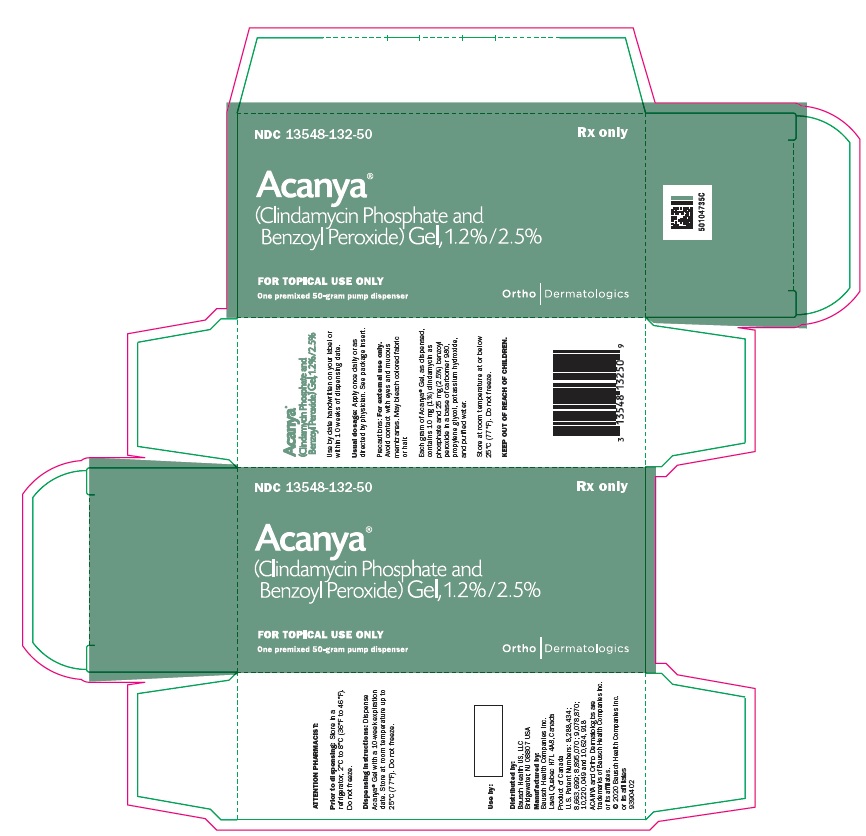
PACKAGE/LABEL PRINCIPAL DISPLAY PANEL NDC 13548-132-50 Rx only Acanya ® (Clindamycin Phosphate and Benzoyl Peroxide) Gel, 1.2% /2.5% FOR TOPICAL USE ONLY One premixed 50-gram pump dispenser Ortho Dermatologics carton
Medicaid utilization & spend
Reported adverse events (FAERS)
Top reported reactions
Age at onset
Reporter sex
Serious outcomes
Where does this data come from?
About this NDC listing & data coverage
What data is (and isn’t) available for this NDC — tap to expand
| NDC identity (package / product / labeler codes) | ✓ Available |
| Labeler | ✓ Available |
| Product & package description | ✓ Available |
| Marketing category & status | ✓ Available |
| Active ingredient / dosage form / route | ✓ Available |
| FDA label (SPL via DailyMed) | ✓ Available |
| Package photos | ✓ Available |
| Inactive ingredients (structured) | ✓ Available |
| NADAC pharmacy acquisition price (CMS) | — Not published for this NDC CMS publishes NADAC only for NDCs reported in its retail-pharmacy survey. |
| Orange Book / therapeutic-equivalence data | ✓ Available |
| HCPCS J-code billing crosswalk | — Not published for this NDC Most self-administered / retail products have no J-code — that is normal. |
| Medicaid utilization (CMS SDUD) | ✓ Available |