
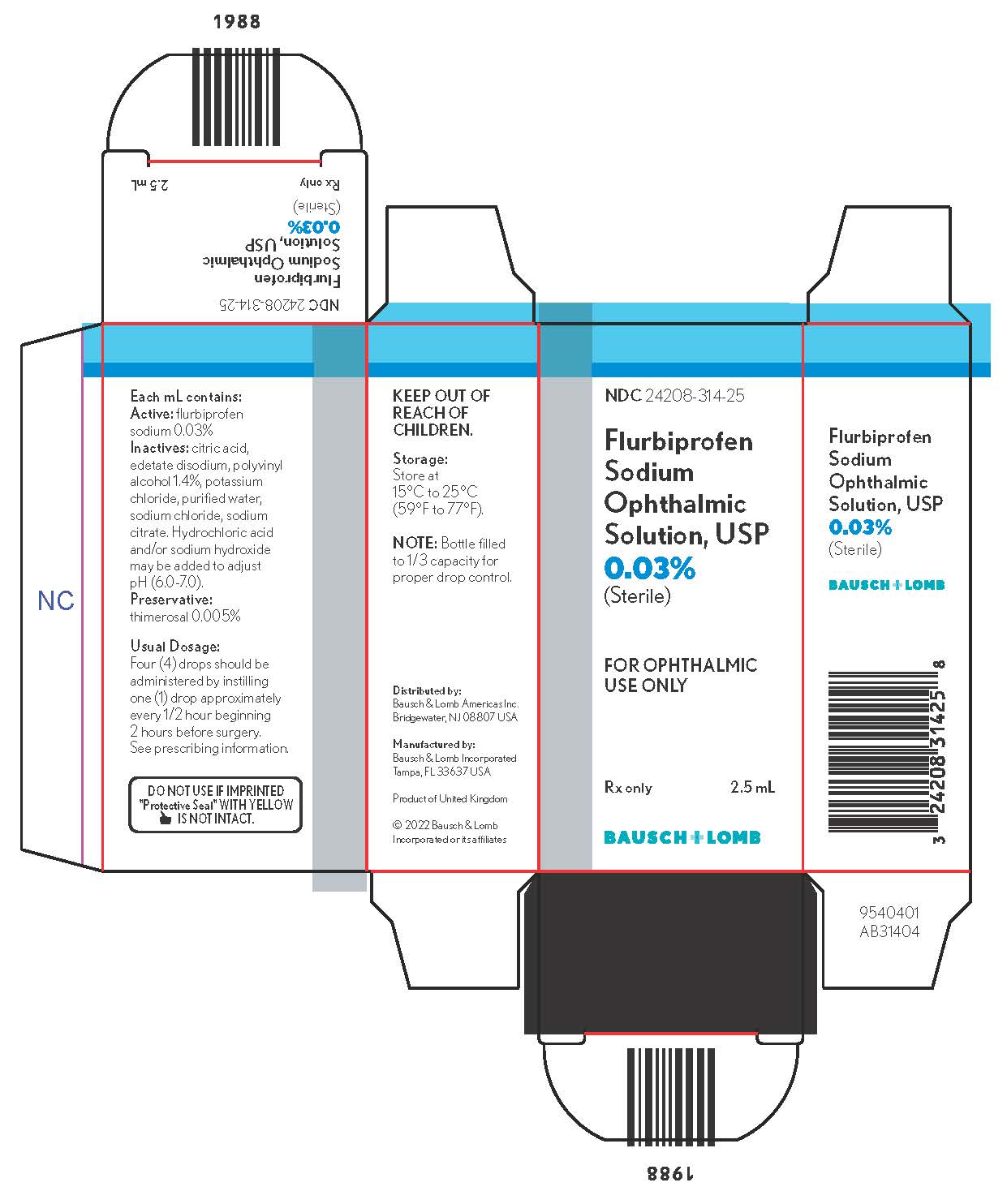
Flurbiprofen Sodium .3 mg/mL Solution/ Drops, 1 bottle — NDC 24208-314-25 (Billing 24208-0314-25)
This is a package of 1 bottle of Flurbiprofen Sodium .3 mg/mL Solution/ Drops from Bausch & Lomb Incorporated, marketed since Jan 1995 and currently FDA-listed. It is this product's only package size.
NDC database record
One package, one record: these facts belong to NDC 24208-314-25 alone.
- Record
- FDA NDC Directory package listing · Human prescription drug
- Code segments
- 24208 labeler · 314 product · 25 package
- Package marketed since
- Jan 4, 1995
- Sample package
- No — commercial package
- Listing certified through
- Dec 31, 2027
- Barcode (UPC-A, from the NDC)
- 3 2420831425 8
- FDA record last changed
- Oct 8, 2026
Identity & classification
Regulatory identifiers FDA, NLM and CMS codes for this package
Drug-database identifiers Medi-Span GPI and First Databank GCN / HICL / AHFS classification
- GSN (GCN sequence number): 007905
- GCN: 34360
- GPI-14 (Medi-Span): 86805020102010
- HICL (First Databank): 003485
- AHFS class code: 28:08.04.04
- RxCUI (RxNorm): 1243585
Where does this data come from?
- FDA openFDA NDC Directory · synced Oct 8, 2026
- FDA label on DailyMed · label index refreshed Oct 8, 2026
- RxNorm (NLM RxNav) · catalog refreshed Oct 8, 2026
- Medi-Span GPI (licensed)
- First Databank (licensed) · refreshed Oct 8, 2026
RxNorm drug class
This medicine belongs to the Nonsteroidal Anti-inflammatory Drug class.
Where does this data come from?
- RxClass (NLM) · catalog refreshed Oct 8, 2026
Clinical
Flurbiprofen ophthalmic is used to prevent or reduce changes in the eye that may occur during eye surgery. Flurbiprofen ophthalmic is in a class of medications called nonsteroidal anti-inflammatory drugs (NSAIDs). It works by stopping the release of certain natural substances that cause pain and swelling.
Read the full MedlinePlus article ↗- The tablets relieve the signs and symptoms of rheumatoid arthritis and osteoarthritis. The eye drops are a different product used around eye surgery to keep the pupil from narrowin...
- They are taken by mouth, split into two, three or four doses a day as your prescriber directs. We aim for the lowest effective dose for the shortest time. Food or antacids may chan...
- Stomach upset is the big one: pain, heartburn, nausea, diarrhea or constipation. Headache and swelling can also happen. Call your doctor if symptoms are bothersome or don't settle.
- Get help for chest pain, shortness of breath, weakness on one side, slurred speech, black or bloody stools, vomiting blood, a skin rash, yellow skin or eyes, or swelling of the fac...
Patient education
Supplement & herbal interactions
Where does this data come from?
- MedlinePlus (NLM) · refreshed Oct 8, 2026
- FDA label on DailyMed · label index refreshed Oct 8, 2026
Ask a licensed pharmacist directly — free, answered by our team.
Pricing
A drug doesn't have one price. Each row is a different public payment system, and none is what you'd pay at the counter — that depends on your insurance. The ⓘ on each row explains what it measures.
| Price system | Per mL | Per package |
|---|---|---|
| Retail pharmacies payNADAC · weekly | Not in the retail survey — common for institutional, discontinued, or low-volume packs. | |
| Medicaid paysCMS SDUD · 12 mo | No recent Medicaid claims on file for this NDC — rare and low-volume NDCs are suppressed in the public data. | |
| Medicare drug plans payPart D · Q2 2026 | $12.70 | $31.74 / 2.5 ml |
Where does this data come from?
- CMS NADAC weekly file
- CMS ASP pricing files · refreshed Sep 20, 2026
- CMS Medicaid State Drug Utilization Data · refreshed Oct 9, 2026
- CMS Part D plan pricing files · refreshed Sep 24, 2026
- VA National Acquisition Center price file
Packaging — all sizes for this product
| Package NDC | Description | Marketing start | Marketing end | Status |
|---|---|---|---|---|
| 24208-0314-25 You're viewing this Main listing | 1 BOTTLE, DROPPER in 1 CARTON / 2.5 mL in 1 BOTTLE, DROPPER | 1995-01-04 | — | Active |
Therapeutic equivalents
| Product | Labeler | Pack | NADAC/unit | TE | Status | Price vs. this |
|---|---|---|---|---|---|---|
| Flurbiprofen Sodium .3 mg/mL 69292-0722-25 | Amici | 1 bottle | $9.829 | — | Availability likely | — |
| Flurbiprofen Sodium .3 mg/mLthis 24208-0314-25 | Bausch | 1 bottle | — | — | FDA listed | — |
| Flurbiprofen Sodium .3 mg/mL 50090-3946-00 | A-S | 1 bottle | — | — | FDA listed | — |
| Flurbiprofen Sodium .3 mg/mL 63187-0937-25 | Proficient | 1 bottle | — | — | FDA listed | — |
Where does this data come from?
- FDA openFDA NDC Directory · synced Oct 8, 2026
- FDA Orange Book · refreshed Oct 3, 2026
- CMS NADAC weekly file
Availability & generic status
This product is an FDA-approved generic. Other versions of the same drug are listed under Therapeutic equivalents, least expensive first.
Where does this data come from?
- FDA Orange Book · refreshed Oct 3, 2026
Inactive Ingredients / Excipients
Inactive ingredients, also called excipients, are components of the drug product other than the active ingredient. They may include fillers, dyes, coatings, preservatives, flavors, or other formulation ingredients.
🧪 Avoiding an ingredient? See Flurbiprofen inactive ingredients by manufacturer: every current product's list side by side, so you can ask your pharmacy for the version that does not list it.
💡 Tap an ingredient (hover on desktop) to see what it is and why it’s used.
-
UNII 2968PHW8QP
A weak organic acid derived from citrus fruits or made through fermentation. It works as a buffer to control pH, a preservative to extend shelf life, and a flavoring agent in medications.
-
UNII 7FLD91C86K
Edetate disodium is a chemical compound that binds and removes certain metal ions. In medicines, it acts as a preservative and stabilizer by preventing metals like calcium from interfering with the product's shelf life and consistency.
-
UNII QTT17582CB
A strong acid used to adjust and maintain the proper pH level in liquid medicines, ensuring stability and preventing breakdown of active ingredients.
-
UNII 532B59J990
Polyvinyl alcohol is a synthetic polymer made from plant-derived materials. It's used as a binder to hold ingredients together, a film-former in coatings, and a thickener in liquid formulations.
-
UNII 660YQ98I10
Potassium chloride is a mineral salt used in medicines as a buffer and to help maintain the proper pH balance and stability of the formulation during storage and use.
-
UNII 451W47IQ8X
Sodium chloride is common table salt. It's used in medicines as a buffer to maintain proper pH, as a filler to add bulk, or to adjust the osmotic balance in liquid formulations.
-
UNII 1Q73Q2JULR
Sodium citrate is a salt derived from citric acid. It works as a buffer to maintain the medicine's pH level and may also help improve taste or act as a preservative in the formulation.
-
UNII 55X04QC32I
A strong alkaline chemical used to adjust and maintain the pH balance of liquid medicines. It helps keep the medicine stable and ensures it stays effective during storage.
-
UNII 2225PI3MOV
A mercury-containing preservative used to prevent bacterial and fungal contamination in multi-dose vials of vaccines and some injectable medicines. It stops microorganisms from growing in the product during storage and use.
-
UNII 059QF0KO0R
Water is a liquid solvent that dissolves and mixes ingredients together in liquid medicines, syrups, and injections. It helps distribute the active drug evenly throughout the product.
10 inactive ingredients listed in the exact product block matched to this NDC.
Where does this data come from?
ingredient classCode="IACT" elements from the exact product block matched by this NDC. Label-section narrative from DailyMed / the openFDA label index is shown separately when available.- FDA label on DailyMed · label index refreshed Oct 8, 2026
- FDA openFDA NDC Directory · synced Oct 8, 2026
Inactive ingredient FAQ
Are inactive ingredients the same for every manufacturer?
Why might an inactive ingredient be missing?
Can inactive ingredients matter?
Manufacturer & labeler
More NDCs from Bausch & Lomb Incorporated labeler code 24208
- Muro 128 sodium chloride 20 mg/mL Solution NDC 24208-276-15
- Muro 128 sodium chloride 50 mg/mL Solution NDC 24208-277-15
- Tobramycin 3 mg/mL Solution NDC 24208-290-05
- Tobramycin and Dexamethasone 3 mg/mL; 1 mg/mL Suspension/ Drops NDC 24208-295-05
- LOTEMAX loteprednol etabonate 5 mg/mL Suspension/ Drops NDC 24208-299-01
- Soothe Night Time white petrolatum mineral oil 200 mg/g; 800 mg/g Ointment NDC 24208-313-34
- Polymyxin B Sulfate and Trimethoprim 10000 [USP'U]/mL; 1 mg/mL Solution/ Drops NDC 24208-315-10
- Sulfacetamide Sodium and Prednisolone Sodium Phosphate 100 mg/mL; 2.3 mg/mL Solution/ Drops NDC 24208-317-05
- Desmopressin Acetate .1 mg/mL Solution NDC 24208-342-05
- Flunisolide .25 mg/mL Solution NDC 24208-344-25
- Alrex loteprednol etabonate 2 mg/mL Suspension/ Drops NDC 24208-353-01
- Zylet loteprednol etabonate and tobramycin 5 mg/mL; 3 mg/mL Suspension/ Drops NDC 24208-358-01
Where does this data come from?
- FDA openFDA NDC Directory · synced Oct 8, 2026
- Drugs@FDA
Full prescribing information FDA SPL
🎯 Indications and Usage ▾
INDICATIONS AND USAGE Flurbiprofen sodium ophthalmic solution is indicated for the inhibition of intraoperative miosis.
⏱️ Dosage and Administration ▾
DOSAGE AND ADMINISTRATION A total of four (4) drops of flurbiprofen sodium ophthalmic solution should be administered by instilling one (1) drop approximately every 1/2 hour beginning 2 hours before surgery.
⛔ Contraindications ▾
CONTRAINDICATIONS Flurbiprofen sodium ophthalmic solution is contraindicated in individuals who are hypersensitive to any components of the medication.
⚠️ Warnings ▾
WARNINGS With some nonsteroidal anti-inflammatory drugs, there exists the potential for increased bleeding time due to interference with thrombocyte aggregation. There have been reports that flurbiprofen sodium ophthalmic solution may cause increased bleeding of ocular tissues (including hyphemas) in conjunction with ocular surgery. There is the potential for cross-sensitivity to acetylsalicylic acid and other nonsteroidal anti-inflammatory drugs.
Therefore, caution should be used when treating individuals who have previously exhibited sensitivities to these drugs.
🤒 Adverse Reactions ▾
ADVERSE REACTIONS Transient burning and stinging upon instillation and other minor symptoms of ocular irritation have been reported with the use of flurbiprofen sodium ophthalmic solution. Other adverse reactions reported with the use of flurbiprofen sodium ophthalmic solution include: fibrosis, hyphema, miosis, mydriasis, and ocular hyperemia. Increased bleeding tendency of ocular tissues in conjunction with ocular surgery has also been reported [see Warnings ].
To report SUSPECTED ADVERSE REACTIONS, contact Bausch & Lomb Incorporated at 1-800-553-5340 or FDA at 1-800-FDA-1088 or www.fda.gov/medwatch.
🔄 Drug Interactions ▾
Drug Interactions Interaction of flurbiprofen sodium ophthalmic solution with other topical ophthalmic medications has not been fully investigated. Although clinical studies with acetylcholine chloride and animal studies with acetylcholine chloride or carbachol revealed no interference, and there is no known pharmacological basis for an interaction, there have been reports that acetylcholine chloride and carbachol have been ineffective when used in patients treated with flurbiprofen sodium ophthalmic solution.
🤰 Pregnancy ▾
Pregnancy Flurbiprofen has been shown to be embryocidal, delay parturition, prolong gestation, reduce weight, and/or slightly retard growth of fetuses when given to rats in daily oral doses of 0.4 mg/kg (approximately 300 times the human daily topical dose) and above. There are no adequate and well-controlled studies in pregnant women. Flurbiprofen sodium ophthalmic solution should be used during pregnancy only if the potential benefit justifies the potential risk to the fetus.
🧒 Pediatric Use ▾
Pediatric Use Safety and effectiveness in pediatric patients have not been established.
🧓 Geriatric Use ▾
Geriatric Use No overall differences in safety or effectiveness have been observed between elderly and younger patients.
🆘 Overdosage ▾
OVERDOSAGE Overdosage will not ordinarily cause acute problems. If accidentally ingested, drink fluids to dilute.
🧬 Clinical Pharmacology ▾
CLINICAL PHARMACOLOGY Flurbiprofen sodium is one of a series of phenylalkanoic acids that have shown analgesic, antipyretic, and anti-inflammatory activity in animal inflammatory diseases. Its mechanism of action is believed to be through inhibition of the cyclo-oxygenase enzyme that is essential in the biosynthesis of prostaglandins. Prostaglandins have been shown in many animal models to be mediators of certain kinds of intraocular inflammation.
In studies performed on animal eyes, prostaglandins have been shown to produce disruption of the blood-aqueous humor barrier, vasodilatation, increased vascular permeability, leukocytosis, and increased intraocular pressure. Prostaglandins also appear to play a role in the miotic response produced during ocular surgery by constricting the iris sphincter independently of cholinergic mechanisms. In clinical studies, flurbiprofen sodium ophthalmic solution has been shown to inhibit the miosis induced during the course of cataract surgery.
Results from clinical studies indicate that flurbiprofen sodium has no significant effect upon intraocular pressure.
📦 How Supplied / Storage and Handling ▾
HOW SUPPLIED Flurbiprofen sodium ophthalmic solution USP, 0.03% is supplied in a plastic bottle with a controlled drop tip in the following size: 2.5 mL - NDC 24208-314-25 DO NOT USE
📦 Storage and Handling ▾
Storage: Store at 15°C to 25°C (59°F to 77°F). Distributed by: Bausch & Lomb Americas Inc. Bridgewater, NJ 08807 USA Manufactured by: Bausch & Lomb Incorporated Tampa, FL 33637 USA © 2022 Bausch & Lomb Incorporated or its affiliates Revised: September 2022 9100605 (Folded) 9100705 (Flat)
📋 Description ▾
DESCRIPTION Flurbiprofen sodium ophthalmic solution USP, 0.03% is a sterile topical nonsteroidal anti-inflammatory product for ophthalmic use. Chemical Name: Sodium (±)-2-(2-fluoro-4-biphenylyl)propionate dihydrate. Structural Formula: Each mL contains: Active: flurbiprofen sodium 0.03%.
Inactives: citric acid, edetate disodium, polyvinyl alcohol 1.4%, potassium chloride, purified water, sodium chloride, sodium citrate. Hydrochloric acid and/or sodium hydroxide may be added to adjust pH (6.0 – 7.0). Preservative: thimerosal 0.005%.
Diagram Description automatically generated
⚠️ Precautions ▾
PRECAUTIONS General Topical nonsteroidal anti-inflammatory drugs (NSAIDs) may slow or delay healing. Topical corticosteroids are also known to slow or delay healing. Concomitant use of topical NSAIDs and topical steroids may increase the potential for healing problems.
It is recommended that flurbiprofen sodium ophthalmic solution be used with caution in surgical patients with known bleeding tendencies or who are receiving other medications which may prolong bleeding time. Information for Patients Patients should be instructed to avoid allowing the tip of the bottle to contact the eye or surrounding structures because this could cause the tip to become contaminated by common bacteria known to cause ocular infections. Serious damage to the eye and subsequent loss of vision may result from using contaminated solutions.
To avoid the potential for cross-contamination, the patient should be advised to use one bottle for each eye with bilateral ocular surgery. The use of the same bottle of eye drops for both eyes is not recommended with ocular surgery. Drug Interactions Interaction of flurbiprofen sodium ophthalmic solution with other topical ophthalmic medications has not been fully investigated.
Although clinical studies with acetylcholine chloride and animal studies with acetylcholine chloride or carbachol revealed no interference, and there is no known pharmacological basis for an interaction, there have been reports that acetylcholine chloride and carbachol have been ineffective when used in patients treated with flurbiprofen sodium ophthalmic solution. Carcinogenesis, Mutagenesis, Impairment of Fertility Long-term studies in mice and/or rats have shown no evidence of carcinogenicity with flurbiprofen. Long-term mutagenicity studies in animals have not been performed.
Pregnancy Flurbiprofen has been shown to be embryocidal, delay parturition, prolong gestation, reduce weight, and/or slightly retard growth of fetuses when given to rats in daily oral doses of 0.4 mg/kg (approximately 300 times the human daily topical dose) and above. There are no adequate and well-controlled studies in pregnant women. Flurbiprofen sodium ophthalmic solution should be used during pregnancy only if the potential benefit justifies the potential risk to the fetus.
Nursing Mothers: It is not known whether this drug is excreted in human milk. Because many drugs are excreted in human milk and because of the potential for serious adverse reactions in nursing infants from flurbiprofen sodium, a decision should be made whether to discontinue nursing or to discontinue the drug, taking into account the importance of the drug to the mother. Pediatric Use Safety and effectiveness in pediatric patients have not been established.
Geriatric Use No overall differences in safety or effectiveness have been observed between elderly and younger patients.
🍼 Nursing Mothers ▾
Nursing Mothers: It is not known whether this drug is excreted in human milk. Because many drugs are excreted in human milk and because of the potential for serious adverse reactions in nursing infants from flurbiprofen sodium, a decision should be made whether to discontinue nursing or to discontinue the drug, taking into account the importance of the drug to the mother.
📄 Carcinogenesis, Mutagenesis, Impairment of Fertility ▾
Carcinogenesis, Mutagenesis, Impairment of Fertility Long-term studies in mice and/or rats have shown no evidence of carcinogenicity with flurbiprofen. Long-term mutagenicity studies in animals have not been performed.
📄 Package Label / Principal Display Panel ▾
Principal Display Panel NDC 24208-314-25 Flurbiprofen Sodium Ophthalmic Solution, USP 0.03% (Sterile) FOR OPHTHALMIC USE ONLY Rx only 2.5 mL BAUSCH + LOMB 9540402 AB31404 carton
Medicare Part D spend CMS · PART D · 2026 (Q1)
About this NDC listing & data coverage
What data is (and isn’t) available for this NDC — tap to expand
| NDC identity (package / product / labeler codes) | ✓ Available |
| Labeler | ✓ Available |
| Product & package description | ✓ Available |
| Marketing category & status | ✓ Available |
| Active ingredient / dosage form / route | ✓ Available |
| FDA label (SPL via DailyMed) | ✓ Available |
| Package photos | ✓ Available |
| Inactive ingredients (structured) | ✓ Available |
| NADAC pharmacy acquisition price (CMS) | — Not published for this NDC CMS publishes NADAC only for NDCs reported in its retail-pharmacy survey. |
| Orange Book / therapeutic-equivalence data | — Not published for this NDC Applies only to products approved under an NDA/ANDA; many listings are out of scope. |
| HCPCS J-code billing crosswalk | — Not published for this NDC Most self-administered / retail products have no J-code — that is normal. |
| Medicaid utilization (CMS SDUD) | — Not published for this NDC CMS reports utilization only for NDCs with Medicaid claims above its privacy threshold. |