
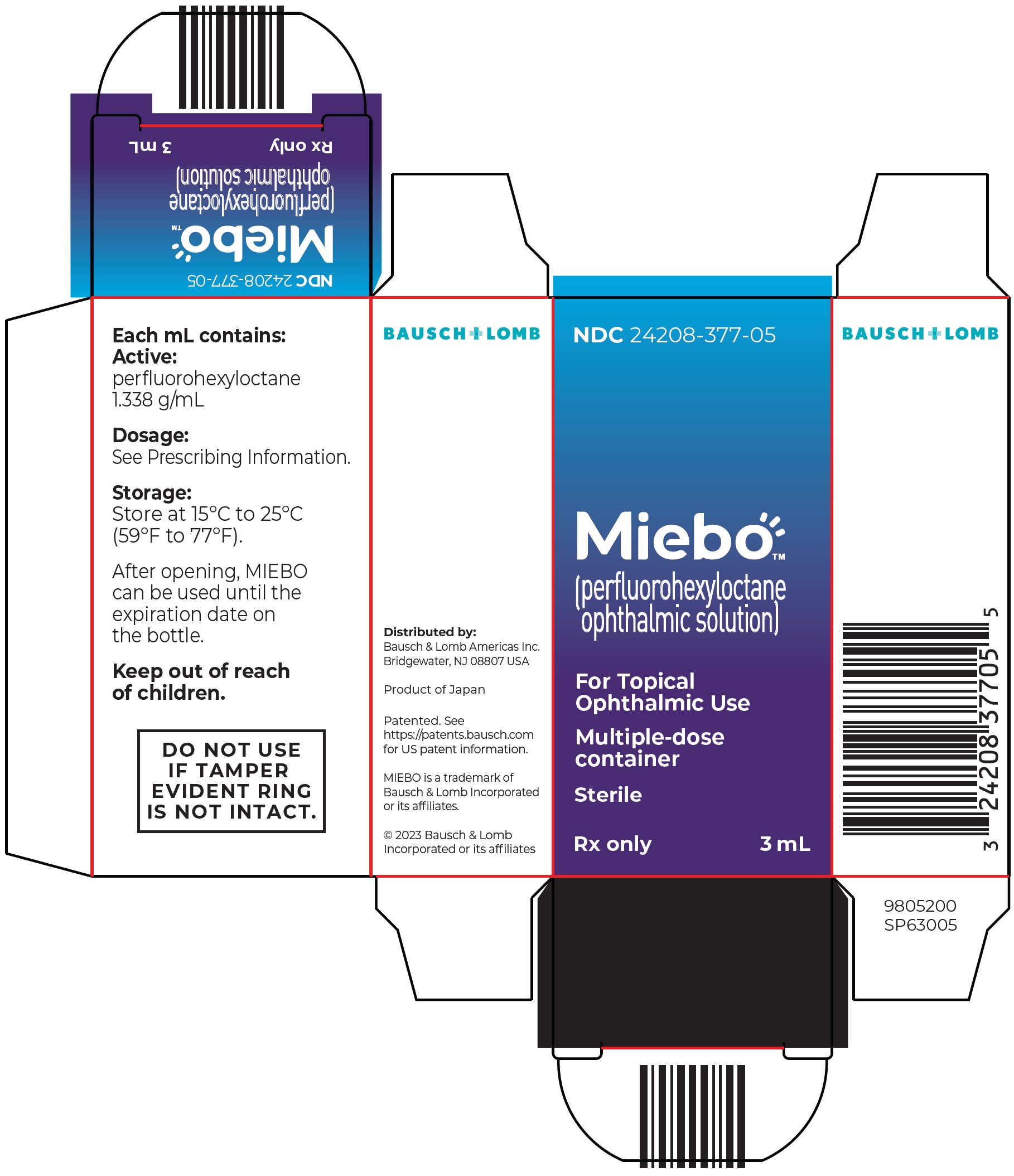
MIEBO Perfluorohexyloctane 1 mg/mg Solution — NDC 24208-377-05 (Billing 24208-0377-05)
This is a package of MIEBO Perfluorohexyloctane 1 mg/mg Solution from Bausch & Lomb Incorporated, marketed since May 2023 and currently FDA-listed; retail pharmacies pay about $263.57 per mL (NADAC). It is the main listing for this product, which comes in 3 package sizes.
NDC database record
One package, one record: these facts belong to NDC 24208-377-05 alone.
- Record
- FDA NDC Directory package listing · Human prescription drug
- Code segments
- 24208 labeler · 377 product · 05 package
- Package marketed since
- May 18, 2023
- Sample package
- No — commercial package
- Listing certified through
- Dec 31, 2027
- Barcode (UPC)
- 0324208377055
- Medicaid fills, this package
- 49,792 prescriptions in the last four reported quarters
- FDA record last changed
- Jul 24, 2026
Identity & classification
Regulatory identifiers FDA, NLM and CMS codes for this package
Drug-database identifiers Medi-Span GPI and First Databank GCN / HICL / AHFS classification
- GSN (GCN sequence number): 079188
- GCN: 45636
- GPI-14 (Medi-Span): 86807018002020
- HICL (First Databank): 045391
- AHFS class code: 52:08.00.00
- RxCUI (RxNorm): 2637551
Where does this data come from?
- FDA openFDA NDC Directory · synced Oct 8, 2026
- FDA label on DailyMed · label index refreshed Oct 8, 2026
- RxNorm (NLM RxNav) · catalog refreshed Oct 8, 2026
- Medi-Span GPI (licensed)
- First Databank (licensed) · refreshed Oct 8, 2026
RxNorm drug class
This medicine belongs to the Semifluorinated Alkane class.
Where does this data come from?
- RxClass (NLM) · catalog refreshed Oct 8, 2026
Clinical
Patient education
Supplement & herbal interactions
Some supplements/herbs that may interact with Perfluorohexyloctane — tap one for details:
Where does this data come from?
- MedlinePlus (NLM) · refreshed Oct 8, 2026
- FDA label on DailyMed · label index refreshed Oct 8, 2026
Ask a licensed pharmacist directly — free, answered by our team.
Pricing
A drug doesn't have one price. Each row is a different public payment system, and none is what you'd pay at the counter — that depends on your insurance. The ⓘ on each row explains what it measures.
| Price system | Per mL | Per package |
|---|---|---|
| Retail pharmacies payNADAC · weekly | $263.567 | — |
| Medicaid paysCMS SDUD · 12 mo | $261.08 | — |
| Medicare drug plans payPart D · Q2 2026 | $264.29 | — |
Where does this data come from?
- CMS NADAC weekly file · file of Oct 7, 2026
- CMS ASP pricing files · refreshed Sep 20, 2026
- CMS Medicaid State Drug Utilization Data · through Q1 2026
- CMS Part D plan pricing files · refreshed Sep 24, 2026
- VA National Acquisition Center price file
Packaging — all sizes for this product
| Package NDC | Description | Per unit | Per pack | Marketing start | Marketing end | Status |
|---|---|---|---|---|---|---|
| 24208-0377-01 24208-377-01 | 1 BOTTLE in 1 CARTON / 3 mg in 1 BOTTLE Sample | — | — | 2023-05-18 | — | Active |
| 24208-0377-05 You're viewing this Main listing | 1 BOTTLE in 1 CARTON / 3 mg in 1 BOTTLE | $263.57 / mL | — | 2023-05-18 | — | Active |
| 24208-0377-06 24208-377-06 | 1 BOTTLE in 1 CARTON / 1.6 mg in 1 BOTTLE Sample | — | — | 2024-07-19 | — | Active |
In Medicaid, this is the most-dispensed pack of this product — about 100% of fills over the last four reported quarters. See all packs ↓
Pack size FAQ
What quantity is in this package?
What NDC number is used to bill for this package of MIEBO Perfluorohexyloctane 1 mg/mg Solution?
Prices are the latest CMS NADAC pharmacy acquisition cost per NDC; per-pack figures are per-unit × pack quantity, shown only when the pack is denominated in the same measure NADAC prices.
Therapeutic equivalents
| Product | Labeler | Pack | NADAC/unit | TE | Status | Price vs. this |
|---|---|---|---|---|---|---|
| Miebo 1 mg/mgthis 24208-0377-05 | Bausch | 1 bottle | $263.567 | — | Availability likely | — |
Where does this data come from?
- FDA openFDA NDC Directory · synced Oct 8, 2026
- FDA Orange Book · refreshed Oct 9, 2026
- CMS NADAC weekly file · file of Oct 7, 2026
Availability & generic status
We did not find an FDA-approved generic match for this exact strength, form and route. Patent/protection dates below may affect future generic timing.
Why the date isn’t exact: Generic timing can change because patents may be challenged, settled, licensed, added, removed, or worked around with a narrower label — and FDA approval does not always mean a pharmacy can get the generic today.
🛈 What do these terms mean?
- Patent
- Legal protection listed in the Orange Book that may delay generic approval or launch. Issued by the U.S. Patent & Trademark Office.
- Substance patent
- Covers the active drug molecule itself — the hardest to design around. A generic generally can’t launch until it expires.
- Formulation (product) patent
- Covers a specific formulation or dosage form. A generic can sometimes work around it with a different formulation.
- Method-of-use patent
- A patent covering one specific approved use of the drug — not necessarily the whole molecule. A generic can sometimes launch with a “skinny label” that carves out the protected use and keeps the others.
- Skinny label
- A generic label that omits a still-patented use when the FDA allows it — letting a generic reach the market for the unprotected uses.
- Exclusivity
- FDA-granted marketing protection, separate from patents — e.g. 5-yr new chemical entity, 7-yr orphan drug, or a +6-month pediatric extension.
- Paragraph IV
- A generic applicant’s formal challenge to a listed patent. It can potentially lead to earlier generic entry, but often involves litigation or a settlement.
- RLD / RS
- Reference Listed Drug — the brand product the FDA uses as the reference for generic applications. Reference Standard — the product the FDA expects generics to compare against in bioequivalence testing.
- TE / AB rating
- FDA therapeutic-equivalence rating. An AB rating generally means the FDA considers a generic therapeutically equivalent to — and substitutable for — the brand.
- LOE (loss of exclusivity)
- The latest patent or exclusivity currently listed — the loss-of-exclusivity / latest-listed-protection date shown on this page. Paragraph-IV challenges and settlements can move the real date earlier; FDA approval and a manufacturer’s decision to market can move it later.
Built from the FDA Orange Book. The bars above are scaled to each protection’s expiry; the red LOE marker is the last one to lapse.
| Patent | Type | Use code | Expires |
|---|---|---|---|
| US 10576154 ↗ | Method of use | U-1900 | Oct 1, 2035 |
| US 10507132 ↗ | Method of use | U-1900 | Jun 21, 2037 |
| US 10449164 ↗ | Method of use | U-1900 | Sep 12, 2033 |
| US 10369117 ↗ | Method of use | U-1900 | Sep 12, 2033 |
| US 10058615 ↗ | Method of use | U-1900 | Sep 12, 2033 |
| US 12005033 ↗ | Method of use | U-4586 | Sep 12, 2033 |
| US 10682315 ↗ | Method of use | U-4586 | Sep 29, 2036 |
| US RE50060 ↗ | Method of use | U-4586 | Jun 21, 2037 |
| US 11357738 ↗ | Drug product | — | Sep 29, 2036 |
| US 12128010 ↗ | Drug product | — | Sep 29, 2036 |
| Code | What it grants | Expires |
|---|---|---|
| NCE | New Chemical Entity (5-year) | May 18, 2028 |
Is there a generic version of MIEBO 100% EYE DROP?
The FDA approved a generic — why can’t I get it at my pharmacy yet?
Why do different websites show different generic release dates?
What does “FDA listed” mean?
What does a patent or protection date mean here?
What does “current Orange Book estimate” mean?
Can a generic come out before the last patent expires?
Can a generic come out after the listed dates?
What is the difference between patents and exclusivity?
Why are there multiple patent dates?
Where does this data come from?
- FDA Orange Book · refreshed Oct 9, 2026
Inactive Ingredients / Excipients
Inactive ingredients, also called excipients, are components of the drug product other than the active ingredient. They may include fillers, dyes, coatings, preservatives, flavors, or other formulation ingredients.
Where does this data come from?
IACT rows and label-wide narrative are kept separate; availability and product-level specificity depend on the submitted label.- FDA label on DailyMed · label index refreshed Oct 8, 2026
- FDA openFDA NDC Directory · synced Oct 8, 2026
Inactive ingredient FAQ
Are inactive ingredients the same for every manufacturer?
Why might an inactive ingredient be missing?
Can inactive ingredients matter?
Manufacturer & labeler
More NDCs from Bausch & Lomb Incorporated labeler code 24208
- Polymyxin B Sulfate and Trimethoprim 10000 [USP'U]/mL; 1 mg/mL Solution/ Drops NDC 24208-315-10
- Sulfacetamide Sodium and Prednisolone Sodium Phosphate 100 mg/mL; 2.3 mg/mL Solution/ Drops NDC 24208-317-05
- Desmopressin Acetate .1 mg/mL Solution NDC 24208-342-05
- Flunisolide .25 mg/mL Solution NDC 24208-344-25
- Alrex loteprednol etabonate 2 mg/mL Suspension/ Drops NDC 24208-353-01
- Zylet loteprednol etabonate and tobramycin 5 mg/mL; 3 mg/mL Suspension/ Drops NDC 24208-358-01
- Muro 128 sodium chloride 50 mg/g Ointment NDC 24208-385-01
- Ipratropium bromide 21 ug Spray, Metered NDC 24208-398-30
- Ipratropium Bromide 42 ug Spray, Metered NDC 24208-399-15
- Ofloxacin 3 mg/mL Solution NDC 24208-410-05
- Brimonidine Tartrate 2 mg/mL Solution/ Drops NDC 24208-411-05
- Retisert Fluocinolone Acetonide .59 mg Implant NDC 24208-416-01
Where does this data come from?
- FDA openFDA NDC Directory · synced Oct 8, 2026
- Drugs@FDA
Full prescribing information FDA SPL
🎯 Indications and Usage ▾
1 INDICATIONS AND USAGE MIEBO ® (perfluorohexyloctane ophthalmic solution) is indicated for the treatment of the signs and symptoms of dry eye disease (DED). MIEBO (perfluorohexyloctane ophthalmic solution) is a semifluorinated alkane indicated for treatment of the signs and symptoms of dry eye disease. ( 1 )
⏱️ Dosage and Administration ▾
2 DOSAGE AND ADMINISTRATION Instill one drop of MIEBO four times daily into each eye. ( 2.1 )
2.1Recommended Dosage Instill one drop of MIEBO four times daily into affected eye(s). Contact lenses should be removed prior to and for at least 30 minutes after the administration of MIEBO.
2.2Administration Instructions Step 1. Remove the cap from eye drop bottle. Step 2. Holding the bottle upright, gently squeeze the bottle. Step 3. While squeezing, turn the bottle upside down and release the pressure (drawing air into the bottle). Step 4. Keeping the bottle upside down, place the bottle above your eye and squeeze it again to release a drop into your eye. Repeat steps 1 - 4 for the second affected eye. Step 2. Step 3. Step 4.
💊 Dosage Forms and Strengths ▾
3 DOSAGE FORMS AND STRENGTHS MIEBO (perfluorohexyloctane ophthalmic solution) is a sterile, clear and colorless ophthalmic solution containing 100% perfluorohexyloctane. Ophthalmic solution: 100% perfluorohexyloctane. ( 3 )
⛔ Contraindications ▾
4 CONTRAINDICATIONS Hypersensitivity. ( 4.1 )
4.1Hypersensitivity MIEBO is contraindicated in patients with a history of hypersensitivity reaction to perfluorohexyloctane [see Adverse Reactions ( 6.1 )] .
⚠️ Warnings and Cautions ▾
5 WARNINGS AND PRECAUTIONS
5.1Use with Contact Lenses MIEBO should not be administered while wearing contact lenses. Advise patients that contact lenses should be removed prior to and for at least 30 minutes after administration of MIEBO.
🤒 Adverse Reactions ▾
6 ADVERSE REACTIONS Most common ocular adverse reaction was blurred vision. Blurred vision was reported in less than 4% of individuals. ( 6.1 ) To report SUSPECTED ADVERSE REACTIONS, contact Bausch & Lomb Incorporated at 1-800-553-5340 or FDA at 1-800-FDA-1088 or www.fda.gov/medwatch.
6.1Clinical Trials Experience Because clinical trials are conducted under widely varying conditions, adverse reaction rates observed in clinical trials of a drug cannot be directly compared to rates in the clinical trials of another drug and may not reflect the rates observed in practice. In patients with DED, 614 patients received at least one dose of MIEBO in two randomized controlled clinical trials across 68 sites in the United States. The most common ocular adverse reaction was blurred vision.
Blurred vision and conjunctival redness were reported in 1-3% of individuals. In four premarketing studies (three open-label [n=127], one randomized [n=24 treated with at least one dose of perfluorohexyloctane]) the most common adverse reaction was hypersensitivity.
👥 Use in Specific Populations ▾
8 USE IN SPECIFIC POPULATIONS
8.1Pregnancy Risk Summary There are no adequate and well controlled studies with MIEBO in pregnant women. In animal reproduction studies with oral administration of perfluorohexyloctane during the period of organogenesis, no adverse maternal or developmental effects were observed in rats at doses up to 162 times the recommended human ophthalmic dose (RHOD) ( see Data ). Maternal toxicity, miscarriages and reduced fetal weights were observed in rabbits at all doses tested, with the lowest dose as 41 times the RHOD.
All pregnancies have a risk of birth defect, loss, or other adverse outcomes. In the US general population, the estimated background risk of major birth defects is 2 to 4%, and of miscarriage is 15 to 20%, of clinically recognized pregnancies. Data Animal Data An embryofetal study was conducted in pregnant rabbits administered perfluorohexyloctane by oral gavage on gestation days 6 to 19, to target the period of organogenesis.
Perfluorohexyloctane produced maternal toxicity, characterized by reduced body weight gain and food consumption, and miscarriages at all doses tested, with the lowest dose as ≥ 250 mg/kg/day (41 times the RHOD based on body surface area). Reduced fetal weights were also observed at ≥ 250 mg/kg/day but no fetal mortality or malformations. A no observed adverse effect level (NOAEL) for maternal toxicity was not established in rabbits.
An embryofetal study was conducted in pregnant rats administered perfluorohexyloctane by oral gavage on gestation days 6 to 17, to target the period of organogenesis. There was no evidence of embryofetal toxicity or teratogenicity at doses up to 2,000 mg/kg/day (162 times the RHOD).
8.2Lactation There are no data on the presence of perfluorohexyloctane in human milk, the effects on the breastfed infant, or the effects on milk production. The lack of clinical data during lactation precludes a clear determination of the risk of MIEBO to an infant during lactation; however, the developmental and health benefits of breastfeeding should be considered along with the mother’s clinical need for MIEBO.
8.4Pediatric Use The safety and effectiveness of MIEBO in pediatric patients below the age of 18 years have not been established.
8.5Geriatric Use No overall differences in safety and effectiveness have been observed between elderly and younger patients.
🤰 Pregnancy ▾
8.1Pregnancy Risk Summary There are no adequate and well controlled studies with MIEBO in pregnant women. In animal reproduction studies with oral administration of perfluorohexyloctane during the period of organogenesis, no adverse maternal or developmental effects were observed in rats at doses up to 162 times the recommended human ophthalmic dose (RHOD) ( see Data ). Maternal toxicity, miscarriages and reduced fetal weights were observed in rabbits at all doses tested, with the lowest dose as 41 times the RHOD.
All pregnancies have a risk of birth defect, loss, or other adverse outcomes. In the US general population, the estimated background risk of major birth defects is 2 to 4%, and of miscarriage is 15 to 20%, of clinically recognized pregnancies. Data Animal Data An embryofetal study was conducted in pregnant rabbits administered perfluorohexyloctane by oral gavage on gestation days 6 to 19, to target the period of organogenesis.
Perfluorohexyloctane produced maternal toxicity, characterized by reduced body weight gain and food consumption, and miscarriages at all doses tested, with the lowest dose as ≥ 250 mg/kg/day (41 times the RHOD based on body surface area). Reduced fetal weights were also observed at ≥ 250 mg/kg/day but no fetal mortality or malformations. A no observed adverse effect level (NOAEL) for maternal toxicity was not established in rabbits.
An embryofetal study was conducted in pregnant rats administered perfluorohexyloctane by oral gavage on gestation days 6 to 17, to target the period of organogenesis. There was no evidence of embryofetal toxicity or teratogenicity at doses up to 2,000 mg/kg/day (162 times the RHOD).
🧒 Pediatric Use ▾
8.4Pediatric Use The safety and effectiveness of MIEBO in pediatric patients below the age of 18 years have not been established.
🧓 Geriatric Use ▾
8.5Geriatric Use No overall differences in safety and effectiveness have been observed between elderly and younger patients.
🧬 Clinical Pharmacology ▾
12 CLINICAL PHARMACOLOGY
12.1Mechanism of Action Perfluorohexyloctane, a semifluorinated alkane, contains 6 perfluorinated carbon atoms and 8 hydrogenated carbon atoms. Perfluorohexyloctane forms a monolayer at the air-liquid interface of the tear film which can be expected to reduce evaporation. The exact mechanism of action for MIEBO in DED is not known.
12.3Pharmacokinetics The pharmacokinetics of perfluorohexyloctane following topical ocular administration of MIEBO has not been quantitatively characterized in humans. A single pharmacokinetic (PK) study was conducted that showed low systemic perfluorohexyloctane blood levels after topical ocular administration. Perfluorohexyloctane was not metabolized by human liver microsomes in vitro.
🧬 Mechanism of Action ▾
12.1Mechanism of Action Perfluorohexyloctane, a semifluorinated alkane, contains 6 perfluorinated carbon atoms and 8 hydrogenated carbon atoms. Perfluorohexyloctane forms a monolayer at the air-liquid interface of the tear film which can be expected to reduce evaporation. The exact mechanism of action for MIEBO in DED is not known.
📦 How Supplied / Storage and Handling ▾
16 HOW SUPPLIED/STORAGE AND HANDLING MIEBO ® (perfluorohexyloctane ophthalmic solution) is supplied as a sterile, clear and colorless liquid in multiple-dose 5 mL polypropylene bottles with dropper tips and screw caps, packaged in a carton - NDC 24208-377-05. Storage Store MIEBO at 15ºC to 25ºC (59ºF to 77ºF). After opening, MIEBO can be used until the expiration date on the bottle.
📋 Description ▾
11 DESCRIPTION MIEBO ® (perfluorohexyloctane ophthalmic solution) is a sterile, clear and colorless liquid containing 100% perfluorohexyloctane, for topical ophthalmic use. The active ingredient is 1,1,1,2,2,3,3,4,4,5,5,6,6-tridecafluorotetradecane and is a semifluorinated alkane. It has a molecular formula of C 14 H 17 F 13 and a molecular weight of 432.26 g/mol.
The chemical structure is: Perfluorohexyloctane is practically immiscible with water. It is miscible with ethanol and most organic solvents. Each multiple-dose bottle contains 3 mL of perfluorohexyloctane, 1.338 g/mL as a clear and colorless liquid.
A structure of a chemical formula AI-generated content may be incorrect.
💬 Information for Patients ▾
17 PATIENT COUNSELING INFORMATION Use with Contact Lenses Advise patients that contact lenses should be removed prior to and for at least 30 minutes after administration of MIEBO. Administration Instructions Advise patients to instill one drop of MIEBO four times daily into each eye as depicted in the Administration Instructions [see Dosage and Administration ( 2.2 )] . Distributed by: Bausch & Lomb Americas Inc.
Bridgewater, NJ 08807 USA Patented. See https://patents.bausch.com for US patent information. MIEBO is a trademark of Bausch & Lomb Incorporated or its affiliates. © 2025 Bausch & Lomb Incorporated or its affiliates 9805301
🧬 Pharmacokinetics ▾
12.3Pharmacokinetics The pharmacokinetics of perfluorohexyloctane following topical ocular administration of MIEBO has not been quantitatively characterized in humans. A single pharmacokinetic (PK) study was conducted that showed low systemic perfluorohexyloctane blood levels after topical ocular administration. Perfluorohexyloctane was not metabolized by human liver microsomes in vitro.
🔬 Clinical Studies ▾
14 CLINICAL STUDIES In two randomized, multicenter, double-masked, saline-controlled trials (GOBI and MOJAVE), a total of 1,217 patients with a history of DED and clinical signs of meibomian gland dysfunction were randomized to MIEBO or saline 0.6% (1:1 ratio) to evaluate safety and efficacy after receiving MIEBO four times daily (QID) for 57 days.The mean age of the 614 patients who received MIEBO was 57 years (range, 19-87 years). The majority of patients were female (76%). Effects on Signs of Dry Eye Disease Total corneal fluorescein staining (tCFS) was recorded at each study visit using a standardized grading system of 0-3 for each of the five areas on the cornea (inferior, superior, central, nasal, and temporal), totaling a maximum tCFS score for each eye of 15.
The average baseline tCFS was approximately 6.7 in GOBI and 7.0 in MOJAVE. At Days 15 and 57, a statistically significant reduction in tCFS favoring MIEBO was observed in both studies (Figure 1). Effects on Symptoms of Dry Eye Disease Eye dryness score was rated by patients using a visual analogue scale (VAS) (0=no discomfort, 100=maximal discomfort) at each study visit.
The baseline VAS eye dryness average score was approximately 67 in GOBI and 65 in MOJAVE. At Days 15 and 57, a statistically significant reduction in VAS eye dryness score favoring MIEBO was observed in both studies (Figure 2). Table Description automatically generated Table Description automatically generated
🧪 Nonclinical Toxicology ▾
13 NONCLINICAL TOXICOLOGY
13.1Carcinogenesis, Mutagenesis, Impairment of Fertility Long-term studies in animals have not been conducted to evaluate the carcinogenic potential of perfluorohexyloctane. Perfluorohexyloctane was not mutagenic or clastogenic in a standard battery of genotoxicity tests, including a bacterial mutagenicity assay (Ames assay), an in vitro chromosome aberration assay using human peripheral lymphocytes, and an in vivo bone marrow micronucleus assay in rats.
📄 Carcinogenesis, Mutagenesis, Impairment of Fertility ▾
13.1Carcinogenesis, Mutagenesis, Impairment of Fertility Long-term studies in animals have not been conducted to evaluate the carcinogenic potential of perfluorohexyloctane. Perfluorohexyloctane was not mutagenic or clastogenic in a standard battery of genotoxicity tests, including a bacterial mutagenicity assay (Ames assay), an in vitro chromosome aberration assay using human peripheral lymphocytes, and an in vivo bone marrow micronucleus assay in rats.
📄 Recent Major Changes ▾
Contraindications, Hypersensitivity ( 4.1 ) 10/2025
📄 Package Label / Principal Display Panel ▾
PACKAGE/LABEL PRINCIPAL DISPLAY PANEL NDC 24208-377-05 Miebo® (perfluorohexyloctane ophthalmic solution) For Topical Ophthalmic Use Multiple-dose container Sterile Rx only 3 mL 9805201 SP63005 carton