
Lotemax SM loteprednol etabonate 3.8 mg/g Gel, 1 bottle — NDC 24208-507-01 (Billing 24208-0507-01)
This is a package of 1 bottle of Lotemax SM loteprednol etabonate 3.8 mg/g Gel from Bausch & Lomb Incorporated, marketed since Feb 2019 and currently FDA-listed.
NDC database record
One package, one record: these facts belong to NDC 24208-507-01 alone.
- Record
- FDA NDC Directory package listing · Human prescription drug
- Code segments
- 24208 labeler · 507 product · 01 package
- Package marketed since
- Feb 25, 2019
- Sample package
- Yes — professional sample, not for sale
- Listing certified through
- Dec 31, 2027
- Barcode (UPC-A, from the NDC)
- 3 2420850701 8
- FDA record last changed
- Jul 24, 2026
Identity & classification
Regulatory identifiers FDA, NLM and CMS codes for this package
Drug-database identifiers Medi-Span GPI and First Databank GCN / HICL / AHFS classification
- GSN (GCN sequence number): 079545
- GCN: 46053
- GPI-14 (Medi-Span): 86300035104015
- HICL (First Databank): 018026
- AHFS class code: 52:08.08.00
- RxCUI (RxNorm): 2118537
Where does this data come from?
- FDA openFDA NDC Directory · synced Oct 8, 2026
- FDA label on DailyMed · label index refreshed Oct 8, 2026
- RxNorm (NLM RxNav) · catalog refreshed Oct 1, 2026
- Medi-Span GPI (licensed)
- First Databank (licensed) · refreshed Oct 8, 2026
Clinical
Ophthalmic loteprednol products are used to treat different eye conditions: Loteprednol (Inveltys, Lotemax, Lotemax SM) is used to treat swelling and pain after cataract surgery (procedure to treat clouding of the lens in the eye). Loteprednol (Alrex) is used to reduce eye redness, itching, and swelling caused by seasonal allergies. Loteprednol (Lotemax) is used to reduce eye swelling caused by allergies, certain eye infections, ocular rosacea (condition that can cause swelling, redness, and itching of the eye), herpes zoster (shingles; a rash that can occur in people who have had chickenp...
Read the full MedlinePlus article ↗- It is a steroid eye medicine. Depending on the product, it treats inflammation and pain after eye surgery, steroid-responsive eye inflammation, seasonal allergic conjunctivitis (Al...
- Wash your hands first and follow the directions for your product. Suspensions need to be shaken, and gels need the closed bottle inverted and shaken once. If you use other eye drop...
- Eye pain and clouding behind the lens were the most common in trials after surgery, and surgery may have caused them. Steroid eye medicines can also raise eye pressure or cause cat...
- Call if your vision changes, your eye pain or redness gets worse, or you see discharge. Also call if symptoms do not improve after two days when using the suspension for inflammati...
Patient education
Supplement & herbal interactions
Where does this data come from?
- MedlinePlus (NLM) · refreshed Oct 8, 2026
- FDA label on DailyMed · label index refreshed Oct 8, 2026
Ask a licensed pharmacist directly — free, answered by our team.
Pricing
A drug doesn't have one price. Each row is a different public payment system, and none is what you'd pay at the counter — that depends on your insurance. The ⓘ on each row explains what it measures.
| Price system | Per g | Per package |
|---|---|---|
| Retail pharmacies payNADAC · weekly | Not in the retail survey — common for institutional, discontinued, or low-volume packs. | |
| Medicaid paysCMS SDUD · 12 mo | No recent Medicaid claims on file for this NDC — rare and low-volume NDCs are suppressed in the public data. | |
| Medicare drug plans payPart D · Q2 2026 | $50.33 | $25.17 / 0.5 g |
Where does this data come from?
- CMS NADAC weekly file
- CMS ASP pricing files · refreshed Sep 20, 2026
- CMS Medicaid State Drug Utilization Data · refreshed Oct 8, 2026
- CMS Part D plan pricing files · refreshed Sep 24, 2026
- VA National Acquisition Center price file
Packaging — all sizes for this product
| Package NDC | Description | Per unit | Per pack | Marketing start | Marketing end | Status |
|---|---|---|---|---|---|---|
| 24208-0507-01 You're viewing this | 1 BOTTLE in 1 CARTON / .5 g in 1 BOTTLE Sample | — | — | 2019-02-25 | — | Active |
| 24208-0507-02 24208-507-02 | 1 BOTTLE in 1 CARTON / 5 g in 1 BOTTLE | — | — | 2019-02-25 | — | Discontinued by firm |
| 24208-0507-07 24208-507-07 Main listing | 1 BOTTLE in 1 CARTON / 5 g in 1 BOTTLE | $49.48 / g | $247.42 | 2019-02-25 | — | Active |
This pack shows little to no recent Medicaid volume — a different pack size carries most fills. See all packs ↓
Pack size FAQ
What quantity is in this package?
What NDC number is used to bill for this package of Lotemax SM loteprednol etabonate 3.8 mg/g Gel?
Prices are the latest CMS NADAC pharmacy acquisition cost per NDC; per-pack figures are per-unit × pack quantity, shown only when the pack is denominated in the same measure NADAC prices.
Therapeutic equivalents
| Product | Labeler | Pack | NADAC/unit | TE | Status | Price vs. this |
|---|---|---|---|---|---|---|
| Lotemax SM 3.8 mg/gthis 24208-0507-01 | Bausch | 1 bottle | — | AB | FDA listed | — |
Where does this data come from?
- FDA openFDA NDC Directory · synced Oct 8, 2026
- FDA Orange Book · refreshed Oct 3, 2026
- CMS NADAC weekly file
Availability & generic status
FDA-approved generic versions are listed, and recent pricing/market data suggests they may be available — see Therapeutic equivalents.
Why the date isn’t exact: Generic timing can change because patents may be challenged, settled, licensed, added, removed, or worked around with a narrower label — and FDA approval does not always mean a pharmacy can get the generic today.
🛈 What do these terms mean?
- Patent
- Legal protection listed in the Orange Book that may delay generic approval or launch. Issued by the U.S. Patent & Trademark Office.
- Substance patent
- Covers the active drug molecule itself — the hardest to design around. A generic generally can’t launch until it expires.
- Formulation (product) patent
- Covers a specific formulation or dosage form. A generic can sometimes work around it with a different formulation.
- Method-of-use patent
- A patent covering one specific approved use of the drug — not necessarily the whole molecule. A generic can sometimes launch with a “skinny label” that carves out the protected use and keeps the others.
- Skinny label
- A generic label that omits a still-patented use when the FDA allows it — letting a generic reach the market for the unprotected uses.
- Exclusivity
- FDA-granted marketing protection, separate from patents — e.g. 5-yr new chemical entity, 7-yr orphan drug, or a +6-month pediatric extension.
- Paragraph IV
- A generic applicant’s formal challenge to a listed patent. It can potentially lead to earlier generic entry, but often involves litigation or a settlement.
- RLD / RS
- Reference Listed Drug — the brand product the FDA uses as the reference for generic applications. Reference Standard — the product the FDA expects generics to compare against in bioequivalence testing.
- TE / AB rating
- FDA therapeutic-equivalence rating. An AB rating generally means the FDA considers a generic therapeutically equivalent to — and substitutable for — the brand.
- LOE (loss of exclusivity)
- The latest patent or exclusivity currently listed — the loss-of-exclusivity / latest-listed-protection date shown on this page. Paragraph-IV challenges and settlements can move the real date earlier; FDA approval and a manufacturer’s decision to market can move it later.
Built from the FDA Orange Book. The bars above are scaled to each protection’s expiry; the red LOE marker is the last one to lapse.
| Patent | Type | Use code | Expires |
|---|---|---|---|
| US 11534395 ↗ | Method of use | U-2764 | Jan 26, 2036 |
| US 10596107 ↗ | Method of use | U-2764 | Dec 23, 2036 |
| US 12589069 ↗ | Method of use | U-2764 | Jan 26, 2036 |
Is there a generic version of LOTEMAX SM 0.38% OPHTH GEL?
The FDA approved a generic — why can’t I get it at my pharmacy yet?
Why do different websites show different generic release dates?
What does “FDA listed” mean?
What does a patent or protection date mean here?
What does “current Orange Book estimate” mean?
Can a generic come out before the last patent expires?
Can a generic come out after the listed dates?
What is the difference between patents and exclusivity?
Why are there multiple patent dates?
Where does this data come from?
- FDA Orange Book · refreshed Oct 3, 2026
Inactive Ingredients / Excipients
Inactive ingredients, also called excipients, are components of the drug product other than the active ingredient. They may include fillers, dyes, coatings, preservatives, flavors, or other formulation ingredients.
🧪 Avoiding an ingredient? See Loteprednol Etabonate inactive ingredients by manufacturer: every current product's list side by side, so you can ask your pharmacy for the version that does not list it.
💡 Tap an ingredient (hover on desktop) to see what it is and why it’s used.
-
UNII F5UM2KM3W7
Benzalkonium chloride is a chemical compound that works as a preservative and antimicrobial agent in medications. It prevents bacterial and fungal growth in liquid formulations to keep the product safe during storage and use.
-
UNII R57ZHV85D4
Boric acid is a weak acid derived from boron. In medicines, it typically serves as a buffer to help maintain the product's pH level and may act as a preservative in certain formulations.
-
UNII 7FLD91C86K
Edetate disodium is a chemical compound that binds and removes certain metal ions. In medicines, it acts as a preservative and stabilizer by preventing metals like calcium from interfering with the product's shelf life and consistency.
-
UNII PDC6A3C0OX
Glycerin is a clear, thick liquid derived from plant oils or fats. It acts as a humectant to retain moisture, a sweetener, and a solvent in medications.
-
UNII 3NXW29V3WO
Hypromellose is a plant-based thickener made from cellulose. It's used in medicines as a binder to hold ingredients together, a coating for tablets, and a thickener for liquids.
-
UNII TUF2IVW3M2
Poloxamer 407 is a synthetic polymer made from ethylene oxide and propylene oxide. In medicines, it acts as a thickener, emulsifier, and solubilizer to help mix ingredients and create the right texture.
-
UNII W25LM17A4W
Polycarbophil is a synthetic polymer that absorbs water and swells. It's used as a binder to hold tablet ingredients together and as a disintegrant to help the tablet break apart in the digestive system.
-
UNII 6DC9Q167V3
Propylene glycol is a clear liquid derived from petroleum or vegetable sources. It acts as a solvent, humectant, and preservative in medicines, helping dissolve active ingredients and maintain product stability.
-
UNII 451W47IQ8X
Sodium chloride is common table salt. It's used in medicines as a buffer to maintain proper pH, as a filler to add bulk, or to adjust the osmotic balance in liquid formulations.
-
UNII 55X04QC32I
A strong alkaline chemical used to adjust and maintain the pH balance of liquid medicines. It helps keep the medicine stable and ensures it stays effective during storage.
-
UNII 059QF0KO0R
Water is a liquid solvent that dissolves and mixes ingredients together in liquid medicines, syrups, and injections. It helps distribute the active drug evenly throughout the product.
11 inactive ingredients listed in the exact product block matched to this NDC.
Where does this data come from?
ingredient classCode="IACT" elements from the exact product block matched by this NDC. Label-section narrative from DailyMed / the openFDA label index is shown separately when available.- FDA label on DailyMed · label index refreshed Oct 8, 2026
- FDA openFDA NDC Directory · synced Oct 8, 2026
Inactive ingredient FAQ
Are inactive ingredients the same for every manufacturer?
Why might an inactive ingredient be missing?
Can inactive ingredients matter?
Manufacturer & labeler
More NDCs from Bausch & Lomb Incorporated labeler code 24208
- Soothe glycerin and propylene glycol 6 mg/mL; 6 mg/mL Solution/ Drops NDC 24208-495-28
- Timoptic in Ocudose Timolol Maleate 3.4 mg/mL Solution NDC 24208-498-34
- Timoptic in Ocudose Timolol Maleate 6.8 mg/mL Solution NDC 24208-499-00
- LOTEMAX loteprednol etabonate 5 mg/g Gel NDC 24208-503-07
- Vyzulta latanoprostene bunod .24 mg/mL Solution/ Drops NDC 24208-504-01
- Levobunolol Hydrochloride 5 mg/mL Solution/ Drops NDC 24208-505-05
- Loteprednol Etabonate 5 mg/g Gel NDC 24208-508-01
- ZIRGAN ganciclovir 1.5 mg/g Gel NDC 24208-535-15
- LUMIFY Redness Reliever Eye Drops BRIMONIDINE TARTRATE .25 mg/mL Solution/ Drops NDC 24208-537-01
- LUMIFY PRESERVATIVE FREE EYE DROPS brimonidine tartrate .25 mg/mL Solution/ Drops NDC 24208-538-05
- Miochol E acetylcholine chloride Kit NDC 24208-539-20
- Bacitracin Zinc and Polymyxin B Sulfate 500 [USP'U]/g; 10000 [USP'U]/g Ointment NDC 24208-555-55
Where does this data come from?
- FDA openFDA NDC Directory · synced Oct 8, 2026
- Drugs@FDA
Full prescribing information FDA SPL
🎯 Indications and Usage ▾
1 INDICATIONS AND USAGE LOTEMAX ® SM (loteprednol etabonate ophthalmic gel) 0.38% is a corticosteroid indicated for the treatment of post-operative inflammation and pain following ocular surgery. LOTEMAX ® SM is a corticosteroid indicated for the treatment of post-operative inflammation and pain following ocular surgery. ( 1 )
⏱️ Dosage and Administration ▾
2 DOSAGE AND ADMINISTRATION Invert closed bottle and shake once to fill tip before instilling drops. Apply one drop of LOTEMAX ® SM into the conjunctival sac of the affected eye three times daily beginning the day after surgery and continuing throughout the first 2 weeks of the post-operative period. Invert closed bottle and shake once to fill tip before instilling drops.
( 2 ) Apply one drop of LOTEMAX ® SM into the conjunctival sac of the affected eye three times daily beginning the day after surgery and continuing throughout the first 2 weeks of the post-operative period. ( 2 )
💊 Dosage Forms and Strengths ▾
3 DOSAGE FORMS AND STRENGTHS LOTEMAX ® SM (loteprednol etabonate ophthalmic gel) 0.38% is a sterile preserved ophthalmic gel containing 3.8 mg of loteprednol etabonate per gram of gel. LOTEMAX ® SM is a sterile preserved ophthalmic gel containing 3.8 mg of loteprednol etabonate per gram of gel. ( 3 )
⛔ Contraindications ▾
4 CONTRAINDICATIONS LOTEMAX ® SM, as with other ophthalmic corticosteroids, is contraindicated in most viral diseases of the cornea and conjunctiva including epithelial herpes simplex keratitis (dendritic keratitis), vaccinia, and varicella, in mycobacterial infection of the eye and fungal diseases of ocular structures. LOTEMAX ® SM, as with other ophthalmic corticosteroids, is contraindicated in most viral diseases of the cornea and conjunctiva including epithelial herpes simplex keratitis (dendritic keratitis), vaccinia, and varicella, and also in mycobacterial infection of the eye and fungal diseases of ocular structures.
( 4 )
⚠️ Warnings and Cautions ▾
5 WARNINGS AND PRECAUTIONS Intraocular pressure (IOP) increase - Prolonged use of corticosteroids may result in glaucoma with damage to the optic nerve, defects in visual acuity and fields of vision. If this product is used for 10 days or longer, IOP should be monitored. () Cataracts - Use of corticosteroids may result in posterior subcapsular cataract formation.
( 5.2 ) Delayed healing – The use of steroids after cataract surgery may delay healing and increase the incidence of bleb formation. In those diseases causing thinning of the cornea or sclera, perforations have been known to occur with the use of topical steroids. The initial prescription and renewal of the medication order should be made by a physician only after examination of the patient with the aid of magnification such as slit lamp biomicroscopy and, where appropriate, fluorescein staining.
( 5.3 ) Bacterial infections – Prolonged use of corticosteroids may suppress the host response and thus increase the hazard of secondary ocular infections. In acute purulent conditions, steroids may mask infection or enhance existing infection. ( 5.4 ) Viral infections – Employment of a corticosteroid medication in the treatment of patients with a history of herpes simplex requires great caution.
Use of ocular steroids may prolong the course and may exacerbate the severity of many viral infections of the eye (including herpes simplex). ( 5.5 ) Fungal infections – Fungal infections of the cornea are particularly prone to develop coincidentally with long-term local steroid application. Fungus invasion must be considered in any persistent corneal ulceration where a steroid has been used or is in use.
( 5.6 )
5.1Intraocular Pressure (IOP) Increase Prolonged use of corticosteroids may result in glaucoma with damage to the optic nerve, defects in visual acuity and fields of vision. Steroids should be used with caution in the presence of glaucoma. If this product is used for 10 days or longer, intraocular pressure should be monitored.
5.2Cataracts Use of corticosteroids may result in posterior subcapsular cataract formation.
5.3Delayed Healing The use of steroids after cataract surgery may delay healing and increase the incidence of bleb formation. In those diseases causing thinning of the cornea or sclera, perforations have been known to occur with the use of topical steroids. The initial prescription and renewal of the medication order should be made by a physician only after examination of the patient with the aid of magnification such as slit lamp biomicroscopy and, where appropriate, fluorescein staining.
5.4Bacterial Infections Prolonged use of corticosteroids may suppress the host response and thus increase the hazard of secondary ocular infections. In acute purulent conditions of the eye, steroids may mask infection or enhance existing infection.
5.5Viral Infections Employment of a corticosteroid medication in the treatment of patients with a history of herpes simplex requires great caution. Use of ocular steroids may prolong the course and may exacerbate the severity of many viral infections of the eye (including herpes simplex).
5.6Fungal Infections Fungal infections of the cornea are particularly prone to develop coincidentally with long-term local steroid application. Fungus invasion must be considered in any persistent corneal ulceration where a steroid has been used or is in use. Fungal cultures should be taken when appropriate.
5.7Contact Lens Wear Contact lenses should not be worn when the eyes are inflamed.
🤒 Adverse Reactions ▾
6 ADVERSE REACTIONS Because clinical trials are conducted under widely varying conditions, adverse reaction rates observed in the clinical trials of a drug cannot be directly compared to rates in the clinical trials of another drug and may not reflect the rates observed in practice. Adverse reactions associated with ophthalmic steroids include elevated intraocular pressure, which may be associated with infrequent optic nerve damage, visual acuity and field defects, posterior subcapsular cataract formation, delayed wound healing and secondary ocular infection from pathogens including herpes simplex, and perforation of the globe where there is thinning of the cornea or sclera.
There were no treatment-emergent adverse drug reactions that occurred in more than 1% of subjects in the three times daily group compared to vehicle. There were no treatment-emergent adverse drug reactions that occurred in more than 1% of subjects in the three times daily group compared to vehicle. ( 6 ) To report SUSPECTED ADVERSE REACTIONS, contact Bausch & Lomb Incorporated at 1-800-553-5340 or FDA at 1-800-FDA-1088 or www.fda.gov/medwatch.
👥 Use in Specific Populations ▾
8 USE IN SPECIFIC POPULATIONS
8.1Pregnancy Risk Summary There are no adequate and well controlled studies with loteprednol etabonate in pregnant women. Loteprednol etabonate produced teratogenicity at clinically relevant doses in the rabbit and rat when administered orally during pregnancy. Loteprednol etabonate produced malformations when administered orally to pregnant rabbits at doses 4.2 times the recommended human ophthalmic dose (RHOD) and to pregnant rats at doses 106 times the RHOD.
In pregnant rats receiving oral doses of loteprednol etabonate during the period equivalent to the last trimester of pregnancy through lactation in humans, survival of offspring was reduced at doses 10.6 times the RHOD. Maternal toxicity was observed in rats at doses 1066 times the RHOD, and a maternal no observed adverse effect level (NOAEL) was established at 106 times the RHOD. The background risk of major birth defects and miscarriage for the indicated population is unknown.
However, the background risk in the U.S. general population of major birth defects is 2 to 4%, and of miscarriage is 15 to 20%, of clinically recognized pregnancies. Data Animal Data Embryofetal studies were conducted in pregnant rabbits administered loteprednol etabonate by oral gavage on gestation days 6 to 18, to target the period of organogenesis. Loteprednol etabonate produced fetal malformations at 0.1 mg/kg (4.2 times the recommended human ophthalmic dose (RHOD) based on body surface area, assuming 100% absorption).
Spina bifida (including meningocele) was observed at 0.1 mg/kg, and exencephaly and craniofacial malformations were observed at 0.4 mg/kg (17 times the RHOD). At 3 mg/kg (128 times the RHOD), loteprednol etabonate was associated with increased incidences of abnormal left common carotid artery, limb flexures, umbilical hernia, scoliosis, and delayed ossification. Abortion and embryofetal lethality (resorption) occurred at 6 mg/kg (256 times the RHOD).
A NOAEL for developmental toxicity was not established in this study. The NOAEL for maternal toxicity in rabbits was 3 mg/kg/day. Embryofetal studies were conducted in pregnant rats administered loteprednol etabonate by oral gavage on gestation days 6 to 15, to target the period of organogenesis.
Loteprednol etabonate produced fetal malformations, including absent innominate artery at 5 mg/kg (106 times the RHOD); and cleft palate, agnathia, cardiovascular defects, umbilical hernia, decreased fetal body weight and decreased skeletal ossification at 50 mg/kg (1066 times the RHOD). Embryofetal lethality (resorption) was observed at 100 mg/kg (2133 times the RHOD). The NOAEL for developmental toxicity in rats was 0.5 mg/kg (10.6 times the RHOD).
Loteprednol etabonate was maternally toxic (reduced body weight gain) at 50 mg/kg/day. The NOAEL for maternal toxicity was 5 mg/kg. A peri-/postnatal study was conducted in rats administered loteprednol etabonate by oral gavage from gestation day 15 (start of fetal period) to postnatal day 21 (the end of lactation period).
At 0.5 mg/kg (10.6 times the clinical dose), reduced survival was observed in live-born offspring. Doses ≥ 5 mg/kg (106 times the RHOD) caused umbilical hernia/incomplete gastrointestinal tract. Doses ≥ 50 mg/kg (1066 times the RHOD) produced maternal toxicity (reduced body weight gain, death), decreased number of live-born offspring, decreased birth weight, and delays in postnatal development.
A developmental NOAEL was not established in this study. The NOAEL for maternal toxicity was 5 mg/kg.
8.2Lactation There are no data on the presence of loteprednol etabonate in human milk, the effects on the breastfed infant, or the effects on milk production. The developmental and health benefits of breastfeeding should be considered, along with the mother’s clinical need for LOTEMAX ® SM and any potential adverse effects on the breastfed infant from LOTEMAX ® SM.
8.4Pediatric Use Safety and effectiveness of LOTEMAX ® SM in pediatric patients have no… [Excerpted — this section continues on DailyMed.]
🤰 Pregnancy ▾
8.1Pregnancy Risk Summary There are no adequate and well controlled studies with loteprednol etabonate in pregnant women. Loteprednol etabonate produced teratogenicity at clinically relevant doses in the rabbit and rat when administered orally during pregnancy. Loteprednol etabonate produced malformations when administered orally to pregnant rabbits at doses 4.2 times the recommended human ophthalmic dose (RHOD) and to pregnant rats at doses 106 times the RHOD.
In pregnant rats receiving oral doses of loteprednol etabonate during the period equivalent to the last trimester of pregnancy through lactation in humans, survival of offspring was reduced at doses 10.6 times the RHOD. Maternal toxicity was observed in rats at doses 1066 times the RHOD, and a maternal no observed adverse effect level (NOAEL) was established at 106 times the RHOD. The background risk of major birth defects and miscarriage for the indicated population is unknown.
However, the background risk in the U.S. general population of major birth defects is 2 to 4%, and of miscarriage is 15 to 20%, of clinically recognized pregnancies. Data Animal Data Embryofetal studies were conducted in pregnant rabbits administered loteprednol etabonate by oral gavage on gestation days 6 to 18, to target the period of organogenesis. Loteprednol etabonate produced fetal malformations at 0.1 mg/kg (4.2 times the recommended human ophthalmic dose (RHOD) based on body surface area, assuming 100% absorption).
Spina bifida (including meningocele) was observed at 0.1 mg/kg, and exencephaly and craniofacial malformations were observed at 0.4 mg/kg (17 times the RHOD). At 3 mg/kg (128 times the RHOD), loteprednol etabonate was associated with increased incidences of abnormal left common carotid artery, limb flexures, umbilical hernia, scoliosis, and delayed ossification. Abortion and embryofetal lethality (resorption) occurred at 6 mg/kg (256 times the RHOD).
A NOAEL for developmental toxicity was not established in this study. The NOAEL for maternal toxicity in rabbits was 3 mg/kg/day. Embryofetal studies were conducted in pregnant rats administered loteprednol etabonate by oral gavage on gestation days 6 to 15, to target the period of organogenesis.
Loteprednol etabonate produced fetal malformations, including absent innominate artery at 5 mg/kg (106 times the RHOD); and cleft palate, agnathia, cardiovascular defects, umbilical hernia, decreased fetal body weight and decreased skeletal ossification at 50 mg/kg (1066 times the RHOD). Embryofetal lethality (resorption) was observed at 100 mg/kg (2133 times the RHOD). The NOAEL for developmental toxicity in rats was 0.5 mg/kg (10.6 times the RHOD).
Loteprednol etabonate was maternally toxic (reduced body weight gain) at 50 mg/kg/day. The NOAEL for maternal toxicity was 5 mg/kg. A peri-/postnatal study was conducted in rats administered loteprednol etabonate by oral gavage from gestation day 15 (start of fetal period) to postnatal day 21 (the end of lactation period).
At 0.5 mg/kg (10.6 times the clinical dose), reduced survival was observed in live-born offspring. Doses ≥ 5 mg/kg (106 times the RHOD) caused umbilical hernia/incomplete gastrointestinal tract. Doses ≥ 50 mg/kg (1066 times the RHOD) produced maternal toxicity (reduced body weight gain, death), decreased number of live-born offspring, decreased birth weight, and delays in postnatal development.
A developmental NOAEL was not established in this study. The NOAEL for maternal toxicity was 5 mg/kg.
🧒 Pediatric Use ▾
8.4Pediatric Use Safety and effectiveness of LOTEMAX ® SM in pediatric patients have not been established.
🧓 Geriatric Use ▾
8.5Geriatric Use No overall differences in safety and effectiveness have been observed between elderly and younger patients.
🧬 Clinical Pharmacology ▾
12 CLINICAL PHARMACOLOGY
12.1Mechanism of Action Loteprednol etabonate is a corticosteroid. Corticosteroids have been shown to inhibit the inflammatory response to a variety of inciting agents. They inhibit the edema, fibrin deposition, capillary dilation, leukocyte migration, capillary proliferation, fibroblast proliferation, deposition of collagen, and scar formation associated with inflammation.
While glucocorticoids are known to bind to and activate the glucocorticoid receptor, the molecular mechanisms involved in glucocorticoid/glucocorticoid receptor-dependent modulation of inflammation are not clearly established. However, corticosteroids are thought to inhibit prostaglandin production through several independent mechanisms.
12.3Pharmacokinetics The pharmacokinetic exposure to loteprednol etabonate following topical bilateral ocular administration of one drop three times daily of LOTEMAX ® SM for up to two weeks (Day 15) was evaluated in 18 healthy adult subjects. Plasma concentrations of loteprednol etabonate were analyzed using a validated LC/MS/MS method and the lower limit of quantitation for loteprednol etabonate was 0.05 ng/mL. The mean (± SD) C max values for loteprednol etabonate in plasma were 0.13 (± 0.06) ng/mL on Day 1 after a single dose and 0.16 (± 0.06) ng/mL after the last dose on Day 15 of the study.
The mean (± SD) AUC t values for loteprednol etabonate in plasma were 0.15 (± 0.15) hr•ng/mL on Day 1 after a single dose and 0.35 (± 0.32) hr•ng/mL after the last dose on Day 15.
🧬 Mechanism of Action ▾
12.1Mechanism of Action Loteprednol etabonate is a corticosteroid. Corticosteroids have been shown to inhibit the inflammatory response to a variety of inciting agents. They inhibit the edema, fibrin deposition, capillary dilation, leukocyte migration, capillary proliferation, fibroblast proliferation, deposition of collagen, and scar formation associated with inflammation.
While glucocorticoids are known to bind to and activate the glucocorticoid receptor, the molecular mechanisms involved in glucocorticoid/glucocorticoid receptor-dependent modulation of inflammation are not clearly established. However, corticosteroids are thought to inhibit prostaglandin production through several independent mechanisms.
📦 How Supplied / Storage and Handling ▾
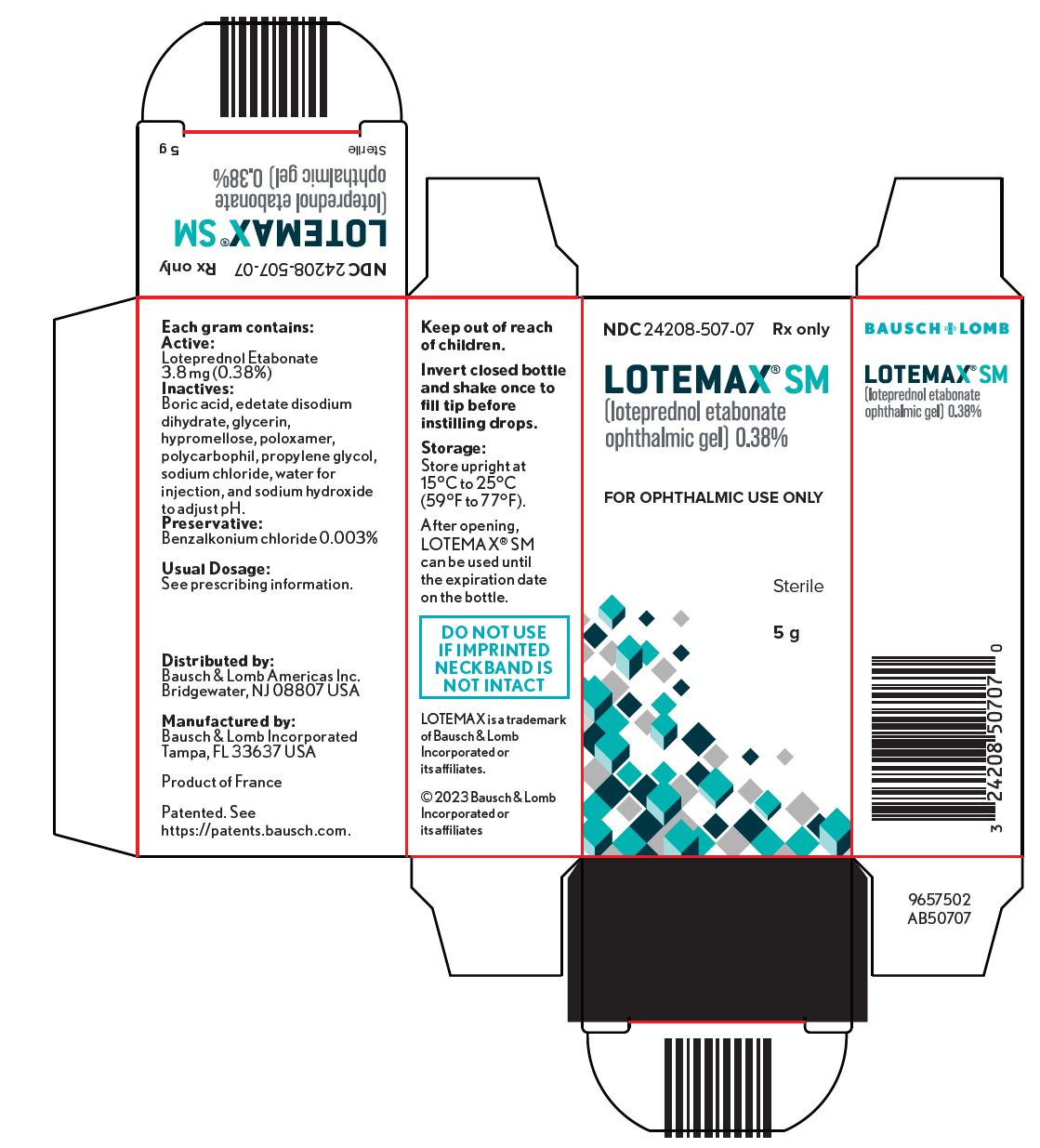
16 HOW SUPPLIED/STORAGE AND HANDLING LOTEMAX ® SM (loteprednol etabonate ophthalmic gel) 0.38% is a sterile ophthalmic submicron gel supplied in a white low-density polyethylene plastic bottle with a white controlled drop tip and a pink polypropylene cap in the following size: NDC 24208-507-07 5g in a 10 mL bottle Use only if imprinted neckband is intact. Storage: Store upright at 15ºC to 25ºC (59ºF to 77ºF). After opening, LOTEMAX ® SM can be used until the expiration date on the bottle.
📋 Description ▾
11 DESCRIPTION LOTEMAX ® SM (loteprednol etabonate ophthalmic gel) 0.38% contains a sterile, topical corticosteroid for ophthalmic use. Loteprednol etabonate is a white to off-white powder. Loteprednol etabonate is represented by the following structural formula: Chemical Name: chloromethyl 17α-[(ethoxycarbonyl)oxy]-11β-hydroxy-3-oxoandrosta-1,4-diene-17β-carboxylate Each gram contains: Active: loteprednol etabonate 3.8 mg (0.38%); Inactives: boric acid, edetate disodium dihydrate, glycerin, hypromellose, poloxamer, polycarbophil, propylene glycol, sodium chloride, water for injection, and sodium hydroxide to adjust to a pH of between 6 and 7.
Preservative: benzalkonium chloride 0.003% chemstructure
💬 Information for Patients ▾
17 PATIENT COUNSELING INFORMATION Administration Invert closed bottle and shake once to fill tip before instilling drops. Risk of Contamination Advise patients not to allow the dropper tip to touch any surface, as this may contaminate the gel. Contact Lens Wear Advise patients contact lenses should not be worn when the eyes are inflamed.
Risk of Secondary Infection Advise the patient to consult a physician if pain develops, redness, itching or inflammation becomes aggravated. Distributed by: Bausch & Lomb Americas Inc. Bridgewater, NJ 08807 USA Manufactured by: Bausch & Lomb Incorporated Tampa, FL 33637 USA Patented.
See https://patents.bausch.com. LOTEMAX is a trademark of Bausch & Lomb Incorporated or its affiliates. © 2023 Bausch & Lomb Incorporated or its affiliates 9669602 (Folded) 9669702 (Flat)
🧬 Pharmacokinetics ▾
12.3Pharmacokinetics The pharmacokinetic exposure to loteprednol etabonate following topical bilateral ocular administration of one drop three times daily of LOTEMAX ® SM for up to two weeks (Day 15) was evaluated in 18 healthy adult subjects. Plasma concentrations of loteprednol etabonate were analyzed using a validated LC/MS/MS method and the lower limit of quantitation for loteprednol etabonate was 0.05 ng/mL. The mean (± SD) C max values for loteprednol etabonate in plasma were 0.13 (± 0.06) ng/mL on Day 1 after a single dose and 0.16 (± 0.06) ng/mL after the last dose on Day 15 of the study.
The mean (± SD) AUC t values for loteprednol etabonate in plasma were 0.15 (± 0.15) hr•ng/mL on Day 1 after a single dose and 0.35 (± 0.32) hr•ng/mL after the last dose on Day 15.
🔬 Clinical Studies ▾
14 CLINICAL STUDIES In two randomized, multicenter, double-masked, parallel group, vehicle-controlled trials in patients who underwent cataract extraction with intraocular lens implantation, LOTEMAX ® SM administered three times daily to the affected eye beginning the day after cataract surgery was more effective compared to its vehicle in resolving anterior chamber inflammation and pain following surgery. In these studies, LOTEMAX ® SM had statistically significantly higher rates of subjects with complete clearing of anterior chamber cells and of subjects who were pain free at post-operative Day 8 compared to vehicle.
Results are shown in the following table. Proportion of Subjects with Complete Clearing of Anterior Chamber Cells and Proportion of Subjects with Complete Resolution of Pain at Post-Operative Day 8. Outcome Study 1 Study 2 LOTEMAX ® SM N=171 n (%) Vehicle N=172 n (%) Difference (95 CI) % LOTEMAX ® SM N=200 n (%) Vehicle N=199 n (%) Difference (95% CI) % Cells 49 (29%) 16 (9%) 19 (11, 27) 61 (31%) 40 (20%) 10 (2, 19) Pain 125 (73%) 82 (48%) 25 (15, 35) 151 (76%) 99 (50%) 26 (17, 35)
🧪 Nonclinical Toxicology ▾
13 NONCLINICAL TOXICOLOGY
13.1Carcinogenesis, Mutagenesis, Impairment of Fertility Long-term animal studies have not been conducted to evaluate the carcinogenic potential of loteprednol etabonate. Loteprednol etabonate was not genotoxic in vitroin the Ames test, the mouse lymphoma tk assay, or in the chromosomal aberration test in human lymphocytes, or in vivoin the mouse micronucleus assay. Treatment of male and female rats with 25 mg/kg/day of loteprednol etabonate (533 times the RHOD based on body surface area, assuming 100% absorption) prior to and during mating caused preimplantation loss and decreased the number of live fetuses/live births.
The NOAEL for fertility in rats was 5 mg/kg/day (106 times the RHOD).
📄 Carcinogenesis, Mutagenesis, Impairment of Fertility ▾
13.1Carcinogenesis, Mutagenesis, Impairment of Fertility Long-term animal studies have not been conducted to evaluate the carcinogenic potential of loteprednol etabonate. Loteprednol etabonate was not genotoxic in vitroin the Ames test, the mouse lymphoma tk assay, or in the chromosomal aberration test in human lymphocytes, or in vivoin the mouse micronucleus assay. Treatment of male and female rats with 25 mg/kg/day of loteprednol etabonate (533 times the RHOD based on body surface area, assuming 100% absorption) prior to and during mating caused preimplantation loss and decreased the number of live fetuses/live births.
The NOAEL for fertility in rats was 5 mg/kg/day (106 times the RHOD).
📄 Package Label / Principal Display Panel ▾
PACKAGE/LABEL PRINCIPAL DISPLAY PANEL NDC 24208-507-07 Rx only Lotemax ® SM (loteprednol etabonate Ophthalmic gel) 0.38% FOR OPHTHALMIC USE ONLY Sterile 5 g Carton
Medicaid utilization by pack size
Medicare Part D spend CMS · PART D · 2026 (Q1)
About this NDC listing & data coverage
What data is (and isn’t) available for this NDC — tap to expand
| NDC identity (package / product / labeler codes) | ✓ Available |
| Labeler | ✓ Available |
| Product & package description | ✓ Available |
| Marketing category & status | ✓ Available |
| Active ingredient / dosage form / route | ✓ Available |
| FDA label (SPL via DailyMed) | ✓ Available |
| Package photos | ✓ Available |
| Inactive ingredients (structured) | ✓ Available |
| NADAC pharmacy acquisition price (CMS) | — Not published for this NDC CMS publishes NADAC only for NDCs reported in its retail-pharmacy survey. |
| Orange Book / therapeutic-equivalence data | ✓ Available |
| HCPCS J-code billing crosswalk | — Not published for this NDC Most self-administered / retail products have no J-code — that is normal. |
| Medicaid utilization (CMS SDUD) | — Not published for this NDC CMS reports utilization only for NDCs with Medicaid claims above its privacy threshold. |