
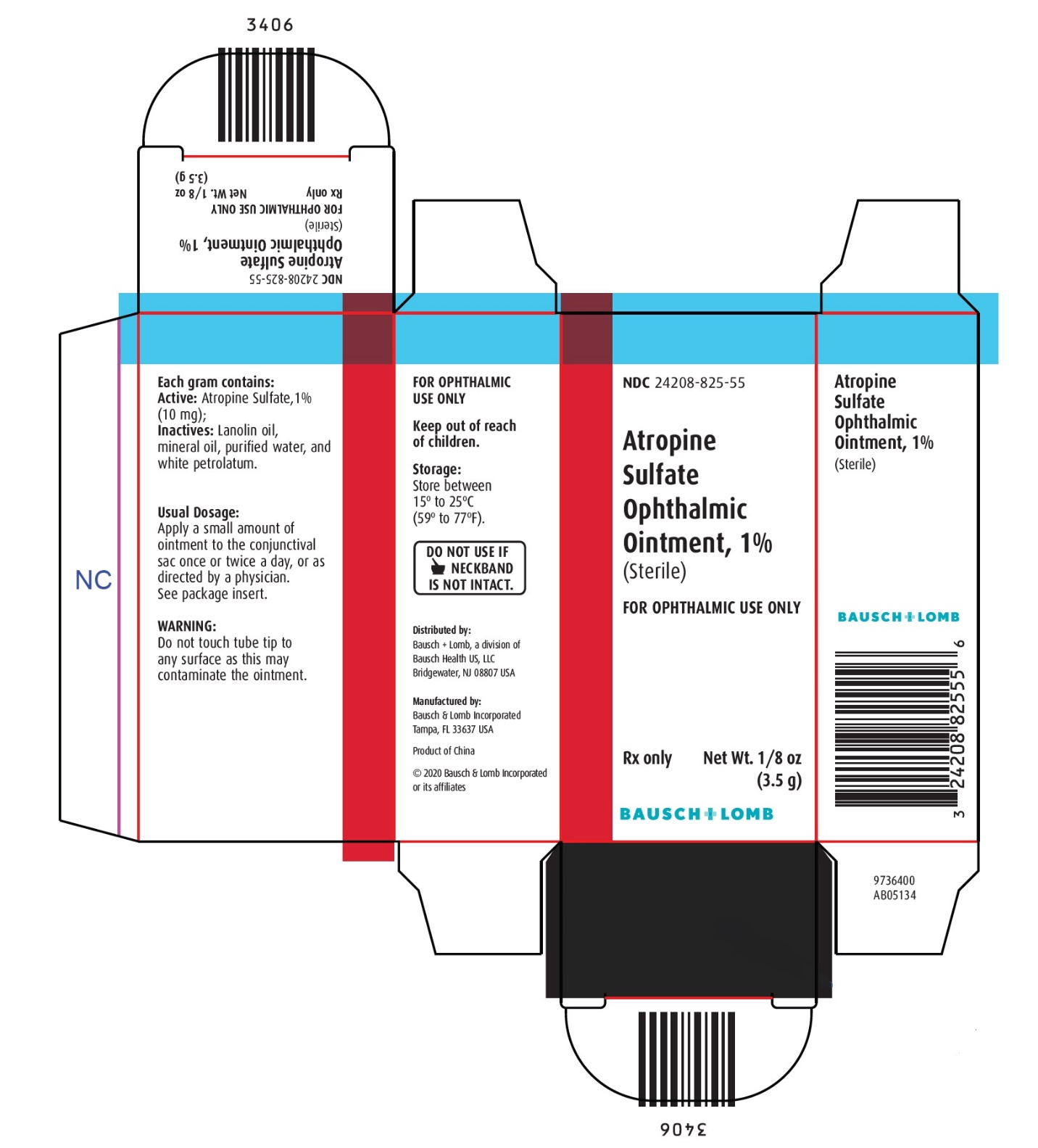
Atropine Sulfate 10 mg/g Ointment, 1 tube — NDC 24208-825-55 (Billing 24208-0825-55)
This is a package of 1 tube of Atropine Sulfate 10 mg/g Ointment from Bausch & Lomb Incorporated, marketed since Sep 1990 and currently FDA-listed. It is this product's only package size.
NDC database record
One package, one record: these facts belong to NDC 24208-825-55 alone.
- Record
- FDA NDC Directory package listing · Human prescription drug
- Code segments
- 24208 labeler · 825 product · 55 package
- Package marketed since
- Sep 30, 1990
- Sample package
- No — commercial package
- Listing certified through
- Dec 31, 2026
- Barcode (UPC)
- 0324208825556
- FDA record last changed
- Jul 24, 2026
Other active recalls for Atropine Sulfate (different manufacturers) — 2 · tap to view
Identity & classification
Regulatory identifiers FDA, NLM and CMS codes for this package
Drug-database identifiers Medi-Span GPI and First Databank GCN / HICL / AHFS classification
- GSN (GCN sequence number): 007864
- GCN: 32931
- GPI-14 (Medi-Span): 86350010104210
- HICL (First Databank): 002004
- AHFS class code: 12:08.08.00
- RxCUI (RxNorm): 1190570
Where does this data come from?
- FDA openFDA NDC Directory · synced Oct 1, 2026
- FDA label on DailyMed · label index refreshed Oct 3, 2026
- RxNorm (NLM RxNav) · catalog refreshed Oct 1, 2026
- Medi-Span GPI (licensed)
- First Databank (licensed) · refreshed Oct 1, 2026
RxNorm drug class
This medicine belongs to the Anticholinergic class.
Where does this data come from?
- RxClass (NLM) · catalog refreshed Oct 1, 2026
Clinical
Ophthalmic atropine is used before eye examinations to dilate (open) the pupil, the black part of the eye through which you see. It is also used to relieve pain caused by swelling and inflammation of the eye.
Read the full MedlinePlus article ↗- It depends on the form. The injection is used in emergencies like poisonings and slow heart rhythms, and around surgery to reduce secretions. The eye drops and ointment dilate the...
- Injections are given by a healthcare professional, usually into a vein. ATROPEN is injected into the outer thigh in an emergency, and you should seek medical care right away. Eye p...
- Dry mouth, blurred vision, light sensitivity, a faster heartbeat, flushing, dizziness, and constipation are common. These come from atropine's drying effects. Injection site pain c...
- Seek emergency help for trouble breathing, swelling or a spreading rash, chest pain, a racing or irregular heartbeat, hallucinations, or a high fever with no sweating. Eye pain wit...
Patient education
Supplement & herbal interactions
Some supplements/herbs that may interact with Atropine Sulfate — tap one for details:
Where does this data come from?
- MedlinePlus (NLM) · refreshed Oct 1, 2026
- FDA label on DailyMed · label index refreshed Oct 3, 2026
Ask a licensed pharmacist directly — free, answered by our team.
Pricing
A drug doesn't have one price. Each row is a different public payment system, and none is what you'd pay at the counter — that depends on your insurance. The ⓘ on each row explains what it measures.
| Price system | Per g | Per package |
|---|---|---|
| Retail pharmacies payNADAC · weekly | Not in the retail survey — common for institutional, discontinued, or low-volume packs. | |
| Medicaid paysCMS SDUD · 12 mo | No recent Medicaid claims on file for this NDC — rare and low-volume NDCs are suppressed in the public data. | |
| Medicare drug plans payPart D · quarterly | No Part D plan price is available for this NDC in our data. | |
Where does this data come from?
- CMS NADAC weekly file
- CMS ASP pricing files · refreshed Sep 20, 2026
- CMS Medicaid State Drug Utilization Data · refreshed Oct 4, 2026
- CMS Part D plan pricing files · refreshed Sep 24, 2026
- VA National Acquisition Center price file
Packaging — all sizes for this product
| Package NDC | Description | Marketing start | Marketing end | Status |
|---|---|---|---|---|
| 24208-0825-55 You're viewing this Main listing | 1 TUBE in 1 CARTON / 3.5 g in 1 TUBE | 1990-09-30 | — | Active |
Therapeutic equivalents
| Product | Labeler | Pack | NADAC/unit | TE | Status | Price vs. this |
|---|---|---|---|---|---|---|
| Atropine Sulfate 10 mg/gthis 24208-0825-55 | Bausch | 1 tube | — | — | FDA listed | — |
Where does this data come from?
- FDA openFDA NDC Directory · synced Oct 1, 2026
- FDA Orange Book · refreshed Oct 3, 2026
- CMS NADAC weekly file
Availability & generic status
We did not find an FDA-approved generic match for this exact strength, form and route.
Where does this data come from?
- FDA Orange Book · refreshed Oct 3, 2026
Inactive Ingredients / Excipients
Inactive ingredients, also called excipients, are components of the drug product other than the active ingredient. They may include fillers, dyes, coatings, preservatives, flavors, or other formulation ingredients.
💡 Tap an ingredient (hover on desktop) to see what it is and why it’s used.
-
UNII OVV5IIJ58F
Lanolin oil is a waxy substance derived from sheep's wool that acts as an emollient and skin-conditioning agent. It helps soften and smooth the skin while also serving as a moisturizing component in topical formulations.
-
UNII T5L8T28FGP
Mineral oil is a clear, odorless liquid derived from crude oil. It acts as a lubricant and emollient in medications, helping pills slide smoothly during manufacturing and aiding moisture retention in topical products.
-
UNII 4T6H12BN9U
Petrolatum is a purified mineral oil-based jelly derived from petroleum. In medicines, it acts as an emollient, lubricant, and moisture barrier to soften skin, reduce friction, and help prevent water loss from formulations.
-
UNII 059QF0KO0R
Water is a liquid solvent that dissolves and mixes ingredients together in liquid medicines, syrups, and injections. It helps distribute the active drug evenly throughout the product.
4 inactive ingredients listed in the exact product block matched to this NDC.
Where does this data come from?
ingredient classCode="IACT" elements from the exact product block matched by this NDC. Label-section narrative from DailyMed / the openFDA label index is shown separately when available.- FDA label on DailyMed · label index refreshed Oct 3, 2026
- FDA openFDA NDC Directory · synced Oct 1, 2026
Inactive ingredient FAQ
Are inactive ingredients the same for every manufacturer?
Why might an inactive ingredient be missing?
Can inactive ingredients matter?
Manufacturer & labeler
More NDCs from Bausch & Lomb Incorporated labeler code 24208
- NEOMYCIN AND POLYMYXIN B SULFATES AND GRAMICIDIN neomycin sulfate, polymyxin b sulfate 1.75 mg/mL; 10000 [USP'U]/mL; .025 mg/mL Solution/ Drops NDC 24208-790-62
- Neomycin and Polymyxin B Sulfates and Dexamethasone Neomycin Sulfate, 3.5 mg/g; 10000 [USP'U]/g; 1 mg/g Ointment NDC 24208-795-35
- Timoptic Timolol Maleate 2.5 mg/mL Solution NDC 24208-812-05
- Timoptic Timolol Maleate 5 mg/mL Solution NDC 24208-813-05
- Timoptic-XE Timolol Maleate 2.5 mg/mL Solution NDC 24208-814-25
- Timoptic-XE Timolol Maleate 5 mg/mL Solution NDC 24208-816-05
- Neomycin Polymyxin B Sulfates and Dexamethasone Neomycin sulfate, Polymyxin B Sulfate 3.5 mg/mL; 10000 [USP'U]/mL; 1 mg/mL Suspension/ Drops NDC 24208-830-60
- Erythromycin 5 mg/g Ointment NDC 24208-910-19
- Xiidra Lifitegrast 50 mg/mL Solution/ Drops NDC 24208-911-12
- Atropine Sulfate 10 mg/mL Solution NDC 24208-965-01
- Olopatadine Hydrochloride Ophthalmic Solution 1 mg/mL Solution NDC 24208-966-01
- OLOPATADINE HYDROCHLORIDE 2 mg/mL Solution NDC 24208-967-01
Where does this data come from?
- FDA openFDA NDC Directory · synced Oct 1, 2026
- Drugs@FDA
Full prescribing information FDA SPL
🎯 Indications and Usage ▾
INDICATIONS AND USAGE For mydriasis and/or cycloplegia. For cycloplegic refraction, for pupillary dilation desired in inflammatory conditions of the iris and uveal tract.
⏱️ Dosage and Administration ▾
DOSAGE AND ADMINISTRATION Apply a small amount of ointment to the conjunctival sac once or twice a day, or as directed by a physician. FOR OPHTHALMIC USE ONLY
⛔ Contraindications ▾
CONTRAINDICATIONS This product should not be used in patients with primary glaucoma or a predisposition to narrow anterior chamber angle glaucoma. This product should not be used in pediatric patients who have previously had a severe systemic reaction to atropine. This product should not be used in those persons showing hypersensitivity to any component of this preparation.
⚠️ Warnings ▾
WARNINGS In pediatric patients, use with extreme caution. Excessive use in pediatric patients or in certain individuals with a previous history of susceptibility to belladonna alkaloids may produce systemic symptoms of atropine poisoning. If this occurs, discontinue medication and use appropriate therapy as outlined in OVERDOSAGE .
🤒 Adverse Reactions ▾
ADVERSE REACTIONS Prolonged use may produce local irritation characterized by follicular conjunctivitis, vascular congestion, edema, exudate, and an eczematoid dermatitis. Severe reactions are manifested by hypotension with progressive respiratory depression. Coma and death have been reported in the very young. To report SUSPECTED ADVERSE REACTIONS, contact Bausch & Lomb Incorporated at 1-800-321-4576 or FDA at 1-800-FDA-1088 or www.fda.gov/medwatch.
🧒 Pediatric Use ▾
Pediatric Use: See CONTRAINDICATIONS and WARNINGS .
🆘 Overdosage ▾
OVERDOSAGE Systemic atropine toxicity is manifested by flushing and dryness of the skin (a rash may be present in pediatric patients), blurred vision, a rapid and irregular pulse, fever, abdominal distension in infants, mental aberration (hallucinosis) and loss of neuromuscular coordination. Atropine poisoning, although distressing, is rarely fatal, even with large doses of atropine, and is self-limited if the cause is recognized and the atropine medication is discontinued. In severe intoxication, physostigmine salicylate may be administered parenterally to provide more prompt relief of the intoxication.
Give physostigmine salicylate as 1-5 mL IV of dilution containing 1 mg in 5 mL of saline. The smaller dose is for pediatric patients, and injection should take not less than 2 minutes. EKG control is advisable.
Dosage can be repeated every 5 minutes up to a total dose of 2 mg in pediatric patients and 6 mg in adults every 30 minutes. Physostigmine is contraindicated in hypotensive reactions. Atropine (1 mg) should be available for immediate injection if physostigmine causes bradycardia, convulsions or bronchoconstriction.
In pediatric patients, the body surface must be kept moist. Use extreme caution when employing short-acting barbiturates to control excitement.
🧬 Clinical Pharmacology ▾
CHEMICAL PHARMACOLOGY The anticholinergic effect of this product blocks the responses of the sphincter muscle of the iris and the accommodative muscle of the ciliary body to cholinergic stimulation, producing pupillary dilation (mydriasis) and paralysis of accommodation (cycloplegia).
📦 How Supplied / Storage and Handling ▾
HOW SUPPLIED Atropine Sulfate Ophthalmic Ointment, 1% is supplied in an ophthalmic tip applicator tube in the following size: 3.5 g tubes - NDC 24208-825-55 Image 1
📋 Description ▾
DESCRIPTION: Atropine Sulfate Ophthalmic Ointment, 1% is a sterile topical anticholinergic for ophthalmic use. The active ingredient is represented by the chemical structural formula: (C 17 H 23 NO 3 ) 2 •H 2 SO 4 •H 2 O Mol. Wt.
694.83 Chemical Name: Benzeneacetic acid, α-(hydroxymethyl)-, 8-methyl-8-azabicyclo-[3.2.1]oct-3-yl ester, endo -(±)-, sulfate (2:1) (salt), monohydrate. Each gram contains: ACTIVE: Atropine Sulfate, 1% (10 mg); INACTIVES: Lanolin oil, mineral oil, purified water, and white petrolatum. chem_structure.jpg
⚠️ Precautions ▾
PRECAUTIONS To avoid excessive systemic absorption, the lacrimal sac should be compressed by digital pressure for two to three minutes after instillation. To avoid inducing angle closure glaucoma, an estimation of the depth of the angle of the anterior chamber should be made. Administration of atropine in infants requires great caution.
Patient Warning: Patients should be advised not to drive or engage in other hazardous activities while pupils are dilated. Patients may experience sensitivity to light and should protect eyes in bright illumination during dilation. Parents should be warned not to get this preparation in their children’s mouth and to wash their own hands and the child’s hands following administration.
Carcinogenesis, Mutagenesis, Impairment of Fertility: No studies have been conducted in animals or in humans to evaluate the potential of these effects. Animal reproduction studies have not been performed with atropine. It is also not known whether atropine can cause fetal harm when administered to a pregnant woman or can affect reproduction capacity.
Atropine should be given to pregnant women only if clearly needed. Pediatric Use: See CONTRAINDICATIONS and WARNINGS .
📄 Carcinogenesis, Mutagenesis, Impairment of Fertility ▾
Carcinogenesis, Mutagenesis, Impairment of Fertility: No studies have been conducted in animals or in humans to evaluate the potential of these effects. Animal reproduction studies have not been performed with atropine. It is also not known whether atropine can cause fetal harm when administered to a pregnant woman or can affect reproduction capacity. Atropine should be given to pregnant women only if clearly needed.
📄 Package Label / Principal Display Panel ▾
PACKAGE/LABEL PRINCIPAL DISPLAY PANEL NDC 24208-825-55 Atropine Sulfate Ophthalmic Ointment, 1% (Sterile) FOR OPHTALMIC USE ONLY Rx only Net. Wt. 1/8 oz. (3.5g) BAUSCH + LOMB carton
Medicare Part D spend CMS · PART D · 2026 (Q1)
About this NDC listing & data coverage
Listed without an FDA application
This product's marketing category indicates it is marketed without an approved FDA application (no NDA, ANDA, or BLA on file). Having an NDC does not by itself establish FDA approval — the NDC Directory is a listing system, not an approval decision. Approval-linked data such as Orange Book therapeutic-equivalence ratings therefore does not apply.
What data is (and isn’t) available for this NDC — tap to expand
| NDC identity (package / product / labeler codes) | ✓ Available |
| Labeler | ✓ Available |
| Product & package description | ✓ Available |
| Marketing category & status | ✓ Available |
| Active ingredient / dosage form / route | ✓ Available |
| FDA label (SPL via DailyMed) | ✓ Available |
| Package photos | ✓ Available |
| Inactive ingredients (structured) | ✓ Available |
| NADAC pharmacy acquisition price (CMS) | — Not published for this NDC CMS publishes NADAC only for NDCs reported in its retail-pharmacy survey. |
| Orange Book / therapeutic-equivalence data | — Not published for this NDC Applies only to products approved under an NDA/ANDA; many listings are out of scope. |
| HCPCS J-code billing crosswalk | — Not published for this NDC Most self-administered / retail products have no J-code — that is normal. |
| Medicaid utilization (CMS SDUD) | — Not published for this NDC CMS reports utilization only for NDCs with Medicaid claims above its privacy threshold. |