
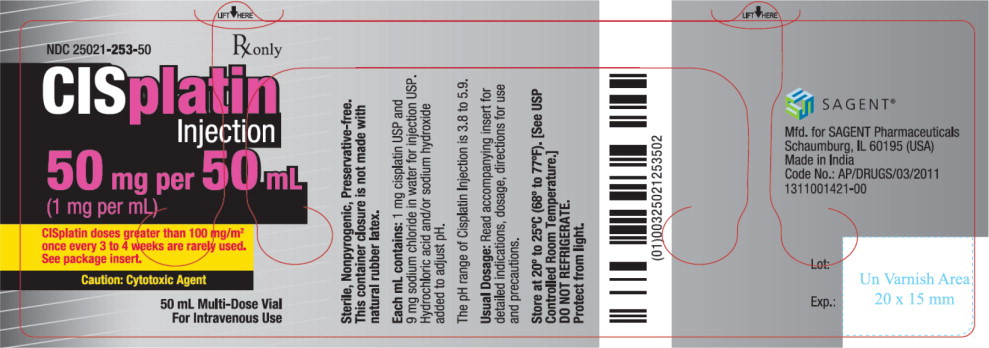
Cisplatin 1 mg/mL Injection, Solution — NDC 25021-253-50 (Billing 25021-0253-50)
This is a package of Cisplatin 1 mg/mL Injection, Solution from Sagent Pharmaceuticals, marketed since Jul 2023 and currently FDA-listed.
NDC database record
One package, one record: these facts belong to NDC 25021-253-50 alone.
- Record
- FDA NDC Directory package listing · Human prescription drug
- Code segments
- 25021 labeler · 253 product · 50 package
- Package marketed since
- Jul 1, 2023
- Sample package
- No — commercial package
- Listing certified through
- Dec 31, 2026
- Barcode (UPC-A, from the NDC)
- 3 2502125350 2
- Medicaid fills, this package
- 291 prescriptions in the last four reported quarters
- FDA record last changed
- Jul 24, 2026
Identity & classification
Regulatory identifiers FDA, NLM and CMS codes for this package
Drug-database identifiers Medi-Span GPI and First Databank GCN / HICL / AHFS classification
- GSN (GCN sequence number): 008785
- GCN: 38920
- HICL (First Databank): 003902
- AHFS class code: 10:00.00.00
- RxCUI (RxNorm): 309311
Where does this data come from?
- FDA openFDA NDC Directory · synced Oct 8, 2026
- FDA label on DailyMed · label index refreshed Oct 8, 2026
- RxNorm (NLM RxNav) · catalog refreshed Oct 8, 2026
- Medi-Span GPI (licensed)
- First Databank (licensed) · refreshed Oct 8, 2026
RxNorm drug class
This medicine belongs to the Platinum-based Drug class.
Where does this data come from?
- RxClass (NLM) · catalog refreshed Oct 8, 2026
Clinical
- It is a chemotherapy medicine for metastatic testicular tumors, metastatic ovarian tumors and advanced transitional cell bladder cancer. It is often combined with other chemotherap...
- You get it as a slow IV infusion, usually over 6 to 8 hours, in a medical setting. You will also receive fluids before and after to protect your kidneys. It is given in cycles, so...
- Very likely without treatment, so you will get strong anti-nausea medicine beforehand. Nausea can start within hours and may peak 2 to 3 days later. Tell your team if it persists,...
- Will I have nausea and vomiting with cisplatin?
Patient education
Supplement & herbal interactions
Some supplements/herbs that may interact with Cisplatin — tap one for details:
Cisplatin may be associated with lower levels of 6 nutrients — worth a chat with your pharmacist, not a cause for alarm.
Where does this data come from?
- MedlinePlus (NLM) · refreshed Oct 8, 2026
- FDA label on DailyMed · label index refreshed Oct 8, 2026
Ask a licensed pharmacist directly — free, answered by our team.
Pricing
A drug doesn't have one price. Each row is a different public payment system, and none is what you'd pay at the counter — that depends on your insurance. The ⓘ on each row explains what it measures.
| Price system | Per mL | Per package |
|---|---|---|
| Retail pharmacies payNADAC · weekly | Not in the retail survey — common for institutional, discontinued, or low-volume packs. | |
| Medicaid paysCMS SDUD · 12 mo | $0.3010 | $15.05 / 50 ml |
| Medicare drug plans payPart D · quarterly | No Part D plan price is available for this NDC in our data. | |
| Medicare Part B allowsASP · J9060 | $2.130 / J9060 unit | — |
Where does this data come from?
- CMS NADAC weekly file
- CMS ASP pricing files · refreshed Sep 20, 2026
- CMS Medicaid State Drug Utilization Data · through Q1 2026
- CMS Part D plan pricing files · refreshed Sep 24, 2026
- VA National Acquisition Center price file
Billing & reimbursement
Where does this data come from?
- CMS ASP NDC-HCPCS crosswalk · refreshed Sep 22, 2026
- DMEPDAC NDC-HCPCS crosswalk
- openFDA NSDE billing units · refreshed Oct 7, 2026
Packaging — all sizes for this product
| Package NDC | Description | Marketing start | Marketing end | Status |
|---|---|---|---|---|
| 25021-0253-50 You're viewing this | 1 VIAL in 1 CARTON / 50 mL in 1 VIAL | 2023-07-01 | — | Active |
| 25021-0253-51 25021-253-51 Main listing | 1 VIAL in 1 CARTON / 100 mL in 1 VIAL | 2023-07-01 | — | Active |
This pack accounts for about 18% of this product's recent Medicaid fills; most go to a different pack size. See all packs ↓
Pack size FAQ
What quantity is in this package?
What NDC number is used to bill for this package of Cisplatin 1 mg/mL Injection, Solution?
Therapeutic equivalents
| Product | Labeler | Pack | NADAC/unit | TE | Status | Price vs. this |
|---|---|---|---|---|---|---|
| CISplatin 1 mg/mL 00143-9504-01 | Hikma | 1 vial | — | AP | FDA listed | — |
| CISplatin 1 mg/mL 00143-9505-01 | Hikma | 1 vial | — | AP | FDA listed | — |
| Cisplatin 50 mg/50mL 00703-5747-11 | Teva | 1 vial | — | AP | FDA listed | — |
| Cisplatin 100 mg/100mL 00703-5748-11 | Teva | 1 vial | — | AP | FDA listed | — |
| Cisplatin 1 mg/mL 16729-0288-11 | Accord | 50 ml | — | AP | FDA listed | — |
| Cisplatin 1 mg/mLthis 25021-0253-50 | Sagent | 1 vial | — | AP | FDA listed | — |
| CISplatin 1 mg/mL 44567-0509-01 | WG | 1 vial | — | AP | FDA listed | — |
| CISplatin 1 mg/mL 44567-0510-01 | WG | 1 vial | — | AP | FDA listed | — |
| CISplatin 1 mg/mL 44567-0511-01 | WG | 1 vial | — | AP | FDA listed | — |
| CISplatin 1 mg/mL 60505-6279-00 | Apotex | 1 vial | — | AP | FDA listed | — |
| Cisplatin 1 mg/mL 63323-0103-51 | Fresenius | 1 vial | — | AP | FDA listed | — |
| Cisplatin 1 mg/mL 68001-0283-27 | BluePoint | 1 vial | — | AP | FDA listed | — |
| Cisplatin 1 mg/mL 68001-0608-24 | BluePoint | 1 vial | — | AP | FDA listed | — |
| Cisplatin 1 mg/mL 68001-0609-33 | BluePoint | 1 vial | — | AP | FDA listed | — |
| Cisplatin 1 mg/mL 68083-0162-01 | Gland | 1 vial | — | AP | FDA listed | — |
| Cisplatin 1 mg/mL 68083-0163-01 | Gland | 1 vial | — | AP | FDA listed | — |
| Cisplatin 1 mg/mL 72266-0252-01 | FOSUN | 1 vial | — | AP | FDA listed | — |
| Cisplatin 1 mg/mL 72266-0253-01 | FOSUN | 1 vial | — | AP | FDA listed | — |
| Cisplatin 1 mg/mL 44567-0530-01 | WG | 1 vial | — | AP | FDA listed | — |
| Cisplatin 1 mg/mL 65219-0359-50 | Fresenius | 1 vial | — | — | Discontinued | — |
Where does this data come from?
- FDA openFDA NDC Directory · synced Oct 8, 2026
- FDA Orange Book · refreshed Oct 9, 2026
- CMS NADAC weekly file
Availability & generic status
This product is an FDA-approved generic. Other versions of the same drug are listed under Therapeutic equivalents, least expensive first.
Where does this data come from?
- FDA Orange Book · refreshed Oct 9, 2026
Inactive Ingredients / Excipients
Inactive ingredients, also called excipients, are components of the drug product other than the active ingredient. They may include fillers, dyes, coatings, preservatives, flavors, or other formulation ingredients.
🧪 Avoiding an ingredient? See Cisplatin Injection inactive ingredients by manufacturer: every current product's list side by side, so you can ask your pharmacy for the version that does not list it.
💡 Tap an ingredient (hover on desktop) to see what it is and why it’s used.
-
UNII QTT17582CB
A strong acid used to adjust and maintain the proper pH level in liquid medicines, ensuring stability and preventing breakdown of active ingredients.
-
UNII 451W47IQ8X
Sodium chloride is common table salt. It's used in medicines as a buffer to maintain proper pH, as a filler to add bulk, or to adjust the osmotic balance in liquid formulations.
-
UNII 55X04QC32I
A strong alkaline chemical used to adjust and maintain the pH balance of liquid medicines. It helps keep the medicine stable and ensures it stays effective during storage.
3 inactive ingredients listed in the exact product block matched to this NDC.
Where does this data come from?
ingredient classCode="IACT" elements from the exact product block matched by this NDC. Label-section narrative from DailyMed / the openFDA label index is shown separately when available.- FDA label on DailyMed · label index refreshed Oct 8, 2026
- FDA openFDA NDC Directory · synced Oct 8, 2026
Inactive ingredient FAQ
Are inactive ingredients the same for every manufacturer?
Why might an inactive ingredient be missing?
Can inactive ingredients matter?
Manufacturer & labeler
More NDCs from Sagent Pharmaceuticals labeler code 25021
- Cyclophosphamide 500 mg/25mL Injection, Powder, Lyophilized, For Solution NDC 25021-247-50
- Cyclophosphamide 1 g/50mL Injection, Powder, Lyophilized, For Solution NDC 25021-248-51
- Cyclophosphamide 2 g/100mL Injection, Powder, Lyophilized, For Solution NDC 25021-249-51
- Mitomycin 5 mg/10mL Injection, Powder, Lyophilized, For Solution NDC 25021-250-20
- Mitomycin 20 mg/40mL Injection, Powder, Lyophilized, For Solution NDC 25021-251-50
- Mitomycin 40 mg/80mL Injection, Powder, Lyophilized, For Solution NDC 25021-252-51
- Docetaxel 10 mg/mL Injection NDC 25021-254-08
- Paclitaxel 6 mg/mL Injection, Solution NDC 25021-255-05
- Melphalan Hydrochloride Kit NDC 25021-258-61
- Nelarabine 5 mg/mL Injection, Solution NDC 25021-259-50
- Pemetrexed 100 mg/4.2mL Injection, Powder, Lyophilized, For Solution NDC 25021-260-10
- Pemetrexed 500 mg/20mL Injection, Powder, Lyophilized, For Solution NDC 25021-261-50
Where does this data come from?
- FDA openFDA NDC Directory · synced Oct 8, 2026
- Drugs@FDA
Full prescribing information FDA SPL
🚨 Boxed Warning ▾
WARNING Cisplatin should be administered under the supervision of a qualified physician experienced in the use of cancer chemotherapeutic agents. Appropriate management of therapy and complications is possible only when adequate diagnostic and treatment facilities are readily available. Cumulative renal toxicity associated with cisplatin is severe.
Other major dose-related toxicities are myelosuppression, nausea, and vomiting. Ototoxicity, which may be more pronounced in children, and is manifested by tinnitus, and/or loss of high frequency hearing and occasionally deafness, is significant. Anaphylactic-like reactions to cisplatin have been reported.
Facial edema, bronchoconstriction, tachycardia, and hypotension may occur within minutes of cisplatin administration. Epinephrine, corticosteroids, and antihistamines have been effectively employed to alleviate symptoms (see WARNINGS and ADVERSE REACTIONS ). Exercise caution to prevent inadvertent cisplatin overdose .
Doses greater than 100 mg/m 2 /cycle once every 3 to 4 weeks are rarely used. Care must be taken to avoid inadvertent cisplatin overdose due to confusion with carboplatin or prescribing practices that fail to differentiate daily doses from total dose per cycle.
🎯 Indications and Usage ▾
INDICATIONS AND USAGE Cisplatin Injection is indicated as therapy to be employed as follows: Metastatic Testicular Tumors In established combination therapy with other approved chemotherapeutic agents in patients with metastatic testicular tumors who have already received appropriate surgical and/or radio therapeutic procedures. Metastatic Ovarian Tumors In established combination therapy with other approved chemotherapeutic agents in patients with metastatic ovarian tumors who have already received appropriate surgical and/or radiotherapeutic procedures.
An established combination consists of cisplatin and cyclophosphamide. Cisplatin Injection, as a single agent, is indicated as secondary therapy in patients with metastatic ovarian tumors refractory to standard chemotherapy who have not previously received Cisplatin Injection therapy. Advanced Bladder Cancer Cisplatin Injection is indicated as a single agent for patients with transitional cell bladder cancer which is no longer amenable to local treatments, such as surgery and/or radiotherapy.
⏱️ Dosage and Administration ▾
DOSAGE AND ADMINISTRATION Cisplatin is administered by slow intravenous infusion. CISPLATIN SHOULD NOT BE GIVEN BY RAPID INTRAVENOUS INJECTION. Note: Needles or intravenous sets containing aluminum parts that may come in contact with cisplatin should not be used for preparation or administration.
Aluminum reacts with cisplatin, causing precipitate formation and a loss of potency. Metastatic Testicular Tumors The usual cisplatin dose for the treatment of testicular cancer in combination with other approved chemotherapeutic agents is 20 mg/m 2 IV daily for 5 days per cycle. Metastatic Ovarian Tumors The usual cisplatin dose for the treatment of metastatic ovarian tumors in combination with cyclophosphamide is 75 to 100 mg/m 2 IV per cycle once every 4 weeks (DAY 1).
The dose of cyclophosphamide when used in combination with cisplatin is 600 mg/m 2 IV once every 4 weeks (DAY 1). For directions for the administration of cyclophosphamide, refer to the cyclophosphamide package insert. In combination therapy, cisplatin and cyclophosphamide are administered sequentially.
As a single agent, cisplatin should be administered at a dose of 100 mg/m 2 IV per cycle once every 4 weeks. Advanced Bladder Cancer Cisplatin should be administered as a single agent at a dose of 50 to 70 mg/m 2 IV per cycle once every 3 to 4 weeks depending on the extent of prior exposure to radiation therapy and/or prior chemotherapy. For heavily pretreated patients an initial dose of 50 mg/m 2 per cycle repeated every 4 weeks is recommended.
All Patients Pretreatment hydration with 1 to 2 liters of fluid infused for 8 to 12 hours prior to a cisplatin dose is recommended. The drug is then diluted in 2 liters of 5% Dextrose in 1/2 or 1/3 normal saline containing 37.5 g of mannitol, and infused over a 6 hour to 8 hour period. If diluted solution is not to be used within 6 hours, protect solution from light.
Do not dilute cisplatin in just 5% Dextrose Injection. Adequate hydration and urinary output must be maintained during the following 24 hours. A repeat course of cisplatin should not be given until the serum creatinine is below 1.5 mg/100 mL, and/or the BUN is below 25 mg/100 mL.
A repeat course should not be given until circulating blood elements are at an acceptable level (platelets ≥ 100,000/mm 3 , WBC ≥ 4,000/mm 3 ). Subsequent doses of cisplatin should not be given until an audiometric analysis indicates that auditory acuity is within normal limits.
⛔ Contraindications ▾
CONTRAINDICATIONS Cisplatin is contraindicated in patients with pre-existing renal impairment. Cisplatin should not be employed in myelosuppressed patients, or in patients with hearing impairment. Cisplatin is contraindicated in patients with a history of allergic reactions to cisplatin or other platinum containing compounds.
⚠️ Warnings ▾
WARNINGS Cisplatin produces cumulative nephrotoxicity which is potentiated by aminoglycoside antibiotics. The serum creatinine, blood urea nitrogen (BUN), creatinine clearance, and magnesium, sodium, potassium, and calcium levels should be measured prior to initiating therapy, and prior to each subsequent course. At the recommended dosage, cisplatin should not be given more frequently than once every 3 to 4 weeks (see ADVERSE REACTIONS ).
Elderly patients may be more susceptible to nephrotoxicity (see PRECAUTIONS, Geriatric Use ). There are reports of severe neuropathies in patients in whom regimens are employed using higher doses of cisplatin or greater dose frequencies than those recommended. These neuropathies may be irreversible and are seen as paresthesias in a stocking-glove distribution, areflexia, and loss of proprioception and vibratory sensation.
Elderly patients may be more susceptible to peripheral neuropathy (see PRECAUTIONS, Geriatric Use ). Loss of motor function has also been reported. Anaphylactic-like reactions to cisplatin have been reported.
These reactions have occurred within minutes of administration to patients with prior exposure to cisplatin, and have been alleviated by administration of epinephrine, corticosteroids, and antihistamines. Cisplatin can commonly cause ototoxicity which is cumulative and may be severe. Audiometric testing should be performed prior to initiating therapy and prior to each subsequent dose of drug (see ADVERSE REACTIONS ).
All pediatric patients receiving cisplatin should have audiometric testing at baseline, prior to each subsequent dose of drug and for several years post therapy. Cisplatin can cause fetal harm when administered to a pregnant woman. Cisplatin is mutagenic in bacteria and produces chromosome aberrations in animal cells in tissue culture.
In mice cisplatin is teratogenic and embryotoxic. If this drug is used during pregnancy or if the patient becomes pregnant while taking this drug, the patient should be apprised of the potential hazard to the fetus. Patients should be advised to avoid becoming pregnant.
The carcinogenic effect of cisplatin was studied in BD IX rats. Cisplatin was administered intraperitoneally (i.p.) to 50 BD IX rats for 3 weeks, 3 x 1 mg/kg body weight per week. Four hundred and fifty-five days after the first application, 33 animals died, 13 of them related to malignancies: 12 leukemias and 1 renal fibrosarcoma.
The development of acute leukemia coincident with the use of cisplatin has been reported. In these reports, cisplatin was generally given in combination with other leukemogenic agents. Injection site reactions may occur during the administration of cisplatin (see ADVERSE REACTIONS ).
Given the possibility of extravasation, it is recommended to closely monitor the infusion site for possible infiltration during drug administration. A specific treatment for extravasation reactions is unknown at this time.
🤒 Adverse Reactions ▾
ADVERSE REACTIONS Nephrotoxicity Dose-related and cumulative renal insufficiency, including acute renal failure, is the major dose-limiting toxicity of cisplatin. Renal toxicity has been noted in 28% to 36% of patients treated with a single dose of 50 mg/m 2 . It is first noted during the second week after a dose and is manifested by elevations in BUN and creatinine, serum uric acid and/or a decrease in creatinine clearance.
Renal toxicity becomes more prolonged and severe with repeated courses of the drug. Renal function must return to normal before another dose of cisplatin can be given. Elderly patients may be more susceptible to nephrotoxicity (see PRECAUTIONS, Geriatric Use ).
Impairment of renal function has been associated with renal tubular damage. The administration of cisplatin using a 6 hour to 8 hour infusion with intravenous hydration, and mannitol has been used to reduce nephrotoxicity. However, renal toxicity still can occur after utilization of these procedures.
Ototoxicity Ototoxicity has been observed in up to 31% of patients treated with a single dose of cisplatin 50 mg/m 2 , and is manifested by tinnitus and/or hearing loss in the high frequency range (4,000 to 8,000 Hz). The prevalence of hearing loss in children is particularly high and is estimated to be 40 to 60%. Decreased ability to hear normal conversational tones may occur.
Deafness after the initial dose of cisplatin has been reported. Ototoxic effects may be more severe in children receiving cisplatin. Hearing loss can be unilateral or bilateral and tends to become more frequent and severe with repeated cisplatin doses.
It is unclear whether cisplatin-induced ototoxicity is reversible. Vestibular toxicity has also been reported. Ototoxic effects may be related to the peak plasma concentration of cisplatin.
Ototoxicity can occur during treatment or be delayed. Audiometric monitoring should be performed prior to initiation of therapy, prior to each subsequent dose, and for several years post therapy. The risk of ototoxicity may be increased by prior or simultaneous cranial irradiation, and may be more severe in patients less than 5 years of age, patients being treated with other ototoxic drugs (e.g., aminoglycosides and vancomycin), and in patients with renal impairment.
Genetic factors (e.g., variants in the thiopurine S-methyltransferase [TPMT] gene) may contribute to cisplatin-induced ototoxicity; although this association has not been consistent across populations and study designs. Hematologic Myelosuppression occurs in 25% to 30% of patients treated with cisplatin. The nadirs in circulating platelets and leukocytes occur between days 18 to 23 (range 7.5 to 45) with most patients recovering by day 39 (range 13 to 62).
Leukopenia and thrombocytopenia are more pronounced at higher doses (>50 mg/m 2 ). Anemia (decrease of 2 g hemoglobin/100 mL) occurs at approximately the same frequency and with the same timing as leukopenia and thrombocytopenia. Fever and infection have also been reported in patients with neutropenia.
Potential fatalities due to infection (secondary to myelosuppression) have been reported. Elderly patients may be more susceptible to myelosuppression (see PRECAUTIONS, Geriatric Use ). In addition to anemia secondary to myelosuppression, a Coombs' positive hemolytic anemia has been reported.
In the presence of cisplatin hemolytic anemia, a further course of treatment may be accompanied by increased hemolysis and this risk should be weighed by the treating physician. The development of acute leukemia coincident with the use of cisplatin has been reported. In these reports, cisplatin was generally given in combination with other leukemogenic agents.
Gastrointestinal Marked nausea and vomiting occur in almost all patients treated with cisplatin, and may be so severe that the drug must be discontinued. Nausea and vomiting may begin within 1 hour to 4 hours after treatment and last up to 24 hours. Various degrees of vomiting, nausea and… [Excerpted — this section continues on DailyMed.]
🔄 Drug Interactions ▾
Drug Interactions Plasma levels of anticonvulsant agents may become subtherapeutic during cisplatin therapy. In a randomized trial in advanced ovarian cancer, response duration was adversely affected when pyridoxine was used in combination with altretamine (hexamethylmelamine) and cisplatin.
🤰 Pregnancy ▾
Pregnancy Pregnancy Category D (See WARNINGS ).
🧒 Pediatric Use ▾
Pediatric Use Safety and effectiveness in pediatric patients have not been established. All children should have audiometric monitoring performed prior to initiation of therapy, prior to each subsequent dose, and for several years post therapy. Advanced testing methods may allow for earlier detection of hearing loss in an attempt to facilitate the rapid initiation of interventions that can limit the potential adverse impact of hearing impairment on a child's cognitive and social development.
🧓 Geriatric Use ▾
Geriatric Use Insufficient data are available from clinical trials of cisplatin in the treatment of metastatic testicular tumors or advanced bladder cancer to determine whether elderly patients respond differently than younger patients. In four clinical trials of combination chemotherapy for advanced ovarian carcinoma, 1,484 patients received cisplatin either in combination with cyclophosphamide or paclitaxel. Of these, 426 (29%) were older than 65 years.
In these trials, age was not found to be a prognostic factor for survival. However, in a later secondary analysis for one of these trials, elderly patients were found to have shorter survival compared with younger patients. In all four trials, elderly patients experienced more severe neutropenia than younger patients.
Higher incidences of severe thrombocytopenia and leukopenia were also seen in elderly compared with younger patients, although not in all cisplatin-containing treatment arms. In the two trials where nonhematologic toxicity was evaluated according to age, elderly patients had a numerically higher incidence of peripheral neuropathy than younger patients. Other reported clinical experience suggests that elderly patients may be more susceptible to myelosuppression, infectious complications, and nephrotoxicity than younger patients.
Cisplatin is known to be substantially excreted by the kidney and is contraindicated in patients with pre-existing renal impairment. Because elderly patients are more likely to have decreased renal function, care should be taken in dose selection, and renal function should be monitored.
🆘 Overdosage ▾
OVERDOSAGE Caution should be exercised to prevent inadvertent overdosage with cisplatin. Acute overdosage with this drug may result in kidney failure, liver failure, deafness, ocular toxicity (including detachment of the retina), significant myelosuppression, intractable nausea and vomiting and/or neuritis. In addition, death can occur following overdosage.
No proven antidotes have been established for cisplatin overdosage. Hemodialysis, even when initiated four hours after the overdosage, appears to have little effect on removing platinum from the body because of cisplatin's rapid and high degree of protein binding. Management of overdosage should include general supportive measures to sustain the patient through any period of toxicity that may occur.
🧬 Clinical Pharmacology ▾
CLINICAL PHARMACOLOGY Plasma concentrations of the parent compound, cisplatin, decay monoexponentially with a half-life of about 20 to 30 minutes following bolus administrations of 50 or 100 mg/m 2 doses. Monoexponential decay and plasma half-lives of about 0.5 hour are also seen following 2 hour or 7 hour infusions of 100 mg/m 2 . After the latter, the total-body clearances and volumes of distribution at steady-state for cisplatin are about 15 to 16 L/h/m 2 and 11 to 12 L/m 2 .
Due to its unique chemical structure, the chlorine atoms of cisplatin are more subject to chemical displacement reactions by nucleophiles, such as water or sulfhydryl groups, than to enzyme-catalyzed metabolism. At physiological pH in the presence of 0.1M NaCl, the predominant molecular species are cisplatin and monohydroxymonochloro cis -diammine platinum (II) in nearly equal concentrations. The latter, combined with the possible direct displacement of the chlorine atoms by sulfhydryl groups of amino acids or proteins, accounts for the instability of cisplatin in biological matrices.
The ratios of cisplatin to total free (ultrafilterable) platinum in the plasma vary considerably between patients and range from 0.5 to 1.1 after a dose of 100 mg/m 2 . Cisplatin does not undergo the instantaneous and reversible binding to plasma proteins that is characteristic of normal drug-protein binding. However, the platinum from cisplatin, but not cisplatin itself, becomes bound to several plasma proteins, including albumin, transferrin, and gamma globulin.
Three hours after a bolus injection and two hours after the end of a three hour infusion, 90% of the plasma platinum is protein bound. The complexes between albumin and the platinum from cisplatin do not dissociate to a significant extent and are slowly eliminated with a minimum half-life of five days or more. Following cisplatin doses of 20 to 120 mg/m 2 , the concentrations of platinum are highest in liver, prostate, and kidney; somewhat lower in bladder, muscle, testicle, pancreas, and spleen; and lowest in bowel, adrenal, heart, lung, cerebrum, and cerebellum.
Platinum is present in tissues for as long as 180 days after the last administration. With the exception of intracerebral tumors, platinum concentrations in tumors are generally somewhat lower than the concentrations in the organ where the tumor is located. Different metastatic sites in the same patient may have different platinum concentrations.
Hepatic metastases have the highest platinum concentrations, but these are similar to the platinum concentrations in normal liver. Maximum red blood cell concentrations of platinum are reached within 90 to 150 minutes after a 100 mg/m 2 dose of cisplatin and decline in a biphasic manner with a terminal half-life of 36 to 47 days. Over a dose range of 40 to 140 mg cisplatin/m 2 given as a bolus injection or as infusions varying in length from 1 hour to 24 hours, from 10% to about 40% of the administered platinum is excreted in the urine in 24 hours.
Over five days following administration of 40 to 100 mg/m 2 doses given as rapid, 2 hour to 3 hour, or 6 hour to 8 hour infusions, a mean of 35% to 51% of the dosed platinum is excreted in the urine. Similar mean urinary recoveries of platinum of about 14% to 30% of the dose are found following five daily administrations of 20, 30, or 40 mg/m 2 /day. Only a small percentage of the administered platinum is excreted beyond 24 hours post-infusion and most of the platinum excreted in the urine in 24 hours is excreted within the first few hours.
Platinum-containing species excreted in the urine are the same as those found following the incubation of cisplatin with urine from healthy subjects, except that the proportions are different. The parent compound, cisplatin, is excreted in the urine and accounts for 13% to 17% of the dose excreted within one hour after administration of 50 mg/m 2 . The mean renal clearance of cisplatin exceeds creatinine clearance and is 62 and 5… [Excerpted — this section continues on DailyMed.]
📦 How Supplied / Storage and Handling ▾
HOW SUPPLIED CISplatin Injection (1 mg per mL) is supplied as follows: NDC CISplatin Injection (1 mg per mL) Package Factor 25021-253-50 50 mg per 50 mL Multi-Dose Vial 1 vial per carton 25021-253-51 100 mg per 100 mL Multi-Dose Vial 1 vial per carton The above products are multiple dose vials packaged individually. Storage Conditions Store at 20° to 25°C (68° to 77°F). [See USP Controlled Room Temperature.] Do not refrigerate. Protect from light.
Sterile, Nonpyrogenic, Preservative-free. This container closure is not made with natural rubber latex.
📦 Storage and Handling ▾
Storage Conditions Store at 20° to 25°C (68° to 77°F). [See USP Controlled Room Temperature.] Do not refrigerate. Protect from light. Sterile, Nonpyrogenic, Preservative-free. This container closure is not made with natural rubber latex.
📋 Description ▾
DESCRIPTION Cisplatin Injection is a clear, colorless to pale yellow solution. Each 100 mL amber vial of Cisplatin Injection contains: 1 mg per mL cisplatin USP, 9 mg per mL sodium chloride, hydrochloric acid and/or sodium hydroxide to adjust pH, and water for injection USP to a final volume of 50 mL and 100 mL respectively. The pH range of Cisplatin Injection is 3.8 to 5.9.
Cisplatin Injection must be further diluted prior to administration (see DOSAGE AND ADMINISTRATION, All Patients ). The active ingredient, cisplatin USP, is a yellow to orange crystalline powder. Cisplatin is a heavy metal complex containing a central atom of platinum surrounded by two chloride atoms and two ammonia molecules in the cis position.
It is soluble in water or saline at 1 mg per mL and in dimethylformamide at 24 mg per mL. It has a melting point of 207°C. PtCl 2 H 6 N 2 M.W.
300.05 Chemical Structure
⚠️ Precautions ▾
PRECAUTIONS Peripheral blood counts should be monitored weekly. Liver function should be monitored periodically. Neurologic examination should also be performed regularly (see ADVERSE REACTIONS ).
Drug Interactions Plasma levels of anticonvulsant agents may become subtherapeutic during cisplatin therapy. In a randomized trial in advanced ovarian cancer, response duration was adversely affected when pyridoxine was used in combination with altretamine (hexamethylmelamine) and cisplatin. Carcinogenesis, Mutagenesis, Impairment of Fertility (See WARNINGS ).
Pregnancy Pregnancy Category D (See WARNINGS ). Nursing Mothers Cisplatin has been reported to be found in human milk; patients receiving cisplatin should not breast-feed. Pediatric Use Safety and effectiveness in pediatric patients have not been established.
All children should have audiometric monitoring performed prior to initiation of therapy, prior to each subsequent dose, and for several years post therapy. Advanced testing methods may allow for earlier detection of hearing loss in an attempt to facilitate the rapid initiation of interventions that can limit the potential adverse impact of hearing impairment on a child's cognitive and social development. Geriatric Use Insufficient data are available from clinical trials of cisplatin in the treatment of metastatic testicular tumors or advanced bladder cancer to determine whether elderly patients respond differently than younger patients.
In four clinical trials of combination chemotherapy for advanced ovarian carcinoma, 1,484 patients received cisplatin either in combination with cyclophosphamide or paclitaxel. Of these, 426 (29%) were older than 65 years. In these trials, age was not found to be a prognostic factor for survival.
However, in a later secondary analysis for one of these trials, elderly patients were found to have shorter survival compared with younger patients. In all four trials, elderly patients experienced more severe neutropenia than younger patients. Higher incidences of severe thrombocytopenia and leukopenia were also seen in elderly compared with younger patients, although not in all cisplatin-containing treatment arms.
In the two trials where nonhematologic toxicity was evaluated according to age, elderly patients had a numerically higher incidence of peripheral neuropathy than younger patients. Other reported clinical experience suggests that elderly patients may be more susceptible to myelosuppression, infectious complications, and nephrotoxicity than younger patients. Cisplatin is known to be substantially excreted by the kidney and is contraindicated in patients with pre-existing renal impairment.
Because elderly patients are more likely to have decreased renal function, care should be taken in dose selection, and renal function should be monitored.
🍼 Nursing Mothers ▾
Nursing Mothers Cisplatin has been reported to be found in human milk; patients receiving cisplatin should not breast-feed.
📄 Carcinogenesis, Mutagenesis, Impairment of Fertility ▾
Carcinogenesis, Mutagenesis, Impairment of Fertility (See WARNINGS ).
📚 References ▾
REFERENCES NIOSH Alert: Preventing occupational exposures to antineoplastic and other hazardous drugs in healthcare settings. 2004. U.S.
Department of Health and Human Services, Public Health Service, Centers for Disease Control and Prevention, National Institute for Occupational Safety and Health, DHHS (NIOSH) Publication No. 2004-165. OSHA Technical Manual, TED 1-0.15A, Section VI: Chapter 2.
Controlling occupational exposure to hazardous drugs. OSHA, 1999. http://www.osha.gov/dts/osta/otm/otm_vi/otm_vi_2.html. American Society of Health-System Pharmacists.
ASHP guidelines on handling hazardous drugs. Am J Health-Syst Pharm . 2006; 63:1172-1193.
Polovich M, White JM, Kelleher LO, eds. 2005. Chemotherapy and biotherapy guidelines and recommendations for practice.
2nd ed. Pittsburgh, PA: Oncology Nursing Society. SAGENT ® Mfd. for SAGENT Pharmaceuticals Schaumburg, IL 60195 (USA) Made in India ©2023 Sagent Pharmaceuticals Revised: December 2023 SAGENT Pharmaceuticals ®
📄 Package Label / Principal Display Panel ▾
PACKAGE LABEL – PRINCIPAL DISPLAY PANEL – Vial Label NDC 25021-253-50 Rx only Cisplatin Injection 50 mg per 50 mL (1 mg per mL) Cisplatin doses greater than 100 mg/m 2 once every 3 to 4 weeks are rarely used. See package insert. Caution: Cytotoxic Agent 50 mL Multi-Dose Vial For Intravenous Use PACKAGE LABEL – PRINCIPAL DISPLAY PANEL – Vial Label
PACKAGE LABEL – PRINCIPAL DISPLAY PANEL – Sticker Label PLACE ON DRUG CONTAINER PACKAGE LABEL – PRINCIPAL DISPLAY PANEL – Sticker Label
Medicaid utilization & spend
Medicaid utilization by pack size
Medicare Part D spend CMS · PART D · 2026 (Q1)
About this NDC listing & data coverage
What data is (and isn’t) available for this NDC — tap to expand
| NDC identity (package / product / labeler codes) | ✓ Available |
| Labeler | ✓ Available |
| Product & package description | ✓ Available |
| Marketing category & status | ✓ Available |
| Active ingredient / dosage form / route | ✓ Available |
| FDA label (SPL via DailyMed) | ✓ Available |
| Package photos | ✓ Available |
| Inactive ingredients (structured) | ✓ Available |
| NADAC pharmacy acquisition price (CMS) | — Not published for this NDC CMS publishes NADAC only for NDCs reported in its retail-pharmacy survey. |
| Orange Book / therapeutic-equivalence data | ✓ Available |
| HCPCS J-code billing crosswalk | ✓ Available |
| Medicaid utilization (CMS SDUD) | ✓ Available |