
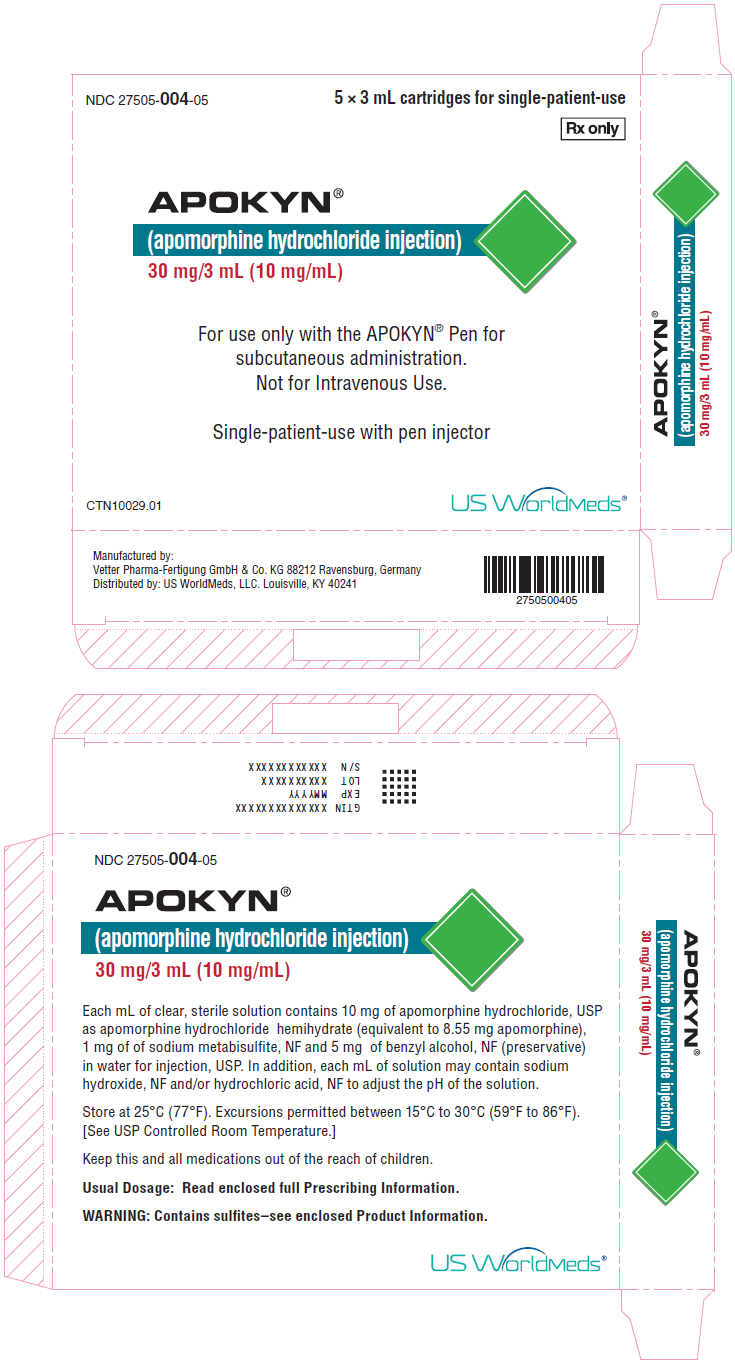
APOKYN APOMORPHINE HYDROCHLORIDE 30 mg/3mL Injection — NDC 27505-004-05 (Billing 27505-0004-05)
This is a package of APOKYN APOMORPHINE HYDROCHLORIDE 30 mg/3mL Injection from MDD US Operations, LLC, marketed since Jul 2004 and currently FDA-listed. It is this product's only package size.
NDC database record
One package, one record: these facts belong to NDC 27505-004-05 alone.
- Record
- FDA NDC Directory package listing · Human prescription drug
- Code segments
- 27505 labeler · 004 product · 05 package
- Package marketed since
- Jul 2, 2004
- Sample package
- No — commercial package
- Listing certified through
- Dec 31, 2027
- Barcode (UPC-A, from the NDC)
- 3 2750500405 1
- Medicaid fills, this package
- 38 prescriptions in the last four reported quarters
- FDA record last changed
- Oct 2, 2026
Identity & classification
Regulatory identifiers FDA, NLM and CMS codes for this package
Drug-database identifiers Medi-Span GPI and First Databank GCN / HICL / AHFS classification
- GSN (GCN sequence number): 044660
- GCN: 42078
- HICL (First Databank): 001934
- AHFS class code: 28:36.20.08
Where does this data come from?
- FDA openFDA NDC Directory · synced Oct 1, 2026
- FDA label on DailyMed · label index refreshed Oct 5, 2026
- RxNorm (NLM RxNav) · catalog refreshed Oct 1, 2026
- Medi-Span GPI (licensed)
- First Databank (licensed) · refreshed Oct 1, 2026
Clinical
Apomorphine injection is used to treat ''off'' episodes (times of difficulty moving, walking, and speaking that may happen as medication wears off or at random) in people with Parkinson's disease (PD; a disorder of the nervous system that causes difficulties with movement, muscle control, and balance). Apomorphine injection is in a class of medications called dopamine agonists. It works by acting in place of dopamine (a natural substance produced in the brain) to control movement.
Read the full MedlinePlus article ↗Patient education
Supplement & herbal interactions
Some supplements/herbs that may interact with Apomorphine Hydrochloride — tap one for details:
Where does this data come from?
- MedlinePlus (NLM) · refreshed Oct 1, 2026
- FDA label on DailyMed · label index refreshed Oct 5, 2026
Ask a licensed pharmacist directly — free, answered by our team.
Pricing
A drug doesn't have one price. Each row is a different public payment system, and none is what you'd pay at the counter — that depends on your insurance. The ⓘ on each row explains what it measures.
| Price system | Per each | Per package |
|---|---|---|
| Retail pharmacies payNADAC · weekly | Not in the retail survey — common for institutional, discontinued, or low-volume packs. | |
| Medicaid paysCMS SDUD · 12 mo | $493.18 | $2,465.92 / 5 cartridges |
| Medicare drug plans payPart D · Q2 2026 | $490.80 | $2,454.00 / 5 cartridges |
Where does this data come from?
- CMS NADAC weekly file
- CMS ASP pricing files · refreshed Sep 20, 2026
- CMS Medicaid State Drug Utilization Data · through Q1 2026
- CMS Part D plan pricing files · refreshed Sep 24, 2026
- VA National Acquisition Center price file
Packaging — all sizes for this product
| Package NDC | Description | Marketing start | Marketing end | Status |
|---|---|---|---|---|
| 27505-0004-05 You're viewing this Main listing | 5 CARTRIDGE in 1 CARTON / 3 mL in 1 CARTRIDGE | 2004-07-02 | — | Active |
Therapeutic equivalents
| Product | Labeler | Pack | NADAC/unit | TE | Status | Price vs. this |
|---|---|---|---|---|---|---|
| apomorphine hydrocloride 30 mg/3mL 52817-0720-05 | TruPharma, | 5 cartridges | — | AP | FDA listed | — |
| Apokyn 30 mg/3mLthis 27505-0004-05 | MDD | 5 cartridges | — | AP | FDA listed | — |
Where does this data come from?
- FDA openFDA NDC Directory · synced Oct 1, 2026
- FDA Orange Book · refreshed Oct 3, 2026
- CMS NADAC weekly file
Availability & generic status
The FDA lists approved generic versions of this medicine, but that does not always mean a pharmacy can get one today. Patent rules, launch agreements, supply and pricing can affect when generics actually arrive.
Where does this data come from?
- FDA Orange Book · refreshed Oct 3, 2026
Inactive Ingredients / Excipients
Inactive ingredients, also called excipients, are components of the drug product other than the active ingredient. They may include fillers, dyes, coatings, preservatives, flavors, or other formulation ingredients.
💡 Tap an ingredient (hover on desktop) to see what it is and why it’s used.
-
15 mg / 3 mL
UNII LKG8494WBH
Benzyl alcohol is a clear liquid used as a preservative and solvent in medicines. It helps prevent bacterial and fungal growth and dissolves other ingredients to create uniform liquid formulations.
-
UNII QTT17582CB
A strong acid used to adjust and maintain the proper pH level in liquid medicines, ensuring stability and preventing breakdown of active ingredients.
-
UNII 55X04QC32I
A strong alkaline chemical used to adjust and maintain the pH balance of liquid medicines. It helps keep the medicine stable and ensures it stays effective during storage.
-
3 mg / 3 mL
UNII 4VON5FNS3C
Sodium metabisulfite is a preservative derived from sulfur compounds. It prevents microbial growth and oxidation in medicines, helping extend shelf life and maintain product stability.
-
UNII 059QF0KO0R
Water is a liquid solvent that dissolves and mixes ingredients together in liquid medicines, syrups, and injections. It helps distribute the active drug evenly throughout the product.
5 inactive ingredients listed in the exact product block matched to this NDC.
Where does this data come from?
ingredient classCode="IACT" elements from the exact product block matched by this NDC. Label-section narrative from DailyMed / the openFDA label index is shown separately when available.- FDA label on DailyMed · label index refreshed Oct 5, 2026
- FDA openFDA NDC Directory · synced Oct 1, 2026
Inactive ingredient FAQ
Are inactive ingredients the same for every manufacturer?
Why might an inactive ingredient be missing?
Can inactive ingredients matter?
Manufacturer & labeler
More NDCs from MDD US Operations, LLC labeler code 27505
Where does this data come from?
- FDA openFDA NDC Directory · synced Oct 1, 2026
- Drugs@FDA
Full prescribing information FDA SPL
🎯 Indications and Usage ▾
1 INDICATIONS AND USAGE APOKYN (apomorphine hydrochloride injection) is indicated for the acute, intermittent treatment of hypomobility, "off" episodes ("end-of-dose wearing off" and unpredictable "on/off" episodes) in patients with advanced Parkinson's disease. APOKYN has been studied as an adjunct to other medications [see Clinical Studies (14) ] . APOKYN is a non-ergoline dopamine agonist indicated for the acute, intermittent treatment of hypomobility, "off" episodes ("end-of-dose wearing off" and unpredictable "on/off" episodes) associated with advanced Parkinson's disease ( 1 )
⏱️ Dosage and Administration ▾
2 DOSAGE AND ADMINISTRATION For subcutaneous use only ( 2.1 ) Always express APOKYN dose in mL to minimize dosing errors ( 2.1 ) The starting dose of APOKYN is 0.1 mL (1mg) to 0.2 mL (2 mg); give the first dose under medical supervision; titrate the dose to effect and tolerance; the maximum recommended dose is 0.6 mL (6 mg) ( 2.3 ) Treatment with trimethobenzamide is recommended, starting 3 days prior to the first dose of APOKYN. Treatment with trimethobenzamide should only be continued as long as necessary to control nausea and vomiting, and generally no longer than two months ( 2.2 , 5.2 , 6.1 , 17 ) APOKYN doses must be separated by at least 2 hours ( 2.5 ) Renal impairment: reduce test dose, and reduce starting dose to 0.1 mL (1 mg) ( 2.4 , 8.6 , 12.3 )
2.1Important Administration Instructions APOKYN is indicated for subcutaneous administration only [see Warnings and Precautions (5.1) ] and only by a multiple-dose APOKYN Pen with supplied cartridges. The initial dose and dose titrations should be performed by a healthcare provider. Blood pressure and pulse should be measured in the supine and standing position before and after dosing.
A caregiver or patient may administer APOKYN if a healthcare provider determines that it is appropriate. Instruct patients to follow the directions provided in the Patients Instructions For Use. Because the APOKYN Pen has markings in milliliters (mL), the prescribed dose of APOKYN should be expressed in mL to avoid confusion.
Visually inspect the APOKYN drug product through the viewing window for particulate matter and discoloration prior to administration. The solution should not be used if discolored (it should be colorless), or cloudy, or if foreign particles are present. Rotate the injection site and use proper aseptic technique [see How Supplied/Storage and Handling (16) and Patient Counseling Information (17) ] .
2.2Premedication and Concomitant Medication Because of the incidence of nausea and vomiting with APOKYN, it is recommended that treatment with trimethobenzamide 300 mg three times a day be started 3 days prior to the initial dose of APOKYN [see Warnings and Precautions (5.2) ] . Alternatively, consider starting APOKYN therapy at 0.1 mL (1 mg) and titrate based upon effectiveness and tolerance. If trimethobenzamide is used, it should only be continued as long as necessary to control nausea and vomiting, and generally no longer than two months after initiation of treatment with APOKYN, as trimethobenzamide increases the incidence of somnolence, dizziness, and falls in patients treated with APOKYN [see Warnings and Precautions (5.2) ] .
Based on reports of profound hypotension and loss of consciousness when apomorphine was administered with ondansetron, the concomitant use of apomorphine with drugs of the 5HT 3 antagonist class including antiemetics (for example, ondansetron, granisetron, dolasetron, palonosetron) and alosetron are contraindicated [see Contraindications (4) ].
2.3Dosing Information The recommended starting dose of APOKYN is 0.1 mL (1 mg) to 0.2 mL (2 mg). Titrate on the basis of effectiveness and tolerance, up to a maximum recommended dose of 0.6 mL (6 mg) [see Clinical Studies (14) ] . There is no evidence from controlled trials that doses greater than 0.6 mL (6 mg) gave an increased effect Reference ID: 5002510 - 3 - and therefore, individual doses above 0.6 mL (6 mg) are not recommended.
The average frequency of dosing in the development program was 3 times per day. There is limited experience with single doses greater than 0.6 mL (6 mg), dosing more than 5 times per day and with total daily doses greater than 2 mL (20 mg). Begin dosing when patients are in an "off" state.
The initial test dose should be a 0.1 mL (1 mg) or 0.2 mL (2 mg) test dose in a setting where medical personnel can closely monitor blood pressure and pulse. Both supine and standing blood pressure and pulse should be checked pre-dose and at 20 minutes, 40 minutes, and 60 minutes post-dose… [Excerpted — this section continues on DailyMed.]
💊 Dosage Forms and Strengths ▾
3 DOSAGE FORMS AND STRENGTHS APOKYN injection: 30 mg/3 mL (10 mg/mL) apomorphine hydrochloride (as apomorphine hydrochloride hemihydrate), USP as a clear, colorless, sterile, solution in a single-patient-use cartridge for use with a manual reusable pen injector (APOKYN Pen). Injection; 30 mg/3 mL (10 mg/mL) as a clear, colorless, sterile solution available in single-patient-use cartridges ( 3 , 16 )
⛔ Contraindications ▾
4 CONTRAINDICATIONS APOKYN is contraindicated in patients: Using concomitant drugs of the 5HT 3 antagonist class including antiemetics (e.g., ondansetron, granisetron, dolasetron, palonosetron) and alosetron [see Drug Interactions (7.1) ] . There have been reports of profound hypotension and loss of consciousness when APOKYN was administered with ondansetron. With hypersensitivity/allergic reaction to apomorphine or to any of the excipients of APOKYN, including a sulfite (i.e., sodium metabisulfite).
Angioedema or anaphylaxis may occur [see Warnings and Precautions (5.13) ]. Concomitant use of APOKYN with 5HT 3 antagonists, including antiemetics (e.g., ondansetron, granisetron, dolasetron, palonosetron) and alosetron, is contraindicated ( 4 ) Hypersensitivity to apomorphine, its excipients or sodium metabisulfite ( 4 , 5.13 )
⚠️ Warnings and Cautions ▾
5 WARNINGS AND PRECAUTIONS For subcutaneous use only; thrombus formation and pulmonary embolism have followed intravenous administration of APOKYN ( 5.1 ) Falling asleep during activities of daily living, and daytime somnolence may occur ( 5.3 ) Syncope and hypotension/orthostatic hypotension may occur ( 5.4 ) Falls may occur, or increase ( 5.5 ) May cause hallucinations and psychotic-like behavior ( 5.6 ) May cause dyskinesia or exacerbate pre-existing dyskinesia ( 5.7 ) May cause hemolytic anemia ( 5.8 ) May cause problems with impulse control and impulsive behaviors ( 5.9 ) May cause coronary events ( 5.10 ) May prolong QTc and cause torsades de pointes or sudden death ( 5.11 )
5.1Serious Adverse Reactions After Intravenous Administration Following intravenous administration of APOKYN, serious adverse reactions including thrombus formation and pulmonary embolism due to intravenous crystallization of apomorphine have occurred. Consequently, APOKYN should not be administered intravenously.
5.2Nausea and Vomiting Nausea and vomiting, which may be severe, can happen with APOKYN when it is administered at recommended doses. Because of this, in domestic clinical studies, 98% of all patients were premedicated with trimethobenzamide, an antiemetic, for three days prior to study enrollment, and were then encouraged to continue trimethobenzamide for at least 6 weeks. Even with the use of concomitant trimethobenzamide in clinical studies, 31% and 11% of the APOKYN-treated patients had nausea and vomiting, respectively, and 3% and 2% of the patients discontinued APOKYN due to nausea and vomiting, respectively.
Among 522 patients treated, 262 (50%) discontinued trimethobenzamide while continuing APOKYN. The average time to discontinuation of trimethobenzamide was about 2 months (range: 1 day to 33 months). For the 262 patients who discontinued trimethobenzamide, 249 patients continued apomorphine without trimethobenzamide for a duration of follow-up that averaged 1 year (range: 0 years to 3 years).
The effect of trimethobenzamide on reducing nausea and vomiting during treatment with APOKYN was evaluated in a 12-week, placebo-controlled study in 194 patients. The study suggests that trimethobenzamide reduces the incidence of nausea and vomiting during the first 4 weeks of APOKYN treatment (incidence of nausea and vomiting 43% on trimethobenzamide vs. 59% on placebo).
However, over the 12-week period, compared with placebo, patients treated with trimethobenzamide had a greater incidence of somnolence (19% for trimethobenzamide vs. 12% for placebo), dizziness (14% for trimethobenzamide vs. 8% for placebo), and falls (8% for trimethobenzamide vs.
1% for placebo). Therefore, the benefit of treatment with trimethobenzamide must be balanced with the risk for those adverse events, and treatment with trimethobenzamide should only be continued as long as necessary to control nausea and vomiting, and generally no longer than two months. The ability of concomitantly administered antiemetic drugs (other than trimethobenzamide) has not been studied.
Antiemetics with anti-dopaminergic actions (e.g., haloperidol, chlorpromazine, promethazine, prochlorperazine, metaclopramide) have the potential to worsen the symptoms in patients with Parkinson's disease and should be avoided.
5.3Falling Asleep During Activities of Daily Living and Somnolence There have been reports in the literature of patients treated with APOKYN subcutaneous injections who suddenly fell asleep without prior warning of sleepiness while engaged in activities of daily living. Somnolence is commonly associated with APOKYN, and it is reported that falling asleep while engaged in activities of daily living always occurs in a setting of pre-existing somnolence, even if patients do not give such a history. Somnolence was reported in 35% of patients treated with APOKYN and in none of the patients in the placebo group.
Prescribers should reassess patients for drowsiness or sleepiness, espec… [Excerpted — this section continues on DailyMed.]
🤒 Adverse Reactions ▾
6 ADVERSE REACTIONS The following serious adverse reactions are discussed in more detail in the Warnings and Precautions section of labeling: Serious Adverse Reactions After Intravenous Administration [see Warnings and Precautions (5.1) ] Nausea and Vomiting [see Warnings and Precautions (5.2) ] Falling Asleep During Activities of Daily Living and Somnolence [see Warnings and Precautions (5.3) ] Syncope/Hypotension/Orthostatic Hypotension [see Warnings and Precautions (5.4) ] Falls [see Warnings and Precautions (5.5) ] Hallucinations/Psychotic-Like Behavior [see Warnings and Precautions (5.6) ] Dyskinesias [see Warnings and Precautions (5.7) ] Hemolytic Anemia [see Warnings and Precautions (5.8) Impulse Control/Compulsive Behaviors [see Warnings and Precautions (5.9) ] Coronary Events [see Warnings and Precautions (5.10) ] QTc Prolongation and Potential for Proarrhythymic Effects [see Warnings and Precautions (5.11) ] Withdrawal-Emergent Hyperpyrexia and Confusion [see Warnings and Precautions (5.12) ] Hypersensitivity [see Warnings and Precautions (5.13) ] Fibrotic Complications [see Warnings and Precautions (5.14) ] Priapism [see Warnings and Precautions (5.15) ] Most common adverse reactions (incidence at least 10% greater on APOKYN than on placebo) were yawning, drowsiness/somnolence, dyskinesias, dizziness/postural hypotension, rhinorrhea, nausea and/or vomiting, hallucination/confusion, and edema/swelling of extremities ( 6.1 ) To report SUSPECTED ADVERSE REACTIONS, contact MDD US Operations, LLC at 1-877-727-6596 or FDA at 1-800-FDA-1088 or www.fda.gov/medwatch.
6.1Clinical Trials Experience Because clinical trials are conducted under widely varying conditions, the incidence of adverse reactions (number of unique patients experiencing an adverse reaction associated with treatment per total number of patients treated) observed in the clinical trials of a drug cannot be directly compared to the incidence of adverse reactions in the clinical trials of another drug and may not reflect the incidence of adverse reactions observed in practice. In placebo-controlled trials, most patients received only one subcutaneous dose of APOKYN.
All patients received concomitant levodopa and 86% received a concomitant dopamine agonist. All patients had some degree of spontaneously occurring periods of hypomobility ("off episodes") at baseline. The most common adverse reactions (APOKYN incidence at least 10% greater than placebo incidence) observed in a placebo-controlled trial were yawning, drowsiness/somnolence, dyskinesias, dizziness/postural hypotension, rhinorrhea, nausea and/or vomiting, hallucination/confusion, and edema/swelling of extremities.
Table 1 presents the most common adverse reactions reported by APOKYN-naïve Parkinson's disease patients who were enrolled in a randomized placebo-controlled, parallel group trial and who were treated for up to 4 weeks (Study 1) [see Clinical Studies (14) ] . Individual APOKYN doses in this trial ranged from 2 mg to 10 mg, and were titrated to achieve tolerability and control of symptoms. Table 1: Adverse Reactions Occurring in Two or More APOKYN-Treated Patients in Study 1 APOKYN (n = 20) PLACEBO (n = 9) % % Yawning 40 0 Dyskinesias 35 11 Drowsiness or Somnolence 35 0 Nausea and/or Vomiting 30 11 Dizziness or Postural Hypotension 20 0 Rhinorrhea 20 0 Chest Pain/Pressure/Angina 15 11 Hallucination or Confusion 10 0 Edema/Swelling of Extremities 10 0 Other Adverse Reactions Injection Site Reactions Patients treated with APOKYN subcutaneous injections during clinical studies, 26% of patients had injection site reactions, including bruising (16%), granuloma (4%), and pruritus (2%).
In addition to those in Table 1, the most common adverse reactions in pooled APOKYN trials (occurring in at least 5% of the patients) in descending order were injection site reaction, fall, arthralgia, insomnia, headache, depression, urinary tract infection, anxiety, congestive heart failure, limb pain, back pain, Pa… [Excerpted — this section continues on DailyMed.]
🔄 Drug Interactions ▾
7 DRUG INTERACTIONS Concomitant use of antihypertensive medications and vasodilators: increased risk for hypotension, myocardial infarction, pneumonia, falls, and injuries ( 7.2 ) Dopamine antagonists such as neuroleptics or metoclopramide, may diminish the effectiveness of APOKYN ( 7.4 ) 7.1 5HT 3 Antagonists Based on reports of profound hypotension and loss of consciousness when APOKYN was administered with ondansetron, the concomitant use of APOKYN with 5HT 3 antagonists including antiemetics (for example, ondansetron, granisetron, dolasetron, palonosetron) and alosetron, is contraindicated.
7.2Antihypertensive Medications and Vasodilators In clinical studies, the following adverse events were experienced more commonly in patients receiving concomitant antihypertensive medications or vasodilators (n=94) than in patients not receiving these medications (n=456): hypotension (10% vs 4%) [see Warnings and Precautions (5.4) ] , myocardial infarction (3% vs 1%), serious pneumonia (5% vs 3%), serious falls (9% vs 3%), and bone and joint injuries (6% vs 2%). Some of the events may be related to the increased incidence of hypotension in patients receiving concomitant antihypertensive medications or vasodilators [see Warnings and Precautions (5.4 , 5.5) ] .
Concomitant administration of 0.4 mg sublingual nitroglycerin with APOKYN in healthy subjects causes greater decreases in blood pressure compared to APOKYN alone. When nitroglycerin and APOKYN were concomitantly administered to healthy subjects, the mean largest decrease (the mean of each subject's largest drop in blood pressure measured within the 6-hour period following administration of APOKYN) in supine systolic and diastolic blood pressure (measured over 6 hours) was 9.7 mm Hg and 9.3 mm Hg, respectively [see Clinical Pharmacology (12.3) ].
The mean largest decrease in standing systolic and diastolic blood pressure was 14.3 mm Hg and 13.5 mm Hg, respectively. Some individuals experienced very large decreases in standing systolic and diastolic blood pressure, up to a maximum decrease of 65 mm Hg and 43 mm Hg, respectively. In comparison, the mean largest decrease in supine systolic and diastolic blood pressure when APOKYN was administered alone was 6.1 mm Hg and 7.3 mm Hg, respectively, and in standing systolic and diastolic blood pressure was 6.7 mm Hg and 8.4 mm Hg, respectively.
Patients taking APOKYN should lie down before and after taking sublingual nitroglycerin [see Warnings and Precautions (5.4) ].
7.3Alcohol Concomitant administration of high dose (0.6 g/kg) or low dose (0.3 g/kg) ethanol with APOKYN in healthy subjects causes greater decreases in blood pressure compared to APOKYN alone. When high dose ethanol and APOKYN were concomitantly administered to healthy subjects, the mean largest decrease (the mean of each subject's largest drop in blood pressure measured within the 6-hour period following administration of APOKYN) for supine systolic and diastolic blood pressure was 9.1 mm Hg and 10.5 mm Hg, respectively [see Clinical Pharmacology (12.3) ].
The mean largest standing systolic and diastolic blood pressure decrease was 11.3 mm Hg and 12.6 mm Hg, respectively. In some individuals, the decrease was as high as 61 mm Hg and 51 mm Hg, respectively, for standing systolic and diastolic blood pressure. When low dose ethanol and APOKYN were concomitantly administered, the mean largest decrease in supine systolic and diastolic blood pressure was 10.2 mm Hg and 9.9 mm Hg, respectively.
The mean largest decrease in standing systolic and diastolic blood pressure was 8.4 mm Hg and 7.1 mm Hg, respectively. In comparison, the mean largest decrease in supine systolic and diastolic blood pressure when APOKYN was administered alone was 6.1 mm Hg and 7.3 mm Hg, respectively, and in standing systolic and diastolic blood pressure was 6.7 mm Hg 8.4 mm Hg, respectively. Patients should avoid drinking alcohol after using APOKYN [see Warnings and Precautions (5.4) ].
7.4Dopamine Ant… [Excerpted — this section continues on DailyMed.]
👥 Use in Specific Populations ▾
8 USE IN SPECIFIC POPULATIONS Pregnancy: Based on animal data, may cause fetal harm ( 8.1 ) Geriatric Use: In clinical trials, patients 65 years of age and older were more likely to experience certain adverse events ( 8.5 )
8.1Pregnancy Risk Summary There are no adequate data on the developmental risk associated with use of APOKYN in pregnant women. In animal reproduction studies, apomorphine had adverse developmental effects in rats (increased neonatal deaths) and rabbits (increased incidence of malformation) when administered during pregnancy at clinically relevant doses. These doses were also associated with maternal toxicity [see Data ] .
In the U.S. general population, the estimated background risk of major birth defects and miscarriage in clinically recognized pregnancies is 2% to 4% and 15% to 20%, respectively. The background risk of major birth defects and miscarriage for the indicated population is unknown. Data Animal Data No adverse developmental effects were observed when apomorphine (0.3, 1, or 3 mg/kg/day) was administered by subcutaneous injection to pregnant rats throughout organogenesis; the highest dose tested is 1.5 times the maximum recommended human dose (MRHD) of 20 mg/day on a mg/m 2 basis.
Administration of apomorphine (0.3, 1, or 3 mg/kg/day) by subcutaneous injection to pregnant rabbits throughout organogenesis resulted in an increased incidence of malformations of the heart and/or great vessels at the mid and high doses; maternal toxicity was observed at the highest dose tested. The no-effect dose for adverse developmental effects is less than the MRHD on a mg/m 2 basis. Apomorphine (0.3, 1, or 3 mg/kg/day), administered by subcutaneous injection to females throughout gestation and lactation, resulted in increased offspring mortality at the highest dose tested, which was associated with maternal toxicity.
There were no effects on developmental parameters or reproductive performance in surviving offspring. The no-effect dose for developmental toxicity (1 mg/kg/day) is less than the MRHD on a mg/m 2 basis.
8.2Lactation Risk Summary There are no data on the presence of apomorphine in human milk, the effects of apomorphine on the breastfed infant, or the effects of apomorphine on milk production. The developmental and health benefits of breastfeeding should be considered along with the mother's clinical need for APOKYN and any potential adverse effects on the breastfed infant from APOKYN or from the underlying maternal condition.
8.4Pediatric Use Safety and effectiveness in pediatric patients have not been established.
8.5Geriatric Use In the APOKYN clinical development program, there were 239 patients less than age 65 treated with APOKYN and 311 patients who were age 65 or older. Confusion and hallucinations were reported more frequently with patients age 65 and older compared to patients with less than age 65. Serious adverse reactions (life-threatening events or events resulting in hospitalization and/or increased disability) were also more common in patients age 65 and older.
Patients age 65 and older were more likely to fall (experiencing bone and joint injuries), have cardiovascular events, develop respiratory disorders, and have gastrointestinal events. Patients age 65 and above were also more likely to discontinue APOKYN treatment as a result of one or more adverse reactions.
8.6Renal Impairment The starting APOKYN dose should be reduced in patients with mild or moderate renal impairment because the concentration and exposure (C max and AUC) are increased in these patients. Studies in subjects with severe renal impairment have not been conducted [see Dosage and Administration (2.4) and Clinical Pharmacology (12.3) ] .
8.7Hepatic Impairment Caution should be exercised when administrating APOKYN to patients with mild and moderate hepatic impairment because of the increased C max and AUC in these patients. Closely monitor patients with mild and moderate hepatic impairment. Studies of subjects… [Excerpted — this section continues on DailyMed.]
🤰 Pregnancy ▾
8.1Pregnancy Risk Summary There are no adequate data on the developmental risk associated with use of APOKYN in pregnant women. In animal reproduction studies, apomorphine had adverse developmental effects in rats (increased neonatal deaths) and rabbits (increased incidence of malformation) when administered during pregnancy at clinically relevant doses. These doses were also associated with maternal toxicity [see Data ] .
In the U.S. general population, the estimated background risk of major birth defects and miscarriage in clinically recognized pregnancies is 2% to 4% and 15% to 20%, respectively. The background risk of major birth defects and miscarriage for the indicated population is unknown. Data Animal Data No adverse developmental effects were observed when apomorphine (0.3, 1, or 3 mg/kg/day) was administered by subcutaneous injection to pregnant rats throughout organogenesis; the highest dose tested is 1.5 times the maximum recommended human dose (MRHD) of 20 mg/day on a mg/m 2 basis.
Administration of apomorphine (0.3, 1, or 3 mg/kg/day) by subcutaneous injection to pregnant rabbits throughout organogenesis resulted in an increased incidence of malformations of the heart and/or great vessels at the mid and high doses; maternal toxicity was observed at the highest dose tested. The no-effect dose for adverse developmental effects is less than the MRHD on a mg/m 2 basis. Apomorphine (0.3, 1, or 3 mg/kg/day), administered by subcutaneous injection to females throughout gestation and lactation, resulted in increased offspring mortality at the highest dose tested, which was associated with maternal toxicity.
There were no effects on developmental parameters or reproductive performance in surviving offspring. The no-effect dose for developmental toxicity (1 mg/kg/day) is less than the MRHD on a mg/m 2 basis.
🧒 Pediatric Use ▾
8.4Pediatric Use Safety and effectiveness in pediatric patients have not been established.
🧓 Geriatric Use ▾
8.5Geriatric Use In the APOKYN clinical development program, there were 239 patients less than age 65 treated with APOKYN and 311 patients who were age 65 or older. Confusion and hallucinations were reported more frequently with patients age 65 and older compared to patients with less than age 65. Serious adverse reactions (life-threatening events or events resulting in hospitalization and/or increased disability) were also more common in patients age 65 and older.
Patients age 65 and older were more likely to fall (experiencing bone and joint injuries), have cardiovascular events, develop respiratory disorders, and have gastrointestinal events. Patients age 65 and above were also more likely to discontinue APOKYN treatment as a result of one or more adverse reactions.
🆘 Overdosage ▾
10 OVERDOSAGE A 62-year-old man accidentally injected 25 mg of APOKYN subcutaneously. After 3 minutes, the patient felt nauseated and lost consciousness for 20 minutes. Afterwards, he was alert with a heart rate 40/minute and a supine blood pressure of 90/50. He recovered completely within an hour.
🧬 Clinical Pharmacology ▾
12 CLINICAL PHARMACOLOGY
12.1Mechanism of Action APOKYN is a non-ergoline dopamine agonist with high in vitro binding affinity for the dopamine D 4 receptor, and moderate affinity for the dopamine D 2 , D 3 , and D 5 , and adrenergic α 1 D, α 2 B, α 2 C receptors. The precise mechanism of action of APOKYN as a treatment for Parkinson's disease is unknown, although it is believed to be due to stimulation of post-synaptic dopamine D 2 -type receptors within the caudate-putamen in the brain.
12.2Pharmacodynamics Prolongation of the QTc Interval In a thorough QT study at exposures similar to those achieved with the recommended dosing, apomorphine resulted in a prolongation of QTcF of 10 msec (90% upper confidence interval of 16 msec). The thorough QT study also identified a significant exposure-response relationship between apomorphine concentration and QTcF. Decreases in Blood Pressure Dose-dependent mean decreases in systolic blood pressure ranged from 5 mm Hg to 16 mm Hg after administration of APOKYN 2 mg and 10 mg, respectively.
Dose-dependent mean decreases in diastolic blood pressure ranged from 3 mm Hg to 8 mm Hg after administration of APOKYN 2 mg and 10 mg, respectively. These changes were observed 20 minutes after dosing, and were maximal between 20 and 40 minutes after dosing. Lesser, but still noteworthy blood pressure decreases persisted up to at least 90 minutes after dosing.
Effects on blood pressure are additive when APOKYN is coadministered with nitroglycerin or alcohol [see Drug Interactions (7.3 , 7.4) ].
12.3Pharmacokinetics Absorption Apomorphine hydrochloride is a lipophilic compound that is rapidly absorbed (time to peak concentration ranges from 10 minutes to 60 minutes) following subcutaneous administration into the abdominal wall. After subcutaneous administration, apomorphine appears to have bioavailability equal to that of an intravenous administration. Apomorphine exhibits linear pharmacokinetics over a dose range of 2 mg to 8 mg following a single subcutaneous injection of APOKYN into the abdominal wall in patients with idiopathic Parkinson's disease.
Distribution The plasma-to-whole blood apomorphine concentration ratio is equal to one. Mean (range) apparent volume of distribution was 218 L (123 L to 404 L). Maximum concentrations in cerebrospinal fluid (CSF) are less than 10% of maximum plasma concentrations and occur 10 minutes to 20 minutes later.
Metabolism and Elimination The mean apparent clearance (range) is 223 L/hr (125 L/hr to 401 L/hr) and the mean terminal elimination half-life is about 40 minutes (range about 30 minutes to 60 minutes). The route of metabolism in humans is not known. Potential routes of metabolism in humans include sulfation, N-demethylation, glucuronidation and oxidation.
In vitro , apomorphine undergoes rapid autooxidation. Specific Populations The clearance of apomorphine does not appear to be influenced by age, gender, weight, duration of Parkinson's disease, levodopa dose, or duration of therapy. Renal Impairment In a study comparing renally-impaired subjects (moderately impaired as determined by estimated creatinine clearance) to healthy matched volunteers, the AUC 0 -∞ and C max values were increased by approximately 16% and 50%, respectively, following a single subcutaneous administration of APOKYN into the abdominal wall.
The mean time to peak concentrations and the mean terminal half-life of apomorphine were unaffected by the renal status of the individual. Studies in subjects with severe renal impairment have not been conducted. The starting dose for patients with mild or moderate renal impairment should be reduced [see Dosage and Administration (2.4) and Use in Specific Populations (8.6) ] .
Hepatic Impairment In a study comparing subjects with hepatic impairment (moderately impaired as determined by the Child-Pugh classification method) to healthy matched volunteers, the AUC 0 -∞ and C max values were increased by approximately 10% and 25%, respectively,… [Excerpted — this section continues on DailyMed.]
🧬 Mechanism of Action ▾
12.1Mechanism of Action APOKYN is a non-ergoline dopamine agonist with high in vitro binding affinity for the dopamine D 4 receptor, and moderate affinity for the dopamine D 2 , D 3 , and D 5 , and adrenergic α 1 D, α 2 B, α 2 C receptors. The precise mechanism of action of APOKYN as a treatment for Parkinson's disease is unknown, although it is believed to be due to stimulation of post-synaptic dopamine D 2 -type receptors within the caudate-putamen in the brain.
📦 How Supplied / Storage and Handling ▾
16 HOW SUPPLIED/STORAGE AND HANDLING APOKYN injection is supplied as a clear, colorless, sterile solution in cartridges, 30 mg/3 mL (10 mg/mL), for single-patient-use with a pen injector (APOKYN Pen). NDC 27505-004-05 Cartons of five 3 mL cartridges APOKYN Pen The pen injector is provided in a package with five needles and a carrying case. Store at 25°C (77°F). Excursions permitted between 15°C to 30°C (59°F to 86°F) [See USP Controlled Room Temperature]
📦 Storage and Handling ▾
Store at 25°C (77°F). Excursions permitted between 15°C to 30°C (59°F to 86°F) [See USP Controlled Room Temperature]
📋 Description ▾
11 DESCRIPTION APOKYN (apomorphine hydrochloride injection) contains apomorphine hydrochloride, a non-ergoline dopamine agonist. Apomorphine hydrochloride is chemically designated as 6aβ-Aporphine-10,11-diol hydrochloride hemihydrate with a molecular formula of C 17 H 17 NO 2 ∙ HCl ∙ ½ H 2 O. Its structural formula and molecular weight are: Figure 1: Structural Formula and Molecular Weight of Apomorphine M.W.
312.79 Apomorphine hydrochloride appears as minute, white or grayish-white glistening crystals or as white powder that is soluble in water at 80°C. APOKYN is a clear, colorless, sterile solution for subcutaneous injection and is available in 3 mL (30 mg) multi-dose cartridges. Each mL of solution contains 10 mg of apomorphine hydrochloride, USP as apomorphine hydrochloride hemihydrate (equivalent to 8.55 mg apomorphine), 1 mg of sodium metabisulfite, NF and 5 mg of benzyl alcohol, NF (preservative) in water for injection, USP.
In addition, each mL of solution may contain sodium hydroxide, NF and/or hydrochloric acid, NF to adjust the pH of the solution. Figure 1
💬 Information for Patients ▾
17 PATIENT COUNSELING INFORMATION Advise the patient to read the FDA-approved patient labeling (Patient Information and Instructions for Use) Administration with the APOKYN Pen Instruct patients and caregivers that the APOKYN Pen is dosed in milliliters, not milligrams. Inform patients and caregivers that it is possible to dial in their usual dose of APOKYN even though the cartridge may contain less than that amount of drug. In this case, they will receive only a partial dose with the injection, and the amount left to inject will appear in the dosing window.
To complete the correct dose, patients/caregivers will need to "re-arm" the device and dial in the correct amount of the remaining dose. Patients and caregivers should be alerted to the fact that there may be insufficient drug left in the cartridge to deliver a complete dose (for example, patients and caregivers should be urged to keep records of how many doses they have delivered for each cartridge, so that they can replace any cartridge that has an inadequate amount of drug remaining). Instruct patients to rotate the injection site and to observe proper aseptic technique.
Advise patients that APOKYN is intended only for subcutaneous injection and must not be given intravenously because of the risk of serious complications such as thrombus formation and pulmonary embolism due to crystallization [see Warnings and Precautions (5.1) ]. Hypersensitivity / Allergic Reactions Advise patients that hypersensitivity/allergic reaction characterized by urticaria, rash, pruritus, and/or various manifestations of angioedema may occur because of APOKYN or any of its excipients including a sulfite (i.e., sodium metabisulfite).
Inform patients with a sulfite sensitivity that they may experience various allergic-type reactions, including anaphylactic symptoms and life-threatening asthmatic attacks [see Warnings and Precautions (5.13) ]. Advise patients who experience any hypersensitivity/allergic reaction to APOKYN that they should not take APOKYN again [see Contraindications (4) ]. Nausea and Vomiting Advise patients they may experience nausea and/or vomiting, which may be severe, and that treatment with oral trimethobenzamide 300 mg 3 times per day for 3 days prior to starting APOKYN injections has been used to help minimize these symptoms.
Alternatively, starting APOKYN at a lower dose and titrating based on individual tolerance and treatment effect may be attempted. Advise patients that APOKYN taken with trimethobenzamide may increase the risks for somnolence, dizziness, and falls, and to consult their healthcare provider before discontinuing trimethobenzamide [see Warnings and Precautions (5.2) ] . Falling Asleep Suddenly and Sedation / Sleepiness Alert patients to the potential sedating effects of APOKYN, including somnolence and falling asleep while engaged in activities of daily living.
Instruct patients not to drive a car or engage in other potentially dangerous activities until they have gained sufficient experience with APOKYN to gauge whether or not it affects their mental and/or motor performance adversely. Advise patients that if increased somnolence or episodes of falling asleep during activities of daily living (e.g., watching television, passenger in a car, etc.) occur, they should not drive or participate in potentially dangerous activities until they have contacted their physician. Because of possible additive effects of alcohol use, advise patients to limit their alcohol intake [see Warnings and Precautions (5.3) ].
Hypotension / Orthostatic Hypotension Advise patients that they may develop postural (orthostatic) hypotension with or without symptoms such as dizziness, nausea, syncope, and sometimes sweating. Hypotension and/or orthostatic symptoms may occur more frequently during initial therapy or with an increase in dose at any time (cases have been seen after months of treatment). Instruct patients to rise slowly after sitting or lying down after taking APOKYN.
Info… [Excerpted — this section continues on DailyMed.]
🧬 Pharmacokinetics ▾
12.3Pharmacokinetics Absorption Apomorphine hydrochloride is a lipophilic compound that is rapidly absorbed (time to peak concentration ranges from 10 minutes to 60 minutes) following subcutaneous administration into the abdominal wall. After subcutaneous administration, apomorphine appears to have bioavailability equal to that of an intravenous administration. Apomorphine exhibits linear pharmacokinetics over a dose range of 2 mg to 8 mg following a single subcutaneous injection of APOKYN into the abdominal wall in patients with idiopathic Parkinson's disease.
Distribution The plasma-to-whole blood apomorphine concentration ratio is equal to one. Mean (range) apparent volume of distribution was 218 L (123 L to 404 L). Maximum concentrations in cerebrospinal fluid (CSF) are less than 10% of maximum plasma concentrations and occur 10 minutes to 20 minutes later.
Metabolism and Elimination The mean apparent clearance (range) is 223 L/hr (125 L/hr to 401 L/hr) and the mean terminal elimination half-life is about 40 minutes (range about 30 minutes to 60 minutes). The route of metabolism in humans is not known. Potential routes of metabolism in humans include sulfation, N-demethylation, glucuronidation and oxidation.
In vitro , apomorphine undergoes rapid autooxidation. Specific Populations The clearance of apomorphine does not appear to be influenced by age, gender, weight, duration of Parkinson's disease, levodopa dose, or duration of therapy. Renal Impairment In a study comparing renally-impaired subjects (moderately impaired as determined by estimated creatinine clearance) to healthy matched volunteers, the AUC 0 -∞ and C max values were increased by approximately 16% and 50%, respectively, following a single subcutaneous administration of APOKYN into the abdominal wall.
The mean time to peak concentrations and the mean terminal half-life of apomorphine were unaffected by the renal status of the individual. Studies in subjects with severe renal impairment have not been conducted. The starting dose for patients with mild or moderate renal impairment should be reduced [see Dosage and Administration (2.4) and Use in Specific Populations (8.6) ] .
Hepatic Impairment In a study comparing subjects with hepatic impairment (moderately impaired as determined by the Child-Pugh classification method) to healthy matched volunteers, the AUC 0 -∞ and C max values were increased by approximately 10% and 25%, respectively, following a single subcutaneous administration of APOKYN into the abdominal wall. Studies in subjects with severe hepatic impairment have not been conducted [see Dosage and Administration (2.5) and Use in Specific Populations (8.7) ] . Drug Interaction Studies Carbidopa/levodopa Levodopa pharmacokinetics were unchanged when subcutaneous APOKYN and levodopa were co-administrated in patients.
However, motor response differences were significant. The threshold levodopa concentration necessary for an improved motor response was reduced significantly, leading to an increased duration of effect without a change in the maximal response to levodopa therapy. Ethanol and Nitroglycerin Co-administration of low dose ethanol (0.3 g/kg) or nitroglycerin (0.4 mg) with APOKYN in healthy subjects did not have a significant impact on the pharmacokinetics of apomorphine, but high dose ethanol (0.6 g/kg), equivalent to approximately 3 standardized alcohol-containing beverages, increased the C max of apomorphine by about 63%.
However, the hypotensive effect of APOKYN was increased by the concomitant use of alcohol or of sublingual nitroglycerin [see Warnings and Precautions (5.4) and Drug Interactions (7.2 , 7.3) ]. Other Drugs Eliminated Via Hepatic Metabolism Based upon an in vitro study, cytochrome P450 enzymes play a minor role in the metabolism of apomorphine. In vitro studies have also demonstrated that drug interactions are unlikely due to apomorphine acting as a substrate, an inhibitor, or an inducer of cytochrome P450 enzymes.
COMT Int… [Excerpted — this section continues on DailyMed.]
🧬 Pharmacodynamics ▾
12.2Pharmacodynamics Prolongation of the QTc Interval In a thorough QT study at exposures similar to those achieved with the recommended dosing, apomorphine resulted in a prolongation of QTcF of 10 msec (90% upper confidence interval of 16 msec). The thorough QT study also identified a significant exposure-response relationship between apomorphine concentration and QTcF. Decreases in Blood Pressure Dose-dependent mean decreases in systolic blood pressure ranged from 5 mm Hg to 16 mm Hg after administration of APOKYN 2 mg and 10 mg, respectively.
Dose-dependent mean decreases in diastolic blood pressure ranged from 3 mm Hg to 8 mm Hg after administration of APOKYN 2 mg and 10 mg, respectively. These changes were observed 20 minutes after dosing, and were maximal between 20 and 40 minutes after dosing. Lesser, but still noteworthy blood pressure decreases persisted up to at least 90 minutes after dosing.
Effects on blood pressure are additive when APOKYN is coadministered with nitroglycerin or alcohol [see Drug Interactions (7.3 , 7.4) ].
🔬 Clinical Studies ▾
14 CLINICAL STUDIES The effectiveness of APOKYN in the acute symptomatic treatment of the recurring episodes of hypomobility, "off" episodes ("end-of-dose wearing off" and unpredictable "on/off" episodes), in patients with advanced Parkinson's disease was established in three randomized, controlled trials of APOKYN given subcutaneously (Studies 1, 2, and 3). At baseline in these trials, the mean duration of Parkinson's disease was approximately 11 years. Whereas all patients were using concomitant L-dopa at baseline, 86% of patients were using a concomitant oral dopaminergic agonist, 31% were using a concomitant catechol-ortho-methyl transferase (COMT) inhibitor, and 10% were using a concomitant monoamine B oxidase inhibitor.
Study 1 was conducted in patients who did not have prior exposure to APOKYN (i.e., APOKYN naïve) and Studies 2 and 3 were conducted in patients with at least 3 months of APOKYN use immediately prior to study enrollment. Almost all patients without prior exposure to APOKYN began taking an antiemetic (trimethobenzamide) three days prior to starting APOKYN and 50% of patients were able to discontinue the concomitant antiemetic, on average 2 months after initiating APOKYN. The change from baseline in Part III (Motor Examination) of the Unified Parkinson's Disease Rating Scale (UPDRS) served as the primary outcome assessment measure in each study.
Part III of the UPDRS contains 14 items designed to assess the severity of the cardinal motor findings (e.g., tremor, rigidity, bradykinesia, postural instability, etc.) in patients with Parkinson's disease. Study 1 Study 1 was a randomized, double-blind, placebo-controlled, parallel-group trial in 29 patients with advanced Parkinson's disease who had at least 2 hours of "off" time per day despite an optimized oral regimen for Parkinson's disease including levodopa and an oral dopaminergic agonist. Patients with atypical Parkinson's disease, psychosis, dementia, hypotension, or those taking dopamine antagonists were excluded from participation.
In an office setting, hypomobility was allowed to occur by withholding the patients' Parkinson's disease medications overnight. The following morning, patients (in a hypomobile state) were started on study treatment in a 2:1 ratio (2 mg of APOKYN or placebo given subcutaneously). At least 2 hours after the first dose, patients were given additional doses of study medication until they achieved a "therapeutic response" (defined as a response similar to the patient's response to their usual dose of levodopa) or until 10 mg of APOKYN or placebo equivalent was given.
At each injection re-dosing, the study drug dose was increased in 2 mg increments up to 4 mg, 6 mg, 8 mg, 10 mg of APOKYN) or placebo equivalent. Of the 20 patients randomized to APOKYN, 18 achieved a "therapeutic response" at about 20 minutes. The mean APOKYN dose was 5.4 mg (3 patients on 2 mg, 7 patients on 4 mg, 5 patients on 6 mg, 3 patients on 8 mg, and 2 patients on 10 mg).
In contrast, of the 9 placebo-treated patients, none reached a "therapeutic response." The mean change from baseline for UPDRS Part III score for APOKYN group (highest dose) was statistically significant compared to that for the placebo group (Table 2). Table 2: Mean Change from Baseline in UPDRS Motor Score for Intent-to-Treat Population in Study 1 Treatment Baseline UPDRS Motor Score Mean Change from Baseline Difference from placebo Placebo 36.3 -
0.1NA APOKYN 39.7 - 23.9 -
23.8Study 2 Study 2 used a randomized, placebo-controlled crossover design of 17 patients with Parkinson's disease who had been using APOKYN for at least 3 months. Patients received their usual morning doses of Parkinson's disease medications and were followed until hypomobility occurred, at which time they received either a single dose of subcutaneous APOKYN (at their usual dose) and placebo on different days in random order. UPDRS Part III scores were evaluated over time.
The mean dose of APOKYN was 4 mg (2 patients… [Excerpted — this section continues on DailyMed.]
🔒 Drug Abuse and Dependence ▾
9 DRUG ABUSE AND DEPENDENCE
9.2Abuse In premarketing clinical experience, APOKYN did not reveal any tendency for a withdrawal syndrome or any drug-seeking behavior. However, there are rare postmarketing reports of abuse of medications containing APOKYN or levodopa. In general, these reports consist of patients taking increasing doses of medication in order to achieve a euphoric state.
🧪 Nonclinical Toxicology ▾
13 NONCLINICAL TOXICOLOGY
13.1Carcinogenesis, Mutagenesis, Impairment of Fertility Carcinogenesis Lifetime carcinogenicity studies of apomorphine were conducted in male (0.1, 0.3, or 0.8 mg/kg/day) and female (0.3, 0.8, or 2 mg/kg/day) rats. Apomorphine was administered by subcutaneous injection for 22 months or 23 months, respectively. In males, there was an increase in Leydig cell tumors at the highest dose tested, which is less than the MRHD (20 mg) on a mg/m 2 basis.
This finding is of questionable significance because the endocrine mechanisms believed to be involved in the production of Leydig cell tumors in rats are not relevant to humans. No drug-related tumors were observed in females; the highest dose tested is similar to the MRHD on a mg/m 2 basis. In a 26-week carcinogenicity study in P53-knockout transgenic mice, there was no evidence of carcinogenic potential when apomorphine was administered by subcutaneous injection at doses up to 20 mg/kg/day (male) or 40 mg/kg/day (female).
Mutagenesis Apomorphine was mutagenic in the in vitro bacterial reverse mutation (Ames) and the in vitro mouse lymphoma tk assays. Apomorphine was clastogenic in the in vitro chromosomal aberration assay in human lymphocytes and in the in vitro mouse lymphoma tk assay. Apomorphine was negative in the in vivo micronucleus assay in mice.
Impairment of Fertility Apomorphine was administered subcutaneously at doses up to 3 mg/kg/day (approximately 1.5 times the MRHD on a mg/m 2 basis) to male and female rats prior to and throughout the mating period and continuing in females through gestation day 6. There was no evidence of adverse effects on fertility or on early fetal viability. A significant decrease in testis weight was observed in a 39-week study in cynomolgus monkey at all subcutaneous doses tested (0.3, 1, or 1.5 mg/kg/day); the lowest dose tested is less than the MRHD on a mg/m 2 basis.
In a published fertility study, apomorphine was administered to male rats at subcutaneous doses of 0.2, 0.8, or 2 mg/kg prior to and throughout the mating period. Fertility was reduced at the highest dose tested.
📄 Carcinogenesis, Mutagenesis, Impairment of Fertility ▾
13.1Carcinogenesis, Mutagenesis, Impairment of Fertility Carcinogenesis Lifetime carcinogenicity studies of apomorphine were conducted in male (0.1, 0.3, or 0.8 mg/kg/day) and female (0.3, 0.8, or 2 mg/kg/day) rats. Apomorphine was administered by subcutaneous injection for 22 months or 23 months, respectively. In males, there was an increase in Leydig cell tumors at the highest dose tested, which is less than the MRHD (20 mg) on a mg/m 2 basis.
This finding is of questionable significance because the endocrine mechanisms believed to be involved in the production of Leydig cell tumors in rats are not relevant to humans. No drug-related tumors were observed in females; the highest dose tested is similar to the MRHD on a mg/m 2 basis. In a 26-week carcinogenicity study in P53-knockout transgenic mice, there was no evidence of carcinogenic potential when apomorphine was administered by subcutaneous injection at doses up to 20 mg/kg/day (male) or 40 mg/kg/day (female).
Mutagenesis Apomorphine was mutagenic in the in vitro bacterial reverse mutation (Ames) and the in vitro mouse lymphoma tk assays. Apomorphine was clastogenic in the in vitro chromosomal aberration assay in human lymphocytes and in the in vitro mouse lymphoma tk assay. Apomorphine was negative in the in vivo micronucleus assay in mice.
Impairment of Fertility Apomorphine was administered subcutaneously at doses up to 3 mg/kg/day (approximately 1.5 times the MRHD on a mg/m 2 basis) to male and female rats prior to and throughout the mating period and continuing in females through gestation day 6. There was no evidence of adverse effects on fertility or on early fetal viability. A significant decrease in testis weight was observed in a 39-week study in cynomolgus monkey at all subcutaneous doses tested (0.3, 1, or 1.5 mg/kg/day); the lowest dose tested is less than the MRHD on a mg/m 2 basis.
In a published fertility study, apomorphine was administered to male rats at subcutaneous doses of 0.2, 0.8, or 2 mg/kg prior to and throughout the mating period. Fertility was reduced at the highest dose tested.
📄 Patient Package Insert ▾
Patient Information APOKYN ® (AY-po-kin) (apomorphine hydrochloride injection) Read this Patient Information before you start using APOKYN and each time you get a refill. There may be new information. This information does not take the place of talking to your healthcare provider about your medical condition or your treatment.
What is APOKYN? APOKYN is a prescription medicine used to treat acute, intermittent episodes of poor mobility called "off" episodes (end-of-dose wearing "off" or unpredictable "on-off" episodes) in people with advanced Parkinson's disease (PD). It is not known if APOKYN is safe and effective in children.
Who should not take APOKYN? Do not take APOKYN if you are: taking certain medicines to treat nausea called 5HT 3 antagonists including, ondansetron, granisetron, dolasetron, palonosetron, and alosetron. People taking ondansetron together with apomorphine, the active ingredient in APOKYN, have had very low blood pressure and lost consciousness or "blacked out." allergic to apomorphine hydrochloride or to any of the ingredients in APOKYN and experience hives, itching, rash, or swelling (e.g., eyes, tongue, etc.).
APOKYN also contains a sulfite called sodium metabisulfite. Sulfites can cause severe, life-threatening allergic reactions in some people. An allergy to sulfites is not the same as an allergy to sulfa.
People with asthma are more likely to be allergic to sulfites. Call your healthcare provider if you have hives, itching, rash, swelling of the eyes, tongue, lips, chest pain, trouble breathing or swallowing. See the end of this leaflet for a complete list of ingredients in APOKYN.
What should I tell my healthcare provider before taking APOKYN? Before you start using APOKYN, tell your healthcare provider if you: have difficulty staying awake during the daytime have dizziness have fainting spells have low blood pressure have asthma are allergic to any medicines containing sulfites have liver problems have kidney problems have heart problems have had a stroke or other brain problems have a mental problem called a major psychotic disorder drink alcohol are pregnant or plan to become pregnant. It is not known if APOKYN will harm your unborn baby. are breastfeeding or plan to breastfeed.
It is not known if APOKYN passes into your breast milk. You and your healthcare provider should decide if you will take APOKYN or breastfeed. You should not do both.
Tell your healthcare provider about all the medicines you take, including prescription and non-prescription medicines, vitamins, and herbal supplements. Using APOKYN with certain other medicines may affect each other. Using APOKYN with other medicines can cause serious side effects.
If you take nitroglycerin under your tongue while using APOKYN, your blood pressure may decrease and cause dizziness. After taking nitroglycerin, you should lie down and try to continue lying down for at least 45 minutes. You should avoid standing for 45 minutes after taking nitroglycerin.
Know the medicines you take. Keep a list of them to show your healthcare provider or pharmacist when you get a new medicine. How should I use APOKYN?
Read the Instructions for Use starting on page 6 of this leaflet for specific information about the right way to use APOKYN. Use APOKYN exactly as your healthcare provider tells you to use it. Your healthcare provider will tell you how much APOKYN to use and teach you the right way to use it.
Your healthcare provider may change your dose if needed. Do not change your dose of APOKYN or use it more often than prescribed unless your healthcare provider has told you to. Do not give another dose of APOKYN sooner than 2 hours after the last dose.
Your healthcare provider will prescribe APOKYN that comes in prefilled glass cartridges, for single-patient-use, that are used with a special pen injector. Your APOKYN pen is dosed in milliliters (mL), not milligrams (mg). Make sure your prescription tells you how many milliliters (mL) to use.
Inject APOKYN unde… [Excerpted — this section continues on DailyMed.]
📖 Instructions for Use ▾
APOKYN ® Pen Instructions for Use Designed to be used only with 3 mL APOKYN ® (apomorphine hydrochloride injection) Cartridges For more information, call your specialty pharmacy provider or 1-877-7APOKYN (727-6596). APOKYN ® (apomorphine hydrochloride injection) APOKYN Pen APOKYN ® (apomorphine hydrochloride injection) is for under the skin (subcutaneous) injection only. Do not inject APOKYN into a vein.
Do not use the APOKYN ® Pen unless you and your care partner have been taught the right way to use it and both of you understand all of the instructions. The APOKYN Pen is for use only with 3 mL APOKYN ® (apomorphine hydrochloride injection) Cartridges. The APOKYN Pen is only for use by 1 patient and should not be shared.
Gray Pen Cap Gray Pen Body Pen Needle Unit Cartridge a. Clip Teal Cartridge Holder b. Black Rod c.
White Dose Window d. White Dose Knob e. Teal Injection Button f.
Outer Needle Shield g. Pink Inner Needle Shield h. Pen Needle i.
Pink Paper Tab j. Rubber Septum k. Metal Cap l.
Cartridge Plunger Read First: Important Safety Information The APOKYN Pen is a medicine delivery device. It is very important that you or your care partner read this Instructions for Use and follow the instructions for using the APOKYN Pen correctly to receive the correct APOKYN dose. Always perform a flow check (prime) before every injection and after loading a new cartridge.
The liquid in the APOKYN Cartridge can cause irritation if it gets on your skin or in your eyes. Flush your eyes with cold water and wash the liquid off your skin right away if this happens. The BD pen needle unit is sterile.
Avoid contaminating the needle after opening. Do not place it on a surface or touch other items with the needle. Do not dial the dose or try to correct a dialing error with the pen needle in the skin.
You could receive the wrong dose. Be careful when removing the needle. Accidental needle sticks can transmit serious infections.
Never store or carry the APOKYN Pen with a pen needle attached. Never recap pen with needle attached. Storing or carrying the APOKYN Pen with a pen needle attached may let: Air enter the cartridge Medicine leak out This can affect your APOKYN dose.
The APOKYN Pen should only be used with pen needles (29G × 1/2"). These needles are available through your specialty pharmacy provider or your local pharmacy. You must use a new, sterile BD pen needle with each injection.
Magnification: 50× How to Use the APOKYN Pen Preparing the APOKYN Pen for Cartridge Loading Step 1. Remove the gray pen cap by pulling it straight off. Step 2.
Unscrew the teal cartridge holder from the gray pen body by turning it clockwise. Loading a Cartridge Step 3. Only use APOKYN that is clear and colorless.
Do not use an APOKYN Cartridge that contains medicine that is cloudy, green, or contains particles. Call your specialty pharmacy provider for replacement cartridges. Insert the APOKYN Cartridge, metal cap first, into the teal cartridge holder.
Step 4. Lower the gray pen body onto the teal cartridge holder so that the black rod presses against the cartridge plunger. Screw the teal cartridge holder onto the gray pen body.
Tighten the pieces by turning the teal cartridge holder clockwise until no gap remains and 1 of the white arrows line up with the white marker on the gray pen body. Step 5. If you already have a cartridge in the pen and have used the pen, you should check the cartridge through the window in the teal cartridge holder to make sure there is enough APOKYN solution in the cartridge to provide your next dose.
If the gray cartridge plunger has reached the red line on the cartridge, remove the cartridge and insert a new cartridge into the pen before attaching the pen needle and preparing the dose. Attaching the Pen Needle Step 6. Remove the pink paper tab from the back of a new pen needle.
Use a new needle for each injection. Never reuse needles. Step 7.
Holding the APOKYN Pen by the teal cartridge holder, push the pen needle unit onto the p… [Excerpted — this section continues on DailyMed.]
📄 Recent Major Changes ▾
Dosage and Administration ( 2.2 , 2.3 ) 06/2022 Warnings and Precautions, Hemolytic Anemia ( 5.8 ) 05/2022
📄 Package Label / Principal Display Panel ▾
PRINCIPAL DISPLAY PANEL - 30 mg/3 mL Cartridge Carton NDC 27505-004-05 5 × 3 mL cartridges for single-patient-use Rx only APOKYN ® (apomorphine hydrochloride injection) 30 mg/3 mL (10 mg/mL) For use only with the APOKYN ® Pen for subcutaneous administration. Not for Intravenous Use. Single-patient-use with pen injector CTN10029.01 MDD US Operations, LLC ® PRINCIPAL DISPLAY PANEL - 30 mg/3 mL Cartridge Carton
Medicaid utilization & spend
Medicare Part D spend CMS · PART D · 2026 (Q1)
About this NDC listing & data coverage
What data is (and isn’t) available for this NDC — tap to expand
| NDC identity (package / product / labeler codes) | ✓ Available |
| Labeler | ✓ Available |
| Product & package description | ✓ Available |
| Marketing category & status | ✓ Available |
| Active ingredient / dosage form / route | ✓ Available |
| FDA label (SPL via DailyMed) | ✓ Available |
| Package photos | ✓ Available |
| Inactive ingredients (structured) | ✓ Available |
| NADAC pharmacy acquisition price (CMS) | — Not published for this NDC CMS publishes NADAC only for NDCs reported in its retail-pharmacy survey. |
| Orange Book / therapeutic-equivalence data | ✓ Available |
| HCPCS J-code billing crosswalk | — Not published for this NDC Most self-administered / retail products have no J-code — that is normal. |
| Medicaid utilization (CMS SDUD) | ✓ Available |