
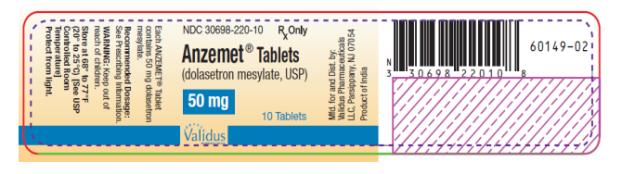
ANZEMET dolasetron mesylate 50 mg Tablet, Film Coated, 10-count
🆔 Identity & classification
Where does this data come from?
🏭 Manufacturer & labeler
Where does this data come from?
🩺 Clinical
Dolasetron is used to prevent nausea and vomiting caused by cancer chemotherapy. Dolasetron is in a class of medications called serotonin 5-HT3 receptor antagonists. It works by blocking the action of serotonin, a natural substance that may cause nausea and vomiting.
Read the full MedlinePlus article ↗- Anzemet is used to prevent the nausea and vomiting that chemotherapy can cause — it's not a pain reliever or a treatment for the cancer itself. You take it by mouth about one hour...
- What exactly is Anzemet for, and when do I take it?
- Good news — food doesn't affect how well Anzemet is absorbed, so you can take it with or without a meal. Whatever is easiest on your stomach that day is fine. Just try to take it a...
- Can I take Anzemet with food, or does it need to be on an empty stomach?
Patient education
Supplement & herbal interactions
Where does this data come from?
Ask a licensed pharmacist directly — free, answered by our team.
💊 What it looks like
Where does this data come from?
🧪 Inactive Ingredients / Excipients
Inactive ingredients, also called excipients, are components of the drug product other than the active ingredient. They may include fillers, dyes, coatings, preservatives, flavors, or other formulation ingredients.
💡 Tap an ingredient (hover on desktop) to see what it is and why it’s used.
-
UNII M28OL1HH48
Croscarmellose sodium is a plant-based substance derived from cellulose. It acts as a disintegrant, helping tablets and capsules break down quickly in the digestive system so the medicine can be absorbed.
-
UNII 1K09F3G675
Ferric oxide red is an inorganic iron compound used as a colorant in medicines. It gives tablets, capsules, or other dosage forms a red or reddish tint for identification and appearance.
-
UNII 3NXW29V3WO
Hypromellose is a plant-based thickener made from cellulose. It's used in medicines as a binder to hold ingredients together, a coating for tablets, and a thickener for liquids.
-
UNII J2B2A4N98G
Lactose is a natural sugar derived from milk. In medications, it serves as a filler and binder to add bulk and help hold tablet or capsule ingredients together during manufacturing.
-
UNII 70097M6I30
Magnesium stearate is a salt made from magnesium and stearic acid, a fatty substance. It's used in tablets and capsules as a lubricant and glidant to help ingredients flow smoothly during manufacturing and prevent sticking.
-
UNII 3WJQ0SDW1A
Polyethylene glycol is a synthetic liquid or solid polymer used in medicines as a solvent, lubricant, and humectant. It helps dissolve active ingredients, reduces friction during manufacturing, and retains moisture in the final product.
-
UNII 6OZP39ZG8H
Polysorbate 80 is a synthetic emulsifier derived from sorbitol and oleic acid. It helps mix oil and water-based ingredients together in medications and improves how the product disperses in the body.
-
UNII O8232NY3SJ
A plant-based carbohydrate derived from corn kernels. It acts as a filler to add bulk, a binder to hold ingredients together, and a disintegrant to help the tablet break apart in your stomach for absorption.
-
UNII 15FIX9V2JP
Titanium dioxide is a bright white mineral powder commonly used as a colorant and opacifying agent. It makes pills and tablets white or lighter in color and helps make coatings non-transparent.
9 inactive ingredients listed in the exact product block matched to this NDC.
Where does this data come from?
ingredient classCode="IACT" elements from the exact product block matched by this NDC. Label-section narrative from DailyMed / the openFDA label index is shown separately when available.Inactive ingredient FAQ
Are inactive ingredients the same for every manufacturer?
Why might an inactive ingredient be missing?
Can inactive ingredients matter?
💲 Pricing
A drug doesn't have one price. Each row is a different public payment system, and none is what you'd pay at the counter — that depends on your insurance. The ⓘ on each row explains what it measures.
| Price system | Per each | Per package |
|---|---|---|
| Retail pharmacies payNADAC · weekly | Not in the retail survey — common for institutional, discontinued, or low-volume packs. | |
| Medicaid paysCMS SDUD · 12 mo | No recent Medicaid claims on file for this NDC — rare and low-volume NDCs are suppressed in the public data. | |
| Medicare drug plans payPart D · quarterly | No Part D plan price is available for this NDC in our data. | |
Where does this data come from?
🔁 Therapeutic equivalents
| Product | Labeler | Pack | NADAC/unit | TE | Status | Price vs. this |
|---|---|---|---|---|---|---|
| Anzemet 50 mgthis 30698-0220-10 | Validus | 10 tablets | — | — | Discontinued | — |
Where does this data come from?
⏳ Availability & generic status
We did not find an FDA-approved generic match for this exact strength, form and route.
Where does this data come from?
📦 Packaging — all sizes for this product
| Package NDC | Description | Marketing start | Status |
|---|---|---|---|
| 30698-0220-10 You're viewing this | 10 TABLET, FILM COATED in 1 BOTTLE (30698-220-10) | 1997-09-11 | Inactivated by FDA |
🧭 About this NDC listing & data coverage
What data is (and isn’t) available for this NDC — tap to expand
| NDC identity (package / product / labeler codes) | ✓ Available |
| Labeler | ✓ Available |
| Product & package description | ✓ Available |
| Marketing category & status | ✓ Available |
| Active ingredient / dosage form / route | ✓ Available |
| FDA label (SPL via DailyMed) | ✓ Available |
| Package photos | ✓ Available |
| Inactive ingredients (structured) | ✓ Available |
| NADAC pharmacy acquisition price (CMS) | — Not published for this NDC CMS publishes NADAC only for NDCs reported in its retail-pharmacy survey. |
| Orange Book / therapeutic-equivalence data | — Not published for this NDC Applies only to products approved under an NDA/ANDA; many listings are out of scope. |
| HCPCS J-code billing crosswalk | — Not published for this NDC Most self-administered / retail products have no J-code — that is normal. |
| Medicaid utilization (CMS SDUD) | — Not published for this NDC CMS reports utilization only for NDCs with Medicaid claims above its privacy threshold. |
Questions about this listing
Why is there no price listed?
What does the discontinued status mean for this NDC?
Is the NDC printed on the package the same as the 11-digit billing NDC?
What do the three segments of this NDC mean?
Who lists this product with the FDA?
Do I need a prescription for this product?
Where does this data come from?
📄 Full prescribing information FDA SPL
🎯 Indications and Usage ▾
INDICATIONS AND USAGE ANZEMET Tablets are indicated for the prevention of nausea and vomiting associated with moderately emetogenic cancer chemotherapy, including initial and repeat courses in adults and children 2 years and older.
⏱️ Dosage and Administration ▾
DOSAGE AND ADMINISTRATION The recommended doses of ANZEMET Tablets should not be exceeded. Adults The recommended oral dosage of ANZEMET (dolasetron mesylate) is 100 mg given within one hour before chemotherapy. Pediatric Patients The recommended oral dosage in pediatric patients 2 to 16 years of age is 1.8 mg/kg given within one hour before chemotherapy, up to a maximum of 100 mg.
Safety and effectiveness in pediatric patients under 2 years of age have not been established. In children for whom 100 mg is not appropriate based on their weight or ability to swallow tablets, the ANZEMET Injection solution may be mixed into apple or apple-grape juice for oral dosing in pediatric patients. The diluted product may be kept up to 2 hours at room temperature before use.
However, ANZEMET Injection solution when administered intravenously is contraindicated in adult and pediatric patients for the prevention of nausea and vomiting associated with initial and repeat courses of emetogenic cancer chemotherapy due to dose dependent QT prolongation. Use in the Elderly, Renal Failure Patients, or Hepatically Impaired Patients No dosage adjustment is recommended, however; ECG monitoring is recommended for elderly and renally impaired patients (see WARNINGS and CLINICAL PHARMACOLOGY, Pharmacokinetics in Humans ).
⛔ Contraindications ▾
CONTRAINDICATIONS ANZEMET Tablets are contraindicated in patients known to have hypersensitivity to the drug.
⚠️ Warnings ▾
WARNINGS QT Interval Prolongation ANZEMET prolongs the QT interval in a dose dependent fashion. Torsade de Pointes has been reported during post-marketing experience. Avoid ANZEMET in patients with congenital long QT syndrome, hypomagnesemia, or hypokalemia.
Hypokalemia and hypomagnesemia must be corrected prior to ANZEMET administration. Monitor these electrolytes after administration as clinically indicated. Use ECG monitoring in patients with congestive heart failure, bradycardia, renal impairment, and elderly patients (see CLINICAL PHARMACOLOGY ).
PR and QRS Interval Prolongation ANZEMET has been shown to cause dose dependent prolongation of the PR and QRS interval and reports of second or third degree atrioventricular block, cardiac arrest and serious ventricular arrhythmias including fatalities in both adult and pediatric patients. At particular risk are patients with underlying structural heart disease and preexisting conduction system abnormalities, elderly, patients with sick sinus syndrome, patients with atrial fibrillation with slow ventricular response, patients with myocardial ischemia or patients receiving drugs known to prolong the PR interval (such as verapamil) and QRS interval (e.g., flecainide or quinidine).
ANZEMET should be used with caution and with ECG monitoring in these patients. ANZEMET should be avoided in patients with complete heart block or at risk for complete heart block, unless they have an implanted pacemaker (see CLINICAL PHARMACOLOGY ). Serotonin Syndrome The development of serotonin syndrome has been reported with 5-HT 3 receptor antagonists.
Most reports have been associated with concomitant use of serotonergic drugs (e.g., selective serotonin re-uptake inhibitors (SSRIs), serotonin and norepinephrine re-uptake inhibitors (SNRIs), monoamine oxidase inhibitors, mirtazapine, fentanyl, lithium, tramadol, and intravenous methylene blue). Some of the reported cases were fatal. Serotonin syndrome occurring with overdose of another 5-HT 3 receptor antagonist alone has also been reported.
The majority of reports of serotonin syndrome related to 5-HT 3 receptor antagonist use occurred in a post-anesthesia care unit or an infusion center. Symptoms associated with serotonin syndrome may include the following combination of signs and symptoms: mental status changes (e.g., agitation, hallucinations, delirium, and coma), autonomic instability (e.g., tachycardia, labile blood pressure, dizziness, diaphoresis, flushing, hyperthermia), neuromuscular symptoms (e.g., tremor, rigidity, myoclonus, hyperreflexia, incoordination), seizures, with or without gastrointestinal symptoms (e.g., nausea, vomiting, diarrhea).
Patients should be monitored for the emergence of serotonin syndrome, especially with concomitant use of Anzemet and other serotonergic drugs. If symptoms of serotonin syndrome occur, discontinue Anzemet and initiate supportive treatment. Patients should be informed of the increased risk of serotonin syndrome, especially if Anzemet is used concomitantly with other serotonergic drugs (see DRUG INTERACTIONS , Patient Counseling Information ).
🤒 Adverse Reactions ▾
ADVERSE REACTIONS In controlled clinical trials, 943 adult cancer patients received ANZEMET Tablets. These patients were receiving concurrent chemotherapy, predominantly cyclophosphamide and doxorubicin regimens. The following adverse events were reported in ≥2% of patients receiving either ANZEMET 25 mg or ANZEMET 100 mg tablets for prevention of cancer chemotherapy induced nausea and vomiting in controlled clinical trials (Table 3 ).
Table 3. Adverse Events ≥2% from Chemotherapy-Induced Nausea and Vomiting Studies ANZEMET Event 25 mg (N=235) 100 mg (N=227) Headache 42 (17.9%) 52 (22.9%) Fatigue 6 (2.6%) 13 (5.7%) Diarrhea 5 (2.1%) 12 (5.3%) Bradycardia 12 (5.1%) 9 (4.0%) Dizziness 3 (1.3%) 7 (3.1%) Pain 0 7 (3.1%) Tachycardia 7 (3.0%) 6 (2.6%) Dyspepsia 7 (3.0%) 5 (2.2%) Chills/Shivering 3 (1.3%) 5 (2.2%) In clinical trials, the following reported adverse events, assessed by investigators as treatment-related or causality unknown, occurred following oral or intravenous administration of ANZEMET in < 2% of adult patients receiving concomitant cancer chemotherapy: Cardiovascular: Hypotension; edema, peripheral edema.
The following events also occurred and with a similar frequency as placebo and/or active comparator: Mobitz I AV block, chest pain, orthostatic hypotension, myocardial ischemia, syncope, severe bradycardia, and palpitations. See PRECAUTIONS section for information on potential effects on ECG. In addition, the following asymptomatic treatment-emergent ECG changes were seen at rates less than or equal to those for active or placebo controls: bradycardia, T-wave change, ST-T wave change, sinus arrhythmia, extrasystole (APCs or VPCs), poor R-wave progression, bundle branch block (left and right), nodal arrhythmia, U wave change, atrial flutter/fibrillation.
Furthermore, severe hypotension, bradycardia and syncope have been reported immediately or closely following IV administration. Dermatologic: Rash, increased sweating. Gastrointestinal System: Constipation, dyspepsia, abdominal pain, anorexia; pancreatitis.
Hearing, Taste and Vision: Taste perversion, abnormal vision, tinnitus, photophobia. Hematologic: Hematuria, epistaxis, prothrombin time prolonged, PTT increased, anemia, purpura/hematoma, thrombocytopenia. Hypersensitivity: Anaphylactic reaction, facial edema, urticaria.
Liver and Biliary System: Transient increases in AST (SGOT) and/or ALT (SGPT) values have been reported as adverse events in less than 1% of adult patients receiving ANZEMET in clinical trials. The increases did not appear to be related to dose or duration of therapy and were not associated with symptomatic hepatic disease. Similar increases were seen with patients receiving active comparator.
Hyperbilirubinemia, increased GGT. Metabolic and Nutritional: Alkaline phosphatase increased. Musculoskeletal: Myalgia, arthralgia.
Nervous System: Flushing, vertigo, paresthesia, tremor; ataxia, twitching. Psychiatric: Agitation, sleep disorder, depersonalization; confusion, anxiety, abnormal dreaming. Respiratory System: Dyspnea, bronchospasm.
Urinary System: Dysuria, polyuria, acute renal failure. Vascular (Extracardiac): Local pain or burning on IV administration; peripheral ischemia, thrombophlebitis/phlebitis. Post - marketing Experience: There are reports of wide complex tachycardia or ventricular tachycardia and of ventricular fibrillation cardiac arrest following intravenous administration.
To report SUSPECTED ADVERSE REACTIONS, contact Validus Pharmaceuticals LLC at 1-866-982-5438 or FDA at 1-800-FDA-1088 or www.fda.gov/medwatch.
🔄 Drug Interactions ▾
Drug Interactions The potential for clinically significant drug-drug interactions posed by dolasetron and hydrodolasetron appears to be low for drugs commonly used in chemotherapy because hydrodolasetron is eliminated by multiple routes. See PRECAUTIONS, General for information about potential interaction with other drugs that prolong the QT c interval. When oral dolasetron (200 mg once daily) was co-administered with cimetidine (300 mg four times daily) for 7 days, the systemic exposure (i.e., AUC) of hydrodolasetron increased by 24% and the maximum plasma concentration of hydrodolasetron increased by 15%.
When oral dolasetron (200 mg once daily) was co-administered with rifampin (600 mg once daily) for 7 days, the systemic exposure of hydrodolasetron decreased by 28% and the maximum plasma concentration of hydrodolasetron decreased by 17%. Caution should be exercised when ANZEMET is co-administered with drugs, including those used in chemotherapy, that prolong ECG intervals and/or cause hypokalemia or hypomagnesemia (see WARNINGS ). In patients taking furosemide, nifedipine, diltiazem, ACE inhibitors, verapamil, glyburide, propranolol, and various chemotherapy agents, no effect was shown on the clearance of hydrodolasetron.
Clearance of hydrodolasetron decreased by about 27% when dolasetron mesylate was administered intravenously concomitantly with atenolol. Dolasetron mesylate did not inhibit the antitumor activity of four chemotherapeutic agents (cisplatin, 5-fluorouracil, doxorubicin, cyclophosphamide) in four murine models. Serotonin syndrome (including altered mental status, autonomic instability, and neuromuscular symptoms) has been described following the concomitant use of 5-HT 3 receptor antagonists and other serotonergic drugs, including selective serotonin re-uptake inhibitors (SSRIs) and serotonin and noradrenaline re-uptake inhibitors (SNRIs).
🤰 Pregnancy ▾
Pregnancy: Teratogenic Effects. Teratology studies have not revealed evidence of impaired fertility or harm to the fetus due to dolasetron mesylate. These studies have been performed in pregnant rats at oral doses up to 100 mg/kg/day (8 times the recommended human dose based on body surface area) and pregnant rabbits at oral doses up to 100 mg/kg/day (16 times the recommended human dose based on body surface area).
There are, however, no adequate and well-controlled studies in pregnant women. Because animal reproduction studies are not always predictive of human response, this drug should be used during pregnancy only if clearly needed.
🧓 Geriatric Use ▾
Geriatric Use Elderly patients are at particular risk for prolongation of the PR, QRS, and QT interval; therefore, caution should be exercised and ECG monitoring should be performed when using ANZEMET in this population (see WARNINGS ). In controlled clinical trials in the prevention of chemotherapy-induced nausea and vomiting, 301 (29%) of 1026 patients were 65 years of age or older. Of the 301 geriatric patients in the trial, 282 received oral ANZEMET Tablets.
No overall differences in safety or effectiveness were observed between geriatric and younger patients, and other reported clinical experience has not identified differences in responses between geriatric and younger patients, but greater sensitivity of some older individuals cannot be ruled out. The pharmacokinetics, including clearance of oral ANZEMET Tablets, in elderly and younger patients are similar (see CLINICAL PHARMACOLOGY, Pharmacokinetics in Humans ). Dosage adjustment is not needed in patients over the age of 65.
🆘 Overdosage ▾
OVERDOSAGE There is no known specific antidote for dolasetron mesylate, and patients with suspected overdose should be managed with supportive therapy. Individual doses as large as 5 mg/kg intravenously or 400 mg orally have been safely given to healthy volunteers or cancer patients. Following a suspected overdose of ANZEMET Injection, a patient found to have second-degree or higher AV conduction block with ECG should undergo cardiac telemetry monitoring.
It is not known if dolasetron mesylate is removed by hemodialysis or peritoneal dialysis. Single intravenous doses of dolasetron mesylate at 160 mg/kg in male mice and 140 mg/kg in female mice and rats of both sexes (6.3 to 12.6 times the recommended human dose based on body surface area) were lethal. Symptoms of acute toxicity were tremors, depression and convulsions.
A 59-year-old man with metastatic melanoma and no known pre-existing cardiac conditions developed severe hypotension and dizziness 40 minutes after receiving a 15 minute intravenous infusion of 1000 mg (13 mg/kg) of dolasetron mesylate. Treatment for the overdose consisted of infusion of 500 mL of a plasma expander, dopamine, and atropine. The patient had normal sinus rhythm and prolongation of PR, QRS and QT c intervals on an ECG recorded 2 hours after the infusion.
The patient’s blood pressure was normal 3 hours after the event and the ECG intervals returned to baseline on follow-up. The patient was released from the hospital 6 hours after the event.
🧬 Clinical Pharmacology ▾
CLINICAL PHARMACOLOGY Dolasetron mesylate and its active metabolite, hydrodolasetron (MDL 74,156), are selective serotonin 5-HT 3 receptor antagonists not shown to have activity at other known serotonin receptors and with low affinity for dopamine receptors. The serotonin 5-HT 3 receptors are located on the nerve terminals of the vagus in the periphery and centrally in the chemoreceptor trigger zone of the area postrema. It is thought that chemotherapeutic agents produce nausea and vomiting by releasing serotonin from the enterochromaffin cells of the small intestine, and that the released serotonin then activates 5-HT 3 receptors located on vagal efferents to initiate the vomiting reflex.
In healthy volunteers (N=64), dolasetron mesylate in single intravenous doses up to 5 mg/kg produced no effect on pupil size or meaningful changes in EEG tracings. Results from neuropsychiatric tests revealed that dolasetron mesylate did not alter mood or concentration. Multiple daily doses of dolasetron have had no effect on colonic transit in humans.
Dolasetron has no effect on plasma prolactin concentrations. Effects on Electrocardiogram QTcF interval was evaluated in a randomized, placebo and active (moxifloxacin 400 mg once-daily) controlled crossover study in 80 healthy adults, with 14 measurements over 24 hours on Day 4. The maximum mean (95% upper confidence bound) differences in QTcF from placebo after baseline-correction were 14.1 (16.1) ms and 36.6 (38.6) ms for 100 mg and supratherapeutic 300 mg ANZEMET, administered intravenously, respectively.
ANZEMET 300 mg once daily resulted in approximately 3-fold higher mean C max values of dolasetron mesylate and its active metabolite hydrodolasetron on Day 4 compared to those observed with the therapeutic 100 mg ANZEMET dose. Based on exposure-response analysis in healthy volunteers, QTc interval prolongations appear to be associated with concentrations of hydrodolasetron. Using the established exposure-response relationship, the mean predicted increase (95% upper prediction interval) in QTcF intervals were 16.0 (17.1) ms and 17.9 (19.1) ms for renally impaired and elderly subjects following an oral dose of 100 mg.
In the thorough QT study, exposure dependent prolongation of the PR and QRS interval was also noted in healthy subjects receiving ANZEMET. The maximum mean (95% upper confidence bound) difference in PR from placebo after baseline-correction was 9.8 (11.6) ms and 33.1 (34.9) ms for 100 mg and supratherapeutic 300 mg ANZEMET, respectively. The maximum mean (95% upper confidence bound) difference in QRS from placebo after baseline-correction was 3.5 (4.5) ms and 13 (14.5) ms for 100 mg and supratherapeutic 300 mg ANZEMET, respectively.
Over one-fourth of the subjects treated with the 300 mg dose had an absolute PR over 200 ms and absolute QRS of over 110 ms post-treatment. A change from baseline ≥ 25% was noted in several of these subjects ( see WARNINGS ) . Pharmacokinetics in Humans Oral dolasetron is well absorbed, although parent drug is rarely detected in plasma due to rapid and complete metabolism to the most clinically relevant species, hydrodolasetron.
The reduction of dolasetron to hydrodolasetron is mediated by a ubiquitous enzyme, carbonyl reductase. Cytochrome P-450 (CYP) 2D6 is primarily responsible for the subsequent hydroxylation of hydrodolasetron and both CYP3A and flavin monooxygenase are responsible for the N-oxidation of hydrodolasetron. Hydrodolasetron is excreted in the urine unchanged (61.0% of administered oral dose).
Other urinary metabolites include hydroxylated glucuronides and N-oxide. Hydrodolasetron appears rapidly in plasma, with a maximum concentration occurring approximately 1 hour after dosing, and is eliminated with a mean half-life of 8.1 hours (%CV=18%) and an apparent clearance of 13.4 mL/min/kg (%CV=29%) in 30 adults. The apparent absolute bioavailability of oral dolasetron, determined by the major active metabolite hydrodolasetron, is appro…
📦 How Supplied / Storage and Handling ▾
HOW SUPPLIED ANZEMET ® Tablets (dolasetron mesylate , USP ) Strength Quantity NDC Number Description 50 mg 10 ct Bottle 30698-220-10 Light pink, film coated, round tablet debossed with “A” on one side and “50” on the other. Store at 68° to 77°F (20° to 25°C) [See USP Controlled Room Temperature]. Protect from light.
📋 Description ▾
DESCRIPTION ANZEMET (dolasetron mesylate, USP) is an antinauseant and antiemetic agent. Chemically, dolasetron mesylate is (2α,6α,8α,9aß)-octahydro-3-oxo-2,6-methano-2 H -quinolizin-8-yl-1 H -indole-3-carboxylate monomethanesulfonate, monohydrate. It is a highly specific and selective serotonin subtype 3 (5-HT 3 ) receptor antagonist both in vitro and in vivo .
Dolasetron mesylate has the following structural formula: The empirical formula is C 19 H 20 N 2 O 3 • CH 3 SO 3 H • H 2 O, with a molecular weight of 438.50. Approximately 74% of dolasetron mesylate monohydrate is dolasetron base. Dolasetron mesylate monohydrate is a white to off-white powder that is freely soluble in water and propylene glycol, slightly soluble in ethanol, and slightly soluble in normal saline.
Each ANZEMET Tablet for oral administration contains dolasetron mesylate (as the monohydrate) and also contains the inactive ingredients: croscarmellose sodium, hypromellose, lactose, magnesium stearate, polyethylene glycol, polysorbate 80, pregelatinized starch, synthetic red iron oxide, and titanium dioxide. See the source image
💬 Information for Patients ▾
PATIENT COUNSELING INFORMATION Patients should be informed that ANZEMET may cause serious cardiac arrhythmias such as QT prolongation or heart block. Patients should be instructed to tell their health care provider right away if they perceive a change in their heart rate, if they feel lightheaded, or if they have a syncopal episode. Patients should be informed that the chances of developing serious cardiac arrhythmias such as QT prolongation and Torsade de Pointes or heart block are higher in the following people: Patients with a personal or family history of abnormal heart rhythms, such as congenital long QT syndrome Patients with a personal history of sick sinus syndrome, atrial fibrillation with slow ventricular response or myocardial ischemia Patients who take medications that may prolong the PR interval, such as certain antihypertensives or medications that may prolong the QRS interval, such as antiarrythmic medications Patients who take medications, such as diuretics, which may cause electrolyte abnormalities Patients with hypokalemia or hypomagnesemia.
Some types of chemotherapy cause hypokalemia and hypomagnesemia Elderly patients and renally impaired patients ANZEMET should be avoided in these patients, since they may be more at risk for cardiac arrhythmias such as QT prolongation and Torsade de Pointes. Advise patients of the possibility of serotonin syndrome with concomitant use of Anzemet and another serotonergic agent such as medications to treat depression and migraines. Advise patients to seek immediate medical attention if the following symptoms occur: changes in mental status, autonomic instability, neuromuscular symptoms with or without gastrointestinal symptoms.
Prescribing Information as of June 2021 Manufactured for and Distributed by: Validus Pharmaceuticals LLC Parsippany, NJ 07054 [email protected] www.validuspharma.com 1-866-982-5438 Product of India © 2021 Validus Pharmaceuticals LLC 60035-08 June 2021