
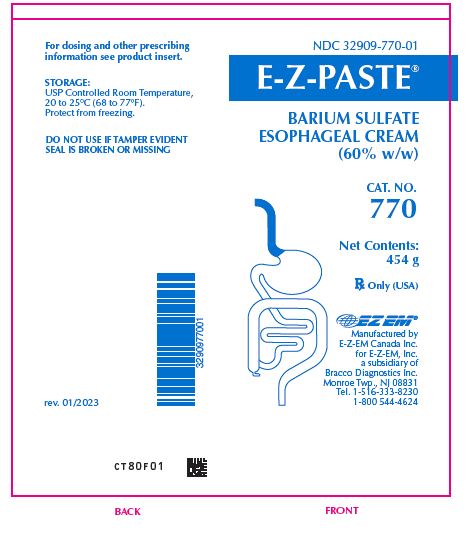
E-Z-Paste Barium Sulfate .6 g/g Cream
🆔 Identity & classification
Where does this data come from?
🏭 Manufacturer & labeler
Where does this data come from?
🩺 Clinical
- Barium sulfate blocks X-rays, so when you drink it, it coats the inside of your esophagus, stomach, and intestines and makes them light up clearly on the scan or X-ray image. Witho...
- Why do I have to drink barium before my scan? What does it actually do?
- Your body doesn't absorb barium sulfate — it passes straight through your digestive tract and comes out in your stool, usually within a day or two. You may notice your stool looks...
- Will it stay in my body? Is it safe to swallow?
Patient education
Supplement & herbal interactions
Some supplements/herbs that may interact with Barium Sulfate — tap one for details:
Where does this data come from?
Ask a licensed pharmacist directly — free, answered by our team.
💊 What it looks like
Where does this data come from?
🧪 Inactive Ingredients / Excipients
Inactive ingredients, also called excipients, are components of the drug product other than the active ingredient. They may include fillers, dyes, coatings, preservatives, flavors, or other formulation ingredients.
💡 Tap an ingredient (hover on desktop) to see what it is and why it’s used.
-
UNII XF417D3PSL
Anhydrous citric acid is a sour, crystalline powder derived from citric acid with water removed. In medicines, it acts as a buffer to control pH, adds tartness to improve taste, and helps tablets disintegrate.
-
UNII K679OBS311
Carboxymethylcellulose sodium is a plant-derived thickening agent made from cellulose. In medicines, it acts as a binder to hold ingredients together, a disintegrant to help the tablet break apart, or a thickener in liquids.
-
UNII MCU2324216
A silicone-based oil that reduces foaming and helps ingredients mix evenly. It's used as an antifoaming agent and lubricant in tablets, capsules, and liquid formulations.
-
UNII 2Y53S6ATLU
Dimethicone 350 is a silicone-based oil. It works as a lubricant and anti-foaming agent to help the medicine flow smoothly during manufacturing and reduce unwanted bubbles in the final product.
-
UNII YC9ST449YJ
Ethyl vanillin is a synthetic vanilla flavoring compound. It's added to medicines to mask bitter or unpleasant tastes, making them easier to take.
-
UNII PDC6A3C0OX
Glycerin is a clear, thick liquid derived from plant oils or fats. It acts as a humectant to retain moisture, a sweetener, and a solvent in medications.
-
UNII A2I8C7HI9T
Methylparaben is a preservative derived from benzoic acid that prevents growth of bacteria, fungi, and mold in medicines. It extends the product's shelf life and maintains safety during storage.
-
UNII Z8IX2SC1OH
Propylparaben is a chemical preservative used to prevent bacterial and fungal growth in medicines and personal care products. It helps extend shelf life and maintain product safety during storage.
-
UNII SB8ZUX40TY
Saccharin sodium is an artificial sweetener made from saccharin salt. It's added to medicines to improve taste, especially in liquid formulations for children or bitter drugs.
-
UNII ETJ7Z6XBU4
Silicon dioxide is a naturally occurring mineral used as a glidant and anti-caking agent. It helps powder ingredients flow smoothly and prevents clumping during manufacturing and storage.
-
UNII 506T60A25R
Sorbitol is a natural sugar alcohol derived from glucose. It serves as a sweetener, humectant, and bulking agent in medications to improve taste and help maintain moisture in the product.
-
UNII B22547B95K
A salt derived from citric acid that helps maintain the proper acid-base balance in the medicine. It's used as a buffer to keep the product stable and at the right pH level.
-
UNII 059QF0KO0R
Water is a liquid solvent that dissolves and mixes ingredients together in liquid medicines, syrups, and injections. It helps distribute the active drug evenly throughout the product.
13 inactive ingredients listed in the exact product block matched to this NDC.
Label-section wording can be broader than the structured product block and may mention additional formulation ingredients.
Where does this data come from?
ingredient classCode="IACT" elements from the exact product block matched by this NDC. Label-section narrative from DailyMed / the openFDA label index is shown separately when available.Inactive ingredient FAQ
Are inactive ingredients the same for every manufacturer?
Why might an inactive ingredient be missing?
Can inactive ingredients matter?
💲 Pricing
A drug doesn't have one price. Each row is a different public payment system, and none is what you'd pay at the counter — that depends on your insurance. The ⓘ on each row explains what it measures.
| Price system | Per g | Per package |
|---|---|---|
| Retail pharmacies payNADAC · weekly | Not in the retail survey — common for institutional, discontinued, or low-volume packs. | |
| Medicaid paysCMS SDUD · 12 mo | No recent Medicaid claims on file for this NDC — rare and low-volume NDCs are suppressed in the public data. | |
| Medicare drug plans payPart D · quarterly | No Part D plan price is available for this NDC in our data. | |
Where does this data come from?
🔁 Therapeutic equivalents
| Product | Labeler | Pack | NADAC/unit | TE | Status | Price vs. this |
|---|---|---|---|---|---|---|
| E-Z-Paste .6 g/gthis 32909-0770-01 | E-Z-EM | 1 tube | — | — | Discontinued | — |
Where does this data come from?
⏳ Availability & generic status
We did not find an FDA-approved generic match for this exact strength, form and route.
Where does this data come from?
📦 Packaging — all sizes for this product
| Package NDC | Description | Marketing start | Status |
|---|---|---|---|
| 32909-0770-01 You're viewing this | 1 TUBE in 1 BOX (32909-770-01) / 454 g in 1 TUBE | 1974-06-01 | Discontinued by firm |
🧭 About this NDC listing & data coverage
Listed without an FDA application
This product's marketing category indicates it is marketed without an approved FDA application (no NDA, ANDA, or BLA on file). Having an NDC does not by itself establish FDA approval — the NDC Directory is a listing system, not an approval decision. Approval-linked data such as Orange Book therapeutic-equivalence ratings therefore does not apply.
What data is (and isn’t) available for this NDC — tap to expand
| NDC identity (package / product / labeler codes) | ✓ Available |
| Labeler | ✓ Available |
| Product & package description | ✓ Available |
| Marketing category & status | ✓ Available |
| Active ingredient / dosage form / route | ✓ Available |
| FDA label (SPL via DailyMed) | ✓ Available |
| Package photos | ✓ Available |
| Inactive ingredients (structured) | ✓ Available |
| NADAC pharmacy acquisition price (CMS) | — Not published for this NDC CMS publishes NADAC only for NDCs reported in its retail-pharmacy survey. |
| Orange Book / therapeutic-equivalence data | — Not published for this NDC Applies only to products approved under an NDA/ANDA; many listings are out of scope. |
| HCPCS J-code billing crosswalk | — Not published for this NDC Most self-administered / retail products have no J-code — that is normal. |
| Medicaid utilization (CMS SDUD) | — Not published for this NDC CMS reports utilization only for NDCs with Medicaid claims above its privacy threshold. |
Questions about this listing
Is this NDC FDA-approved?
Why is there no price listed?
What does the discontinued status mean for this NDC?
Is the NDC printed on the package the same as the 11-digit billing NDC?
What do the three segments of this NDC mean?
Who lists this product with the FDA?
Do I need a prescription for this product?
Where does this data come from?
📄 Full prescribing information FDA SPL
🎯 Indications and Usage ▾
INDICATIONS AND USAGE For use in single contrast radiography of the esophagus, pharynx, hypopharynx and for cardiac series.
⏱️ Dosage and Administration ▾
DOSAGE AND ADMINISTRATION Usual dose is one to four teaspoons as required.
⛔ Contraindications ▾
CONTRAINDICATIONS This product should not be used in patients with known gastric or intestinal perforation or hypersensitivity to barium sulfate products.
⚠️ Warnings ▾
WARNINGS Rarely, severe allergic reactions of an anaphylactoid nature, have been reported following administration of barium sulfate contrast agents. Appropriately trained personnel and facilities should be available for emergency treatment of severe reactions and should remain available for at least 30 to 60 minutes following administration, since delayed reactions can occur.
🤒 Adverse Reactions ▾
ADVERSE REACTIONS Adverse reactions, such as nausea, vomiting, diarrhea and abdominal cramping, accompanying the use of barium sulfate formulations are infrequent and usually mild. Severe reactions (approximately 1 in 1,000,000) and fatalities (approximately 1 in 10,000,000) have occurred. Procedural complications are rare, but may include aspiration pneumonitis, barium sulfate impaction, granuloma formation, intravasation, embolization and peritonitis following intestinal perforation, vasovagal and syncopal episodes, and fatalities.
It is of the utmost importance to be completely prepared to treat any such occurrence.
🔄 Drug Interactions ▾
Drug Interactions The presence of barium sulfate formulations in the GI tract may alter the absorption of therapeutic agents taken concomitantly. In order to minimize any potential change in absorption, the separate administration of barium sulfate from that of other agents should be considered.
🤰 Pregnancy ▾
Usage in Pregnancy Radiation is known to cause harm to the unborn fetus exposed in utero. Therefore, radiographic procedures should only be used when, in the judgement of the physician, its use is deemed essential to the welfare of the pregnant patient.
🆘 Overdosage ▾
OVERDOSAGE On rare occasions following repeated administration, severe stomach cramps, nausea, vomiting, diarrhea or constipation may occur. These are transitory in nature and are not considered serious. Symptoms may be treated according to currently accepted standards of medical care.
🧬 Clinical Pharmacology ▾
CLINICAL PHARMACOLOGY Barium sulfate, due to its high molecular density is opaque to x-rays and, therefore, acts as a positive contrast agent for radiographic studies. Barium sulfate is biologically inert and therefore, is not absorbed or metabolized by the body, and is eliminated unchanged from the body.
📦 How Supplied / Storage and Handling ▾
HOW SUPPLIED E-Z-PASTE ® is supplied in the following quantity: 454 g Tube, Cat. No. 770; NDC 32909-770-01 Manufactured by E-Z-EM Canada Inc. for E-Z-EM, Inc. a subsidiary of Bracco Diagnostics Inc. Monroe Township, NJ 08831 Tel: 1-516-333-8230 1-800 544-4624 rev. 10/17 CL80E01 TX1887
📦 Storage and Handling ▾
Storage Store product at USP Controlled Room Temperature, 20 to 25°C (68 to 77°F). Protect from freezing.
🧪 Inactive Ingredients ▾
Inactive Ingredients: carboxymethylcellulose sodium, citric acid, ethyl vanillin, glycerin, methylparaben, propylparaben, purified water, saccharin sodium, simethicone emulsion, sodium citrate, and sorbitol solution.
📋 Description ▾
DESCRIPTION E-Z-PASTE ® Barium Sulfate Esophageal Cream (60% w/w) is a barium sulfate cream for oral administration. Each 100 g contains 60 g barium sulfate. Barium sulfate, due to its high molecular density is opaque to x-rays and, therefore, acts as a positive contrast agent for radiographic studies.
The active ingredient is barium sulfate and its structural formula is BaSO 4 . Barium sulfate occurs as a fine, white, odorless, tasteless, bulky powder which is free from grittiness. Its aqueous suspensions are neutral to litmus.
It is practically insoluble in water, solutions of acids and alkalies, and organic solvents. Inactive Ingredients: carboxymethylcellulose sodium, citric acid, ethyl vanillin, glycerin, methylparaben, propylparaben, purified water, saccharin sodium, simethicone emulsion, sodium citrate, and sorbitol solution.
💬 Information for Patients ▾
Information for Patients Before administration of this product patients should be instructed to: Inform their physician if they are pregnant. Inform their physician if they are allergic to any drugs or food, or if they have had any prior reactions to barium sulfate products or other contrast agents used in x-ray procedures (see PRECAUTIONS-General ). Inform their physician about any other medications they are currently taking.