
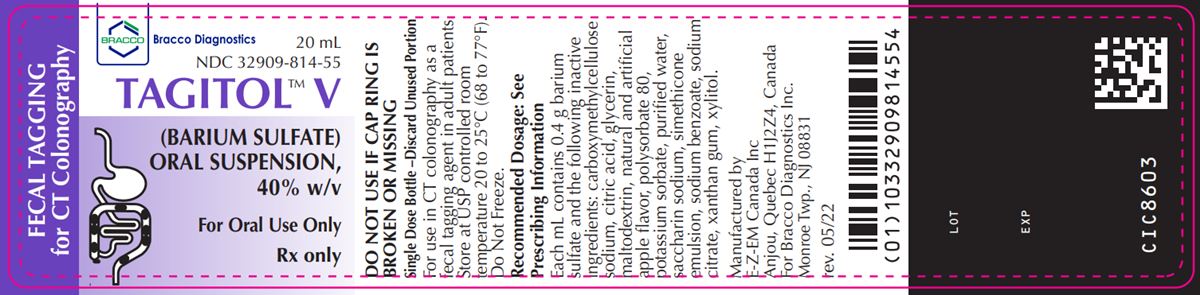
Tagitol V Barium Sulfate 400 mg/mL Suspension
🆔 Identity & classification
Where does this data come from?
🏭 Manufacturer & labeler
Where does this data come from?
🩺 Clinical
- Barium sulfate blocks X-rays, so when you drink it, it coats the inside of your esophagus, stomach, and intestines and makes them light up clearly on the scan or X-ray image. Witho...
- Why do I have to drink barium before my scan? What does it actually do?
- Your body doesn't absorb barium sulfate — it passes straight through your digestive tract and comes out in your stool, usually within a day or two. You may notice your stool looks...
- Will it stay in my body? Is it safe to swallow?
Patient education
Supplement & herbal interactions
Some supplements/herbs that may interact with Barium Sulfate — tap one for details:
Where does this data come from?
Ask a licensed pharmacist directly — free, answered by our team.
💊 What it looks like
Where does this data come from?
🧪 Inactive Ingredients / Excipients
Inactive ingredients, also called excipients, are components of the drug product other than the active ingredient. They may include fillers, dyes, coatings, preservatives, flavors, or other formulation ingredients.
💡 Tap an ingredient (hover on desktop) to see what it is and why it’s used.
-
UNII XF417D3PSL
Anhydrous citric acid is a sour, crystalline powder derived from citric acid with water removed. In medicines, it acts as a buffer to control pH, adds tartness to improve taste, and helps tablets disintegrate.
-
UNII K679OBS311
Carboxymethylcellulose sodium is a plant-derived thickening agent made from cellulose. In medicines, it acts as a binder to hold ingredients together, a disintegrant to help the tablet break apart, or a thickener in liquids.
-
UNII MCU2324216
A silicone-based oil that reduces foaming and helps ingredients mix evenly. It's used as an antifoaming agent and lubricant in tablets, capsules, and liquid formulations.
-
UNII 2Y53S6ATLU
Dimethicone 350 is a silicone-based oil. It works as a lubricant and anti-foaming agent to help the medicine flow smoothly during manufacturing and reduce unwanted bubbles in the final product.
-
UNII PDC6A3C0OX
Glycerin is a clear, thick liquid derived from plant oils or fats. It acts as a humectant to retain moisture, a sweetener, and a solvent in medications.
-
UNII 7CVR7L4A2D
A starch-derived carbohydrate produced by breaking down corn, potato, or tapioca starch. It functions as a filler and binder to give the medicine bulk and texture, and sometimes as a mild sweetener or texture enhancer in powders and tablets.
-
UNII 6OZP39ZG8H
Polysorbate 80 is a synthetic emulsifier derived from sorbitol and oleic acid. It helps mix oil and water-based ingredients together in medications and improves how the product disperses in the body.
-
UNII 1VPU26JZZ4
Potassium sorbate is a salt derived from sorbic acid, a naturally occurring preservative. It prevents growth of mold, yeast, and some bacteria, extending the medicine's shelf life.
-
UNII SB8ZUX40TY
Saccharin sodium is an artificial sweetener made from saccharin salt. It's added to medicines to improve taste, especially in liquid formulations for children or bitter drugs.
-
UNII ETJ7Z6XBU4
Silicon dioxide is a naturally occurring mineral used as a glidant and anti-caking agent. It helps powder ingredients flow smoothly and prevents clumping during manufacturing and storage.
-
UNII OJ245FE5EU
Sodium benzoate is a salt derived from benzoic acid, a preservative. It's added to medicines to prevent growth of bacteria, fungi, and other microorganisms that could spoil the product.
-
UNII B22547B95K
A salt derived from citric acid that helps maintain the proper acid-base balance in the medicine. It's used as a buffer to keep the product stable and at the right pH level.
-
UNII 059QF0KO0R
Water is a liquid solvent that dissolves and mixes ingredients together in liquid medicines, syrups, and injections. It helps distribute the active drug evenly throughout the product.
-
UNII TTV12P4NEE
Xanthan gum is a thickening and stabilizing ingredient made from fermented corn or other sugars. It's added to medicines to improve texture, prevent separation of liquids and solids, and help the product stay consistent.
-
UNII VCQ006KQ1E
Xylitol is a naturally occurring sugar alcohol derived from plants. It's used in medicines as a sweetener, bulking agent, and to improve taste, especially in liquid formulations and chewable tablets.
15 inactive ingredients listed in the exact product block matched to this NDC.
Where does this data come from?
ingredient classCode="IACT" elements from the exact product block matched by this NDC. Label-section narrative from DailyMed / the openFDA label index is shown separately when available.Inactive ingredient FAQ
Are inactive ingredients the same for every manufacturer?
Why might an inactive ingredient be missing?
Can inactive ingredients matter?
💲 Pricing
A drug doesn't have one price. Each row is a different public payment system, and none is what you'd pay at the counter — that depends on your insurance. The ⓘ on each row explains what it measures.
| Price system | Per mL | Per package |
|---|---|---|
| Retail pharmacies payNADAC · weekly | Not in the retail survey — common for institutional, discontinued, or low-volume packs. | |
| Medicaid paysCMS SDUD · 12 mo | No recent Medicaid claims on file for this NDC — rare and low-volume NDCs are suppressed in the public data. | |
| Medicare drug plans payPart D · quarterly | No Part D plan price is available for this NDC in our data. | |
Where does this data come from?
🔁 Therapeutic equivalents
| Product | Labeler | Pack | NADAC/unit | TE | Status | Price vs. this |
|---|---|---|---|---|---|---|
| Varibar Thin Honey 400 mg/mL 32909-0121-07 | E-Z-EM | 1 bottle | — | — | FDA listed | — |
| Varibar Honey 400 mg/mL 32909-0122-07 | E-Z-EM | 1 bottle | — | — | FDA listed | — |
| Tagitol V 400 mg/mLthis 32909-0814-53 | E-Z-EM | 3 bottles | — | — | FDA listed | — |
| Varibar Nectar 400 mg/mL 32909-0116-00 | E-Z-EM | 240 ml | — | — | FDA listed | — |
Where does this data come from?
⏳ Availability & generic status
We did not find an FDA-approved generic match for this exact strength, form and route.
Where does this data come from?
📦 Packaging — all sizes for this product
| Package NDC | Description | Marketing start | Status |
|---|---|---|---|
| 32909-0814-53 You're viewing this | 24 BOX in 1 CASE (32909-814-53) / 3 BOTTLE, PLASTIC in 1 BOX / 20 mL in 1 BOTTLE, PLASTIC | 2017-08-04 | Active |
| 32909-0814-55 | 24 BOX in 1 CASE (32909-814-55) / 3 BOTTLE, GLASS in 1 BOX / 20 mL in 1 BOTTLE, GLASS | 2022-10-01 | Active |
Pack size FAQ
What quantity is in NDC 32909-0814-53?
What NDC number is used to bill for this package of Tagitol V Barium Sulfate 400 mg/mL Suspension?
🧭 About this NDC listing & data coverage
What data is (and isn’t) available for this NDC — tap to expand
| NDC identity (package / product / labeler codes) | ✓ Available |
| Labeler | ✓ Available |
| Product & package description | ✓ Available |
| Marketing category & status | ✓ Available |
| Active ingredient / dosage form / route | ✓ Available |
| FDA label (SPL via DailyMed) | ✓ Available |
| Package photos | ✓ Available |
| Inactive ingredients (structured) | ✓ Available |
| NADAC pharmacy acquisition price (CMS) | — Not published for this NDC CMS publishes NADAC only for NDCs reported in its retail-pharmacy survey. |
| Orange Book / therapeutic-equivalence data | — Not published for this NDC Applies only to products approved under an NDA/ANDA; many listings are out of scope. |
| HCPCS J-code billing crosswalk | — Not published for this NDC Most self-administered / retail products have no J-code — that is normal. |
| Medicaid utilization (CMS SDUD) | — Not published for this NDC CMS reports utilization only for NDCs with Medicaid claims above its privacy threshold. |
Questions about this listing
Why is there no price listed?
Is the NDC printed on the package the same as the 11-digit billing NDC?
What do the three segments of this NDC mean?
Is this package still being marketed?
Does this product come in other package sizes?
Who lists this product with the FDA?
Do I need a prescription for this product?
Where does this data come from?
📄 Full prescribing information FDA SPL
🎯 Indications and Usage ▾
1 INDICATIONS AND USAGE TAGITOL V is indicated for use in adult patients for use in computed tomography (CT) colonography as a fecal tagging agent. TAGITOL V is a radiographic contrast agent indicated in adult patients for use in computed tomography (CT) colonography as a fecal tagging agent ( 1 )
⏱️ Dosage and Administration ▾
2 DOSAGE AND ADMINISTRATION The recommended dose is: One 20 mL bottle (8g barium sulfate) with each meal (breakfast, lunch and dinner) the day before the CT colonography examination ( 2.1 ). Total dose = 3 bottles (24 g barium sulfate) For oral use only ( 2.2 ).
2.1Recommended Dosing The recommended oral dose of TAGITOL V is one 20 mL bottle (8 g barium sulfate) with each meal (breakfast, lunch and dinner) the day before the colonography examination. Total dose = 3 bottles (24 g barium sulfate).
2.2Important Administration Instructions TAGITOL V is typically provided to the patient for self-administration. Advise patients to carefully read and follow the Patient Instructions for Use to be provided to the patient. Shake bottle for 15 seconds prior to administration. For oral use only. Encourage patients to hydrate following the barium sulfate procedure. Discard any unused suspension.
💊 Dosage Forms and Strengths ▾
3 DOSAGE FORMS AND STRENGTHS Oral suspension: barium sulfate (40% w/v) supplied as a ready-to-use suspension in a 20 mL, single-dose, bottle for oral administration. Each 20 mL bottle contains 8 g of barium sulfate. Oral suspension : barium sulfate (40% w/v) 20 mL single dose bottles as a ready to use suspension for oral administration ( 3 )
⛔ Contraindications ▾
4 CONTRAINDICATIONS TAGITOL V is contraindicated in patients with: - known or suspected perforation of the gastrointestinal (GI) tract; - known obstruction of the GI tract; - high risk of GI perforation such as those with a recent GI perforation, acute GI hemorrhage or ischemia, toxic megacolon, severe ileus, post GI surgery or biopsy, acute GI injury or burn, or recent radiotherapy to the pelvis; - high risk of aspiration such as those with prior aspiration, tracheo-esophageal fistula, or obtundation; - known hypersensitivity to barium sulfate or any of the excipients of TAGITOL V.
TAGITOL V is contraindicated in patients with: Known or suspected perforation of the gastrointestinal (GI) tract ( 4 ) Known obstruction of the GI tract ( 4 ) Conditions associated with high risk of GI perforation or aspiration ( 4 ) Known hypersensitivity to barium sulfate or any of the excipients of TAGITOL V ( 4 )
⚠️ Warnings and Cautions ▾
5 WARNINGS AND PRECAUTIONS Hypersensitivity reactions: Emergency equipment and trained personnel should be immediately available ( 5.1 ) Intra-abdominal barium leakage: May occur in conditions which increase the risk of perforation such as - carcinoma, GI fistula, inflammatory bowel disease, gastric or duodenal ulcer, appendicitis, diverticulitis, or severe stenosis or obstructing lesions of the GI tract ( 5.2 ) Delayed GI transit and obstruction: Patients should maintain adequate hydration in days following a barium sulfate procedure to avoid obstruction or impaction by baroliths ( 5.3 ) Aspiration pneumonitis: Caution is recommended in patients with a history of food aspiration and in patients with known swallowing disorders ( 5.4 )
5.1Hypersensitivity Reactions Barium sulfate preparations contain a number of excipients, including natural and artificial flavors and may induce serious hypersensitivity reactions. The manifestations include hypotension, bronchospasm and other respiratory impairments, dermal reactions including rashes, urticaria and itching. A history of bronchial asthma, atopy, or a previous reaction to a contrast agent may increase the risk for hypersensitivity reactions.
Emergency equipment and trained personnel should be immediately available for treatment of a hypersensitivity reaction.
5.2Intra-abdominal Barium Leakage The use of TAGITOL V is contraindicated in patients at high risk of perforation of the GI tract [see Contraindications ( 4 )]. Administration of TAGITOL V may result in leakage of barium from the GI tract in the presence of conditions that increase the risk of perforation such as carcinomas, GI fistula, inflammatory bowel disease, gastric or duodenal ulcer, appendicitis, or diverticulitis, and in patients with a severe stenosis at any level of the gastrointestinal tract, especially if it is distal to the stomach.
The barium leakage has been associated with peritonitis and granuloma formation.
5.3Delayed Gastrointestinal Transit and Obstruction Orally administered barium sulfate may accumulate proximal to a constricting lesion of the colon, causing obstruction or impaction with development of baroliths (inspissated barium associated with feces) and may lead to abdominal pain, appendicitis, bowel obstruction, or rarely perforation. Patients with the following conditions are at higher risk for developing obstruction or baroliths: severe stenosis at any level of the GI tract, impaired gastrointestinal motility, electrolyte imbalance, dehydration, on a low residue diet, on medications that delay GI motility, constipation, cystic fibrosis, Hirschsprung disease, and the elderly.
To reduce the risk of delayed GI transit and obstruction, patients should maintain adequate hydration following a barium sulfate procedure.
5.4Aspiration Pneumonitis The use of TAGITOL V is contraindicated in patients at high risk of aspiration [see Contraindications ( 4 )]. Oral administration of barium is associated with aspiration pneumonitis, especially in patients with a history of food aspiration or with compromised swallowing mechanism. Vomiting following oral administration of barium sulfate may lead to aspiration pneumonitis.
5.5Systemic Embolization Barium sulfate products may occasionally intravasate into the venous drainage of the large bowel and enter the circulation as a "barium embolus" leading to potentially fatal complications which include systemic and pulmonary embolism, disseminated intravascular coagulation, septicemia and prolonged severe hypotension. Although this complication is exceedingly uncommon after oral administration of barium sulfate products, monitor patients for potential intravasation when administering barium sulfate.
🤒 Adverse Reactions ▾
6 ADVERSE REACTIONS The following adverse reactions have been identified from spontaneous reporting or clinical studies of barium sulfate administered orally. Because the reactions are reported voluntarily from a population of uncertain size, it is not always possible to reliably estimate their frequency or to establish a causal relationship to drug exposure: Nausea, vomiting, diarrhea and abdominal cramping Serious adverse reactions and fatalities include aspiration pneumonitis, barium sulfate impaction, intestinal perforation with consequent peritonitis and granuloma formation, vasovagal and syncopal episodes.
Common adverse reactions include nausea, vomiting, diarrhea and abdominal cramping ( 6 ) To report SUSPECTED ADVERSE REACTIONS, contact Bracco Diagnostics Inc at 1-800-257-5181 or FDA at 1-800-FDA-1088 or www.fda.gov/medwatch
👥 Use in Specific Populations ▾
8 USE IN SPECIFIC POPULATIONS
8.1Pregnancy Risk Summary TAGITOL V is not absorbed systemically following oral administration, and maternal use is not expected to result in fetal exposure to the drug [see Clinical Pharmacology ( 12.3 )] .
8.2Lactation Risk Summary TAGITOL V is not absorbed systemically by the mother following oral administration and breastfeeding is not expected to result in exposure of the infant to the drug [see Clinical Pharmacology ( 12.3 )]
8.4Pediatric Use TAGITOL V is not indicated for pediatric use.
8.5Geriatric Use Clinical studies of TAGITOL V do not include sufficient numbers of subjects aged 65 and over to determine whether they respond differently from younger subjects. Other reported clinical experience has not identified differences in responses between the elderly and younger patients. In general, dose selection for an elderly patient should be cautious, usually starting at the low end of the dosing range, reflecting the greater frequency of decreased hepatic, renal, or cardiac function, and of concomitant disease or other drug therapy.
🤰 Pregnancy ▾
8.1Pregnancy Risk Summary TAGITOL V is not absorbed systemically following oral administration, and maternal use is not expected to result in fetal exposure to the drug [see Clinical Pharmacology ( 12.3 )] .
🧒 Pediatric Use ▾
8.4Pediatric Use TAGITOL V is not indicated for pediatric use.
🧓 Geriatric Use ▾
8.5Geriatric Use Clinical studies of TAGITOL V do not include sufficient numbers of subjects aged 65 and over to determine whether they respond differently from younger subjects. Other reported clinical experience has not identified differences in responses between the elderly and younger patients. In general, dose selection for an elderly patient should be cautious, usually starting at the low end of the dosing range, reflecting the greater frequency of decreased hepatic, renal, or cardiac function, and of concomitant disease or other drug therapy.
🧬 Clinical Pharmacology ▾
12 CLINICAL PHARMACOLOGY
12.1Mechanism of Action Due to its high atomic number, barium (the active ingredient in TAGITOL V) is opaque to x-rays and therefore acts as a positive contrast agent for radiographic studies.
12.2Pharmacodynamics Barium sulfate is biologically inert and has no known pharmacological effects.
12.3Pharmacokinetics Under physiological conditions, barium sulfate passes through the gastrointestinal tract in an unchanged form and is absorbed only in pharmacologically insignificant amounts.
🧬 Mechanism of Action ▾
12.1Mechanism of Action Due to its high atomic number, barium (the active ingredient in TAGITOL V) is opaque to x-rays and therefore acts as a positive contrast agent for radiographic studies.
📦 How Supplied / Storage and Handling ▾
16 HOW SUPPLIED/STORAGE AND HANDLING
16.1How Supplied TAGITOL V (barium sulfate) is an oral suspension (40% w/v) supplied as a box of three 20 mL bottles. Each bottle contains 8 grams barium sulfate. Provided as: 24 boxes, each containing 3 (20 mL) bottles (NDC 32909-814)
16.2Storage and Handling Store at room temperature 20° to 25°C (68° to 77°F) [See USP Controlled Room Temperature]. Do Not Freeze.
📋 Description ▾
11 DESCRIPTION TAGITOL V (barium sulfate) is a radiographic contrast agent that is supplied as a 40% w/v, off-white to lightly colored, free-flowing, ready-to-use suspension with an apple aroma for oral administration. The active ingredient barium sulfate is designated chemically as BaSO 4 with a molecular weight of 233.4 g/mol and the following chemical structure: TAGITOL V contains the following excipients: carboxymethylcellulose sodium, citric acid, glycerin, maltodextrin, natural and artificial apple flavor, polysorbate 80, potassium sorbate, purified water, saccharin sodium, simethicone emulsion, sodium benzoate, sodium citrate, xanthan gum, and xylitol. barium-sulfate-structure
💬 Information for Patients ▾
17 PATIENT COUNSELING INFORMATION After administration, advise patients to: Maintain adequate hydration [see Dosage and Administration ( 2.2 ) and Warnings and Precautions ( 5.3 )] . Seek medical attention for worsening of constipation or slow gastrointestinal passage [see Warnings and Precautions ( 5.3 )] . Seek medical attention for any delayed onset of hypersensitivity: rash, urticaria, or respiratory difficulty [see Warnings and Precautions ( 5.1 )] .
Administration Instructions TAGITOL V is typically provided to the patient for self-administration. Advise patients to carefully read and follow the Patient Instructions for Use to be provided to the patient. Provide the patient with any site specific instructions regarding their procedure and when to take meals.
Rx only Manufactured by EZEM Canada Inc Anjou (Quebec) Canada H1J 2Z4 For Bracco Diagnostics Inc. Princeton, NJ 08540 rev. 02/2025