
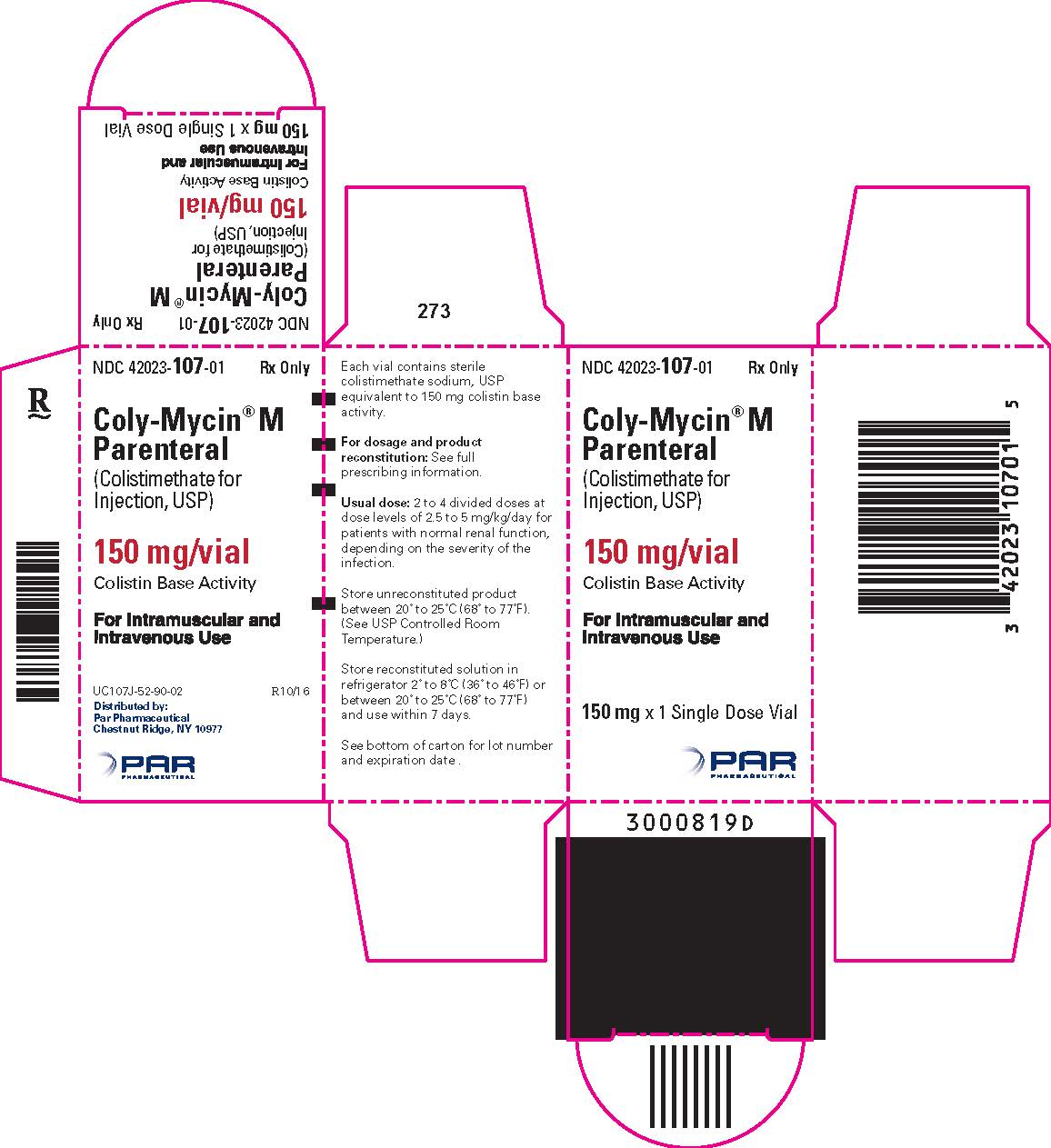
Coly-Mycin M colistimethate 150 mg/2mL Injection — NDC 42023-107-01 (Billing 42023-0107-01)
This is a package of Coly-Mycin M colistimethate 150 mg/2mL Injection from Par Health USA, LLC, marketed since Nov 2007 and currently FDA-listed, this package's marketing is listed to end May 2027. It is this product's only package size.
NDC database record
One package, one record: these facts belong to NDC 42023-107-01 alone.
- Record
- FDA NDC Directory package listing · Human prescription drug
- Code segments
- 42023 labeler · 107 product · 01 package
- Package marketed since
- Nov 1, 2007
- Package marketing ended
- May 31, 2027
- Sample package
- No — commercial package
- Barcode (UPC-A, from the NDC)
- 3 4202310701 5
- FDA record last changed
- Jul 24, 2026
Identity & classification
Regulatory identifiers FDA, NLM and CMS codes for this package
Drug-database identifiers Medi-Span GPI and First Databank GCN / HICL / AHFS classification
- GSN (GCN sequence number): 009357
- GCN: 41350
- GPI-14 (Medi-Span): 16100004202132
- HICL (First Databank): 004051
- AHFS class code: 08:12.28.28
- RxCUI (RxNorm): 1117522
Where does this data come from?
- FDA openFDA NDC Directory · synced Oct 1, 2026
- FDA label on DailyMed · label index refreshed Oct 3, 2026
- RxNorm (NLM RxNav) · catalog refreshed Oct 1, 2026
- Medi-Span GPI (licensed)
- First Databank (licensed) · refreshed Oct 1, 2026
RxNorm drug class
This medicine belongs to the Polymyxin-class Antibacterial class.
Where does this data come from?
- RxClass (NLM) · catalog refreshed Oct 1, 2026
Clinical
- Colistimethate injection is used for serious bacterial infections caused by certain gram-negative bacteria — especially Pseudomonas aeruginosa, which can be a tough bug to treat. I...
- What kind of infections does this medication treat?
- Colistimethate is given by injection — either into a vein (IV) or into a muscle (IM). It's typically administered by a healthcare professional, most often in a hospital or clinical...
- How will I receive this medication — will I get it at home or in the hospital?
Patient education
Supplement & herbal interactions
Some supplements/herbs that may interact with Colistimethate — tap one for details:
Colistimethate may be associated with lower levels of 7 nutrients — worth a chat with your pharmacist, not a cause for alarm.
Where does this data come from?
- MedlinePlus (NLM) · refreshed Oct 1, 2026
- FDA label on DailyMed · label index refreshed Oct 3, 2026
Ask a licensed pharmacist directly — free, answered by our team.
Pricing
A drug doesn't have one price. Each row is a different public payment system, and none is what you'd pay at the counter — that depends on your insurance. The ⓘ on each row explains what it measures.
| Price system | Per each | Per package |
|---|---|---|
| Retail pharmacies payNADAC · weekly | Not in the retail survey — common for institutional, discontinued, or low-volume packs. | |
| Medicaid paysCMS SDUD · 12 mo | No recent Medicaid claims on file for this NDC — rare and low-volume NDCs are suppressed in the public data. | |
| Medicare drug plans payPart D · quarterly | No Part D plan price is available for this NDC in our data. | |
| Medicare Part B allowsASP · J0770 | $14.494 / J0770 unit | — |
Where does this data come from?
- CMS NADAC weekly file
- CMS ASP pricing files · refreshed Sep 20, 2026
- CMS Medicaid State Drug Utilization Data · refreshed Oct 4, 2026
- CMS Part D plan pricing files · refreshed Sep 24, 2026
- VA National Acquisition Center price file
Billing & reimbursement
Where does this data come from?
- CMS ASP NDC-HCPCS crosswalk · refreshed Sep 22, 2026
- DMEPDAC NDC-HCPCS crosswalk
- openFDA NSDE billing units · refreshed Sep 7, 2026
Packaging — all sizes for this product
| Package NDC | Description | Marketing start | Marketing end | Status |
|---|---|---|---|---|
| 42023-0107-01 You're viewing this Main listing | 1 VIAL in 1 CARTON / 2 mL in 1 VIAL | 2007-11-01 | May 31, 2027 | Active |
Therapeutic equivalents
| Product | Labeler | Pack | NADAC/unit | TE | Status | Price vs. this |
|---|---|---|---|---|---|---|
| Colistimethate 150 mg 00143-9443-01 | Hikma | 1 vial | $15.487 | AP | Availability likely | — |
| Colistimethate Sodium 150 mg/4mL 23155-0193-31 | Heritage | 1 vial | $15.487 | AP | Availability likely | — |
| Colistimethate 150 mg/2mL 63323-0393-06 | Fresenius | 1 vial | $15.487 | AP | Availability likely | — |
| Colistimethate 150 mg 70594-0023-01 | Xellia | 1 vial | $15.487 | AP | Availability likely | — |
| Coly-Mycin M 150 mg/2mLthis 42023-0107-01 | Par | 1 vial | — | — | FDA listed | — |
Where does this data come from?
- FDA openFDA NDC Directory · synced Oct 1, 2026
- FDA Orange Book · refreshed Oct 3, 2026
- CMS NADAC weekly file
Availability & generic status
The FDA lists approved generic versions of this medicine, but that does not always mean a pharmacy can get one today. Patent rules, launch agreements, supply and pricing can affect when generics actually arrive.
Where does this data come from?
- FDA Orange Book · refreshed Oct 3, 2026
Inactive Ingredients / Excipients
Inactive ingredients, also called excipients, are components of the drug product other than the active ingredient. They may include fillers, dyes, coatings, preservatives, flavors, or other formulation ingredients.
Where does this data come from?
IACT rows and label-wide narrative are kept separate; availability and product-level specificity depend on the submitted label.- FDA label on DailyMed · label index refreshed Oct 3, 2026
- FDA openFDA NDC Directory · synced Oct 1, 2026
Inactive ingredient FAQ
Are inactive ingredients the same for every manufacturer?
Why might an inactive ingredient be missing?
Can inactive ingredients matter?
Manufacturer & labeler
More NDCs from Par Health USA, LLC labeler code 42023
- Aplisol Tuberculin Purified Protein Derivative 5 [iU]/.1mL Injection NDC 42023-104-01
- Brevital Sodium methohexital 500 mg Injection, Powder, Lyophilized, For Solution NDC 42023-105-01
- Delestrogen estradiol valerate 10 mg/mL Injection NDC 42023-110-01
- Delestrogen estradiol valerate 20 mg/mL Injection NDC 42023-111-01
- Ketalar ketamine hydrochloride 10 mg/mL Injection NDC 42023-113-10
- Ketalar ketamine hydrochloride 50 mg/mL Injection NDC 42023-114-10
- Ketalar ketamine hydrochloride 100 mg/mL Injection NDC 42023-115-10
- Pitocin oxytocin 10 [iU]/mL Injection NDC 42023-116-02
Where does this data come from?
- FDA openFDA NDC Directory · synced Oct 1, 2026
- Drugs@FDA
Full prescribing information FDA SPL
🎯 Indications and Usage ▾
INDICATIONS AND USAGE Coly-Mycin M Parenteral is indicated for the treatment of acute or chronic infections due to sensitive strains of certain gram-negative bacilli. It is particularly indicated when the infection is caused by sensitive strains of Pseudomonas aeruginosa . This antibiotic is not indicated for infections due to Proteus or Neisseria .
Coly-Mycin M Parenteral has proven clinically effective in treatment of infections due to the following gram-negative organisms: Enterobacter aerogenes, Escherichia coli, Klebsiella pneumoniae and Pseudomonas aeruginosa. Coly-Mycin M Parenteral may be used to initiate therapy in serious infections that are suspected to be due to gram-negative organisms and in the treatment of infections due to susceptible gram-negative pathogenic bacilli. To reduce the development of drug-resistant bacteria and maintain the effectiveness of Coly-Mycin M and other antibacterial drugs, Coly-Mycin M should be used only to treat or prevent infections that are proven or strongly suspected to be caused by susceptible bacteria.
When culture and susceptibility information are available, they should be considered in selecting or modifying antibacterial therapy. In the absence of such data, local epidemiology and susceptibility patterns may contribute to the empiric selection of therapy.
⏱️ Dosage and Administration ▾
DOSAGE AND ADMINISTRATION Important: Coly-Mycin M Parenteral is supplied in vials containing colistimethate sodium equivalent to 150 mg colistin base activity per vial. Reconstitution for Intravenous or Intramuscular Administration: The 150 mg vial should be reconstituted with 2 mL Sterile Water for Injection, USP. The reconstituted solution provides colistimethate sodium at a concentration equivalent to 75 mg/mL colistin base activity.
During reconstitution swirl gently to avoid frothing. Parenteral drug products should be inspected visually for particulate matter and discoloration prior to administration, whenever solution and container permit. If these conditions are observed, the product should not be used.
Dosage Adults and Pediatric Patients—Intravenous or Intramuscular Administration: The dose of Coly-Mycin M Parenteral should be 2.5 to 5 mg/kg per day of colistin base in 2 to 4 divided doses for patients with normal renal function, depending on the severity of the infection. In obese individuals, dosage should be based on ideal body weight. The daily dose and frequency should be reduced for the patients with renal impairment.
Suggested modifications of dosage schedule for patients with renal impairment are presented in Table 1. TABLE 1. Suggested Modification of Dosage Schedules of Coly-Mycin M Parenteral for Adults with Impaired Renal Function Degree of Renal Impairment Normal Mild Moderate Severe Note: The suggested total daily dose is calculated from colistin base activity.
Creatinine Clearance (mL/min) ≥80 50-79 30-49 10-29 Dosage Schedule 2.5 – 5 mg/kg, divided into 2 to 4 doses per day 2.5 – 3.8 mg/kg, divided into 2 doses per day 2.5 mg/kg, once daily or divided into 2 doses per day 1.5 mg/kg every 36 hours INTRAVENOUS ADMINISTRATION 1. Direct Intermittent Administration—Slowly inject one-half of the total daily dose over a period of 3 to 5 minutes every 12 hours. 2.
Continuous Infusion—Slowly inject one-half of the total daily dose over 3 to 5 minutes. Add the remaining half of the total daily dose of Coly-Mycin M Parenteral to one of the following: 0.9% NaCl 5% dextrose in 0.9% NaCl 5% dextrose in water 5% dextrose in 0.45% NaCl 5% dextrose in 0.225% NaCl lactated Ringer's solution 10% invert sugar solution There are not sufficient data to recommend usage of Coly-Mycin M Parenteral with other drugs or other than the above listed infusion solutions. Administer the second half of the total daily dose by slow intravenous infusion, starting 1 to 2 hours after the initial dose, over the next 22 to 23 hours.
In the presence of impaired renal function, reduce the infusion rate depending on the degree of renal impairment. The choice of intravenous solution and the volume to be employed are dictated by the requirements of fluid and electrolyte management. Any final intravenous infusion solution containing colistimethate sodium should be freshly prepared and used for no longer than 24 hours.
INTRAMUSCULAR ADMINISTRATION 1. For Intramuscular Injection, administer by deep intramuscular injection into a large muscle mass (such as the gluteal muscles or lateral part of the thigh). Store reconstituted solution for intramuscular injection in a refrigerator 2° to 8°C (36° to 46°F) or between 20° to 25°C (68° to 77°F) and use within 7 days.
⛔ Contraindications ▾
CONTRAINDICATIONS The use of Coly-Mycin M Parenteral is contraindicated for patients with a history of sensitivity to the drug or any of its components.
⚠️ Warnings ▾
WARNINGS Maximum daily dose calculated from colistin base activity should not exceed 5 mg/kg/day with normal renal function. Transient neurological disturbances may occur. These include circumoral paresthesia or numbness, tingling or formication of the extremities, generalized pruritus, vertigo, dizziness, and slurring of speech.
For these reasons, patients should be warned not to drive vehicles or use hazardous machinery while on therapy. Reduction of dosage may alleviate symptoms. Therapy need not be discontinued, but such patients should be observed with particular care.
Nephrotoxicity can occur and is probably a dose-dependent effect of colistimethate sodium. These manifestations of nephrotoxicity are reversible following discontinuation of the antibiotic. Electrolyte and Acid/Base Abnormalities Postmarketing cases of renal tubulopathy (i.e., Pseudo-Bartter syndrome) have been identified with the use of intravenous colistimethate sodium (see ADVERSE REACTIONS ).
All cases reported hypokalemia and metabolic alkalosis. Other common findings included hypocalcemia, hypomagnesemia, increased potassium in the urine, normal serum creatinine, and normal blood pressure. Consider electrolyte monitoring during treatment.
Normalization of electrolyte abnormalities may require drug discontinuation. Overdosage can result in renal insufficiency, muscle weakness, and apnea (see OVERDOSAGE section). See PRECAUTIONS, Drug Interactions subsection for use concomitantly with other antibiotics and curariform drugs.
Respiratory arrest has been reported following intramuscular administration of colistimethate sodium. Impaired renal function increases the possibility of apnea and neuromuscular blockade following administration of colistimethate sodium. Therefore, it is important to follow recommended dosing guidelines.
See DOSAGE AND ADMINISTRATION section for use in renal impairment. Clostridium difficile associated diarrhea (CDAD) has been reported with use of nearly all antibacterial agents, including Coly-Mycin M Parenteral, and may range in severity from mild diarrhea to fatal colitis. Treatment with antibacterial agents alters the normal flora of the colon leading to overgrowth of C. difficile .
C. difficile produces toxins A and B which contribute to the development of CDAD. Hypertoxin producing strains of C. difficile cause increased morbidity and mortality, as these infections can be refractory to antimicrobial therapy and may require colectomy. CDAD must be considered in all patients who present with diarrhea following antibiotic use.
Careful medical history is necessary since CDAD has been reported to occur over two months after the administration of antibacterial agents. If CDAD is suspected or confirmed, ongoing antibiotic use not directed against C. difficile may need to be discontinued. Appropriate fluid and electrolyte management, protein supplementation, antibiotic treatment of C. difficile , and surgical evaluation should be instituted as clinically indicated.
🤒 Adverse Reactions ▾
ADVERSE REACTIONS The following adverse reactions have been reported: Gastrointestinal: gastrointestinal upset Nervous System: tingling of extremities and tongue, slurred speech, dizziness, vertigo, paresthesia, and seizures Integumentary: generalized itching, urticaria and rash Body as a Whole: fever and anaphylaxis Laboratory Deviations: increased blood urea nitrogen (BUN), elevated creatinine and decreased creatinine clearance Respiratory System: respiratory distress and apnea Renal System: electrolyte and acid/base abnormalities (i.e., Pseudo-Bartter syndrome), nephrotoxicity and decreased urine output For medical advice about adverse reactions contact your medical professional.
To report SUSPECTED ADVERSE REACTIONS, contact Endo at 1-800-828-9393 or FDA at 1-800-FDA-1088 or www.fda.gov/medwatch.
🔄 Drug Interactions ▾
Drug Interactions Certain other antibiotics (aminoglycosides and polymyxin) have also been reported to interfere with the nerve transmission at the neuromuscular junction. Based on this reported activity, they should not be given concomitantly with Coly-Mycin M Parenteral except with the greatest caution. Curariform muscle relaxants (e.g., tubocurarine) and other drugs, including ether, succinylcholine, gallamine, decamethonium and sodium citrate, potentiate the neuromuscular blocking effect and should be used with extreme caution in patients being treated with Coly-Mycin M Parenteral.
Sodium cephalothin may enhance the nephrotoxicity of Coly-Mycin M Parenteral. The concomitant use of sodium cephalothin and Coly-Mycin M Parenteral should be avoided.
🤰 Pregnancy ▾
Pregnancy - Teratogenic Effects Colistimethate sodium given intramuscularly during organogenesis to rabbits at 4.15 and 9.3 mg/kg resulted in talipes varus in 2.6% and 2.9% of fetuses, respectively. These doses are 0.25 and 0.55 times the maximum daily human dose based on mg/m 2 . In addition, increased resorption occurred at 9.3 mg/kg.
Colistimethate sodium was not teratogenic in rats at 4.15 or 9.3 mg/kg. These doses are 0.13 and 0.30 times the maximum daily human dose based on mg/m 2 . There are no adequate and well-controlled studies in pregnant women.
Since colistimethate sodium is transferred across the placental barrier in humans, it should be used during pregnancy only if the potential benefit justifies the potential risk to the fetus.
🧒 Pediatric Use ▾
Pediatric Use In clinical studies, colistimethate sodium was administered to the pediatric population (neonates, infants, children and adolescents). Although adverse reactions appear to be similar in the adult and pediatric populations, subjective symptoms of toxicity may not be reported by pediatric patients. Close clinical monitoring of pediatric patients is recommended.
🧓 Geriatric Use ▾
Geriatric Use Clinical studies of colistimethate sodium did not include sufficient numbers of subjects aged 65 and over to determine whether they respond differently from younger subjects. Other reported clinical experience has not identified differences in responses between the elderly and younger patients. In general, dose selection for an elderly patient should be cautious, usually starting at the low end of the dosing range, reflecting the greater frequency of decreased hepatic, renal, or cardiac function, and of concomitant disease or other drug therapy.
This drug is known to be substantially excreted by the kidney, and the risk of toxic reactions to this drug may be greater in patients with impaired renal function. Because elderly patients are more likely to have decreased renal function, care should be taken in dose selection, and it may be useful to monitor renal function.
🆘 Overdosage ▾
OVERDOSAGE Overdosage with colistimethate sodium can cause neuromuscular blockade characterized by paresthesia, lethargy, confusion, dizziness, ataxia, nystagmus, disorders of speech and apnea. Respiratory muscle paralysis may lead to apnea, respiratory arrest and death. Overdosage with the drug can also cause acute renal failure, manifested as decreased urine output and increases in serum concentrations of BUN and creatinine.
As in any case of overdose, colistimethate sodium therapy should be discontinued and general supportive measures should be utilized. It is unknown whether colistimethate sodium can be removed by hemodialysis or peritoneal dialysis in overdose cases.
🧬 Clinical Pharmacology ▾
CLINICAL PHARMACOLOGY Typical serum and urine levels following a single 150 mg dose of Coly-Mycin M Parenteral IM or IV in normal adult subjects are shown in Figure 1. Higher serum levels were obtained at 10 minutes following IV administration. Serum concentration declined with a half-life of 2–3 hours following either intravenous or intramuscular administration in adults and in the pediatric population, including premature infants.
Average urine levels ranged from about 270 mcg/mL at 2 hours to about 15 mcg/mL at 8 hours after intravenous administration and from 200 to about 25 mcg/mL during a similar period following intramuscular administration. Figure Microbiology: Colistimethate sodium is a surface active agent which penetrates into and disrupts the bacterial cell membrane. It has been shown to have bactericidal activity against most strains of the following microorganisms, both in vitro and in clinical infections as described in the INDICATIONS AND USAGE section: Aerobic gram-negative microorganisms: Enterobacter aerogenes, Escherichia coli, Klebsiella pneumoniae and Pseudomonas aeruginosa.
Susceptibility Testing: For specific information regarding susceptibility test interpretive criteria and associated test methods and quality control standards recognized by FDA for this drug, please see: https://www.fda.gov/STIC .
📦 How Supplied / Storage and Handling ▾
HOW SUPPLIED Coly-Mycin M Parenteral is supplied in vials containing colistimethate sodium (equivalent to 150 mg colistin base activity per vial) as a white to slightly yellow lyophilized cake. NDC 42023-107-01: one individual vial. Store unreconstituted product between 20° to 25°C (68° to 77°F).
(See USP Controlled Room Temperature.) Store reconstituted solution in refrigerator 2° to 8°C (36° to 46°F) or between 20° to 25°C (68° to 77°F) and use within 7 days.
📦 Storage and Handling ▾
Store unreconstituted product between 20° to 25°C (68° to 77°F). (See USP Controlled Room Temperature.) Store reconstituted solution in refrigerator 2° to 8°C (36° to 46°F) or between 20° to 25°C (68° to 77°F) and use within 7 days.
📋 Description ▾
DESCRIPTION Coly-Mycin ® M Parenteral (Colistimethate for Injection, USP) is a sterile parenteral antibiotic product which, when reconstituted (see Reconstitution ), is suitable for intramuscular or intravenous administration. Each vial contains colistimethate sodium or pentasodium colistinmethanesulfonate (150 mg colistin base activity). Colistimethate sodium is a polypeptide antibiotic with an approximate molecular weight of 1750.
The empirical formula is C 58 H 105 N 16 Na 5 O 28 S 5 and the structural formula is represented below: Chemical Structure
💬 Information for Patients ▾
Information for Patients Patients should be counseled that antibacterial drugs including Coly-Mycin M should only be used to treat bacterial infections. They do not treat viral infections (e.g., the common cold). When Coly-Mycin M is prescribed to treat a bacterial infection, patients should be told that although it is common to feel better early in the course of therapy, the medication should be taken exactly as directed.
Skipping doses or not completing the full course of therapy may (1) decrease the effectiveness of the immediate treatment and (2) increase the likelihood that bacteria will develop resistance and will not be treatable by Coly-Mycin M or other antibacterial drugs in the future. Diarrhea is a common problem caused by antibiotics which usually ends when the antibiotic is discontinued. Sometimes after starting treatment with antibiotics, patients can develop watery and bloody stools (with or without stomach cramps and fever) even as late as two or more months after having taken the last dose of the antibiotic.
If this occurs, patients should contact their physician as soon as possible.
⚠️ Precautions ▾
PRECAUTIONS General Since Coly-Mycin M Parenteral is eliminated mainly by renal excretion, it should be used with caution when the possibility of impaired renal function exists. The decline in renal function with advanced age should be considered. When actual renal impairment is present, Coly-Mycin M Parenteral may be used, but the greatest caution should be exercised and the dosage should be reduced in proportion to the extent of the impairment.
Administration of amounts of Coly-Mycin M Parenteral in excess of renal excretory capacity will lead to high serum levels and can result in further impairment of renal function, initiating a cycle which, if not recognized, can lead to acute renal insufficiency, renal shutdown, and further concentration of the antibiotic to toxic levels in the body. At this point, interference of nerve transmission at neuromuscular junctions may occur and result in muscle weakness and apnea (see OVERDOSAGE section). Signs indicating the development of impaired renal function include: diminishing urine output, rising BUN and serum creatinine and decreased creatinine clearance.
Therapy with Coly-Mycin M Parenteral should be discontinued immediately if signs of impaired renal function occur. However, if it is necessary to reinstate the drug, dosing should be adjusted accordingly after drug plasma levels have fallen (see DOSAGE AND ADMINISTRATION section). Prescribing Coly-Mycin M in the absence of a proven or strongly suspected bacterial infection or a prophylactic indication is unlikely to provide benefit to the patient and increases the risk of the development of drug-resistant bacteria.
Drug Interactions Certain other antibiotics (aminoglycosides and polymyxin) have also been reported to interfere with the nerve transmission at the neuromuscular junction. Based on this reported activity, they should not be given concomitantly with Coly-Mycin M Parenteral except with the greatest caution. Curariform muscle relaxants (e.g., tubocurarine) and other drugs, including ether, succinylcholine, gallamine, decamethonium and sodium citrate, potentiate the neuromuscular blocking effect and should be used with extreme caution in patients being treated with Coly-Mycin M Parenteral.
Sodium cephalothin may enhance the nephrotoxicity of Coly-Mycin M Parenteral. The concomitant use of sodium cephalothin and Coly-Mycin M Parenteral should be avoided. Carcinogenesis, Mutagenesis, Impairment of Fertility Long-term animal carcinogenicity studies and genetic toxicology studies have not been performed with colistimethate sodium.
There were no adverse effects on fertility or reproduction in rats at doses of 9.3 mg/kg/day (0.30 times the maximum daily human dose when based on mg/m 2 ). Pregnancy - Teratogenic Effects Colistimethate sodium given intramuscularly during organogenesis to rabbits at 4.15 and 9.3 mg/kg resulted in talipes varus in 2.6% and 2.9% of fetuses, respectively. These doses are 0.25 and 0.55 times the maximum daily human dose based on mg/m 2 .
In addition, increased resorption occurred at 9.3 mg/kg. Colistimethate sodium was not teratogenic in rats at 4.15 or 9.3 mg/kg. These doses are 0.13 and 0.30 times the maximum daily human dose based on mg/m 2 .
There are no adequate and well-controlled studies in pregnant women. Since colistimethate sodium is transferred across the placental barrier in humans, it should be used during pregnancy only if the potential benefit justifies the potential risk to the fetus. Nursing Mothers It is not known whether colistimethate sodium is excreted in human breast milk.
However, colistin sulphate is excreted in human breast milk. Therefore, caution should be exercised when colistimethate sodium is administered to nursing women. Geriatric Use Clinical studies of colistimethate sodium did not include sufficient numbers of subjects aged 65 and over to determine whether they respond differently from younger subjects.
Other reported clinical experience has not identified differences… [Excerpted — this section continues on DailyMed.]
🍼 Nursing Mothers ▾
Nursing Mothers It is not known whether colistimethate sodium is excreted in human breast milk. However, colistin sulphate is excreted in human breast milk. Therefore, caution should be exercised when colistimethate sodium is administered to nursing women.
📄 Carcinogenesis, Mutagenesis, Impairment of Fertility ▾
Carcinogenesis, Mutagenesis, Impairment of Fertility Long-term animal carcinogenicity studies and genetic toxicology studies have not been performed with colistimethate sodium. There were no adverse effects on fertility or reproduction in rats at doses of 9.3 mg/kg/day (0.30 times the maximum daily human dose when based on mg/m 2 ).
📄 Package Label / Principal Display Panel ▾
PRINCIPAL DISPLAY PANEL - 150 mg Vial Carton NDC 42023-107-01 Coly-Mycin ® M Parenteral (Colistimethate for Injection, USP 150 mg Colistin base activity For Intramuscular and Intravnous Use Rx Only 1 Vial This is an image of Coly-Mycin® M Parenteral 150/vial Colistin Base Activity 150 X 1 Single Dose Vial Carton.
About this NDC listing & data coverage
What data is (and isn’t) available for this NDC — tap to expand
| NDC identity (package / product / labeler codes) | ✓ Available |
| Labeler | ✓ Available |
| Product & package description | ✓ Available |
| Marketing category & status | ✓ Available |
| Active ingredient / dosage form / route | ✓ Available |
| FDA label (SPL via DailyMed) | ✓ Available |
| Package photos | ✓ Available |
| Inactive ingredients (structured) | — Not published for this NDC The labeler did not submit a structured excipient list, or no SPL is available. |
| NADAC pharmacy acquisition price (CMS) | — Not published for this NDC CMS publishes NADAC only for NDCs reported in its retail-pharmacy survey. |
| Orange Book / therapeutic-equivalence data | — Not published for this NDC Applies only to products approved under an NDA/ANDA; many listings are out of scope. |
| HCPCS J-code billing crosswalk | ✓ Available |
| Medicaid utilization (CMS SDUD) | — Not published for this NDC CMS reports utilization only for NDCs with Medicaid claims above its privacy threshold. |