
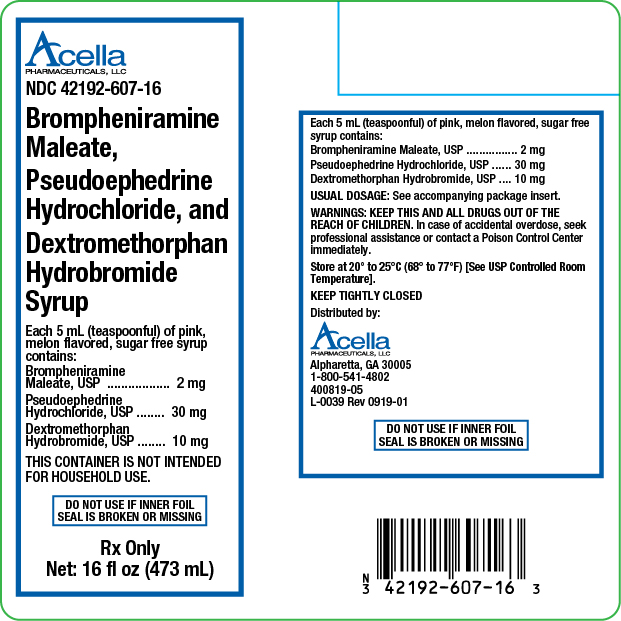
Brompheniramine Maleate, Pseudoephedrine Hydrochloride, Dextromethorphan Hydrobromide 2 mg/5mL; 30 mg/5mL; 10 mg/5mL Syrup, 473 mL — NDC 42192-0607-16 package photo

Brompheniramine Maleate, Pseudoephedrine Hydrochloride, Dextromethorphan Hydrobromide 2 mg/5mL; 30 mg/5mL; 10 mg/5mL Syrup, 473 mL

by Acella Pharmaceuticals, LLC · 473 mL in 1 BOTTLE, PLASTIC (42192-607-16)
NDC 42192-0607-16
🏷️ FDA NDC (as labeled) 42192-607-16 billing pads the product segment with a zero
This package
Contains473 mL Cost per mL$0.0714 NADAC Per package$33.77 / 473 ml Pack sizes3 compare ↓
Also priced by: Medicaid pays $0.1165/unit — full pricing hub ↓
Rx only Generic On market Non-controlled
🗂️ Data synced Aug 27, 2026 · sources: openFDA · FDA label (DailyMed) · FDA Orange & Purple Book · First Databank · CMS NADAC, ASP, Medicare & Medicaid · RxNorm
📋 All sources & update times →

🆔 Identity & classification

FDA NDC (as labeled) 42192-607-16
Product NDC 42192-607
11-digit billing NDC 42192060716
NCPDP billing unit ML — per mL (volume)
RxCUI 1357010
UNII IXA7C9ZN03, 6V9V2RYJ8N, 9D2RTI9KYH
UPC 0342192607057, 0342192607040, 0342192607163
Application # ANDA203375
SPL Set ID 1045e307-f60d-482d-8e06-40e72b84c651
Established class (EPC) Sigma-1 Agonist; Uncompetitive N-methyl-D-aspartate Receptor Antagonist; alpha-Adrenergic Agonist
Mechanism of action Adrenergic alpha-Agonists; Sigma-1 Receptor Agonists; Uncompetitive NMDA Receptor Antagonists
DEA schedule Non-controlled
Marketing category ANDA
Marketing status On market
FDA listing status Listed (active directory)
Marketing start 2016-09-21
Route ORAL
Dosage form SYRUP
Substance BROMPHENIRAMINE MALEATE; PSEUDOEPHEDRINE HYDROCHLORIDE; DEXTROMETHORPHAN HYDROBROMIDE
GPI-14 43995803321210
GPI class Pseudoeph-Bromphen-DM
GCN Seq No 000909
GCN 96136
HICL code 000389
Ingredient (HICL) Brompheniramine/Pseudoephed/Dm
HIC1 code B
Therapeutic class — broad (HIC1) Respiratory System
HIC2 code B3
Therapeutic class — intermediate (HIC2) Drugs Affecting Primarily The Trachea And Bronchi
HIC3 code B3R
Therapeutic class — specific (HIC3) Non-Opioid Antitus-1St Gen.antihistamine-Decongest
AHFS code 12:12.12.00
AHFS class Alpha- And Beta-Adrenergic Agonists
FDB label name BROMPHEN-PSE-DM 2-30-10 MG/5ML
FDB brand name Brompheniramine-Pseudoephed-Dm
Legend status F — Federal legend — prescription drug or device
TE code (Orange Book) AA · RLD · RS
Why two NDCs? The FDA registers this code as 42192-607-16 — a 5-3-2 layout, and that's what's printed on the package and shown on DailyMed. For insurance claims, every NDC is standardized to a uniform 11-digit 5-4-2 format by adding a zero to the product segment → 42192-0607-16. Same drug, same package — only the format differs.
Where does this data come from?
Identifiers from the FDA openFDA NDC Directory and Structured Product Labeling; RxCUI from RxNorm (NLM); GPI from Medi-Span; GCN / HIC / AHFS / legend from First Databank.

🏷️ RxNorm drug class

This medicine belongs to the Substituted alkylamines class.

Drug family (ATC) Substituted alkylamines
Where does this data come from?
Therapeutic classes from RxNorm RxClass (U.S. National Library of Medicine) — Established Pharmacologic Class (FDA), ATC drug family (WHO) and mechanism of action, matched by this product’s RxCUI.

🏭 Manufacturer & labeler

LabelerAcella Pharmaceuticals, LLC
Application holderACELLA PHARMACEUTICALS LLC
FDA applicationANDA203375 (ANDA)
Labeler code42192
First marketedSep 2016
Product typeHuman Prescription Drug
Portfolio36 products on file
The labeler markets the product; the application holder owns the FDA approval. They’re often the same company but can differ (e.g. a repackager or an authorized generic). A mailing address / phone appears here when the manufacturer includes it in the product’s FDA label (not all do).
Where does this data come from?
Labeler, application holder and registered establishment from the FDA openFDA NDC Directory and Drugs@FDA; address/contact from the product’s FDA label.

🩺 Clinical

Label name BROMPHEN-PSE-DM 2-30-10 MG/5ML Ingredient Brompheniramine/Pseudoephed/Dm
📖 What it is MedlinePlus · NLM

Brompheniramine is used to treat allergy and cold symptoms: sneezing runny nose itching of the nose or throat red, itchy, watery eyes Brompheniramine is in a class of medications called antihistamines. It works by blocking the action of histamine, a substance in the body that causes allergic symptoms.

Read the full MedlinePlus article ↗
Where does this data come from?
Plain-language summary from MedlinePlus (U.S. National Library of Medicine); supplement & herbal interactions and nutrient depletion data from the Natural Medicines database; our full guide is HelloPharmacist editorial content.

💊 What it looks like

Color pink
FlavorWatermelon
One label can cover several strengths, so colors may be combined — always confirm a loose pill against the dispensed prescription label or a pharmacist.
Where does this data come from?
Physical description (imprint, shape, color, scoring, coating) from this product’s FDA Structured Product Labeling (SPL), mirrored from DailyMed / openFDA.

🧪 Inactive Ingredients / Excipients

Inactive ingredients, also called excipients, are components of the drug product other than the active ingredient. They may include fillers, dyes, coatings, preservatives, flavors, or other formulation ingredients.

💡 Tap an ingredient (hover on desktop) to see what it is and why it’s used.

  • UNII XF417D3PSL
    Anhydrous citric acid is a sour, crystalline powder derived from citric acid with water removed. In medicines, it acts as a buffer to control pH, adds tartness to improve taste, and helps tablets disintegrate.
  • UNII WZB9127XOA
    A synthetic red dye used to color medications and make them easier to identify. It serves as a colorant in tablets, capsules, and liquid formulations.
  • UNII PDC6A3C0OX
    Glycerin is a clear, thick liquid derived from plant oils or fats. It acts as a humectant to retain moisture, a sweetener, and a solvent in medications.
  • UNII A2I8C7HI9T
    Methylparaben is a preservative derived from benzoic acid that prevents growth of bacteria, fungi, and mold in medicines. It extends the product's shelf life and maintains safety during storage.
  • UNII 6DC9Q167V3
    Propylene glycol is a clear liquid derived from petroleum or vegetable sources. It acts as a solvent, humectant, and preservative in medicines, helping dissolve active ingredients and maintain product stability.
  • UNII OJ245FE5EU
    Sodium benzoate is a salt derived from benzoic acid, a preservative. It's added to medicines to prevent growth of bacteria, fungi, and other microorganisms that could spoil the product.
  • UNII 1Q73Q2JULR
    Sodium citrate is a salt derived from citric acid. It works as a buffer to maintain the medicine's pH level and may also help improve taste or act as a preservative in the formulation.
  • UNII 96K6UQ3ZD4
    Sucralose is a synthetic sweetener made from sugar. It's added to medicines to improve taste without adding calories, helping make bitter or unpleasant-tasting drugs easier to take.
  • UNII 059QF0KO0R
    Water is a liquid solvent that dissolves and mixes ingredients together in liquid medicines, syrups, and injections. It helps distribute the active drug evenly throughout the product.

9 inactive ingredients listed in the exact product block matched to this NDC.

Where does this data come from?
Data sourced from official FDA Structured Product Labeling (SPL) via DailyMedingredient classCode="IACT" elements from the exact product block matched by this NDC. Label-section narrative from DailyMed / the openFDA label index is shown separately when available.

Inactive ingredient FAQ

Are inactive ingredients the same for every manufacturer?
No. Inactive ingredients can differ by manufacturer, dosage form, strength, and package / product version.
Why might an inactive ingredient be missing?
Some SPLs do not provide a complete structured inactive-ingredient list, and older or unusual labels may only include the information in narrative text.
Can inactive ingredients matter?
Yes. They can matter for allergies, intolerances, dyes, gluten / lactose concerns, preservatives, and formulation differences — but confirm with a pharmacist or the manufacturer when it’s clinically important.

💲 Pricing

A drug doesn't have one price. Each row is a different public payment system, and none is what you'd pay at the counter — that depends on your insurance. The ⓘ on each row explains what it measures.

Price systemPer mLPer package
Retail pharmacies payNADAC · weekly $0.071 $33.77 / 473 ml
Medicaid paysCMS SDUD · 12 mo $0.1165 $55.10 / 473 ml
Medicare drug plans payPart D · quarterly No Part D plan price is available for this NDC in our data.
NADAC price history (per mL) — tap or hover for the price & month
Dec 2021 Jul 2022 Dec 2025 Aug 2026 $0.099 $0.050
▲ Up 37% over the last 24 months.
Where does this data come from?
NADAC (National Average Drug Acquisition Cost) is the CMS weekly pharmacy-acquisition-cost survey — what pharmacies pay. ASP (Average Sales Price) is the CMS Medicare Part B drug-payment file, published quarterly. Medicaid pays is computed by us from CMS State Drug Utilization Data (total reimbursed ÷ units, trailing 12 months) — gross of rebates and inclusive of dispensing fees, so it reflects what Medicaid paid, not an acquisition cost. Medicare drug plans pay is the median negotiated point-of-sale unit cost across plans listing this NDC in the CMS quarterly Prescription Drug Plan pricing files, before rebates. The VA pays is the federal contract price (FSS, and the statutory Big 4 ceiling where listed) from the VA National Acquisition Center pharmaceutical price file. All are free public government data; each measures a different payer, so the figures are not directly comparable.

🔁 Therapeutic equivalents

ProductLabelerPackNADAC/unitTEStatusPrice vs. this
Brompheniramine Maleate, Pseudoephedrine Hydrochloride, Dextromethorphan Hydrobromide 2 mg/5mL; 30 mg/5mL; 10 mg/5mLthis 42192-0607-16 Acella 473 ml $0.071 AA Availability likely
Brompheniramine Maleate, Pseudoephedrine Hydrochloride, and Dextromethorphan Hydrobromide 2 mg/5mL; 30 mg/5mL; 10 mg/5mL 62135-0302-47 Chartwell 473 ml $0.071 AA Availability likely
Brompheniramine, Pseudoephedrine, Dextromethorphan 2 mg/5mL; 30 mg/5mL; 10 mg/5mL 67877-0558-16 Ascend 473 ml $0.071 AA Availability likely
Brompheniramine Maleate, Pseudoephedrine Hydrochloride and Dextromethorphan Hydrobromide 2 mg/5mL; 30 mg/5mL; 10 mg/5mL 00121-0933-04 PAI 118 ml $0.080 AA Availability likely +13%
Brompheniramine Maleate, Pseudoephedrine Hydrochloride and Dextromethorphan Hydrobromide 2 mg/5mL; 30 mg/5mL; 10 mg/5mL 00574-1104-04 Padagis 118 ml $0.080 AA Availability likely +13%
Brompheniramine Maleate, Pseudoephedrine Hydrochloride, Dextromethorphan Hydrobromide 2 mg/5mL; 30 mg/5mL; 10 mg/5mL 42192-0630-04 Acella 118 ml $0.080 AA Availability likely +13%
Brompheniramine Maleate, Pseudoephedrine Hydrochloride, and Dextromethorphan Hydrobromide 10 mg/5mL; 30 mg/5mL; 2 mg/5mL 69452-0478-55 BIONPHARMA 118 ml $0.080 AA Availability likely +13%
Brompheniramine Maleate, Pseudoephedrine Hydrochloride, and Dextromethorphan Hydrobromide 2 mg/5mL; 30 mg/5mL; 10 mg/5mL 75907-0207-04 Dr. 118 ml $0.080 AA Availability likely +13%
Brompheniramine Maleate, Pseudoephedrine Hydrochloride and Dextromethorphan Hydrobromide 2 mg/5mL; 30 mg/5mL; 10 mg/5mL 50090-5625-00 A-S 118 ml AA FDA listed
Brompheniramine Maleate, Pseudoephedrine Hydrochloride and Dextromethorphan Hydrobromide 2 mg/5mL; 30 mg/5mL; 10 mg/5mL 63187-0664-04 Proficient 118 ml AA FDA listed
Brompheniramine Maleate, Pseudoephedrine Hydrochloride, Dextromethorphan Hydrobromide 2 mg/5mL; 30 mg/5mL; 10 mg/5mL 63187-0930-04 Proficient 118 ml AA FDA listed
Brompheniramine Maleate, Pseudoephedrine Hydrochloride and Dextromethorphan Hydrobromide 2 mg/5mL; 30 mg/5mL; 10 mg/5mL 63629-8615-01 Bryant 118 ml AA FDA listed
Brompheniramine Maleate, Pseudoephedrine Hydrochloride and Dextromethorphan Hydrobromide 2 mg/5mL; 30 mg/5mL; 10 mg/5mL 63629-8616-01 Bryant 473 ml AA FDA listed
Brompheniramine Maleate, Pseudoephedrine Hydrochloride, and Dextromethorphan Hydrobromide 2 mg/5mL; 30 mg/5mL; 10 mg/5mL 68999-0302-24 Chartwell 10 cups AA FDA listed
Brompheniramine Maleate, Pseudoephedrine Hydrochloride and Dextromethorphan Hydrobromide 2 mg/5mL; 30 mg/5mL; 10 mg/5mL 70518-4526-00 REMEDYREPACK 3 cups AA FDA listed
Brompheniramine maleate, pseudoephedrine hydrochloride, 2 mg/5mL; 30 mg/5mL; 10 mg/5mL 71930-0026-18 Eywa 118 ml AA Discontinued
Brompheniramine Maleate, Pseudoephedrine Hydrochloride and Dextromethorphan Hydrobromide 2 mg/5mL; 30 mg/5mL; 10 mg/5mL 72162-1123-02 Bryant 118 ml AA FDA listed
Brompheniramine Maleate, Pseudoephedrine Hydrochloride, Dextromethorphan Hydrobromide 2 mg/5mL; 30 mg/5mL; 10 mg/5mL 85766-0250-04 Sportpharm 118 ml AA FDA listed
About this product: this is a generic version of the medicine. FDA equivalence ratings are shown when available, and other versions are listed above, least expensive first.
Where does this data come from?
Equivalents are other NDCs of the same ingredient, form and route from the openFDA NDC Directory, ranked least-expensive-first by NADAC. Therapeutic-equivalence (AB) ratings come from the FDA Orange Book; biologics use the FDA Purple Book for biosimilar & interchangeable status.

Availability & generic status

🏛️
2016
On the market since
Sep 2016
📍
2026
Currently FDA-listed
10 years listed
🔓
·
Generic on the market
this product is a generic
This is a generic drug

This product is an FDA-approved generic. Other versions of the same drug are listed under Therapeutic equivalents, least expensive first.

Where does this data come from?
Patents and exclusivity from the FDA Orange Book (small-molecule drugs), refreshed from public FDA data. Generic launch timing is an estimate, not a guarantee.

🗺️ Medicaid utilization & spend

📍 This exact package only: Medicaid data is reported per full 11-digit NDC — labeler, product and pack size — so every number here is for 42192-0607-16, not the drug overall. Other pack sizes report separately.
💊 Pharmacy benefit only: These are Medicaid outpatient pharmacy claims, billed by NDC. They exclude the medical benefit — clinic- or hospital-administered drugs billed under HCPCS J-codes — so drugs used mostly that way (e.g. Avastin, Lucentis, Keytruda) can look low or missing here. That’s expected, not an error.
📅 Q1 2025 – Q4 2025 · 4 quarters of data
ⓘ The newest quarter is usually incomplete when first published; states restate recent quarters in later CMS releases, so the latest figures typically revise upward. State coverage-policy changes can also shift quarter-to-quarter totals.
Prescriptions last 4 qtrs
485.4K
Units reimbursed last 4 qtrs
72.5M
Gross reimbursed last 4 qtrs
$8.44M
Avg / prescription
$17.40
Avg / unit
$0.1165
Latest quarter Q4 2025
92.2KRx
Medicaid pays / mL
$0.1165
gross reimbursed
vs
NADAC / mL
$0.0714
acquisition cost
=
Spread
+$0.0451
+63% vs cost
What Medicaid paid per mL (before rebates; includes the pharmacy’s dispensing fee) compared with NADAC — the average price pharmacies pay to buy the drug. A positive spread means Medicaid reimbursed more than the purchase price, before manufacturer rebates.
Fee-for-service vs managed care
15% FFS 85% MCO
Fee-for-service · 71,476 Rx Managed care · 413,885 Rx
State Medicaid map
Alaska: no data reported AK Maine: no data reported ME Washington: no data reported WA Idaho: no data reported ID Montana: 24,733 units · 2,185 per 100k residents MT North Dakota: no data reported ND Minnesota: no data reported MN Wisconsin: no data reported WI Michigan: 46,655 units · 465 per 100k residents MI New York: no data reported NY Vermont: no data reported VT New Hampshire: no data reported NH Oregon: no data reported OR Nevada: 1,114,700 units · 34,900 per 100k residents NV Wyoming: 27,373 units · 4,687 per 100k residents WY South Dakota: 37,998 units · 4,135 per 100k residents SD Iowa: no data reported IA Illinois: 30,409 units · 242 per 100k residents IL Indiana: 1,173,831 units · 17,106 per 100k residents IN Ohio: 5,318,563 units · 45,130 per 100k residents OH Pennsylvania: 446,641 units · 3,446 per 100k residents PA New Jersey: 1,488,155 units · 16,019 per 100k residents NJ Massachusetts: no data reported MA California: 8,399,890 units · 21,558 per 100k residents CA Utah: 21,699 units · 635 per 100k residents UT Colorado: 127,328 units · 2,166 per 100k residents CO Nebraska: 21,090 units · 1,066 per 100k residents NE Missouri: no data reported MO Kentucky: 10,565,282 units · 233,435 per 100k residents KY West Virginia: 1,128,908 units · 63,780 per 100k residents WV Virginia: 863,214 units · 9,904 per 100k residents VA Maryland: 1,196,755 units · 19,365 per 100k residents MD Connecticut: 455,598 units · 12,596 per 100k residents CT Rhode Island: 8,826 units · 806 per 100k residents RI Arizona: 805,848 units · 10,844 per 100k residents AZ New Mexico: 78,927 units · 3,734 per 100k residents NM Kansas: 184,242 units · 6,267 per 100k residents KS Arkansas: no data reported AR Tennessee: 7,501 units · 105 per 100k residents TN North Carolina: no data reported NC South Carolina: 2,263,426 units · 42,126 per 100k residents SC Delaware: 176,339 units · 17,104 per 100k residents DE Oklahoma: no data reported OK Louisiana: no data reported LA Mississippi: no data reported MS Alabama: no data reported AL Georgia: 3,364,320 units · 30,504 per 100k residents GA D.C.: 40,466 units · 5,960 per 100k residents DC Hawaii: 30,100 units · 2,098 per 100k residents HI Texas: 27,042,952 units · 88,657 per 100k residents TX Florida: 6,004,756 units · 26,558 per 100k residents FL
Units reimbursed · per 100k residents
105233,435
gray = no data reported
Colors are per 100,000 residents, so big states don’t automatically dominate. Tap or hover a state for its actual totals.
Tap or hover a state
…for its Medicaid breakdown
🏆 Top states by units · per 100k residents
1 Kentucky 233,435 /100k
2 Texas 88,657 /100k
3 West Virginia 63,780 /100k
4 Ohio 45,130 /100k
5 South Carolina 42,126 /100k
6 Nevada 34,900 /100k
7 Georgia 30,504 /100k
8 Florida 26,558 /100k
National units — by quarter
💵 About the dollar figures: “reimbursed” is what Medicaid paid pharmacies before confidential manufacturer rebates, so the program’s real net cost is lower than these numbers. Fee-for-service and managed-care claims are combined unless split above. Source: CMS State Drug Utilization Data; per-100k rates use 2023 Census population estimates.

💊 Medicaid utilization by pack size

Medicaid (SDUD) totals over the four most recent reported quarters for every package size of this drug — handy when a specific package (e.g. a starter/titration pack) carries little or no Medicaid volume on its own.
473 ml this page42192-0607-16 485,361 Rx · $8,443,071
118 ml42192-0607-04 37,272 Rx · $797,831
40 cups42192-0607-40 No Medicaid data
Drug total (last 4 qtrs): 522,633 Rx · 77,893,318 units · $9,240,903 gross reimbursed
Tap a pack size to open its page. Source: CMS State Drug Utilization Data, last 4 quarters.

📦 Packaging — all sizes for this product

Package NDCDescription Per unit Per pack Marketing startStatus
42192-0607-04 118 mL in 1 BOTTLE, PLASTIC (42192-607-04) $0.0804 / mL $9.48 2016-09-21 Active
42192-0607-16 You're viewing this 473 mL in 1 BOTTLE, PLASTIC (42192-607-16) $0.0714 / mL $33.79 2016-09-21 Active
42192-0607-40 40 CUP, UNIT-DOSE in 1 CASE (42192-607-40) / 5 mL in 1 CUP, UNIT-DOSE (42192-607-05) 2016-09-21 Discontinued by firm

This pack has the lowest per-mL cost of the 2 priced pack sizes ($0.0714 NADAC).

In Medicaid, this is the most-dispensed pack of this product — about 93% of fills over the last four reported quarters. See all packs ↓

Pack size FAQ

What quantity is in NDC 42192-0607-16?
NDC 42192-0607-16 contains 473 mL — 473 ml in 1 bottle, plastic.
What is the difference between NDC 42192-0607-16 and NDC 42192-0607-04?
Both are Brompheniramine Maleate, Pseudoephedrine Hydrochloride, Dextromethorphan Hydrobromide 2 mg/5mL; 30 mg/5mL; 10 mg/5mL Syrup — the drug itself is identical. NDC 42192-0607-16 is the 473 mL package, while NDC 42192-0607-04 is the 118 ml package. Per-mL NADAC also differs: $0.0714 here vs $0.0804 for the 118 ml pack.
What NDC number is used to bill for this package of Brompheniramine Maleate, Pseudoephedrine Hydrochloride, Dextromethorphan Hydrobromide 2 mg/5mL; 30 mg/5mL; 10 mg/5mL Syrup?
Bill NDC 42192-0607-16 — the 11-digit billing format is 42192060716. Pharmacy and medical claims use the 11-digit form; the FDA label may print a shorter form of the same code.

Prices are the latest CMS NADAC pharmacy acquisition cost per NDC; per-pack figures are per-unit × pack quantity, shown only when the pack is denominated in the same measure NADAC prices.

📄 Full prescribing information FDA SPL

The complete FDA label for this product — the official prescribing information, verbatim, section by section. Jump with a chip, search within the label, or expand everything.
🎯 Indications and Usage 31 words

INDICATIONS AND USAGE Brompheniramine Maleate, Pseudoephedrine Hydrochloride, and Dextromethorphan Hydrobromide Syrup is indicated for relief of coughs and upper respiratory symptoms, including nasal congestion, associated with allergy or the common cold.

⏱️ Dosage and Administration 75 words

DOSAGE AND ADMINISTRATION Adults and pediatric patients 12 years of age and over: 10 mL (2 teaspoonfuls) every 4 hours. Children 6 to under 12 years of age: 5 mL (1 teaspoonful) every 4 hours. Children 2 to under 6 years of age: 2.5 mL (½ teaspoonful) every 4 hours. Infants 6 months to under 2 years of age: Dosage to be established by a physician. Do not exceed 6 doses during a 24-hour period.

Contraindications 58 words

CONTRAINDICATIONS Hypersensitivity to any of the ingredients. Do not use in the newborn, in premature infants, in nursing mothers, or in patients with severe hypertension or severe coronary artery disease. Do not use dextromethorphan in patients receiving monoamine oxidase inhibitors (MAOIs) (see Drug Interactions ). Antihistamines should not be used to treat lower respiratory tract conditions including asthma.

⚠️ Warnings 29 words

WARNINGS Especially in infants and small children, antihistamines in overdosage may cause hallucinations, convulsions, and death. Antihistamines may diminish mental alertness. In the young child, they may produce excitation.

🤒 Adverse Reactions 93 words

ADVERSE REACTIONS The most frequent adverse reactions to Brompheniramine Maleate, Pseudoephedrine Hydrochloride, and Dextromethorphan Hydrobromide Syrup are: sedation; dryness of mouth, nose and throat; thickening of bronchial secretions; dizziness. Other adverse reactions may include: Dermatologic: Urticaria, drug rash, photosensitivity, pruritus. Cardiovascular System: Hypotension, hypertension, cardiac arrhythmias, palpitation.

CNS: Disturbed coordination, tremor, irritability, insomnia, visual disturbances, weakness, nervousness, convulsions, headache, euphoria, and dysphoria. G.U. System: Urinary frequency, difficult urination.

G.I. System: Epigastric discomfort, anorexia, nausea, vomiting, diarrhea, constipation. Respiratory System: Tightness of chest and wheezing, shortness of breath.

Hematologic System: Hemolytic anemia, thrombocytopenia, agranulocytosis.

🔄 Drug Interactions 92 words

Drug Interactions: Monoamine oxidase inhibitors (MAOIs) Hyperpyrexia, hypotension, and death have been reported coincident with the coadministration of MAOIs and products containing dextromethorphan. In addition, MAOIs prolong and intensify the anticholinergic (drying) effects of antihistamines and may enhance the effect of pseudoephedrine. Concomitant administration of Brompheniramine Maleate, Pseudoephedrine Hydrochloride, and Dextromethorphan Hydrobromide Syrup and MAOIs should be avoided (see CONTRAINDICATIONS ).

Central nervous system (CNS) depressants Antihistamines have additive effects with alcohol and other CNS depressants (hypnotics, sedatives, tranquilizers, antianxiety agents, etc.). Antihypertensive drugs Sympathomimetic may reduce the effects of antihypertensive drugs.

🤰 Pregnancy 105 words

Pregnancy: Teratogenic Effects- Pregnancy Category C: Animal reproduction studies have not been conducted with Brompheniramine Maleate, Pseudoephedrine Hydrochloride, and Dextromethorphan Hydrobromide Syrup. It is also not known whether Brompheniramine Maleate, Pseudoephedrine Hydrochloride, and Dextromethorphan Hydrobromide Syrup can cause fetal harm when administered to a pregnant woman or can affect reproduction capacity. It should be given to a pregnant woman only if clearly needed.

Reproduction studies of brompheniramine maleate (a component of Brompheniramine Maleate, Pseudoephedrine Hydrochloride, and Dextromethorphan Hydrobromide Syrup) in rats and mice at doses up to 16 times the maximum human doses have revealed no evidence of impaired fertility or harm to the fetus.

🧒 Pediatric Use 23 words

Pediatric Use: Safety and effectiveness in pediatric patients below the age of 6 months have not been established (see DOSAGE AND ADMINISTRATION ).

🆘 Overdosage ~1 min read

OVERDOSAGE Signs and Symptoms: Central nervous system effects from overdosage of brompheniramine may vary from depression to stimulation, especially in children. Anticholinergic effects may be noted. Toxic doses of pseudoephedrine may result in CNS stimulation, tachycardia, hypertension, and cardiac arrhythmias; signs of CNS depression may occasionally be seen.

Dextromethorphan in toxic doses will cause drowsiness, ataxia, nystagmus, opisthotonos, and convulsive seizures. Toxic Doses: Data suggest that individuals may respond in an unexpected manner to apparently small amounts of a particular drug. A 2½-year-old child survived the ingestion of 21 mg/kg of dextromethorphan exhibiting only ataxia, drowsiness, and fever, but seizures have been reported in 2 children following the ingestion of 13–17 mg/kg.

Another 2½-year-old child survived a dose of 300–900 mg of brompheniramine. The toxic dose of pseudoephedrine should be less than that of ephedrine, which is estimated to be 50 mg/kg. Treatment: Induce emesis if patient is alert and is seen prior to 6 hours following ingestion.

Precautions against aspiration must be taken, especially in infants and small children. Gastric lavage may be carried out, although in some instances tracheostomy may be necessary prior to lavage. Naloxone hydrochloride 0.005 mg/kg intravenously may be of value in reversing the CNS depression that may occur from an overdose of dextromethorphan.

CNS stimulants may counter CNS depression. Should CNS hyperactivity or convulsive seizures occur, intravenous short-acting barbiturates may be indicated. Hypertensive responses and/or tachycardia should be treated appropriately.

Oxygen, intravenous fluids, and other supportive measures should be employed as indicated.

🧬 Clinical Pharmacology 198 words

CLINICAL PHARMACOLOGY Brompheniramine maleate is a histamine antagonist, specifically an H 1 -receptor-blocking agent belonging to the alkylamine class of antihistamines. Antihistamines appear to compete with histamine for receptor sites on effector cells. Brompheniramine also has anticholinergic (drying) and sedative effects.

Among the antihistaminic effects, it antagonizes the allergic response (vasodilation, increased vascular permeability, increased mucus secretion) of nasal tissue. Brompheniramine is well absorbed from the gastrointestinal tract, with peak plasma concentration after single, oral dose of 4 mg reached in 5 hours; urinary excretion is the major route of elimination, mostly as products of biodegradation; the liver is assumed to be the main site of metabolic transformation. Pseudoephedrine acts on sympathetic nerve endings and also on smooth muscle, making it useful as a nasal decongestant.

The nasal decongestant effect is mediated by the action of pseudoephedrine on α-sympathetic receptors, producing vasoconstriction of the dilated nasal arterioles. Following oral administration, effects are noted within 30 minutes with peak activity occurring at approximately one hour. Dextromethorphan acts centrally to elevate the threshold for coughing.

It has no analgesic or addictive properties. The onset of antitussive action occurs in 15 to 30 minutes after administration and is of long duration.

📦 How Supplied / Storage and Handling 98 words

HOW SUPPLIED Brompheniramine Maleate, Pseudoephedrine Hydrochloride, and Dextromethorphan Hydrobromide Syrup is a pink, sugar free syrup with a melon flavor. Each 5 mL (1 teaspoonful) contains: brompheniramine maleate 2 mg, pseudoephedrine hydrochloride 30 mg and dextromethorphan hydrobromide 10 mg, and is available in the following sizes: 5 mL unit dose cups, boxes of 40: 42192-607-40 4 fl oz (118 mL) NDC 42192-607-04 16 fl oz (473 mL) NDC 42192-607-16 RECOMMENDED STORAGE Store at 20 to 25°C (68 to 77°F) [See USP Controlled Room Temperature].

KEEP TIGHTLY CLOSED Dispense in a tight, light-resistant container as defined in the USP.

📦 Storage and Handling 29 words

RECOMMENDED STORAGE Store at 20 to 25°C (68 to 77°F) [See USP Controlled Room Temperature]. KEEP TIGHTLY CLOSED Dispense in a tight, light-resistant container as defined in the USP.

📋 Description 146 words

DESCRIPTION Brompheniramine Maleate, Pseudoephedrine Hydrochloride, and Dextromethorphan Hydrobromide Syrup is a pink, sugar free syrup with a melon flavor. Each 5 mL (1 teaspoonful) contains: Brompheniramine Maleate, USP . . . . . . . . 2 mg Pseudoephedrine Hydrochloride, USP . . . . .

30 mg Dextromethorphan Hydrobromide, USP . . . 10 mg Inactive Ingredients: citric acid anhydrous, FD&C Red No. 40, glycerin, melon flavoring, methylparaben, propylene glycol, purified water, sodium benzoate, sodium citrate dihydrate, and sucralose.

C 16 H 19 BrN 2 •C 4 H 4 O 4 M.W. 435.31 Brompheniramine Maleate, USP (±)-2- p -Bromo-α-2-(dimethylamino)ethylbenzylpyridine maleate (1:1) C 10 H 15 NO•HCl M.W. 201.69 Pseudoephedrine Hydrochloride, USP (+)-Pseudoephedrine hydrochloride C 18 H 25 NO•HBr•H 2 O M.W.

370.32 Dextromethorphan Hydrobromide, USP 3-Methoxy-17-methyl-9α, 13α, 14α -morphinan hydrobromide monohydrate Antihistamine/ Nasal Decongestant/ Antitussive syrup for oral administration. Chemical Structure Chemical Structure Chemical Structure

💬 Information for Patients 23 words

Information for Patients: Patients should be warned about engaging in activities requiring mental alertness, such as driving a car or operating dangerous machinery.

Source: FDA Structured Product Labeling, mirrored from DailyMed / openFDA. Prefer the government’s original formatting? View this label on DailyMed ↗
For educational and professional reference only — not medical advice. Pricing reflects published NADAC and CMS ASP (free public data) and may differ from your acquisition cost; always verify before billing or dispensing.