
HomeNDC LookupIngredientsSelenium Sulfide › 42582-0900-06
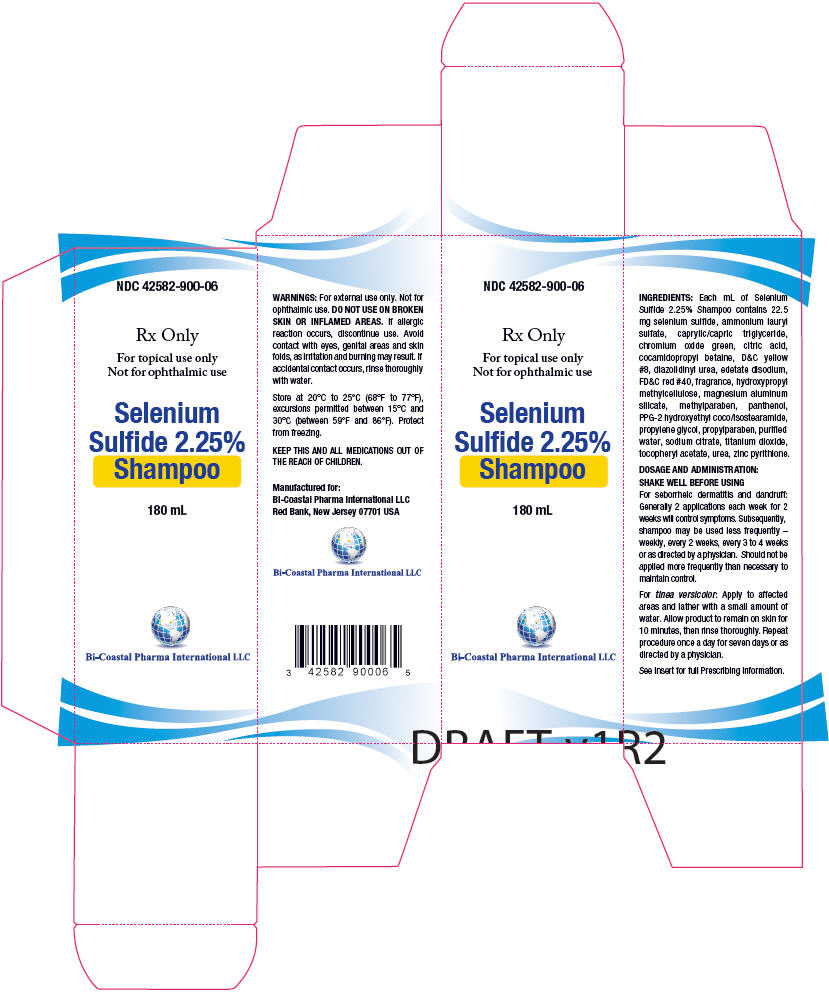
Selenium Sulfide 22.5 mg/mL Shampoo — NDC 42582-0900-06 package photo

Selenium Sulfide 22.5 mg/mL Shampoo

by Bi-Coastal Pharma International LLC · 1 BOTTLE in 1 CARTON (42582-900-06) / 180 mL in 1 BOTTLE
NDC 42582-0900-06
🏷️ FDA NDC (as labeled) 42582-900-06 billing pads the product segment with a zero
Rx only Discontinued Non-controlled ⚠ Inactivated by FDA
🗂️ Data synced Jul 14, 2026 · sources: openFDA · FDA label (DailyMed) · FDA Orange & Purple Book · First Databank · CMS NADAC, ASP, Medicare & Medicaid · RxNorm
📋 All sources & update times →
⚠️
Excluded from the active FDA NDC Directory. FDA inactivated this product’s listing record, so it is excluded from the active NDC Directory. The listing was last certified through Dec 2023. A label may still appear on DailyMed, but the NDC is no longer in the current FDA NDC Directory. Search the FDA NDC Directory ↗

🆔 Identity & classification

FDA NDC (as labeled) 42582-900-06
Product NDC 42582-900
11-digit billing NDC 42582090006
NCPDP billing unit ML — per mL (volume)
SPL Set ID dacbcc5a-d37c-4ea3-8f47-35abb64c7519
DEA schedule Non-controlled
Marketing category UNAPPROVED DRUG OTHER
Marketing status Discontinued
FDA listing status Inactivated by FDA (certified through Dec 2023)
Route TOPICAL
Dosage form SHAMPOO
Substance SELENIUM SULFIDE
GCN Seq No 058399
GCN 23824
HICL code 013406
Ingredient (HICL) Selenium Sulfide
HIC1 code L
Therapeutic class — broad (HIC1) Skin/Subcutaneous Tissue
HIC2 code L5
Therapeutic class — intermediate (HIC2) Keratolytics/Keratoplastics
HIC3 code L5E
Therapeutic class — specific (HIC3) Antiseborrheic Agents
AHFS code 84:04.16.00
AHFS class Astringents, Anti-Infective
FDB label name SELENIUM SULFIDE 2.25% SHAMPOO
FDB brand name Selenium Sulfide
Legend status F — Federal legend — prescription drug or device
Why two NDCs? The FDA registers this code as 42582-900-06 — a 5-3-2 layout, and that's what's printed on the package and shown on DailyMed. For insurance claims, every NDC is standardized to a uniform 11-digit 5-4-2 format by adding a zero to the product segment → 42582-0900-06. Same drug, same package — only the format differs.
Where does this data come from?
Identifiers from the FDA openFDA NDC Directory and Structured Product Labeling; RxCUI from RxNorm (NLM); GPI from Medi-Span; GCN / HIC / AHFS / legend from First Databank.

🏭 Manufacturer & labeler

LabelerBi-Coastal Pharma International LLC
Labeler code42582
Product typeHuman Prescription Drug
Portfolio3 products on file
The labeler markets the product; the application holder owns the FDA approval. They’re often the same company but can differ (e.g. a repackager or an authorized generic). A mailing address / phone appears here when the manufacturer includes it in the product’s FDA label (not all do).
Where does this data come from?
Labeler, application holder and registered establishment from the FDA openFDA NDC Directory and Drugs@FDA; address/contact from the product’s FDA label.

🩺 Clinical

Label name SELENIUM SULFIDE 2.25% SHAMPOO Ingredient Selenium Sulfide
📖 What it is MedlinePlus · NLM

Selenium sulfide, an anti-infective agent, relieves itching and flaking of the scalp and removes the dry, scaly particles that are commonly referred to as dandruff or seborrhea. It is also used to treat tinea versicolor, a fungal infection of the skin. This medication is sometimes prescribed for other uses; ask your doctor or pharmacist for more information.

Read the full MedlinePlus article ↗
📗 Our plain-language guide HelloPharmacist
  • Selenium sulfide is used on your scalp to fight dandruff and seborrheic dermatitis — a skin condition that causes oily, scaly, itchy patches. It helps relieve the flaking, itching,...
  • What is selenium sulfide actually used for?
  • Most selenium sulfide shampoos recommend using at least twice a week for best results. Some products suggest using it every time you shampoo for maximum dandruff control. Always ch...
  • There have been occasional reports of hair discoloration, especially in people with bleached, tinted, gray, or permed hair. The good news is that rinsing your hair thoroughly — for...
📖 Read our full Selenium Sulfide guide →
Where does this data come from?
Plain-language summary from MedlinePlus (U.S. National Library of Medicine); supplement & herbal interactions and nutrient depletion data from the Natural Medicines database; our full guide is HelloPharmacist editorial content.

🧪 Inactive Ingredients / Excipients

Inactive ingredients, also called excipients, are components of the drug product other than the active ingredient. They may include fillers, dyes, coatings, preservatives, flavors, or other formulation ingredients.

Loading inactive ingredients from the official FDA label in the background. No external source is being called by this page request.
Where does this data come from?
Source: official FDA Structured Product Labeling (SPL) via DailyMed and the openFDA label index. Structured IACT rows and label-wide narrative are kept separate; availability and product-level specificity depend on the submitted label.

Inactive ingredient FAQ

Are inactive ingredients the same for every manufacturer?
No. Inactive ingredients can differ by manufacturer, dosage form, strength, and package / product version.
Why might an inactive ingredient be missing?
Some SPLs do not provide a complete structured inactive-ingredient list, and older or unusual labels may only include the information in narrative text.
Can inactive ingredients matter?
Yes. They can matter for allergies, intolerances, dyes, gluten / lactose concerns, preservatives, and formulation differences — but confirm with a pharmacist or the manufacturer when it’s clinically important.

💲 Pricing

A drug doesn't have one price. Each row is a different public payment system, and none is what you'd pay at the counter — that depends on your insurance. The ⓘ on each row explains what it measures.

Price systemPer gPer package
Retail pharmacies payNADAC · weekly Not in the retail survey — common for institutional, discontinued, or low-volume packs.
Medicaid paysCMS SDUD · 12 mo No recent Medicaid claims on file for this NDC — rare and low-volume NDCs are suppressed in the public data.
Medicare drug plans payPart D · quarterly No Part D plan price is available for this NDC in our data.
ℹ️
No price is published for this exact package yet. CMS surveys NADAC per package size, so a different pack of the same drug often has one.
Where does this data come from?
NADAC (National Average Drug Acquisition Cost) is the CMS weekly pharmacy-acquisition-cost survey — what pharmacies pay. ASP (Average Sales Price) is the CMS Medicare Part B drug-payment file, published quarterly. Medicaid pays is computed by us from CMS State Drug Utilization Data (total reimbursed ÷ units, trailing 12 months) — gross of rebates and inclusive of dispensing fees, so it reflects what Medicaid paid, not an acquisition cost. Medicare drug plans pay is the median negotiated point-of-sale unit cost across plans listing this NDC in the CMS quarterly Prescription Drug Plan pricing files, before rebates. The VA pays is the federal contract price (FSS, and the statutory Big 4 ceiling where listed) from the VA National Acquisition Center pharmaceutical price file. All are free public government data; each measures a different payer, so the figures are not directly comparable.

🔁 Therapeutic equivalents

ProductLabelerPackNADAC/unitTEStatusPrice vs. this
Selenium Sulfide 22.5 mg/mL 69367-0229-18 Westminster 180 ml $0.164 Availability likely
Selenium Sulfide 22.5 mg/mL 16477-0422-06 Laser 180 ml FDA listed
Selenium Sulfide 22.5 mg/mLthis 42582-0900-06 Bi-Coastal 1 bottle Discontinued
About this product: other versions of the same ingredient, strength and form are listed above, least expensive first, with FDA equivalence ratings where available.
Where does this data come from?
Equivalents are other NDCs of the same ingredient, form and route from the openFDA NDC Directory, ranked least-expensive-first by NADAC. Therapeutic-equivalence (AB) ratings come from the FDA Orange Book; biologics use the FDA Purple Book for biosimilar & interchangeable status.

Availability & generic status

📍
2026
Currently FDA-listed
listed with the FDA
🔓
·
Generic versions listed
see equivalents
Generic appears available

FDA-approved generic versions are listed, and recent pricing/market data suggests they may be available — see Therapeutic equivalents.

Where does this data come from?
Patents and exclusivity from the FDA Orange Book (small-molecule drugs), refreshed from public FDA data. Generic launch timing is an estimate, not a guarantee.

📊 Medicare Part D spend CMS · PART D · 2026 (Q1)

Medicare Part D (outpatient prescription) spending for Selenium Sulfide — the program that covers self-administered drugs. 2 manufacturers.
⚠️ Drug-level data: CMS publishes Part D spending by drug, not by NDC — these figures combine every manufacturer, strength and package size sold under the name Selenium Sulfide. That’s a different level of aggregation than the Medicaid card above, which is specific to this exact 11-digit NDC (pack size included), so the two aren’t directly comparable.
Period
Total Part D spend
$190.8K
Claims incl. refills
12.2K
Beneficiaries
9.2K
Spend / beneficiary
$20.82
Spend / claim
$15.64
Trend by period
💵 About the dollar figures: spending is what Part D plans paid before confidential manufacturer rebates, so the program’s real net cost is lower. A blank patient count means fewer than 11 people — CMS hides counts that small to protect privacy. Source: CMS Medicare Quarterly Part D Spending by Drug (data.cms.gov), updated quarterly.

📦 Packaging — all sizes for this product

Package NDCDescription Marketing startStatus
42582-0900-06 You're viewing this 1 BOTTLE in 1 CARTON (42582-900-06) / 180 mL in 1 BOTTLE 2011-06-01 Inactivated by FDA

🧭 About this NDC listing & data coverage

Finished prescription product Marketed without an FDA application No longer marketed (per FDA listing data)

Listed without an FDA application

This product's marketing category indicates it is marketed without an approved FDA application (no NDA, ANDA, or BLA on file). Having an NDC does not by itself establish FDA approval — the NDC Directory is a listing system, not an approval decision. Approval-linked data such as Orange Book therapeutic-equivalence ratings therefore does not apply.

What data is (and isn’t) available for this NDC — tap to expand
NDC identity (package / product / labeler codes) ✓ Available
Labeler ✓ Available
Product & package description ✓ Available
Marketing category & status ✓ Available
Active ingredient / dosage form / route ✓ Available
FDA label (SPL via DailyMed) ✓ Available
Package photos ✓ Available
Inactive ingredients (structured) — Not published for this NDC The labeler did not submit a structured excipient list, or no SPL is available.
NADAC pharmacy acquisition price (CMS) — Not published for this NDC CMS publishes NADAC only for NDCs reported in its retail-pharmacy survey.
Orange Book / therapeutic-equivalence data — Not published for this NDC Applies only to products approved under an NDA/ANDA; many listings are out of scope.
HCPCS J-code billing crosswalk — Not published for this NDC Most self-administered / retail products have no J-code — that is normal.
Medicaid utilization (CMS SDUD) — Not published for this NDC CMS reports utilization only for NDCs with Medicaid claims above its privacy threshold.
“Not published” reflects what the public FDA / CMS / NLM sources provide for this exact package code — it is a property of the data feeds, not a judgment about the product.

Questions about this listing

Is this NDC FDA-approved?
An NDC listing does not by itself establish FDA approval — the NDC Directory records that a product is listed with FDA, not that it was reviewed and approved. This listing's marketing category is "Unapproved Drug Other". Products approved under an application carry an NDA, ANDA, or BLA number.
Why is there no price listed?
The pricing shown on our NDC pages comes from CMS NADAC, a voluntary survey of retail community pharmacy invoices. CMS does not publish a NADAC for every NDC — packages outside the retail survey (institutional and hospital products, bulk packages, discontinued items, and many OTC items) may never receive one. A missing price reflects the survey's scope, not this product's actual cost, and does not mean the product is free or unavailable.
What does the discontinued status mean for this NDC?
The labeler reported a marketing end date (or the listing was delisted), so this specific package is no longer actively marketed. Remaining stock may still be dispensed for a time, and the NDC stays valid for historical records and claims — but data feeds (pricing, labeling) typically stop updating for it. Other package sizes or other manufacturers' versions of the same medication may still be marketed — see the equivalents section where available.
Is the NDC printed on the package the same as the 11-digit billing NDC?
Yes, they identify this exact package in different formats. The FDA registers it as 42582-900-06, which is what is printed on the packaging and shown on DailyMed. Insurance claims use a fixed 11-digit 5-4-2 format, so the short segment is padded with a leading zero: 42582-0900-06, written without dashes as 42582090006. The Identity section at the top of this page lists every form of this code.
What do the three segments of this NDC mean?
In 42582-0900-06, the first segment (42582) is the labeler code FDA assigned to Bi-Coastal Pharma International LLC; the middle segment (0900) identifies this specific product — its ingredient, strength, and dosage form; and the last segment (06) identifies this exact package size and type. Together they name one specific package of one specific product.
Who lists this product with the FDA?
Bi-Coastal Pharma International LLC is the labeler of record for this NDC — the company under whose FDA-assigned code the package is listed. The labeler may be the manufacturer itself or a distributor marketing the product under its own code.
Do I need a prescription for this product?
This NDC is listed with FDA as a prescription product, so it is dispensed under a prescriber's order. Your pharmacist can tell you whether any over-the-counter forms of the same medication exist.
This page identifies an FDA-listed package (the NDC) and reports public regulatory and pricing data about the listing. It is reference information, not a medical recommendation — talk to your pharmacist or prescriber about your own medication.
Where does this data come from?
Listing facts (marketing category, packager status, marketing dates) from the FDA openFDA NDC Directory; label availability from DailyMed; pricing coverage from CMS NADAC; equivalence scope from the FDA Orange Book.

📄 Full prescribing information FDA SPL

The complete FDA label for this product — the official prescribing information, verbatim, section by section. Jump with a chip, search within the label, or expand everything.
🎯 Indications and Usage 32 words

INDICATIONS & USAGE A liquid antiseborrheic, antifungal preparation for the treatment of seborrheic dermatitis of the scalp, dandruff and tinea versicolor. Urea hydrates and is useful for conditions such as dry scalp.

⏱️ Dosage and Administration 98 words

DOSAGE AND ADMINISTRATION SHAKE WELL BEFORE USING For seborrheic dermatitis and dandruff Generally 2 applications each week for 2 weeks will control symptoms. Subsequently, shampoo may be used less frequently – weekly, every 2 weeks, every 3 to 4 weeks or as directed by a physician. Should not be applied more frequently than necessary to maintain control.

For tinea versicolor Apply to affected areas and lather with a small amount of water. Allow product to remain on skin for 10 minutes, then rinse thoroughly. Repeat procedure once a day for seven days or as directed by a physician.

Contraindications 15 words

CONTRAINDICATIONS Contraindicated in persons with known or suspected hypersensitivity to any of the listed ingredients.

⚠️ Warnings 47 words

WARNINGS For external use only. Not for ophthalmic use. DO NOT USE ON BROKEN SKIN OR INFLAMED AREAS. If allergic reaction occurs, discontinue use. Avoid contact with eyes, genital areas and skin folds, as irritation and burning may result. If accidental contact occurs, rinse thoroughly with water.

🤒 Adverse Reactions 45 words

ADVERSE REACTIONS In decreasing order of severity: skin irritation; occasional reports of increase in normal hair loss; discoloration of hair (can be avoided or minimized by thorough rinsing of hair after treatment). As with other shampoos, oiliness or dryness of hair and scalp may occur.

🤰 Pregnancy 56 words

USE IN PREGNANCY CATEGORY C Animal reproduction studies have not been conducted with this medication. It is also not known whether this product can cause fetal harm when applied to the body surfaces of a pregnant woman or can affect reproduction capacity. Under ordinary circumstances, selenium sulfide 2.25% shampoo should not be used by pregnant women.

🧒 Pediatric Use 11 words

PEDIATRIC USE Safety and effectiveness in children have not been established.

🆘 Overdosage 52 words

OVERDOSAGE There are no documented reports of serious toxicity in humans resulting from acute ingestion of selenium sulfide 2.25% shampoo. However, acute toxicity studies in animals suggest that ingestion of large amounts could result in potential human toxicity. Evacuation of the stomach contents should be considered in cases of acute oral ingestion.

🧬 Clinical Pharmacology 35 words

CLINICAL PHARMACOLOGY Selenium sulfide appears to have a cytostatic effect on cells of the epidermis and follicular epithelium, reducing corneocyte production. PHARMACOKINETICS The mechanism of action of topically applied selenium sulfide is not yet known.

📦 How Supplied / Storage and Handling 73 words

HOW SUPPLIED Selenium Sulfide 2.25% Shampoo is supplied in 180 mL bottles, NDC 42582-900-06. Store at 20°C to 25°C (68°F to 77°F), excursions permitted between 15°C and 30°C (between 59°F and 86°F). Brief exposure to temperatures up to 40°C (104°F) may be tolerated provided the mean kinetic temperature does not exceed 25°C (77°F); however, such exposure should be minimized. Protect from freezing. KEEP THIS AND ALL MEDICATIONS OUT OF THE REACH OF CHILDREN.

📦 Storage and Handling 59 words

Store at 20°C to 25°C (68°F to 77°F), excursions permitted between 15°C and 30°C (between 59°F and 86°F). Brief exposure to temperatures up to 40°C (104°F) may be tolerated provided the mean kinetic temperature does not exceed 25°C (77°F); however, such exposure should be minimized. Protect from freezing. KEEP THIS AND ALL MEDICATIONS OUT OF THE REACH OF CHILDREN.

📋 Description 68 words

DIRECTIONS A liquid antiseborrehic, antifungal preparation for topical application. Each mL of Selenium Sulfide 2.25% Shampoo contains 22.5 mg selenium sulfide, ammonium lauryl sulfate, caprylic/capric triglyceride, chromium oxide green, citric acid, cocamidopropyl betaine, D&C yellow #8, diazolidinyl urea, edetate disodium, FD&C red #40, fragrance, hydroxypropyl methylcellulose, magnesium aluminum silicate, methylparaben, panthenol, PPG-2 hydroxyethyl coco/isostearamide, propylene glycol, propylparaben, purified water, sodium citrate, titanium dioxide, tocopheryl acetate, urea, zinc pyrithione.

Source: FDA Structured Product Labeling, mirrored from DailyMed / openFDA. Prefer the government’s original formatting? View this label on DailyMed ↗
For educational and professional reference only — not medical advice. Pricing reflects published NADAC and CMS ASP (free public data) and may differ from your acquisition cost; always verify before billing or dispensing.