
Ethambutol Hydrochloride 400 mg Tablet, Film Coated, 100-count — NDC 42806-102-01 (Billing 42806-0102-01)
This is a package of 100 tablets of Ethambutol Hydrochloride 400 mg Tablet, Film Coated from Epic Pharma, LLC, marketed since Mar 2015 and currently FDA-listed; retail pharmacies pay about $0.4580 per tablet (NADAC). It is this product's only package size.
NDC database record
One package, one record: these facts belong to NDC 42806-102-01 alone.
- Record
- FDA NDC Directory package listing · Human prescription drug
- Code segments
- 42806 labeler · 102 product · 01 package
- Package marketed since
- Jul 30, 2020
- Sample package
- No — commercial package
- Listing certified through
- Dec 31, 2026
- Billing quantity
- 100 EA per package
- Barcode (UPC)
- 0342806101018, 0342806102015
- Medicaid fills, this package
- 2,849 prescriptions in the last four reported quarters
- FDA record last changed
- Jul 24, 2026
Identity & classification
Regulatory identifiers FDA, NLM and CMS codes for this package
Drug-database identifiers Medi-Span GPI and First Databank GCN / HICL / AHFS classification
- GSN (GCN sequence number): 009426
- GCN: 41801
- GPI-14 (Medi-Span): 09000040100310
- HICL (First Databank): 004085
- AHFS class code: 08:16.04.00
- RxCUI (RxNorm): 995599
Where does this data come from?
- FDA openFDA NDC Directory · synced Oct 8, 2026
- FDA label on DailyMed · label index refreshed Oct 8, 2026
- RxNorm (NLM RxNav) · catalog refreshed Oct 1, 2026
- Medi-Span GPI (licensed)
- First Databank (licensed) · refreshed Oct 8, 2026
RxNorm drug class
This medicine belongs to the Antimycobacterial class.
Where does this data come from?
- RxClass (NLM) · catalog refreshed Oct 1, 2026
Clinical
- It treats tuberculosis in the lungs. It is always taken with at least one other TB medicine, never alone. Using it with other drugs helps the treatment work and helps prevent resis...
- Take it by mouth once a day. You can take it with or without food. Keep taking it as long as your doctor says, even if you feel better, because TB treatment takes time.
- Some people get nausea, stomach upset, loss of appetite, headache or dizziness. The most important one to watch for is vision change, like blurry vision or trouble seeing colors. C...
- Yes. Your vision should be checked before you start and periodically during treatment. If you are on a higher dose, checks are advised monthly. Tell your doctor about any eye sympt...
Patient education
Supplement & herbal interactions
Ethambutol may be associated with lower levels of 2 nutrients — worth a chat with your pharmacist, not a cause for alarm.
Where does this data come from?
- MedlinePlus (NLM) · refreshed Oct 8, 2026
- FDA label on DailyMed · label index refreshed Oct 8, 2026
Ask a licensed pharmacist directly — free, answered by our team.
Pricing
A drug doesn't have one price. Each row is a different public payment system, and none is what you'd pay at the counter — that depends on your insurance. The ⓘ on each row explains what it measures.
| Price system | Per ea | Per package |
|---|---|---|
| Retail pharmacies payNADAC · weekly | $0.458 | $45.80 / 100 tablets |
| Medicaid paysCMS SDUD · 12 mo | $0.6139 | $61.39 / 100 tablets |
| Medicare drug plans payPart D · Q2 2026 | $0.4026 | $40.26 / 100 tablets |
Where does this data come from?
- CMS NADAC weekly file · file of Oct 7, 2026
- CMS ASP pricing files · refreshed Sep 20, 2026
- CMS Medicaid State Drug Utilization Data · through Q1 2026
- CMS Part D plan pricing files · refreshed Sep 24, 2026
- VA National Acquisition Center price file
Packaging — all sizes for this product
| Package NDC | Description | Marketing start | Marketing end | Status |
|---|---|---|---|---|
| 42806-0102-01 You're viewing this Main listing | 100 TABLET, FILM COATED in 1 BOTTLE | 2020-07-30 | — | Active |
Therapeutic equivalents
| Product | Labeler | Pack | NADAC/unit | TE | Status | Price vs. this |
|---|---|---|---|---|---|---|
| Ethambutol Hydrochloride 400 mgthis 42806-0102-01 | Epic | 100 tablets | $0.458 | AB | Availability likely | — |
| Ethambutol Hydrochloride 400 mg 68084-0280-01 | American | 100 tablets | $0.458 | AB | Availability likely | — |
| Ethambutol Hydrochloride 400 mg 68180-0281-01 | Lupin | 100 tablets | $0.458 | AB | Availability likely | — |
| Ethambutol Hydrochloride 400 mg 54879-0002-01 | STI | 100 tablets | $0.536 | AB | Discontinued | +17% |
| Ethambutol Hydrochloride 400 mg 10135-0797-01 | Marlex | 100 tablets | — | AB | FDA listed | — |
| Ethambutol Hydrochloride 400 mg 70518-2966-00 | REMEDYREPACK | 30 tablets | — | AB | FDA listed | — |
| Ethambutol Hydrochloride 400 mg 85742-0006-04 | Kanchan | 100 tablets | — | AB | FDA listed | — |
Where does this data come from?
- FDA openFDA NDC Directory · synced Oct 8, 2026
- FDA Orange Book · refreshed Oct 3, 2026
- CMS NADAC weekly file · file of Oct 7, 2026
Availability & generic status
This product is an FDA-approved generic. Other versions of the same drug are listed under Therapeutic equivalents, least expensive first.
Where does this data come from?
- FDA Orange Book · refreshed Oct 3, 2026
Inactive Ingredients / Excipients
Inactive ingredients, also called excipients, are components of the drug product other than the active ingredient. They may include fillers, dyes, coatings, preservatives, flavors, or other formulation ingredients.
🧪 Avoiding an ingredient? See Ethambutol inactive ingredients by manufacturer: every current product's list side by side, so you can ask your pharmacy for the version that does not list it.
💡 Tap an ingredient (hover on desktop) to see what it is and why it’s used.
-
UNII M28OL1HH48
Croscarmellose sodium is a plant-based substance derived from cellulose. It acts as a disintegrant, helping tablets and capsules break down quickly in the digestive system so the medicine can be absorbed.
-
UNII F05Q2T2JA0
Docusate sodium is a stool softener compound that helps medicines dissolve and move through the digestive tract. It acts as a surfactant, reducing surface tension in the intestines, and also serves as a wetting agent in tablet formulations.
-
UNII 3NXW29V3WO
Hypromellose is a plant-based thickener made from cellulose. It's used in medicines as a binder to hold ingredients together, a coating for tablets, and a thickener for liquids.
-
UNII EWQ57Q8I5X
Lactose monohydrate is a natural sugar derived from milk. It serves as a filler and binder in tablets and capsules, helping create the proper size, texture, and consistency of the medicine.
-
UNII 70097M6I30
Magnesium stearate is a salt made from magnesium and stearic acid, a fatty substance. It's used in tablets and capsules as a lubricant and glidant to help ingredients flow smoothly during manufacturing and prevent sticking.
-
UNII 3WJQ0SDW1A
Polyethylene glycol is a synthetic liquid or solid polymer used in medicines as a solvent, lubricant, and humectant. It helps dissolve active ingredients, reduces friction during manufacturing, and retains moisture in the final product.
-
UNII 6OZP39ZG8H
Polysorbate 80 is a synthetic emulsifier derived from sorbitol and oleic acid. It helps mix oil and water-based ingredients together in medications and improves how the product disperses in the body.
-
UNII U725QWY32X
Povidone K30 is a synthetic polymer made from petroleum. It acts as a binder to hold tablet ingredients together and as a disintegrant to help the tablet break apart in the stomach so the medicine can be absorbed.
-
UNII ETJ7Z6XBU4
Silicon dioxide is a naturally occurring mineral used as a glidant and anti-caking agent. It helps powder ingredients flow smoothly and prevents clumping during manufacturing and storage.
-
UNII O8232NY3SJ
A plant-based carbohydrate derived from corn kernels. It acts as a filler to add bulk, a binder to hold ingredients together, and a disintegrant to help the tablet break apart in your stomach for absorption.
-
UNII 4ELV7Z65AP
Stearic acid is a fatty acid derived from plant or animal sources. It acts as a binder and lubricant in tablets and capsules, helping them hold together and flow smoothly during manufacturing.
-
UNII C151H8M554
A natural sugar derived from sugar cane or sugar beets. It's used as a sweetener, filler, and binder to improve taste, add bulk, and help hold tablet or capsule ingredients together.
-
UNII 15FIX9V2JP
Titanium dioxide is a bright white mineral powder commonly used as a colorant and opacifying agent. It makes pills and tablets white or lighter in color and helps make coatings non-transparent.
13 inactive ingredients listed in the exact product block matched to this NDC.
Where does this data come from?
ingredient classCode="IACT" elements from the exact product block matched by this NDC. Label-section narrative from DailyMed / the openFDA label index is shown separately when available.- FDA label on DailyMed · label index refreshed Oct 8, 2026
- FDA openFDA NDC Directory · synced Oct 8, 2026
Inactive ingredient FAQ
Are inactive ingredients the same for every manufacturer?
Why might an inactive ingredient be missing?
Can inactive ingredients matter?
Manufacturer & labeler
More NDCs from Epic Pharma, LLC labeler code 42806
- Estradiol 1 mg Tablet NDC 42806-088-01
- Estradiol 2 mg Tablet NDC 42806-089-01
- Potassium Chloride 1.5 g/1.77g Powder, For Solution NDC 42806-094-01
- Protriptyline Hydrochloride 5 mg Tablet, Film Coated NDC 42806-096-01
- Protriptyline Hydrochloride 10 mg Tablet, Film Coated NDC 42806-097-01
- Ethambutol Hydrochloride 100 mg Tablet, Film Coated NDC 42806-101-01
- Hydrocodone Bitartrate and Acetaminophen 325 mg; 5 mg Tablet NDC 42806-111-01
- Hydrocodone Bitartrate and Acetaminophen 7.5 mg; 325 mg Tablet NDC 42806-112-01
- Hydrocodone Bitartrate and Acetaminophen 325 mg; 10 mg Tablet NDC 42806-113-01
- Oxycodone and Acetaminophen 5 mg; 325 mg Tablet NDC 42806-114-01
- Oxycodone and Acetaminophen 7.5 mg; 325 mg Tablet NDC 42806-115-01
- Oxycodone and Acetaminophen 10 mg; 325 mg Tablet NDC 42806-116-01
Where does this data come from?
- FDA openFDA NDC Directory · synced Oct 8, 2026
- Drugs@FDA
Full prescribing information FDA SPL
🎯 Indications and Usage ▾
INDICATIONS AND USAGE Ethambutol Hydrochloride Tablets, USP are indicated for the treatment of pulmonary tuberculosis. It should not be used as the sole antituberculous drug, but should be used in conjunction with at least one other antituberculous drug. Selection of the companion drug should be based on clinical experience, considerations of comparative safety, and appropriate in vitro susceptibility studies.
In patients who have not received previous antituberculous therapy, i.e., initial treatment, the most frequently used regimens have been the following: Ethambutol hydrochloride, USP plus isoniazid Ethambutol hydrochloride, USP plus isoniazid plus streptomycin In patients who have received previous antituberculous therapy, mycobacterial resistance to other drugs used in initial therapy is frequent. Consequently, in such retreatment patients, ethambutol hydrochloride should be combined with at least one of the second line drugs not previously administered to the patient and to which bacterial susceptibility has been indicated by appropriate in vitro studies.
Antituberculous drugs used with ethambutol hydrochloride have included cycloserine, ethionamide, pyrazinamide, viomycin and other drugs. Isoniazid, aminosalicylic acid, and streptomycin have also been used in multiple drug regimens. Alternating drug regimens have also been utilized.
⏱️ Dosage and Administration ▾
DOSAGE AND ADMINISTRATION Ethambutol hydrochloride should not be used alone, in initial treatment or in retreatment. Ethambutol hydrochloride should be administered on a once every 24-hour basis only. Absorption is not significantly altered by administration with food.
Therapy, in general, should be continued until bacteriological conversion has become permanent and maximal clinical improvement has occurred. Ethambutol hydrochloride is not recommended for use in pediatric patients under 13 years of age since safe conditions for use have not been established. Initial Treatment In patients who have not received previous antituberculous therapy, administer ethambutol hydrochloride 15 mg/kg (7 mg/lb) of body weight, as a single oral dose once every 24 hours.
In the more recent studies, isoniazid has been administered concurrently in a single, daily, oral dose. Retreatment In patients who have received previous antituberculous therapy, administer ethambutol hydrochloride 25 mg/kg (11 mg/lb) of body weight, as a single oral dose once every 24 hours. Concurrently administer at least one other antituberculous drug to which the organisms have been demonstrated to be susceptible by appropriate in vitro tests.
Suitable drugs usually consist of those not previously used in the treatment of the patient. After 60 days of ethambutol hydrochloride administration, decrease the dose to 15 mg/kg (7 mg/lb) of body weight, and administer as a single oral dose once every 24 hours. During the period when a patient is on a daily dose of 25 mg/kg, monthly eye examinations are advised.
See Table for easy selection of proper weight-dose tablet(s). Weight-Dose Table 15 mg/kg (7 mg/lb) Schedule Weight Range Pounds Kilograms Daily Dose In mg Under 85 lbs. Under 37 kg 500 85 - 94.5 37 - 43 600 95 - 109.5 43 - 50 700 110 - 124.5 50 - 57 800 125 - 139.5 57 - 64 900 140 - 154.5 64 - 71 1000 155 - 169.5 71 - 79 1100 170 - 184.5 79 - 84 1200 185 - 199.5 84 - 90 1300 200 - 214.5 90 - 97 1400 215 and Over Over 97 1500 25 mg/kg (11 mg/lb) Schedule Under 85 lbs.
Under 38 kg 900 85 - 92.5 38 - 42 1000 92.5 - 101.5 42 - 45.5 1100 102 - 109.5 45.5 - 50 1200 110 - 118.5 50 - 54 1300 119 - 128.5 54 - 58 1400 129 - 136.5 58 - 62 1500 137 - 146.5 62 - 67 1600 147 - 155.5 67 - 71 1700 156 - 164.5 71 - 75 1800 165 - 173.5 75 - 79 1900 174 - 182.5 79 - 83 2000 183 - 191.5 83 - 87 2100 192 - 199.5 87 - 91 2200 200 - 209.5 91 - 95 2300 210 - 218.5 95 - 99 2400 219 and Over Over 99 2500
⛔ Contraindications ▾
CONTRAINDICATIONS Ethambutol hydrochloride is contraindicated in patients who are known to be hypersensitive to this drug. It is also contraindicated in patients with known optic neuritis unless clinical judgment determines that it may be used. Ethambutol hydrochloride is contraindicated in patients who are unable to appreciate and report visual side effects or changes in vision (e.g., young children, unconscious patients).
⚠️ Warnings ▾
WARNINGS Ethambutol hydrochloride may produce decreases in visual acuity which appear to be due to optic neuritis. This effect may be related to dose and duration of treatment. This effect is generally reversible when administration of the drug is discontinued promptly.
However, irreversible blindness has been reported. (See PRECAUTIONS and ADVERSE REACTIONS ). Liver toxicities including fatalities have been reported (See ADVERSE REACTIONS ).
Baseline and periodic assessment of hepatic function should be performed.
🤒 Adverse Reactions ▾
ADVERSE REACTIONS Ethambutol hydrochloride may produce decreases in visual acuity, including irreversible blindness, which appear to be due to optic neuritis. Optic neuropathy including optic neuritis or retrobulbar neuritis occurring in association with ethambutol therapy may be characterized by one or more of the following events: decreased visual acuity, scotoma, color blindness, and/or visual defect. These events have also been reported in the absence of a diagnosis of optic or retrobulbar neuritis.
Patients should be advised to report promptly to their physician any change in visual acuity. The change in visual acuity may be unilateral or bilateral and hence each eye must be tested separately and both eyes tested together. Testing of visual acuity should be performed before beginning ethambutol hydrochloride therapy and periodically during drug administration, except that it should be done monthly when a patient is on a dosage of more than 15 mg/kg/day.
Snellen eye charts are recommended for testing of visual acuity. Studies have shown that there are definite fluctuations of one or two lines of the Snellen chart in the visual acuity of many tuberculous patients not receiving ethambutol hydrochloride. The following table may be useful in interpreting possible changes in visual acuity attributable to ethambutol hydrochloride.
Initial Snellen Reading Reading Indicating Significant Decrease Significant Number of Lines Decrease Number of Points 20/13 20/25 3 12 20/15 0/25 2 10 20/20 20/30 2 10 20/25 20/40 2 15 20/30 20/50 2 20 20/40 20/70 2 30 20/40 20/70 1 20 In general, changes in visual acuity less than those indicated under “Significant Number of Lines” and “Decrease Number of Points”, may be due to chance variation, limitations of the testing method, or physiologic variability. Conversely, changes in visual acuity equaling or exceeding those under “Significant Number of Lines” and “Decrease Number of Points” indicate the need for retesting and careful evaluation of the patient’s visual status.
If careful evaluation confirms the magnitude of visual change and fails to reveal another cause, ethambutol hydrochloride should be discontinued and the patient reevaluated at frequent intervals. Progressive decreases in visual acuity during therapy must be considered to be due to ethambutol hydrochloride. If corrective glasses are used prior to treatment, these must be worn during visual acuity testing.
During 1 to 2 years of therapy, a refractive error may develop which must be corrected in order to obtain accurate test results. Testing the visual acuity through a pinhole eliminates retractive error. Patients developing visual abnormality during ethambutol hydrochloride treatment may show subjective visual symptoms before, or simultaneously with, the demonstration of decreases in visual acuity, and all patients receiving ethambutol hydrochloride should be questioned periodically about blurred vision and other subjective eye symptoms.
Recovery of visual acuity generally occurs over a period of weeks to months after the drug has been discontinued. Some patients have received ethambutol hydrochloride again after such recovery without recurrence of loss of visual acuity. Other adverse reactions reported include: hypersensitivity, anaphylactic/ anaphylactoid reaction, dermatitis, erythema multiforme, pruritus, and joint pain; anorexia, nausea, vomiting, gastrointestinal upset, and abdominal pain; fever, malaise, headache, and dizziness; mental confusion, disorientation, and possible hallucinations; thrombocytopenia, leukopenia, and neutropenia.
Numbness and tingling of the extremities due to peripheral neuritis have been reported. Elevated serum uric acid levels occur and precipitation of acute gout has been reported. Pulmonary infiltrates, with or without eosinophilia, also have been reported during ethambutol hydrochloride therapy.
Liver toxicities, including fatalities, have been reported (See WARNINGS .) Since ethambutol hydrochlor… [Excerpted — this section continues on DailyMed.]
🔄 Drug Interactions ▾
Drug Interactions The results of a study of coadministration of ethambutol hydrochloride (50 mg/kg) with an aluminum hydroxide containing antacid to 13 patients with tuberculosis showed a reduction of mean serum concentrations and urinary excretion of ethambutol of approximately 20% and 13% respectively, suggesting that the oral absorption of ethambutol may be reduced by these antacid products. It is recommended to avoid concurrent administration of ethambutol with aluminum hydroxide containing antacids for at least 4 hours following ethambutol administration.
🤰 Pregnancy ▾
Pregnancy Teratogenic Effects: Pregnancy Category C There are no adequate and well-controlled studies in pregnant women. There are reports of ophthalmic abnormalities occurring in infants born to women on antituberculous therapy that included ethambutol hydrochloride. Ethambutol hydrochloride should be used during pregnancy, only if the benefit justifies the potential risk to the fetus.
Ethambutol hydrochloride has been shown to be teratogenic in pregnant mice and rabbits when given in high doses. When pregnant mice or rabbits were treated with high doses of ethambutol hydrochloride, fetal mortality was slightly but not significantly (P>0.05) increased. Female rats treated with ethambutol hydrochloride displayed slight but insignificant (P>0.05) decreases in fertility and litter size.
In fetuses born of mice treated with high doses of ethambutol hydrochloride during pregnancy, a low incidence of cleft palate, exencephaly and abnormality of the vertebral column were observed. Minor abnormalities of the cervical vertebra were seen in the newborn of rats treated with high doses of ethambutol hydrochloride during pregnancy. Rabbits receiving high doses of ethambutol hydrochloride during pregnancy gave birth to two fetuses with monophthalmia, one with a shortened right forearm accompanied by bilateral wrist-joint contracture and one with hare lip and cleft palate.
🧒 Pediatric Use ▾
Pediatric Use Ethambutol hydrochloride is not recommended for use in pediatric patients under 13 years of age since safe conditions for use have not been established.
🧓 Geriatric Use ▾
Geriatric Use There are limited data on the use of ethambutol hydrochloride in the elderly. One study of 101 patients, 65 years and older, on multiple drug antituberculosis regimens included 94 patients on ethambutol hydrochloride. No differences in safety or tolerability were observed in these patients compared with that reported in adults in general.
Other reported clinical experience has not identified differences in responses between the elderly and younger patients, but greater sensitivity of some older individuals cannot be ruled out.
🧬 Clinical Pharmacology ▾
CLINICAL PHARMACOLOGY Ethambutol hydrochloride following a single oral dose of 25 mg/kg of body weight, attains a peak of 2 to 5 mcg/mL in serum 2 to 4 hours after administration. When the drug is administered daily for longer periods of time at this dose, serum levels are similar. The serum level of ethambutol hydrochloride falls to undetectable levels by 24 hours after the last dose except in some patients with abnormal renal function.
The intercellular concentrations of erythrocytes reach peak values approximately twice those of plasma and maintain this ratio throughout the 24 hours. During the 24-hour period following oral administration of ethambutol hydrochloride approximately 50 percent of the initial dose is excreted unchanged in the urine, while an additional 8 to 15 percent appears in the form of metabolites. The main path of metabolism appears to be an initial oxidation of the alcohol to an aldehydic intermediate, followed by conversion to a dicarboxylic acid.
From 20 to 22 percent of the initial dose is excreted in the feces as unchanged drug. No drug accumulation has been observed with consecutive single daily doses of 25 mg/kg in patients with normal kidney function, although marked accumulation has been demonstrated in patients with renal insufficiency. Ethambutol hydrochloride diffuses into actively growing Mycobacterium cells such as tubercle bacilli.
Ethambutol hydrochloride appears to inhibit the synthesis of one or more metabolites, thus causing impairment of cell metabolism, arrest of multiplication, and cell death. No cross resistance with other available antimycobacterial agents has been demonstrated. Ethambutol hydrochloride has been shown to be effective against strains of Mycobacterium tuberculosis but does not seem to be active against fungi, viruses, or other bacteria.
Mycobacterium tuberculosis strains previously unexposed to ethambutol hydrochloride have been uniformly sensitive to concentrations of 8 or less mcg/mL, depending on the nature of the culture media. When ethambutol hydrochloride has been used alone for treatment of tuberculosis, tubercle bacilli from these patients have developed resistance to ethambutol hydrochloride by in vitro susceptibility tests; the development of resistance has been unpredictable and appears to occur in a step-like manner. No cross resistance between ethambutol hydrochloride and other antituberculous drugs has been reported.
Ethambutol hydrochloride has reduced the incidence of the emergence of mycobacterial resistance to isoniazid when both drugs have been used concurrently. An agar diffusion microbiologic assay, based upon inhibition of Mycobacterium smegmatis (ATCC 607) may be used to determine concentrations of ethambutol hydrochloride in serum and urine. ANIMAL PHPARMACOLOGY Toxicological studies in dogs on high prolonged doses produced evidence of myocardial damage and failure, and depigmentation of the tapetum lucidum of the eyes, the significance of which is not known.
Degenerative changes in the central nervous system, apparently not dose-related, have also been noted in dogs receiving ethambutol hydrochloride over a prolonged period. In the rhesus monkey, neurological signs appeared after treatment with high doses given daily over a period of several months. These were correlated with specific serum levels of ethambutol and with definite neuroanatomical changes in the central nervous system.
Focal interstitial carditis was also noted in monkeys which received ethambutol hydrochloride in high doses for a prolonged period.
📦 How Supplied / Storage and Handling ▾
HOW SUPPLIED Ethambutol Hydrochloride Tablets USP, 100 mg: round, white, film-coated tablets, debossed “VP” on one side and “11” on the other side. • NDC 42806-101-01 Bottles of 100 tablets Ethambutol Hydrochloride Tablets USP, 400 mg: round, white, film-coated tablets, debossed “VP” on one side and “1” to the left of bisect, and “4” to the right of bisect on the other side. • NDC 42806-102-01 Bottles of 100 tablets Store at 20°- 25°C (68°- 77°F) [See USP Controlled Room Temperature]. Protect from light and moisture.
Dispense in a tight, light-resistant container as defined in the USP using a child-resistant closure. KEEP THIS AND ALL MEDICATIONS OUT OF THE REACH OF CHILDREN. To report SUSPECTED ADVERSE REACTIONS, contact FDA at 1-800-FDA-1088 or www.fda.gov/medwatch.
Distributed by: Epic Pharma, LLC Laurelton, NY 11413 Rev. 01-2023-00 MF101REV01/23 OE2965
📋 Description ▾
DESCRIPTION Ethambutol hydrochloride is an oral chemotherapeutic agent which is specifically effective against actively growing microorganisms of the genus Mycobacterium, including M. tuberculosis. Ethambutol hydrochloride is a white, crystalline powder. The structural formula is: C 10 H 24 N 2 O 2 • 2HCl M.W.
277.23 (+)-2,2’ (Ethylenediimino)-di-1-butanol dihydrochloride Each Ethambutol Hydrochloride Tablet, USP for oral administration, contains 100 mg or 400 mg ethambutol hydrochloride. In addition, each Ethambutol Hydrochloride Tablet, USP contains the following inactive ingredients: colloidal silicon dioxide, corn starch, croscarmellose sodium, docusate sodium, lactose monohydrate, magnesium stearate, polyvinylpyrrolidone, stearic acid, sugar. Film coating and polishing contains: hydroxypropyl methylcellulose, polyethylene glycol, polysorbate 80, and titanium dioxide. structure.jpg
⚠️ Precautions ▾
PRECAUTIONS Ethambutol hydrochloride is not recommended for use in pediatric patients under 13 years of age since safe conditions for use have not been established. Patients with decreased renal function need the dosage reduced as determined by serum levels of ethambutol hydrochloride, since the main path of excretion of this drug is by the kidneys. Because this drug may have adverse effects on vision, physical examination should include ophthalmoscopy, finger perimetry and testing of color discrimination.
In patients with visual defects such as cataracts, recurrent inflammatory conditions of the eye, optic neuritis, and diabetic retinopathy, the evaluation of changes in visual acuity is more difficult, and care should be taken to be sure the variations in vision are not due to the underlying disease conditions. In such patients, consideration should be given to relationship between benefits expected and possible visual deterioration since evaluation of visual changes is difficult. (For recommended procedures, see next paragraphs under ADVERSE REACTIONS ).
As with any potent drug, baseline and periodic assessment of organ system functions, including renal, hepatic, and hematopoietic, should be performed. Drug Interactions The results of a study of coadministration of ethambutol hydrochloride (50 mg/kg) with an aluminum hydroxide containing antacid to 13 patients with tuberculosis showed a reduction of mean serum concentrations and urinary excretion of ethambutol of approximately 20% and 13% respectively, suggesting that the oral absorption of ethambutol may be reduced by these antacid products.
It is recommended to avoid concurrent administration of ethambutol with aluminum hydroxide containing antacids for at least 4 hours following ethambutol administration. Pregnancy Teratogenic Effects: Pregnancy Category C There are no adequate and well-controlled studies in pregnant women. There are reports of ophthalmic abnormalities occurring in infants born to women on antituberculous therapy that included ethambutol hydrochloride.
Ethambutol hydrochloride should be used during pregnancy, only if the benefit justifies the potential risk to the fetus. Ethambutol hydrochloride has been shown to be teratogenic in pregnant mice and rabbits when given in high doses. When pregnant mice or rabbits were treated with high doses of ethambutol hydrochloride, fetal mortality was slightly but not significantly (P>0.05) increased.
Female rats treated with ethambutol hydrochloride displayed slight but insignificant (P>0.05) decreases in fertility and litter size. In fetuses born of mice treated with high doses of ethambutol hydrochloride during pregnancy, a low incidence of cleft palate, exencephaly and abnormality of the vertebral column were observed. Minor abnormalities of the cervical vertebra were seen in the newborn of rats treated with high doses of ethambutol hydrochloride during pregnancy.
Rabbits receiving high doses of ethambutol hydrochloride during pregnancy gave birth to two fetuses with monophthalmia, one with a shortened right forearm accompanied by bilateral wrist-joint contracture and one with hare lip and cleft palate. Nursing Mothers Ethambutol hydrochloride is excreted into breast milk. The use of ethambutol hydrochloride should be considered only if the expected benefit to the mother outweighs the potential risk to the infant.
Pediatric Use Ethambutol hydrochloride is not recommended for use in pediatric patients under 13 years of age since safe conditions for use have not been established. Geriatric Use There are limited data on the use of ethambutol hydrochloride in the elderly. One study of 101 patients, 65 years and older, on multiple drug antituberculosis regimens included 94 patients on ethambutol hydrochloride.
No differences in safety or tolerability were observed in these patients compared with that reported in adults in general. Other reported clinical experience has not identified differences in responses between the… [Excerpted — this section continues on DailyMed.]
🍼 Nursing Mothers ▾
Nursing Mothers Ethambutol hydrochloride is excreted into breast milk. The use of ethambutol hydrochloride should be considered only if the expected benefit to the mother outweighs the potential risk to the infant.
📄 Package Label / Principal Display Panel ▾
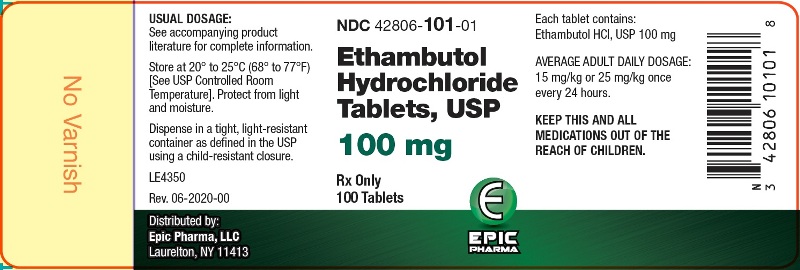
PACKAGE/LABEL PRINCIPAL DISPLAY PANEL – 100 mg 100ct 100mg-100ct
PACKAGE/LABEL PRINCIPAL DISPLAY PANEL – 400 mg 100ct 400mg-100ct