
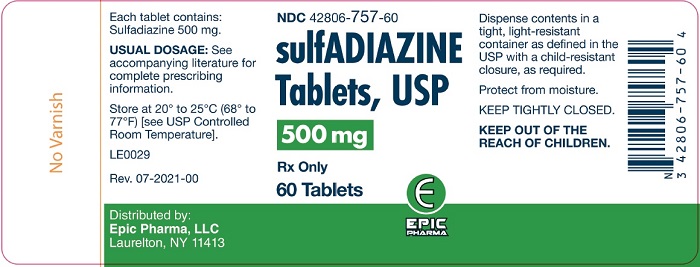
Sulfadiazine 500 mg Tablet, 60-count — NDC 42806-757-60 (Billing 42806-0757-60)
This is a package of 60 tablets of Sulfadiazine 500 mg Tablet from EPIC PHARMA, LLC, marketed since Dec 2021 and currently FDA-listed; retail pharmacies pay about $15.06 per tablet (NADAC). It is this product's only package size.
NDC database record
One package, one record: these facts belong to NDC 42806-757-60 alone.
- Record
- FDA NDC Directory package listing · Human prescription drug
- Code segments
- 42806 labeler · 757 product · 60 package
- Package marketed since
- Dec 15, 2021
- Sample package
- No — commercial package
- Listing certified through
- Dec 31, 2026
- Billing quantity
- 60 EA per package
- Barcode (UPC)
- 0342806757604
- Medicaid fills, this package
- 176 prescriptions in the last four reported quarters
- FDA record last changed
- Jul 24, 2026
Identity & classification
Regulatory identifiers FDA, NLM and CMS codes for this package
Drug-database identifiers Medi-Span GPI and First Databank GCN / HICL / AHFS classification
- GSN (GCN sequence number): 009375
- GCN: 41393
- GPI-14 (Medi-Span): 08000020000305
- HICL (First Databank): 004061
- AHFS class code: 08:12.20.00
- RxCUI (RxNorm): 198228
Where does this data come from?
- FDA openFDA NDC Directory · synced Oct 8, 2026
- FDA label on DailyMed · label index refreshed Oct 8, 2026
- RxNorm (NLM RxNav) · catalog refreshed Oct 1, 2026
- Medi-Span GPI (licensed)
- First Databank (licensed) · refreshed Oct 8, 2026
RxNorm drug class
This medicine belongs to the Sulfonamide Antibacterial class.
Where does this data come from?
- RxClass (NLM) · catalog refreshed Oct 1, 2026
Clinical
Sulfadiazine, a sulfa drug, eliminates bacteria that cause infections, especially urinary tract infections. Antibiotics will not work for colds, flu, or other viral infections. This medication is sometimes prescribed for other uses; ask your doctor or pharmacist for more information.
Read the full MedlinePlus article ↗- It is a sulfa antibiotic used for infections such as certain urinary tract infections, nocardiosis, chancroid, and trachoma. It is also used with other medicines for toxoplasmosis...
- You take the tablets by mouth, usually in several doses spread through the day. Your dose depends on your age, weight, and the infection. Follow your prescriber’s directions and th...
- Nausea, vomiting, stomach pain, diarrhea, headache, rash, and sun sensitivity can happen. Most are manageable, but tell your doctor if they bother you.
- Call if you get a sore throat, fever, pale skin, purple spots, yellow skin or eyes, a severe rash, or little urine. These can signal a serious blood, allergic, or kidney problem.
Patient education
Supplement & herbal interactions
Some supplements/herbs that may interact with Sulfadiazine — tap one for details:
Sulfadiazine may be associated with lower levels of 10 nutrients — worth a chat with your pharmacist, not a cause for alarm.
Where does this data come from?
- MedlinePlus (NLM) · refreshed Oct 8, 2026
- FDA label on DailyMed · label index refreshed Oct 8, 2026
Ask a licensed pharmacist directly — free, answered by our team.
Pricing
A drug doesn't have one price. Each row is a different public payment system, and none is what you'd pay at the counter — that depends on your insurance. The ⓘ on each row explains what it measures.
| Price system | Per ea | Per package |
|---|---|---|
| Retail pharmacies payNADAC · weekly | $15.065 | $903.88 / 60 tablets |
| Medicaid paysCMS SDUD · 12 mo | $13.05 | $783.25 / 60 tablets |
| Medicare drug plans payPart D · Q2 2026 | $14.08 | $844.72 / 60 tablets |
Where does this data come from?
- CMS NADAC weekly file · file of Oct 7, 2026
- CMS ASP pricing files · refreshed Sep 20, 2026
- CMS Medicaid State Drug Utilization Data · through Q1 2026
- CMS Part D plan pricing files · refreshed Sep 24, 2026
- VA National Acquisition Center price file
Packaging — all sizes for this product
| Package NDC | Description | Marketing start | Marketing end | Status |
|---|---|---|---|---|
| 42806-0757-60 You're viewing this Main listing | 60 TABLET in 1 BOTTLE | 2021-12-15 | — | Active |
Therapeutic equivalents
| Product | Labeler | Pack | NADAC/unit | TE | Status | Price vs. this |
|---|---|---|---|---|---|---|
| Sulfadiazine 500 mgthis 42806-0757-60 | EPIC | 60 tablets | $15.065 | — | Availability likely | — |
| sulfADIAZINE 500 mg 62135-0842-60 | Chartwell | 60 tablets | $15.065 | — | Availability likely | — |
Where does this data come from?
- FDA openFDA NDC Directory · synced Oct 8, 2026
- FDA Orange Book · refreshed Oct 3, 2026
- CMS NADAC weekly file · file of Oct 7, 2026
Availability & generic status
This product is an FDA-approved generic. Other versions of the same drug are listed under Therapeutic equivalents, least expensive first.
Where does this data come from?
- FDA Orange Book · refreshed Oct 3, 2026
What it looks like
Where does this data come from?
- FDA label on DailyMed · label index refreshed Oct 8, 2026
Inactive Ingredients / Excipients
Inactive ingredients, also called excipients, are components of the drug product other than the active ingredient. They may include fillers, dyes, coatings, preservatives, flavors, or other formulation ingredients.
🧪 Avoiding an ingredient? See Sulfadiazine inactive ingredients by manufacturer: every current product's list side by side, so you can ask your pharmacy for the version that does not list it.
💡 Tap an ingredient (hover on desktop) to see what it is and why it’s used.
-
UNII M28OL1HH48
Croscarmellose sodium is a plant-based substance derived from cellulose. It acts as a disintegrant, helping tablets and capsules break down quickly in the digestive system so the medicine can be absorbed.
-
UNII F05Q2T2JA0
Docusate sodium is a stool softener compound that helps medicines dissolve and move through the digestive tract. It acts as a surfactant, reducing surface tension in the intestines, and also serves as a wetting agent in tablet formulations.
-
UNII OP1R32D61U
Microcrystalline cellulose is a purified form of cellulose, a natural fiber from plant sources. It acts as a binder and filler in tablets and capsules, helping hold ingredients together and give the medicine its shape and size.
-
UNII FZ989GH94E
Povidone is a synthetic polymer made from a plastic-like material. It acts as a binder to hold tablet ingredients together and as a disintegrant to help the tablet break apart in your stomach so the medicine can be absorbed.
-
UNII OJ245FE5EU
Sodium benzoate is a salt derived from benzoic acid, a preservative. It's added to medicines to prevent growth of bacteria, fungi, and other microorganisms that could spoil the product.
-
UNII 5856J3G2A2
A starch-based powder made from potatoes and processed with sodium. It acts as a disintegrant, helping the tablet or capsule break apart quickly in the stomach so the medicine can be absorbed.
-
UNII 4ELV7Z65AP
Stearic acid is a fatty acid derived from plant or animal sources. It acts as a binder and lubricant in tablets and capsules, helping them hold together and flow smoothly during manufacturing.
7 inactive ingredients listed in the exact product block matched to this NDC.
Where does this data come from?
ingredient classCode="IACT" elements from the exact product block matched by this NDC. Label-section narrative from DailyMed / the openFDA label index is shown separately when available.- FDA label on DailyMed · label index refreshed Oct 8, 2026
- FDA openFDA NDC Directory · synced Oct 8, 2026
Inactive ingredient FAQ
Are inactive ingredients the same for every manufacturer?
Why might an inactive ingredient be missing?
Can inactive ingredients matter?
Manufacturer & labeler
More NDCs from EPIC PHARMA, LLC labeler code 42806
- Metoprolol succinate 25 mg Tablet, Extended Release NDC 42806-724-01
- Metoprolol succinate 50 mg Tablet, Extended Release NDC 42806-725-01
- Metoprolol succinate 100 mg Tablet, Extended Release NDC 42806-726-01
- Metoprolol succinate 200 mg Tablet, Extended Release NDC 42806-727-01
- Calcitriol .25 ug Capsule NDC 42806-732-01
- Calcitriol .5 ug Capsule NDC 42806-733-01
- Rifampin 300 mg Capsule NDC 42806-799-01
- Rifampin 150 mg Capsule NDC 42806-801-01
- Flecainide Acetate 50 mg Tablet NDC 42806-817-01
- Flecainide Acetate 100 mg Tablet NDC 42806-818-01
- Flecainide Acetate 150 mg Tablet NDC 42806-819-01
- Buspirone Hydrochloride 7.5 mg Capsule NDC 42806-831-01
Where does this data come from?
- FDA openFDA NDC Directory · synced Oct 8, 2026
- Drugs@FDA
Full prescribing information FDA SPL
🎯 Indications and Usage ▾
INDICATIONS AND USAGE sulfADIAZINE Tablets, USP are indicated in the following conditions: Chancroid Trachoma Inclusion conjunctivitis Nocardiosis Urinary tract infections (primarily pyelonephritis, pyelitis and cystitis) in the absence of obstructive uropathy or foreign bodies, when these infections are caused by susceptible strains of the following organisms: Esch erichia coli, Klebsiella species, Enterobacter species, Staphylococcus aureus, Proteus mirabilis and P. vulgaris . Sulfadiazine should be used for urinary tract infections only after use of more soluble sulfonamides has been unsuccessful.
Toxoplasmosis encephalitis in patients with and without acquired immunodeficiency syndrome, as adjunctive therapy with pyrimethamine. Malaria due to chloroquine-resistant strains of Plasmodium falciparum , when used as adjunctive therapy. Prophylaxis of meningococcal meningitis when sulfonamide-sensitive group A strains are known to prevail in family groups or larger closed populations (the prophylactic usefulness of sulfonamides when group B or C infections are prevalent is not proved and may be harmful in closed population groups).
Meningococcal meningitis, when the organism has been demonstrated to be susceptible. Acute otitis media due to Haemophilus influenzae, when used concomitantly with adequate doses of penicilin. Prophylaxis against recurrences of rheumatic fever, as an alternative to penicillin.
H. influenzae meningitis, as adjunctive therapy with parental streptomycin. IMPORTANT NOTES In vitro sulfonamide susceptibility tests are not always reliable. The test must be carefully coordinated with bacteriologic and clinical response.
When the patient is already taking sulfonamides, follow-up cultures should have aminobenzoic acid added to the culture media. Currently, the increasing frequency of resistant organisms limits the usefulness of antibacterial agents, including the sulfonamides, especially in the treatment of recurrent and complicated urinary tract infections. Wide variation in blood levels may result with identical doses.
Blood levels should be measured in patients receiving sulfonamides for serious infections. Free sulfonamide blood levels of 5 mg to 15 mg per 100 mL may be considered therapeutically effective for most infections and blood levels of 12 mg to 15 mg per 100 mL may be considered optimal for serious infections. Twenty mg per 100 mL should be the maximum total sulfonamide level, since adverse reactions occur more frequently above this level.
⏱️ Dosage and Administration ▾
DOSAGE AND ADMINISTRATION SYSTEMIC SULFONAMIDES ARE CONTRAINDICATED IN INFANTS UNDER 2 MONTHS OF AGE except as adjunctive therapy with pyrimethamine in the treatment of congenital toxoplasmosis. Usual Dosage for Infants over 2 Months of Age and Children Initially, one-half the 24-hour dose. Maintenance, 150 mg/kg or 4 g/m 2 , divided into 4 to 6 doses, every 24 hours, with a maximum of 6 g every 24 hours.
Rheumatic fever prophylaxis, under 30 kg (66 pounds), 500 mg every 24 hours; over 30 kg (66 pounds), 1 g every 24 hours. Usual Adult Dosage Initially, 2 g to 4 g. Maintenance, 2 g to 4 g, divided into 3 to 6 doses, every 24 hours.
⛔ Contraindications ▾
CONTRAINDICATIONS Sulfadiazine is contraindicated in the following circumstances: Hypersensitivity to sulfonamides. In infants less than 2 months of age (except as adjunctive therapy with pyrimethamine in the treatment of congenital toxoplasmosis). In pregnancy at term and during the nursing period, because sulfonamides cross the placenta and are excreted in breast milk and may cause kernicterus.
⚠️ Warnings ▾
WARNINGS The sulfonamides should not be used for the treatment of group A betahemolytic streptococcal infections. In an established infection, they will not eradicate the streptococcus and, therefore, will not prevent sequelae such as rheumatic fever and glomerulonephritis. Deaths associated with the administration of sulfonamides have been reported from hypersensitivity reactions, agranulocytosis, aplastic anemia and other blood dyscrasias.
The presence of such clinical signs as sore throat, fever, pallor, purpura or jaundice may be early indications of serious blood disorders. The frequency of renal complications is considerably lower in patients receiving the more soluble sulfonamides.
🤒 Adverse Reactions ▾
ADVERSE REACTIONS Blood Dyscrasias Agranulocytosis, aplastic anemia, thrombocytopenia, leukopenia, hemolytic anemia, purpura, hypoprothrombinemia and methemoglobinemia. Allergic Reactions Erythema multiforme (Stevens-Johnson syndrome), generalized skin eruptions, epidermal necrolysis, urticaria, serum sickness, pruritus, exfoliative dermatitis, anaphylactoid reactions, periorbital edema, conjunctival and scleral injection, photosensitization, arthralgia, allergic myocarditis, drug fever and chills. Gastrointestinal Reactions Nausea, emesis, abdominal pains, hepatitis, diarrhea, anorexia, pancreatitis and stomatitis.
C.N.S. Reactions Headache, peripheral neuritis, mental depression, convulsions, ataxia, hallucinations, tinnitus, vertigo and insomnia. Renal Crystalluria, stone formation, toxic nephrosis with oliguria and anuria; periarteritis nodosa and lupus erythematosus phenomenon have been noted.
Miscellaneous Reactions The sulfonamides bear certain chemical similarities to some goitrogens, diuretics (acetazolamide and the thiazides) and oral hypoglycemic agents. Goiter production, diuresis and hypoglycemia have occurred rarely in patients receiving sulfonamides. Cross-sensitivity may exist with these agents.
🔄 Drug Interactions ▾
Drug Interactions Administration of a sulfonamide may increase the effect of oral anticoagulants and methotrexate, probably by displacement of these drugs from binding sites on plasma albumin. Potentiation of the action of sulfonylurea hypoglycemic agents, thiazide diuretics and uricosuric agents may also be noted. This may also be due to displacement of the drugs from albumin or a pharmacodynamic mechanism may play a role.
Conversely, agents such as indomethacin, probenecid and salicylates may displace sulfonamides from plasma albumin and increase the concentrations of free drug in plasma.
🤰 Pregnancy ▾
Pregnancy Teratogenic Effects The safe use of sulfonamides in pregnancy has not been established. The teratogenic potential of most sulfonamides has not been thoroughly investigated in either animals or humans. However, a significant increase in the incidence of cleft palate and other bony abnormalities in offspring has been observed when certain sulfonamides of the short, intermediate and long acting types were given to pregnant rats and mice in high oral doses (7 to 25 times the human therapeutic dose).
🧒 Pediatric Use ▾
Pediatric Use Sulfadiazine is contraindicated in infants less than 2 months of age (except as adjunctive therapy with pyrimethamine in the treatment of congenital toxoplasmosis). See CONTRAINDICATIONS and DOSAGE AND ADMINISTRATION .
🧬 Clinical Pharmacology ▾
CLINICAL PHARMACOLOGY The systemic sulfonamides are bacteriostatic agents having a similar spectrum of activity. Sulfonamides competitively inhibit bacterial synthesis of folic acid (pteroylglutamic acid) from aminobenzoic acid. Resistant strains are capable of utilizing folic acid precursors or preformed folic acid.
Sulfonamides exist in the blood in 3 forms – free, conjugated (acetylated and possibly others) and protein bound. The free form is considered to be the therapeutically active one. Sulfadiazine given orally is readily absorbed from the gastrointestinal tract.
After a single 2 g oral dose, a peak of 6.04 mg/100 mL is reached in 4 hours; of this, 4.65 mg/100 mL is free drug. When a dose of 100 mg/kg of body weight is given initially and followed by 50 mg/kg every 6 hours, blood levels of free sulfadiazine are about 7 mg/100mL. Protein binding is 38% to 48%.
Sulfadiazine diffuses into the cerebrospinal fluid; free drug reaches 32% to 65% of blood levels and total drug 40% to 60%. Sulfadiazine is excreted largely in the urine, where concentrations are 10 to 25 times greater than serum levels. Approximately 10% of a single oral dose is excreted in the first 6 hours, 50% within 24 hours and 60% to 85% in 48 to 72 hours.
Of the amount excreted in the urine, 15% to 40% is in the acetyl form.
📦 How Supplied / Storage and Handling ▾
HOW SUPPLIED sulfADIAZINE Tablets, USP for oral administration are available as 500 mg White, unscored, capsule-shaped tablets, debossed “ E 757” on one face and supplied as: NDC 42806-757-60 bottles of 60 Storage Store at 20° to 25°C (68° to 77°F) [see USP Controlled Room Temperature]. Protect from moisture. Dispense contents in a tight, light-resistant container as defined in the USP with a child-resistant closure, as required.
KEEP TIGHTLY CLOSED. KEEP OUT OF THE REACH OF CHILDREN. To report SUSPECTED ADVERSE REACTIONS, contact Epic Pharma, LLC at 1-888-374-2791 or FDA at 1-800-FDA-1088 or www.fda.gov/medwatch.
Distributed by: Epic Pharma, LLC Laurelton, NY 11413 Rev. 06-2023-00 MF757REV06/23 OS0006
📋 Description ▾
DESCRIPTION Sulfadiazine is an oral sulfonamide antibacterial agent. Each tablet, for oral administration, contains 500 mg sulfadiazine. In addition, each tablet contains the following inactive ingredients: croscarmellose sodium, docusate sodium, microcrystalline cellulose, povidone, sodium benzoate, sodium starch glycolate and stearic acid.
Sulfadiazine occurs as a white or slightly yellow powder. It is odorless or nearly so and slowly darkens on exposure to light. It is practically insoluble in water and slightly soluble in alcohol.
The chemical name of sulfadiazine is N 1 -2-pyrimidinylsulfanilamide. The molecular formula is C 10 H 10 N 4 O 2 S. It has a molecular weight of 250.27.
The structural formula is shown below: Most sulfonamides slowly darken on exposure to light. structure-formula.jpg
💬 Information for Patients ▾
Information for Patients Patients should be instructed to drink an eight ounce glass of water with each dose of medication and at frequent intervals throughout the day. Caution patients to report promptly the onset of sore throat, fever, pallor, purpura or jaundice when taking this drug, since these may be early indications of serious blood disorders.
⚠️ Precautions ▾
PRECAUTIONS General Sulfonamides should be given with caution to patients with impaired renal or hepatic function and to those with severe allergy or bronchial asthma. Hemolysis may occur in individuals deficient in glucose-6-phosphate dehydrogenase. This reaction is dose related.
Adequate fluid intake must be maintained in order to prevent crystalluria and stone formation. Information for Patients Patients should be instructed to drink an eight ounce glass of water with each dose of medication and at frequent intervals throughout the day. Caution patients to report promptly the onset of sore throat, fever, pallor, purpura or jaundice when taking this drug, since these may be early indications of serious blood disorders.
Laboratory Tests Complete blood counts and urinalyses with careful microscopic examinations should be done frequently in patients receiving sulfonamides. Drug Interactions Administration of a sulfonamide may increase the effect of oral anticoagulants and methotrexate, probably by displacement of these drugs from binding sites on plasma albumin. Potentiation of the action of sulfonylurea hypoglycemic agents, thiazide diuretics and uricosuric agents may also be noted.
This may also be due to displacement of the drugs from albumin or a pharmacodynamic mechanism may play a role. Conversely, agents such as indomethacin, probenecid and salicylates may displace sulfonamides from plasma albumin and increase the concentrations of free drug in plasma. Carcinogenesis, Mutagenesis, Impairment of Fertility The sulfonamides bear certain chemical similarities to some goitrogens.
Rats appear to be especially susceptible to the goitrogenic effects of sulfonamides and long-term administration has produced thyroid malignancies in rats. Pregnancy Teratogenic Effects The safe use of sulfonamides in pregnancy has not been established. The teratogenic potential of most sulfonamides has not been thoroughly investigated in either animals or humans.
However, a significant increase in the incidence of cleft palate and other bony abnormalities in offspring has been observed when certain sulfonamides of the short, intermediate and long acting types were given to pregnant rats and mice in high oral doses (7 to 25 times the human therapeutic dose). Nursing Mothers Sulfadiazine is contraindicated for use in nursing mothers because the sulfonamides cross the placenta, are excreted in breast milk and may cause kernicterus. Because of the potential for serious adverse reactions in nursing infants from sulfadiazine, a decision should be made whether to discontinue nursing or to discontinue the drug, taking into account the importance of the drug to the mother.
See CONTRAINDICATIONS . Pediatric Use Sulfadiazine is contraindicated in infants less than 2 months of age (except as adjunctive therapy with pyrimethamine in the treatment of congenital toxoplasmosis). See CONTRAINDICATIONS and DOSAGE AND ADMINISTRATION .
🍼 Nursing Mothers ▾
Nursing Mothers Sulfadiazine is contraindicated for use in nursing mothers because the sulfonamides cross the placenta, are excreted in breast milk and may cause kernicterus. Because of the potential for serious adverse reactions in nursing infants from sulfadiazine, a decision should be made whether to discontinue nursing or to discontinue the drug, taking into account the importance of the drug to the mother. See CONTRAINDICATIONS .
📄 Carcinogenesis, Mutagenesis, Impairment of Fertility ▾
Carcinogenesis, Mutagenesis, Impairment of Fertility The sulfonamides bear certain chemical similarities to some goitrogens. Rats appear to be especially susceptible to the goitrogenic effects of sulfonamides and long-term administration has produced thyroid malignancies in rats.
📄 Package Label / Principal Display Panel ▾
PACKAGE/LABEL PRINCIPAL DISPLAY PANEL – 500 mg 500mg-60ct.jpg