
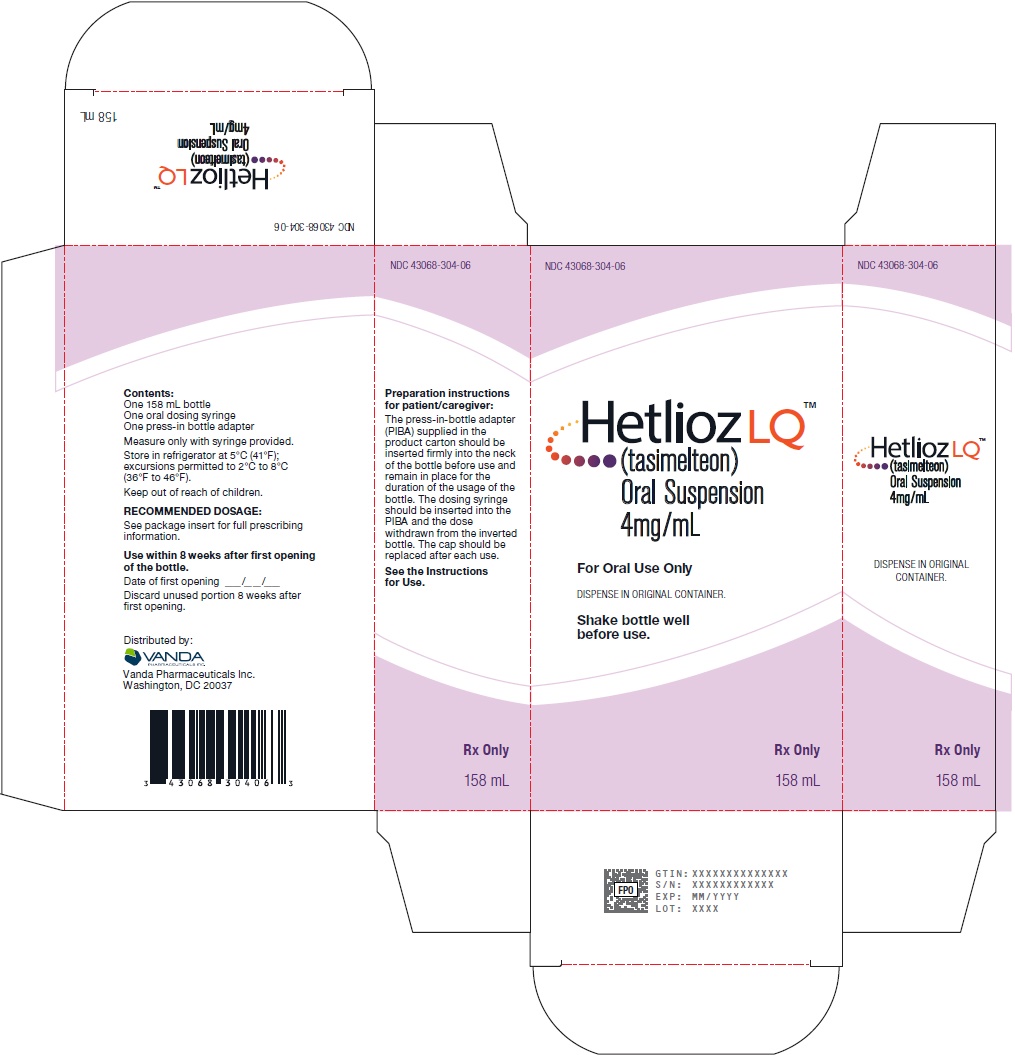
Hetlioz LQ tasimelteon 4 mg/mL Suspension — NDC 43068-304-02 (Billing 43068-0304-02)
This is a package of Hetlioz LQ tasimelteon 4 mg/mL Suspension from Vanda Pharmaceuticals Inc., marketed since Dec 2020 and currently FDA-listed.
NDC database record
One package, one record: these facts belong to NDC 43068-304-02 alone.
- Record
- FDA NDC Directory package listing · Human prescription drug
- Code segments
- 43068 labeler · 304 product · 02 package
- Package marketed since
- Dec 10, 2020
- Sample package
- No — commercial package
- Listing certified through
- Dec 31, 2027
- Barcode (UPC-A, from the NDC)
- 3 4306830402 5
- FDA record last changed
- Aug 20, 2026
Identity & classification
Regulatory identifiers FDA, NLM and CMS codes for this package
Drug-database identifiers Medi-Span GPI and First Databank GCN / HICL / AHFS classification
- GSN (GCN sequence number): 081738
- GCN: 48937
- HICL (First Databank): 040927
- AHFS class code: 28:24.48.00
- RxCUI (RxNorm): 1490473
Where does this data come from?
- FDA openFDA NDC Directory · synced Oct 8, 2026
- FDA label on DailyMed · label index refreshed Oct 8, 2026
- RxNorm (NLM RxNav) · catalog refreshed Oct 8, 2026
- Medi-Span GPI (licensed)
- First Databank (licensed) · refreshed Oct 8, 2026
RxNorm drug class
This medicine belongs to the Melatonin Receptor Agonist class.
Where does this data come from?
- RxClass (NLM) · catalog refreshed Oct 8, 2026
Clinical
Tasimelteon is used to treat non-24-hour sleep-wake disorder (non-24; a condition that occurs mainly in people who are blind in which the body's natural clock is out of sync with the normal day-night cycle and causes a disrupted sleep schedule) in adults. It is also used to treat nighttime sleep problems in adults and children 3 years of age and older with Smith-Magenis Syndrome (SMS; a developmental disorder). Tasimelteon is in a class of medications called melatonin receptor agonists. It works similarly to melatonin, a natural substance in the brain that is needed for sleep.
Read the full MedlinePlus article ↗- It treats Non-24-Hour Sleep-Wake Disorder in adults, a body-clock problem that disrupts sleep. Hetlioz is also used for nighttime sleep problems in Smith-Magenis Syndrome, as capsu...
- Take it about an hour before bedtime, at the same time every night, on an empty stomach. Food, especially a high-fat meal, can make it work less well. Follow your prescriber’s dire...
- If you can’t take it at about the usual time, skip that night’s dose. Take the next dose at your regular time. Don’t double up.
- What happens if I miss a dose of Tasimelteon?
Patient education
Supplement & herbal interactions
Some supplements/herbs that may interact with Tasimelteon — tap one for details:
Where does this data come from?
- MedlinePlus (NLM) · refreshed Oct 8, 2026
- FDA label on DailyMed · label index refreshed Oct 8, 2026
Ask a licensed pharmacist directly — free, answered by our team.
Pricing
A drug doesn't have one price. Each row is a different public payment system, and none is what you'd pay at the counter — that depends on your insurance. The ⓘ on each row explains what it measures.
| Price system | Per mL | Per package |
|---|---|---|
| Retail pharmacies payNADAC · weekly | Not in the retail survey — common for institutional, discontinued, or low-volume packs. | |
| Medicaid paysCMS SDUD · 12 mo | No recent Medicaid claims on file for this NDC — rare and low-volume NDCs are suppressed in the public data. | |
| Medicare drug plans payPart D · Q2 2026 | $172.23 | $8,266.99 / 48 ml |
Where does this data come from?
- CMS NADAC weekly file
- CMS ASP pricing files · refreshed Sep 20, 2026
- CMS Medicaid State Drug Utilization Data · refreshed Oct 9, 2026
- CMS Part D plan pricing files · refreshed Sep 24, 2026
- VA National Acquisition Center price file
Packaging — all sizes for this product
| Package NDC | Description | Marketing start | Marketing end | Status |
|---|---|---|---|---|
| 43068-0304-02 You're viewing this | 1 BOTTLE in 1 CARTON / 48 mL in 1 BOTTLE | 2020-12-10 | — | Active |
| 43068-0304-06 43068-304-06 Main listing | 1 BOTTLE in 1 CARTON / 158 mL in 1 BOTTLE | 2020-12-10 | — | Active |
Pack size FAQ
What quantity is in this package?
What NDC number is used to bill for this package of Hetlioz LQ tasimelteon 4 mg/mL Suspension?
Therapeutic equivalents
| Product | Labeler | Pack | NADAC/unit | TE | Status | Price vs. this |
|---|---|---|---|---|---|---|
| Hetlioz LQ 4 mg/mLthis 43068-0304-02 | Vanda | 1 bottle | — | — | FDA listed | — |
Where does this data come from?
- FDA openFDA NDC Directory · synced Oct 8, 2026
- FDA Orange Book · refreshed Oct 3, 2026
- CMS NADAC weekly file
Availability & generic status
We did not find an FDA-approved generic match for this exact strength, form and route. Patent/protection dates below may affect future generic timing.
Why the date isn’t exact: Generic timing can change because patents may be challenged, settled, licensed, added, removed, or worked around with a narrower label — and FDA approval does not always mean a pharmacy can get the generic today.
🛈 What do these terms mean?
- Patent
- Legal protection listed in the Orange Book that may delay generic approval or launch. Issued by the U.S. Patent & Trademark Office.
- Substance patent
- Covers the active drug molecule itself — the hardest to design around. A generic generally can’t launch until it expires.
- Formulation (product) patent
- Covers a specific formulation or dosage form. A generic can sometimes work around it with a different formulation.
- Method-of-use patent
- A patent covering one specific approved use of the drug — not necessarily the whole molecule. A generic can sometimes launch with a “skinny label” that carves out the protected use and keeps the others.
- Skinny label
- A generic label that omits a still-patented use when the FDA allows it — letting a generic reach the market for the unprotected uses.
- Exclusivity
- FDA-granted marketing protection, separate from patents — e.g. 5-yr new chemical entity, 7-yr orphan drug, or a +6-month pediatric extension.
- Paragraph IV
- A generic applicant’s formal challenge to a listed patent. It can potentially lead to earlier generic entry, but often involves litigation or a settlement.
- RLD / RS
- Reference Listed Drug — the brand product the FDA uses as the reference for generic applications. Reference Standard — the product the FDA expects generics to compare against in bioequivalence testing.
- TE / AB rating
- FDA therapeutic-equivalence rating. An AB rating generally means the FDA considers a generic therapeutically equivalent to — and substitutable for — the brand.
- LOE (loss of exclusivity)
- The latest patent or exclusivity currently listed — the loss-of-exclusivity / latest-listed-protection date shown on this page. Paragraph-IV challenges and settlements can move the real date earlier; FDA approval and a manufacturer’s decision to market can move it later.
Built from the FDA Orange Book. The bars above are scaled to each protection’s expiry; the red LOE marker is the last one to lapse.
| Patent | Type | Use code | Expires |
|---|---|---|---|
| US 11141400 ↗ | Method of use | U-3007 | Oct 10, 2034 |
| US 10980770 ↗ | Method of use | U-3106 | Jan 25, 2033 |
| US 11266622 ↗ | Method of use | U-3003 | Aug 29, 2035 |
| US 11633377 ↗ | Method of use | U-3003 | Jan 25, 2033 |
| US 10149829 ↗ | Method of use | U-3006 | Jan 25, 2033 |
| US 9730910 ↗ | Method of use | U-3005 | May 17, 2034 |
| US 9539234 ↗ | Method of use | U-3004 | Jan 25, 2033 |
| US 10610510 ↗ | Method of use | U-3009 | Jan 25, 2033 |
| US 10376487 ↗ | Method of use | U-3007 | Jul 27, 2035 |
| US 10179119 ↗ | Method of use | U-3003 | Aug 29, 2035 |
| US 10610511 ↗ | Method of use | U-3007 | Oct 10, 2034 |
| US 12447141 ↗ | Method of use | U-3003 | Dec 11, 2040 |
| US 12201604 ↗ | Method of use | U-3003 | Jan 25, 2033 |
| US 11759446 ↗ | Method of use | U-3003 | Feb 21, 2041 |
| US 11786502 ↗ | Method of use | U-3007 | Oct 10, 2034 |
| US 11833130 ↗ | Method of use | U-3003 | Jan 25, 2033 |
| US 11850229 ↗ | Method of use | U-3342 | Jan 25, 2033 |
| US 11918556 ↗ | Method of use | U-3342 | Apr 7, 2033 |
| US 11826339 ↗ | Method of use | U-3342 | Jan 25, 2033 |
| US 11918557 ↗ | Method of use | U-3003 | Jan 25, 2033 |
| US 11285129 ↗ | Method of use | U-3342 | Jan 25, 2033 |
| US 12049457 ↗ | Drug substance | — | Feb 12, 2035 |
| US 10829465 ↗ | Drug substance | — | Feb 12, 2035 |
| US 10071977 ↗ | Drug substance | — | Feb 12, 2035 |
| US 11202770 ↗ | Drug product | — | Dec 11, 2040 |
| US 11566011 ↗ | Drug substance | — | Feb 12, 2035 |
| US 11760740 ↗ | Drug substance | — | Feb 12, 2035 |
| Code | What it grants | Expires |
|---|---|---|
| ODE-329 | Orphan Drug Exclusivity (7-year) | Dec 1, 2027 |
Is there a generic version of HETLIOZ LQ 4 MG/ML SUSPENSION?
The FDA approved a generic — why can’t I get it at my pharmacy yet?
Why do different websites show different generic release dates?
What does “FDA listed” mean?
What does a patent or protection date mean here?
What does “current Orange Book estimate” mean?
Can a generic come out before the last patent expires?
Can a generic come out after the listed dates?
What is the difference between patents and exclusivity?
Why are there multiple patent dates?
Where does this data come from?
- FDA Orange Book · refreshed Oct 3, 2026
What it looks like
Where does this data come from?
- FDA label on DailyMed · label index refreshed Oct 8, 2026
Inactive Ingredients / Excipients
Inactive ingredients, also called excipients, are components of the drug product other than the active ingredient. They may include fillers, dyes, coatings, preservatives, flavors, or other formulation ingredients.
🧪 Avoiding an ingredient? See Tasimelteon inactive ingredients by manufacturer: every current product's list side by side, so you can ask your pharmacy for the version that does not list it.
Where does this data come from?
IACT rows and label-wide narrative are kept separate; availability and product-level specificity depend on the submitted label.- FDA label on DailyMed · label index refreshed Oct 8, 2026
- FDA openFDA NDC Directory · synced Oct 8, 2026
Inactive ingredient FAQ
Are inactive ingredients the same for every manufacturer?
Why might an inactive ingredient be missing?
Can inactive ingredients matter?
Manufacturer & labeler
More NDCs from Vanda Pharmaceuticals Inc. labeler code 43068
- Fanapt Iloperidone 10 mg Tablet NDC 43068-110-02
- Fanapt Iloperidone 12 mg Tablet NDC 43068-112-02
- Fanapt Iloperidone Kit NDC 43068-113-04
- Fanapt Iloperidone Kit NDC 43068-114-03
- Fanapt Iloperidone Kit NDC 43068-115-04
- Hetlioz tasimelteon 20 mg Capsule NDC 43068-220-01
- Nereus Tradipitant 85 mg Capsule NDC 43068-585-01
- PONVORY Ponesimod Kit NDC 43068-610-09
- PONVORY Ponesimod 20 mg Tablet, Film Coated NDC 43068-620-01
- Bysanti Milsaperidone 1 mg Tablet NDC 43068-701-02
- Bysanti Milsaperidone 2 mg Tablet NDC 43068-702-02
- Bysanti Milsaperidone 4 mg Tablet NDC 43068-704-02
Where does this data come from?
- FDA openFDA NDC Directory · synced Oct 8, 2026
- Drugs@FDA
Full prescribing information FDA SPL
🎯 Indications and Usage ▾
1 INDICATIONS AND USAGE HETLIOZ is a melatonin receptor agonist. HETLIOZ capsules are indicated for the treatment of: Non-24-Hour Sleep-Wake Disorder (Non-24) in adults ( 1 ) Nighttime sleep disturbances in Smith-Magenis Syndrome (SMS) in patients 16 years of age and older ( 1 ) HETLIOZ LQ oral suspension is indicated for the treatment of: Nighttime sleep disturbances in SMS in pediatric patients 3 years to 15 years of age ( 1 )
1.1Non-24-Hour Sleep-Wake Disorder (Non-24) HETLIOZ capsules are indicated for the treatment of Non-24 in adults.
1.2Nighttime Sleep Disturbances in Smith-Magenis Syndrome (SMS) HETLIOZ capsules are indicated for the treatment of nighttime sleep disturbances in SMS in patients 16 years of age and older. HETLIOZ LQ oral suspension is indicated for the treatment of nighttime sleep disturbances in SMS in pediatric patients 3 to 15 years of age.
⏱️ Dosage and Administration ▾
2 DOSAGE AND ADMINISTRATION Indicated Population Dosage Form Body Weight Recommended Dosage Non-24 ( 2.2 ) Adults Capsules Not applicable 20 mg one hour prior to bedtime Nighttime sleep disturbances in SMS ( 2.3 ) Patients 16 years of age and older Capsules Not applicable 20 mg one hour prior to bedtime Pediatric Patients 3 to 15 years of age Oral Suspension ≤ 28 kg 0.7 mg/kg one hour before bedtime >28 kg 20 mg one hour before bedtime HETLIOZ capsules and HETLIOZ LQ oral suspension are not substitutable ( 2.1 ) Administer at the same time every night ( 2.2 , 2.3 ) Take without food ( 2.4 )
2.1Non-Interchangeability between HETLIOZ Capsules and HETLIOZ LQ Oral Suspension HETLIOZ capsules and HETLIOZ LQ oral suspension are not substitutable [see Clinical Pharmacology ( 12.3 )].
2.2Recommended Dosage for HETLIOZ Capsules for Non-24 Adults The recommended dosage of HETLIOZ capsules in adults is 20 mg one hour before bedtime, at the same time every night. Because of individual differences in circadian rhythms, drug effect may not occur for weeks or months.
2.3Recommended Dosage for HETLIOZ Capsules and HETLIOZ LQ Oral Suspension for Nighttime Sleep Disturbances in SMS Patients 16 years of Age and Older The recommended dosage of HETLIOZ capsules in patients 16 years and older is 20 mg one hour before bedtime, at the same time every night. Pediatric Patients 3 Years to 15 Years of Age The recommended dosage of HETLIOZ LQ oral suspension in pediatric patients 3 years to 15 years of age is based on body weight ( Table 1 ). Administer HETLIOZ one hour before bedtime, at the same time every night.
Table 1: Recommended Dosage of HETLIOZ LQ Oral Suspension for the Treatment of Nighttime Sleep Disturbances in SMS in Pediatric Patients 3 Years to 15 Years of Age Body Weight Daily Dose (oral suspension) ≤28 kg 0.7 mg/kg one hour before bedtime >28 kg 20 mg one hour before bedtime
2.4Important Administration Information Administer HETLIOZ capsules and HETLIOZ LQ oral suspension without food [see Clinical Pharmacology ( 12.3 )]. If a patient is unable to take HETLIOZ at approximately the same time on a given night, they should skip that dose and take the next dose as scheduled. HETLIOZ LQ Oral Suspension See " Instructions for Use " for complete administration instructions.
Shake HETLIOZ LQ oral suspension well for at least 30 seconds before every administration. Remove seal and insert press-in bottle adapter (included in the package) into the neck of the bottle until a tight seal is made. Turn the bottle upside down and withdraw the prescribed amount of HETLIOZ LQ oral suspension from the bottle.
Leave the press-in bottle adapter in place on bottle neck and replace cap on bottle. Store refrigerated. After opening, discard after 5 weeks (for the 48 mL bottle) and after 8 weeks (for the 158 mL bottle).
💊 Dosage Forms and Strengths ▾
3 DOSAGE FORMS AND STRENGTHS Capsules: 20 mg size 1 dark blue opaque, hard gelatin capsules printed with “VANDA 20 mg” in white. Oral suspension: 4 mg/mL white to slightly yellow opaque suspension in 48 mL or 158 mL bottles. Capsules: 20 mg ( 3 ) Oral suspension: 4 mg/mL ( 3 )
⛔ Contraindications ▾
4 CONTRAINDICATIONS None. None ( 4 )
⚠️ Warnings and Cautions ▾
5 WARNINGS AND PRECAUTIONS May cause somnolence: After taking HETLIOZ, patients should limit their activity to preparing for going to bed, because HETLIOZ can impair the performance of activities requiring complete mental alertness ( 5.1 )
5.1Somnolence After taking HETLIOZ, patients should limit their activity to preparing for going to bed. HETLIOZ can potentially impair the performance of activities requiring complete mental alertness.
🤒 Adverse Reactions ▾
6 ADVERSE REACTIONS The most common adverse reactions (incidence >5% and at least twice as high on HETLIOZ than on placebo) were headache, increased alanine aminotransferase, nightmares or unusual dreams, and upper respiratory or urinary tract infection ( 6.1 ) To report SUSPECTED ADVERSE REACTIONS, contact Vanda Pharmaceuticals Inc. at 1-844-438-5469 or www.hetlioz.com or FDA at 1-800-FDA-1088 or www.fda.gov/medwatch .
6.1Clinical Trials Experience Because clinical trials are conducted under widely varying conditions, adverse reaction rates observed in the clinical trials of a drug cannot be directly compared to rates in the clinical trials of another drug and may not reflect the rates observed in clinical practice. More than 2080 subjects have been treated with at least one dose of HETLIOZ, of which more than 380 have been treated for > 26 weeks and more than 170 have been treated for > 1 year. Non-24-Hour Sleep-Wake Disorder (Non-24) A 26-week, parallel-arm placebo-controlled study (Study 1) evaluated HETLIOZ (n=42) compared to placebo (n=42) in patients with Non-24.
A randomized-withdrawal, placebo- controlled study of 8 weeks duration (Study 2) also evaluated HETLIOZ (n=10), compared to placebo (n=10), in patients with Non-24. In placebo-controlled studies, 6% of patients exposed to HETLIOZ discontinued treatment due to an adverse event, compared with 4% of patients who received placebo. Table 2 shows the incidence of adverse reactions from Study 1. *Adverse reactions with an incidence > 5% and at least twice as high on HETLIOZ than on placebo are displayed.
Table 2: Adverse Reactions in Study 1 HETLIOZ N=42 Placebo N=42 Headache 17 % 7 % Alanine aminotransferase increased 10 % 5 % Nightmare/abnormal dreams 10 % 0 % Upper respiratory tract infection 7 % 0 % Urinary tract infection 7 % 2 % Nighttime Sleep Disturbances in Smith-Magenis Syndrome (SMS) A 9-week, double-blind, randomized, placebo-controlled, two-period crossover study evaluated HETLIOZ (capsules and oral suspension; n=25) compared to placebo (n=26) in the treatment of nighttime sleep disturbances in patients with Smith-Magenis Syndrome.
Pediatric patients (n=11, age 3 to 15 years) received HETLIOZ LQ oral suspension, and patients ≥16 years of age (n=14) received HETLIOZ capsules. Adverse reactions were similar in patients treated for Non-24 and patients with Smith-Magenis syndrome treated for nighttime sleep disturbances. Adverse reactions were also similar in pediatric patients (3 years to 15 years) who received HETLIOZ LQ oral suspension, and patients ≥16 years of age who received HETLIOZ capsules.
🔄 Drug Interactions ▾
7 DRUG INTERACTIONS Strong CYP1A2 inhibitors (e.g., fluvoxamine): Avoid use of HETLIOZ in combination with strong CYP1A2 inhibitors because of increased exposure ( 7.1 , 12.3 ) Strong CYP3A4 inducers (e.g., rifampin): Avoid use of HETLIOZ in combination with rifampin or other CYP3A4 inducers, because of decreased exposure ( 7.2 , 12.3 )
7.1Strong CYP1A2 Inhibitors (e.g., fluvoxamine) Avoid use of HETLIOZ in combination with fluvoxamine or other strong CYP1A2 inhibitors because of a potentially large increase in tasimelteon exposure and greater risk of adverse reactions [see Clinical Pharmacology ( 12.3 )].
7.2Strong CYP3A4 Inducers (e.g., rifampin) Avoid use of HETLIOZ in combination with rifampin or other CYP3A4 inducers because of a potentially large decrease in tasimelteon exposure with reduced efficacy [see Clinical Pharmacology ( 12.3 )].
7.3Beta-adrenergic Receptor Antagonists (e.g., acebutolol, metoprolol) Beta-adrenergic receptor antagonists have been shown to reduce the production of melatonin via specific inhibition of beta-1 adrenergic receptors. Nighttime administration of beta-adrenergic receptor antagonists may reduce the efficacy of HETLIOZ.
👥 Use in Specific Populations ▾
8 USE IN SPECIFIC POPULATIONS Hepatic impairment : HETLIOZ has not been studied in patients with severe hepatic impairment and is not recommended in these patients ( 8.6 )
8.1Pregnancy Risk Summary Available postmarketing case reports with HETLIOZ use in pregnant women are not sufficient to evaluate drug-associated risk of major birth defects, miscarriage or adverse maternal or fetal outcomes. In pregnant rats, no embryofetal developmental toxicity was observed at exposures of 50 mg/kg/day, or up to 24 times higher than the human exposure at the maximum recommended human dose (MRHD) (see Data ). The estimated background risk of major birth defects and miscarriage for the indicated populations are unknown.
In the U.S. general population, the estimated background risk of major birth defects and miscarriage in clinically recognized pregnancies is 2% to 4% and 15% to 20%, respectively. Data Animal Data In pregnant rats administered tasimelteon at oral doses of 5, 50, or 500 mg/kg/day during the period of organogenesis, there were no effects on embryofetal development. The highest dose tested is approximately 240 times the MRHD of 20 mg/day, based on mg/m 2 body surface area.
In pregnant rabbits administered tasimelteon at oral doses of 5, 30, or 200 mg/kg/day during the period of organogenesis, embryolethality and embryofetal toxicity (reduced fetal body weight and delayed ossification) were observed at the highest dose tested. The highest dose is approximately 200 times the MRHD. Oral administration of tasimelteon at 50, 150, or 450 mg/kg/day to rats throughout organogenesis resulted in persistent reductions in body weight, delayed sexual maturation, and physical development, and neurobehavioral impairment in offspring at the highest dose tested which is approximately 220 times the MRHD based on mg/m2 body surface area.
Reduced body weight in offspring was also observed at the mid-dose. The no effect dose (NOEL), (50 mg/kg/day) is approximately 25 times the MRHD based on mg/m 2 body surface area.
8.2Lactation Risk Summary There are no data on the presence of tasimelteon or its metabolites in human or animal milk, the effects on the breastfed infant, or the effects on milk production. The developmental and health benefits of breastfeeding should be considered along with the mother’s clinical need for HETLIOZ and any potential adverse effects on the breastfed infant from HETLIOZ or from the underlying maternal condition.
8.4Pediatric Use Safety and effectiveness of HETLIOZ for the treatment of Non-24 in pediatric patients have not been established. Safety and effectiveness of HETLIOZ LQ oral suspension for the treatment of nighttime sleep disturbances in Smith-Magenis Syndrome (SMS) have been established in pediatric patients 3 years and older. Use is based on a placebo-controlled crossover study of pediatric and adult patients [see Clinical Studies ( 14.2 )].
Safety and effectiveness of HETLIOZ for the treatment of nighttime sleep disturbances in SMS have not been established in patients younger than 3 years old. Juvenile Animal Toxicity Data Juvenile rats received oral doses of tasimelteon at 50, 150, or 450 mg/kg from weaning (day 21) through adulthood (day 90). These doses are approximately 12 to 108 times the maximum recommended human dose (MRHD) of 20 mg based on a mg/m 2 body surface area.
Toxicity was observed mainly at the highest dose and included mortality (females only), tremors, unsteady gait, decrease in growth and development compared to controls. The former reflected as decreases in bone growth, bone mineral content, bone ossification, and a delay in attainment of sexual maturation. Tasimelteon had no effect on fertility, reproduction, or learning and memory.
The No Observed Adverse Effect Level (NOAEL) is 150 mg/kg/day, which is approximately 178 times the MRHD based on AUC.
8.5Geriatric Use The risk of adverse reactions may be greater in elderly (>65 years) patients than younger patients because exposure to ta… [Excerpted — this section continues on DailyMed.]
🤰 Pregnancy ▾
8.1Pregnancy Risk Summary Available postmarketing case reports with HETLIOZ use in pregnant women are not sufficient to evaluate drug-associated risk of major birth defects, miscarriage or adverse maternal or fetal outcomes. In pregnant rats, no embryofetal developmental toxicity was observed at exposures of 50 mg/kg/day, or up to 24 times higher than the human exposure at the maximum recommended human dose (MRHD) (see Data ). The estimated background risk of major birth defects and miscarriage for the indicated populations are unknown.
In the U.S. general population, the estimated background risk of major birth defects and miscarriage in clinically recognized pregnancies is 2% to 4% and 15% to 20%, respectively. Data Animal Data In pregnant rats administered tasimelteon at oral doses of 5, 50, or 500 mg/kg/day during the period of organogenesis, there were no effects on embryofetal development. The highest dose tested is approximately 240 times the MRHD of 20 mg/day, based on mg/m 2 body surface area.
In pregnant rabbits administered tasimelteon at oral doses of 5, 30, or 200 mg/kg/day during the period of organogenesis, embryolethality and embryofetal toxicity (reduced fetal body weight and delayed ossification) were observed at the highest dose tested. The highest dose is approximately 200 times the MRHD. Oral administration of tasimelteon at 50, 150, or 450 mg/kg/day to rats throughout organogenesis resulted in persistent reductions in body weight, delayed sexual maturation, and physical development, and neurobehavioral impairment in offspring at the highest dose tested which is approximately 220 times the MRHD based on mg/m2 body surface area.
Reduced body weight in offspring was also observed at the mid-dose. The no effect dose (NOEL), (50 mg/kg/day) is approximately 25 times the MRHD based on mg/m 2 body surface area.
🧒 Pediatric Use ▾
8.4Pediatric Use Safety and effectiveness of HETLIOZ for the treatment of Non-24 in pediatric patients have not been established. Safety and effectiveness of HETLIOZ LQ oral suspension for the treatment of nighttime sleep disturbances in Smith-Magenis Syndrome (SMS) have been established in pediatric patients 3 years and older. Use is based on a placebo-controlled crossover study of pediatric and adult patients [see Clinical Studies ( 14.2 )].
Safety and effectiveness of HETLIOZ for the treatment of nighttime sleep disturbances in SMS have not been established in patients younger than 3 years old. Juvenile Animal Toxicity Data Juvenile rats received oral doses of tasimelteon at 50, 150, or 450 mg/kg from weaning (day 21) through adulthood (day 90). These doses are approximately 12 to 108 times the maximum recommended human dose (MRHD) of 20 mg based on a mg/m 2 body surface area.
Toxicity was observed mainly at the highest dose and included mortality (females only), tremors, unsteady gait, decrease in growth and development compared to controls. The former reflected as decreases in bone growth, bone mineral content, bone ossification, and a delay in attainment of sexual maturation. Tasimelteon had no effect on fertility, reproduction, or learning and memory.
The No Observed Adverse Effect Level (NOAEL) is 150 mg/kg/day, which is approximately 178 times the MRHD based on AUC.
🧓 Geriatric Use ▾
8.5Geriatric Use The risk of adverse reactions may be greater in elderly (>65 years) patients than younger patients because exposure to tasimelteon is increased by approximately 2-fold compared with younger patients.
🆘 Overdosage ▾
10 OVERDOSAGE There is limited premarketing clinical experience with the effects of an overdosage of HETLIOZ. As with the management of any overdose, general symptomatic and supportive measures should be used, along with immediate gastric lavage where appropriate. Intravenous fluids should be administered as needed.
Respiration, pulse, blood pressure, and other appropriate vital signs should be monitored, and general supportive measures employed. While hemodialysis was effective at clearing HETLIOZ and the majority of its major metabolites in patients with renal impairment, it is not known if hemodialysis will effectively reduce exposure in the case of overdose. As with the management of any overdose, the possibility of multiple drug ingestion should be considered.
Contact a poison control center for current information on the management of overdose.
🧬 Clinical Pharmacology ▾
12 CLINICAL PHARMACOLOGY
12.1Mechanism of Action The mechanism by which tasimelteon exerts its therapeutic effect in patients with Non-24 or nighttime sleep disturbances in SMS is unclear. However, tasimelteon is an agonist at melatonin MT 1 and MT 2 receptors which are thought to be involved in the control of circadian rhythms.
12.2Pharmacodynamics Tasimelteon is an agonist at MT 1 and MT 2 receptors with greater affinity for the MT 2 as compared to the MT 1 receptor (Ki = 0.304 nM and 0.07 nM, respectively). The major metabolites of tasimelteon have less than one-tenth of the binding affinity of the parent molecule for both the MT 1 and MT 2 receptors.
12.3Pharmacokinetics The pharmacokinetics of tasimelteon is linear over doses ranging from 3 to 300 mg (0.15 to 15 times the recommended daily dosage). The pharmacokinetics of tasimelteon and its metabolites did not change with repeated daily dosing. Absorption The absolute oral bioavailability is 38.3%.
The peak concentration (T max ) of tasimelteon capsule occurred approximately 0.5 to 3 hours after fasted oral administration. The Tmax of tasimelteon suspension occurred approximately 15 to 30 minutes after fasted oral administration. The pharmacokinetic profile of oral suspension has not been directly compared to capsules; therefore, capsules are the only dosage form recommended for use in adults.
Effect of food When administered with a high-fat meal, the Cmax of tasimelteon was 44% lower than when given in a fasted state, and the median Tmax was delayed by approximately 1.75 hours. Therefore, HETLIOZ should be taken without food. Distribution The apparent oral volume of distribution of tasimelteon at steady state in young healthy subjects is approximately 59 - 126 L.
At therapeutic concentrations, tasimelteon is about 90% bound to proteins. Metabolism Tasimelteon is extensively metabolized. Metabolism of tasimelteon consists primarily of oxidation at multiple sites and oxidative dealkylation resulting in opening of the dihydrofuran ring followed by further oxidation to give a carboxylic acid.
CYP1A2 and CYP3A4 are the major isozymes involved in the metabolism of tasimelteon. Phenolic glucuronidation is the major phase II metabolic route. Major metabolites had 13-fold or less activity at melatonin receptors compared to tasimelteon.
Elimination Following oral administration of radiolabeled tasimelteon, 80% of total radioactivity was excreted in urine and approximately 4% in feces, resulting in a mean recovery of 84%. Less than 1% of the dose was excreted in urine as the parent compound. The observed mean elimination half-life for tasimelteon is 1.3 ± 0.4 hours.
The mean terminal elimination half-life ± standard deviation of the main metabolites ranges from 1.3 ± 0.5 to 3.7 ± 2.2. Repeated once daily dosing with HETLIOZ does not result in changes in pharmacokinetic parameters or significant accumulation of tasimelteon. Studies in Specific Populations Elderly In elderly subjects, tasimelteon exposure increased by approximately two-fold compared with non-elderly adults.
Pediatric Patients Pharmacokinetic information in pediatric patients are available only for the oral suspension formulation. Body weight was found to have significant effect on the pharmacokinetics. The increase in body weight was associated with increase in tasimelteon clearance up to 28 kg.
The average dose normalized Cmax and AUC inf at the recommended dose was 231 ng/mL and 310 ng.h/mL. No data are available in patients less than 3 years old. Gender The mean overall exposure of tasimelteon was approximately 20-30% greater in female than in male subjects.
Race The effect of race on exposure of HETLIOZ was not evaluated. Hepatic Impairment The pharmacokinetic profile of a 20 mg dose of HETLIOZ was compared among eight subjects with mild hepatic impairment (Child-Pugh Score ≥5 and ≤6 points), eight subjects with moderate hepatic impairment (Child-Pugh Score ≥7 and ≤9 points), and 13 healthy matched controls.… [Excerpted — this section continues on DailyMed.]
🧬 Mechanism of Action ▾
12.1Mechanism of Action The mechanism by which tasimelteon exerts its therapeutic effect in patients with Non-24 or nighttime sleep disturbances in SMS is unclear. However, tasimelteon is an agonist at melatonin MT 1 and MT 2 receptors which are thought to be involved in the control of circadian rhythms.
📦 How Supplied / Storage and Handling ▾
16 HOW SUPPLIED/STORAGE AND HANDLING HETLIOZ Capsules 20 mg capsules are available as size 1, dark blue opaque, hard gelatin capsules printed with “VANDA 20 mg” in white, containing 20 mg of tasimelteon per capsule. NDC 43068-220-01 Bottles of 30 capsules NDC 43068-220-02 Blister Pack containing 3 capsules HETLIOZ LQ Oral Suspension 4 mg/mL white to slightly yellow opaque suspension. Each bottle has a child resistant cap and packaged in a carton.
Each carton contains a bottle of HETLIOZ LQ oral suspension, a 5 mL oral dosing syringe and a press-in bottle adapter. NDC 43068-304-02 Bottles of 48 mL NDC 43068-304-06 Bottles of 158 mL Storage and Handling HETLIOZ Capsules Store HETLIOZ capsules at controlled room temperature, 20°C to 25°C (68°F to 77°F); excursions permitted to 15°C to 30°C (59°F to 86°F) [See USP Controlled Room Temperature]. Protect from exposure to light and moisture.
HETLIOZ LQ Oral Suspension Store HETLIOZ LQ oral suspension at refrigerated temperature 5°C (41°F); excursions permitted to 2°C to 8°C (36°F t o 46°F).
📦 Storage and Handling ▾
Storage and Handling HETLIOZ Capsules Store HETLIOZ capsules at controlled room temperature, 20°C to 25°C (68°F to 77°F); excursions permitted to 15°C to 30°C (59°F to 86°F) [See USP Controlled Room Temperature]. Protect from exposure to light and moisture. HETLIOZ LQ Oral Suspension Store HETLIOZ LQ oral suspension at refrigerated temperature 5°C (41°F); excursions permitted to 2°C to 8°C (36°F t o 46°F).
📋 Description ▾
11 DESCRIPTION HETLIOZ contains tasimelteon, a melatonin receptor agonist, chemically designated as (1 R , 2 R )-N-[2- (2,3-dihydrobenzofuran-4-yl)cyclopropylmethyl]propanamide, containing two chiral centers. The molecular formula is C 15 H 19 NO 2 , and the molecular weight is 245.32. The structural formula is: Tasimelteon is a white to off-white crystalline powder. It is very slightly soluble in cyclohexane, slightly soluble in water and
0.1N hydrochloric acid, and freely soluble or very soluble in methanol, 95% ethanol, acetonitrile, isopropanol, polyethylene glycol 300, propylene glycol and ethyl acetate. HETLIOZ capsules are intended for oral administration. Each capsule contains 20 mg of tasimelteon and the following inactive ingredients: colloidal silicon dioxide, croscarmellose sodium, lactose anhydrous, magnesium stearate, and microcrystalline cellulose.
Each hard gelatin capsule consists of FD&C Blue #1, FD&C Red #3, and FD&C Yellow #6, gelatin, and titanium dioxide. HETLIOZ LQ oral suspension contains 4 mg of tasimelteon per mL of suspension and the following inactive ingredients: ascorbic acid, cherry flavor, mannitol, microcrystalline cellulose/carboxymethylcellulose sodium, polysorbate 80, sodium benzoate, sodium chloride, sucrose, sucralose, and water. Chemical Structure
💬 Information for Patients ▾
17 PATIENT COUNSELING INFORMATION Advise the patient to read the FDA-approved patient labeling for HETLIOZ LQ oral suspension, if appropriate ( Instructions for Use ). Advise patients to limit their activities to preparing for going to bed after taking HETLIOZ capsules or HETLIOZ LQ oral suspension because HETLIOZ can potentially impair the performance of activities requiring complete mental alertness [see Warnings and Precautions ( 5.1 )]. Administration Information for HETLIOZ capsules and HETLIOZ LQ oral suspension [see Dosage and Administration ( 2.1 , 2.2 , 2.3 , 2.4 )] .
Advise patients to take HETLIOZ without food. Advise patients to take HETLIOZ before bedtime at the same time every night. Advise patients to skip the dose that night if they cannot take HETLIOZ at approximately the same time on a given night.
Advise patients to swallow HETLIOZ capsules whole. HETLIOZ LQ oral suspension: Advise patients to shake the bottle for at least 30 seconds before each administration; use the press-in bottle adapter included in the package; leave the adapter in place on the bottle neck; replace the cap; and refrigerate after each use. After opening, discard after 5 weeks (for the 48 mL bottle) and after 8 weeks (for the 158 mL bottle).
Non-24 (HETLIOZ capsules) Advise patients that because of individual differences in circadian rhythms, daily use for several weeks or months may be necessary before benefit from HETLIOZ is observed [see Dosage and Administration ( 2.2 )] . Distributed by: Vanda Pharmaceuticals Inc. Washington, D.C.
20037 USA www.hetlioz.com Vanda, HETLIOZ, and HETLIOZ LQ are registered trademarks of Vanda Pharmaceuticals Inc. in the United States and other countries.
🧬 Pharmacokinetics ▾
12.3Pharmacokinetics The pharmacokinetics of tasimelteon is linear over doses ranging from 3 to 300 mg (0.15 to 15 times the recommended daily dosage). The pharmacokinetics of tasimelteon and its metabolites did not change with repeated daily dosing. Absorption The absolute oral bioavailability is 38.3%.
The peak concentration (T max ) of tasimelteon capsule occurred approximately 0.5 to 3 hours after fasted oral administration. The Tmax of tasimelteon suspension occurred approximately 15 to 30 minutes after fasted oral administration. The pharmacokinetic profile of oral suspension has not been directly compared to capsules; therefore, capsules are the only dosage form recommended for use in adults.
Effect of food When administered with a high-fat meal, the Cmax of tasimelteon was 44% lower than when given in a fasted state, and the median Tmax was delayed by approximately 1.75 hours. Therefore, HETLIOZ should be taken without food. Distribution The apparent oral volume of distribution of tasimelteon at steady state in young healthy subjects is approximately 59 - 126 L.
At therapeutic concentrations, tasimelteon is about 90% bound to proteins. Metabolism Tasimelteon is extensively metabolized. Metabolism of tasimelteon consists primarily of oxidation at multiple sites and oxidative dealkylation resulting in opening of the dihydrofuran ring followed by further oxidation to give a carboxylic acid.
CYP1A2 and CYP3A4 are the major isozymes involved in the metabolism of tasimelteon. Phenolic glucuronidation is the major phase II metabolic route. Major metabolites had 13-fold or less activity at melatonin receptors compared to tasimelteon.
Elimination Following oral administration of radiolabeled tasimelteon, 80% of total radioactivity was excreted in urine and approximately 4% in feces, resulting in a mean recovery of 84%. Less than 1% of the dose was excreted in urine as the parent compound. The observed mean elimination half-life for tasimelteon is 1.3 ± 0.4 hours.
The mean terminal elimination half-life ± standard deviation of the main metabolites ranges from 1.3 ± 0.5 to 3.7 ± 2.2. Repeated once daily dosing with HETLIOZ does not result in changes in pharmacokinetic parameters or significant accumulation of tasimelteon. Studies in Specific Populations Elderly In elderly subjects, tasimelteon exposure increased by approximately two-fold compared with non-elderly adults.
Pediatric Patients Pharmacokinetic information in pediatric patients are available only for the oral suspension formulation. Body weight was found to have significant effect on the pharmacokinetics. The increase in body weight was associated with increase in tasimelteon clearance up to 28 kg.
The average dose normalized Cmax and AUC inf at the recommended dose was 231 ng/mL and 310 ng.h/mL. No data are available in patients less than 3 years old. Gender The mean overall exposure of tasimelteon was approximately 20-30% greater in female than in male subjects.
Race The effect of race on exposure of HETLIOZ was not evaluated. Hepatic Impairment The pharmacokinetic profile of a 20 mg dose of HETLIOZ was compared among eight subjects with mild hepatic impairment (Child-Pugh Score ≥5 and ≤6 points), eight subjects with moderate hepatic impairment (Child-Pugh Score ≥7 and ≤9 points), and 13 healthy matched controls. Tasimelteon exposure was increased less than two-fold in subjects with moderate hepatic impairment.
Therefore, no dose adjustment is needed in patients with mild or moderate hepatic impairment. HETLIOZ has not been studied in patients with severe hepatic impairment (Child-Pugh Class C) and is not recommended in these patients. Renal Impairment The pharmacokinetic profile of a 20 mg dose of HETLIOZ was compared among eight subjects with severe renal impairment (estimated glomerular filtration rate [eGFR] ≤ 29 mL/min/1.73m 2 ), eight subjects with end-stage renal disease (ESRD) (GFR < 15 mL/min/1.73m 2 ) requiring hemodialysis, and sixteen healthy matched con… [Excerpted — this section continues on DailyMed.]
🧬 Pharmacodynamics ▾
12.2Pharmacodynamics Tasimelteon is an agonist at MT 1 and MT 2 receptors with greater affinity for the MT 2 as compared to the MT 1 receptor (Ki = 0.304 nM and 0.07 nM, respectively). The major metabolites of tasimelteon have less than one-tenth of the binding affinity of the parent molecule for both the MT 1 and MT 2 receptors.
🔬 Clinical Studies ▾
14 CLINICAL STUDIES
14.1Non-24-Hour Sleep-Wake Disorder (Non-24) The effectiveness of HETLIOZ in the treatment of Non-24-Hour Sleep-Wake Disorder (Non-24) was established in two randomized double-masked, placebo-controlled, multicenter, parallel-group studies (Study 1; NCT 01163032 and Study 2; NCT 01430754) in totally blind patients with Non-24. In study 1, 84 patients with Non-24 (median age 54 years) were randomized to receive HETLIOZ 20 mg or placebo, one hour prior to bedtime, at the same time every night for up to 6 months. Study 2 was a randomized withdrawal trial in 20 patients with Non-24 (median age 55 years) that was designed to evaluate the maintenance of efficacy of HETLIOZ after 12-weeks.
Patients were treated for approximately 12 weeks with HETLIOZ 20 mg one hour prior to bedtime, at the same time every night. Patients in whom the calculated time of peak melatonin level (melatonin acrophase) occurred at approximately the same time of day (in contrast to the expected daily delay) during the run-in phase were randomized to receive placebo or continue treatment with HETLIOZ 20 mg for 8 weeks. Study 1 and Study 2 evaluated the duration and timing of nighttime sleep and daytime naps via patient-recorded diaries.
During Study 1, patient diaries were recorded for an average of 88 days during screening, and 133 days during randomization. During Study 2, patient diaries were recorded for an average of 57 days during the run-in phase, and 59 days during the randomized-withdrawal phase. Because symptoms of nighttime sleep disruption and daytime sleepiness are cyclical in patients with Non-24, with severity varying according to the state of alignment of the individual patient’s circadian rhythm with the 24-hour day (least severe when fully aligned, most severe when 12 hours out of alignment), efficacy endpoints for nighttime total sleep time and daytime nap duration were based on the 25% of nights with the least nighttime sleep, and the 25% of days with the most daytime nap time.
In Study 1, patients in the HETLIOZ group had, at baseline, an average 195 minutes of nighttime sleep and 137 minutes of daytime nap time on the 25% of most symptomatic nights and days, respectively. Treatment with HETLIOZ resulted in a significant improvement, compared with placebo, for both of these endpoints in Study 1 and Study 2 (see Table 3 ). Table 3: Effects of HETLIOZ 20 MG on Nighttime Sleep Time and Daytime Nap Time in Study 1 and Study 2 Study 1 Study 2 Change from Baseline HETLIOZ 20 MG N=42 Placebo N=42 HETLIOZ 20 MG N=10 Placebo N=10 Nighttime sleep time on 25% most symptomatic nights (minutes) 50 22 -7 -74 Daytime nap time on 25% most symptomatic days (minutes) -49 -22 -9 50 A responder analysis of patients with both ≥ 45 minutes increase in nighttime sleep and ≥ 45 minutes decrease in daytime nap time was conducted in Study 1: 29% (n=12) of patients treated with HETLIOZ, compared with 12% (n=5) of patients treated with placebo met the responder criteria.
14.2Nighttime Sleep Disturbances in Smith-Magenis Syndrome (SMS) The effectiveness of HETLIOZ in the treatment of nighttime sleep disturbances in Smith-Magenis Syndrome (SMS) was established in a 9-week, double-blind, placebo- controlled cross-over study in adults and pediatric patients with SMS (Study 3; NCT 02231008). Patients 16 years of age and older received HETLIOZ 20 mg capsules, and pediatric patients 3 years to 15 years of age received a weight-based dose of oral suspension. Study 3 had two 4-week periods, separated by a 1-week washout interval.
Patients were randomized to a treatment sequence of HELTIOZ in the first period and placebo in the second period, or placebo in the first period and HETLIOZ in the second period. Patients were to take the study drug one hour prior to bedtime. The primary endpoints in Study 3 were nighttime total sleep time and nighttime sleep quality from a parent/guardian-recorded diary.
Nighttime total sleep time was reported as a time unit in… [Excerpted — this section continues on DailyMed.]
🔒 Drug Abuse and Dependence ▾
9 DRUG ABUSE AND DEPENDENCE
9.1Controlled Substance Tasimelteon is not a controlled substance under the Controlled Substances Act.
9.2Abuse Tasimelteon did not produce any abuse-related signals in animal behavioral studies. Rats did not self-administer tasimelteon, suggesting that the drug does not have rewarding properties. There were also no signs or symptoms indicative of abuse potential in clinical studies with HETLIOZ.
9.3Dependence Discontinuation of HETLIOZ in humans following chronic administration did not produce withdrawal signs. HETLIOZ does not appear to produce physical dependence.
🔒 Controlled Substance ▾
9.1Controlled Substance Tasimelteon is not a controlled substance under the Controlled Substances Act.
🧪 Nonclinical Toxicology ▾
13 NONCLINICAL TOXICOLOGY
13.1Carcinogenesis, Mutagenesis, Impairment of Fertility Carcinogenesis Tasimelteon was administered orally for up to two years to mice (30, 100, and 300 mg/kg/day) and rats (20, 100, and 250 mg/kg/day). No evidence of carcinogenic potential was observed in mice; the highest dose tested is approximately 75 times the maximum recommended human dose (MRHD) of 20 mg/day, based on a mg/m 2 body surface area. In rats, the incidence of liver tumors was increased in males (adenoma and carcinoma) and females (adenoma) at 100 and 250 mg/kg/day; the incidence of tumors of the uterus (endometrial adenocarcinoma) and uterus and cervix (squamous cell carcinoma) were increased at 250 mg/kg/day.
There was no increase in tumors at the lowest dose tested in rats, which is approximately 10 times the MRHD based on a mg/m 2 body surface area. Mutagenesis Tasimelteon was negative in an in vitro bacterial reverse mutation (Ames) assay, an in vitro cytogenetics assay in primary human lymphocytes, and an in vivo micronucleus assay in rats. Impairment of Fertility When male and female rats were given tasimelteon at oral doses of 5, 50, or 500 mg/kg/day prior to and throughout mating and continuing in females to gestation day 7, estrus cycle disruption and decreased fertility were observed at all but the lowest dose tested.
The no-effect dose for effects on female reproduction (5 mg/kg/day) is approximately 2 times the MRHD based on a mg/m 2 body surface area.
📄 Carcinogenesis, Mutagenesis, Impairment of Fertility ▾
13.1Carcinogenesis, Mutagenesis, Impairment of Fertility Carcinogenesis Tasimelteon was administered orally for up to two years to mice (30, 100, and 300 mg/kg/day) and rats (20, 100, and 250 mg/kg/day). No evidence of carcinogenic potential was observed in mice; the highest dose tested is approximately 75 times the maximum recommended human dose (MRHD) of 20 mg/day, based on a mg/m 2 body surface area. In rats, the incidence of liver tumors was increased in males (adenoma and carcinoma) and females (adenoma) at 100 and 250 mg/kg/day; the incidence of tumors of the uterus (endometrial adenocarcinoma) and uterus and cervix (squamous cell carcinoma) were increased at 250 mg/kg/day.
There was no increase in tumors at the lowest dose tested in rats, which is approximately 10 times the MRHD based on a mg/m 2 body surface area. Mutagenesis Tasimelteon was negative in an in vitro bacterial reverse mutation (Ames) assay, an in vitro cytogenetics assay in primary human lymphocytes, and an in vivo micronucleus assay in rats. Impairment of Fertility When male and female rats were given tasimelteon at oral doses of 5, 50, or 500 mg/kg/day prior to and throughout mating and continuing in females to gestation day 7, estrus cycle disruption and decreased fertility were observed at all but the lowest dose tested.
The no-effect dose for effects on female reproduction (5 mg/kg/day) is approximately 2 times the MRHD based on a mg/m 2 body surface area.
📖 Instructions for Use ▾
INSTRUCTIONS FOR USE HETLIOZ LQ ® (HeT-lee-ōz eL-Cue) (tasimelteon) oral suspension Read this Instructions for Use before you give HETLIOZ LQ to your child and each time you get a refill. There may be new information. This leaflet does not take the place of talking to your healthcare provider about your medical condition or treatment.
Important information you need to know before giving HETLIOZ LQ to your child: Give HETLIOZ LQ exactly as your healthcare provider tells you to. Your healthcare provider will prescribe the dose of HETLIOZ that is right for your child based on body weight. Give HETLIOZ LQ one hour before bedtime, at the same time every night.
Give HETLIOZ LQ without food. Skip the dose that night if you cannot give HETLIOZ LQ at about the same time on a given night. Limit your child’s activities to preparing for going to bed after taking HETLIOZ LQ because HETLIOZ LQ can potentially decrease mental alertness.
People who have problems using their hands may need help to draw up and give the correct dose of HETLIOZ LQ. Write the date that you first open the bottle on the bottle label. Each HETLIOZ LQ carton includes: 1 bottle of HETLIOZ LQ oral suspension 1 press-in bottle adapter A 5 mL oral dosing syringe.
Always use the oral dosing syringe that comes with HETLIOZ LQ to measure your child’s prescribed dose. (see Figure A) Preparing a dose of HETLIOZ LQ: Step 1. Remove the HETLIOZ LQ bottle, bottle adapter, and oral dosing syringe from the carton.
Shake the bottle well for at least 30 seconds before each use (see Figure B) . Step 2. Press down on the child-resistant cap and twist the cap counterclockwise to open bottle (see Figure C).
Do not throw away the child-resistant cap. Step 3. First time use only: Remove seal from bottle and insert press-in bottle adapter into the bottle.
Press on the bottle adapter until it is even with the top of the bottle (see Figure D) . After the bottle adapter is in place, it should not be removed. Step 4.
First time use of bottle only: Replace child-resistant cap tightly by turning clockwise and shake well again for at least 30 seconds (see Figure E). Step 5. Press down on the child-resistant cap and twist the cap counterclockwise to open bottle.
Push plunger of oral dosing syringe completely down. Insert the oral dosing syringe into the opening of the press-in bottle adapter as far as it will go (see Figure F) . Step 6.
With the oral dosing syringe in the bottle adapter, carefully turn the bottle upside down. Slowly pull back on the plunger to withdraw the prescribed amount of HETLIOZ LQ from the bottle. Line up the end of the plunger with the mL (milliliter) marking for your child’s prescribed dose of HETLIOZ LQ (see Figure G).
If you see more than a few air bubbles in the oral dosing syringe, fully push in the plunger so that the liquid flows back into the bottle. Repeat Step 6 until the air bubbles are mostly gone. Step 7.
Leave the oral dosing syringe in the bottle adapter and turn the bottle upright. Carefully remove the oral dosing syringe from the bottle adapter. Replace the child-resistant cap securely (see Figure H) .
Step 8. Place the tip of the oral dosing syringe in the child’s mouth and toward the inside of their cheek. Slowly push the plunger all the way in to give the entire dose.
Make sure the child has time to swallow the medicine (see Figure I) . Step 9. Remove the plunger from the barrel of the oral dosing syringe.
Rinse the oral dosing syringe barrel and plunger with water (see Figure J) . When the barrel and plunger are dry, put the plunger back into the oral dosing syringe. Do not wash the oral dosing syringe in the dishwasher Do not throw away the oral dosing syringe.
Keep this oral dosing syringe for use with this bottle of HETLIOZ LQ. Storing HETLIOZ LQ: Store HETLIOZ LQ in a refrigerator at 36°F to 46°F (2°C to 8°C). Keep HETLIOZ LQ and all medicines out of the reach of children.
Disposal of HETLIOZ LQ Suspension Once opened, the 48 mL bottle can be stored… [Excerpted — this section continues on DailyMed.]
📄 Package Label / Principal Display Panel ▾
PRINCIPAL DISPLAY PANEL - 3 Capsule Blister Pack Hetlioz ° (tasimelteon) capsules 20 mg per capsule Dosage: See Prescribing Information Rx Only | 3 Capsules 20mg 20mg 20mg Store at 20°C to 25°C (68°F to 77°F),with excursions permitted between 15°C to 30°C (59°F to 86°F). Principal Display Panel - 3 Capsule Blister Pack
PRINCIPAL DISPLAY PANEL - 3 Capsule Blister Pack Inner Pack NDC 43068-220-02 Hetlioz ° (tasimelteon) capsules 20 mg per capsule Press and hold Pull out This pack contains: Three 20 mg capsules Rx Only Principal Display Panel - 3 Capsule Blister Pack Inner Pack
PRINCIPAL DISPLAY PANEL - 3 Capsule Blister Pack Carton NDC 43068-220-02 Hetlioz ° (tasimelteon) capsules 20 mg per capsule This pack contains: Three 20 mg capsules Rx Only Principal Display Panel
PRINCIPAL DISPLAY PANEL - NDC 43068-220-01 - 20 mg Bottle 20 mg Bottle (Composite)
PRINCIPAL DISPLAY PANEL - NDC 43068-304-02 - 48 mL Bottle Label 48 mL Bottle Label
PRINCIPAL DISPLAY PANEL - NDC 43068-304-02 - 48 mL Carton Label 48 mL Carton Label
PRINCIPAL DISPLAY PANEL - NDC 43068-304-06 - 158 mL Bottle Label 158 mL Bottle Label
PRINCIPAL DISPLAY PANEL - NDC 43068-304-06 - 158 mL Carton Label 158 mL Carton Label
Medicaid utilization by pack size
Medicare Part D spend CMS · PART D · 2025 (Q1-Q4)
Reported adverse events (FAERS)
Top reported reactions
Age at onset
Reporter sex
Serious outcomes
Where does this data come from?
About this NDC listing & data coverage
What data is (and isn’t) available for this NDC — tap to expand
| NDC identity (package / product / labeler codes) | ✓ Available |
| Labeler | ✓ Available |
| Product & package description | ✓ Available |
| Marketing category & status | ✓ Available |
| Active ingredient / dosage form / route | ✓ Available |
| FDA label (SPL via DailyMed) | ✓ Available |
| Package photos | ✓ Available |
| Inactive ingredients (structured) | — Not published for this NDC The labeler did not submit a structured excipient list, or no SPL is available. |
| NADAC pharmacy acquisition price (CMS) | — Not published for this NDC CMS publishes NADAC only for NDCs reported in its retail-pharmacy survey. |
| Orange Book / therapeutic-equivalence data | ✓ Available |
| HCPCS J-code billing crosswalk | — Not published for this NDC Most self-administered / retail products have no J-code — that is normal. |
| Medicaid utilization (CMS SDUD) | — Not published for this NDC CMS reports utilization only for NDCs with Medicaid claims above its privacy threshold. |