
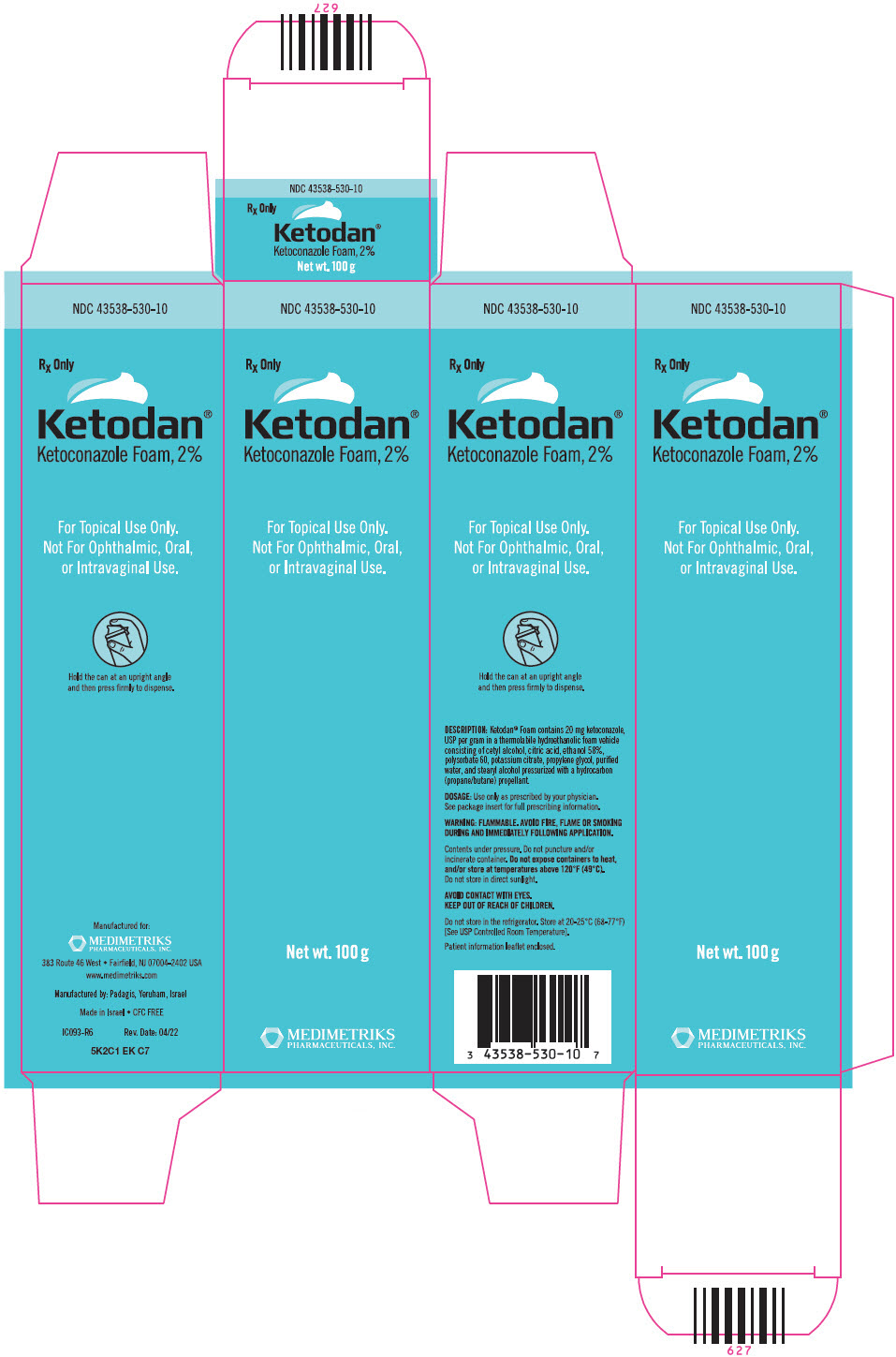
Ketodan ketoconazole 20 mg/g Aerosol, Foam — NDC 43538-530-10 (Billing 43538-0530-10)
This is a package of Ketodan ketoconazole 20 mg/g Aerosol, Foam from Medimetriks Pharmaceuticals, Inc., marketed since Jun 2012 and currently FDA-listed; retail pharmacies pay about $3.44 per g (NADAC). It is this product's only package size.
Identity & classification
Regulatory identifiers FDA, NLM and CMS codes for this package
Drug-database identifiers Medi-Span GPI and First Databank GCN / HICL / AHFS classification
- GSN (GCN sequence number): 063088
- GCN: 98848
- GPI-14 (Medi-Span): 90154045003920
- HICL (First Databank): 004132
- AHFS class code: 08:14.08.00
- RxCUI (RxNorm): 728550
Where does this data come from?
- FDA openFDA NDC Directory · synced Oct 1, 2026
- FDA label on DailyMed · label index refreshed Oct 1, 2026
- RxNorm (NLM RxNav) · catalog refreshed Oct 1, 2026
- Medi-Span GPI (licensed)
- First Databank (licensed) · refreshed Oct 1, 2026
RxNorm drug class
This medicine belongs to the Cortisol Synthesis Inhibitor class.
Where does this data come from?
- RxClass (NLM) · catalog refreshed Oct 1, 2026
Clinical
Ketoconazole cream is used to treat tinea corporis (ringworm; fungal skin infection that causes a red scaly rash on different parts of the body), tinea cruris (jock itch; fungal infection of the skin in the groin or buttocks), tinea pedis (athlete's foot; fungal infection of the skin on the feet and between the toes), tinea versicolor (fungal infection of the skin that causes brown or light colored spots on the chest, back, arms, legs, or neck), and yeast infections of the skin. Prescription ketoconazole shampoo is used to treat tinea versicolor. Over-the-counter ketoconazole shampoo is used t...
Read the full MedlinePlus article ↗- It depends on the form. The tablets treat serious fungal infections like blastomycosis and histoplasmosis. The creams, foam and shampoos treat skin and scalp conditions like ringwo...
- Take them with a meal, since that helps your body absorb them best. Follow your prescriber's directions. If you take acid-reducing medicine, ask me how to time it, because it can l...
- Nausea, stomach upset, headache and dizziness are among the more common ones. Call your doctor right away if you notice yellow skin or eyes, dark urine, unusual tiredness, fainting...
- The tablets have caused serious liver injury, sometimes fatal, even in people with no known liver problems. That's why you'll have liver blood tests before and during treatment. Av...
Patient education
Supplement & herbal interactions
Some supplements/herbs that may interact with Ketoconazole — tap one for details:
Where does this data come from?
- MedlinePlus (NLM) · refreshed Oct 1, 2026
- FDA label on DailyMed · label index refreshed Oct 1, 2026
Ask a licensed pharmacist directly — free, answered by our team.
Pricing
A drug doesn't have one price. Each row is a different public payment system, and none is what you'd pay at the counter — that depends on your insurance. The ⓘ on each row explains what it measures.
| Price system | Per g | Per package |
|---|---|---|
| Retail pharmacies payNADAC · weekly | $3.441 | $344.06 / 100 g |
| Medicaid paysCMS SDUD · 12 mo | $3.38 | $338.18 / 100 g |
| Medicare drug plans payPart D · Q2 2026 | $5.61 | $561.08 / 100 g |
Where does this data come from?
- CMS NADAC weekly file · file of Sep 30, 2026
- CMS ASP pricing files · refreshed Sep 20, 2026
- CMS Medicaid State Drug Utilization Data · through Q1 2026
- CMS Part D plan pricing files · refreshed Sep 24, 2026
- VA National Acquisition Center price file
Packaging — all sizes for this product
| Package NDC | Description | Marketing start | Marketing end | Status |
|---|---|---|---|---|
| 43538-0530-10 You're viewing this Main listing | 1 CAN in 1 CARTON / 100 g in 1 CAN | 2012-06-15 | — | Active |
Therapeutic equivalents
| Product | Labeler | Pack | NADAC/unit | TE | Status | Price vs. this |
|---|---|---|---|---|---|---|
| Ketodan 20 mg/gthis 43538-0530-10 | Medimetriks | 1 can | $3.441 | AB | Availability likely | — |
| ketoconazole 2 g/100g 45802-0532-32 | Padagis | 1 canister | $5.597 | AB | Availability likely | +63% |
| Ketoconazole 20 mg/g 70700-0160-19 | Xiromed, | 50 g | $5.597 | AB | Availability likely | +63% |
| ketoconazole 2 g/100g 63629-8676-01 | Bryant | 1 canister | — | AB | FDA listed | — |
| ketoconazole 2 g/100g 63629-8677-01 | Bryant | 1 canister | — | AB | FDA listed | — |
| ketoconazole 2 g/100g 71335-2941-01 | Bryant | 1 canister | — | AB | FDA listed | — |
| ketoconazole 2 g/100g 71335-2943-01 | Bryant | 1 canister | — | AB | FDA listed | — |
| ketoconazole 2 g/100g 72162-1417-01 | Bryant | 1 canister | — | AB | FDA listed | — |
Where does this data come from?
- FDA openFDA NDC Directory · synced Oct 1, 2026
- FDA Orange Book · refreshed Sep 3, 2026
- CMS NADAC weekly file · file of Sep 30, 2026
Availability & generic status
This product is an FDA-approved generic. Other versions of the same drug are listed under Therapeutic equivalents, least expensive first.
Where does this data come from?
- FDA Orange Book · refreshed Sep 3, 2026
Inactive Ingredients / Excipients
Inactive ingredients, also called excipients, are components of the drug product other than the active ingredient. They may include fillers, dyes, coatings, preservatives, flavors, or other formulation ingredients.
💡 Tap an ingredient (hover on desktop) to see what it is and why it’s used.
-
UNII 3K9958V90M
A liquid solvent derived from fermentation or chemical synthesis. In medicines, alcohol dissolves active ingredients, helps preserve the product, and improves how the body absorbs certain drugs.
-
UNII KY7O12XPOQ
Brucine sulfate is a salt form of brucine, an alkaloid compound derived from plants in the Strychnos genus. It may be used as a flavoring agent or alkalizing component in pharmaceutical formulations.
-
UNII 6LV4FOR43R
Butane is a colorless gas derived from petroleum. In medicines, it serves as a propellant in inhalers and aerosol sprays, helping deliver the active drug to the lungs or skin.
-
UNII 936JST6JCN
Cetyl alcohol is a waxy, fatty substance derived from plant or animal sources. It acts as an emulsifier and thickener in medicines, helping blend oil and water components and giving products a smooth, creamy texture.
-
UNII 2968PHW8QP
A weak organic acid derived from citrus fruits or made through fermentation. It works as a buffer to control pH, a preservative to extend shelf life, and a flavoring agent in medications.
-
UNII CAL22UVI4M
A synthetic emulsifier derived from sorbitol and fatty acids. It helps mix oil and water-based ingredients together and improves the texture and stability of the medicine.
-
UNII EE90ONI6FF
Potassium citrate is a salt derived from citric acid and potassium. In medicines, it acts as a buffer to adjust and maintain the pH balance of the product, helping keep it stable and palatable.
-
UNII T75W9911L6
A flammable gas used as a propellant in aerosol formulations. It helps dispense the medicine as a fine mist or spray when you activate the inhaler or pump.
-
UNII 6DC9Q167V3
Propylene glycol is a clear liquid derived from petroleum or vegetable sources. It acts as a solvent, humectant, and preservative in medicines, helping dissolve active ingredients and maintain product stability.
-
UNII 2KR89I4H1Y
Stearyl alcohol is a waxy, fatty substance derived from natural oils or made synthetically. It acts as an emulsifier and thickener in medicines, helping mix ingredients together and give the product the right texture.
-
UNII MD83SFE959
A volatile organic liquid used as a solvent and preservative in medications. It helps dissolve active ingredients and other components, and can improve product stability and shelf life.
-
UNII 059QF0KO0R
Water is a liquid solvent that dissolves and mixes ingredients together in liquid medicines, syrups, and injections. It helps distribute the active drug evenly throughout the product.
12 inactive ingredients listed in the exact product block matched to this NDC.
Where does this data come from?
ingredient classCode="IACT" elements from the exact product block matched by this NDC. Label-section narrative from DailyMed / the openFDA label index is shown separately when available.- FDA label on DailyMed · label index refreshed Oct 1, 2026
- FDA openFDA NDC Directory · synced Oct 1, 2026
Inactive ingredient FAQ
Are inactive ingredients the same for every manufacturer?
Why might an inactive ingredient be missing?
Can inactive ingredients matter?
Manufacturer & labeler
Where does this data come from?
- FDA openFDA NDC Directory · synced Oct 1, 2026
- Drugs@FDA
Full prescribing information FDA SPL
🎯 Indications and Usage ▾
1. INDICATIONS AND USAGE Ketodan ® Foam, 2% is indicated for the topical treatment of seborrheic dermatitis in immunocompetent patients 12 years of age and older. Ketodan ® Foam, 2% is indicated for topical treatment of seborrheic dermatitis in immunocompetent patients 12 years of age and older ( 1 ).
Limitations of Use Safety and efficacy of Ketodan ® Foam, 2% for treatment of fungal infections have not been established. Limitations of Use Safety and efficacy of Ketodan ® Foam, 2% for treatment of fungal infections have not been established.
⏱️ Dosage and Administration ▾
2. DOSAGE AND ADMINISTRATION Ketodan ® Foam, 2% should be applied to the affected area(s) twice daily for four weeks. Hold the container upright, and dispense Ketodan ® Foam, 2% into the cap of the can or other cool surface in an amount sufficient to cover the affected area(s).
Dispensing directly onto hands is not recommended, as the foam will begin to melt immediately upon contact with warm skin. Pick up small amounts of Ketodan ® Foam, 2% with the fingertips, and gently massage into the affected area(s) until the foam disappears. For hair-bearing areas, part the hair, so that Ketodan ® Foam, 2% may be applied directly to the skin (rather than on the hair).
Avoid contact with the eyes and other mucous membranes. Ketodan ® Foam, 2% is not for ophthalmic, oral or intravaginal use. Ketodan ® Foam, 2% should be applied to the affected area(s) twice daily for four weeks ( 2 ).
Ketodan ® Foam, 2% is not for ophthalmic, oral, or intravaginal use ( 2 ).
💊 Dosage Forms and Strengths ▾
3. DOSAGE FORMS AND STRENGTHS Ketodan ® Foam, 2% contains 20 mg of ketoconazole, USP per gram, supplied in 100 g containers. Foam: 2% ketoconazole in 100 g containers ( 3 ).
⛔ Contraindications ▾
4. CONTRAINDICATIONS None. None.
⚠️ Warnings and Cautions ▾
5. WARNINGS AND PRECAUTIONS Ketodan ® Foam, 2% may result in contact sensitization, including photoallergenicity ( 5.1 , 6.2 ). The contents of Ketodan ® Foam, 2% are flammable. Avoid fire, flame, or smoking during and immediately following application. ( 5.2 ).
5.1Contact Sensitization Ketodan ® Foam, 2% may result in contact sensitization, including photoallergenicity [see Adverse Reactions (6.2) ].
5.2Flammable Contents The contents of Ketodan ® Foam, 2% include alcohol and propane/butane, which are flammable. Avoid fire, flame and/or smoking during and immediately following application. Do not puncture and/or incinerate the containers. Do not expose containers to heat and/or store at temperatures above 120°F (49°C).
5.3Systemic Effects Hepatitis has been seen with orally administered ketoconazole (1:10,000 reported incidence). Lowered testosterone and ACTH–induced corticosteroid serum levels have been seen with high doses of orally administered ketoconazole. These effects have not been seen with topical ketoconazole.
🤒 Adverse Reactions ▾
6. ADVERSE REACTIONS The most common adverse reactions observed in clinical studies (incidence >1%) were application site burning and application site reaction ( 6.1 ). To report SUSPECTED ADVERSE REACTIONS, contact Medimetriks at 1-973-882-7512 or FDA at 1-800-FDA-1088 or www.fda.gov/medwatch.
6.1Clinical Trials Experience Because clinical trials are conducted under widely varying conditions, adverse reaction rates observed in the clinical trials of a drug cannot be directly compared to rates in the clinical trials of another drug, and may not reflect the rates observed in practice. The adverse reaction information from clinical trials does, however, provide a basis for identifying the adverse reactions that appear to be related to drug use and for approximating rates. The safety data presented in Table 1 reflect exposure to ketoconazole foam, 2% in 672 subjects, 12 years and older with seborrheic dermatitis.
Subjects applied ketoconazole foam, 2% or vehicle foam twice daily for 4 weeks to affected areas on the face, scalp, and/or chest. Adverse reactions occurring in > 1% of subjects are presented in Table 1. Table 1: Adverse Reactions Reported by > 1% Subjects in Clinical Trials Adverse Reactions Ketoconazole Foam, 2% N = 672 n (%) Vehicle Foam N = 497 n (%) Subjects with an Adverse Reaction 188 (28%) 122 (25%) Application site burning 67 (10%) 49 (10%) Application site reaction 41 (6%) 24 (5%) Application site reactions that were reported in <1% of subjects were dryness, erythema, irritation, paresthesia, pruritus, rash and warmth.
6.2Dermal Safety Studies In a photoallergenicity study, 9 of 53 subjects (17%) had reactions during the challenge period at both the irradiated and non-irradiated sites treated with ketoconazole foam, 2%. Ketodan ® Foam, 2% may cause contact sensitization.
6.3Postmarketing Experience The following adverse events have been identified during postmarketing use of ketoconazole foam, 2%: Gastrointestinal disorders: Cheilitis General disorders and administration site conditions: Application site pain and application site burn Skin and subcutaneous tissue disorders: Skin burning sensation and erythema Because these events are reported voluntarily from a population of uncertain size, it is not always possible to reliably estimate their frequency or establish a causal relationship to drug exposure.
👥 Use in Specific Populations ▾
8. USE IN SPECIFIC POPULATIONS
8.1Pregnancy Risk Summary There are no available data on ketoconazole foam, 2% use in pregnant women to identify a drug-associated risk of major birth defects, miscarriage or adverse maternal or fetal outcomes. No reproductive studies in animals have been performed with ketoconazole foam, 2%. In animal reproduction studies with pregnant mice, rats and rabbits both embryotoxic and developmental effects (structural abnormalities) were observed following oral dosing of ketoconazole during organogenesis.
Assuming equivalent systemic absorption of topical and oral ketoconazole doses and a ketoconazole foam, 2% maximum recommended human dose (MRHD) of 8 grams (equivalent to 160 mg ketoconazole), embryotoxic effects were observed at 0.8 to 2.4 times the MRHD and developmental effects were observed at 4.8 times the MRHD [see Data ] . The background risk of major birth defects and miscarriage for the indicated population is unknown. All pregnancies have a background risk of birth defect, loss, or other adverse outcomes.
In the U.S. general population, the estimated background risk of major birth defects and miscarriage in clinically recognized pregnancies is 2 to 4% and 15 to 20%, respectively. Data Animal Data The animal multiples of human exposure calculations are based on body surface area (BSA) comparisons of oral doses administered to animals and a ketoconazole foam, 2% maximum recommended human dose (MRHD) of 8 grams (equivalent to 2.67 mg ketoconazole/kg/day for a 60 kg individual or 98.8 mg ketoconazole/m 2 /day). Embryofetal development studies have been conducted in mice, rats and rabbits with orally administered ketoconazole.
When orally administered to mice on gestational days 6 through 18 (covering the period of organogenesis), ketoconazole was embryotoxic (25 mg/kg and higher; 0.8 times the MRHD based on BSA comparisons) with a high incidence of resorptions, increased number of stillbirths and delayed parturition. Delays in maturation were also observed. There was no evidence of maternal toxicity or malformations at up to 50 mg/kg (1.5 times the MRHD based on BSA comparisons).
No treatment related developmental effects were observed at 10 mg/kg (0.3 times the MRHD based on BSA comparisons). In the presence of maternal toxicity in rats, orally administered ketoconazole was both embryotoxic (40 mg/kg and higher; 2.4 times the MRHD based on BSA comparisons), including increased resorbed fetuses and stillbirths, and teratogenic (80 mg/kg and higher; 4.8 times the MRHD based on BSA comparisons), including syndactylia, oligodactylia, waved ribs and cleft palate. Additionally, 100 mg/kg (6 times the MRHD based on BSA comparisons) ketoconazole orally administered on a single day during gestation (gestational days 9 through 12) was embryotoxic (increased resorptions).
This same oral dose given on gestation day 12, 13, 14 or 15 induced external malformations including cleft palate, micromelia and digital anomalies (brachydactyly, ectrodactyly, syndactyly). In pregnant rabbits orally administered ketoconazole, evidence of embryotoxicity (increased resorptions) was observed at 10 mg/kg (1.2 times the MRHD based on BSA comparisons) and higher and an increased incidence of skeletal abnormalities was observed at 40 mg/kg (4.8 times the MRHD based on BSA comparisons).
8.2Lactation Risk Summary There is no information available on the presence of ketoconazole in human milk, or the effects on the breastfed child, or the effects on milk production after topical application of ketoconazole foam, 2% to women who are breastfeeding. In animal studies ketoconazole was found in milk following oral administration. The developmental and health benefits of breastfeeding should be considered along with the mother's clinical need for Ketodan ® Foam, 2% and any potential adverse effects on the breastfed infant from Ketodan ® Foam, 2% or from the underlying maternal condition.
8.3Females and Males of Reproductive Potent… [Excerpted — this section continues on DailyMed.]
🤰 Pregnancy ▾
8.1Pregnancy Risk Summary There are no available data on ketoconazole foam, 2% use in pregnant women to identify a drug-associated risk of major birth defects, miscarriage or adverse maternal or fetal outcomes. No reproductive studies in animals have been performed with ketoconazole foam, 2%. In animal reproduction studies with pregnant mice, rats and rabbits both embryotoxic and developmental effects (structural abnormalities) were observed following oral dosing of ketoconazole during organogenesis.
Assuming equivalent systemic absorption of topical and oral ketoconazole doses and a ketoconazole foam, 2% maximum recommended human dose (MRHD) of 8 grams (equivalent to 160 mg ketoconazole), embryotoxic effects were observed at 0.8 to 2.4 times the MRHD and developmental effects were observed at 4.8 times the MRHD [see Data ] . The background risk of major birth defects and miscarriage for the indicated population is unknown. All pregnancies have a background risk of birth defect, loss, or other adverse outcomes.
In the U.S. general population, the estimated background risk of major birth defects and miscarriage in clinically recognized pregnancies is 2 to 4% and 15 to 20%, respectively. Data Animal Data The animal multiples of human exposure calculations are based on body surface area (BSA) comparisons of oral doses administered to animals and a ketoconazole foam, 2% maximum recommended human dose (MRHD) of 8 grams (equivalent to 2.67 mg ketoconazole/kg/day for a 60 kg individual or 98.8 mg ketoconazole/m 2 /day). Embryofetal development studies have been conducted in mice, rats and rabbits with orally administered ketoconazole.
When orally administered to mice on gestational days 6 through 18 (covering the period of organogenesis), ketoconazole was embryotoxic (25 mg/kg and higher; 0.8 times the MRHD based on BSA comparisons) with a high incidence of resorptions, increased number of stillbirths and delayed parturition. Delays in maturation were also observed. There was no evidence of maternal toxicity or malformations at up to 50 mg/kg (1.5 times the MRHD based on BSA comparisons).
No treatment related developmental effects were observed at 10 mg/kg (0.3 times the MRHD based on BSA comparisons). In the presence of maternal toxicity in rats, orally administered ketoconazole was both embryotoxic (40 mg/kg and higher; 2.4 times the MRHD based on BSA comparisons), including increased resorbed fetuses and stillbirths, and teratogenic (80 mg/kg and higher; 4.8 times the MRHD based on BSA comparisons), including syndactylia, oligodactylia, waved ribs and cleft palate. Additionally, 100 mg/kg (6 times the MRHD based on BSA comparisons) ketoconazole orally administered on a single day during gestation (gestational days 9 through 12) was embryotoxic (increased resorptions).
This same oral dose given on gestation day 12, 13, 14 or 15 induced external malformations including cleft palate, micromelia and digital anomalies (brachydactyly, ectrodactyly, syndactyly). In pregnant rabbits orally administered ketoconazole, evidence of embryotoxicity (increased resorptions) was observed at 10 mg/kg (1.2 times the MRHD based on BSA comparisons) and higher and an increased incidence of skeletal abnormalities was observed at 40 mg/kg (4.8 times the MRHD based on BSA comparisons).
🧒 Pediatric Use ▾
8.4Pediatric Use The safety and effectiveness of ketoconazole foam, 2% in pediatric patients less than 12 years of age have not been established. Of the 672 subjects treated with ketoconazole foam, 2% in the clinical trials, 44 (7%) were from 12 to 17 years of age. [See Clinical Studies (14) ].
🧓 Geriatric Use ▾
8.5Geriatric Use Of the 672 subjects treated with ketoconazole foam, 2% in the clinical trials, 107 (16%) were 65 years and over. Clinical trials of ketoconazole foam, 2% did not include sufficient numbers of subjects aged 65 and over to determine whether they respond differently than younger subjects.
🧬 Clinical Pharmacology ▾
12. CLINICAL PHARMACOLOGY
12.1Mechanism of Action The mechanism of action of ketoconazole in the treatment of seborrheic dermatitis is not known.
12.2Pharmacodynamics The pharmacodynamics of Ketodan ® Foam, 2% has not been established.
12.3Pharmacokinetics In a bioavailability study, 12 subjects with moderate to severe seborrheic dermatitis applied 3 g of ketoconazole foam, 2% twice daily for 4 weeks. Circulating plasma levels of ketoconazole were < 6 ng/mL for a majority of subjects (75%), with a maximum level of 11 ng/mL observed in one subject.
12.4Microbiology Ketoconazole is an antifungal agent which inhibits the in vitro synthesis of ergosterol, a key sterol in the cell membrane of Malassezia furfur . The clinical significance of antifungal activity in the treatment of seborrheic dermatitis is not known.
🧬 Mechanism of Action ▾
12.1Mechanism of Action The mechanism of action of ketoconazole in the treatment of seborrheic dermatitis is not known.
📦 How Supplied / Storage and Handling ▾
16. HOW SUPPLIED/STORAGE AND HANDLING Ketodan ® Foam, 2% contains 20 mg of ketoconazole, USP per gram. The thermolabile hydroethanolic foam is available as follows: NDC 43538-530-10 100 g aluminum can Store at 20° to 25°C (68° to 77°F). [See USP Controlled Room Temperature.] Do not store under refrigerated conditions.
Contents are flammable. Do not expose containers to heat and/or store at temperatures above 49°C (120°F). Do not store in direct sunlight.
Contents under pressure. Do not puncture and/or incinerate container. Keep out of reach of children.
📦 Storage and Handling ▾
Store at 20° to 25°C (68° to 77°F). [See USP Controlled Room Temperature.] Do not store under refrigerated conditions. Contents are flammable. Do not expose containers to heat and/or store at temperatures above 49°C (120°F). Do not store in direct sunlight. Contents under pressure. Do not puncture and/or incinerate container. Keep out of reach of children.
📋 Description ▾
11. DESCRIPTION Ketodan ® Foam, 2% contains 2% ketoconazole USP, an antifungal agent, in a thermolabile hydroethanolic foam for topical application. The chemical name for ketoconazole is piperazine, 1-acetyl-4-[4-[[2-(2,4-dichlorophenyl)-2-(1 H -imidazol-1-ylmethyl)-1,3-dioxolan-4-yl]methoxy]phenyl]-, cis - with the molecular formula C 26 H 28 Cl 2 N 4 O 4 and a molecular weight of 531.43.
The following is the chemical structure: Ketodan ® Foam, 2% contains 20 mg ketoconazole per gram in a thermolabile hydroethanolic foam vehicle consisting of cetyl alcohol, citric acid, ethanol 58%, polysorbate 60, potassium citrate, propylene glycol, purified water, and stearyl alcohol pressurized with a hydrocarbon (propane/butane) propellant. Chemical Structure
💬 Information for Patients ▾
17. PATIENT COUNSELING INFORMATION See FDA-approved patient labeling ( Patient Package Insert ). Instruct patients on a proper use of Ketodan ® Foam, 2% Avoid fire, flame and/or smoking during and immediately following application.
Do not apply Ketodan ® Foam, 2% directly to hands. Dispense onto a cool surface, and apply to the affected areas using the fingertips. Wash their hands after application Ketodan ® Foam, 2% may cause skin irritation (application site burning and/or reactions) Instruct a patient to contact a health care provider if the area of application shows signs of increased irritation and report any signs of adverse reactions.
🧬 Pharmacokinetics ▾
12.3Pharmacokinetics In a bioavailability study, 12 subjects with moderate to severe seborrheic dermatitis applied 3 g of ketoconazole foam, 2% twice daily for 4 weeks. Circulating plasma levels of ketoconazole were < 6 ng/mL for a majority of subjects (75%), with a maximum level of 11 ng/mL observed in one subject.
🧬 Pharmacodynamics ▾
12.2Pharmacodynamics The pharmacodynamics of Ketodan ® Foam, 2% has not been established.
🔬 Clinical Studies ▾
14. CLINICAL STUDIES The safety and efficacy of ketoconazole foam, 2% were evaluated in a randomized, double-blind, vehicle-controlled trial in subjects 12 years and older with mild to severe seborrheic dermatitis. In the trial, 427 subjects received ketoconazole foam, 2% and 420 subjects received vehicle foam.
Subjects applied ketoconazole foam, 2% or vehicle foam twice daily for 4 weeks to affected areas on the face, scalp, and/or chest. The overall disease severity in terms of erythema, scaling, and induration was assessed at Baseline and week 4 on a 5-point Investigator's Static Global Assessment (ISGA) scale. Treatment success was defined as achieving a Week 4 (end of treatment) ISGA score of 0 (clear) or 1 (majority of lesions have individual scores for scaling, erythema, and induration that averages 1 [minimal or faint]) and at least two grades of improvement from baseline.
The results are presented in Table 2. The database was not large enough to assess whether there were differences in effects in age, gender, or race subgroups. Table 2: Efficacy Results Number of Subjects Ketoconazole Foam, 2% N = 427 n (%) Vehicle Foam N = 420 n (%) Subjects Achieving Treatment Success 239 (56%) 176 (42%)
🧪 Nonclinical Toxicology ▾
13. NONCLINICAL TOXICOLOGY
13.1Carcinogenesis, Mutagenesis, Impairment of Fertility Long-term animal studies have not been performed to evaluate the carcinogenic or photo-carcinogenic potential of ketoconazole foam, 2%. In oral carcinogenicity studies in mice (18-months) and rats (24-months) at dose levels of 5, 20 and 80 mg/kg/day ketoconazole was not carcinogenic. The high dose in these studies was approximately 2.4 to 4.8 times the MRHD based on BSA comparisons.
In a bacterial reverse mutation assay, ketoconazole did not express any mutagenic potential. In three in vivo assays (sister chromatid exchange in humans, dominant lethal and micronucleus tests in mice), ketoconazole did not exhibit any genotoxic potential. In animal fertility studies, oral ketoconazole impaired both male and female fertility in rats in a dose and duration dependent manner.
In females, oral doses up to 40 mg/kg (2.4 times the MRHD based on BSA comparisons) had no effect on fertility, while doses of 75 mg/kg (4.5 times the MRHD based on BSA comparisons) and higher decreased the pregnancy rate and number of implantation sites. In male rats, oral dosing at 200 mg/kg/day (12 times the MRHD based on BSA comparisons) for three days decreased fertility and 400 mg/kg/day (24 times the MRHD based on BSA comparisons) for three days resulted in a complete loss of fertility. When administered for longer durations (up to 3 months), decreased fertility in male rats was observed at doses as low as 24 mg/kg/day (1.4 times the MRHD based on BSA comparisons).
In male beagle dogs, an oral dose of 25 mg/kg/day ketoconazole for up to 4 weeks (5.2 times the MRHD based on BSA comparisons) resulted in decreased sperm motility, decreased sperm count, increased abnormal sperm and atrophy of the testes. These effects were reversed subsequent to withdrawal of treatment.
📄 Carcinogenesis, Mutagenesis, Impairment of Fertility ▾
13.1Carcinogenesis, Mutagenesis, Impairment of Fertility Long-term animal studies have not been performed to evaluate the carcinogenic or photo-carcinogenic potential of ketoconazole foam, 2%. In oral carcinogenicity studies in mice (18-months) and rats (24-months) at dose levels of 5, 20 and 80 mg/kg/day ketoconazole was not carcinogenic. The high dose in these studies was approximately 2.4 to 4.8 times the MRHD based on BSA comparisons.
In a bacterial reverse mutation assay, ketoconazole did not express any mutagenic potential. In three in vivo assays (sister chromatid exchange in humans, dominant lethal and micronucleus tests in mice), ketoconazole did not exhibit any genotoxic potential. In animal fertility studies, oral ketoconazole impaired both male and female fertility in rats in a dose and duration dependent manner.
In females, oral doses up to 40 mg/kg (2.4 times the MRHD based on BSA comparisons) had no effect on fertility, while doses of 75 mg/kg (4.5 times the MRHD based on BSA comparisons) and higher decreased the pregnancy rate and number of implantation sites. In male rats, oral dosing at 200 mg/kg/day (12 times the MRHD based on BSA comparisons) for three days decreased fertility and 400 mg/kg/day (24 times the MRHD based on BSA comparisons) for three days resulted in a complete loss of fertility. When administered for longer durations (up to 3 months), decreased fertility in male rats was observed at doses as low as 24 mg/kg/day (1.4 times the MRHD based on BSA comparisons).
In male beagle dogs, an oral dose of 25 mg/kg/day ketoconazole for up to 4 weeks (5.2 times the MRHD based on BSA comparisons) resulted in decreased sperm motility, decreased sperm count, increased abnormal sperm and atrophy of the testes. These effects were reversed subsequent to withdrawal of treatment.
📄 Patient Package Insert ▾
PATIENT INFORMATION Ketodan ® Foam, 2% Important Information: Ketodan ® Foam, 2% is for use on the skin only. Do not use Ketodan ® Foam, 2% in your eyes, mouth or vagina. What is Ketodan ® Foam, 2%?
Ketodan ® Foam, 2% is a prescription medicine used on the skin (topical) to treat seborrheic dermatitis in people 12 years of age and older with a normal immune system. It is not known if Ketodan ® Foam, 2% is safe and effective when used to treat fungal infections. It is not known if Ketodan ® Foam, 2% is safe and effective in children less than 12 years of age.
Before using Ketodan ® Foam, 2%, tell your healthcare provider about all of your medical conditions, including if you: are pregnant or plan to become pregnant. It is not known if Ketodan ® Foam, 2% will harm your unborn baby. are breastfeeding or plan to breastfeed. It is not known if Ketodan ® Foam, 2% passes into your breast milk.
Talk to your healthcare provider about the best way to feed your baby during treatment with Ketodan ® Foam, 2%. Tell your healthcare provider about all the medicines you take, including prescription and over-the-counter medicines, vitamins, and herbal supplements. How should I use Ketodan ® Foam, 2%?
Use Ketodan ® Foam, 2% exactly as your healthcare provider tells you to use it. See the detailed " Instructions for Use " at the end of this leaflet for directions about how to apply Ketodan ® Foam, 2% the right way. Apply Ketodan ® Foam, 2% to the affected skin area(s) 2 times each day for 4 weeks.
You should apply enough Ketodan ® Foam, 2% to cover the entire affected area(s). Talk to your healthcare provider if your skin does not improve after 4 weeks of treatment with Ketodan ® Foam, 2%. Dispense Ketodan ® Foam, 2% directly into the cap.
Do not dispense Ketodan ® Foam, 2% directly onto your hands, because the foam will begin to melt on contact with warm skin. Wash your hands after applying Ketodan ® Foam, 2%. What should I avoid while using Ketodan ® Foam, 2%?
Ketodan ® Foam, 2% is flammable. Avoid fire, flames, or smoking during and right after you apply Ketodan ® Foam, 2% to your skin. Avoid getting Ketodan ® Foam, 2% in or near your eyes, mouth, lips or vagina.
If you get Ketodan ® Foam, 2% on your lips or in your eyes, mouth or vagina, rinse well with water. What are the possible side effects of Ketodan ® Foam, 2%? Ketodan ® Foam, 2% may cause serious side effects, including: Skin irritation at the application area(s), including skin reactions caused by exposure to light.
Tell your healthcare provider if you develop skin irritation during treatment with Ketodan ® Foam, 2%. The most common side effects of Ketodan ® Foam, 2% include, burning, dryness, redness, irritation, numbness, itching, rash and warmth at the application site. These are not all of the possible side effects of Ketodan ® Foam, 2%.
Call your doctor for medical advice about side effects. You may report side effects to FDA at 1-800-FDA-1088. How should I store Ketodan ® Foam, 2%?
Store Ketodan ® Foam, 2% at room temperature between 68°F to 77°F (20°C to 25°C). Do not store the Ketodan ® Foam, 2% can in the refrigerator or freezer. Keep Ketodan ® Foam, 2% away from heat.
Never throw the Ketodan ® Foam, 2% can into a fire, even if the can is empty. Do not store Ketodan ® Foam, 2% at temperatures above 120°F (49°C). Do not break through (puncture) the Ketodan ® Foam, 2% can.
Keep Ketodan ® Foam, 2% and all medicines out of the reach of children. General information about the safe and effective use of Ketodan ® Foam, 2%. Medicines are sometimes prescribed for purposes other than those listed in a Patient Information leaflet.
Do not use Ketodan ® Foam, 2% for a condition for which it was not prescribed. Do not give Ketodan ® Foam, 2% to other people, even if they have the same symptoms that you have. It may harm them.
You can ask your pharmacist or healthcare provider for information about Ketodan ® Foam, 2% that is written for health professionals. What are the ingredients in Keto… [Excerpted — this section continues on DailyMed.]
📖 Instructions for Use ▾
Instructions for Use Ketodan ® Foam, 2% Important Information: Ketodan ® Foam, 2% is for use on the skin only. Do not use Ketodan ® Foam, 2% in your eyes, mouth or vagina. Step 1: Remove the clear cap from the Ketodan ® Foam, 2% can.
Step 2: Hold the can upright and firmly press the nozzle to dispense Ketodan ® Foam, 2% into the clear cap. Dispense enough Ketodan ® Foam, 2% to cover the entire affected area(s). If the can seems warm or the foam seems runny, run the can under cold water.
Step 3: Pick up small amounts of Ketodan ® Foam, 2% with your fingertips and gently rub the foam into the affected area(s) until the foam disappears. If you are treating areas such as your scalp, part the hair so that Ketodan ® Foam, 2% may be applied directly to the skin. Step 4: Wash your hands after applying Ketodan ® Foam, 2%.
Throw away any of the unused medicine that is left in the cap. How should I store Ketodan ® Foam, 2%? Store Ketodan ® Foam, 2% at room temperature between 68°F to 77°F (20°C to 25°C).
Do not store the Ketodan ® Foam, 2% can in the refrigerator or freezer. Keep Ketodan ® Foam, 2% away from heat. Never throw the can into a fire, even if the can is empty.
Do not store Ketodan ® Foam, 2% at temperatures above 120°F (49°C). Do not break through (puncture) the Ketodan ® Foam, 2% can. Keep Ketodan ® Foam, 2% and all medicines out of the reach of children.
This Instructions for Use has been approved by the U.S. Food and Drug Administration. Image Image Image Image Image Image Image
📄 Package Label / Principal Display Panel ▾
PRINCIPAL DISPLAY PANEL - 100 g Can Carton NDC 43538-530-10 R x Only Ketodan ® Ketoconazole Foam, 2% For Topical Use Only. Not For Ophthalmic, Oral, or Intravaginal Use. Net wt. 100 g MEDIMETRIKS PHARMACEUTICALS, INC. PRINCIPAL DISPLAY PANEL - 100 g Can Carton