
PHYTONADIONE 10 mg/mL Injection, Emulsion, 25 ampules — NDC 43598-405-16 (Billing 43598-0405-16)
This is a package of 25 ampules of PHYTONADIONE 10 mg/mL Injection, Emulsion from Dr.Reddy's Laboratories Inc, marketed since May 2019 and currently FDA-listed. It is this product's only package size.
NDC database record
One package, one record: these facts belong to NDC 43598-405-16 alone.
- Record
- FDA NDC Directory package listing · Human prescription drug
- Code segments
- 43598 labeler · 405 product · 16 package
- Package marketed since
- May 31, 2019
- Sample package
- No — commercial package
- Listing certified through
- Dec 31, 2026
- Barcode (UPC-A, from the NDC)
- 3 4359840516 2
- Medicaid fills, this package
- 1,052 prescriptions in the last four reported quarters
- FDA record last changed
- Jul 24, 2026
Other active recalls for Phytonadione (different manufacturers) — 1 · tap to view
Past resolved recalls for this product (1)
Identity & classification
Regulatory identifiers FDA, NLM and CMS codes for this package
Drug-database identifiers Medi-Span GPI and First Databank GCN / HICL / AHFS classification
- GSN (GCN sequence number): 002301
- GCN: 94725
- GPI-14 (Medi-Span): 77204030002010
- HICL (First Databank): 001040
- AHFS class code: 88:24.00.00
- RxCUI (RxNorm): 1670192
Where does this data come from?
- FDA openFDA NDC Directory · synced Oct 8, 2026
- FDA label on DailyMed · label index refreshed Oct 8, 2026
- RxNorm (NLM RxNav) · catalog refreshed Oct 8, 2026
- Medi-Span GPI (licensed)
- First Databank (licensed) · refreshed Oct 8, 2026
RxNorm drug class
This medicine belongs to the Warfarin Reversal Agent class.
Where does this data come from?
- RxClass (NLM) · catalog refreshed Oct 8, 2026
Clinical
- It's vitamin K1. It helps your blood clot when vitamin K is low or blocked, for example by a blood thinner like warfarin, some antibiotics, or conditions that limit absorption. The...
- The tablets are taken by mouth, and your prescriber may add bile salts if your body doesn't make enough bile. The injection is given by a healthcare professional, preferably under...
- It isn't instant. Your INR may take 1 to 8 hours to improve, and after an IV dose a normal INR is often reached in about 12 to 14 hours. If bleeding is severe, you may need other t...
- Some people feel dizzy, flushed, or sweaty, notice an odd taste, or have a fast heartbeat. Injection-site soreness can happen. Get emergency help for trouble breathing, chest pain,...
Patient education
Supplement & herbal interactions
Where does this data come from?
- MedlinePlus (NLM) · refreshed Oct 8, 2026
- FDA label on DailyMed · label index refreshed Oct 8, 2026
Ask a licensed pharmacist directly — free, answered by our team.
Pricing
A drug doesn't have one price. Each row is a different public payment system, and none is what you'd pay at the counter — that depends on your insurance. The ⓘ on each row explains what it measures.
| Price system | Per mL | Per package |
|---|---|---|
| Retail pharmacies payNADAC · weekly | Not in the retail survey — common for institutional, discontinued, or low-volume packs. | |
| Medicaid paysCMS SDUD · 12 mo | $43.99 | $1,099.79 / 25 ml |
| Medicare drug plans payPart D · quarterly | No Part D plan price is available for this NDC in our data. | |
| Medicare Part B allowsASP · J3430 | $3.253 / J3430 unit | — |
Where does this data come from?
- CMS NADAC weekly file
- CMS ASP pricing files · refreshed Sep 20, 2026
- CMS Medicaid State Drug Utilization Data · through Q1 2026
- CMS Part D plan pricing files · refreshed Sep 24, 2026
- VA National Acquisition Center price file
Billing & reimbursement
Where does this data come from?
- CMS ASP NDC-HCPCS crosswalk · refreshed Sep 22, 2026
- DMEPDAC NDC-HCPCS crosswalk
- openFDA NSDE billing units · refreshed Oct 7, 2026
Packaging — all sizes for this product
| Package NDC | Description | Marketing start | Marketing end | Status |
|---|---|---|---|---|
| 43598-0405-16 You're viewing this Main listing | 25 AMPULE in 1 CARTON / 1 mL in 1 AMPULE | 2019-05-31 | — | Active |
Therapeutic equivalents
| Product | Labeler | Pack | NADAC/unit | TE | Status | Price vs. this |
|---|---|---|---|---|---|---|
| Phytonadione 10 mg/mL 00404-9969-01 | Henry | 1 ampule | — | AB1 | FDA listed | — |
| Vitamin K1 10 mg/mL 00409-9158-01 | Hospira, | 5 ampules | — | AB1 | FDA listed | — |
| Phytonadione Phytonadione 10 mg/mLthis 43598-0405-16 | Dr.Reddy's | 25 ampules | — | AB1 | FDA listed | — |
| Vitamin K1 - Phytonadione 10 mg/mL 51662-1536-03 | HF | 25 pouches | — | AB1 | FDA listed | — |
| Phytonadione 10 mg/mL 65145-0151-10 | Caplin | 5 vials | — | AB1 | FDA listed | — |
| Phytonadione 10 mg/mL 65219-0635-01 | Fresenius | 5 vials | — | AB1 | FDA listed | — |
| Phytonadione 10 mg/mL 68083-0606-25 | Gland | 5 ampules | — | AB1 | FDA listed | — |
| Phytonadione 10 mg/mL 68462-0758-25 | GLENMARK | 5 ampules | — | AB1 | FDA listed | — |
| Phytonadione 10 mg/mL 69097-0708-96 | Cipla | 10 vials | — | — | FDA listed | — |
| Phytonadione 10 mg/mL 70700-0331-25 | Xiromed | 5 ampules | — | AB1 | FDA listed | — |
| Phytonadione 10 mg/mL 80830-1683-03 | Amneal | 5 vials | — | AB1 | FDA listed | — |
| Phytonadione 10 mg/mL 51662-1698-03 | HF | 25 pouches | — | AB1 | FDA listed | — |
Where does this data come from?
- FDA openFDA NDC Directory · synced Oct 8, 2026
- FDA Orange Book · refreshed Oct 3, 2026
- CMS NADAC weekly file
Availability & generic status
This product is an FDA-approved generic. Other versions of the same drug are listed under Therapeutic equivalents, least expensive first.
Where does this data come from?
- FDA Orange Book · refreshed Oct 3, 2026
Inactive Ingredients / Excipients
Inactive ingredients, also called excipients, are components of the drug product other than the active ingredient. They may include fillers, dyes, coatings, preservatives, flavors, or other formulation ingredients.
🧪 Avoiding an ingredient? See Phytonadione inactive ingredients by manufacturer: every current product's list side by side, so you can ask your pharmacy for the version that does not list it.
💡 Tap an ingredient (hover on desktop) to see what it is and why it’s used.
-
9 mg / 1 mL
UNII LKG8494WBH
Benzyl alcohol is a clear liquid used as a preservative and solvent in medicines. It helps prevent bacterial and fungal growth and dissolves other ingredients to create uniform liquid formulations.
-
37.5 mg / 1 mL
UNII LX22YL083G
A simple sugar derived from corn or other sources. It acts as a filler to give the medicine bulk and volume, and as a sweetener to improve taste in oral medications.
-
UNII QTT17582CB
A strong acid used to adjust and maintain the proper pH level in liquid medicines, ensuring stability and preventing breakdown of active ingredients.
-
70 mg / 1 mL
UNII 6D4M1DAL6O
Polyoxyl 35 castor oil is a synthetic compound made by chemically treating castor oil. It works as a solubilizer and emulsifier to help dissolve and evenly mix oily and water-based ingredients in medicines.
-
UNII 059QF0KO0R
Water is a liquid solvent that dissolves and mixes ingredients together in liquid medicines, syrups, and injections. It helps distribute the active drug evenly throughout the product.
5 inactive ingredients listed in the exact product block matched to this NDC.
Where does this data come from?
ingredient classCode="IACT" elements from the exact product block matched by this NDC. Label-section narrative from DailyMed / the openFDA label index is shown separately when available.- FDA label on DailyMed · label index refreshed Oct 8, 2026
- FDA openFDA NDC Directory · synced Oct 8, 2026
Inactive ingredient FAQ
Are inactive ingredients the same for every manufacturer?
Why might an inactive ingredient be missing?
Can inactive ingredients matter?
Manufacturer & labeler
More NDCs from Dr.Reddy's Laboratories Inc labeler code 43598
- Pemetrexed disodium 500 mg/20mL Injection, Powder, Lyophilized, For Solution NDC 43598-387-11
- Docetaxel 160 mg/8mL Injection, Solution NDC 43598-389-57
- Finasteride 1 mg Tablet, Film Coated NDC 43598-390-30
- Melphalan Hydrochloride Kit NDC 43598-392-48
- Tetrabenazine 12.5 mg Tablet NDC 43598-394-05
- Tetrabenazine 25 mg Tablet NDC 43598-395-05
- Esomeprazole Magnesium 20 mg Capsule, Delayed Release NDC 43598-407-27
- Daptomycin 500 mg/10mL Injection, Powder, Lyophilized, For Solution NDC 43598-413-11
- Bortezomib 3.5 mg Injection, Powder, Lyophilized, For Solution NDC 43598-426-60
- Decitabine 50 mg/10mL Injection, Powder, Lyophilized, For Solution NDC 43598-427-37
- Dimethyl Fumarate 120 mg Capsule, Delayed Release NDC 43598-429-52
- Dimethyl Fumarate 240 mg Capsule, Delayed Release NDC 43598-430-60
Where does this data come from?
- FDA openFDA NDC Directory · synced Oct 8, 2026
- Drugs@FDA
Full prescribing information FDA SPL
🚨 Boxed Warning ▾
BOXED WARNING WARNING — INTRAVENOUS AND INTRAMUSCULAR USE Severe reactions, including fatalities, have occurred during and immediately after INTRAVENOUS injection of phytonadione, even when precautions have been taken to dilute the phytonadione and to avoid rapid infusion. Severe reactions, including fatalities, have also been reported following INTRAMUSCULAR administration. Typically these severe reactions have resembled hypersensitivity or anaphylaxis, including shock and cardiac and/or respiratory arrest.
Some patients have exhibited these severe reactions on receiving phytonadione for the first time. Therefore the INTRAVENOUS and INTRAMUSCULAR routes should be restricted to those situations where the subcutaneous route is not feasible and the serious risk involved is considered justified.
🎯 Indications and Usage ▾
INDICATIONS AND USAGE Phytonadione injectable emulsion, USP is indicated in the following coagulation disorders which are due to faulty formation of factors II, VII, IX and X when caused by Vitamin K deficiency or interference with Vitamin K activity. Phytonadione injectable emulsion is indicated in anticoagulant-induced prothrombin deficiency caused by coumarin or indanedione derivatives; prophylaxis and therapy of hemorrhagic disease of the newborn; hypoprothrombinemia due to antibacterial therapy; hypoprothrombinemia secondary to factors limiting absorption or synthesis of Vitamin K, e.g., obstructive jaundice, biliary fistula, sprue, ulcerative colitis, celiac disease, intestinal resection, cystic fibrosis of the pancreas, and regional enteritis; other drug-induced hypoprothrombinemia where it is definitely shown that the result is due to interference with phytonadione injectable emulsion metabolism, e.g., salicylates.
⏱️ Dosage and Administration ▾
DOSAGE AND ADMINISTRATION Whenever possible, phytonadione injectable emulsion, should be given by the subcutaneous route. (See Box Warning .) When intravenous administration is considered unavoidable, the drug should be injected very slowly, not exceeding 1 mg per minute. Protect from light at all times.
Parenteral drug products should be inspected visually for particulate matter and discoloration prior to administration, whenever solution and container permit. Directions for Dilution Phytonadione injectable emulsion may be diluted with 0.9% Sodium Chloride Injection, 5% Dextrose Injection, or 5% Dextrose and Sodium Chloride Injection. Benzyl alcohol as a preservative has been associated with toxicity in newborns.
Therefore, all of the above diluents should be preservative-free (see WARNINGS ). Other diluents should not be used . When dilutions are indicated, administration should be startedimmediately after mixture with the diluent, and unused portions of the dilution should be discarded, as well as unused contents of the ampule.
Prophylaxis of Hemorrhagic Diseas e of the Newborn The American Academy of Pediatrics recommends that phytonadione be given to the newborn. A single intramuscular dose of phytonadione injectable emulsion 0.5 to 1 mg within one hour of birth is recommended. Treatment of Hemorrhagic Diseas e of the Newborn Empiric administration of phytonadione should not replace proper laboratory evaluation of the coagulation mechanism.
A prompt response (shortening of the prothrombin time in 2 to 4 hours) following administration of phytonadione is usually diagnostic of hemorrhagic disease of the newborn, and failure to respond indicates another diagnosis or coagulation disorder. Phytonadione injectable emulsion 1 mg should be given either subcutaneously or intramuscularly. Higher doses may be necessary if the mother has been receiving oral anticoagulants.
Whole blood or component therapy may be indicated if bleeding is excessive. This therapy, however, does not correct the underlying disorder and phytonadione injectable emulsion should be given concurrently. Anticoagulant-Induced Prothrombin Deficiency in Adults To correct excessively prolonged prothrombin time caused by oral anticoagulant therapy—2.5 to 10 mg or up to 25 mg initially is recommended.
In rare instances 50 mg may be required. Frequency and amount of subsequent doses should be determined by prothrombin time response or clinical condition (see WARNINGS). If in 6 to 8 hours after parenteral administration the prothrombin time has not been shortened satisfactorily, the dose should be repeated.
Phytonadione Injectable Emulsion, USP Summary of Dosage Guidelines (See circular text for details) Newborns Dosage Hemorrhagic Disease of the Newborn Prophylaxis 0.5 to 1 mg IM within 1 hour of birth Treatment 1 mg SC or It (Higher doses may be necessary if the mother has been receiving oral anticoagulants) Adults Initial Dosage Anticoagulant-Induced Prothrombin Deficiency(caused by coumarin or indanedione derivatives) 2.5 mg to 10 mg or up to 25 mg (rarely 50 mg) Hypoprothrombinemia Due to other causes(Antibiotics; Salicylates or other drugs; Factors limiting absorption or synthesis) 2.5 mg to 25 mg ormore (rarely up to 50 mg) In the event of shock or excessive blood loss, the use of whole blood or component therapy is indicated.
Hypoprothrombinemia Due to Other Causes in Adults A dosage of 2.5 to 25 mg or more (rarely up to 50 mg) is recommended, the amount and route of administration depending upon the severity of the condition and response obtained. If possible, discontinuation or reduction of the dosage of drugs interfering with coagulation mechanisms (such as salicylates; antibiotics) is suggested as an alternative to administering concurrent phytonadione injectable emulsion. The severity of the coagulation disorder should determine whether the immediate administration of phytonadione injectable emulsion is required in addition to discontinuation or reduction… [Excerpted — this section continues on DailyMed.]
⛔ Contraindications ▾
CONTRAINDICATIONS Hypersensitivity to any component of this medication.
⚠️ Warnings ▾
WARNINGS Benzyl alcohol as a preservative in Bacteriostatic Sodium Chloride Injection has been associated with toxicity in newborns. Data are unavailable on the toxicity of other preservatives in this age group. There is no evidence to suggest that the small amount of benzyl alcohol contained in phytonadione injectable emulsion, USP, when used as recommended, is associated with toxicity.
An immediate coagulant effect should not be expected after administration of phytonadione. It takes a minimum of 1 to 2 hours for measurable improvement in the prothrombin time. Whole blood or component therapy may also be necessary if bleeding is severe.
Phytonadione will not counteract the anticoagulant action of heparin. When Phytonadione is used to correct excessive anticoagulant-induced hypoprothrombinemia, anticoagulant therapy still being indicated, the patient is again faced with the clotting hazards existing prior to starting the anticoagulant therapy. Phytonadione is not a clotting agent, but overzealous therapy with phytonadione injectable emulsion may restore conditions which originally permitted thromboembolic phenomena.
Dosage should be kept as low as possible, and prothrombin time should be checked regularly as clinical conditions indicate.Repeated large doses of Vitamin K are not warranted in liver disease if the response to initial use of the vitamin is unsatisfactory. Failure to respond to Vitamin K may indicate that the condition being treated is inherently unresponsive to Vitamin K. Benzyl alcohol has been reported to be associated with a fatal “Gasping Syndrome” in premature infants.
WARNING: This product contains aluminum that may be toxic. Aluminum may reach toxic levels with prolonged parenteral administration if kidney function is impaired. Premature neonates are particularly at risk because their kidneys are immature, and they required large amounts of calcium and phosphate solutions, which contain aluminum.
Research indicates that patients with impaired kidney function, including premature neonates, who receive parenteral levels of aluminum at greater than 4 to 5 mcg/kg/day accumulate aluminum at levels associated with central nervous system and bone toxicity. Tissue loading may occur at even lower rates of administration.
🤒 Adverse Reactions ▾
ADVERSE REACTIONS Deaths have occurred after intravenous and intramuscular administration. (See Box Warning .) Transient “flushing sensations” and “peculiar” sensations of taste have been observed, as well as rare instances of dizziness, rapid and weak pulse, profuse sweating, brief hypotension, dyspnea, and cyanosis. Pain, swelling, and tenderness at the injection site may occur.
The possibility of allergic sensitivity including an anaphylactoid reaction, should be kept in mind. Infrequently, usually after repeated injection, erythematous, indurated, pruritic plaques have occurred; rarely, these have progressed to scleroderma-like lesions that have persisted for long periods. In other cases, these lesions have resembled erythema perstans.
Hyperbilirubinemia has been observed in the newborn following administration of phytonadione. This has occurred rarely and primarily with doses above those recommended. (See PRECAUTIONS, Pediatric Use .)
🔄 Drug Interactions ▾
Drug Interactions Temporary resistance to prothrombin-depressing anticoagulants may result, especially when larger doses of phytonadione are used. If relatively large doses have been employed, it may be necessary when reinstituting anticoagulant therapy to use somewhat larger doses of the prothrombin-depressing anticoagulant, or to use one which acts on a different principle, such as heparin sodium.
🤰 Pregnancy ▾
Pregnancy Category C: Animal reproduction studies have not been conducted with phytonadione injectable emulsion It is also not known whether phytonadione injectable emulsion can cause fetal harm when administered to a pregnant woman or can affect reproduction capacity. Phytonadione injectable emulsion should be given to a pregnant woman only if clearly needed.
🧒 Pediatric Use ▾
Pediatric Use Hemolysis, jaundice, and hyperbilirubinemia in neonates, particularly those that are premature, may be related to the dose of phytonadione injectable emulsion. Therefore, the recommended dose should not be exceeded (see ADVERSE REACTIONS and DOSAGE AND ADMINISTRATION ).
🆘 Overdosage ▾
OVERDOSAGE The intravenous LD 50 of phytonadione injectable emulsion in the mouse is 41.5 and 52 mL/kg for the 0.2% and 1% concentrations, respectively
🧬 Clinical Pharmacology ▾
CLINICAL PHARMACOLOGY Phytonadione injectable emulsion, is indicated in the following coagulation disorders which are due to faulty formation of factors II, VII, IX and X when caused by Vitamin K deficiency or interference with Vitamin K activity. Phytonadione injectable emulsion is indicated in: • anticoagulant-induced prothrombin deficiency caused by coumarin or indanedione derivatives; •prophylaxis and therapy of hemorrhagic disease of the newborn; • hypoprothrombinemia due to antibacterial therapy; •hypoprothrombinemia secondary to factors limiting absorption or synthesis of Vitamin K, e.g., obstructive jaundice, biliary fistula, sprue, ulcerative colitis, celiac disease, intestinal resection, cystic fibrosis of the pancreas, and regional enteritis; •other drug-induced hypoprothrombinemia where it is definitely shown that the result is due to interference with phytonadione metabolism, e.g., salicylates.
📦 How Supplied / Storage and Handling ▾
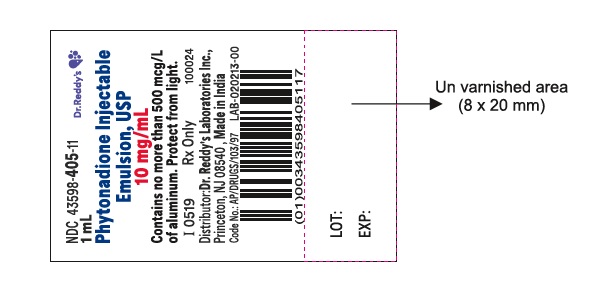
HOW SUPPLIED Phytonadione injectable emulsion, USP is supplied as follows: For Carton: Package Description NDC 25 x 1 mL Ampules 43598-405-16 For Ampule: Package Description Amount of Phytonadione Injectable Emulsion In Container Volume Concentration NDC 1 mL Ampule 10 mg 1 mL 10 mg/mL 43598-405-11 Store at 20 to 25°C (68 to 77°F). [See USP Controlled Room Temperature.] Protect from light. Keep ampules in carton until time of use. Rx Only Distributor: Dr.
Reddy's Laboratories Inc. , Princeton, NJ 08540 Made in India Issued: 0519 To report SUSPECTED ADVERSE REACTIONS, contact Dr. Reddy's Laboratories Inc., at 1- 888-375-3784, or FDA at 1-800-FDA-1088 or www.fda.gov/medwatch.
📋 Description ▾
DESCRIPTION Phytonadione is a vitamin, which is a clear, yellow to amber, viscous, odorless or nearly odorlessliquid. It is insoluble in water, soluble in chloroform and slightly soluble in ethanol. It has a molecular weight of 450.70.Phytonadione is 2-methyl-3-phytyl-1, 4-naphthoquinone.
Its empirical formula is C 31 H 46 O 2 and its structural formula is: Phytonadione injectable emulsion, USP is a yellow, sterile, nonpyrogenic aqueous dispersion available for injection by the intravenous, intramuscular and subcutaneous routes. Each milliliter contains phytonadione 10 mg, polyoxyethylated fatty acid derivative 70 mg, dextrose, hydrous 37.5 mg in water for injection; benzyl alcohol 9 mg added as preservative. May contain hydrochloric acid for pH adjustment. pH is 6.3 (5.0 to 7.0).
Phytonadione is oxygen sensitive.
⚠️ Precautions ▾
PRECAUTIONS Drug Interactions Temporary resistance to prothrombin-depressing anticoagulants may result, especially when larger doses of phytonadione are used. If relatively large doses have been employed, it may be necessary when reinstituting anticoagulant therapy to use somewhat larger doses of the prothrombin-depressing anticoagulant, or to use one which acts on a different principle, such as heparin sodium. Laboratory Tests Prothrombin time should be checked regularly as clinical conditions indicate.
Carcinogenesis, Mutagenesis, Impairment of Fertility Studies of carcinogenicity, mutagenesis or impairment of fertility have not been conducted with phytonadione injectable emulsion. Pregnancy Category C: Animal reproduction studies have not been conducted with phytonadione injectable emulsion It is also not known whether phytonadione injectable emulsion can cause fetal harm when administered to a pregnant woman or can affect reproduction capacity. Phytonadione injectable emulsion should be given to a pregnant woman only if clearly needed.
Nursing Mothers It is not known whether this drug is excreted in human milk. Because many drugs are excreted in human milk, caution should be exercised when phytonadione injectable emulsion is administered to a nursing woman. Pediatric Use Hemolysis, jaundice, and hyperbilirubinemia in neonates, particularly those that are premature, may be related to the dose of phytonadione injectable emulsion.
Therefore, the recommended dose should not be exceeded (see ADVERSE REACTIONS and DOSAGE AND ADMINISTRATION ).
🍼 Nursing Mothers ▾
Nursing Mothers It is not known whether this drug is excreted in human milk. Because many drugs are excreted in human milk, caution should be exercised when phytonadione injectable emulsion is administered to a nursing woman.
📄 Carcinogenesis, Mutagenesis, Impairment of Fertility ▾
Carcinogenesis, Mutagenesis, Impairment of Fertility Studies of carcinogenicity, mutagenesis or impairment of fertility have not been conducted with phytonadione injectable emulsion.
📄 Package Label / Principal Display Panel ▾
PACKAGE LABEL PRINCIPAL DISPLAY PANEL SECTION Ampule Unvarnished Area Consists of: 2D Barcode, Lot Number, Expiry Date and Serial Number
Carton Unvarnished Area Consists of: 2D Barcode, Lot Number, Expiry Date and Serial Number
Medicaid utilization & spend
About this NDC listing & data coverage
What data is (and isn’t) available for this NDC — tap to expand
| NDC identity (package / product / labeler codes) | ✓ Available |
| Labeler | ✓ Available |
| Product & package description | ✓ Available |
| Marketing category & status | ✓ Available |
| Active ingredient / dosage form / route | ✓ Available |
| FDA label (SPL via DailyMed) | ✓ Available |
| Package photos | ✓ Available |
| Inactive ingredients (structured) | ✓ Available |
| NADAC pharmacy acquisition price (CMS) | — Not published for this NDC CMS publishes NADAC only for NDCs reported in its retail-pharmacy survey. |
| Orange Book / therapeutic-equivalence data | ✓ Available |
| HCPCS J-code billing crosswalk | ✓ Available |
| Medicaid utilization (CMS SDUD) | ✓ Available |