
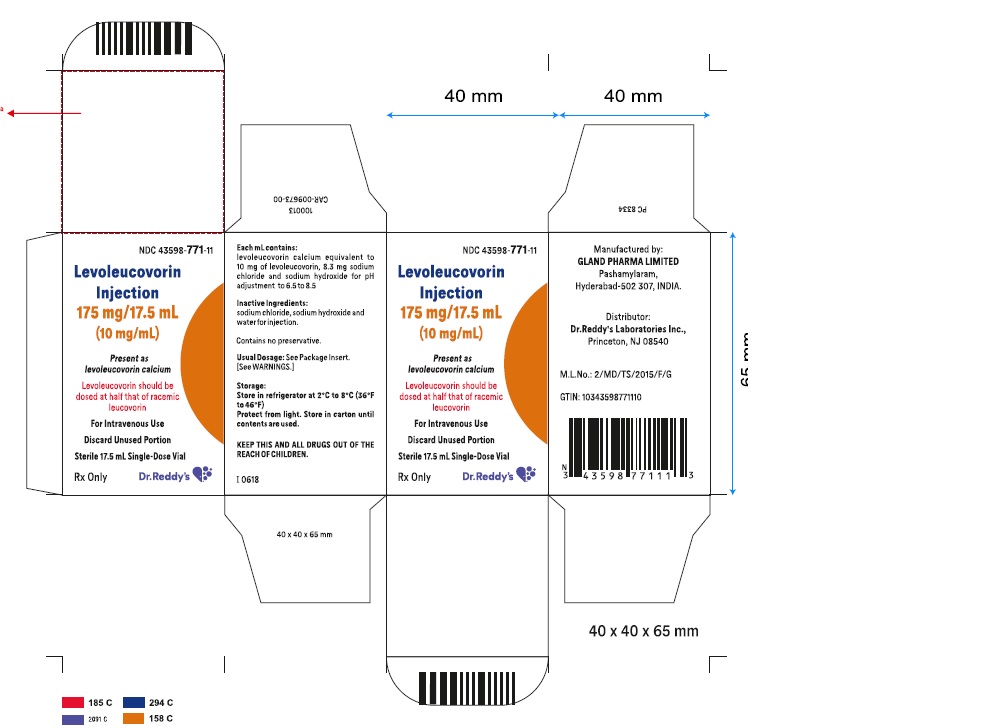
LEVOLEUCOVORIN 175 mg/17.5mL Injection, Solution, 1 vial — NDC 43598-771-11 (Billing 43598-0771-11)
This is a package of 1 vial of LEVOLEUCOVORIN 175 mg/17.5mL Injection, Solution from Dr.Reddy's Laboratories Inc, marketed since Sep 2018 and currently FDA-listed. It is this product's only package size.
NDC database record
One package, one record: these facts belong to NDC 43598-771-11 alone.
- Record
- FDA NDC Directory package listing · Human prescription drug
- Code segments
- 43598 labeler · 771 product · 11 package
- Package marketed since
- Sep 26, 2018
- Sample package
- No — commercial package
- Listing certified through
- Dec 31, 2026
- Barcode (UPC-A, from the NDC)
- 3 4359877111 3
- FDA record last changed
- Jul 24, 2026
Identity & classification
Regulatory identifiers FDA, NLM and CMS codes for this package
Drug-database identifiers Medi-Span GPI and First Databank GCN / HICL / AHFS classification
- GSN (GCN sequence number): 073897
- GCN: 37577
- GPI-14 (Medi-Span): 21755050102021
- HICL (First Databank): 011043
- AHFS class code: 91:04.12.00
- RxCUI (RxNorm): 1720765
Where does this data come from?
- FDA openFDA NDC Directory · synced Oct 8, 2026
- FDA label on DailyMed · label index refreshed Oct 8, 2026
- RxNorm (NLM RxNav) · catalog refreshed Oct 1, 2026
- Medi-Span GPI (licensed)
- First Databank (licensed) · refreshed Oct 8, 2026
RxNorm drug class
This medicine belongs to the Folate Analog class.
Where does this data come from?
- RxClass (NLM) · catalog refreshed Oct 1, 2026
Clinical
Levoleucovorin injection is used in adults and children to prevent harmful effects of methotrexate (Trexall) when methotrexate is used to treat osteosarcoma (cancer that forms in bones). Levoleucovorin injection is also used to treat adults and children who have accidentally received an overdose of methotrexate or similar medications or who are not able to eliminate these medications properly from their bodies. Levoleucovorin injection is also used with fluorouracil (5-FU, a chemotherapy medication) to treat adults with colorectal cancer (cancer that begins in the large intestine) that has spr...
Read the full MedlinePlus article ↗- It is used to rescue your body after high-dose methotrexate for osteosarcoma and to reduce methotrexate toxicity if it clears too slowly or is overdosed. It is also used with 5-flu...
- It is given through a vein by a healthcare professional. It must never be given into the spinal fluid. Your team decides the timing and checks your blood tests as you go.
- Nausea, vomiting and mouth sores are common. With 5-fluorouracil, diarrhea is very common too. Tiredness, reduced appetite, skin irritation and hair loss can also occur.
- Call right away for diarrhea, mouth sores, vomiting or dehydration, especially with 5-fluorouracil, since this can worsen quickly. Also report rash, itching, trouble breathing, chi...
Patient education
Supplement & herbal interactions
Where does this data come from?
- MedlinePlus (NLM) · refreshed Oct 8, 2026
- FDA label on DailyMed · label index refreshed Oct 8, 2026
Ask a licensed pharmacist directly — free, answered by our team.
Pricing
A drug doesn't have one price. Each row is a different public payment system, and none is what you'd pay at the counter — that depends on your insurance. The ⓘ on each row explains what it measures.
| Price system | Per mL | Per package |
|---|---|---|
| Retail pharmacies payNADAC · weekly | Not in the retail survey — common for institutional, discontinued, or low-volume packs. | |
| Medicaid paysCMS SDUD · 12 mo | No recent Medicaid claims on file for this NDC — rare and low-volume NDCs are suppressed in the public data. | |
| Medicare drug plans payPart D · quarterly | No Part D plan price is available for this NDC in our data. | |
Where does this data come from?
- CMS NADAC weekly file
- CMS ASP pricing files · refreshed Sep 20, 2026
- CMS Medicaid State Drug Utilization Data · refreshed Oct 8, 2026
- CMS Part D plan pricing files · refreshed Sep 24, 2026
- VA National Acquisition Center price file
Packaging — all sizes for this product
| Package NDC | Description | Marketing start | Marketing end | Status |
|---|---|---|---|---|
| 43598-0771-11 You're viewing this Main listing | 1 VIAL, SINGLE-DOSE in 1 CARTON / 17.5 mL in 1 VIAL, SINGLE-DOSE | 2018-09-26 | — | Active |
Therapeutic equivalents
| Product | Labeler | Pack | NADAC/unit | TE | Status | Price vs. this |
|---|---|---|---|---|---|---|
| Levoleucovorin Calcium 10 mg/mL 14335-0340-01 | Hainan | 1 vial | — | AP | FDA listed | — |
| Levoleucovorin 175 mg/17.5mLthis 43598-0771-11 | Dr.Reddy's | 1 vial | — | AP | FDA listed | — |
| levoleucovorin 10 mg/mL 68083-0278-01 | Gland | 1 vial | — | AP | FDA listed | — |
| levoleucovorin 10 mg/mL 68083-0279-01 | Gland | 1 vial | — | AP | FDA listed | — |
| Levoleucovorin Calcium 10 mg/mL 70121-1572-01 | Amneal | 1 vial | — | — | FDA listed | — |
| Levoleucovorin Calcium 10 mg/mL 70436-0209-80 | Slate | 1 vial | — | AP | FDA listed | — |
| Levoleucovorin 10 mg/mL 71288-0105-18 | Meitheal | 1 vial | — | AP | FDA listed | — |
Where does this data come from?
- FDA openFDA NDC Directory · synced Oct 8, 2026
- FDA Orange Book · refreshed Oct 3, 2026
- CMS NADAC weekly file
Availability & generic status
This product is an FDA-approved generic. Other versions of the same drug are listed under Therapeutic equivalents, least expensive first.
Where does this data come from?
- FDA Orange Book · refreshed Oct 3, 2026
Inactive Ingredients / Excipients
Inactive ingredients, also called excipients, are components of the drug product other than the active ingredient. They may include fillers, dyes, coatings, preservatives, flavors, or other formulation ingredients.
🧪 Avoiding an ingredient? See Levoleucovorin Injection inactive ingredients by manufacturer: every current product's list side by side, so you can ask your pharmacy for the version that does not list it.
💡 Tap an ingredient (hover on desktop) to see what it is and why it’s used.
-
UNII 451W47IQ8X
Sodium chloride is common table salt. It's used in medicines as a buffer to maintain proper pH, as a filler to add bulk, or to adjust the osmotic balance in liquid formulations.
-
UNII 55X04QC32I
A strong alkaline chemical used to adjust and maintain the pH balance of liquid medicines. It helps keep the medicine stable and ensures it stays effective during storage.
-
UNII 059QF0KO0R
Water is a liquid solvent that dissolves and mixes ingredients together in liquid medicines, syrups, and injections. It helps distribute the active drug evenly throughout the product.
3 inactive ingredients listed in the exact product block matched to this NDC.
Where does this data come from?
ingredient classCode="IACT" elements from the exact product block matched by this NDC. Label-section narrative from DailyMed / the openFDA label index is shown separately when available.- FDA label on DailyMed · label index refreshed Oct 8, 2026
- FDA openFDA NDC Directory · synced Oct 8, 2026
Inactive ingredient FAQ
Are inactive ingredients the same for every manufacturer?
Why might an inactive ingredient be missing?
Can inactive ingredients matter?
Manufacturer & labeler
More NDCs from Dr.Reddy's Laboratories Inc labeler code 43598
- Loratadine 10 mg Tablet, Orally Disintegrating NDC 43598-758-10
- Levetiracetam 15 mg/mL Injection NDC 43598-759-10
- Olopatadine Hydrochloride Ophthalmic Solution 2 mg/mL Solution NDC 43598-764-02
- Olopatadine Hydrochloride Ophthalmic 1 mg/mL Solution/ Drops NDC 43598-765-07
- Sumatriptan Succinate 6 mg/.5mL Injection NDC 43598-768-23
- Loperamide Hydrochloride 2 mg Capsule, Liquid Filled NDC 43598-770-24
- LEVOLEUCOVORIN 250 mg/25mL Injection, Solution NDC 43598-773-11
- arformoterol tartrate 15 ug/2mL Solution NDC 43598-777-30
- Formoterol Fumarate 20 ug/2mL Solution NDC 43598-778-30
- Fexofenadine hydrochloride 180 mg Tablet NDC 43598-809-18
- levocetirizine dihydrochloride 5 mg Tablet, Coated NDC 43598-810-76
- Cetirizine Hydrochloride 10 mg Tablet, Film Coated NDC 43598-811-05
Where does this data come from?
- FDA openFDA NDC Directory · synced Oct 8, 2026
- Drugs@FDA
Full prescribing information FDA SPL
🎯 Indications and Usage ▾
1 INDICATIONS AND USAGE Levoleucovorin injection is a folate analog. Levoleucovorin injection rescue is indicated after high-dose methotrexate therapy in osteosarcoma. Levoleucovorin injection is also indicated to diminish the toxicity and counteract the effects of impaired methotrexate elimination and of inadvertent overdosage of folic acid antagonists.
Levoleucovorin injection is indicated for use in combination chemotherapy with 5-fluorouracil in the palliative treatment of patients with advanced metastatic colorectal cancer. Levoleucovor injection is a folate analog indicated for: · Rescue after high-dose methotrexate therapy in osteosarcoma. · Diminishing the toxicity and counteracting the effects of impaired methotrexate elimination and of inadvertent overdosage of folic acid antagonists. · Use in combination chemotherapy with 5-fluorouracil in the palliative treatment of patients with advanced metastatic colorectal cancer.( 1 ) Limitations of Use Levoleucovorin injection is not approved for pernicious anemia and megaloblastic anemias.
Improper use may cause a hematologic remission while neurologic manifestations continue to progress. ( 1.1)
1.1Limitations of Use · Levoleucovorin injection is not approved for pernicious anemia and megaloblastic anemias secondary to the lack of vitamin B 12 .Improper use may cause a hematologic remission while neurologic manifestations continue to progress.
⏱️ Dosage and Administration ▾
2 DOSAGE AND ADMINISTRATION Do not administer intrathecally. ( 2.1 ) Levoleucovorin injection is dosed at one-half the usual dose of racemic d,l-leucovorin. ( 2.1 ) Levoleucovorin injection Rescue After High-Dose Methotrexate Therapy Levoleucovorin injection rescue recommendations are based on a methotrexate dose of 12 grams/m 2 administered by intravenous infusion over 4 hours.
Levoleucovorin injection rescue at a dose of 7.5 mg (approximately 5 mg/m 2 ) every 6 hours for 10 doses starts 24 hours after the beginning of the methotrexate infusion. Determine serum creatinine and methotrexate levels at least once daily. Continue Levoleucovorin injection administration, hydration, and urinary alkalinization (pH of 7.0 or greater) until the methotrexate level is below 5 x 10 -8 M (0.05 micromolar).
The Levoleucovorin injection dose may need to be adjusted. ( 2.3) Levoleucovorin Injection Administration in Combination with 5-Fluorouracil (5-FU) 2 2 2 2 The following regimens have been used historically for the treatment of colorectal cancer: 1. Levoleucovorin injection is administered at 100 mg/m 2 by slow intravenous injection over a minimum of 3 minutes, followed by 5-FU at 370 mg/m 2 by intravenous injection.
( 2.5 ) 2. Levoleucovorin injection is administered at 10 mg/m 2 by intravenous injection followed by 5-FU at 425 mg/m 2 by intravenous injection. ( 2.5 ) 5-FU and Levoleucovorin injection should be administered separately to avoid the formation of a precipitate.
Treatment is repeated daily for five days. This five-day treatment course may be repeated at 4 week (28-day) intervals, for 2 courses and then repeated at 4 to 5 week (28 to 35 day) intervals provided that the patient has completely recovered from the toxic effects of the prior treatment course. In subsequent treatment courses, the dosage of 5-FU should be adjusted based on patient tolerance of the prior treatment course.
The daily dosage of 5-FU should be reduced by 20% for patients who experienced moderate hematologic or gastrointestinal toxicity in the prior treatment course, and by 30% for patients who experienced severe toxicity. For patients who experienced no toxicity in the prior treatment course, 5-FU dosage may be increased by 10%. Levoleucovorin injection dosages are not adjusted for toxicity.
( 2.5) 2 .1 Administration Guidelines Levoleucovorin injection is dosed at one-half the usual dose of racemic d,l-leucovorin. Levoleucovorin injection is indicated for intravenous administration only . Do not administer intrathecally .
2.2Co-administration of Levoleucovorin with other agents Due to the risk of precipitation, do not co-administer Levoleucovorin injection with other agents in the same admixture.
2.3Levoleucovorin injection Rescue After High-Dose Methotrexate Therapy The recommendations for Levoleucovorin injection rescue are based on a methotrexate dose of 12 grams/m 2 administered by intravenous infusion over 4 hours (see methotrexate package insert for full prescribing information). Levoleucovorin injection rescue at a dose of 7.5 mg (approximately 5 mg/m 2 ) every 6 hours for 10 doses starts 24 hours after the beginning of the methotrexate infusion. Serum creatinine and methotrexate levels should be determined at least once daily.
Levoleucovorin injection administration, hydration, and urinary alkalinization (pH of 7.0 or greater) should be continued until the methotrexate level is below 5 x 10 -8 M (0.05 micromolar). The Levoleucovorin injection dose should be adjusted or rescue extended based on the following guidelines. Table 1 Guidelines for Levoleucovorin injection Dosage and Administration Clinical Situation Laboratory Findings Levoleucovorin injection Dosage and Duration Normal Methotrexate Elimination Serum methotrexate level approximately 10 micromolar at 24 hours after administration, 1 micromolar at 48 hours, and less than 0.2 micromolar at 72 hours 7.5 mg IV q 6 hours for 60 hours (10 doses starting at 24 hours after start of methotre… [Excerpted — this section continues on DailyMed.]
💊 Dosage Forms and Strengths ▾
3 DOSAGE FORMS AND STRENGTHS Levoleucovorin Injection, 175 mg is supplied in a single-dose vial containing 17.5 mL sterile solution. Each mL contains levoleucovorin calcium pentahydrate equivalent to 10 mg levoleucovorin and 8.3 mg sodium chloride. Levoleucovorin Injection, 250 mg is supplied in a single-dose vial containing 25 mL sterile solution.
Each mL contains levoleucovorin calcium pentahydrate equivalent to 10 mg levoleucovorin and 8.3 mg sodium chloride. Levoleucovorin Injection: 17.5 mL of a sterile solution containing levoleucovorin calcium pentahydrate equivalent to 175 mg Levoleucovorin and 0.83% sodium chloride. ( 3 , 11 , 16 ) Levoleucovorin Injection: 25 mL of a sterile solution containing levoleucovorin calcium pentahydrate equivalent to 250 mg levoleucovorin and 0.83% sodium chloride.
( 3 , 11 , 16 )
⛔ Contraindications ▾
4 CONTRAINDICATIONS Levoleucovorin injection is contraindicated for patients who have had previous allergic reactions attributed to folic acid or folinic acid. Levoleucovorin is contraindicated for patients who have had previous allergic reactions attributed to folic acid or folinic acid. (4 )
⚠️ Warnings and Cautions ▾
5 WARNINGS AND PRECAUTIONS Due to Ca ++ content, no more than 16 mL (160 mg) of levoleucovorin solution should be injected intravenously per minute. ( 5.1 ) Levoleucovorin injection enhances the toxicity of fluorouracil. ( 5 .
2 , 7 ) Concomitant use of d,l-leucovorin with trimethoprim sulfamethoxazole for Pneumocystis carinii pneumonia in HIV patients was associated with increased rates of treatment failure in a placebo-controlled study. ( 5.3 ) 5 .1 Rate of Administration Because of the Ca ++ content of the levoleucovorin solution, no more than 16 mL (160 mg of levoleucovorin) should be injected intravenously per minute.
5.2Potential for Enhanced Toxicity with 5-Fluorouracil Levoleucovorin injection enhances the toxicity of 5-fluorouracil. Deaths from severe enterocolitis, diarrhea, and dehydration have been reported in elderly patients receiving weekly d,l-leucovorin and 5-fluorouracil. When these drugs are administered concurrently in the palliative treatment of advanced colorectal cancer, the dosage of 5-FU must be lower than usually administered.
Although the toxicities observed in patients treated with the combination of levoleucovorin injection and 5-FU are qualitatively similar to those observed with 5-FU alone, gastrointestinal toxicities (particularly stomatitis and diarrhea) are observed more commonly and may be of greater severity and of prolonged duration in patients treated with the combination. In the first Mayo/NCCTG controlled trial, toxicity, primarily gastrointestinal, resulted in 7% of patients requiring hospitalization when treated with 5-FU alone or 5-FU in combination with 200 mg/m 2 of d,l-leucovorin and 20% when treated with 5-FU in combination with 20 mg/m 2 of d,l-leucovorin.
In the second Mayo/NCCTG trial, hospitalizations related to treatment toxicity also appeared to occur more often in patients treated with the low dose d,l-leucovorin/5-FU combination than in patients treated with the high dose combination – 11% versus 3%. Therapy with levoleucovorin injection and 5-FU must not be initiated or continued in patients who have symptoms of gastrointestinal toxicity of any severity, until those symptoms have completely resolved. Patients with diarrhea must be monitored with particular care until the diarrhea has resolved, as rapid clinical deterioration leading to death can occur.
In an additional study utilizing higher weekly doses of 5-FU and d,l-leucovorin, elderly and/or debilitated patients were found to be at greater risk for severe gastrointestinal toxicity. Seizures and/or syncope have been reported rarely in cancer patients receiving d,l-leucovorin, usually in association with fluoropyrimidine administration, and most commonly in those with CNS metastases or other predisposing factors. However, a causal relationship has not been established.
5.3Potential for interaction with trimethoprim-sulfamethoxazole The concomitant use of d,l-leucovorin with trimethoprim-sulfamethoxazole for the acute treatment of Pneumocystis carinii pneumonia in patients with HIV infection was associated with increased rates of treatment failure and morbidity in a placebo-controlled study.
🤒 Adverse Reactions ▾
6 ADVERSE REACTIONS Allergic reactions were reported in patients receiving Levoleucovorin injection. ( 6.3 ) Vomiting (38%), stomatitis (38%) and nausea (19%) were reported in patients receiving Levoleucovorin injection as rescue after high-dose methotrexate therapy. ( 6.1 ) The most common adverse reactions (>50%) in patients with advanced colorectal cancer receiving Levoleucovorin injection in combination with 5-FU were diarrhea, nausea and stomatitis.
( 6.2) To report SUSPECTED ADVERSE REACTIONS, contact Dr.Reddys’ Laboratories Inc., at 1-888-375-3784 or FDA at 1-800-FDA-1088 or www.fda.gov/medwatch
6.1Clinical Studies in High-Dose Methotrexate Therapy Since clinical trials are conducted under widely varying conditions, adverse reaction rates observed in the clinical trials of a drug cannot be directly compared to rates in the clinical trials of another drug and may not reflect the rates observed in practice. The following table presents the frequency of adverse reactions which occurred during the administration of 58 courses of high-dose methotrexate 12 grams/m 2 followed by Levoleucovorin injection rescue for osteosarcoma in 16 patients age 6 to 21.
Most patients received levoleucovorin injection 7.5 mg every 6 hours for 60 hours or longer beginning 24 hours after completion of methotrexate. Table 2 Adverse Reactions with High-Dose Methotrexate Therapy Body System/ Adverse Reactions Number (%) of Patients with Adverse Reactions (N =16) Number (%) of Courses with Adverse Reactions (N = 58) All Grade 3+ All Grade 3+ Gastrointestinal Stomatitis 6 (37.5) 1 (6.3) 10 (17.2) 1 (1.7) Vomiting 6 (37.5) 0 14 (24.1) 0 Nausea 3 (18.8) 0 3 (5.2) 0 Diarrhea 1 (6.3) 0 1 (1.7) 0 Dyspepsia 1 (6.3) 0 1 (1.7) 0 Typhlitis 1 (6.3) 1 (6.3) 1 (1.7) 1 (1.7) Respiratory Dyspnea 1 (6.3) 0 1 (1.7) 0 Skin and Appendages Dermatitis 1 (6.3) 0 1 (1.7) 0 Other Confusion 1 (6.3) 0 1 (1.7) 0 Neuropathy 1 (6.3) 0 1 (1.7) 0 Renal function abnormal 1 (6.3) 0 3 (5.2) 0 Taste perversion 1 (6.3) 0 1 (1.7) 0 Total number of patients 9 (56.3) 2 (12.5) Total number of courses 25 (43.1) 2 (3.4) The incidence of adverse reactions may be underestimated because not all patients were fully evaluable for toxicity for all cycles in the clinical trials.
Leukopenia and thrombocytopenia were observed, but could not be attributed to high-dose methotrexate with levoleucovorin injection rescue because patients were receiving other myelosuppressive chemotherapy.
6.2Clinical Studies in Combination with 5-FU in Colorectal Cancer A randomized controlled trial conducted by the North Central Cancer Treatment Group (NCCTG) in patients with advanced colorectal cancer failed to show superiority of a regimen of 5-FU + levoleucovorin to 5-FU + d,l-leucovorin in overall survival. Patients were randomized to 5-FU 370 mg/m 2 intravenously and levoleucovorin 100 mg/m 2 intravenously, both daily for 5 days, or with 5-FU 370 mg/m 2 intravenously and d,l-leucovorin 200 mg/m 2 intravenously, both daily for 5 days.
Treatment was repeated week 4 and week 8, and then every 5 weeks until disease progression or unacceptable toxicity. The following table presents the most frequent adverse reactions which occurred in patients in the 2 treatment arms. Table 3 Adverse Reactions Occurring in ≥ 10% of Patients in Either Arm Adverse Reaction Levoleucovorin injection /5FU n=318 d,l -Leucovorin/5FU n=307 Adverse Event N (%) Grade 1-4 Grade 3-4 Grade 1-4 Grade 3-4 Gastrointestinal Stomatitis 229 (72%) 37 (12%) 221 (72%) 44 (14%) Diarrhea 222 (70%) 61 (19%) 201 (65%) 51 (17%) Nausea 197 (62%) 25 (8%) 186 (61%) 26 (8%) Vomiting 128 (40%) 17 (5%) 114 (37%) 18 (6%) Abdominal Pain 1 45 (14%) 10 (3%) 57 (19%) 10 (3%) General Disorders Asthenia/Fatigue/Malaise 91 (29%) 15 (5%) 99 (32%) 34 (11%) Metabolism and Nutrition Anorexia/Decreased Appetite 76 (24%) 13 (4%) 77 (25%) 5 (2%) Skin Disorders Dermatitis 91 (29%) 3 (1%) 86 (28%) 4 (1%) Alopecia 83 (26%) 1 (0.3%) 87 (28%) 3 (1%) 1 Includes abdominal pain, upper abdo… [Excerpted — this section continues on DailyMed.]
🔄 Drug Interactions ▾
7 DRUG INTERACTIONS Folic acid in large amounts may counteract the antiepileptic effect of phenobarbital, phenytoin and primidone, and increase the frequency of seizures in susceptible children. It is not known whether folinic acid has the same effects. However, both folic and folinic acids share some common metabolic pathways.
Caution should be taken when taking folinic acid in combination with anticonvulsant drugs. Preliminary human studies have shown that small quantities of systemically administered leucovorin enter the CSF, primarily as its major metabolite, 5-methyltetrahydrofolate (5-MTHFA). In humans, the CSF levels of 5-MTHFA remain 1 to 3 orders of magnitude lower than the usual methotrexate concentrations following intrathecal administration.
Levoleucovorin injection increases the toxicity of 5-fluorouracil [see Warnings and Precautions ( 5.2 )]. Levoleucovorin injection may counteract the antiepileptic effect of phenobarbital, phenytoin and primidone, and increase the frequency of seizures in susceptible patients. ( 7 )
👥 Use in Specific Populations ▾
8 USE IN SPECIFIC POPULATIONS
8.1Pregnancy Pregnancy Category C. Animal reproduction studies have not been conducted with levoleucovorin injection. It is not known whether levoleucovorin injection can cause fetal harm when administered to a pregnant woman or can affect reproduction capacity. Levoleucovorin injection should be given to a pregnant woman only if clearly needed.
8.3Nursing Mothers It is not known whether this drug is excreted in human milk. Because many drugs are excreted in human milk, and because of the potential for serious adverse reactions in nursing infants from levoleucovorin injection, a decision should be made whether to discontinue nursing or discontinue the drug, taking into account the importance of the drug to the mother.
8.4 Pediatric Use [See Clinical Studies ( 14 )]
8.5Geriatric Use Clinical studies of levoleucovorin injection in the treatment of osteosarcoma did not include subjects aged 65 and over to determine whether they respond differently from younger subjects. In the NCCTG clinical trial of levoleucovorin injection in combination with 5-FU in advanced colorectal cancer, adverse reactions were consistent with 5-FU related toxicity and were similar for patients age 65 and older and for patients younger than age 65.
🤰 Pregnancy ▾
8.1Pregnancy Pregnancy Category C. Animal reproduction studies have not been conducted with levoleucovorin injection. It is not known whether levoleucovorin injection can cause fetal harm when administered to a pregnant woman or can affect reproduction capacity. Levoleucovorin injection should be given to a pregnant woman only if clearly needed.
🧒 Pediatric Use ▾
8.4 Pediatric Use [See Clinical Studies ( 14 )]
🧓 Geriatric Use ▾
8.5Geriatric Use Clinical studies of levoleucovorin injection in the treatment of osteosarcoma did not include subjects aged 65 and over to determine whether they respond differently from younger subjects. In the NCCTG clinical trial of levoleucovorin injection in combination with 5-FU in advanced colorectal cancer, adverse reactions were consistent with 5-FU related toxicity and were similar for patients age 65 and older and for patients younger than age 65.
🆘 Overdosage ▾
10 OVERDOSAGE No data are available for overdosage with levoleucovorin.
🧬 Clinical Pharmacology ▾
12 CLINICAL PHARMACOLOGY
12.1Mechanism of Action 12.1.1 Levoleucovorin effects during high-dose methotrexate therapy Levoleucovorin is the pharmacologically active isomer of 5-formyl tetrahydrofolic acid. Levoleucovorin does not require reduction by the enzyme dihydrofolate reductase in order to participate in reactions utilizing folates as a source of “onecarbon” moieties. Administration of levoleucovorin can counteract the therapeutic and toxic effects of folic acid antagonists such as methotrexate, which act by inhibiting dihydrofolate reductase.
12.1.2Levoleucovorin effects in combination with 5-fluorouracil Levoleucovorin can enhance the therapeutic and toxic effects of fluoropyrimidines used in cancer therapy such as 5-fluorouracil. 5-fluorouracil is metabolized to 5-fluoro-2'-deoxyuridine-5'-monophosphate (FdUMP), which binds to and inhibits thymidylate synthase (an enzyme important in DNA repair and replication). Levoleucovorin is readily converted to another reduced folate, 5,10-methylenetetrahydrofolate, which acts to stabilize the binding of FdUMP to thymidylate synthase and thereby enhances the inhibition of this enzyme.
12.2Pharmacodynamics Levoleucovorin is actively and passively transported across cell membranes. In vivo, levoleucovorin is converted to 5-methyltetrahydrofolic acid (5-methyl-THF), the primary circulating form of active reduced folate. Levoleucovorin and 5-methyl-THF are polyglutamated intracellularly by the enzyme folylpolyglutamate synthetase. Folylpolyglutamates are active and participate in biochemical pathways that require reduced folate.
12.3Pharmacokinetics The pharmacokinetics of levoleucovorin after intravenous administration of a 15 mg dose was studied in healthy male volunteers. After rapid intravenous administration, serum total tetrahydrofolate (total-THF) concentrations reached a mean peak of 1722 ng/mL. Serum (6S)-5-methyl-5,6,7,8-tetrahydrofolate concentrations reached a mean peak of 275 ng/mL and the mean time to peak was 0.9 hours.
The mean terminal half-life for total-THF and (6S)-5-methyl-5,6,7,8 tetrahydrofolate was 5.1 and 6.8 hours, respectively. A pharmacokinetic study was conducted in 40 healthy subjects who received a single intravenous dose of either levoleucovorin (200 mg/m 2 ) or racemic d,l-leucovorin (400 mg/m 2 ), each administered as a 2-hour infusion in a crossover design. Results indicate that the 90% confidence interval for the geometric mean ratios for both AUC 0-inf and Cmax were within the standard limit of 80 to 125% for both l-leucovorin and l-5-methyl-THF.
Therefore, the exposure to l-leucovorin and 5-methyl-THF (AUC 0-inf and C max ) was comparable whether it was administered as levoleucovorin or as d,l-leucovorin. The geometric mean AUC 0-inf values for levoleucovorin were 30719 ng.h/mL and 31296 ng.h/mL for levoleucovorin and d,l-leucovorin, respectively. The geometric mean Cmax values for levoleucovorin were 10895 ng/mL and 11301 ng/ mL for levoleucovorin and d,l-leucovorin, respectively.
The geometric mean AUC 0-inf values for 5-methyl-THF were 52105 ng.h/mL and 50137 ng.h/mL for levoleucovorin and d,l-leucovorin, respectively. The geometric mean C max values for 5-methyl-THF were 4930 ng/mL and 4658 ng/mL for levoleucovorin and d,l-leucovorin, respectively. Use of Levoleucovorin in combination with 5-fluorouracil A published cross study comparison showed that the mean dose-normalized steady-state plasma concentrations for both levoleucovorin and 5-methyl-THF were comparable whether 5-FU (370 mg/m 2 /day IV bolus) was given in combination with levoleucovorin (250 mg/m 2 and 1000 mg/m 2 as a continuous IV infusion for 5.5 days, N=9) or in combination with d,l-leucovorin (500 mg/m 2 as a continuous IV infusion for 5.5 days, N=6).
🧬 Mechanism of Action ▾
12.1Mechanism of Action 12.1.1 Levoleucovorin effects during high-dose methotrexate therapy Levoleucovorin is the pharmacologically active isomer of 5-formyl tetrahydrofolic acid. Levoleucovorin does not require reduction by the enzyme dihydrofolate reductase in order to participate in reactions utilizing folates as a source of “onecarbon” moieties. Administration of levoleucovorin can counteract the therapeutic and toxic effects of folic acid antagonists such as methotrexate, which act by inhibiting dihydrofolate reductase.
12.1.2Levoleucovorin effects in combination with 5-fluorouracil Levoleucovorin can enhance the therapeutic and toxic effects of fluoropyrimidines used in cancer therapy such as 5-fluorouracil. 5-fluorouracil is metabolized to 5-fluoro-2'-deoxyuridine-5'-monophosphate (FdUMP), which binds to and inhibits thymidylate synthase (an enzyme important in DNA repair and replication). Levoleucovorin is readily converted to another reduced folate, 5,10-methylenetetrahydrofolate, which acts to stabilize the binding of FdUMP to thymidylate synthase and thereby enhances the inhibition of this enzyme.
📦 How Supplied / Storage and Handling ▾
16 HOW SUPPLIED/STORAGE AND HANDLING Levoleucovorin Injection, 175 mg contains 17.5 mL sterile clear pale yellow color solution in a single-dose vial. Each mL contains levoleucovorin calcium pentahydrate equivalent to 10 mg levoleucovorin and 8.3 mg sodium chloride. 175 mg/17.5 mL solution – NDC 43598-771-11 Levoleucovorin Injection, 250 mg contains 25 mL sterile clear pale yellow color solution in a single-dose vial.
Each mL contains levoleucovorin calcium pentahydrate equivalent to 10 mg levoleucovorin and 8.3 mg sodium chloride. 250 mg/25 mL solution – NDC 43598-773-11 Store in refrigerator at 2°C to 8°C (36°F to 46°F). Protect from light.
Store in carton until contents are used. Trademarks are the property of their respective owners. Manufactured by: Gland Pharma Limited Pashamylaram, Hyderabad, INDIA Distributor: Dr.Reddy’s Laboratories Inc., Princeton, NJ 08540 Issued: 1217
📋 Description ▾
11 DESCRIPTION Levoleucovorin is the levo isomeric form of racemic d,l-leucovorin, present as the calcium salt. Levoleucovorin is the pharmacologically active isomer of leucovorin [(6-S)-leucovorin]. Levoleucovorin Injection contain levoleucovorin calcium, which is one of several active, chemically reduced derivatives of folic acid.
It is useful as antidote to the inhibition of dihydrofolate reductase by methotrexate. This compound has the chemical designation calcium (6S)-N-{4-[[(2-amino-5-formyl-1,4,5,6,7,8-hexahydro-4-oxo-6pteridinyl)methyl] amino]benzoyl}-L-glutamate pentahydrate. The molecular weight is 601.6 and the structural formula is: Its molecular formula is: C 20 H 21 CaN 7 O 7 .
5 H 2 O Levoleucovorin Injection is supplied as a sterile solution of either 175 mg levoleucovorin in 17.5 mL or 250 mg levoleucovorin in 25 mL. Each mL contains levoleucovorin calcium pentahydrate equivalent to 10 mg levoleucovorin and 8.3 mg sodium chloride. Sodium hydroxide is used for pH adjustment to pH 8.0 (6.5 to 8.5).
🍼 Nursing Mothers ▾
8.3Nursing Mothers It is not known whether this drug is excreted in human milk. Because many drugs are excreted in human milk, and because of the potential for serious adverse reactions in nursing infants from levoleucovorin injection, a decision should be made whether to discontinue nursing or discontinue the drug, taking into account the importance of the drug to the mother.
🧬 Pharmacokinetics ▾
12.3Pharmacokinetics The pharmacokinetics of levoleucovorin after intravenous administration of a 15 mg dose was studied in healthy male volunteers. After rapid intravenous administration, serum total tetrahydrofolate (total-THF) concentrations reached a mean peak of 1722 ng/mL. Serum (6S)-5-methyl-5,6,7,8-tetrahydrofolate concentrations reached a mean peak of 275 ng/mL and the mean time to peak was 0.9 hours.
The mean terminal half-life for total-THF and (6S)-5-methyl-5,6,7,8 tetrahydrofolate was 5.1 and 6.8 hours, respectively. A pharmacokinetic study was conducted in 40 healthy subjects who received a single intravenous dose of either levoleucovorin (200 mg/m 2 ) or racemic d,l-leucovorin (400 mg/m 2 ), each administered as a 2-hour infusion in a crossover design. Results indicate that the 90% confidence interval for the geometric mean ratios for both AUC 0-inf and Cmax were within the standard limit of 80 to 125% for both l-leucovorin and l-5-methyl-THF.
Therefore, the exposure to l-leucovorin and 5-methyl-THF (AUC 0-inf and C max ) was comparable whether it was administered as levoleucovorin or as d,l-leucovorin. The geometric mean AUC 0-inf values for levoleucovorin were 30719 ng.h/mL and 31296 ng.h/mL for levoleucovorin and d,l-leucovorin, respectively. The geometric mean Cmax values for levoleucovorin were 10895 ng/mL and 11301 ng/ mL for levoleucovorin and d,l-leucovorin, respectively.
The geometric mean AUC 0-inf values for 5-methyl-THF were 52105 ng.h/mL and 50137 ng.h/mL for levoleucovorin and d,l-leucovorin, respectively. The geometric mean C max values for 5-methyl-THF were 4930 ng/mL and 4658 ng/mL for levoleucovorin and d,l-leucovorin, respectively. Use of Levoleucovorin in combination with 5-fluorouracil A published cross study comparison showed that the mean dose-normalized steady-state plasma concentrations for both levoleucovorin and 5-methyl-THF were comparable whether 5-FU (370 mg/m 2 /day IV bolus) was given in combination with levoleucovorin (250 mg/m 2 and 1000 mg/m 2 as a continuous IV infusion for 5.5 days, N=9) or in combination with d,l-leucovorin (500 mg/m 2 as a continuous IV infusion for 5.5 days, N=6).
🧬 Pharmacodynamics ▾
12.2Pharmacodynamics Levoleucovorin is actively and passively transported across cell membranes. In vivo, levoleucovorin is converted to 5-methyltetrahydrofolic acid (5-methyl-THF), the primary circulating form of active reduced folate. Levoleucovorin and 5-methyl-THF are polyglutamated intracellularly by the enzyme folylpolyglutamate synthetase. Folylpolyglutamates are active and participate in biochemical pathways that require reduced folate.
🔬 Clinical Studies ▾
14 CLINICAL STUDIES
14.1High-Dose Methotrexate Therapy The safety and efficacy of levoleucovorin rescue following high-dose methotrexate were evaluated in 16 patients age 6 to 21 who received 58 courses of therapy for osteogenic sarcoma. High-dose methotrexate was one component of several different combination chemotherapy regimens evaluated across several trials. Methotrexate 12 g/m 2 IV over 4 hours was administered to 13 patients, who received levoleucovorin 7.5 mg every 6 hours for 60 hours or longer beginning 24 hours after completion of methotrexate.
Three patients received methotrexate 12.5 g/m 2 IV over 6 hours, followed by levoleucovorin 7.5 mg every 3 hours for 18 doses beginning 12 hours after completion of methotrexate. The mean number of levoleucovorin doses per course was 18.2 and the mean total dose per course was 350 mg. The efficacy of levoleucovorin rescue following high-dose methotrexate was based on the adverse reaction profile. [See Adverse Reactions ( 6 )]
14.2Combination with 5-FU in Colorectal Cancer In a randomized clinical study conducted by the Mayo Clinic and the North Central Cancer Treatment Group (Mayo/NCCTG) in patients with advanced metastatic colorectal cancer, three treatment regimens were compared: d,l-leucovorin (LV) 200 mg/m 2 and 5-fluorouracil (5-FU) 370 mg/m 2 versus LV 20 mg/m 2 and 5-FU 425 mg/m 2 versus 5-FU 500 mg/m 2 . All drugs were administered by slow intravenous infusion daily for 5 days repeated every 28 to 35 days. Response rates were 26% (p=0.04 versus 5-FU alone), 43% (p=0.001 versus 5-FU alone) and 10% for the high dose leucovorin, low dose leucovorin and 5-FU alone groups, respectively.
Respective median survival times were 12.2 months (p=0.037), 12 months (p=0.050), and 7.7 months. The low dose LV regimen gave a statistically significant improvement in weight gain of more than 5%, relief of symptoms, and improvement in performance status. The high dose LV regimen gave a statistically significant improvement in performance status and trended toward improvement in weight gain and in relief of symptoms but these were not statistically significant.
In a second Mayo/NCCTG randomized clinical study the 5-FU alone arm was replaced by a regimen of sequentially administered methotrexate (MTX), 5-FU, and LV. Response rates with LV 200 mg/m 2 and 5-FU 370 mg/m 2 versus LV 20 mg/m 2 and 5-FU 425 mg/m 2 versus sequential MTX and 5-FU and LV were respectively 31% (p≤0.01), 42% (p≤0.01), and 14%. Respective median survival times were 12.7 months (p≤0.04), 12.7 months (p≤0.01), and 8.4 months.
No statistically significant difference in weight gain of more than 5% or in improvement in performance status was seen between the treatment arms. A randomized controlled trial conducted by the NCCTG in patients with advanced metastatic colorectal cancer failed to show superiority of a regimen of 5-FU + levoleucovorin to 5-FU + d,l-leucovorin in overall survival. Patients were randomized to 5-FU 370 mg/m 2 intravenously and levoleucovorin 100 mg/m 2 intravenously, both daily for 5 days, or with 5-FU 370 mg/m 2 intravenously and d,l-leucovorin 200 mg/m 2 intravenously, both daily for 5 days.
Treatment was repeated week 4 and week 8, and then every 5 weeks until disease progression or unacceptable toxicity. Levoleucovorin is dosed at one-half the usual dose of racemic d,l-leucovorin.
🧪 Nonclinical Toxicology ▾
13 NONCLINICAL TOXICOLOGY
13.1Carcinogenesis, Mutagenesis, Impairment Of Fertility No studies have been conducted to evaluate the potential of levoleucovorin for carcinogenesis, mutagenesis and impairment of fertility.
13.2Animal Pharmacology and/or Toxicology The acute intravenous LD 50 values in adult mice and rats were 575 mg/kg (1725 mg/m 2 ) and 378 mg/kg (2268 mg/m 2 ), respectively. Signs of sedation, tremors, reduced motor activity, prostration, labored breathing, and/or convulsion were observed in these studies. Anticipated human dose for each administration is approximately 5 mg/m 2 for high-dose methotrexate therapy which represents a 3-log safety margin.
📄 Carcinogenesis, Mutagenesis, Impairment of Fertility ▾
13.1Carcinogenesis, Mutagenesis, Impairment Of Fertility No studies have been conducted to evaluate the potential of levoleucovorin for carcinogenesis, mutagenesis and impairment of fertility.
📄 Package Label / Principal Display Panel ▾
Unvarnished Area Consists of: 2D Barcode, Lot Number, Expiry Date and Serial Number
Unvarnished Area Consists of: 2D Barcode, Lot Number, Expiry Date and Serial Number
About this NDC listing & data coverage
What data is (and isn’t) available for this NDC — tap to expand
| NDC identity (package / product / labeler codes) | ✓ Available |
| Labeler | ✓ Available |
| Product & package description | ✓ Available |
| Marketing category & status | ✓ Available |
| Active ingredient / dosage form / route | ✓ Available |
| FDA label (SPL via DailyMed) | ✓ Available |
| Package photos | ✓ Available |
| Inactive ingredients (structured) | ✓ Available |
| NADAC pharmacy acquisition price (CMS) | — Not published for this NDC CMS publishes NADAC only for NDCs reported in its retail-pharmacy survey. |
| Orange Book / therapeutic-equivalence data | ✓ Available |
| HCPCS J-code billing crosswalk | — Not published for this NDC Most self-administered / retail products have no J-code — that is normal. |
| Medicaid utilization (CMS SDUD) | — Not published for this NDC CMS reports utilization only for NDCs with Medicaid claims above its privacy threshold. |