
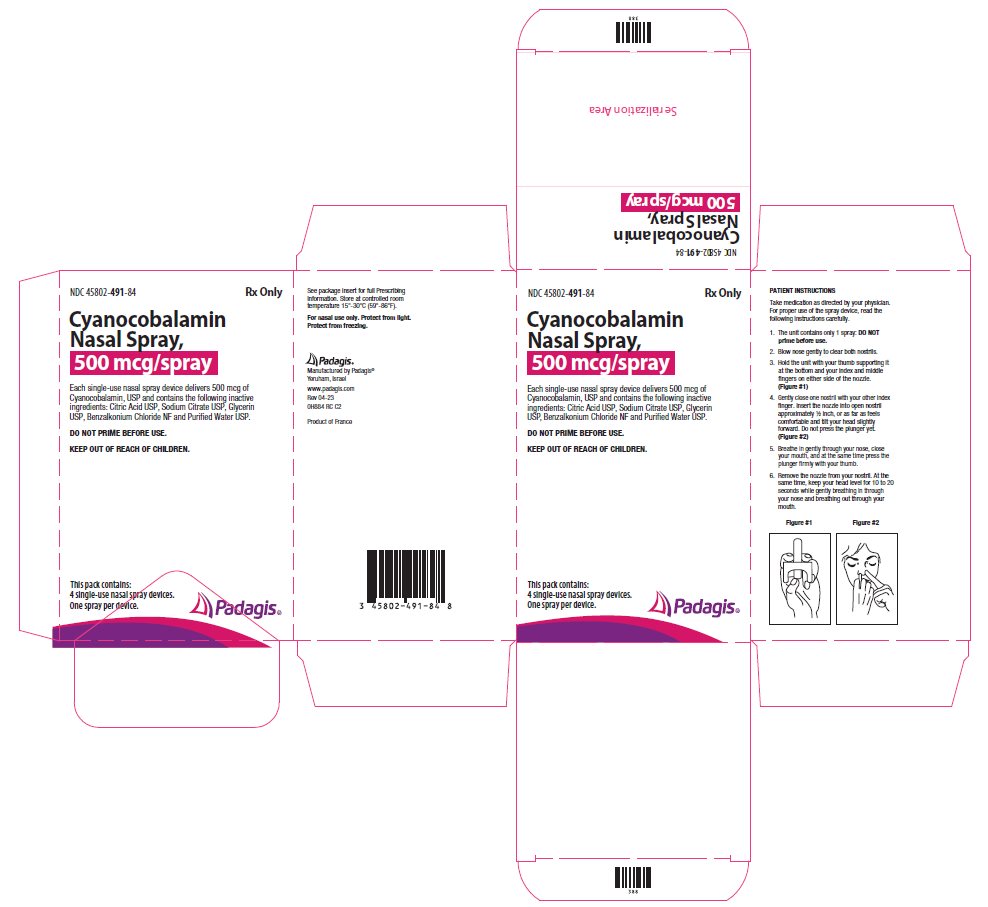
cyanocobalamin 500 ug Spray, 4 bottles — NDC 45802-491-84 (Billing 45802-0491-84)
This is a package of 4 bottles of cyanocobalamin 500 ug Spray from Padagis Israel Pharmaceuticals Ltd, marketed since Dec 2023 and currently FDA-listed; retail pharmacies pay about $95.91 per bottle (NADAC). It is this product's only package size.
NDC database record
One package, one record: these facts belong to NDC 45802-491-84 alone.
- Record
- FDA NDC Directory package listing · Human prescription drug
- Code segments
- 45802 labeler · 491 product · 84 package
- Package marketed since
- Dec 28, 2023
- Sample package
- No — commercial package
- Listing certified through
- Dec 31, 2026
- Billing quantity
- 4 EA per package
- Barcode (UPC-A, from the NDC)
- 3 4580249184 8
- Medicaid fills, this package
- 6,720 prescriptions in the last four reported quarters
- FDA record last changed
- Jul 24, 2026
Other active recalls for Cyanocobalamin (different manufacturers) — 2 · tap to view
Identity & classification
Regulatory identifiers FDA, NLM and CMS codes for this package
Drug-database identifiers Medi-Span GPI and First Databank GCN / HICL / AHFS classification
- GSN (GCN sequence number): 072532
- GCN: 36786
- GPI-14 (Medi-Span): 82100010002020
- HICL (First Databank): 001053
- AHFS class code: 88:08.00.00
- RxCUI (RxNorm): 861113
Where does this data come from?
- FDA openFDA NDC Directory · synced Oct 1, 2026
- FDA label on DailyMed · label index refreshed Oct 5, 2026
- RxNorm (NLM RxNav) · catalog refreshed Oct 1, 2026
- Medi-Span GPI (licensed)
- First Databank (licensed) · refreshed Oct 1, 2026
RxNorm drug class
This medicine belongs to the Vitamin B12 class.
Where does this data come from?
- RxClass (NLM) · catalog refreshed Oct 1, 2026
Clinical
Cyanocobalamin nasal gel is used to prevent a lack of vitamin B12 that may be caused by any of the following: pernicious anemia (lack of a natural substance needed to absorb vitamin B12 from the intestine); certain diseases, infections or medications that decrease the amount of vitamin B12 absorbed from food; or a vegan diet (strict vegetarian diet that does not allow any animal products including eggs and dairy products). Lack of vitamin B12 can cause anemia (condition in which the red blood cells do not bring enough oxygen to the organs) and permanent damage to the nerves. This anemia must b...
Read the full MedlinePlus article ↗- It replaces vitamin B12 when you are low. Doctors use it for deficiency from poor absorption, pernicious anemia, or a diet low in B12. The injection and the nasal spray are approve...
- The usual approach is one spray in one nostril once a week. Use it at least an hour before or after hot foods or drinks. Follow your prescriber and your product label.
- Some injection products are labeled to be given by a healthcare professional and not for self-administration. Ask your prescriber how yours should be given. It should never go into...
- With the nasal spray, people reported colds, headache, weakness, nausea, a sore tongue, tingling and a runny nose. Call your doctor about anything that bothers you. Get emergency h...
Patient education
Supplement & herbal interactions
Where does this data come from?
- MedlinePlus (NLM) · refreshed Oct 1, 2026
- FDA label on DailyMed · label index refreshed Oct 5, 2026
Ask a licensed pharmacist directly — free, answered by our team.
Pricing
A drug doesn't have one price. Each row is a different public payment system, and none is what you'd pay at the counter — that depends on your insurance. The ⓘ on each row explains what it measures.
| Price system | Per ea | Per package |
|---|---|---|
| Retail pharmacies payNADAC · weekly | $95.908 | $383.63 / 4 spray |
| Medicaid paysCMS SDUD · 12 mo | $949.72 | $3,798.89 / 4 spray |
| Medicare drug plans payPart D · quarterly | No Part D plan price is available for this NDC in our data. | |
Where does this data come from?
- CMS NADAC weekly file · file of Sep 30, 2026
- CMS ASP pricing files · refreshed Sep 20, 2026
- CMS Medicaid State Drug Utilization Data · through Q1 2026
- CMS Part D plan pricing files · refreshed Sep 24, 2026
- VA National Acquisition Center price file
Packaging — all sizes for this product
| Package NDC | Description | Marketing start | Marketing end | Status |
|---|---|---|---|---|
| 45802-0491-84 You're viewing this Main listing | 4 BOTTLE, UNIT-DOSE in 1 CARTON / 1 SPRAY in 1 BOTTLE, UNIT-DOSE | 2023-12-28 | — | Active |
Therapeutic equivalents
| Product | Labeler | Pack | NADAC/unit | TE | Status | Price vs. this |
|---|---|---|---|---|---|---|
| cyanocobalamin 500 ugthis 45802-0491-84 | Padagis | 4 bottles | $95.908 | AB | Availability likely | — |
| Nascobal 500 ug 49884-0270-82 | Par | 4 sprays | $171.739 | — | Availability likely | +79% |
| Cyanocobalamin 500 ug 43386-0237-60 | Lupin | 4 sprays | — | AB | FDA listed | — |
Where does this data come from?
- FDA openFDA NDC Directory · synced Oct 1, 2026
- FDA Orange Book · refreshed Oct 3, 2026
- CMS NADAC weekly file · file of Sep 30, 2026
Availability & generic status
This product is an FDA-approved generic. Other versions of the same drug are listed under Therapeutic equivalents, least expensive first.
Where does this data come from?
- FDA Orange Book · refreshed Oct 3, 2026
Inactive Ingredients / Excipients
Inactive ingredients, also called excipients, are components of the drug product other than the active ingredient. They may include fillers, dyes, coatings, preservatives, flavors, or other formulation ingredients.
🧪 Avoiding an ingredient? See Cyanocobalamin inactive ingredients by manufacturer: every current product's list side by side, so you can ask your pharmacy for the version that does not list it.
💡 Tap an ingredient (hover on desktop) to see what it is and why it’s used.
-
UNII F5UM2KM3W7
Benzalkonium chloride is a chemical compound that works as a preservative and antimicrobial agent in medications. It prevents bacterial and fungal growth in liquid formulations to keep the product safe during storage and use.
-
UNII 2968PHW8QP
A weak organic acid derived from citrus fruits or made through fermentation. It works as a buffer to control pH, a preservative to extend shelf life, and a flavoring agent in medications.
-
UNII PDC6A3C0OX
Glycerin is a clear, thick liquid derived from plant oils or fats. It acts as a humectant to retain moisture, a sweetener, and a solvent in medications.
-
UNII 1Q73Q2JULR
Sodium citrate is a salt derived from citric acid. It works as a buffer to maintain the medicine's pH level and may also help improve taste or act as a preservative in the formulation.
-
UNII 059QF0KO0R
Water is a liquid solvent that dissolves and mixes ingredients together in liquid medicines, syrups, and injections. It helps distribute the active drug evenly throughout the product.
5 inactive ingredients listed in the exact product block matched to this NDC.
Where does this data come from?
ingredient classCode="IACT" elements from the exact product block matched by this NDC. Label-section narrative from DailyMed / the openFDA label index is shown separately when available.- FDA label on DailyMed · label index refreshed Oct 5, 2026
- FDA openFDA NDC Directory · synced Oct 1, 2026
Inactive ingredient FAQ
Are inactive ingredients the same for every manufacturer?
Why might an inactive ingredient be missing?
Can inactive ingredients matter?
Manufacturer & labeler
More NDCs from Padagis Israel Pharmaceuticals Ltd labeler code 45802
- Ketoconazole 20 mg/mL Shampoo, Suspension NDC 45802-465-64
- Econazole Nitrate 10 mg/g Cream NDC 45802-466-11
- Hydrocortisone Acetate Pramoxine Hcl 2.5 g/100g; 1 g/100g Cream NDC 45802-472-53
- Fluocinolone acetonide .01 mg/100mL Oil NDC 45802-485-26
- Docusate Sodium 100 mg Capsule, Liquid Filled NDC 45802-486-78
- Naproxen Sodium 220 mg Tablet, Film Coated NDC 45802-490-71
- Ammonium Lactate 12 g/100g Cream NDC 45802-493-26
- Desoximetasone 2.5 mg/g Cream NDC 45802-495-35
- desoximetasone 2.5 mg/g Ointment NDC 45802-496-14
- Alogliptin and Pioglitazone 25 mg; 45 mg Tablet, Film Coated NDC 45802-499-65
- Betamethasone Dipropionate .5 mg/g Ointment NDC 45802-505-14
- Clindamycin and Benzoyl Peroxide Kit NDC 45802-507-02
Where does this data come from?
- FDA openFDA NDC Directory · synced Oct 1, 2026
- Drugs@FDA
Full prescribing information FDA SPL
🎯 Indications and Usage ▾
1 INDICATIONS AND USAGE Cyanocobalamin Nasal Spray is indicated for: • Vitamin B 12 maintenance therapy in adult patients with pernicious anemia who are in remission following intramuscular vitamin B 12 therapy and who have no nervous system involvement • Treatment of adult patients with dietary, drug-induced, or malabsorption-related vitamin B 12 deficiency not due to pernicious anemia • Prevention of vitamin B 12 deficiency in adult patients with vitamin B 12 requirements in excess of normal Limitations of Use • Cyanocobalamin Nasal Spray should not be used for the vitamin B 12 absorption test (Schilling test). • In patients with correctible or temporary causes of vitamin B 12 deficiency, the benefit of continued long-term use of Cyanocobalamin Nasal Spray following adequate correction of vitamin B 12 deficiency and underlying disease has not been established. • The effectiveness of Cyanocobalamin Nasal Spray in patients with active symptoms of nasal congestion, allergic rhinitis or upper respiratory infection has not been determined.
Treatment with Cyanocobalamin Nasal Spray should be deferred until symptoms have subsided. Cyanocobalamin Nasal Spray is a vitamin B 12 indicated for: • Vitamin B 12 maintenance therapy in adult patients with pernicious anemia who are in remission following intramuscular vitamin B 12 therapy and who have no nervous system involvement ( 1 ) • Treatment of adult patients with dietary, drug-induced, or malabsorption-related vitamin B 12 deficiency not due to pernicious anemia ( 1 ) • Prevention of vitamin B 12 deficiency in adult patients with vitamin B 12 requirements in excess of normal ( 1 ) Limitations of Use: • Should not be used for the vitamin B 12 absorption test (Schilling test).
( 1 ) • In patients with correctible or temporary causes of vitamin B 12 deficiency the benefit of continued long-term use following correction of vitamin B 12 deficiency and underlying disease has not been established. ( 1 ) • In patients with active symptoms of nasal congestion, allergic rhinitis or upper respiratory infection effectiveness has not been established. ( 1 )
⏱️ Dosage and Administration ▾
2 DOSAGE AND ADMINISTRATION • Prior to treatment, obtain hematocrit, reticulocyte count, vitamin B 12 , folate, and iron levels. ( 2.1 ) • The recommended initial dose is one spray (500 mcg) in one nostril once weekly. ( 2.2 ) • Administer at least one hour before or one hour after ingestion of hot foods or liquids.
( 2.2 ) • Monitor serum B 12 levels periodically. Obtain a serum B 12 level and peripheral blood count one month after treatment initiation, then subsequently at intervals of 3 to 6 months. ( 2.3 ) • If serum levels of B 12 decline after one month of treatment, consider increasing the dose.
Assess serum B 12 level one month after each dose adjustment. If serum B 12 levels are persistently low, consider alternative therapy (e.g., intramuscular or subcutaneous vitamin B 12 therapy). ( 2.3 ) • See Full Prescribing Information to see what other therapies should be administered with Cyanocobalamin Nasal Spray.
( 2.4 )
2.1Testing and Other Considerations Prior to Dosing Prior to treatment, obtain hematocrit, reticulocyte count, vitamin B 12 , folate, and iron levels [see Dosage and Administration (2.4) ] . Consider the potential for concomitant drugs to interfere with vitamin B 12 and folate diagnostic blood assays [see Drug Interactions (7) ] . In patients with suspected cobalamin hypersensitivity, consider administering an intradermal test dose of parenteral vitamin B 12 prior to use of Cyanocobalamin Nasal Spray [see Warnings and Precautions (5.2) ] .
2.2Recommended Dosage The recommended initial dose of Cyanocobalamin Nasal Spray is one spray (500 mcg) administered in ONE nostril once weekly. Administer Cyanocobalamin Nasal Spray at least one hour before or one hour after ingestion of hot foods or liquids since hot foods may cause nasal secretions and a resulting loss of medication. Defer use of Cyanocobalamin Nasal Spray in patients with nasal congestion, allergic rhinitis, or upper respiratory infections until after symptoms have subsided.
2.3Monitoring, Dosage Modifications, and Treatment Duration Monitoring for Response and Safety Monitor serum B 12 levels periodically during therapy to establish adequacy of therapy. Obtain a serum B 12 level and peripheral blood count one month after treatment initiation, then subsequently at intervals of 3 to 6 months [see Warnings and Precautions (5.3)]. Dosage Modifications If serum levels of B 12 decline after one month of treatment with Cyanocobalamin Nasal Spray, consider increasing the dose.
Assess serum B 12 level one month after each dose adjustment. If serum B 12 levels are persistently low, consider alternative therapy (e.g., intramuscular or subcutaneous vitamin B 12 therapy). Treatment Duration In patients whose underlying cause of vitamin B 12 deficiency has been corrected and are deemed no longer at risk for vitamin B 12 deficiency, discontinue Cyanocobalamin Nasal Spray.
The safety and effectiveness of continued long-term use in these individuals has not been established. In patients with pernicious anemia, continue appropriate vitamin B 12 treatment indefinitely.
2.4Administration of Cyanocobalamin Nasal Spray with Other Therapy Cyanocobalamin Nasal Spray should be administered with other therapy(ies) in: - Patients with concurrent folate and vitamin B 12 deficiency: Administer folic acid in addition to Cyanocobalamin Nasal Spray - Patients with concurrent iron and vitamin B 12 deficiency: Administer iron in addition to Cyanocobalamin Nasal Spray - Patients with correctible causes of vitamin B 12 deficiency: Consider measures to treat the underlying condition associated with vitamin B 12 deficiency in addition to treatment with Cyanocobalamin Nasal Spray
💊 Dosage Forms and Strengths ▾
3 DOSAGE FORMS AND STRENGTHS Nasal spray: 500 mcg/0.1 mL (per actuation), packaged in a single-use device containing 0.125 mL of solution Nasal spray: 500 mcg cyanocobalamin/0.1 mL (per actuation) ( 3 )
⛔ Contraindications ▾
4 CONTRAINDICATIONS Cyanocobalamin Nasal Spray is contraindicated in patients with hypersensitivity to cobalt and/or vitamin B 12 or any of its excipients [see Warnings and Precautions (5.2) ] . Anaphylactic shock and death have been reported after parenteral vitamin B 12 administration in sensitive patients. • Hypersensitivity to cobalt, vitamin B 12 or any excipients ( 4 )
⚠️ Warnings and Cautions ▾
5 WARNINGS AND PRECAUTIONS • Severe Optic Atrophy in Patients with Leber’s Disease: Patients with early Leber’s disease who were treated with vitamin B 12 suffered severe and swift optic atrophy. Cyanocobalamin Nasal Spray is not recommended for use in these patients. ( 5.1 ) • Anaphylactic Reactions: Anaphylactic shock and death have been reported after parenteral vitamin B 12 administration.
If patients are to start Cyanocobalamin Nasal Spray before having tolerated cyanocobalamin parenterally, consider administering an intradermal test dose of parenteral vitamin B 12 to patients suspected of cyanocobalamin hypersensitivity. ( 2.1 , 5.2 ) • Masking of Folate Deficiency with Vitamin B 12 Use: Doses of vitamin B 12 exceeding 10 mcg daily may produce hematologic response in patients with folate deficient megaloblastic anemia and may therefore mask a previously unrecognized folate deficiency. Assess both vitamin B 12 and folate levels prior to initiating therapy with Cyanocobalamin Nasal Spray or with folic acid.
( 5.3 ) • Hypokalemia and Thrombocytosis Due to Intense Treatment of Megaloblastic Anemia: Hypokalemia and sudden death may occur in severe megaloblastic anemia that is treated intensely with vitamin B 12 . Monitor serum potassium levels and platelet count during therapy. ( 5.4 ) • Unmasking of Polycythemia Vera: Vitamin B 12 deficiency may suppress the signs of polycythemia vera.
Treatment with Cyanocobalamin Nasal Spray may unmask this condition. Patients exhibiting clinical or hematologic response consistent with polycythemia vera should be referred for further evaluation. ( 5.5 )
5.1Severe Optic Atrophy in Patients with Leber’s Disease Patients with early Leber’s disease (hereditary optic nerve atrophy) who were treated with vitamin B 12 suffered severe and swift optic atrophy. Cyanocobalamin products, including Cyanocobalamin Nasal Spray, is not recommended for use in patients with Leber’s optic atrophy. For patients with Leber’s disease requiring vitamin B 12 , consider alternative therapy (e.g., hydroxocobalamin) for B 12 supplementation.
5.2Anaphylactic Reactions Anaphylactic shock and death have been reported after parenteral vitamin B 12 administration. If patients are to start Cyanocobalamin Nasal Spray before having tolerated cyanocobalamin parenterally, consider administering an intradermal test dose of parenteral vitamin B 12 to patients suspected of cyanocobalamin hypersensitivity [see Dosage and Administration (2.1) ] .
5.3Masking of Folate Deficiency with Vitamin B 12 Use Doses of vitamin B 12 exceeding 10 mcg daily may produce hematologic response in patients with folate deficient megaloblastic anemia and may therefore mask a previously unrecognized folate deficiency. Vitamin B 12 is not a substitute for folic acid [see Dosage and Administration (2.4) ] . Assess both vitamin B 12 and folate levels prior to initiating therapy with vitamin B 12 , including Cyanocobalamin Nasal Spray, or with folic acid [see Dosage and Administration (2.1) ] .
5.4Hypokalemia and Thrombocytosis Due to Intense Treatment of Megaloblastic Anemia Hypokalemia and sudden death may occur in severe megaloblastic anemia that is treated intensely with vitamin B 12 . Hypokalemia and thrombocytosis can occur upon conversion of severe megaloblastic anemia to normal erythropoiesis with vitamin B 12 therapy. Therefore, serum potassium levels and platelet count should be monitored carefully during therapy [see Dosage and Administration (2.3) ] .
5.5Unmasking of Polycythemia Vera Vitamin B 12 deficiency may suppress the signs of polycythemia vera. Treatment with vitamin B 12 may unmask this condition. Patients exhibiting clinical or hematologic response consistent with polycythemia vera should be referred for further evaluation.
🤒 Adverse Reactions ▾
6 ADVERSE REACTIONS The following serious adverse reactions are described elsewhere in the labeling: • Severe Optic Atrophy in Patients with Leber’s Disease [see Warnings and Precautions (5.1) ] . • Anaphylactic Reactions [see Warnings and Precautions (5.2) ] . • Hypokalemia and Thrombocytosis Due to Intense Treatment of Megaloblastic Anemia [see Warnings and Precautions (5.4) ] . The most common adverse reactions (≥ 4%) were infection, headache, glossitis, paresthesia, asthenia, nausea and rhinitis ( 6.1 ) To report SUSPECTED ADVERSE REACTIONS, contact Padagis ® at 1-866-634-9120 or FDA at 1-800-FDA-1088 or www.fda.gov/medwatch.
6.1Clinical Trials Experience Because clinical trials are conducted under widely varying conditions, adverse reaction rates observed in the clinical trials of a drug cannot be directly compared to rates in the clinical trials of another drug and may not reflect the rates observed in practice. The adverse reactions described in Table 1 below are based on data from an eight week cross over trial in which vitamin B 12 deficient patients in hematologic remission received one vitamin B 12 intramuscular injection (N=25) and then received once weekly intranasal administration of another nasal cyanocobalamin formulation (N=24) for 4 weeks.
Table 1. Adverse Reactions Following Intranasal or Intramuscular Administration of Cyanocobalamin In Vitamin B 12 Deficient Patients in Hematologic Remission Adverse Reaction Number of Patients (%) Another Cyanocobalamin Nasal Formulation, 500 mcg (n=24) Intramuscular Cyanocobalamin*, 100 mcg (n=25) Infection a 3 (13) 3 (12) Headache 1 (4) 5 (20) Asthenia 1 (4) 4 (16) Nausea 1 (4) 1 (4) Glossitis 1 (4) 0 (0) Paresthesia 1 (4) 1 (4) Rhinitis 1 (4) 2 (8) a Sore throat, common cold * The data are not an adequate basis for comparison of rates between the study drug and the active control
🔄 Drug Interactions ▾
7 DRUG INTERACTIONS Chloramphenicol may decrease the efficacy of Cyanocobalamin Nasal Spray when used for treatment of anemia. If Cyanocobalamin Nasal Spray is used for the treatment of anemia concomitantly with chloramphenicol, monitor for reduced efficacy and if needed, consider an alternative therapy.
👥 Use in Specific Populations ▾
8 USE IN SPECIFIC POPULATIONS
8.1Pregnancy Risk Summary The limited available data on Cyanocobalamin Nasal Spray in pregnant women are insufficient to inform a drug-associated risk of adverse developmental outcomes. However, vitamin B 12 is an essential vitamin and requirements are increased during pregnancy. Animal reproduction studies have not been conducted with vitamin B 12 .
The estimated background risk of major birth defects and miscarriage for the indicated population is unknown. In the U.S. general population, the estimated background risks of major birth defects and miscarriage in clinically recognized pregnancies is 2-4% and 15-20%, respectively.
8.2Lactation Risk Summary Vitamin B 12 is present in the milk of lactating women in concentrations which approximate the mother’s vitamin B 12 blood level. Vitamin B 12 does not appear to pose more than a minimal risk to breastfeeding children.
8.4Pediatric Use Safety and effectiveness have not been established in pediatric patients.
8.5Geriatric Use Clinical studies of cyanocobalamin nasal spray did not include sufficient numbers of subjects aged 65 and over to determine whether they respond differently from younger subjects. Other reported clinical experience has not identified differences in responses between the elderly and younger patients.
🤰 Pregnancy ▾
8.1Pregnancy Risk Summary The limited available data on Cyanocobalamin Nasal Spray in pregnant women are insufficient to inform a drug-associated risk of adverse developmental outcomes. However, vitamin B 12 is an essential vitamin and requirements are increased during pregnancy. Animal reproduction studies have not been conducted with vitamin B 12 .
The estimated background risk of major birth defects and miscarriage for the indicated population is unknown. In the U.S. general population, the estimated background risks of major birth defects and miscarriage in clinically recognized pregnancies is 2-4% and 15-20%, respectively.
🧒 Pediatric Use ▾
8.4Pediatric Use Safety and effectiveness have not been established in pediatric patients.
🧓 Geriatric Use ▾
8.5Geriatric Use Clinical studies of cyanocobalamin nasal spray did not include sufficient numbers of subjects aged 65 and over to determine whether they respond differently from younger subjects. Other reported clinical experience has not identified differences in responses between the elderly and younger patients.
🧬 Clinical Pharmacology ▾
12 CLINICAL PHARMACOLOGY
12.1Mechanism of Action Vitamin B 12 can be converted to coenzyme B 12 in tissues, and as such is essential for conversion of methylmalonate to succinate and synthesis of methionine from homocysteine, a reaction which also requires folate. In the absence of coenzyme B 12 , tetrahydrofolate cannot be regenerated from its inactive storage form, 5-methyltetrahydrofolate, and a functional folate deficiency occurs. Vitamin B 12 also may be involved in maintaining sulfhydryl (SH) groups in the reduced form required by many SH-activated enzyme systems.
Through these reactions, vitamin B 12 is associated with fat and carbohydrate metabolism and protein synthesis.
12.2Pharmacodynamics Parenteral (intramuscular) administration of vitamin B 12 completely reverses the megaloblastic anemia and GI symptoms of vitamin B 12 deficiency; the degree of improvement in neurologic symptoms depends on the duration and severity of the lesions, although progression of the lesions is immediately arrested. In pernicious anemia patients, once weekly intranasal dosing with 500 mcg B 12 gel resulted in a consistent increase in pre-dose serum B 12 levels during one month of treatment (p < 0.003) above that seen one month after 100 mcg intramuscular dose (Figure 2).
Figure 2. Vitamin B 12 Serum Trough Levels After Intramuscular Solution (IM) of 100 mcg and Nasal Gel (IN) Administration of 500 mcg Cyanocobalamin After Weekly Doses. figure-2
12.3Pharmacokinetics Absorption Vitamin B 12 is bound to intrinsic factor during transit through the stomach; separation occurs in the terminal ileum in the presence of calcium, and vitamin B 12 enters the mucosal cell for absorption. It is then transported by the transcobalamin binding proteins. A small amount (approximately 1% of the total amount ingested) is absorbed by simple diffusion, but this mechanism is adequate only with very large doses.
A three way crossover study in 25 fasting healthy subjects was conducted to compare the bioavailability of the B 12 nasal spray to the B 12 nasal gel and to evaluate the relative bioavailability of the nasal formulations as compared to the intramuscular injection. The peak concentrations after administration of intranasal spray were reached in 1.25 +/- 1.9 hours. The mean peak plasma concentration (C max ) of B 12 , obtained after baseline correction, following administration of intranasal spray were 748 +/-549 pg/mL.
The bioavailability of the B 12 nasal spray was found to be 10% less than the B 12 nasal gel. Distribution In the blood, B 12 is bound to transcobalamin II, a specific B-globulin carrier protein, and is distributed and stored primarily in the liver and bone marrow. Elimination About 3-8 mcg of B 12 is secreted into the GI tract daily via the bile and undergoes some enterohepatic recycling; in normal subjects with sufficient intrinsic factor, all but about 1 mcg is reabsorbed.
When B 12 is administered in doses which saturate the binding capacity of plasma proteins and the liver, the unbound B 12 is rapidly eliminated in the urine. Retention of B 12 in the body is dose-dependent. About 80-90% of an intramuscular dose up to 50 mcg is retained in the body; this percentage drops to 55% for a 100 mcg dose, and decreases to 15% when a 1000 mcg dose is given.
🧬 Mechanism of Action ▾
12.1Mechanism of Action Vitamin B 12 can be converted to coenzyme B 12 in tissues, and as such is essential for conversion of methylmalonate to succinate and synthesis of methionine from homocysteine, a reaction which also requires folate. In the absence of coenzyme B 12 , tetrahydrofolate cannot be regenerated from its inactive storage form, 5-methyltetrahydrofolate, and a functional folate deficiency occurs. Vitamin B 12 also may be involved in maintaining sulfhydryl (SH) groups in the reduced form required by many SH-activated enzyme systems.
Through these reactions, vitamin B 12 is associated with fat and carbohydrate metabolism and protein synthesis.
📦 How Supplied / Storage and Handling ▾
16 HOW SUPPLIED/STORAGE AND HANDLING Cyanocobalamin Nasal Spray is a nasal spray available in a dosage strength of 500 mcg cyanocobalamin/0.1 mL (per actuation). It is supplied in boxes of 4 single-use nasal spray devices and a package insert (NDC 45802-491-84). Protect from light. Keep covered in carton until ready to use. Store upright at controlled room temperature 15°C to 30°C (59°F to 86°F). Protect from freezing.
📋 Description ▾
11 DESCRIPTION Cyanocobalamin is a synthetic form of vitamin B 12 . The chemical name is 5,6-dimethyl-benzimidazolyl cyanocobamide. The cobalt content is 4.35%.
The molecular formula is C 63 H 88 CoN 14 O 14 P, which corresponds to a molecular weight of 1355.38 and the following structural formula: Figure 1. Cyanocobalamin Nasal Spray Chemical Structure Cyanocobalamin occurs as dark red crystals or orthorhombic needles or crystalline red powder. It is very hygroscopic in the anhydrous form, and sparingly to moderately soluble in water (1:80).
Its pharmacologic activity is destroyed by heavy metals (iron) and strong oxidizing or reducing agents (vitamin C), but not by autoclaving for short periods of time (15-20 minutes) at 121°C. The vitamin B 12 coenzymes are very unstable in light. Cyanocobalamin Nasal Spray is a solution of cyanocobalamin, USP (vitamin B 12 ) for administration as a spray to the nasal mucosa.
Each unit dose device of Cyanocobalamin Nasal Spray contains 0.125 mL of a 500 mcg/0.1 mL solution of cyanocobalamin with benzalkonium chloride in purified water, citric acid, glycerin and sodium citrate. The spray solution has a pH between 4.5 and 5.5. Each spray delivers an average of 500 mcg of cyanocobalamin per actuation. chemical structure image
💬 Information for Patients ▾
17 PATIENT COUNSELING INFORMATION Advise the patient to read the FDA-approved patient labeling (Instructions for Use). Importance of Adherence to Therapy and Follow-up Advise patients of the importance of adhering to therapy to prevent the development, recurrence, or progression of anemia and the development or progression of neurological manifestations. Patients experiencing symptomatic nasal congestion, allergic rhinitis or an upper respiratory infection should be advised to defer treatment with Cyanocobalamin Nasal Spray until symptoms have subsided.
Counsel patients on the importance of returning for follow-up blood tests every 3 to 6 months to confirm adequacy of therapy [see Dosage and Administration (2.3) ] . Specific Instructions for Administration Advise patients to administer Cyanocobalamin Nasal Spray at least one hour before or one hour after ingestion of hot foods or liquids since hot foods may cause nasal secretions and a resulting loss of medication. Use of Nasal Spray Device Provide patients with instructions on nasal administration of Cyanocobalamin Nasal Spray.
In addition to alerting patients to the instructions contained in the Instructions For Use and instructions supplied on each carton, demonstrate procedures for use to each patient. Manufactured by Padagis® Yeruham, Israel www.padagis.com Rev 02-23 0H800 RC PH1
🧬 Pharmacokinetics ▾
12.3Pharmacokinetics Absorption Vitamin B 12 is bound to intrinsic factor during transit through the stomach; separation occurs in the terminal ileum in the presence of calcium, and vitamin B 12 enters the mucosal cell for absorption. It is then transported by the transcobalamin binding proteins. A small amount (approximately 1% of the total amount ingested) is absorbed by simple diffusion, but this mechanism is adequate only with very large doses.
A three way crossover study in 25 fasting healthy subjects was conducted to compare the bioavailability of the B 12 nasal spray to the B 12 nasal gel and to evaluate the relative bioavailability of the nasal formulations as compared to the intramuscular injection. The peak concentrations after administration of intranasal spray were reached in 1.25 +/- 1.9 hours. The mean peak plasma concentration (C max ) of B 12 , obtained after baseline correction, following administration of intranasal spray were 748 +/-549 pg/mL.
The bioavailability of the B 12 nasal spray was found to be 10% less than the B 12 nasal gel. Distribution In the blood, B 12 is bound to transcobalamin II, a specific B-globulin carrier protein, and is distributed and stored primarily in the liver and bone marrow. Elimination About 3-8 mcg of B 12 is secreted into the GI tract daily via the bile and undergoes some enterohepatic recycling; in normal subjects with sufficient intrinsic factor, all but about 1 mcg is reabsorbed.
When B 12 is administered in doses which saturate the binding capacity of plasma proteins and the liver, the unbound B 12 is rapidly eliminated in the urine. Retention of B 12 in the body is dose-dependent. About 80-90% of an intramuscular dose up to 50 mcg is retained in the body; this percentage drops to 55% for a 100 mcg dose, and decreases to 15% when a 1000 mcg dose is given.
🧬 Pharmacodynamics ▾
12.2Pharmacodynamics Parenteral (intramuscular) administration of vitamin B 12 completely reverses the megaloblastic anemia and GI symptoms of vitamin B 12 deficiency; the degree of improvement in neurologic symptoms depends on the duration and severity of the lesions, although progression of the lesions is immediately arrested. In pernicious anemia patients, once weekly intranasal dosing with 500 mcg B 12 gel resulted in a consistent increase in pre-dose serum B 12 levels during one month of treatment (p < 0.003) above that seen one month after 100 mcg intramuscular dose (Figure 2).
Figure 2. Vitamin B 12 Serum Trough Levels After Intramuscular Solution (IM) of 100 mcg and Nasal Gel (IN) Administration of 500 mcg Cyanocobalamin After Weekly Doses. figure-2
🧪 Nonclinical Toxicology ▾
13 NONCLINICAL TOXICOLOGY
13.1Carcinogenesis, Mutagenesis, Impairment of Fertility Long-term studies in animals to evaluate carcinogenic potential have not been done.
📄 Carcinogenesis, Mutagenesis, Impairment of Fertility ▾
13.1Carcinogenesis, Mutagenesis, Impairment of Fertility Long-term studies in animals to evaluate carcinogenic potential have not been done.
📄 Patient Package Insert ▾
PATIENT INFORMATION PATIENT INFORMATION Cyanocobalamin (sye-an-oh-Koe-BAL-a-min) Nasal Spray Cyanocobalamin Nasal Spray is for use in your nose only. What is Cyanocobalamin Nasal Spray? Cyanocobalamin Nasal Spray is a prescription medicine used: • for maintenance therapy to treat vitamin B 12 deficiency (low levels of vitamin B 12 ) in adults with pernicious anemia who achieved healthy vitamin B 12 levels after receiving vitamin B 12 shots and do not have nervous system problems. • to treat vitamin B 12 deficiency caused by: o certain food limitations, o other medicines that cause vitamin B 12 deficiency, or o lack of absorption (malabsorption) that are not related to pernicious anemia. • to prevent vitamin B 12 deficiency in adults who require higher amounts of vitamin B 12 . to treat vitamin B 12 deficiency caused by: certain food limitations, other medicines that cause vitamin B 12 deficiency, or lack of absorption (malabsorption) that are not related to pernicious anemia. to prevent vitamin B 12 deficiency in adults who require higher amounts of vitamin B 12 .
Cyanocobalamin Nasal Spray should not be used for a vitamin B 12 absorption test known as the Schilling test. In people that have corrected or have fixed their short-term causes of vitamin B 12 deficiency, the benefit of continued long-term use of Cyanocobalamin Nasal Spray is not known after vitamin B 12 deficiency has been corrected. It is not known if Cyanocobalamin Nasal Spray is effective in people that currently have a stuffy nose, allergies or an upper respiratory infection.
You should wait until these symptoms have gone away before using Cyanocobalamin Nasal Spray. It is not known if Cyanocobalamin Nasal Spray is safe and effective in children. Do not use Cyanocobalamin Nasal Spray if you are allergic to cobalt, vitamin B 12 , cyanocobalamin or any ingredients in Cyanocobalamin Nasal Spray.
See the end of this leaflet for a complete list of ingredients in Cyanocobalamin Nasal Spray. Before you use Cyanocobalamin Nasal Spray, tell your healthcare provider about all of your medical conditions, including if you: • have a history of a certain disease that effects or weakens the optic nerve in your eye (early Leber’s disease). Cyanocobalamin Nasal Spray is not recommended in people with Leber’s optic atrophy. • have had an allergic reaction to vitamin B 12 injections or intravenous (IV) infusion. • have low levels of folate or iron. • are pregnant or plan to become pregnant.
It is not known if Cyanocobalamin Nasal Spray will harm your unborn baby. have had an allergic reaction to vitamin B 12 injections or intravenous (IV) infusion. have low levels of folate or iron. are pregnant or plan to become pregnant. It is not known if Cyanocobalamin Nasal Spray will harm your unborn baby. Tell your healthcare provider about all the medicines you take, including prescription and over-the-counter medicines, vitamins, and herbal supplements.
How should I use Cyanocobalamin Nasal Spray? • See the Instructions for Use at the end of this leaflet for instructions on how to use Cyanocobalamin Nasal Spray. • You should use Cyanocobalamin Nasal Spray exactly as your healthcare provider tells you to use it. • Your healthcare provider will tell you how much Cyanocobalamin Nasal Spray to use and when to use it. • You should not use Cyanocobalamin Nasal Spray 1 hour before or 1 hour after eating hot foods or drinking hot liquids. Eating hot food or drinking hot liquids too soon before or after taking Cyanocobalamin Nasal Spray can cause you to have a runny nose and can affect the amount of Cyanocobalamin Nasal Spray you receive. • Your healthcare provider may do certain blood tests before you use Cyanocobalamin Nasal Spray and every 3 to 6 months while you are taking it.
Your healthcare provider may change your dose based on the results of your blood tests. You should use Cyanocobalamin Nasal Spray exactly as your healthcare provider tells you to use it. Your healthcare provider will te… [Excerpted — this section continues on DailyMed.]
📖 Instructions for Use ▾
INSTRUCTIONS FOR USE Cyanocobalamin (sye-an-oh-Koe-BAL-a-min) Nasal Spray Cyanocobalamin Nasal Spray is for use in your nose only. Read this Instructions for Use before you start using Cyanocobalamin Nasal Spray and each time you get a refill. There may be new information.
This information does not take the place of talking to your healthcare provider about your medical condition or your treatment. Your healthcare provider should teach you how to use Cyanocobalamin Nasal Spray before you use it for the first time. If you have any questions or do not understand the instructions, talk with your healthcare provider or pharmacist.
Cyanocobalamin Nasal Spray contains only 1 spray. You do not need to prime Cyanocobalamin Nasal Spray before you use it. If you are eating hot foods or liquids, use Cyanocobalamin Nasal Spray at least one hour before or one hour afterwards because eating hot food or drinking hot liquids too soon before or after taking Cyanocobalamin Nasal Spray can cause you to have a runny nose and can affect the amount of Cyanocobalamin Nasal Spray you receive.
How to use Cyanocobalamin Nasal Spray? Step 1. Blow your nose gently to clear both nostrils.
Step 2. Hold Cyanocobalamin Nasal Spray with your thumb on the bottom and your index (pointer) finger and middle finger on either side of the nozzle (see Figure A). (Figure A) Step 3.
Gently close 1 side of your nose (nostril) with your other index finger. Insert the nozzle into the open nostril about half an inch or as far as it feels comfortable and tilt your head slightly forward (see Figure B). Do not press the plunger yet.
(Figure B) Step 4. Breathe in gently through your nose, close your mouth, and at the same time press the plunger firmly upwards with your thumb. Step 5.
Remove the nozzle from your nostril. At the same time, keep your head straight for 10 to 20 seconds while gently breathing in through your nose and breathing out through your mouth. How to dispose of (throw away) Cyanocobalamin Nasal Spray?
Cyanocobalamin Nasal Spray can be disposed of in your household trash. Place the Cyanocobalamin Nasal Spray in a container such as a zip-top or sealable plastic bag, and throw the container away in your household trash. Manufactured by Padagis ® Yeruham, Israel www.padagis.com Rev 02-23 0H800 RC PH1 This Instructions for Use has been approved by the U.S.
Food and Drug Administration Revised: 02/2023 image of hand holding nasal spray image showing nozzle placement in nostril
📄 Package Label / Principal Display Panel ▾
PACKAGE/LABEL PRINCIPAL DISPLAY PANEL NDC 45802-491-84 Rx Only Cyanocobalamin Nasal Spray, 500 mcg/spray Each single-use nasal spray device delivers 500 mcg of Cyanocobalamin, USP and contains the following inactive ingredients: Citric Acid USP, Sodium Citrate USP, Glycerin USP, Benzalkonium Chloride NF and Purified Water USP. DO NOT PRIME BEFORE USE. KEEP OUT OF REACH OF CHILDREN.
This pack contains: 4 single-use nasal spray devices. One spray per device. carton