
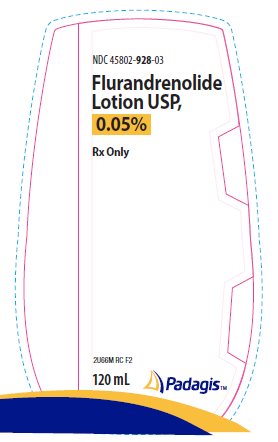
Flurandrenolide .5 mg/mL Lotion, 120 mL
🆔 Identity & classification
Where does this data come from?
🏷️ RxNorm drug class
This medicine belongs to the Corticosteroid class.
Where does this data come from?
🏭 Manufacturer & labeler
Where does this data come from?
🩺 Clinical
Flurandrenolide topical is used to treat the itching, redness, dryness, crusting, scaling, inflammation, and discomfort of various skin conditions, including psoriasis (a skin disease in which red, scaly patches form on some areas of the body and eczema (a skin disease that causes the skin to be dry and itchy and to sometimes develop red, scaly rashes). Flurandrenolide is in a class of medications called corticosteroids. It works by activating natural substances in the skin to reduce swelling, redness, and itching.
Read the full MedlinePlus article ↗- It's used for skin conditions that respond to steroid treatment — things like eczema, psoriasis, and allergic skin reactions that cause inflammation and itching. Your doctor may al...
- What skin conditions is flurandrenolide used for?
- The general guideline is to replace Cordran Tape every 12 hours — this is when side effects are least likely to occur. If the tape is comfortable and sticking well, your doctor may...
- How often do I need to change the Cordran Tape?
Patient education
Supplement & herbal interactions
Some supplements/herbs that may interact with Flurandrenolide — tap one for details:
Where does this data come from?
Ask a licensed pharmacist directly — free, answered by our team.
🧪 Inactive Ingredients / Excipients
Inactive ingredients, also called excipients, are components of the drug product other than the active ingredient. They may include fillers, dyes, coatings, preservatives, flavors, or other formulation ingredients.
Where does this data come from?
IACT rows and label-wide narrative are kept separate; availability and product-level specificity depend on the submitted label.Inactive ingredient FAQ
Are inactive ingredients the same for every manufacturer?
Why might an inactive ingredient be missing?
Can inactive ingredients matter?
💲 Pricing
A drug doesn't have one price. Each row is a different public payment system, and none is what you'd pay at the counter — that depends on your insurance. The ⓘ on each row explains what it measures.
| Price system | Per mL | Per package |
|---|---|---|
| Retail pharmacies payNADAC · weekly | $1.155 | $138.62 / 120 ml |
| Medicaid paysCMS SDUD · 12 mo | $1.41 | $168.85 / 120 ml |
| Medicare drug plans payPart D · Q2 2026 | $1.58 | $189.28 / 120 ml |
Where does this data come from?
🔁 Therapeutic equivalents
| Product | Labeler | Pack | NADAC/unit | TE | Status | Price vs. this |
|---|---|---|---|---|---|---|
| Flurandrenolide .5 mg/mLthis 45802-0928-03 | Padagis | 120 ml | $1.155 | — | Availability likely | — |
| Flurandrenolide .5 mg/mL 63629-8657-01 | Bryant | 1 bottle | — | — | FDA listed | — |
| Flurandrenolide .5 mg/mL 72162-1439-02 | Bryant | 120 ml | — | — | FDA listed | — |
Where does this data come from?
⏳ Availability & generic status
This product is an FDA-approved generic. Other versions of the same drug are listed under Therapeutic equivalents, least expensive first.
Where does this data come from?
🗺️ Medicaid utilization & spend
📊 Medicare Part D spend CMS · PART D · 2026 (Q1)
📦 Packaging — all sizes for this product
| Package NDC | Description | Marketing start | Status |
|---|---|---|---|
| 45802-0928-03 You're viewing this | 120 mL in 1 BOTTLE, PLASTIC (45802-928-03) | 2016-10-06 | Active |
📄 Full prescribing information FDA SPL
🎯 Indications and Usage ▾
INDICATIONS AND USAGE Flurandrenolide Lotion USP, 0.05% is indicated for the relief of the inflammatory and pruritic manifestations of corticosteroid-responsive dermatoses.
⏱️ Dosage and Administration ▾
DOSAGE AND ADMINISTRATION Shake well before using. A small quantity of Flurandrenolide Lotion USP, 0.05% should be rubbed gently into the affected area 2 or 3 times daily. Therapy should be discontinued when control is achieved.
If no improvement is seen within 2 weeks, reassessment of the diagnosis may be necessary. Flurandrenolide Lotion USP, 0.05% should not be used with occlusive dressings unless directed by a physician. Tight-fitting diapers or plastic pants may constitute occlusive dressings.
⛔ Contraindications ▾
CONTRAINDICATIONS Topical corticosteroids are contraindicated in patients with a history of hypersensitivity to any of the components of these preparations.
🤒 Adverse Reactions ▾
ADVERSE REACTIONS The following local adverse reactions are reported infrequently with topical corticosteroids but may occur more frequently with the use of occlusive dressings. These reactions are listed in an approximate decreasing order of occurrence: Burning Itching Irritation Dryness Folliculitis Hypertrichosis Acneiform eruptions Hypopigmentation Perioral dermatitis Allergic contact dermatitis The following may occur more frequently with occlusive dressings: Maceration of the skin Secondary infection Skin atrophy Striae Miliaria Postmarketing Adverse Reactions The following adverse reactions have been identified during post approval use of flurandrenolide lotion.
Because these reactions are reported voluntarily from a population of uncertain size, it is not always possible to reliably estimate their frequency or establish a causal relationship to drug exposure. Skin : skin striae, hypersensitivity, skin atrophy, contact dermatitis, and skin discoloration.
🤰 Pregnancy ▾
Usage in Pregnancy - Pregnancy Category C - Corticosteroids are generally teratogenic in laboratory animals when administered systemically at relatively low dosage levels. The more potent cortico-steroids have been shown to be teratogenic after dermal application in laboratory animals. There are no adequate and well-controlled studies in pregnant women on teratogenic effects from topically applied corticosteroids.
Therefore, topical corticosteroids should be used during pregnancy only if the potential benefit justifies the potential risk to the fetus. Drugs of this class should not be used extensively for pregnant patients or in large amounts or for prolonged periods of time.
🧒 Pediatric Use ▾
Pediatric Use - Pediatric patients may demonstrate greater susceptibility to topical corticosteroid-induced HPA axis suppression and Cushing’s syndrome than do mature patients because of a larger skin surface area to body weight ratio. Hypothalamic-pituitary-adrenal (HPA) axis suppression, Cushing’s syndrome, and intracranial hypertension have been reported in pediatric patients receiving topical corticosteroids. Manifestations of adrenal suppression in pediatric patients include linear growth retardation, delayed weight gain, low plasma cortisol levels, and absence of response to ACTH stimulation.
Manifestations of intracranial hypertension include bulging fontanelles, headaches, and bilateral papilledema. Administration of topical corticosteroids to pediatric patients should be limited to the least amount compatible with an effective therapeutic regimen. Chronic corticosteroid therapy may interfere with the growth and development of pediatric patients.
🆘 Overdosage ▾
OVERDOSAGE Topically applied corticosteroids can be absorbed in sufficient amounts to produce systemic effects ( see PRECAUTIONS ).
🧬 Clinical Pharmacology ▾
CLINICAL PHARMACOLOGY Flurandrenolide Lotion USP, 0.05% is primarily effective because of its anti-inflammatory, antipruritic, and vasoconstrictive actions. The mechanism of the anti-inflammatory effect of topical corticosteroids is not completely understood. Various laboratory methods, including vasoconstrictor assays, are used to compare and predict potencies and/or clinical efficacies of the topical corticosteroids.
There is some evidence to suggest that a recognizable correlation exists between vasoconstrictor potency and therapeutic efficacy in man. Corticosteroids with anti-inflammatory activity may stabilize cellular and lysosomal membranes. There is also the suggestion that the effect on the membranes of lysosomes prevents the release of proteolytic enzymes and, thus, plays a part in reducing inflammation.
Evaporation of water from the lotion vehicle produces a cooling effect, which is often desirable in the treatment of acutely inflamed or weeping lesions. Pharmacokinetics - The extent of percutaneous absorption of topical corticosteroids is determined by many factors, including the vehicle, the integrity of the epidermal barrier, and the use of occlusive dressings. Topical corticosteroids can be absorbed from normal intact skin.
Inflammation and/or other disease processes in the skin increase percutaneous absorption. Once absorbed through the skin, topical corticosteroids are handled through pharmacokinetic pathways similar to those of systemically administered corticosteroids. Corticosteroids are bound to plasma proteins in varying degrees.
They are metabolized primarily in the liver and then excreted in the kidneys. Some of the topical corticosteroids and their metabolites are also excreted into the bile.
📦 How Supplied / Storage and Handling ▾
HOW SUPPLIED Flurandrenolide Lotion USP, 0.05% is supplied in plastic squeeze bottles as follows: 60 mL (NDC 45802- 928 -02) 120 mL (NDC 45802- 928 -03) Keep out of reach of children. Storage: Avoid freezing. Keep tightly closed.
Protect from light. Store at 20° to 25°C (68° to 77°F) with excursions permitted to 15° to 30°C (59° to 86°F) [see USP Controlled Room Temperature]. Rx Only Manufactured By Padagis Yeruham, Israel Distributed By Padagis Allegan, MI 49010 • www.padagis.com Rev 02-22 2U66M RC F2
📋 Description ▾
DESCRIPTION Flurandrenolide Lotion USP, 0.05% is a potent corticosteroid intended for topical use. Flurandrenolide occurs as white to off-white, fluffy, crystalline powder and is odorless. Flurandrenolide is practically insoluble in water and in ether.
One g dissolves in 72 mL of alcohol and in 10 mL of chloroform. The molecular weight of flurandrenolide is 436.52. The chemical name of flurandrenolide is Pregn-4-ene-3,20-dione, 6-fluoro-11,21-dihydroxy-16,17-[(1-methylethylidene)bis (oxy)]-, (6α, 11β, 16α)-; its empirical formula is C 24 H 33 FO 6 .
The structure is as follows: Each mL of Flurandrenolide Lotion USP, 0.05% contains 0.5 mg (1.145 μmol) (0.05%) flurandrenolide in an oil-in-water emulsion base composed of glycerin, cetyl alcohol, stearic acid, glyceryl monostearate, mineral oil, polyoxyl 40 stearate, menthol, benzyl alcohol, and purified water. Chemical Structure
💬 Information for Patients ▾
Information for Patient - Patients using topical corticosteroids should receive the following information and instructions: 1. This medication is to be used as directed by the physician. It is for external use only.
Avoid contact with the eyes. 2. Do not use Flurandrenolide Lotion USP, 0.05% on the face, underarms, or groin areas unless directed by your physician.
3. Patients should be advised not to use this medication for any disorder other than that for which it was prescribed. 4.
The treated skin area should not be bandaged or otherwise covered or wrapped in order to be occlusive unless the patient is directed to do so by the physician. 5. Patients should report any signs of local adverse reactions, especially under occlusive dressing.
6. Parents of pediatric patients should be advised not to use tight-fitting diapers or plastic pants on a patient being treated in the diaper area, because these garments may constitute occlusive dressings. 7.
If no improvement is seen within 2 weeks, contact your physician. 8. Do not use other corticosteroid-containing products while using Flurandrenolide Lotion USP, 0.05% without first consulting your physician.