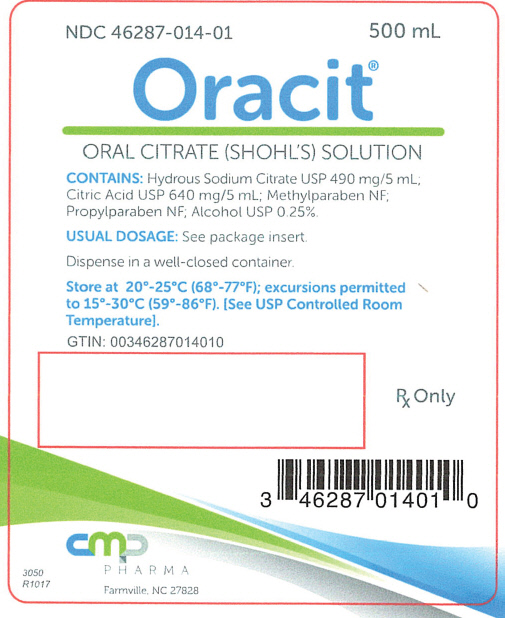
Label image from the product's FDA listing (DailyMed) — may show a different pack size or an older label revision.
Oracit Citric Acid and Sodium Citrate 640 mg/5mL; 490 mg/5mL Solution, 500 mL — NDC 46287-014-01 (Billing 46287-0014-01)
by CMP Pharma, Inc. · 500 mL in 1 BOTTLE
This is a package of 500 mL of Oracit Citric Acid and Sodium Citrate 640 mg/5mL; 490 mg/5mL Solution from CMP Pharma, Inc., marketed since May 1984 and currently FDA-listed; retail pharmacies pay about $0.0768 per mL (NADAC). It is the main listing for this product, which comes in 3 package sizes.
NDC 46287-0014-01
🏷️ FDA NDC (as labeled)46287-014-01billing pads the product segment with a zero
This package
Contains500 mLCost per mL$0.0768 NADACPer package$38.40 / 500 ml Pack sizes3 compare ↓
🗂️ FDA directory synced Oct 8, 2026 · this listing last changed Oct 8, 2026 · sources: openFDA · FDA label (DailyMed) · FDA Orange & Purple Book · First Databank · CMS NADAC, ASP, Medicare & Medicaid · RxNorm
Drug-database identifiers Medi-Span GPI and First Databank GCN / HICL / AHFS classification
GPI-1456202020002020
GPI classOracit
GCN Seq No043911
GCN51959
HICL code003682
Ingredient (HICL)Citric Acid/Sodium Citrate
HIC1 codeR
Therapeutic class — broad (HIC1)Kidney/Urinary Tract
HIC2 codeR1
Therapeutic class — intermediate (HIC2)Affect Primarily Kidneys/Urinary Tract
HIC3 codeR1S
Therapeutic class — specific (HIC3)Urinary Ph Modifiers
AHFS code40:08.00.00
AHFS classAlkalinizing Agents
FDB label nameORACIT ORAL SOLUTION
FDB brand nameOracit
Legend statusF — Federal legend — prescription drug or device
Quick answers
GSN (GCN sequence number):043911
GCN:51959
GPI-14 (Medi-Span):56202020002020
HICL (First Databank):003682
AHFS class code:40:08.00.00
RxCUI (RxNorm):544550
Why two NDCs?
The FDA registers this code as 46287-014-01 — a 5-3-2 layout, and that's what's printed on the package and shown on DailyMed. For insurance claims, every NDC is standardized to a uniform 11-digit 5-4-2 format by adding a zero to the product segment → 46287-0014-01. Same drug, same package — only the format differs.
Where does this data come from?
Identifiers from the FDA openFDA NDC Directory and Structured Product Labeling; RxCUI from RxNorm (NLM); GPI from Medi-Span; GCN / HIC / AHFS / legend from First Databank.
How it worksCalcium Chelating Activity, Acidifying Activity
Where does this data come from?
Therapeutic classes from RxNorm RxClass (U.S. National Library of Medicine) — Established Pharmacologic Class (FDA), ATC drug family (WHO) and mechanism of action, matched by this product’s RxCUI.
Label name ORACIT ORAL SOLUTIONIngredient Citric Acid/Sodium Citrate
🧪 What is this product?
Oracit is an oral solution containing citric acid and sodium citrate, two forms of citrate that function to make urine less acidic. These ingredients are typically used to treat conditions where urine alkalinization is desired, such as certain types of kidney stones or urinary tract discomfort related to acidic urine. This product is marketed without an approved FDA application.
Plain-language summary from MedlinePlus (U.S. National Library of Medicine); supplement & herbal interactions and nutrient depletion data from the Natural Medicines database; our full guide is HelloPharmacist editorial content.
A drug doesn't have one price. Each row is a different public payment system, and none is what you'd pay at the counter — that depends on your insurance. The ⓘ on each row explains what it measures.
Price system
Per mL
Per package
Retail pharmacies payNADAC · weekly
$0.077
$38.40 / 500 ml
Medicaid paysCMS SDUD · 12 mo
$0.1014
$50.70 / 500 ml
Medicare drug plans payPart D · quarterly
No Part D plan price is available for this NDC in our data.
NADAC price history (per mL) — tap or hover for the price & month
▲ Up 1% over the last 10 months.
Where does this data come from?
NADAC (National Average Drug Acquisition Cost) is the CMS weekly pharmacy-acquisition-cost survey — what pharmacies pay. ASP (Average Sales Price) is the CMS Medicare Part B drug-payment file, published quarterly. Medicaid pays is computed by us from CMS State Drug Utilization Data (total reimbursed ÷ units, trailing 12 months) — gross of rebates and inclusive of dispensing fees, so it reflects what Medicaid paid, not an acquisition cost. Medicare drug plans pay is the median negotiated point-of-sale unit cost across plans listing this NDC in the CMS quarterly Prescription Drug Plan pricing files, before rebates. The VA pays is the federal contract price (FSS, and the statutory Big 4 ceiling where listed) from the VA National Acquisition Center pharmaceutical price file. All are free public government data; each measures a different payer, so the figures are not directly comparable.
10 BOTTLE, UNIT-DOSE in 1 CARTON / 30 mL in 1 BOTTLE, UNIT-DOSE
—
—
1984-05-15
—
Active
Swipe sideways for more columns →
In Medicaid, this is the most-dispensed pack of this product — about 97% of fills over the last four reported quarters. See all packs ↓
Pack size FAQ
What quantity is in this package?
This package contains 500 mL — 500 ml in 1 bottle.
What NDC number is used to bill for this package of Oracit Citric Acid and Sodium Citrate 640 mg/5mL; 490 mg/5mL Solution?
Use the 11-digit billing form listed in the identifiers section of this page. Pharmacy and medical claims use the 11-digit form; the FDA label may print a shorter form of the same code.
Prices are the latest CMS NADAC pharmacy acquisition cost per NDC; per-pack figures are per-unit × pack quantity, shown only when the pack is denominated in the same measure NADAC prices.
About this product: other versions of the same ingredient, strength and form are listed above, least expensive first, with FDA equivalence ratings where available.
Where does this data come from?
Equivalents are other NDCs of the same ingredient, form and route from the openFDA NDC Directory, ranked least-expensive-first by NADAC. Therapeutic-equivalence (AB) ratings come from the FDA Orange Book; biologics use the FDA Purple Book for biosimilar & interchangeable status.
We did not find an FDA-approved generic match for this exact strength, form and route.
Where does this data come from?
Patents and exclusivity from the FDA Orange Book (small-molecule drugs), refreshed from public FDA data. Generic launch timing is an estimate, not a guarantee.
Inactive ingredients, also called excipients, are components of the drug product
other than the active ingredient. They may include fillers, dyes, coatings, preservatives, flavors,
or other formulation ingredients.
💡 Tap an ingredient (hover on desktop) to see what it is and why it’s used.
UNII 3K9958V90M
A liquid solvent derived from fermentation or chemical synthesis. In medicines, alcohol dissolves active ingredients, helps preserve the product, and improves how the body absorbs certain drugs.
UNII A2I8C7HI9T
Methylparaben is a preservative derived from benzoic acid that prevents growth of bacteria, fungi, and mold in medicines. It extends the product's shelf life and maintains safety during storage.
UNII Z8IX2SC1OH
Propylparaben is a chemical preservative used to prevent bacterial and fungal growth in medicines and personal care products. It helps extend shelf life and maintain product safety during storage.
3 inactive ingredients listed in the exact product block matched to this NDC.
Where does this data come from?
Data sourced from official FDA Structured Product Labeling (SPL) via DailyMed — ingredient classCode="IACT" elements from the exact product block matched by this NDC. Label-section narrative from DailyMed / the openFDA label index is shown separately when available.
Are inactive ingredients the same for every manufacturer?
No. Inactive ingredients can differ by manufacturer, dosage form, strength, and package / product version.
Why might an inactive ingredient be missing?
Some SPLs do not provide a complete structured inactive-ingredient list, and older or unusual labels may only include the information in narrative text.
Can inactive ingredients matter?
Yes. They can matter for allergies, intolerances, dyes, gluten / lactose concerns, preservatives, and formulation differences — but confirm with a pharmacist or the manufacturer when it’s clinically important.
Manufacturer & labeler
LabelerCMP Pharma, Inc.
Labeler code46287
First marketedMay 1984
Product typeHuman Prescription Drug
Portfolio11 products on file
More NDCs from CMP Pharma, Inc. labeler code 46287
The labeler markets the product; the application holder owns the FDA approval. They’re often the same company but can differ (e.g. a repackager or an authorized generic). A mailing address / phone appears here when the manufacturer includes it in the product’s FDA label (not all do).
Where does this data come from?
Labeler, application holder and registered establishment from the FDA openFDA NDC Directory and Drugs@FDA; address/contact from the product’s FDA label.
The complete FDA label for this product — the official prescribing information, verbatim, section by section. Jump with a chip, search within the label, or expand everything.
INDICATIONS ORACIT ® is indicated for the treatment of metabolic acidosis. This solution is also useful in conditions where long term maintenance of alkaline urine is needed (e.g. uric acid and cystine calculi of the urinary tract). ORACIT ® is also effective in treatment for acidosis of certain renal tubular disorders.
⏱️Dosage and Administration30 words▾
DOSAGE AND ADMINISTRATION The dose of ORACIT ® is 10 to 30 mL, diluted with water, after meals and at bedtime. The dose should be titrated to achieve desired effects.
⛔Contraindications30 words▾
CONTRAINDICATIONS ORACIT ® is contraindicated in patients with severe renal impairment, oliguria or azotemia, untreated Addison's disease, adynamia episodica hereditaria, acute dehydration, heat cramp, anuria, severe myocardial damage, and hyperkalemia.
🤒Adverse Reactions40 words▾
ADVERSE REACTIONS Citrate solution is generally well tolerated when given in recommended doses when the patient has normal renal functions. To report suspected adverse reactions, contact CMP Pharma, Inc., toll free at 1-844-321-1443 or the FDA at 1-800-FDA-1088 or www.fda.gov/medwatch.
🧬Clinical Pharmacology33 words▾
ACTION Oral citrate solution is used as a systemic and urinary alkalinizer. Less than 5% of the citrate is excreted in the urine unchanged, since citrate oxidation is to a great extent complete.
📦How Supplied / Storage and Handling54 words▾
HOW SUPPLIED ORACIT ® is supplied in 500 mL bottles (NDC 46287-014-01), 30 mL unit dose bottles, 10 bottles per carton (NDC 46287-014-30), and 15 mL unit dose bottles, 10 bottles per carton (NDC 46287-014-15). PHARMACIST Dispense in well-closed containers. Store at 20°-25°C (68°-77°F); excursions permitted to 15°-30°C (59°-86°F). [See USP Controlled Room Temperature].
📦Storage and Handling14 words▾
Store at 20°-25°C (68°-77°F); excursions permitted to 15°-30°C (59°-86°F). [See USP Controlled Room Temperature].
📋Description50 words▾
DESCRIPTION The product is a clear, colorless solution containing Citric Acid USP 640 mg/5 mL, and Hydrous Sodium Citrate USP 490 mg/5 mL. It also contains Methylparaben NF and Propylparaben NF as preservatives. These concentrations yield 1 mEq of sodium, equivalent to 1 mEq of bicarbonate per mL of solution.
⚠️Precautions72 words▾
PRECAUTIONS The citrate solution should be used with caution in patients with impaired renal function to avoid hypernatremia or alkalosis in the presence of hypocalcemia. Periodic determinations of serum electrolyte levels (especially bicarbonate levels) should be done in patients with renal disease to avoid cardiac failure, hypertension, peripheral and pulmonary edema, and toxemia of pregnancy. The solution should be diluted with water and preferably taken after meals to avoid saline laxative effects.
📄Package Label / Principal Display Panel82 words▾
PRINCIPAL DISPLAY PANEL - 500 mL Bottle Label NDC 46287-014-01 500 mL Oracit ® ORAL CITRATE (SHOHL'S) SOLUTION CONTAINS: Hydrous Sodium Citrate USP 490 mg/5 mL; Citric Acid USP 640 mg/5 mL; Methylparaben NF; Propylparaben NF; Alcohol USP 0.25%. USUAL DOSAGE: See package insert. Dispense in a well-closed container.
Store at 20°-25°C (68°-77°F); excursions permitted to 15°-30°C (59°-86°F). [See USP Controlled Room Temperature]. GTIN: 00346287014010 Rx Only cmp PHARMA Farmville, NC 27828 3050 R1017 PRINCIPAL DISPLAY PANEL - 500 mL Bottle Label
No label section mentions that — try another word, or open the full label on DailyMed below.
Glossary — plain-language definitions of medical terms used in this label:
contraindicated: Should not be used in that situation, because the risk is considered too high.
Adverse Reactions: Unwanted or harmful effects that people experienced while taking a medicine, listed on its official label.
anuria: Producing little or no urine, which can be a sign of severe kidney problems.
Contraindications: A list of situations or health conditions in which a medicine should not be used because the chance of harm is too high.
Dosage and Administration: The label section explaining how much of a medicine to use and how to take or give it.
edema: Swelling caused by extra fluid trapped in the body's tissues.
electrolyte: A mineral in the blood and body fluids, such as sodium, potassium, or calcium, that carries a small electric charge and helps the body work.
hyperkalemia: A higher-than-normal level of potassium, an important mineral, in the blood.
hypernatremia: A higher-than-normal level of sodium (salt) in the blood.
hypertension: Blood pressure that stays higher than normal, commonly called high blood pressure.
hypocalcemia: A lower-than-normal level of calcium, a mineral, in the blood.
metabolic acidosis: A condition where too much acid builds up in the body's blood and fluids.
NDC: A unique number that identifies a specific medicine, its maker, strength, and package size.
oliguria: Producing much less urine than normal, which is often a sign the kidneys are under stress.
package insert: The detailed printed information about a medicine, written for health professionals, that comes with the product.
pulmonary edema: A buildup of fluid in the lungs' air sacs that makes it hard to breathe.
renal impairment: Reduced kidney function, meaning the kidneys do not filter waste and fluid from the blood as well as normal.
Rx only: A label marking meaning the medicine can be obtained only with a prescription from a licensed health professional.
Source: FDA Structured Product Labeling, mirrored from DailyMed / openFDA.
Prefer the government’s original formatting? View this label on DailyMed ↗
Medicaid utilization & spend
📍 This exact package only: Medicaid data is reported per full 11-digit NDC — labeler, product and pack size — so every number here is for this package alone, not the drug overall. Other pack sizes report separately.
💊 Pharmacy benefit only: These are Medicaid outpatient pharmacy claims, billed by NDC. They exclude the medical benefit — clinic- or hospital-administered drugs billed under HCPCS J-codes — so drugs used mostly that way (e.g. Avastin, Lucentis, Keytruda) can look low or missing here. That’s expected, not an error.
📅 Q1 2025 – Q1 2026 · 5 quarters of data
ⓘ The newest quarter is usually incomplete when first published; states restate recent quarters in later CMS releases, so the latest figures typically revise upward. State coverage-policy changes can also shift quarter-to-quarter totals.
Prescriptions last 4 qtrs
831
Units reimbursed last 4 qtrs
722.6K
Gross reimbursed last 4 qtrs
$73.3K
Avg / prescription
$88.21
Avg / unit
$0.1014
Latest quarter Q1 2026
177Rx
Medicaid pays / mL
$0.1014
gross reimbursed
vs
NADAC / mL
$0.0768
acquisition cost
=
Spread
+$0.0246
+32% vs cost
What Medicaid paid per mL (before rebates; includes the pharmacy’s dispensing fee) compared with NADAC — the average price pharmacies pay to buy the drug. A positive spread means Medicaid reimbursed more than the purchase price, before manufacturer rebates.
Fee-for-service vs managed care ⓘ
59% FFS41% MCO
Fee-for-service · 488 Rx Managed care · 343 Rx
State Medicaid map
Units reimbursed · per 100k residents
7965,380
gray = no data reported ⓘ
Colors are per 100,000 residents, so big states don’t automatically dominate. Tap or hover a state for its actual totals.
Tap or hover a state
…for its Medicaid breakdown
Prescriptions—
Units—
Reimbursed—
🏆 Top states by units · per 100k residents
1Alabama5,380 /100k
2Nevada1,311 /100k
3Iowa1,177 /100k
4Pennsylvania987 /100k
5New Jersey969 /100k
6Illinois825 /100k
7Colorado796 /100k
National units — by quarter
💵 About the dollar figures: “reimbursed” is what Medicaid paid pharmacies before confidential manufacturer rebates, so the program’s real net cost is lower than these numbers. Fee-for-service and managed-care claims are combined unless split above. Source: CMS State Drug Utilization Data; per-100k rates use 2023 Census population estimates.
Medicaid utilization by pack size
Medicaid (SDUD) totals over the four most recent reported quarters for every package size of this drug — handy when a specific package (e.g. a starter/titration pack) carries little or no Medicaid volume on its own.
Drug total (last 4 qtrs): 855 Rx · 731,135 units · $74,360 gross reimbursed
Tap a pack size to open its page. Source: CMS State Drug Utilization Data, last 4 quarters.
Medicare Part D spend CMS · PART D · 2026 (Q1)
Medicare Part D (outpatient prescription) spending for Oracit — the program that covers self-administered drugs. 1 manufacturer.
⚠️ Drug-level data: CMS publishes Part D spending by drug, not by NDC — these figures combine every manufacturer, strength and package size sold under the name Oracit. That’s a different level of aggregation than the Medicaid card above, which is specific to this exact 11-digit NDC (pack size included), so the two aren’t directly comparable.
Period
Total Part D spend
$2.8K
Claims incl. refills
27
Beneficiaries
17
Spend / beneficiary
$163.23
Spend / claim
$102.78
Trend by period
💵 About the dollar figures: spending is what Part D plans paid before confidential manufacturer rebates, so the program’s real net cost is lower. A blank patient count means fewer than 11 people — CMS hides counts that small to protect privacy. Source: CMS Medicare Quarterly Part D Spending by Drug (data.cms.gov), updated quarterly.
About this NDC listing & data coverage
Finished prescription productMarketed without an FDA application
Listed without an FDA application
This product's marketing category indicates it is marketed without an approved FDA application (no NDA, ANDA, or BLA on file). Having an NDC does not by itself establish FDA approval — the NDC Directory is a listing system, not an approval decision. Approval-linked data such as Orange Book therapeutic-equivalence ratings therefore does not apply.
What data is (and isn’t) available for this NDC — tap to expand
NDC identity (package / product / labeler codes)
✓ Available
Labeler
✓ Available
Product & package description
✓ Available
Marketing category & status
✓ Available
Active ingredient / dosage form / route
✓ Available
FDA label (SPL via DailyMed)
✓ Available
Package photos
✓ Available
Inactive ingredients (structured)
✓ Available
NADAC pharmacy acquisition price (CMS)
✓ Available
Orange Book / therapeutic-equivalence data
— Not published for this NDCApplies only to products approved under an NDA/ANDA; many listings are out of scope.
HCPCS J-code billing crosswalk
— Not published for this NDCMost self-administered / retail products have no J-code — that is normal.
Medicaid utilization (CMS SDUD)
✓ Available
“Not published” reflects what the public FDA / CMS / NLM sources provide for this exact package code — it is a property of the data feeds, not a judgment about the product.
Questions about this listing
Is this NDC FDA-approved?
An NDC listing does not by itself establish FDA approval — the NDC Directory records that a product is listed with FDA, not that it was reviewed and approved. This listing's marketing category is "Unapproved Drug Other". Products approved under an application carry an NDA, ANDA, or BLA number.
Is the NDC printed on the package the same as the 11-digit billing NDC?
Yes, they identify this exact package in different formats. The form printed on the packaging and shown on DailyMed is the one the FDA registered. Insurance claims use a fixed 11-digit 5-4-2 format, so the short segment is padded with a leading zero and the dashes are dropped. The Identity section at the top of this page lists each form of this code.
Is this package still being marketed?
Yes, per the latest FDA NDC Directory data on this page: this package is listed as actively marketed, with no marketing end date reported by CMP Pharma, Inc.. Listing status can change — the directory data on this page refreshes weekly.
Does this product come in other package sizes?
Yes — the FDA directory lists 2 other package presentations of this same product, including 10 bottles (46287-0014-15), 10 bottles (46287-0014-30). Each has its own NDC and its own page — see the package list near the top of this page.
Who lists this product with the FDA?
CMP Pharma, Inc. is the labeler of record for this NDC — the company under whose FDA-assigned code the package is listed. The labeler may be the manufacturer itself or a distributor marketing the product under its own code.
Do I need a prescription for this product?
This NDC is listed with FDA as a prescription product, so it is dispensed under a prescriber's order. Your pharmacist can tell you whether any over-the-counter forms of the same medication exist.
This page identifies an FDA-listed package (the NDC) and reports public regulatory and pricing data about the listing. It is reference information, not a medical recommendation — talk to your pharmacist or prescriber about your own medication.
Where does this data come from?
Listing facts (marketing category, packager status, marketing dates) from the FDA openFDA NDC Directory; label availability from DailyMed; pricing coverage from CMS NADAC; equivalence scope from the FDA Orange Book.
For educational and professional reference only — not medical advice. Pricing reflects published
NADAC and CMS ASP (free public data) and may differ from your acquisition cost; always verify before billing or dispensing.