
Oracit Citric Acid and Sodium Citrate 640 mg/5mL; 490 mg/5mL Solution — NDC 46287-014-15 (Billing 46287-0014-15)
This is a package of Oracit Citric Acid and Sodium Citrate 640 mg/5mL; 490 mg/5mL Solution from CMP Pharma, Inc., marketed since May 1984 and currently FDA-listed.
NDC database record
One package, one record: these facts belong to NDC 46287-014-15 alone.
- Record
- FDA NDC Directory package listing · Human prescription drug
- Code segments
- 46287 labeler · 014 product · 15 package
- Package marketed since
- May 15, 1984
- Sample package
- No — commercial package
- Listing certified through
- Dec 31, 2026
- Barcode (UPC)
- 0346287014010
- FDA record last changed
- Oct 8, 2026
Identity & classification
Regulatory identifiers FDA, NLM and CMS codes for this package
Drug-database identifiers Medi-Span GPI and First Databank GCN / HICL / AHFS classification
- GSN (GCN sequence number): 043911
- GCN: 51959
- GPI-14 (Medi-Span): 56202020002020
- HICL (First Databank): 003682
- AHFS class code: 40:08.00.00
- RxCUI (RxNorm): 544550
Where does this data come from?
- FDA openFDA NDC Directory · synced Oct 8, 2026
- FDA label on DailyMed · label index refreshed Oct 8, 2026
- RxNorm (NLM RxNav) · catalog refreshed Oct 1, 2026
- Medi-Span GPI (licensed)
- First Databank (licensed) · refreshed Oct 8, 2026
RxNorm drug class
This medicine belongs to the Calculi Dissolution Agent class.
Where does this data come from?
- RxClass (NLM) · catalog refreshed Oct 1, 2026
Clinical
Oracit is an oral solution containing citric acid and sodium citrate, two forms of citrate that function to make urine less acidic. These ingredients are typically used to treat conditions where urine alkalinization is desired, such as certain types of kidney stones or urinary tract discomfort related to acidic urine. This product is marketed without an approved FDA application.
Patient education
Supplement & herbal interactions
Where does this data come from?
- MedlinePlus (NLM) · refreshed Oct 8, 2026
- FDA label on DailyMed · label index refreshed Oct 8, 2026
Ask a licensed pharmacist directly — free, answered by our team.
Pricing
A drug doesn't have one price. Each row is a different public payment system, and none is what you'd pay at the counter — that depends on your insurance. The ⓘ on each row explains what it measures.
| Price system | Per mL | Per package |
|---|---|---|
| Retail pharmacies payNADAC · weekly | Not in the retail survey — common for institutional, discontinued, or low-volume packs. | |
| Medicaid paysCMS SDUD · 12 mo | No recent Medicaid claims on file for this NDC — rare and low-volume NDCs are suppressed in the public data. | |
| Medicare drug plans payPart D · quarterly | No Part D plan price is available for this NDC in our data. | |
Where does this data come from?
- CMS NADAC weekly file
- CMS ASP pricing files · refreshed Sep 20, 2026
- CMS Medicaid State Drug Utilization Data · refreshed Oct 8, 2026
- CMS Part D plan pricing files · refreshed Sep 24, 2026
- VA National Acquisition Center price file
Packaging — all sizes for this product
| Package NDC | Description | Per unit | Per pack | Marketing start | Marketing end | Status |
|---|---|---|---|---|---|---|
| 46287-0014-01 46287-014-01 Main listing | 500 mL in 1 BOTTLE | $0.0768 / mL | $38.38 | 1984-05-15 | — | Active |
| 46287-0014-15 You're viewing this | 10 BOTTLE, UNIT-DOSE in 1 CARTON / 15 mL in 1 BOTTLE, UNIT-DOSE | — | — | 1984-05-15 | — | Active |
| 46287-0014-30 46287-014-30 | 10 BOTTLE, UNIT-DOSE in 1 CARTON / 30 mL in 1 BOTTLE, UNIT-DOSE | — | — | 1984-05-15 | — | Active |
This pack shows little to no recent Medicaid volume — the 500 ml pack carries most fills. See all packs ↓
Pack size FAQ
What quantity is in this package?
What NDC number is used to bill for this package of Oracit Citric Acid and Sodium Citrate 640 mg/5mL; 490 mg/5mL Solution?
Prices are the latest CMS NADAC pharmacy acquisition cost per NDC; per-pack figures are per-unit × pack quantity, shown only when the pack is denominated in the same measure NADAC prices.
Therapeutic equivalents
| Product | Labeler | Pack | NADAC/unit | TE | Status | Price vs. this |
|---|---|---|---|---|---|---|
| Oracit 640 mg/5mL; 490 mg/5mLthis 46287-0014-15 | CMP | 10 bottles | — | — | FDA listed | — |
Where does this data come from?
- FDA openFDA NDC Directory · synced Oct 8, 2026
- FDA Orange Book · refreshed Oct 3, 2026
- CMS NADAC weekly file
Availability & generic status
We did not find an FDA-approved generic match for this exact strength, form and route.
Where does this data come from?
- FDA Orange Book · refreshed Oct 3, 2026
Inactive Ingredients / Excipients
Inactive ingredients, also called excipients, are components of the drug product other than the active ingredient. They may include fillers, dyes, coatings, preservatives, flavors, or other formulation ingredients.
💡 Tap an ingredient (hover on desktop) to see what it is and why it’s used.
-
UNII 3K9958V90M
A liquid solvent derived from fermentation or chemical synthesis. In medicines, alcohol dissolves active ingredients, helps preserve the product, and improves how the body absorbs certain drugs.
-
UNII A2I8C7HI9T
Methylparaben is a preservative derived from benzoic acid that prevents growth of bacteria, fungi, and mold in medicines. It extends the product's shelf life and maintains safety during storage.
-
UNII Z8IX2SC1OH
Propylparaben is a chemical preservative used to prevent bacterial and fungal growth in medicines and personal care products. It helps extend shelf life and maintain product safety during storage.
3 inactive ingredients listed in the exact product block matched to this NDC.
Where does this data come from?
ingredient classCode="IACT" elements from the exact product block matched by this NDC. Label-section narrative from DailyMed / the openFDA label index is shown separately when available.- FDA label on DailyMed · label index refreshed Oct 8, 2026
- FDA openFDA NDC Directory · synced Oct 8, 2026
Inactive ingredient FAQ
Are inactive ingredients the same for every manufacturer?
Why might an inactive ingredient be missing?
Can inactive ingredients matter?
Manufacturer & labeler
More NDCs from CMP Pharma, Inc. labeler code 46287
- Sodium Polystyrene Sulfonate 15 g/60mL Suspension NDC 46287-006-01
- Isoniazid 50 mg/5mL Solution NDC 46287-009-01
- Triamcinolone Acetonide .5 mg/g Ointment NDC 46287-010-11
- Sodium Polystyrene Sulfonate 1 g/g Powder, For Suspension NDC 46287-012-16
- CaroSpir 25 mg/5mL Suspension NDC 46287-020-01
- ATORVALIQ 20 mg/5mL Suspension NDC 46287-030-01
- NORLIQVA amlodipine 1 mg/mL Solution NDC 46287-035-15
- NORLIQVA amlodipine 1 mg/mL Solution NDC 46287-037-01
- TADLIQ Tadalafil 20 mg/5mL Suspension NDC 46287-045-15
- QLONILIK clonidine hydrochloride .05 mg/mL Solution NDC 46287-085-04
Where does this data come from?
- FDA openFDA NDC Directory · synced Oct 8, 2026
- Drugs@FDA
Full prescribing information FDA SPL
🎯 Indications and Usage ▾
INDICATIONS ORACIT ® is indicated for the treatment of metabolic acidosis. This solution is also useful in conditions where long term maintenance of alkaline urine is needed (e.g. uric acid and cystine calculi of the urinary tract). ORACIT ® is also effective in treatment for acidosis of certain renal tubular disorders.
⏱️ Dosage and Administration ▾
DOSAGE AND ADMINISTRATION The dose of ORACIT ® is 10 to 30 mL, diluted with water, after meals and at bedtime. The dose should be titrated to achieve desired effects.
⛔ Contraindications ▾
CONTRAINDICATIONS ORACIT ® is contraindicated in patients with severe renal impairment, oliguria or azotemia, untreated Addison's disease, adynamia episodica hereditaria, acute dehydration, heat cramp, anuria, severe myocardial damage, and hyperkalemia.
🤒 Adverse Reactions ▾
ADVERSE REACTIONS Citrate solution is generally well tolerated when given in recommended doses when the patient has normal renal functions. To report suspected adverse reactions, contact CMP Pharma, Inc., toll free at 1-844-321-1443 or the FDA at 1-800-FDA-1088 or www.fda.gov/medwatch.
🧬 Clinical Pharmacology ▾
ACTION Oral citrate solution is used as a systemic and urinary alkalinizer. Less than 5% of the citrate is excreted in the urine unchanged, since citrate oxidation is to a great extent complete.
📦 How Supplied / Storage and Handling ▾
HOW SUPPLIED ORACIT ® is supplied in 500 mL bottles (NDC 46287-014-01), 30 mL unit dose bottles, 10 bottles per carton (NDC 46287-014-30), and 15 mL unit dose bottles, 10 bottles per carton (NDC 46287-014-15). PHARMACIST Dispense in well-closed containers. Store at 20°-25°C (68°-77°F); excursions permitted to 15°-30°C (59°-86°F). [See USP Controlled Room Temperature].
📦 Storage and Handling ▾
Store at 20°-25°C (68°-77°F); excursions permitted to 15°-30°C (59°-86°F). [See USP Controlled Room Temperature].
📋 Description ▾
DESCRIPTION The product is a clear, colorless solution containing Citric Acid USP 640 mg/5 mL, and Hydrous Sodium Citrate USP 490 mg/5 mL. It also contains Methylparaben NF and Propylparaben NF as preservatives. These concentrations yield 1 mEq of sodium, equivalent to 1 mEq of bicarbonate per mL of solution.
⚠️ Precautions ▾
PRECAUTIONS The citrate solution should be used with caution in patients with impaired renal function to avoid hypernatremia or alkalosis in the presence of hypocalcemia. Periodic determinations of serum electrolyte levels (especially bicarbonate levels) should be done in patients with renal disease to avoid cardiac failure, hypertension, peripheral and pulmonary edema, and toxemia of pregnancy. The solution should be diluted with water and preferably taken after meals to avoid saline laxative effects.
📄 Package Label / Principal Display Panel ▾
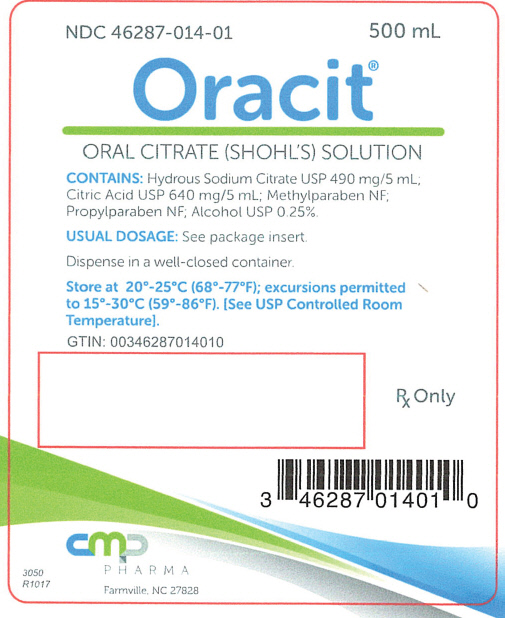
PRINCIPAL DISPLAY PANEL - 500 mL Bottle Label NDC 46287-014-01 500 mL Oracit ® ORAL CITRATE (SHOHL'S) SOLUTION CONTAINS: Hydrous Sodium Citrate USP 490 mg/5 mL; Citric Acid USP 640 mg/5 mL; Methylparaben NF; Propylparaben NF; Alcohol USP 0.25%. USUAL DOSAGE: See package insert. Dispense in a well-closed container.
Store at 20°-25°C (68°-77°F); excursions permitted to 15°-30°C (59°-86°F). [See USP Controlled Room Temperature]. GTIN: 00346287014010 Rx Only cmp PHARMA Farmville, NC 27828 3050 R1017 PRINCIPAL DISPLAY PANEL - 500 mL Bottle Label
Medicaid utilization by pack size
Medicare Part D spend CMS · PART D · 2026 (Q1)
About this NDC listing & data coverage
Listed without an FDA application
This product's marketing category indicates it is marketed without an approved FDA application (no NDA, ANDA, or BLA on file). Having an NDC does not by itself establish FDA approval — the NDC Directory is a listing system, not an approval decision. Approval-linked data such as Orange Book therapeutic-equivalence ratings therefore does not apply.
What data is (and isn’t) available for this NDC — tap to expand
| NDC identity (package / product / labeler codes) | ✓ Available |
| Labeler | ✓ Available |
| Product & package description | ✓ Available |
| Marketing category & status | ✓ Available |
| Active ingredient / dosage form / route | ✓ Available |
| FDA label (SPL via DailyMed) | ✓ Available |
| Package photos | ✓ Available |
| Inactive ingredients (structured) | ✓ Available |
| NADAC pharmacy acquisition price (CMS) | — Not published for this NDC CMS publishes NADAC only for NDCs reported in its retail-pharmacy survey. |
| Orange Book / therapeutic-equivalence data | — Not published for this NDC Applies only to products approved under an NDA/ANDA; many listings are out of scope. |
| HCPCS J-code billing crosswalk | — Not published for this NDC Most self-administered / retail products have no J-code — that is normal. |
| Medicaid utilization (CMS SDUD) | — Not published for this NDC CMS reports utilization only for NDCs with Medicaid claims above its privacy threshold. |