
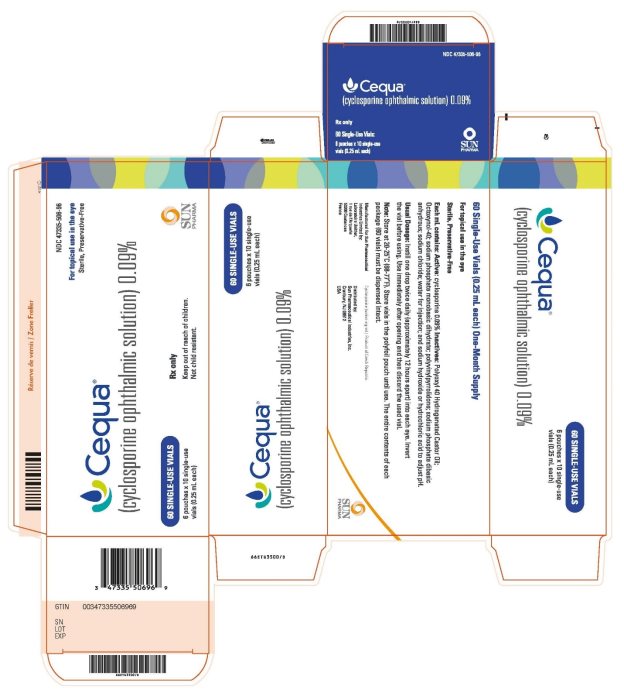
CEQUA cyclosporine .0009 g/mL Solution/ Drops
Past resolved recalls for this product (2)
🆔 Identity & classification
Where does this data come from?
🏷️ RxNorm drug class
This medicine belongs to the Calcineurin Inhibitor Immunosuppressant class.
Where does this data come from?
🏭 Manufacturer & labeler
Where does this data come from?
🩺 Clinical
Ophthalmic cyclosporine is used to increase tear production in people with dry eye disease. Cyclosporine is in a class of medications called immunomodulators. It works by decreasing swelling in the eye to allow for tear production.
Read the full MedlinePlus article ↗- It works by calming the immune-related inflammation in your eye that is preventing your tear glands from making enough tears. Over time, reducing that inflammation can help your ey...
- What is this eye drop actually supposed to do for my dry eyes?
- The label doesn't specify an exact timeline, but cyclosporine eye drops are generally a longer-term treatment. Don't be discouraged if you don't feel a big difference right away —...
- How long will it take before I notice it working?
Patient education
Supplement & herbal interactions
Some supplements/herbs that may interact with Cyclosporine — tap one for details:
Cyclosporine may be associated with lower levels of 1 nutrient — worth a chat with your pharmacist, not a cause for alarm.
Where does this data come from?
Ask a licensed pharmacist directly — free, answered by our team.
🧪 Inactive Ingredients / Excipients
Inactive ingredients, also called excipients, are components of the drug product other than the active ingredient. They may include fillers, dyes, coatings, preservatives, flavors, or other formulation ingredients.
💡 Tap an ingredient (hover on desktop) to see what it is and why it’s used.
-
UNII QTT17582CB
A strong acid used to adjust and maintain the proper pH level in liquid medicines, ensuring stability and preventing breakdown of active ingredients.
-
0.0005 g / 1 mL
UNII 9T1C662FKS
A synthetic detergent and emulsifier derived from octylphenol. It helps blend water and oil-based ingredients together and improves how the medicine disperses in the body, commonly used in injectable and topical formulations.
-
0.01 g / 1 mL
UNII 7YC686GQ8F
A synthetic oily substance made from castor oil. It works as a solubilizer and emulsifier to help mix oily and water-based ingredients together in the medicine.
-
0.003 g / 1 mL
UNII RDH86HJV5Z
Povidone K90 is a synthetic polymer made from a chemical called vinyl pyrrolidone. It acts as a binder to hold pill ingredients together and as a dispersant to help the medicine break down and dissolve properly in your body.
-
0.0005 g / 1 mL
UNII 451W47IQ8X
Sodium chloride is common table salt. It's used in medicines as a buffer to maintain proper pH, as a filler to add bulk, or to adjust the osmotic balance in liquid formulations.
-
UNII 55X04QC32I
A strong alkaline chemical used to adjust and maintain the pH balance of liquid medicines. It helps keep the medicine stable and ensures it stays effective during storage.
-
0.0047 g / 1 mL
UNII 22ADO53M6F
A mineral salt derived from phosphoric acid, used as a buffer to maintain the pH balance of the medication and help stabilize the active ingredients.
-
0.0053 g / 1 mL
UNII 5QWK665956
A salt derived from phosphoric acid and sodium, used primarily as a buffer to control the acidity or pH of a medication, helping keep it stable during storage and use.
-
UNII 059QF0KO0R
Water is a liquid solvent that dissolves and mixes ingredients together in liquid medicines, syrups, and injections. It helps distribute the active drug evenly throughout the product.
9 inactive ingredients listed in the exact product block matched to this NDC.
Where does this data come from?
ingredient classCode="IACT" elements from the exact product block matched by this NDC. Label-section narrative from DailyMed / the openFDA label index is shown separately when available.Inactive ingredient FAQ
Are inactive ingredients the same for every manufacturer?
Why might an inactive ingredient be missing?
Can inactive ingredients matter?
💲 Pricing
A drug doesn't have one price. Each row is a different public payment system, and none is what you'd pay at the counter — that depends on your insurance. The ⓘ on each row explains what it measures.
| Price system | Per ea | Per package |
|---|---|---|
| Retail pharmacies payNADAC · weekly | $10.381 | $622.88 / 60 vials |
| Medicaid paysCMS SDUD · 12 mo | $15.52 | $931.34 / 60 vials |
| Medicare drug plans payPart D · Q2 2026 | $10.08 | $605.02 / 60 vials |
Where does this data come from?
🔁 Therapeutic equivalents
| Product | Labeler | Pack | NADAC/unit | TE | Status | Price vs. this |
|---|---|---|---|---|---|---|
| Cequa .0009 g/mLthis 47335-0506-96 | Sun | 6 pouches | $10.381 | — | Availability likely | — |
| Cequa .0009 mg/mL 47335-0507-97 | Sun | 1 pouch | — | — | FDA listed | — |
Where does this data come from?
⏳ Availability & generic status
We did not find an FDA-approved generic match for this exact strength, form and route. Patent/protection dates below may affect future generic timing.
Why the date isn’t exact: Generic timing can change because patents may be challenged, settled, licensed, added, removed, or worked around with a narrower label — and FDA approval does not always mean a pharmacy can get the generic today.
🛈 What do these terms mean?
- Patent
- Legal protection listed in the Orange Book that may delay generic approval or launch. Issued by the U.S. Patent & Trademark Office.
- Substance patent
- Covers the active drug molecule itself — the hardest to design around. A generic generally can’t launch until it expires.
- Formulation (product) patent
- Covers a specific formulation or dosage form. A generic can sometimes work around it with a different formulation.
- Method-of-use patent
- A patent covering one specific approved use of the drug — not necessarily the whole molecule. A generic can sometimes launch with a “skinny label” that carves out the protected use and keeps the others.
- Skinny label
- A generic label that omits a still-patented use when the FDA allows it — letting a generic reach the market for the unprotected uses.
- Exclusivity
- FDA-granted marketing protection, separate from patents — e.g. 5-yr new chemical entity, 7-yr orphan drug, or a +6-month pediatric extension.
- Paragraph IV
- A generic applicant’s formal challenge to a listed patent. It can potentially lead to earlier generic entry, but often involves litigation or a settlement.
- RLD / RS
- Reference Listed Drug — the brand product the FDA uses as the reference for generic applications. Reference Standard — the product the FDA expects generics to compare against in bioequivalence testing.
- TE / AB rating
- FDA therapeutic-equivalence rating. An AB rating generally means the FDA considers a generic therapeutically equivalent to — and substitutable for — the brand.
- LOE (loss of exclusivity)
- The latest patent or exclusivity currently listed — the loss-of-exclusivity / latest-listed-protection date shown on this page. Paragraph-IV challenges and settlements can move the real date earlier; FDA approval and a manufacturer’s decision to market can move it later.
Built from the FDA Orange Book. The bars above are scaled to each protection’s expiry; the red LOE marker is the last one to lapse.
| Patent | Type | Use code | Expires |
|---|---|---|---|
| US 8980839 ↗ | Method of use | U-1483 | Aug 23, 2033 |
| US 9937225 ↗ | Method of use | U-1483 | Aug 23, 2033 |
| US 11951153 ↗ | Method of use | U-1483 | Feb 28, 2037 |
| US 10441630 ↗ | Drug product | — | Aug 23, 2033 |
| US 10918694 ↗ | Drug product | — | Feb 28, 2037 |
Is there a generic version of CEQUA 0.09% SOLUTION?
The FDA approved a generic — why can’t I get it at my pharmacy yet?
Why do different websites show different generic release dates?
What does “FDA listed” mean?
What does a patent or protection date mean here?
What does “current Orange Book estimate” mean?
Can a generic come out before the last patent expires?
Can a generic come out after the listed dates?
What is the difference between patents and exclusivity?
Why are there multiple patent dates?
Where does this data come from?
🗺️ Medicaid utilization & spend
📊 Medicare Part D spend CMS · PART D · 2026 (Q1)
🔬 Reported adverse events (FAERS)
Top reported reactions
Age at onset
Reporter sex
Serious outcomes
Where does this data come from?
📦 Packaging — all sizes for this product
| Package NDC | Description | Marketing start | Status |
|---|---|---|---|
| 47335-0506-96 You're viewing this | 6 POUCH in 1 BOX (47335-506-96) / 10 VIAL, SINGLE-DOSE in 1 POUCH / .25 mL in 1 VIAL, SINGLE-DOSE | 2018-08-15 | Active |
📄 Full prescribing information FDA SPL
🎯 Indications and Usage ▾
1 INDICATIONS AND USAGE CEQUA ophthalmic solution is a calcineurin inhibitor immunosuppressant indicated to increase tear production in patients with keratoconjunctivitis sicca (dry eye). ( 1 ) CEQUA ophthalmic solution is a calcineurin inhibitor immunosuppressant indicated to increase tear production in patients with keratoconjunctivitis sicca (dry eye) ( 1 ).
⏱️ Dosage and Administration ▾
2 DOSAGE AND ADMINISTRATION Instill one drop of CEQUA twice daily (approximately 12 hours apart) into each eye. CEQUA can be used concomitantly with artificial tears, allowing a 15 minute interval between products. Discard the vial immediately after using in both eyes. ( 2 ) Instill one drop of CEQUA twice daily (approximately 12 hours apart) into each eye. Discard the vial immediately after using in both eyes ( 2 ).
💊 Dosage Forms and Strengths ▾
3 DOSAGE FORMS AND STRENGTHS Ophthalmic solution containing cyclosporine 0.9 mg/mL ( 3 ) Ophthalmic solution containing cyclosporine 0.9 mg/mL ( 3 ).
⛔ Contraindications ▾
4 CONTRAINDICATIONS None. ( 4 ) None ( 4 ).
⚠️ Warnings and Cautions ▾
5 WARNINGS AND PRECAUTIONS To avoid the potential for eye injury and contamination, advise patients not to touch the vial tip to the eye or other surfaces ( 5.1 ).
5.1Potential for Eye Injury and Contamination To avoid the potential for eye injury and contamination, advise patients not to touch the vial tip to the eye or other surfaces.
5.2Use with Contact Lenses CEQUA should not be administered while wearing contact lenses. If contact lenses are worn, they should be removed prior to administration of the solution. Lenses may be reinserted 15 minutes following administration of CEQUA ophthalmic solution.
🤒 Adverse Reactions ▾
6 ADVERSE REACTIONS The most common adverse reactions following the use of CEQUA (cyclosporine ophthalmic solution) 0.09% was instillation site pain (22%) and conjunctival hyperemia (6%) ( 6.1 ). To report SUSPECTED ADVERSE REACTIONS, contact Sun Pharmaceutical Industries, Inc. at 1-800-406-7984 or FDA at 1-800-FDA-1088 or www.fda.gov/medwatch.
6.1Clinical Trials Experience Because clinical trials are conducted under widely varying conditions, adverse reaction rates observed in the clinical trials of a drug cannot be directly compared to rates in the clinical trials of another drug and may not reflect the rates observed in practice. In clinical trials, 769 subjects received at least 1 dose of cyclosporine ophthalmic solution. The majority of the treated subjects were female (83%).
The most common adverse reactions reported in greater than 5% of subjects were pain on instillation of drops (22%) and conjunctival hyperemia (6%). Other adverse reactions reported in 1% to 5% of the patients were blepharitis, eye irritation, headache, and urinary tract infection.
👥 Use in Specific Populations ▾
8 USE IN SPECIFIC POPULATIONS
8.1Pregnancy Risk Summary There are no adequate and well-controlled studies of CEQUA administration in pregnant women to inform a drug-associated risk. Oral administration of cyclosporine to pregnant rats or rabbits did not produce teratogenicity at clinically relevant doses [see Data]. Data Animal Data Oral administration of cyclosporine oral solution (USP) to pregnant rats or rabbits was teratogenic at maternally toxic doses of 30 mg/kg/day in rats and 100 mg/kg/day in rabbits, as indicated by increased pre- and postnatal mortality, reduced fetal weight and skeletal retardations.
These doses (normalized to body weight) were approximately 3200 and 21000 times higher than the maximum recommended human ophthalmic dose (MRHOD) of 1.5 mcg/kg/day, respectively. No adverse embryofetal effects were observed in rats or rabbits receiving cyclosporine during organogenesis at oral doses up to 17 mg/kg/day or 30 mg/kg/day, respectively (approximately 1800 and 6400 times higher than the MRHOD, respectively). An oral dose of 45 mg/kg/day cyclosporine (approximately 4800 times higher than MRHOD) administered to rats from Day 15 of pregnancy until Day 21 postpartum produced maternal toxicity and an increase in postnatal mortality in offspring.
No adverse effects in dams or offspring were observed at oral doses up to 15 mg/kg/day (approximately 1600 times greater than the MRHOD).
8.2Lactation Risk Summary Cyclosporine blood concentrations are low following topical ocular administration of CEQUA [see Clinical Pharmacology ( 12.3 )] . There is no information regarding the presence of cyclosporine in human milk following topical administration or on the effects of CEQUA on the breastfed infants and milk production. Administration of oral cyclosporine to rats during lactation did not produce adverse effects in offspring at clinically relevant doses [see Pregnancy ( 8.1 )] .
The developmental and health benefits of breastfeeding should be considered along with the mother’s clinical need for CEQUA and any potential adverse effects on the breast-fed child from cyclosporine.
8.4Pediatric Use The safety and efficacy of CEQUA ophthalmic solution have not been established in pediatric patients below the age of 18.
8.5Geriatric Use No overall differences in safety or effectiveness have been observed between elderly and younger adult patients.
🤰 Pregnancy ▾
8.1Pregnancy Risk Summary There are no adequate and well-controlled studies of CEQUA administration in pregnant women to inform a drug-associated risk. Oral administration of cyclosporine to pregnant rats or rabbits did not produce teratogenicity at clinically relevant doses [see Data]. Data Animal Data Oral administration of cyclosporine oral solution (USP) to pregnant rats or rabbits was teratogenic at maternally toxic doses of 30 mg/kg/day in rats and 100 mg/kg/day in rabbits, as indicated by increased pre- and postnatal mortality, reduced fetal weight and skeletal retardations.
These doses (normalized to body weight) were approximately 3200 and 21000 times higher than the maximum recommended human ophthalmic dose (MRHOD) of 1.5 mcg/kg/day, respectively. No adverse embryofetal effects were observed in rats or rabbits receiving cyclosporine during organogenesis at oral doses up to 17 mg/kg/day or 30 mg/kg/day, respectively (approximately 1800 and 6400 times higher than the MRHOD, respectively). An oral dose of 45 mg/kg/day cyclosporine (approximately 4800 times higher than MRHOD) administered to rats from Day 15 of pregnancy until Day 21 postpartum produced maternal toxicity and an increase in postnatal mortality in offspring.
No adverse effects in dams or offspring were observed at oral doses up to 15 mg/kg/day (approximately 1600 times greater than the MRHOD).
🧒 Pediatric Use ▾
8.4Pediatric Use The safety and efficacy of CEQUA ophthalmic solution have not been established in pediatric patients below the age of 18.
🧓 Geriatric Use ▾
8.5Geriatric Use No overall differences in safety or effectiveness have been observed between elderly and younger adult patients.
🧬 Clinical Pharmacology ▾
12 CLINICAL PHARMACOLOGY
12.1Mechanism of Action Cyclosporine is a calcineurin inhibitor immunosuppressant agent when administered systemically. In patients whose tear production is presumed to be suppressed due to ocular inflammation associated with keratoconjunctivitis sicca, topical administration of cyclosporine is thought to act as a partial immunomodulator. The exact mechanism of action is not known.
12.3Pharmacokinetics Blood concentrations of cyclosporine after twice daily topical ocular administration of CEQUA into each eye of healthy subjects for up to 7 days, and once on Day 8, were either not detectable or were marginally above the lower limit of assay quantitation of 0.100 ng/mL (range 0.101 to 0.195 ng/mL) for up to 2 hours after a single dose, and up to 4 hours after multiple doses.
🧬 Mechanism of Action ▾
12.1Mechanism of Action Cyclosporine is a calcineurin inhibitor immunosuppressant agent when administered systemically. In patients whose tear production is presumed to be suppressed due to ocular inflammation associated with keratoconjunctivitis sicca, topical administration of cyclosporine is thought to act as a partial immunomodulator. The exact mechanism of action is not known.
📦 How Supplied / Storage and Handling ▾
16 HOW SUPPLIED/STORAGE AND HANDLING CEQUA ophthalmic solution is packaged in sterile, preservative-free, single-use vials. Each vial contains 0.25 mL fill in a 0.9 mL LDPE vial; 10 vials (2 cards of 5 vials) are packaged in a polyfoil aluminum pouch; 6 pouches are packaged in a box. The entire contents of each box of 60 vials must be dispensed intact.
60 Single-Use Vials 0.25 mL each - NDC 47335-506-96 Storage: Store at 20°C to 25°C (68°F to 77°F). Store single-use vials in the original foil pouch.
📋 Description ▾
11 DESCRIPTION CEQUA (cyclosporine ophthalmic solution) 0.09% contains a topical calcineurin inhibitor immunosuppressant. Cyclosporine’s chemical name is Cyclo[[(E)-(2S,3R,4R)-3-hydroxy-4-methyl-2-(methylamino)-6-octenoyl]-L-2-aminobutyryl-N-methylglycyl-N-methyl-L-leucyl-L-valyl-N-methyl-L-leucyl-L-alanyl-D-alanyl-N-methyl-L-leucyl-N-methyl-L-leucyl-N-methyl-L-valyl] and it has the following structure: Structural Formula Formula: C 62 H 111 N 11 O 12 Mol. Wt.: 1202.6 Cyclosporine is a white powder that is insoluble in water.
CEQUA is supplied as a sterile, clear, colorless ophthalmic solution for topical ophthalmic use. It has an osmolality of 160 to 190 mOsmol/kg and a pH of 6.5-7.2. Each mL of CEQUA contains: Active: cyclosporine 0.09% Inactives: Polyoxyl 40 Hydrogenated Castor Oil, Octoxynol-40, polyvinylpyrrolidone, sodium phosphate monobasic dihydrate, sodium phosphate dibasic anhydrous, sodium chloride, water for injection, and sodium hydroxide or hydrochloric acid to adjust pH. structure
💬 Information for Patients ▾
17 PATIENT COUNSELING INFORMATION Handling the Vial Advise patients to not allow the tip of the vial to touch the eye or any surface, as this may contaminate the solution. Advise patients also not to touch the vial tip to their eye to avoid the potential for injury to the eye [see Warnings and Precautions ( 5.1 )] . Use with Contact Lenses CEQUA should not be administered while wearing contact lenses.
Patients with decreased tear production typically should not wear contact lenses. Advise patients that if contact lenses are worn, they should be removed prior to the administration of the solution. Lenses may be reinserted 15 minutes following administration of CEQUA ophthalmic solution [see Warnings and Precautions ( 5.2 )] .
Administration Advise patients that the solution from one individual single-use vial is to be used immediately after opening for administration to one or both eyes, and the remaining contents should be discarded immediately after administration. Rx Only Manufactured for: Sun Pharmaceutical Industries Limited By: Laboratoire Unither 1 rue de l’Arquerie 50200 Coutances France Cyclosporine (active ingred.) Product of Czech Republic. Product of France Distributed by: Sun Pharmaceutical Industries, Inc.
Cranbury, NJ 08512 Copyright 2022, Sun Pharmaceutical Industries Limited All rights reserved 07/2022 uspi-CEQUA-sol-00004